Memory Gateway to Learning
Types of Memory Declarative memory = Explicit memory Learning about people, places and things Nondeclarative memory = Implicit memory Memory for skills or behavior  Working memory temporary information storage  includes several types of information probably from several sites in the brain  Spatial memory  memory of location  Relational memory  things that happen at same time get stored together in a manner that ties them together
Explicit Memory Learning about people, places and things Can be verbally reported Requires conscious awareness Short-term memory  temporary, limited in capacity requires continual rehearsal  Long-term memory  more permanent, much greater capacity does not require continual rehearsal  Consolidation  transfer from short-term memory to long-term memory
Implicit Memory Procedural memory  Memory for skills or behavior  Perceptual and motor learning Does not require conscious awareness
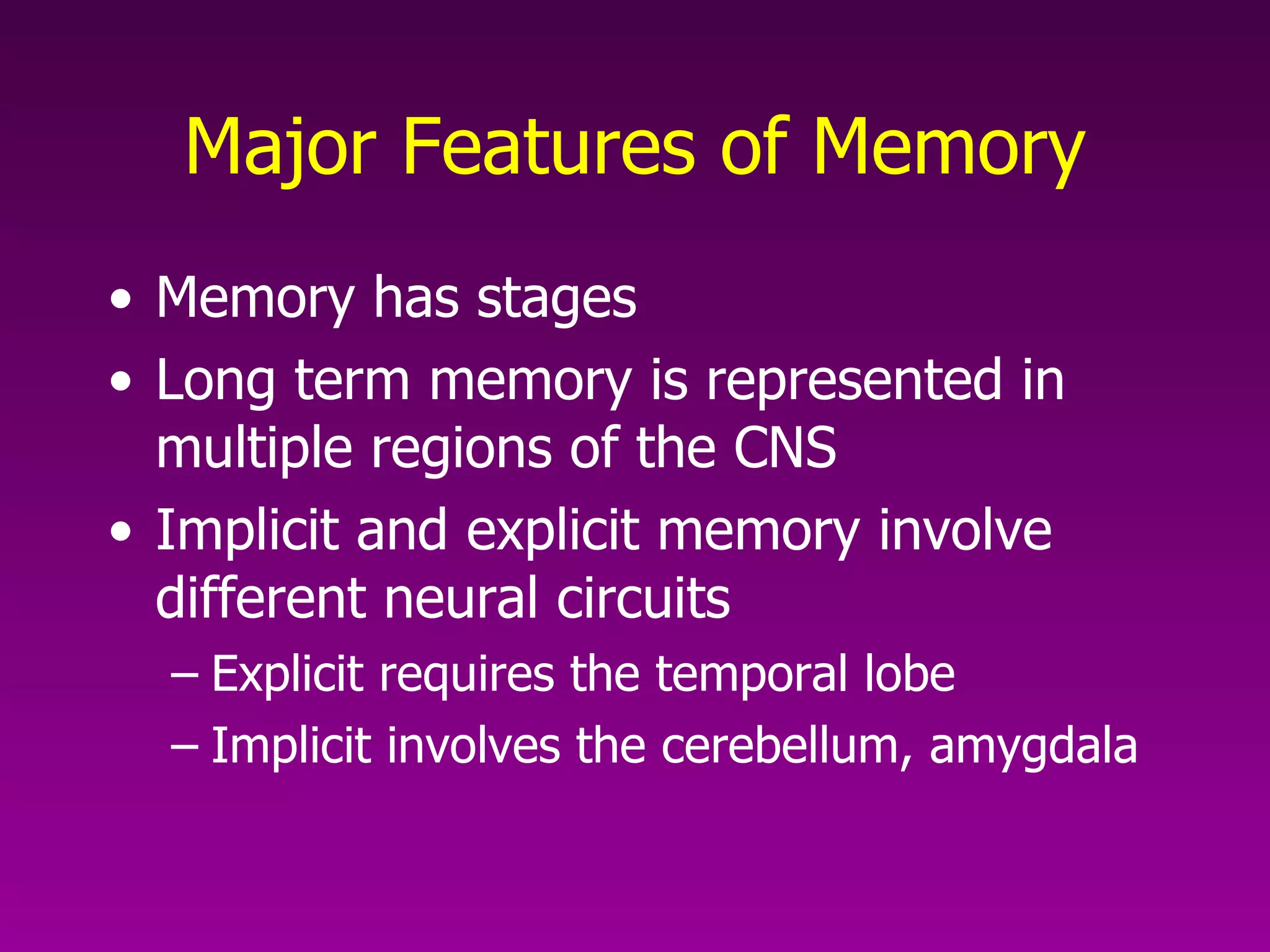
Major Features of Memory Memory has stages Long term memory is represented in multiple regions of the CNS Implicit and explicit memory involve different neural circuits Explicit requires the temporal lobe Implicit involves the cerebellum, amygdala
Memory is Not Unitary Memory is not an “all or none” phenomenon Can be implicit or explicit or a mixture Depends on how the information is stored and recalled
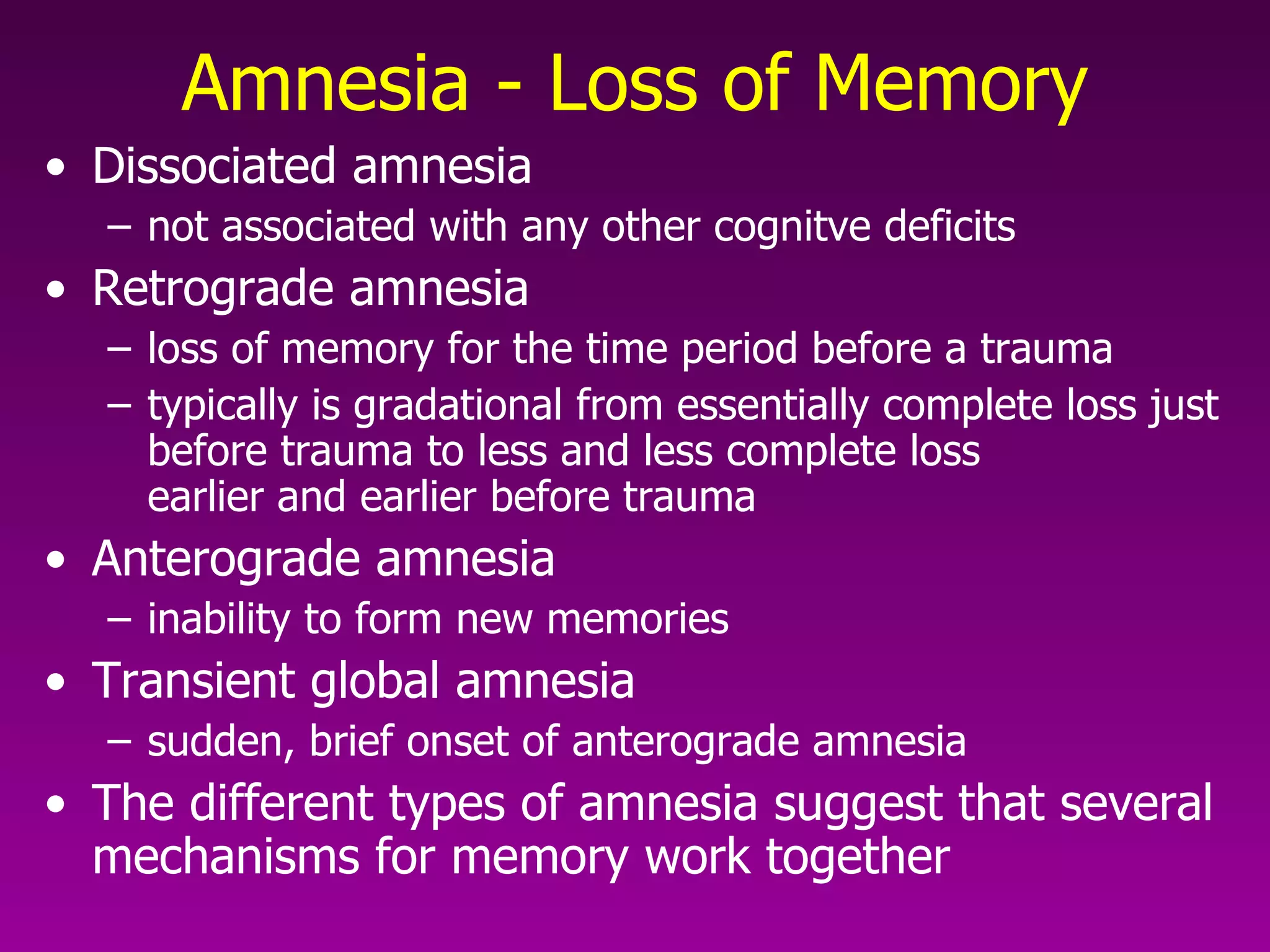
Amnesia - Loss of Memory Dissociated amnesia  not associated with any other cognitve deficits  Retrograde amnesia  loss of memory for the time period before a trauma  typically is gradational from essentially complete loss just before trauma to less and less complete loss  earlier and earlier before trauma  Anterograde amnesia inability to form new memories  Transient global amnesia  sudden, brief onset of anterograde amnesia  The different types of amnesia suggest that several mechanisms for memory work together
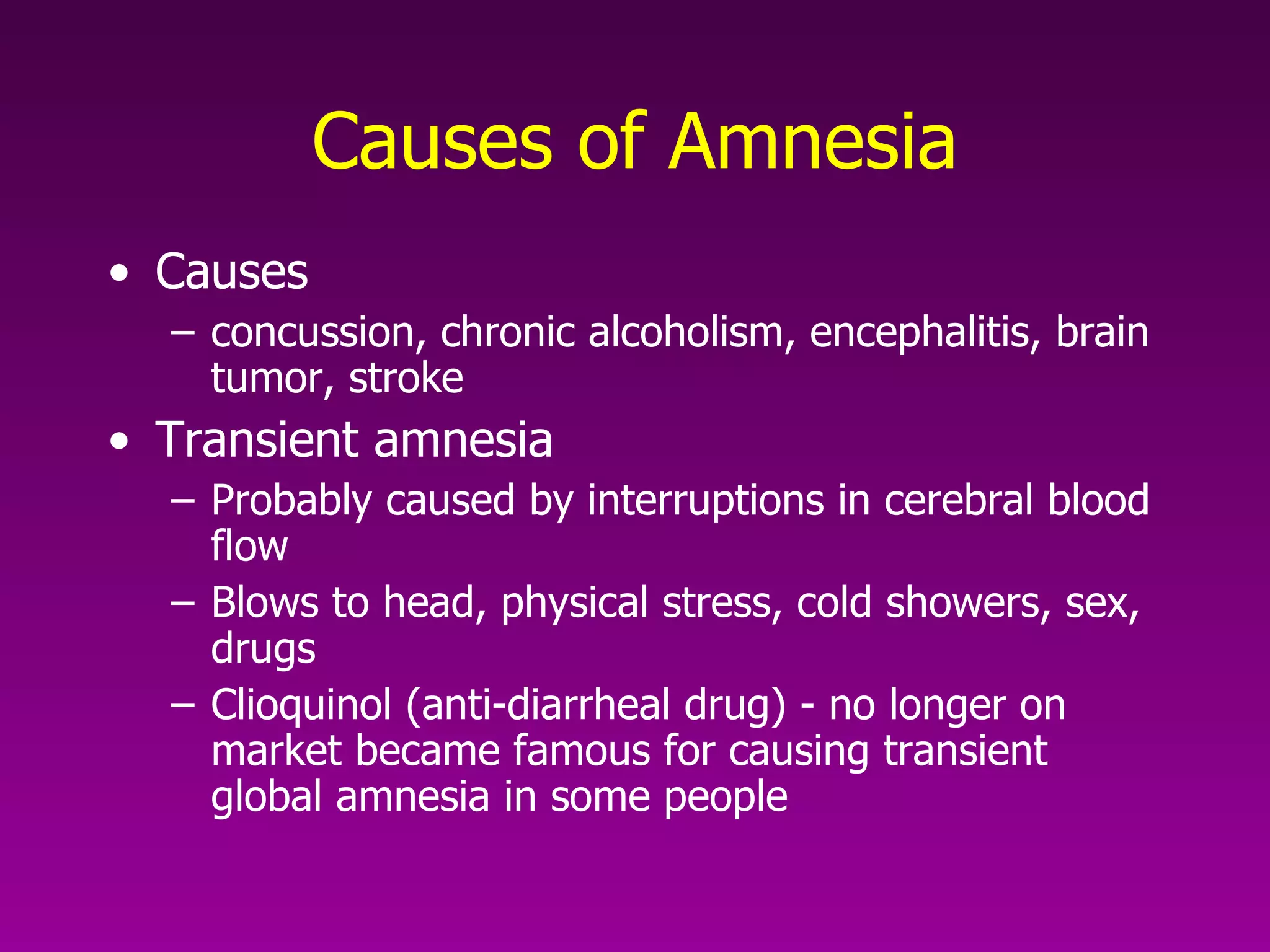
Causes of Amnesia Causes concussion, chronic alcoholism, encephalitis, brain tumor, stroke  Transient amnesia Probably caused by interruptions in cerebral blood flow Blows to head, physical stress, cold showers, sex, drugs Clioquinol (anti-diarrheal drug) - no longer on market became famous for causing transient global amnesia in some people
Localization of Memory Functions Long thought memory was a function of the whole cerebral cortex We now realize that different types of memory are localized in different regions Engram  physical representation or location of a memory
Cortical Ablation Studies   Karl Lashley – 1920s Tried to localize memory engram to association areas of the neocortex  Studied effect of brain lesions on ability to learn a maze in rats As more and more of the rat's cortex was ablated, more and more errors were made ability to learn was progressively impaired  Lashley incorrectly concluded that the whole neocortex equally participated in memory  now know that the problem was that the lesions were too large
Cell Assembly   Donald Hebb – 1949 The internal representation of an object consists of the cortical cells that are activated by the stimulus Group of simultaneously acting neurons = cell assembly  Same neurons are involved in sensation and perception All of these cells are reciprocally interconnected Internal representation of an object remains in short term memory as long as the cell assembly is active If assembly active long enough, consolidation occurs Long term memory Neurons that fire together wire together Activating any cells in the assembly activates the memory Led to neural network model                       
Localization of Declarative Memories   Studies in macaque monkeys -   Lesions in the inferotemporal cortex (IT)   cause loss of memory about previously learned visual discrimination tasks, even though vision itself remains normal  Cells in the IT may respond preferentially to a familiar face in a particular orientation  Cells in IT may change their response during repeated exposure to an unfamiliar face – learning The IT is involved both in vision and visual memory
Human Studies fMRI shows what part of the brain is activated during exposure to various types of objects  Bird watchers respond more vigorously to pictures of birds  Car buffs respond more vigorously to pictures of cars and responses are in different places
The Temporal Lobe Wilder Penfield – 1940’s Electrical stimulation of human temporal lobe Studied patients with epilepsy During surgery for epilepsy, stimulated temporal lobe electrically  Some patients reported sensations like hallucinations or vivid memories but the patients had other cortical abnormalities Still, temporal lobe stimulation caused different effects than stimulation of other parts of the neocortex  Consistant with seizure “aura”
Kluver-Bucy Syndrome Researchers at U. Chicago in the 1930’s Studying emotion circuitry Bilateral temporal lobectomy in rhesus monkeys Produces bizarre behavioral abnormnalities One of these is “psychic blindness” Although they could see, could not recognize or understand the meaning of common objects Thus loss of declarative memory More on this phenomenon with emotion
Building on Penfield Brenda Milner – 1950’s Studied patients with surgical interventions to treat epilepsy Bilateral removal of the hippocampus and neighboring regions of the temporal lobe Most famous case was “H.M.”
Patient “H.M.” Sheds New Light Bilateral removal of mid-temporal lobe Stopped seizures Short term memory was OK Memories formed prior to surgery were OK Ability to form new, long term memories was lost Couldn’t transfer information from short term to long term memory! Similar findings in all bilateral temporal lobe surgical patients
Impact on Learning All of the things these patients could recall have an automatic quality Do not require conscious recall Do not require complex cognitive skills such as comparison If the patient practices a puzzle, they improve their ability to solve it, but they don’t remember how.
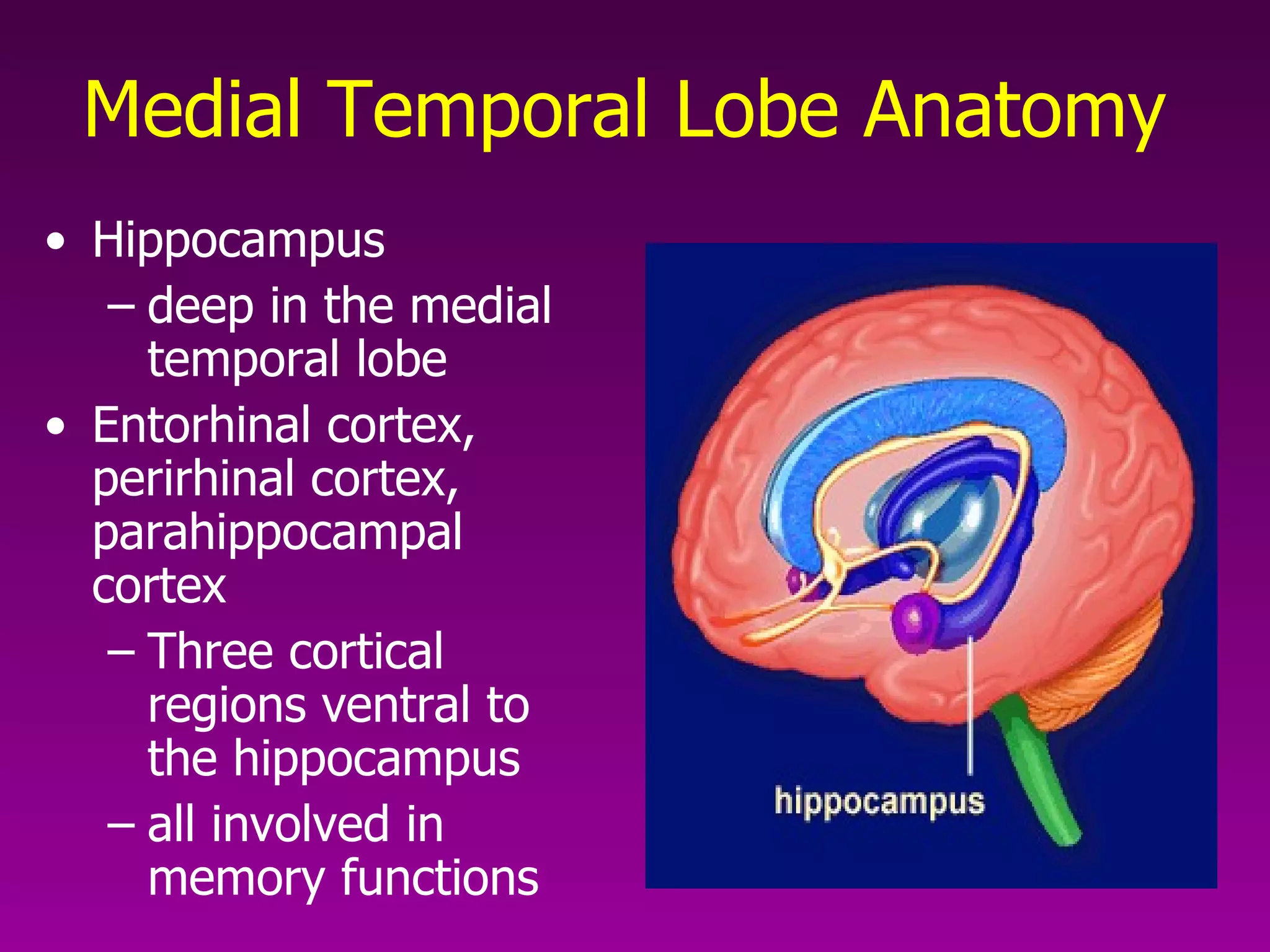
Medial Temporal Lobe Anatomy Hippocampus  deep in the medial temporal lobe Entorhinal cortex, perirhinal cortex, parahippocampal cortex  Three cortical regions ventral to the hippocampus all involved in memory functions
Function of the Medial Temporal Lobe Lesions in monkeys impair discrimination memory ability to recognize whether object has been seen before  Lesions impair declarative memory, not procedural memory  Lesions impair long-term memory storage, but short-term memory seems to be normal  This region seems to be involved in packaging short-term memory for relay to the rest of the neocortex for long-term storage
The Diencephalon & Memory Outside of the temporal lobe, one of the regions most associated with memory Axons from the hippocampus project to the mammillary bodies which project to the thalamus Thalamus also receives input from temporal lobe structures including the amygdala & IT Large midline thalamic lesions in monkeys produce severe deficits in ability to learn a matching task Lesions which impact fewer nuclei produce smaller deficits
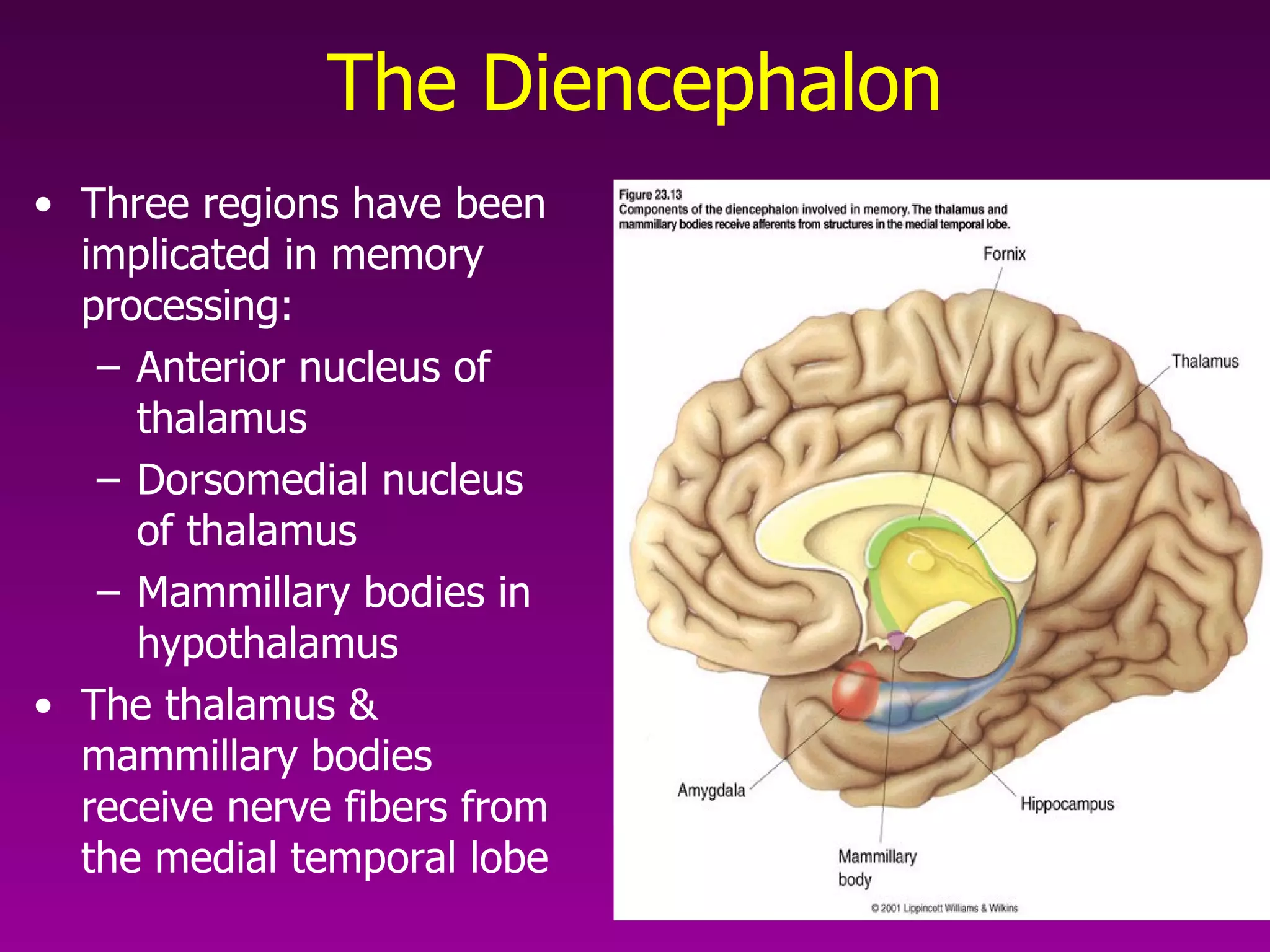
The Diencephalon Three regions have been implicated in memory processing: Anterior nucleus of thalamus Dorsomedial nucleus of thalamus Mammillary bodies in hypothalamus The thalamus & mammillary bodies receive nerve fibers from the medial temporal lobe
The Case of “N.A.” Accidentally stabbed with a fencing foil Through his right nostril into his brain Produced a lesion in his left dorsomedial thalamus Cognitive ability normal but memory impaired Caused moderate retrograde amnesia (for the 2 years prior) and profound anterograde amnesia similar to the more extensive damage to H. M. Short term memory and preservation of old memories was intact  Suggests that both the temporal lobe and parts of the thalamus may be involved in the formation of long-term declarative memories
Korsakoff's Syndrome   Usually due to chronic alcoholism Results from alcohol associated thiamin deficiency Produces confusion, severe memory impairment, apathy First presents as abnormal eye movements, loss of coordination, tremors  Can be treated in early stages Untreated thiamin defiency leads to brain damage which produces Korsokoff’s Lesions in dorsomedial thalamus and mammillary bodies  Anterograde and severe retrograde amnesia Further supports role of diencephalon in memory
Anterograde & Retrograde Amnesia While often found together, may have different causes The degree of severity of the two does not correlate in Korsokoff’s Suggests different mechanisms involved Damage to the dorsomedial thalamus and mammillary bodies probably causes anterograde amnesia What causes retrograde amnesia is still unclear
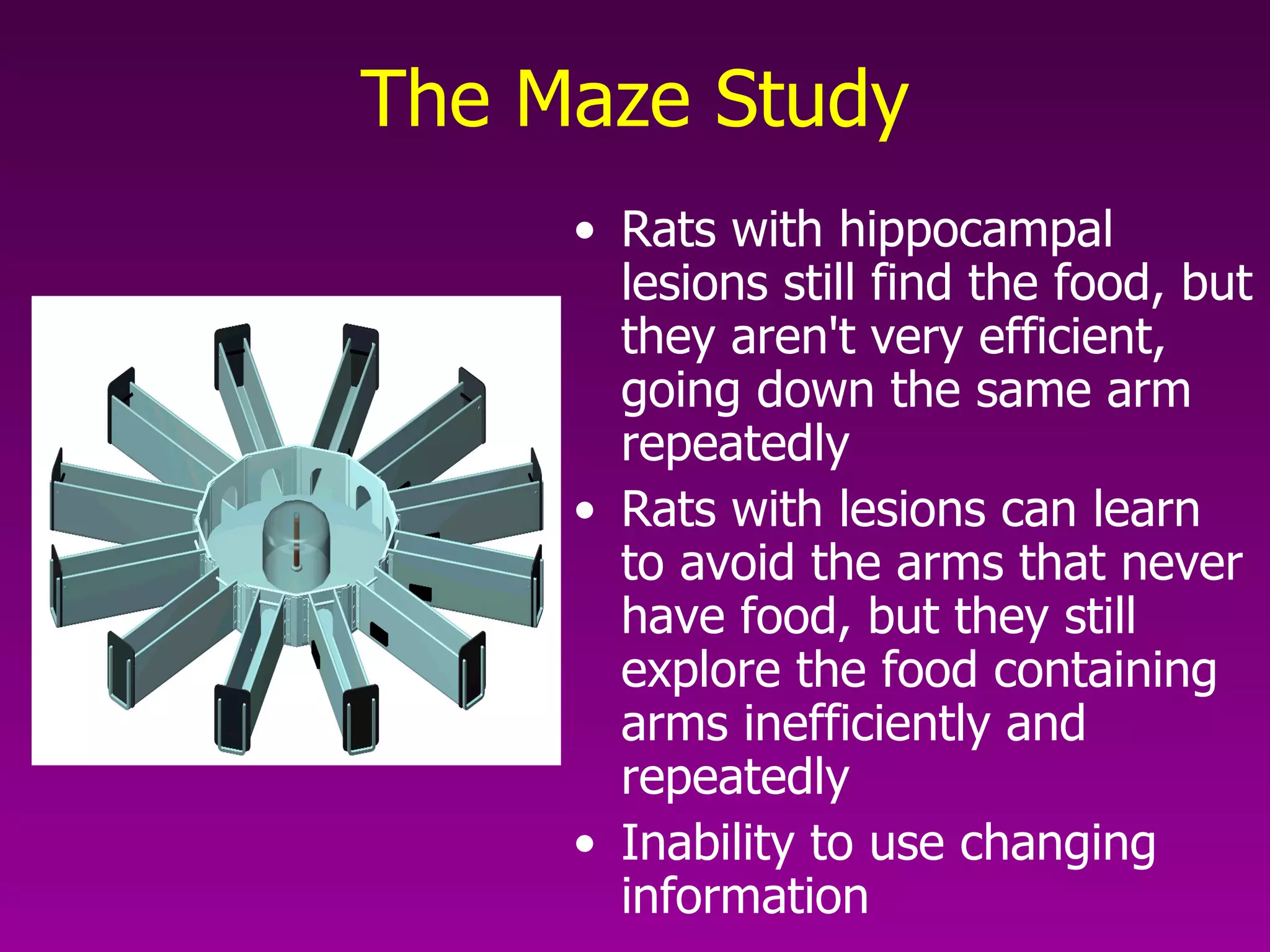
Working Memory & the Hippocampus   Hippocampus is involved in memory function for a diverse range of tasks Studies of hippocampal ablation in rats Studied “working memory” Used a radial maze containing food Normal rats learn to visit each arm only once If only some arms are used, they learn only to go down those arms, and then only once.
The Maze Study Rats with hippocampal lesions still find the food, but they aren't very efficient, going down the same arm repeatedly  Rats with lesions can learn to avoid the arms that never have food, but they still explore the food containing arms inefficiently and repeatedly  Inability to use changing information
Place Cells in the Hippocampus   Neurons in the hippocampus selectively respond when rat is in a particular location. If vision is used to determine place, (like landmarks) cell fires in response to where the animal thinks he is May be responsible for learning radial arm maze More than spatial memory is involved Hippocampus may control relational memory
Relational Memory Highly processed sensory information comes into the hippocampus & cortex Processing occurs leading to the storage of memories  All things happening at the same time are stored together Thus, remembering one thing brings back related memories It's easier to remember events that you had strong feelings about. Spatial navigation is based on a spatial map & relational memories
Striatum and Procedural Memory   Procedural memory = memory involved in forming behavioral habits Striatum is the major structure involved in procedural memory Striatum may be involved in forming 'habits' in rats, humans, & non-human primates Data from humans suggests that the striatum is involved in a procedural memory system that is separate and distinct from the medial temporal system used for declarative memory
Neocortex and Working Memory   Humans have much more prefrontal cortex than any other animals  Pathways:  Medial temporal lobe >> hypothalamus >> anterior nucleus of thalamus >> cingulate cortex Medial temporal lobe >> dorsomedial nucleus of thalamus >> frontal cortex  Experiments suggest that frontal cortex is involved with working memory for problem solving and planning of behavior
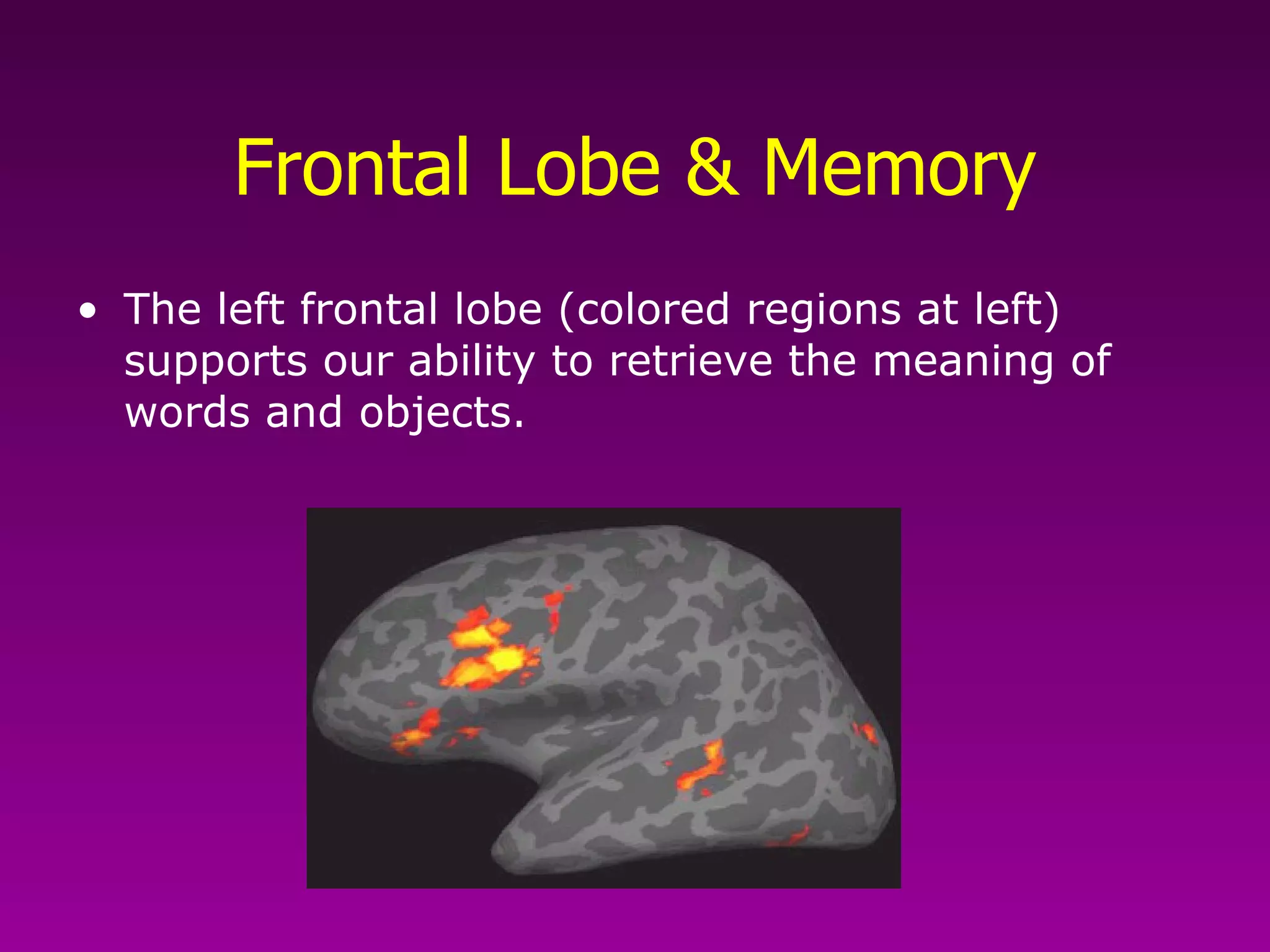
Frontal Lobe & Memory The left frontal lobe (colored regions at left) supports our ability to retrieve the meaning of words and objects.
Lateral Intraparietal Cortex (LIP)   Cortex buried in intraparietal sulcus  Involved in working memory Responses specific to vision  Example: monkey looks at fixation point while a stimulus is flashed in periphery; after delay, monkey moves eyes to where the stimulus was Cells in LIP seem to store information about where the eyes are to be moved they remain active during the delay - specific for visual working memory There is a different area specific for auditory working memory
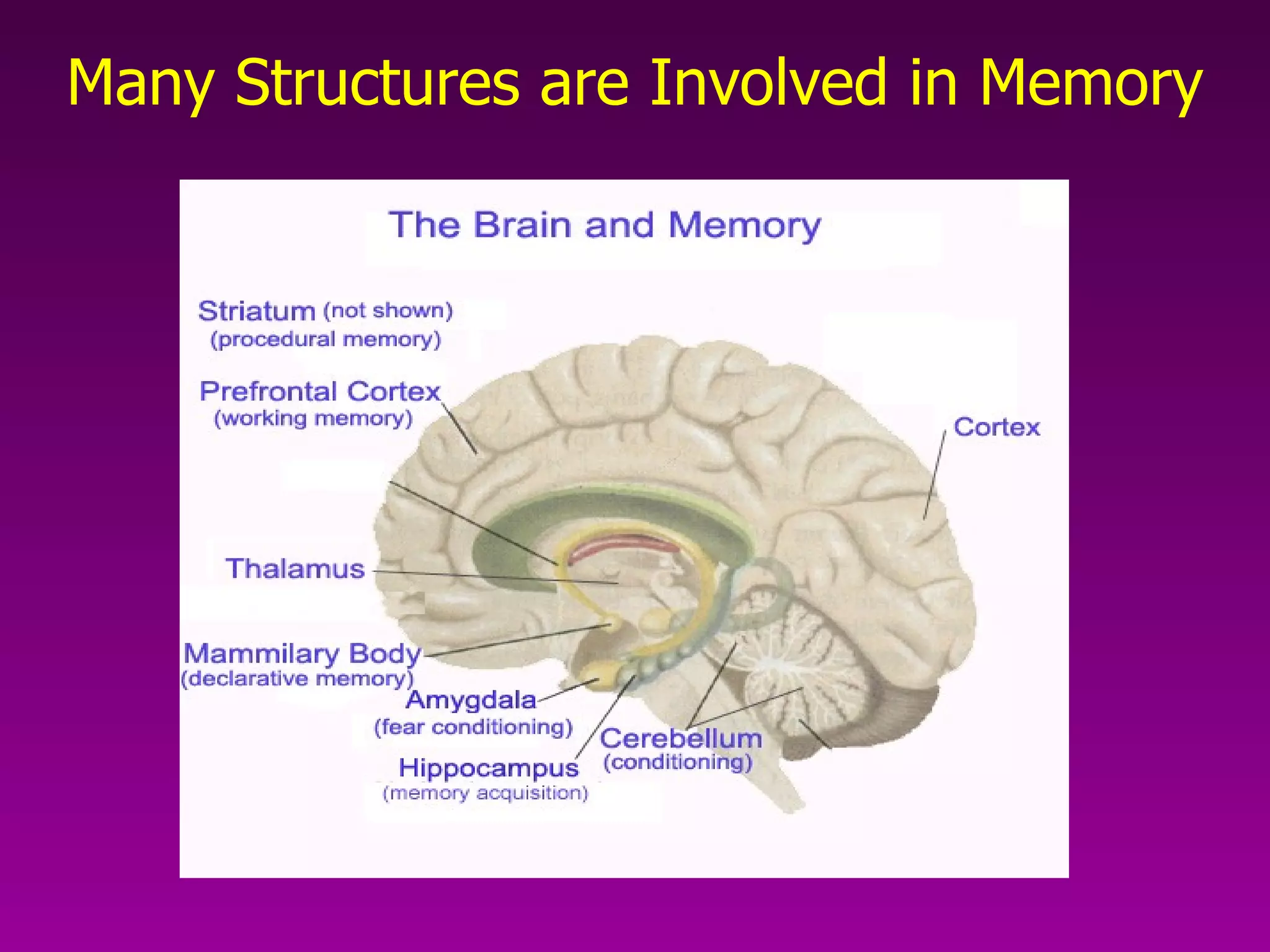
Many Structures are Involved in Memory
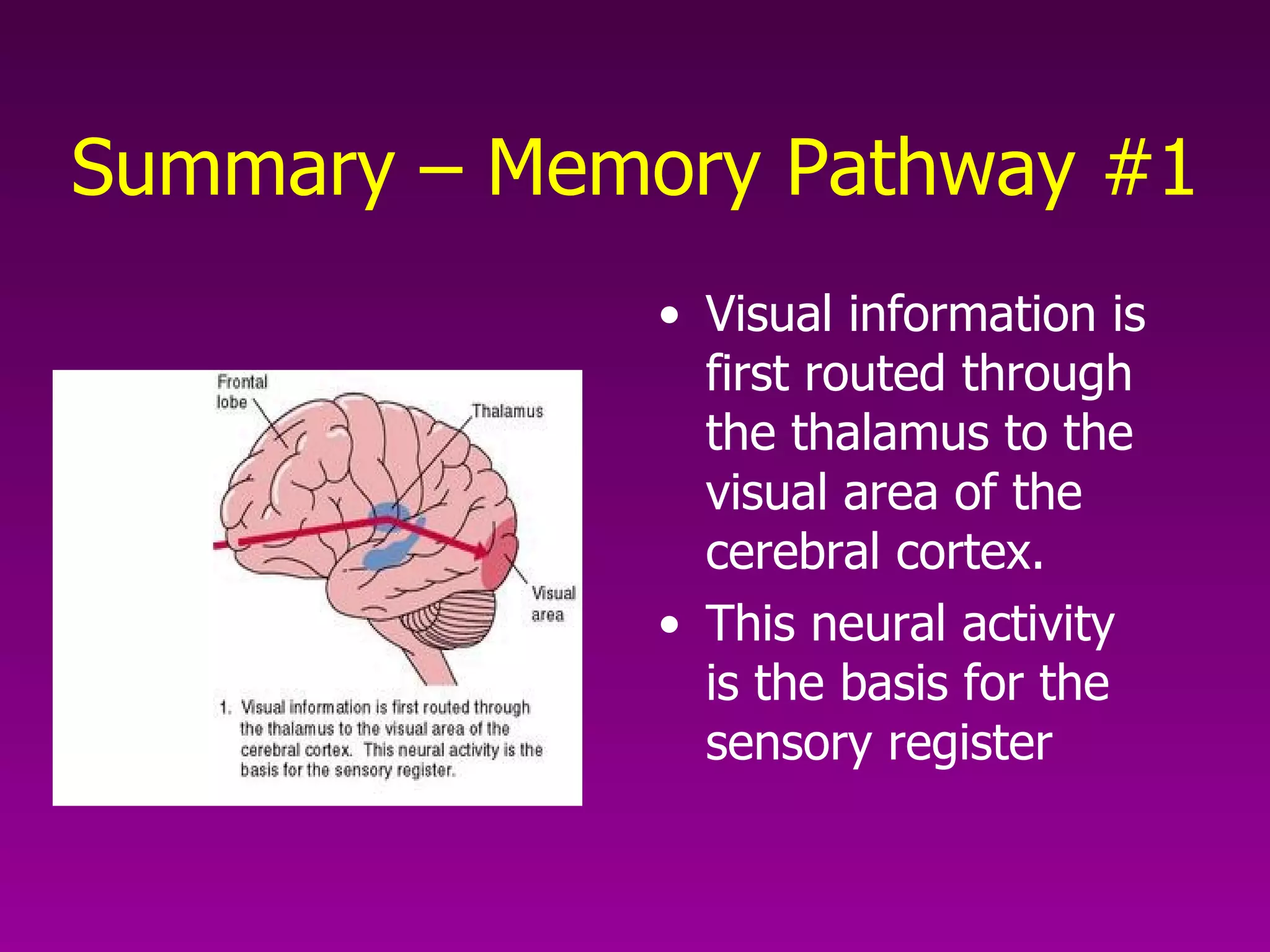
Summary – Memory Pathway #1 Visual information is first routed through the thalamus to the visual area of the cerebral cortex.  This neural activity is the basis for the sensory register
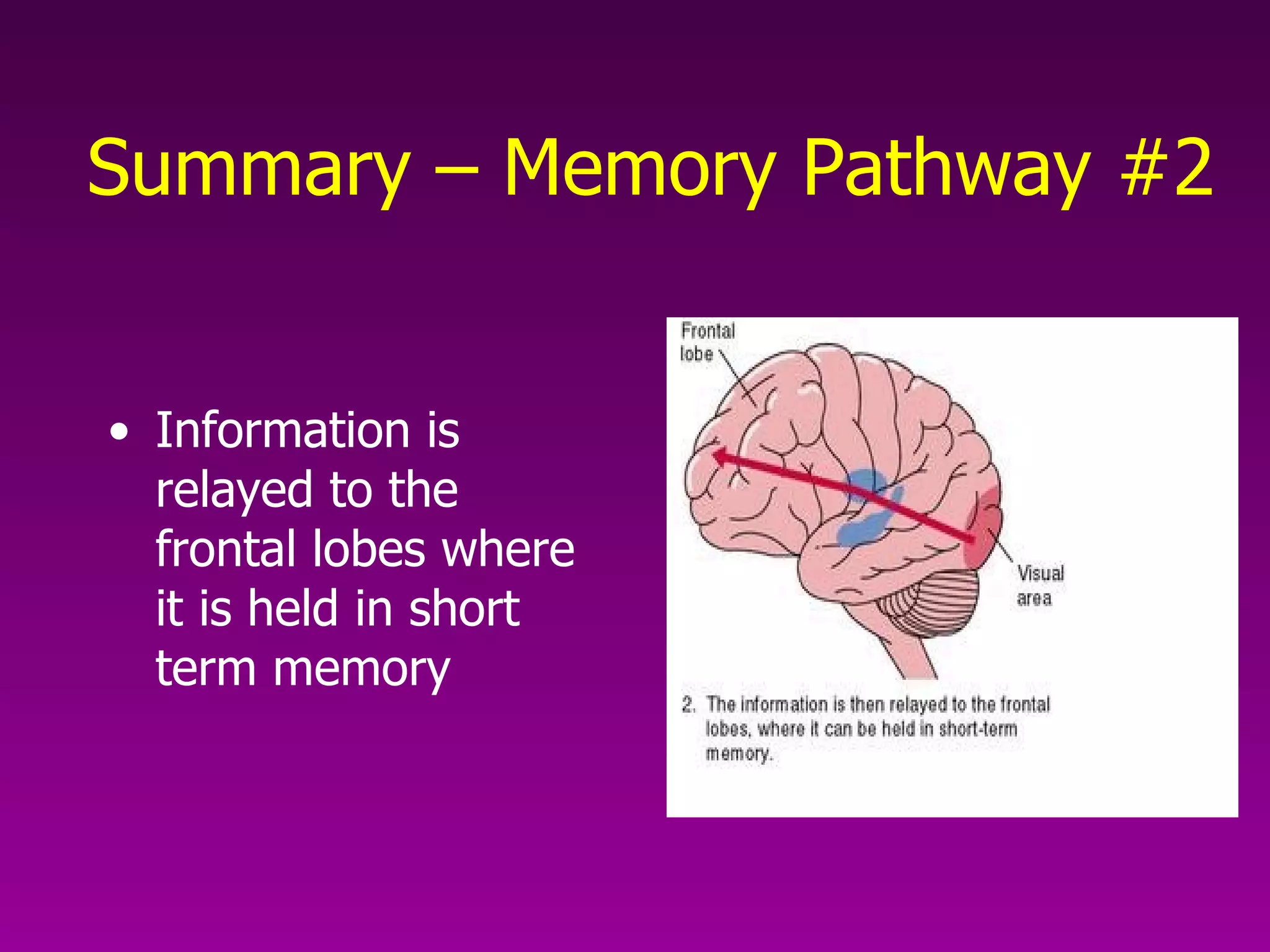
Summary – Memory Pathway #2 Information is relayed to the frontal lobes where it is held in short term memory
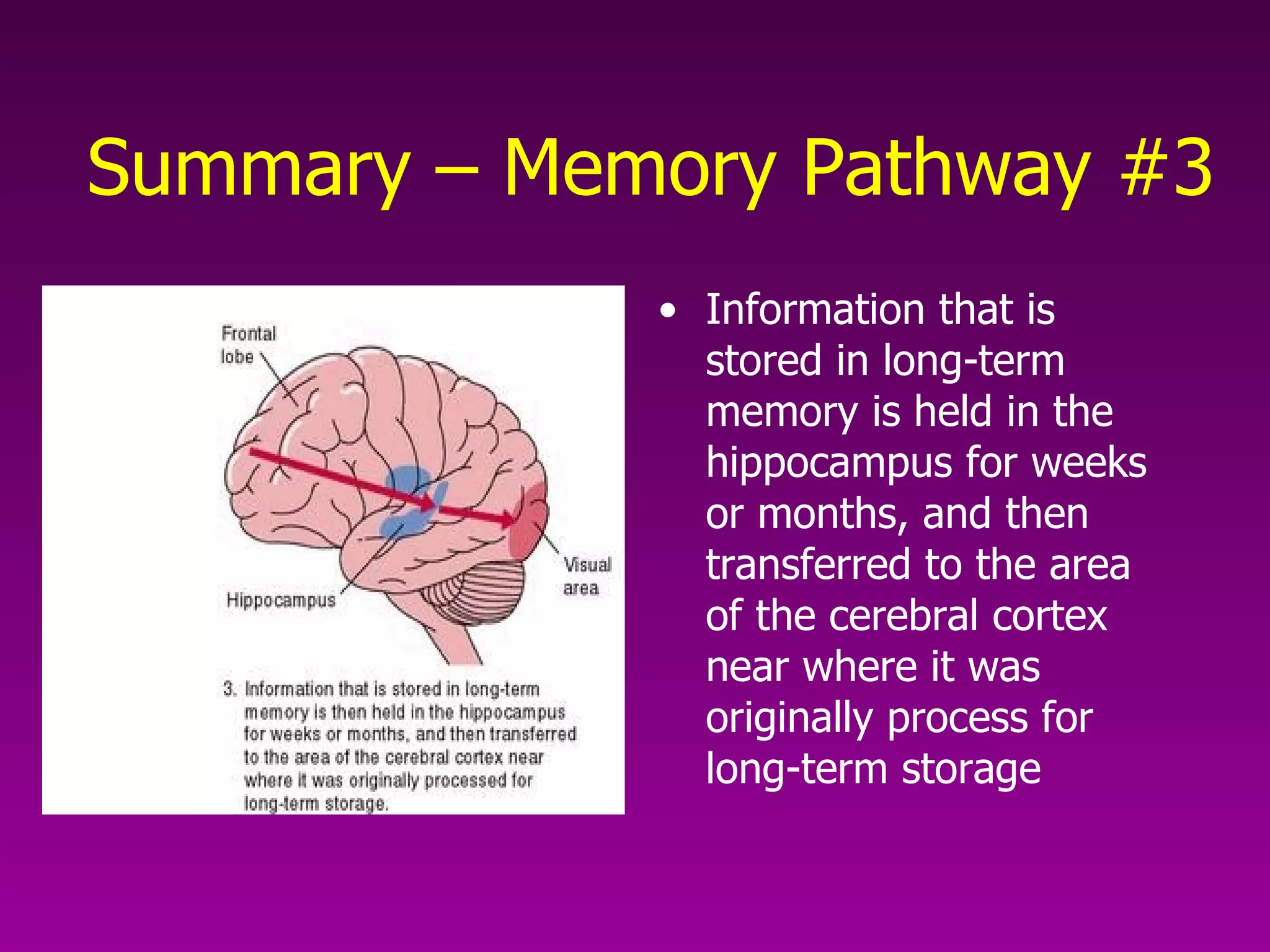
Summary – Memory Pathway #3 Information that is stored in long-term memory is held in the hippocampus for weeks or months, and then transferred to the area of the cerebral cortex near where it was originally process for long-term storage
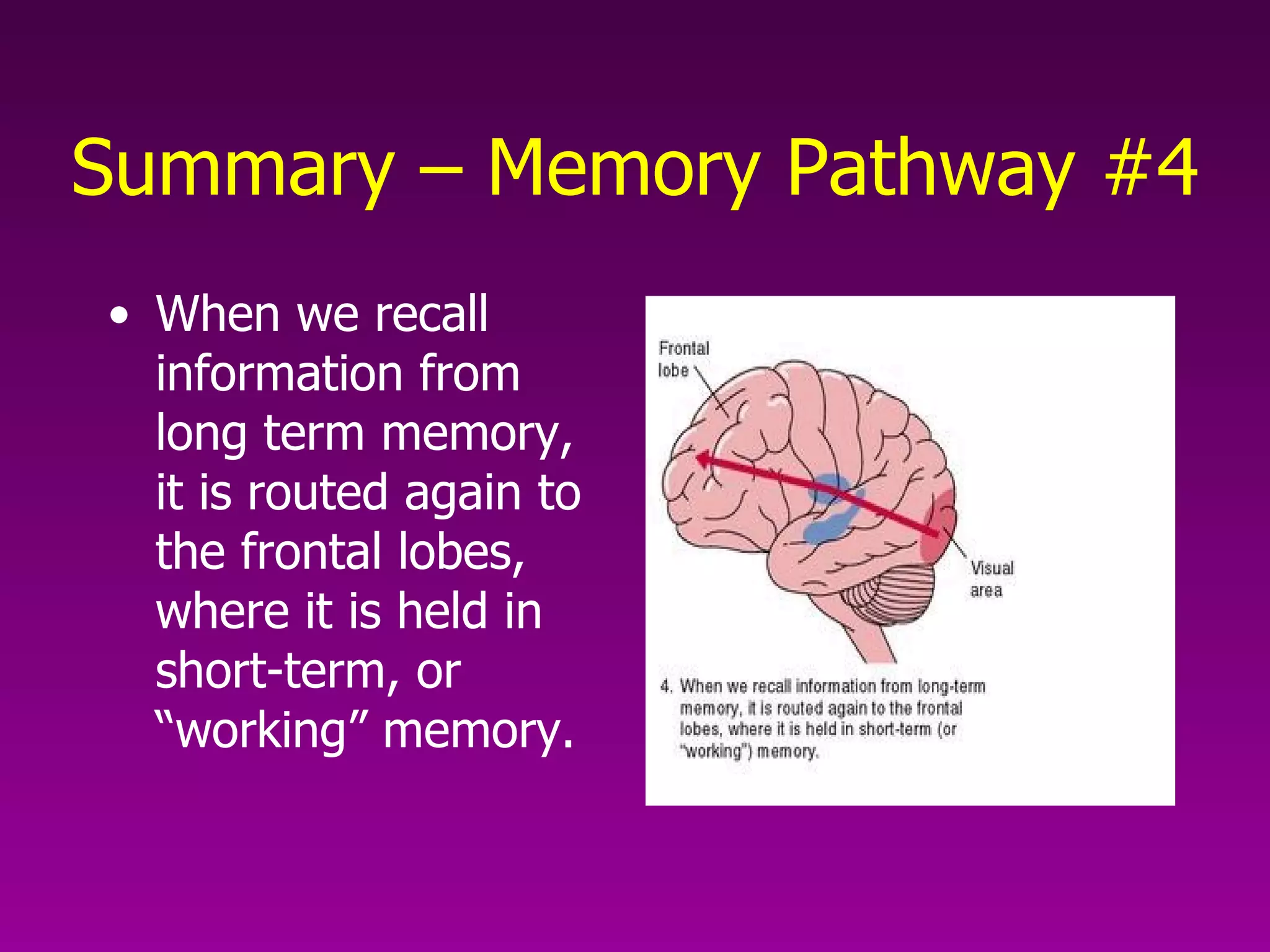
Summary – Memory Pathway #4 When we recall information from long term memory, it is routed again to the frontal lobes, where it is held in short-term, or “working” memory.
Memory

  • 1.
  • 2.
    Types of MemoryDeclarative memory = Explicit memory Learning about people, places and things Nondeclarative memory = Implicit memory Memory for skills or behavior Working memory temporary information storage includes several types of information probably from several sites in the brain Spatial memory memory of location Relational memory things that happen at same time get stored together in a manner that ties them together
  • 3.
    Explicit Memory Learningabout people, places and things Can be verbally reported Requires conscious awareness Short-term memory temporary, limited in capacity requires continual rehearsal Long-term memory more permanent, much greater capacity does not require continual rehearsal Consolidation transfer from short-term memory to long-term memory
  • 4.
    Implicit Memory Proceduralmemory Memory for skills or behavior Perceptual and motor learning Does not require conscious awareness
  • 5.
    Major Features ofMemory Memory has stages Long term memory is represented in multiple regions of the CNS Implicit and explicit memory involve different neural circuits Explicit requires the temporal lobe Implicit involves the cerebellum, amygdala
  • 6.
    Memory is NotUnitary Memory is not an “all or none” phenomenon Can be implicit or explicit or a mixture Depends on how the information is stored and recalled
  • 7.
    Amnesia - Lossof Memory Dissociated amnesia not associated with any other cognitve deficits Retrograde amnesia loss of memory for the time period before a trauma typically is gradational from essentially complete loss just before trauma to less and less complete loss earlier and earlier before trauma Anterograde amnesia inability to form new memories Transient global amnesia sudden, brief onset of anterograde amnesia The different types of amnesia suggest that several mechanisms for memory work together
  • 8.
    Causes of AmnesiaCauses concussion, chronic alcoholism, encephalitis, brain tumor, stroke Transient amnesia Probably caused by interruptions in cerebral blood flow Blows to head, physical stress, cold showers, sex, drugs Clioquinol (anti-diarrheal drug) - no longer on market became famous for causing transient global amnesia in some people
  • 9.
    Localization of MemoryFunctions Long thought memory was a function of the whole cerebral cortex We now realize that different types of memory are localized in different regions Engram physical representation or location of a memory
  • 10.
    Cortical Ablation Studies Karl Lashley – 1920s Tried to localize memory engram to association areas of the neocortex Studied effect of brain lesions on ability to learn a maze in rats As more and more of the rat's cortex was ablated, more and more errors were made ability to learn was progressively impaired Lashley incorrectly concluded that the whole neocortex equally participated in memory now know that the problem was that the lesions were too large
  • 11.
    Cell Assembly Donald Hebb – 1949 The internal representation of an object consists of the cortical cells that are activated by the stimulus Group of simultaneously acting neurons = cell assembly Same neurons are involved in sensation and perception All of these cells are reciprocally interconnected Internal representation of an object remains in short term memory as long as the cell assembly is active If assembly active long enough, consolidation occurs Long term memory Neurons that fire together wire together Activating any cells in the assembly activates the memory Led to neural network model                       
  • 12.
    Localization of DeclarativeMemories Studies in macaque monkeys -  Lesions in the inferotemporal cortex (IT) cause loss of memory about previously learned visual discrimination tasks, even though vision itself remains normal Cells in the IT may respond preferentially to a familiar face in a particular orientation Cells in IT may change their response during repeated exposure to an unfamiliar face – learning The IT is involved both in vision and visual memory
  • 13.
    Human Studies fMRIshows what part of the brain is activated during exposure to various types of objects Bird watchers respond more vigorously to pictures of birds Car buffs respond more vigorously to pictures of cars and responses are in different places
  • 14.
    The Temporal LobeWilder Penfield – 1940’s Electrical stimulation of human temporal lobe Studied patients with epilepsy During surgery for epilepsy, stimulated temporal lobe electrically Some patients reported sensations like hallucinations or vivid memories but the patients had other cortical abnormalities Still, temporal lobe stimulation caused different effects than stimulation of other parts of the neocortex Consistant with seizure “aura”
  • 15.
    Kluver-Bucy Syndrome Researchersat U. Chicago in the 1930’s Studying emotion circuitry Bilateral temporal lobectomy in rhesus monkeys Produces bizarre behavioral abnormnalities One of these is “psychic blindness” Although they could see, could not recognize or understand the meaning of common objects Thus loss of declarative memory More on this phenomenon with emotion
  • 16.
    Building on PenfieldBrenda Milner – 1950’s Studied patients with surgical interventions to treat epilepsy Bilateral removal of the hippocampus and neighboring regions of the temporal lobe Most famous case was “H.M.”
  • 17.
    Patient “H.M.” ShedsNew Light Bilateral removal of mid-temporal lobe Stopped seizures Short term memory was OK Memories formed prior to surgery were OK Ability to form new, long term memories was lost Couldn’t transfer information from short term to long term memory! Similar findings in all bilateral temporal lobe surgical patients
  • 18.
    Impact on LearningAll of the things these patients could recall have an automatic quality Do not require conscious recall Do not require complex cognitive skills such as comparison If the patient practices a puzzle, they improve their ability to solve it, but they don’t remember how.
  • 19.
    Medial Temporal LobeAnatomy Hippocampus deep in the medial temporal lobe Entorhinal cortex, perirhinal cortex, parahippocampal cortex Three cortical regions ventral to the hippocampus all involved in memory functions
  • 20.
    Function of theMedial Temporal Lobe Lesions in monkeys impair discrimination memory ability to recognize whether object has been seen before Lesions impair declarative memory, not procedural memory Lesions impair long-term memory storage, but short-term memory seems to be normal This region seems to be involved in packaging short-term memory for relay to the rest of the neocortex for long-term storage
  • 21.
    The Diencephalon &Memory Outside of the temporal lobe, one of the regions most associated with memory Axons from the hippocampus project to the mammillary bodies which project to the thalamus Thalamus also receives input from temporal lobe structures including the amygdala & IT Large midline thalamic lesions in monkeys produce severe deficits in ability to learn a matching task Lesions which impact fewer nuclei produce smaller deficits
  • 22.
    The Diencephalon Threeregions have been implicated in memory processing: Anterior nucleus of thalamus Dorsomedial nucleus of thalamus Mammillary bodies in hypothalamus The thalamus & mammillary bodies receive nerve fibers from the medial temporal lobe
  • 23.
    The Case of“N.A.” Accidentally stabbed with a fencing foil Through his right nostril into his brain Produced a lesion in his left dorsomedial thalamus Cognitive ability normal but memory impaired Caused moderate retrograde amnesia (for the 2 years prior) and profound anterograde amnesia similar to the more extensive damage to H. M. Short term memory and preservation of old memories was intact Suggests that both the temporal lobe and parts of the thalamus may be involved in the formation of long-term declarative memories
  • 24.
    Korsakoff's Syndrome Usually due to chronic alcoholism Results from alcohol associated thiamin deficiency Produces confusion, severe memory impairment, apathy First presents as abnormal eye movements, loss of coordination, tremors Can be treated in early stages Untreated thiamin defiency leads to brain damage which produces Korsokoff’s Lesions in dorsomedial thalamus and mammillary bodies Anterograde and severe retrograde amnesia Further supports role of diencephalon in memory
  • 25.
    Anterograde & RetrogradeAmnesia While often found together, may have different causes The degree of severity of the two does not correlate in Korsokoff’s Suggests different mechanisms involved Damage to the dorsomedial thalamus and mammillary bodies probably causes anterograde amnesia What causes retrograde amnesia is still unclear
  • 26.
    Working Memory &the Hippocampus Hippocampus is involved in memory function for a diverse range of tasks Studies of hippocampal ablation in rats Studied “working memory” Used a radial maze containing food Normal rats learn to visit each arm only once If only some arms are used, they learn only to go down those arms, and then only once.
  • 27.
    The Maze StudyRats with hippocampal lesions still find the food, but they aren't very efficient, going down the same arm repeatedly Rats with lesions can learn to avoid the arms that never have food, but they still explore the food containing arms inefficiently and repeatedly Inability to use changing information
  • 28.
    Place Cells inthe Hippocampus Neurons in the hippocampus selectively respond when rat is in a particular location. If vision is used to determine place, (like landmarks) cell fires in response to where the animal thinks he is May be responsible for learning radial arm maze More than spatial memory is involved Hippocampus may control relational memory
  • 29.
    Relational Memory Highlyprocessed sensory information comes into the hippocampus & cortex Processing occurs leading to the storage of memories All things happening at the same time are stored together Thus, remembering one thing brings back related memories It's easier to remember events that you had strong feelings about. Spatial navigation is based on a spatial map & relational memories
  • 30.
    Striatum and ProceduralMemory Procedural memory = memory involved in forming behavioral habits Striatum is the major structure involved in procedural memory Striatum may be involved in forming 'habits' in rats, humans, & non-human primates Data from humans suggests that the striatum is involved in a procedural memory system that is separate and distinct from the medial temporal system used for declarative memory
  • 31.
    Neocortex and WorkingMemory Humans have much more prefrontal cortex than any other animals Pathways: Medial temporal lobe >> hypothalamus >> anterior nucleus of thalamus >> cingulate cortex Medial temporal lobe >> dorsomedial nucleus of thalamus >> frontal cortex Experiments suggest that frontal cortex is involved with working memory for problem solving and planning of behavior
  • 32.
    Frontal Lobe &Memory The left frontal lobe (colored regions at left) supports our ability to retrieve the meaning of words and objects.
  • 33.
    Lateral Intraparietal Cortex(LIP) Cortex buried in intraparietal sulcus Involved in working memory Responses specific to vision Example: monkey looks at fixation point while a stimulus is flashed in periphery; after delay, monkey moves eyes to where the stimulus was Cells in LIP seem to store information about where the eyes are to be moved they remain active during the delay - specific for visual working memory There is a different area specific for auditory working memory
  • 34.
    Many Structures areInvolved in Memory
  • 35.
    Summary – MemoryPathway #1 Visual information is first routed through the thalamus to the visual area of the cerebral cortex. This neural activity is the basis for the sensory register
  • 36.
    Summary – MemoryPathway #2 Information is relayed to the frontal lobes where it is held in short term memory
  • 37.
    Summary – MemoryPathway #3 Information that is stored in long-term memory is held in the hippocampus for weeks or months, and then transferred to the area of the cerebral cortex near where it was originally process for long-term storage
  • 38.
    Summary – MemoryPathway #4 When we recall information from long term memory, it is routed again to the frontal lobes, where it is held in short-term, or “working” memory.