Domina Petric, MD
ECG D
De Winter’s T waves
Burns E. De Winter´s T Waves (November 16, 2017). Retrieved from
https://lifeinthefastlane.com/ecg-library/de-winters-t-waves/
PowerPlugs Templates for PowerPoint Preview 2
De Winter’s T waves
PowerPlugs Templates for PowerPoint Preview 3
Diagnostic criteria
• Tall, prominent, symmetric T waves in the
precordial leads!
• Upsloping ST segment depression >1mm at the J-
point in the precordial leads!
• Absence of ST elevation in the precordial leads!
• ST segment elevation (0,5-1 mm) in aVR!
• STEMI morphology may precede or follow De
Winter pattern!
PowerPlugs Templates for PowerPoint Preview 4
De Winter´s T waves
PowerPlugs Templates for PowerPoint Preview 5
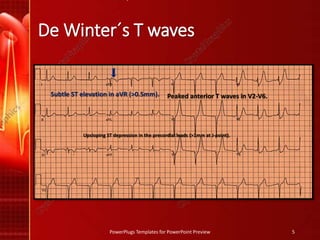
Subtle ST elevation in aVR (>0.5mm).
Upsloping ST depression in the precordial leads (>1mm at J-point).
Peaked anterior T waves in V2-V6.
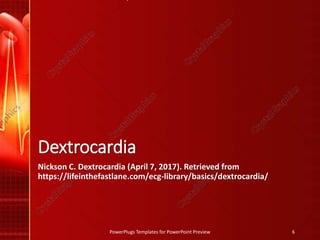
Dextrocardia
Nickson C. Dextrocardia (April 7, 2017). Retrieved from
https://lifeinthefastlane.com/ecg-library/basics/dextrocardia/
PowerPlugs Templates for PowerPoint Preview 6
Dextrocardia
• Right axis deviation!
• Positive QRS complexes (with upright P and
T waves) in aVR!
• Lead I: inversion of all complexes (inverted P
wave, negative QRS, inverted T wave)!
• Absent R-wave progression in the chest
leads (dominant S waves throughout)!
PowerPlugs Templates for PowerPoint Preview 7
Dextrocardia
PowerPlugs Templates for PowerPoint Preview 8
Right axis deviation
Positive QRS in aVR
Inverted P, T wave and QRS in DI
Dominant S waves in precordial leads
Digoxin effect
Burns E. Digoxin Effect (April 5, 2017). Retrieved from
https://lifeinthefastlane.com/ecg-library/digoxin-effect/
PowerPlugs Templates for PowerPoint Preview 9
Digoxin effect
• Down-sloping ST depression with a characteristic
“Salvador Dali sagging” appearance!
• Flattened, inverted or biphasic T waves.
• Shortened QT interval.
• Mild PR interval prolongation due to increased vagal
tone up to 240 ms.
• Prominent U waves.
• Peaking of the terminal portion of the T waves.
• J point depression.
PowerPlugs Templates for PowerPoint Preview 10
Digoxin effect
PowerPlugs Templates for PowerPoint Preview 11
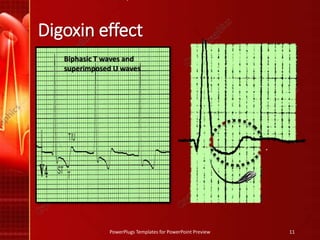
Biphasic T waves and
superimposed U waves
Digoxin toxicity
Burns E. Digoxin Toxicity (April 4, 2017). Retrieved from
https://lifeinthefastlane.com/ecg-library/basics/digoxin-toxicity/
PowerPlugs Templates for PowerPoint Preview 12
Digoxin toxicity
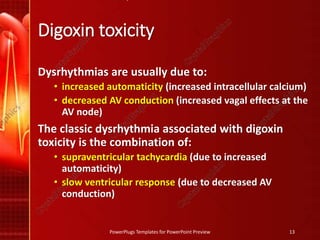
Dysrhythmias are usually due to:
• increased automaticity (increased intracellular calcium)
• decreased AV conduction (increased vagal effects at the
AV node)
The classic dysrhythmia associated with digoxin
toxicity is the combination of:
• supraventricular tachycardia (due to increased
automaticity)
• slow ventricular response (due to decreased AV
conduction)
PowerPlugs Templates for PowerPoint Preview 13
Digoxin toxicity
PowerPlugs Templates for PowerPoint Preview 14
ECG
PowerPlugs Templates for PowerPoint Preview 15
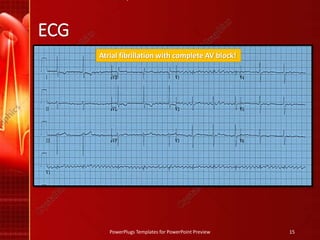
Atrial fibrillation with complete AV block!
Literature

ECG D

  • 1.
  • 2.
    De Winter’s Twaves Burns E. De Winter´s T Waves (November 16, 2017). Retrieved from https://lifeinthefastlane.com/ecg-library/de-winters-t-waves/ PowerPlugs Templates for PowerPoint Preview 2
  • 3.
    De Winter’s Twaves PowerPlugs Templates for PowerPoint Preview 3
  • 4.
    Diagnostic criteria • Tall,prominent, symmetric T waves in the precordial leads! • Upsloping ST segment depression >1mm at the J- point in the precordial leads! • Absence of ST elevation in the precordial leads! • ST segment elevation (0,5-1 mm) in aVR! • STEMI morphology may precede or follow De Winter pattern! PowerPlugs Templates for PowerPoint Preview 4
  • 5.
    De Winter´s Twaves PowerPlugs Templates for PowerPoint Preview 5 Subtle ST elevation in aVR (>0.5mm). Upsloping ST depression in the precordial leads (>1mm at J-point). Peaked anterior T waves in V2-V6.
  • 6.
    Dextrocardia Nickson C. Dextrocardia(April 7, 2017). Retrieved from https://lifeinthefastlane.com/ecg-library/basics/dextrocardia/ PowerPlugs Templates for PowerPoint Preview 6
  • 7.
    Dextrocardia • Right axisdeviation! • Positive QRS complexes (with upright P and T waves) in aVR! • Lead I: inversion of all complexes (inverted P wave, negative QRS, inverted T wave)! • Absent R-wave progression in the chest leads (dominant S waves throughout)! PowerPlugs Templates for PowerPoint Preview 7
  • 8.
    Dextrocardia PowerPlugs Templates forPowerPoint Preview 8 Right axis deviation Positive QRS in aVR Inverted P, T wave and QRS in DI Dominant S waves in precordial leads
  • 9.
    Digoxin effect Burns E.Digoxin Effect (April 5, 2017). Retrieved from https://lifeinthefastlane.com/ecg-library/digoxin-effect/ PowerPlugs Templates for PowerPoint Preview 9
  • 10.
    Digoxin effect • Down-slopingST depression with a characteristic “Salvador Dali sagging” appearance! • Flattened, inverted or biphasic T waves. • Shortened QT interval. • Mild PR interval prolongation due to increased vagal tone up to 240 ms. • Prominent U waves. • Peaking of the terminal portion of the T waves. • J point depression. PowerPlugs Templates for PowerPoint Preview 10
  • 11.
    Digoxin effect PowerPlugs Templatesfor PowerPoint Preview 11 Biphasic T waves and superimposed U waves
  • 12.
    Digoxin toxicity Burns E.Digoxin Toxicity (April 4, 2017). Retrieved from https://lifeinthefastlane.com/ecg-library/basics/digoxin-toxicity/ PowerPlugs Templates for PowerPoint Preview 12
  • 13.
    Digoxin toxicity Dysrhythmias areusually due to: • increased automaticity (increased intracellular calcium) • decreased AV conduction (increased vagal effects at the AV node) The classic dysrhythmia associated with digoxin toxicity is the combination of: • supraventricular tachycardia (due to increased automaticity) • slow ventricular response (due to decreased AV conduction) PowerPlugs Templates for PowerPoint Preview 13
  • 14.
    Digoxin toxicity PowerPlugs Templatesfor PowerPoint Preview 14
  • 15.
    ECG PowerPlugs Templates forPowerPoint Preview 15 Atrial fibrillation with complete AV block!
  • 16.