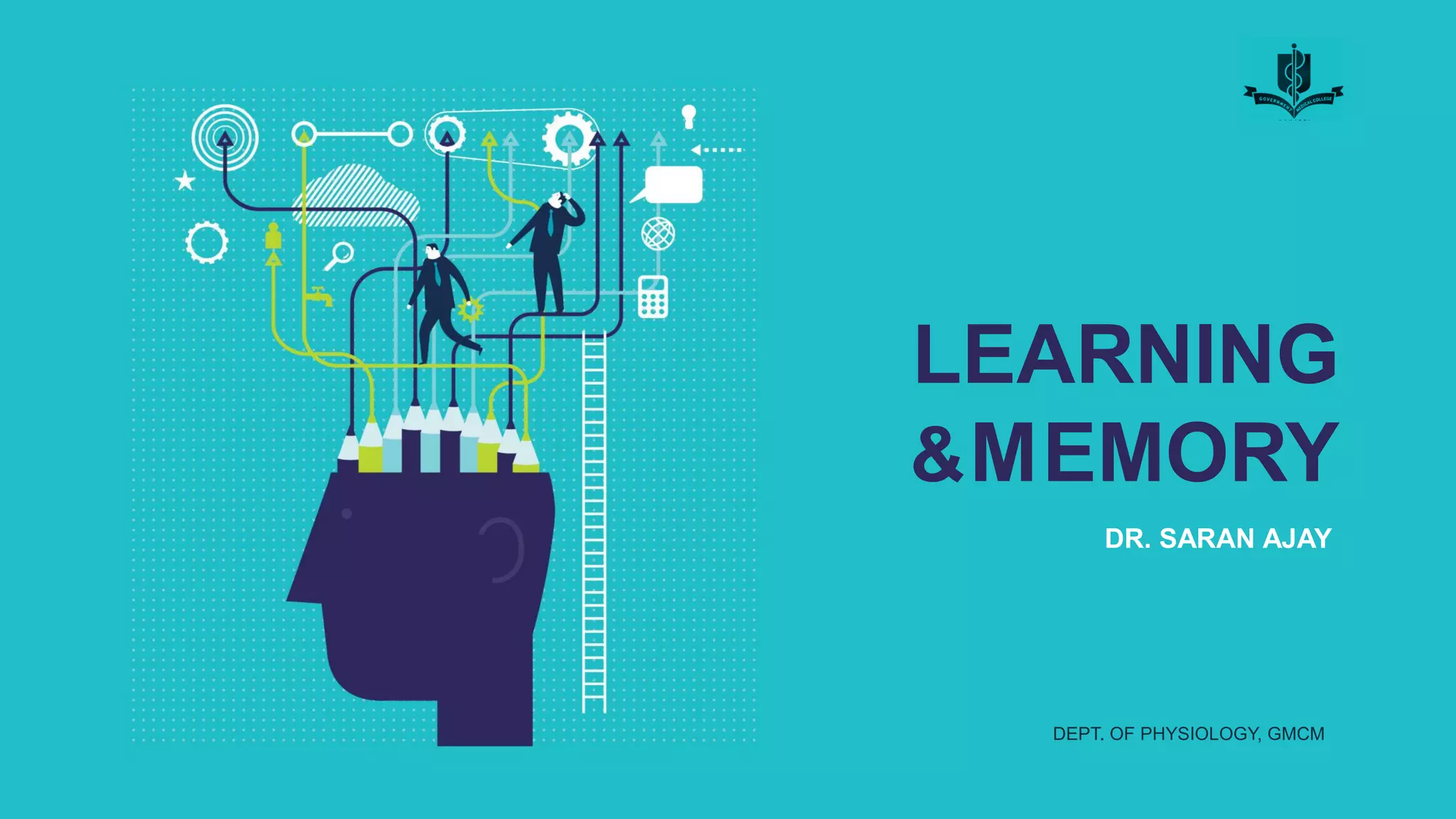
LEARNING
&MEMORY
DEPT. OF PHYSIOLOGY, GMCM
DR. SARAN AJAY
Specific Learning Objectives
• Defintion
• Types of Learning
Learning is the process of acquisition of new information,
which along with experience is used to alter the individual’s
behavior.
Memory is the storage of learned information for later recall.
Learning and memory form the basis by which
individuals adapt their behavior to their particular
external circumstances.
Specific Learning Objectives
• Defintion
• Types of Learning
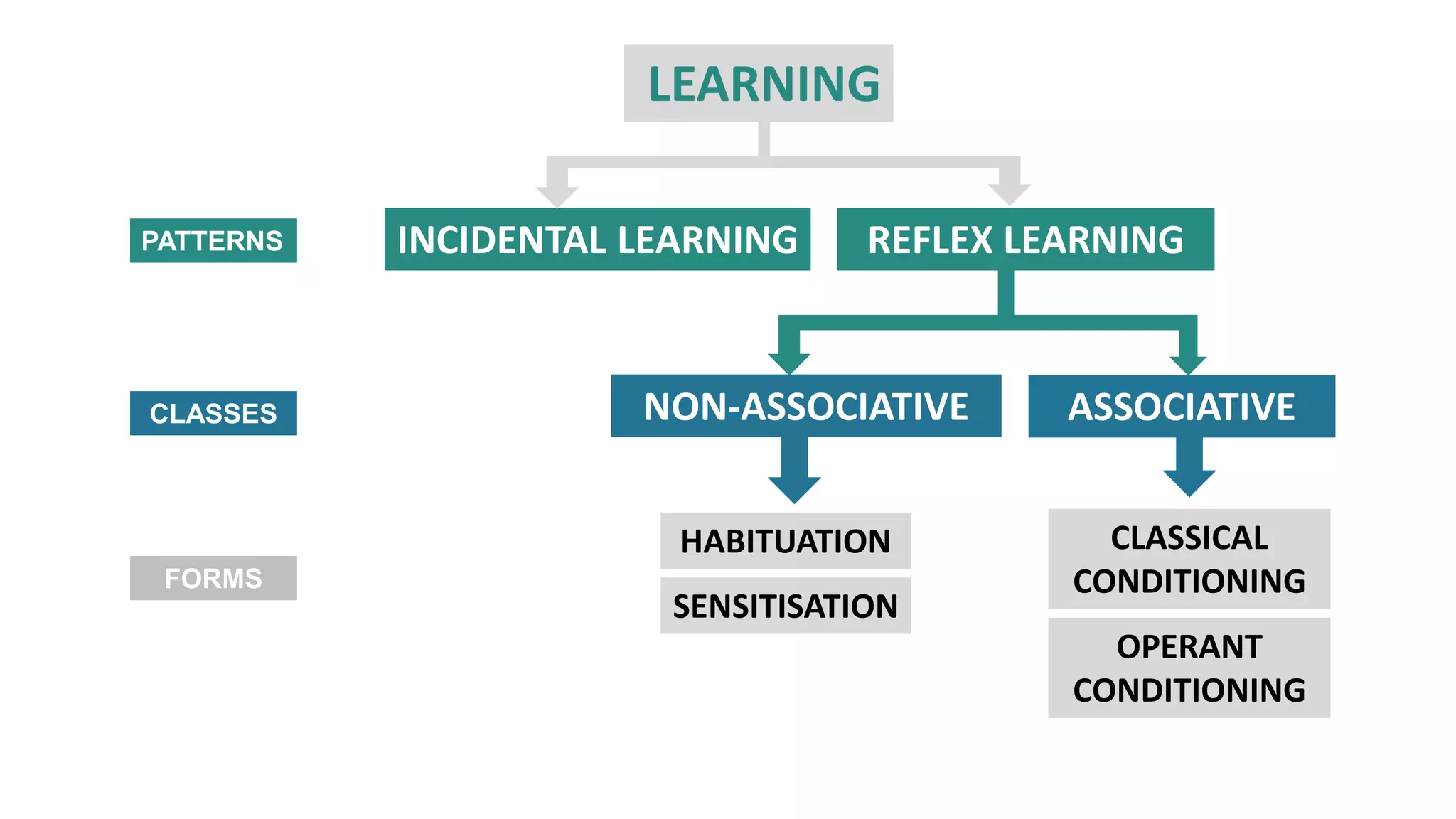
INCIDENTAL LEARNING REFLEX LEARNING
ASSOCIATIVE
NON-ASSOCIATIVE
HABITUATION
SENSITISATION
CLASSICAL
CONDITIONING
OPERANT
CONDITIONING
LEARNING
PATTERNS
CLASSES
FORMS
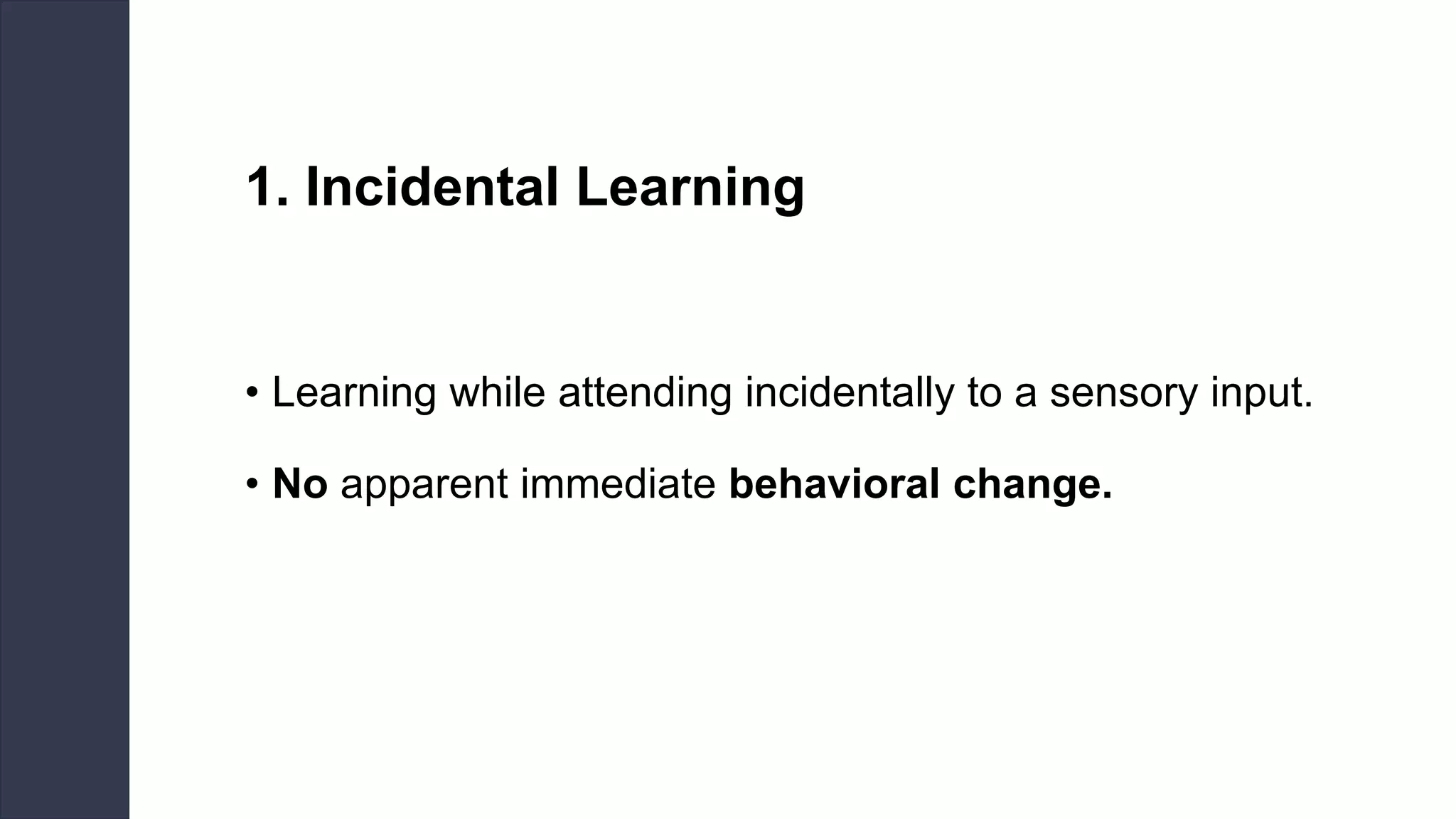
1. Incidental Learning
• Learning while attending incidentally to a sensory input.
• No apparent immediate behavioral change.
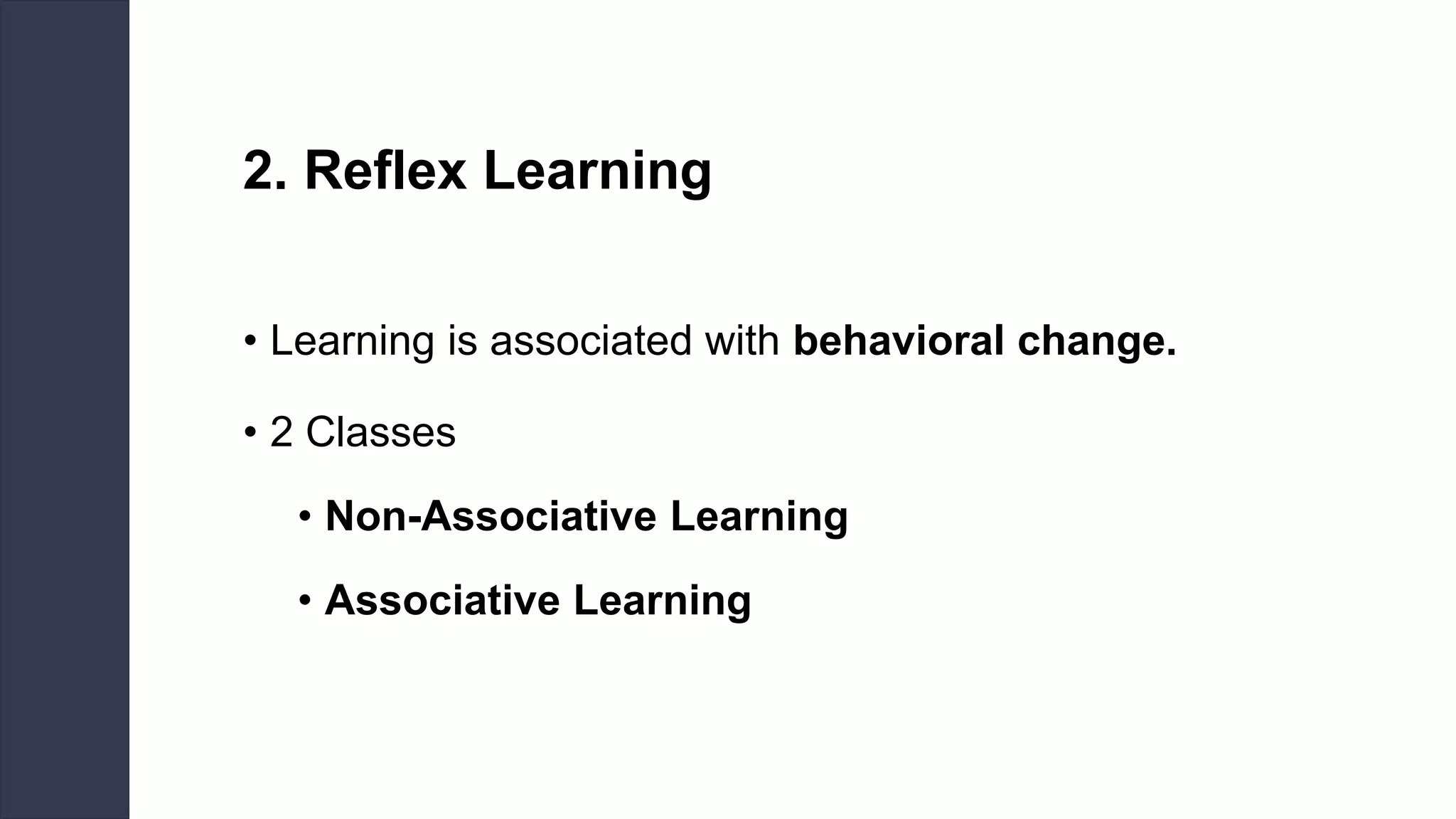
2. Reflex Learning
• Learning is associated with behavioral change.
• 2 Classes
• Non-Associative Learning
• Associative Learning
A. Non-Associative Learning
• Learns about the property of a single stimulus.
• Occurs when the animal/subject is repeatedly exposed to
a single type of stimulus.
• 2 forms – Habituation and Sensitization
Habituation
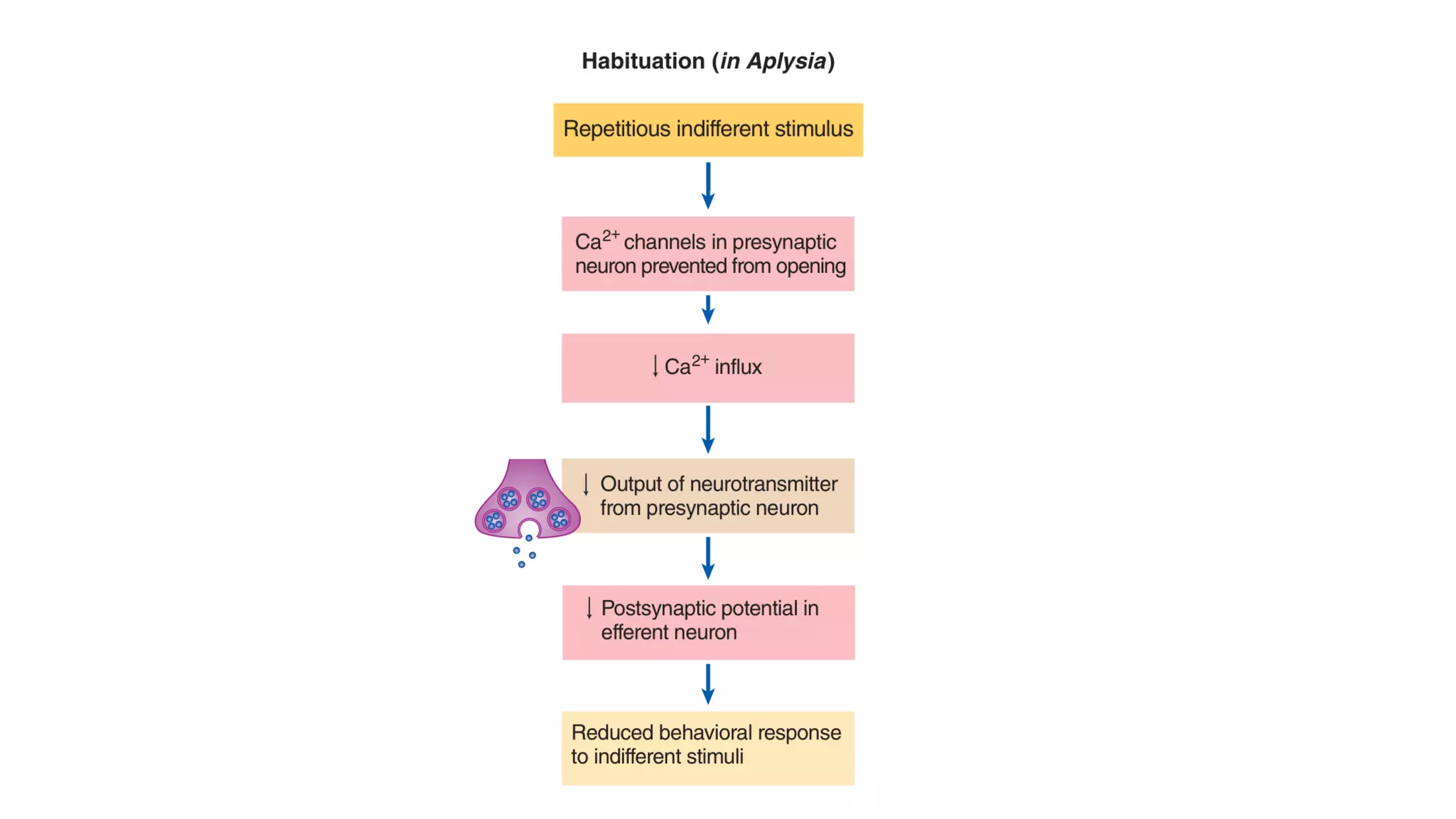
Refers to the decrease in response to a benign/neutral
stimuli, when it is presented repeatedly.
• 1st time application of a stimulus – Orientation Reflex or
‘What is it?’ response.
• Due to habituation, on repeated application of such stimuli
– subsequent decreases in response.
• Finally, the subject/ animal ignores the stimuli.
Cellular Mechanisms of Habituation
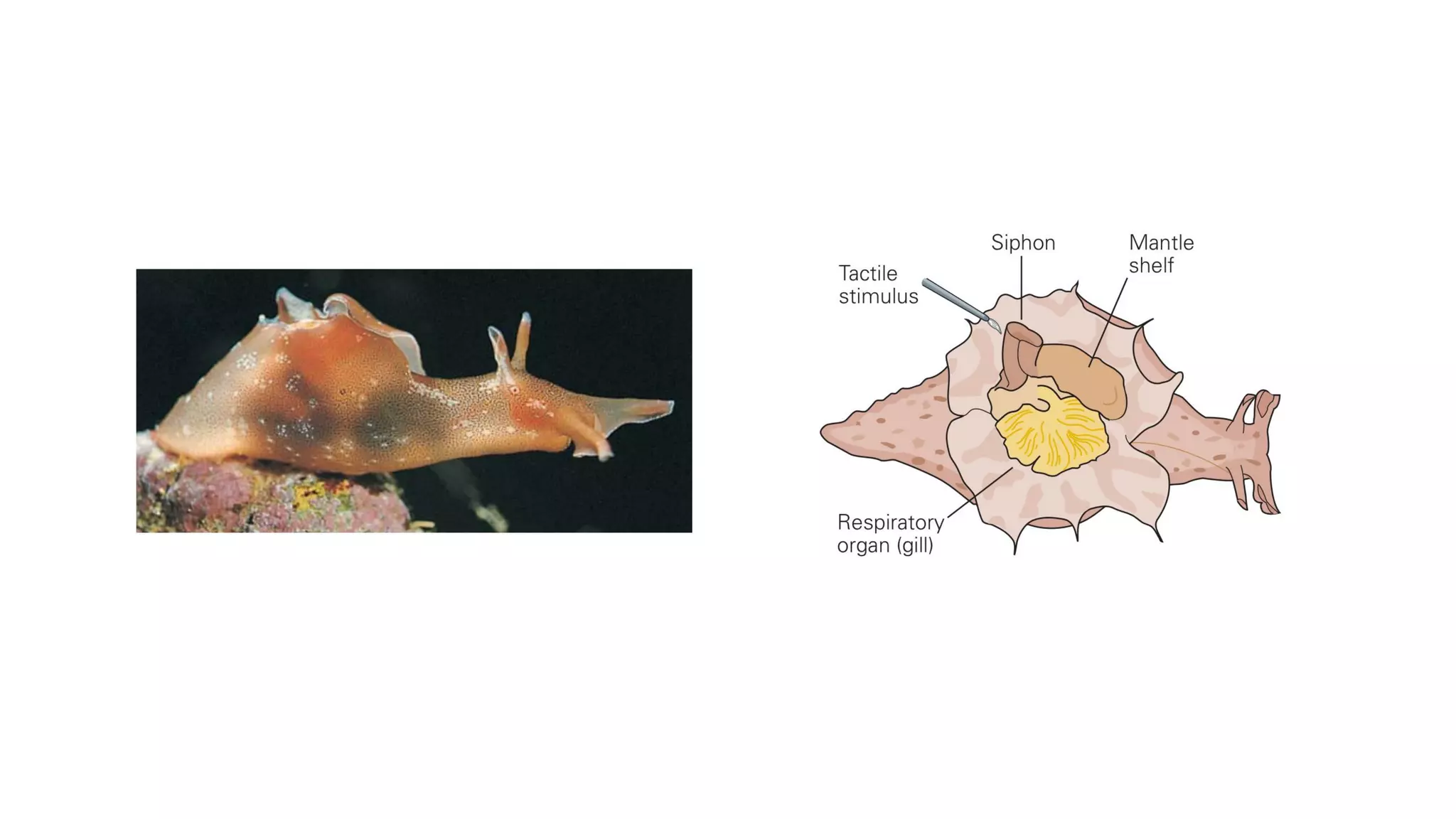
• Studied in Aplysia
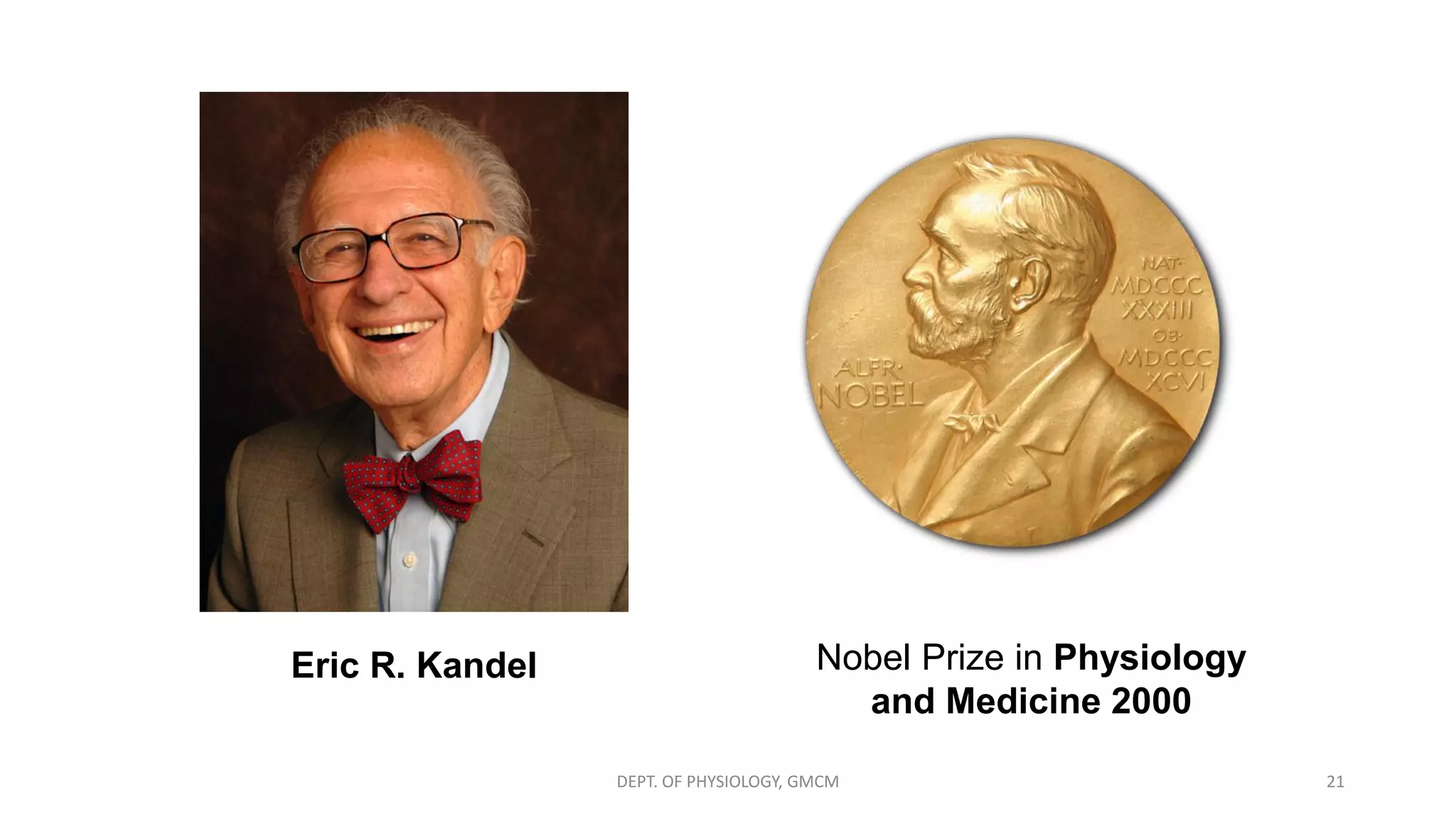
• Seminal work by Eric R Kandel
• Nobel Prize in Physiology and Medicine 2000 for
elucidating the cellular mechanisms of underlying
memory.
Eric R. Kandel Nobel Prize in Physiology
and Medicine 2000
DEPT. OF PHYSIOLOGY, GMCM 21
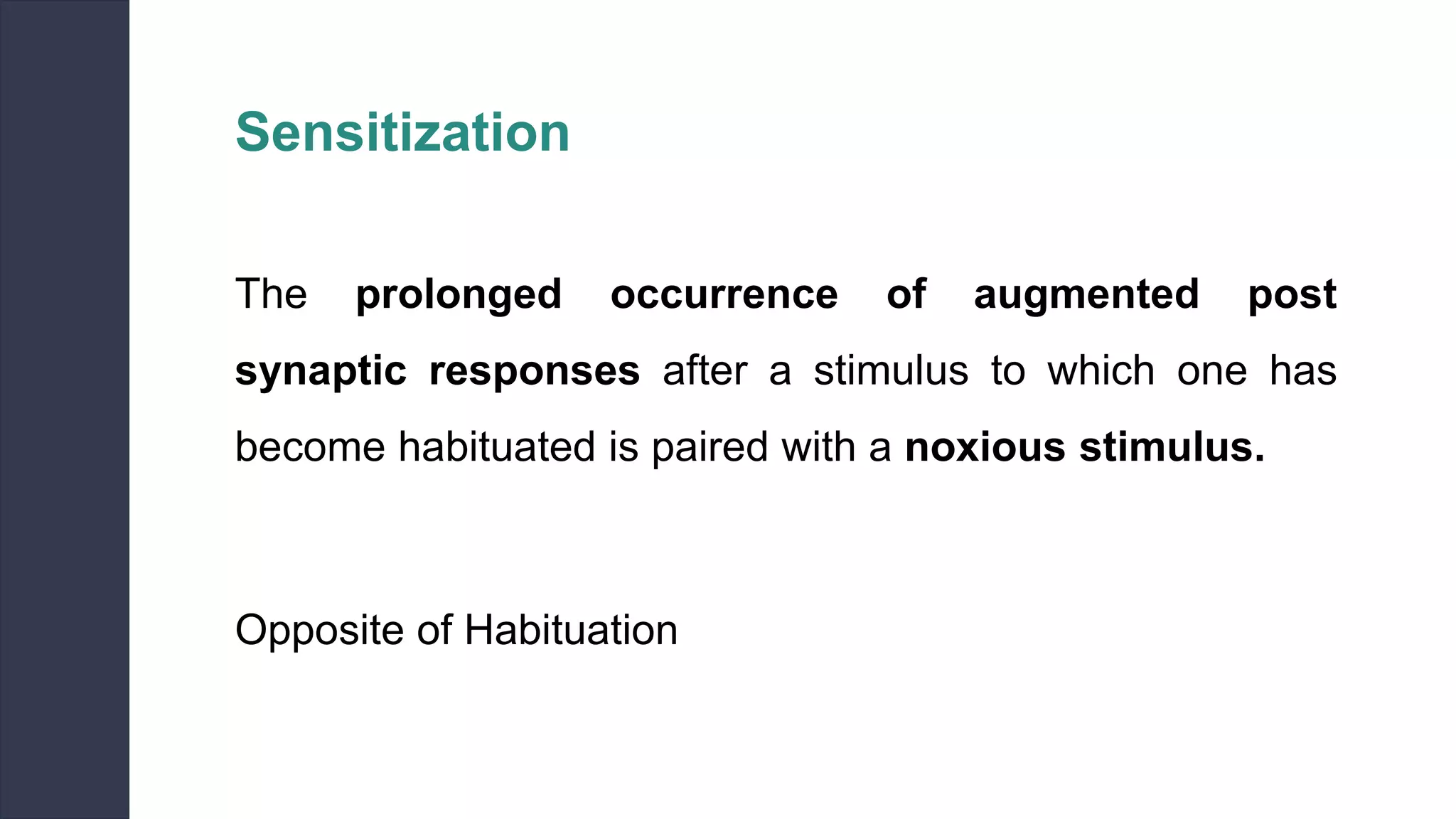
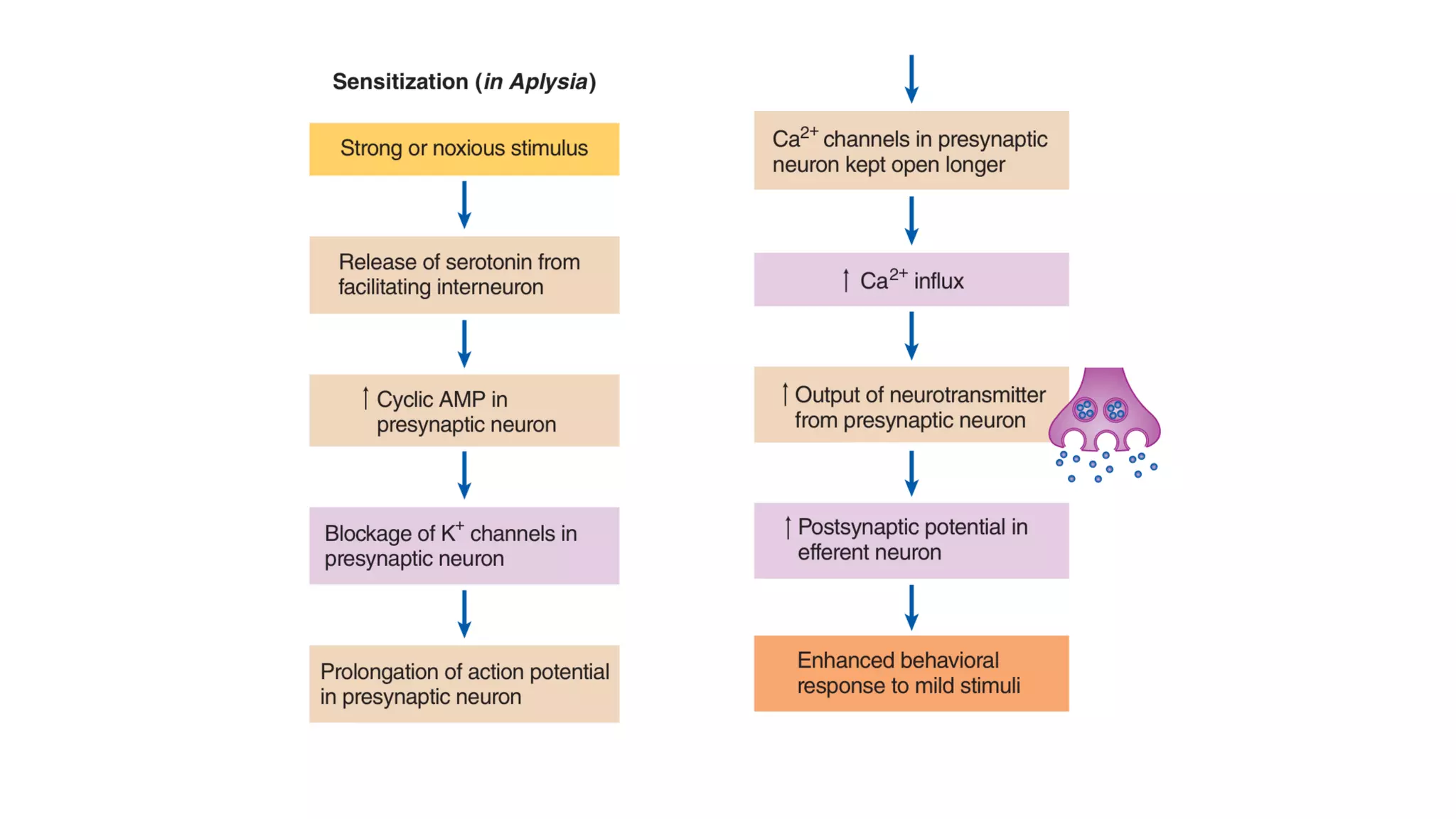
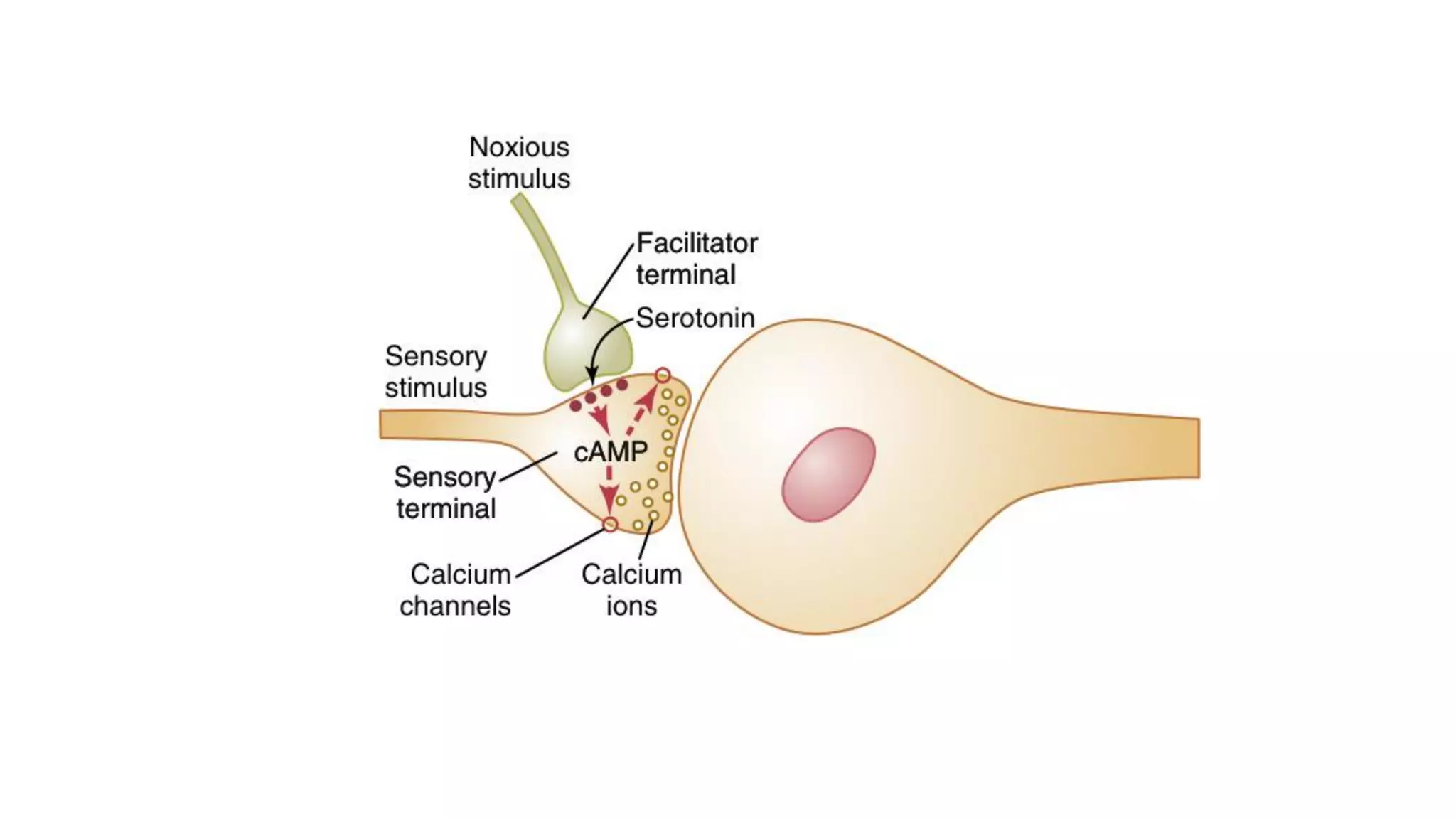
Sensitization
The prolonged occurrence of augmented post
synaptic responses after a stimulus to which one has
become habituated is paired with a noxious stimulus.
Opposite of Habituation
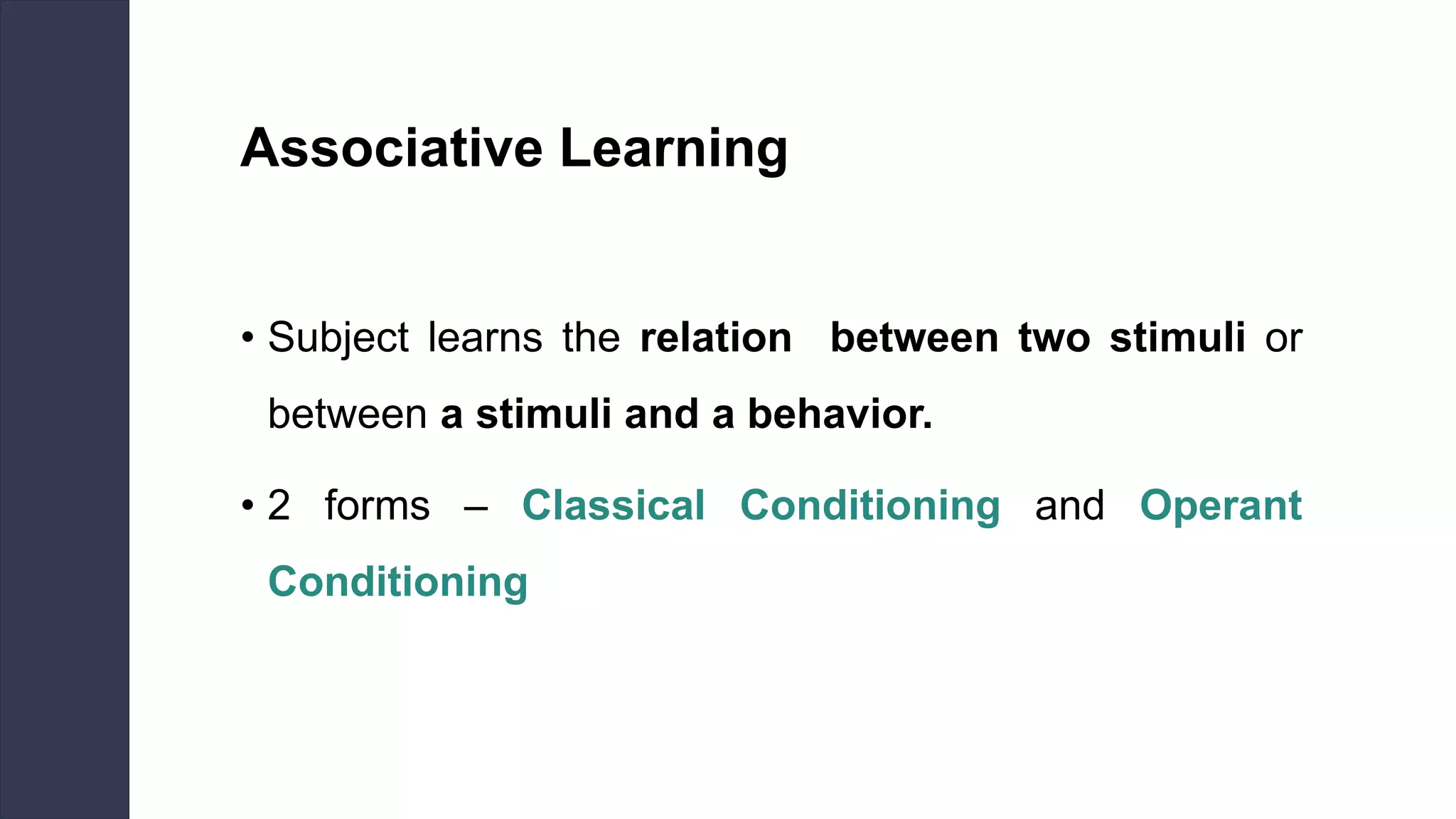
Associative Learning
• Subject learns the relation between two stimuli or
between a stimuli and a behavior.
• 2 forms – Classical Conditioning and Operant
Conditioning
Classical Conditioning
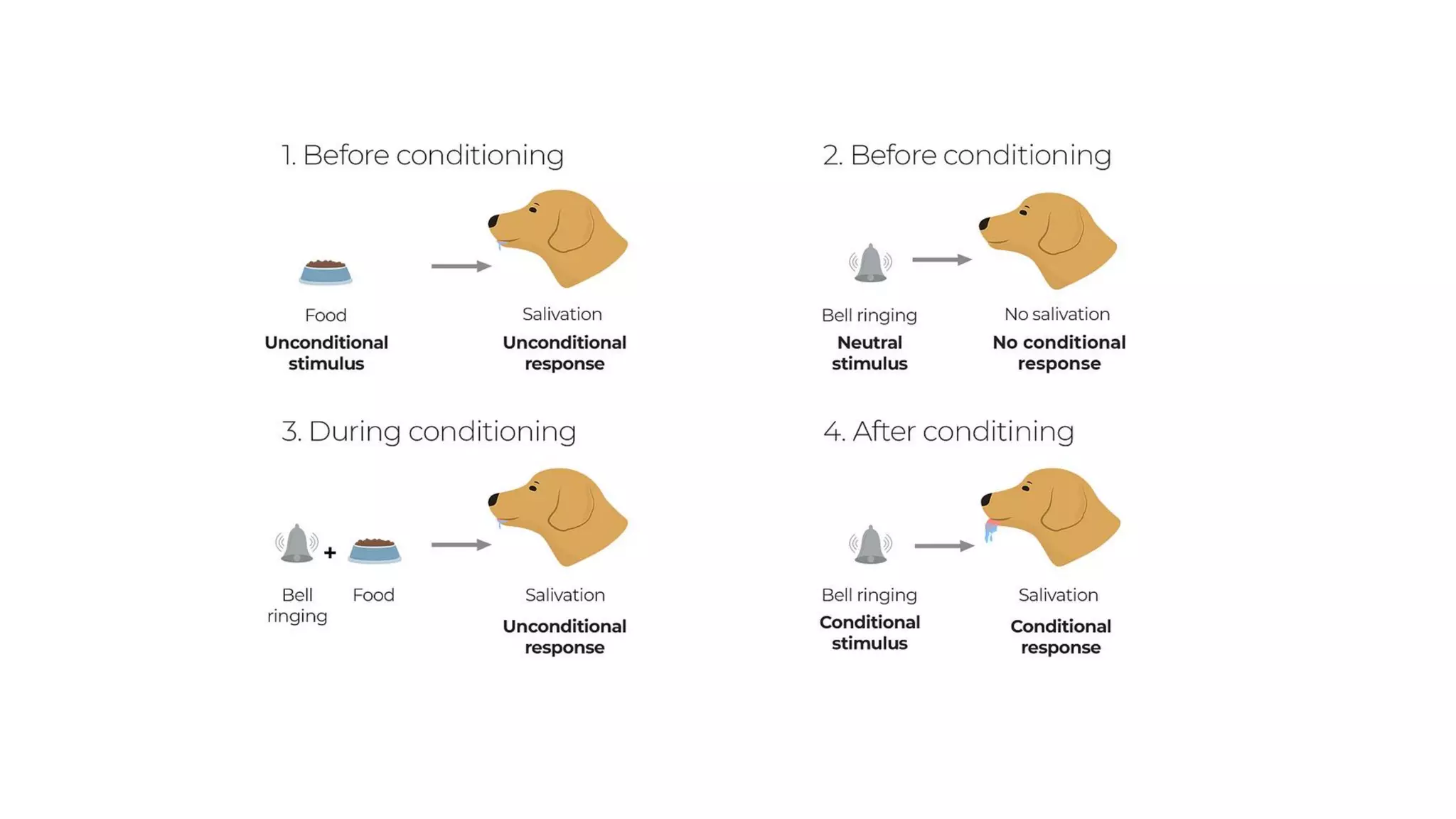
• Learning the relationship between two stimuli
• Also called as Pavlovian Conditioning
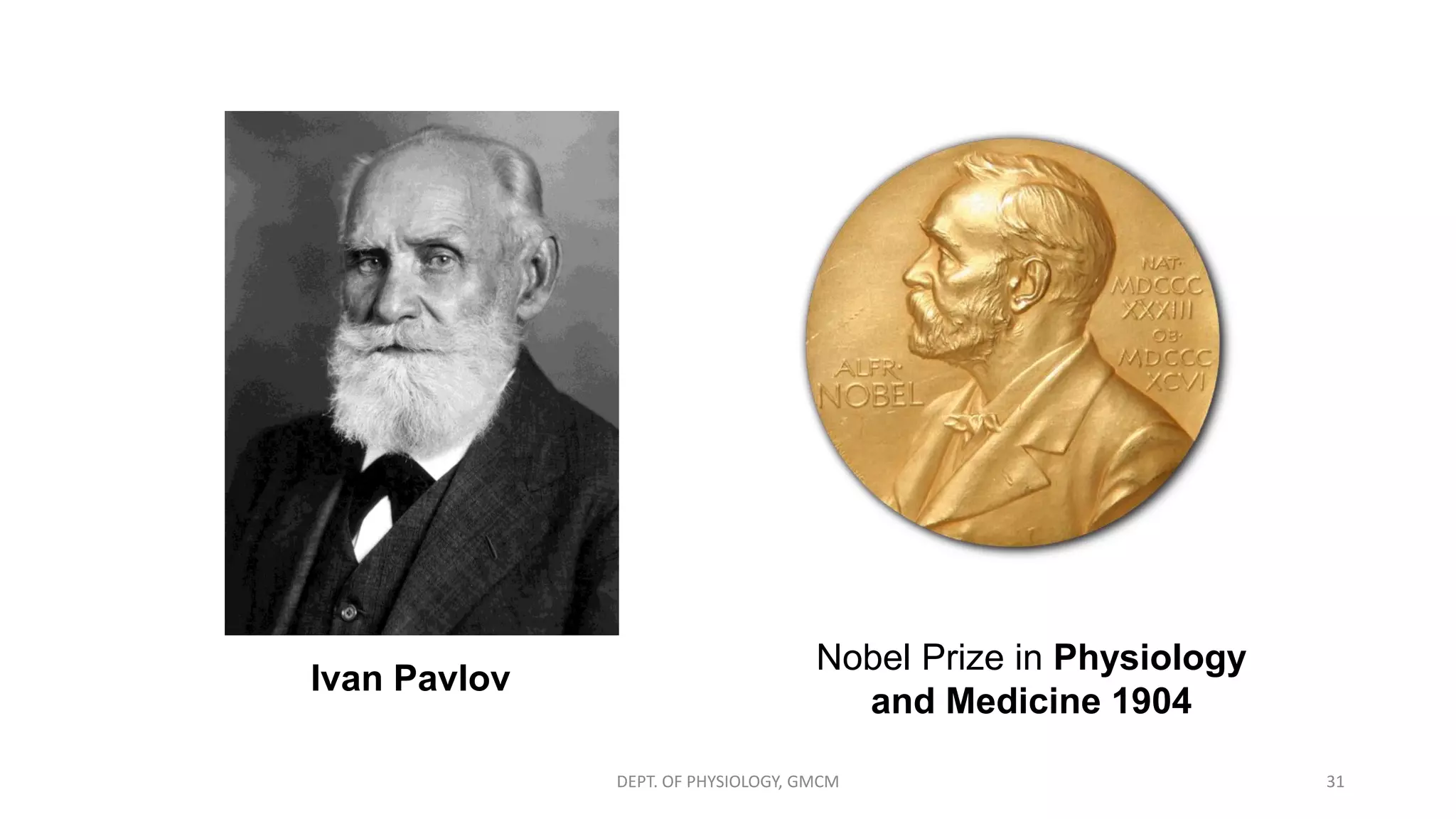
Ivan Pavlov
Nobel Prize in Physiology
and Medicine 1904
DEPT. OF PHYSIOLOGY, GMCM 31
It is a reflex response to a stimuli that previously elicited
little or no response, acquired by repeatedly pairing the
stimulus with another stimulus that normally produces the
response.
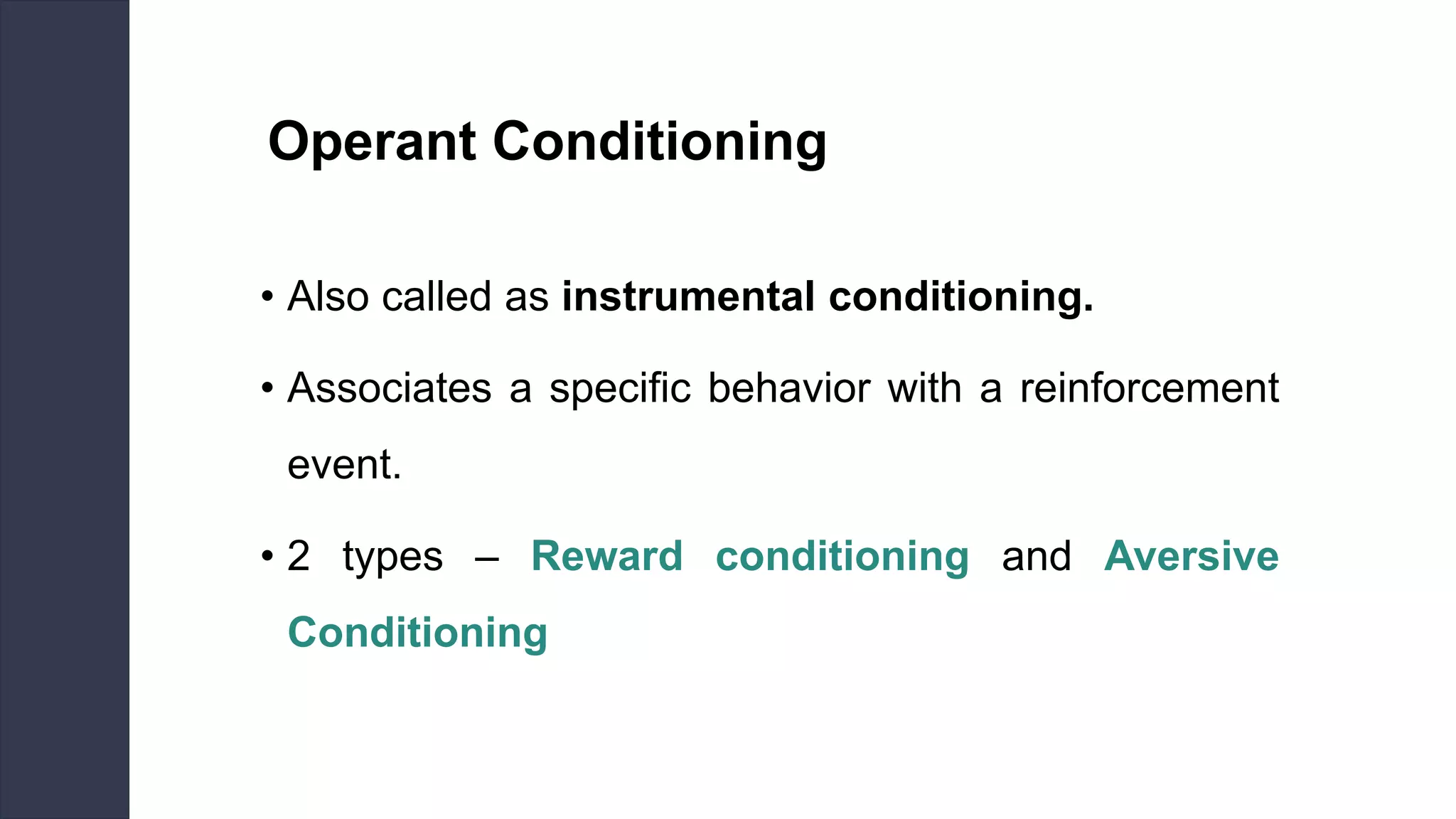
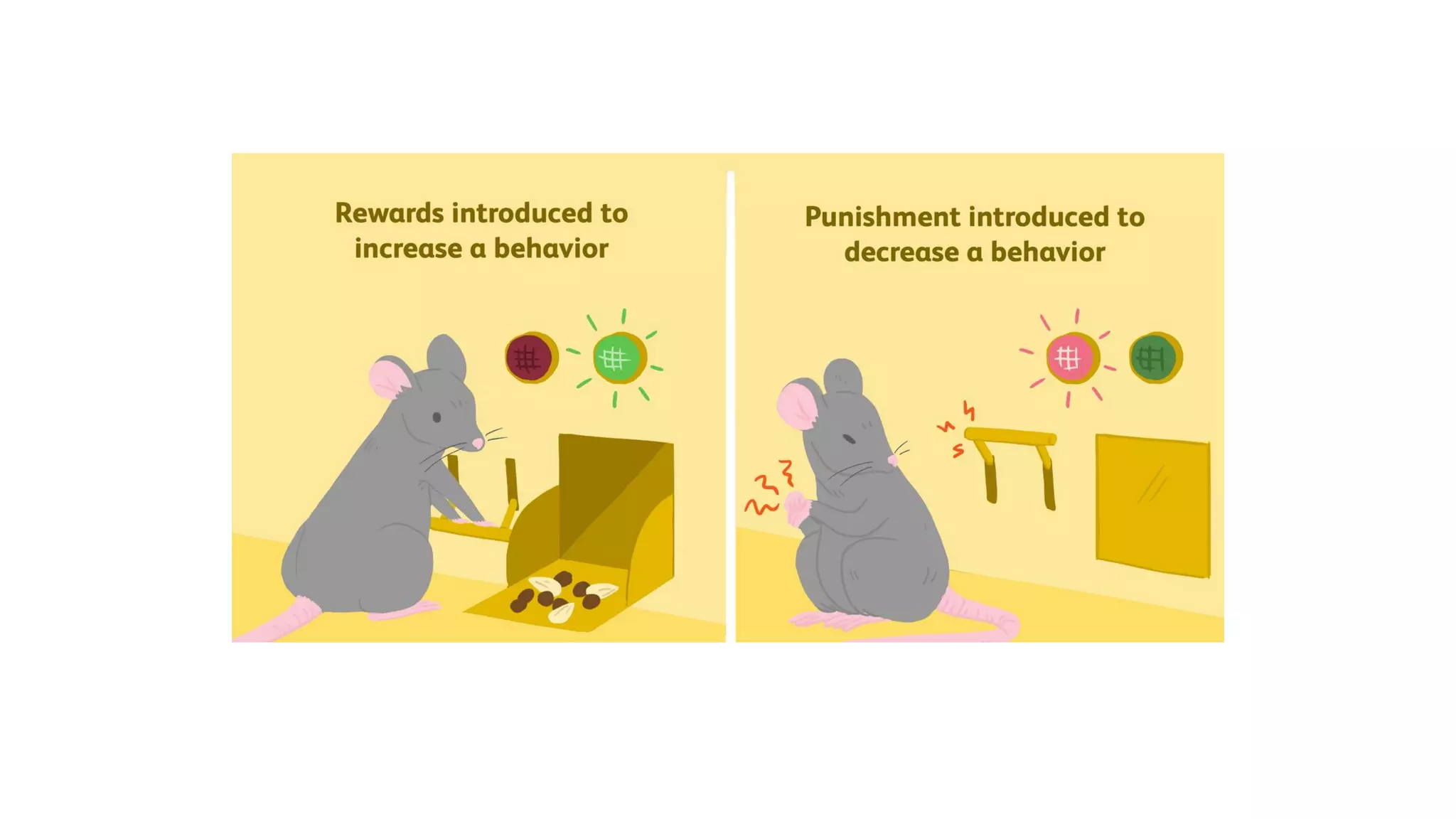
Operant Conditioning
• Also called as instrumental conditioning.
• Associates a specific behavior with a reinforcement
event.
• 2 types – Reward conditioning and Aversive
Conditioning
saran.adhoc@gmail.com
DEPT. OF PHYSIOLOGY, GMCM
NEXT CLASS!
LEARNING
&MEMORY-2
DEPT. OF PHYSIOLOGY, GMCM
DR. SARAN AJAY
Specific Learning Objectives
• Memory and its types
• Implicit Memory
• Explicit Memory
• Neurological Basis of Memory
• Disorders of memory
Memory is the storage of acquired information for later
recall.
Learning and memory form the basis by which individuals
adapt their behavior to their particular external circumstances.
The neural change responsible for retention or storage
of knowledge is known as the memory trace.
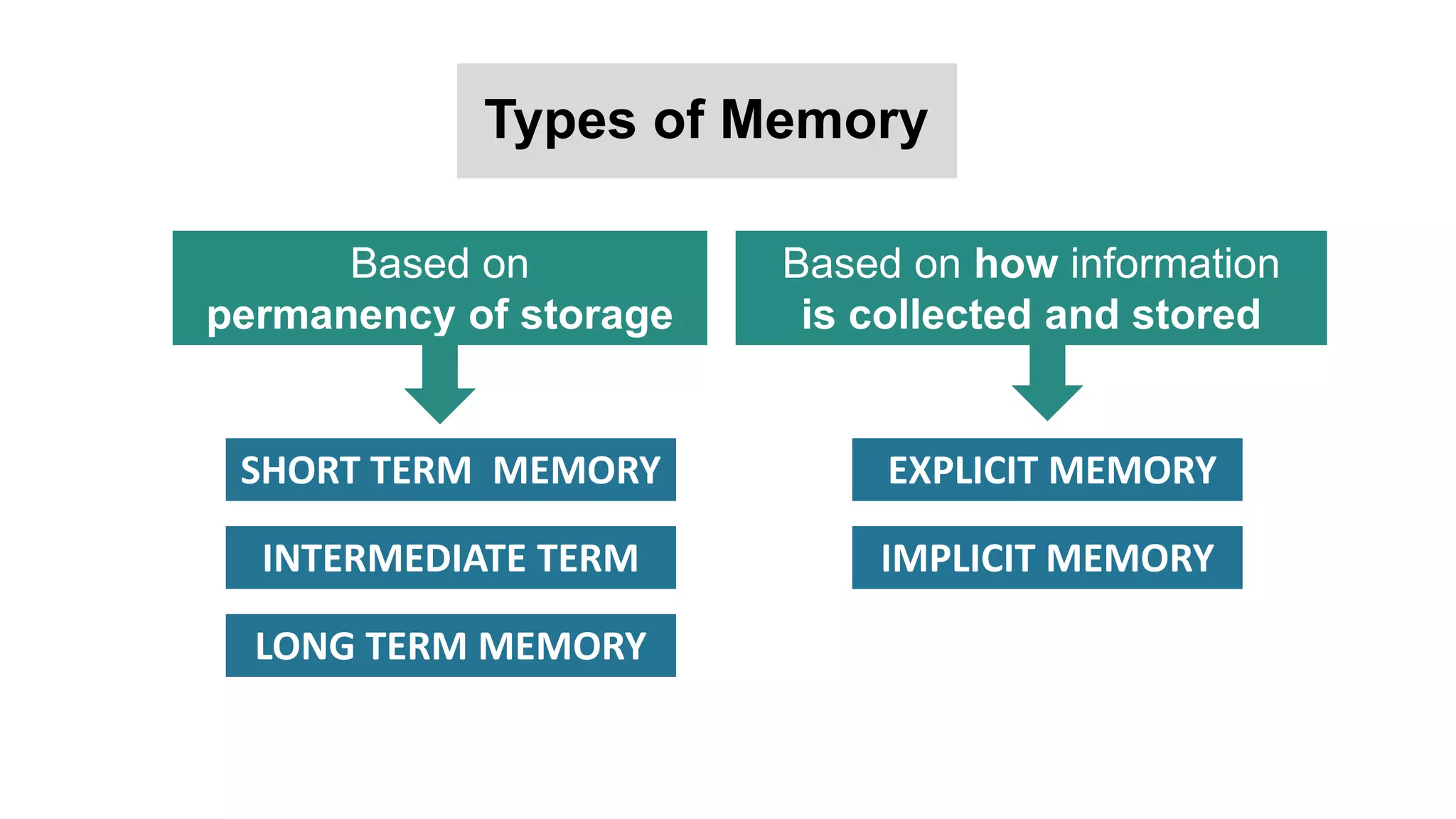
Types of Memory
Based on
permanency of storage
Based on how information
is collected and stored
EXPLICIT MEMORY
IMPLICIT MEMORY
SHORT TERM MEMORY
INTERMEDIATE TERM
LONG TERM MEMORY
Short Term Memory
• Last seconds to hours unless they are converted into
long term memory.
• Mechanisms : Synaptic facilitation/ inhibition
Working Memory
• A form of short memory
• Information is made available for a very short period
during which the individual plans action based on it.
Intermediate Term Memory
• Lasts from days to weeks, but eventually lost.
• Chemical or physical changes or both in presynaptic
and post synaptic membrane.
Long Term Memory
• Can be recalled for a long time – entire lifetime.
• Chemical and structural changes happening at the
level of synapse.
Specific Learning Objectives
• Memory and its types
• Implicit Memory
• Explicit Memory
• Neurological Basis of Memory
• Disorders of memory
Implicit Memory
• Non declarative/ Reflexive memory
• Does not involve awareness.
• Automatic and unconscious.
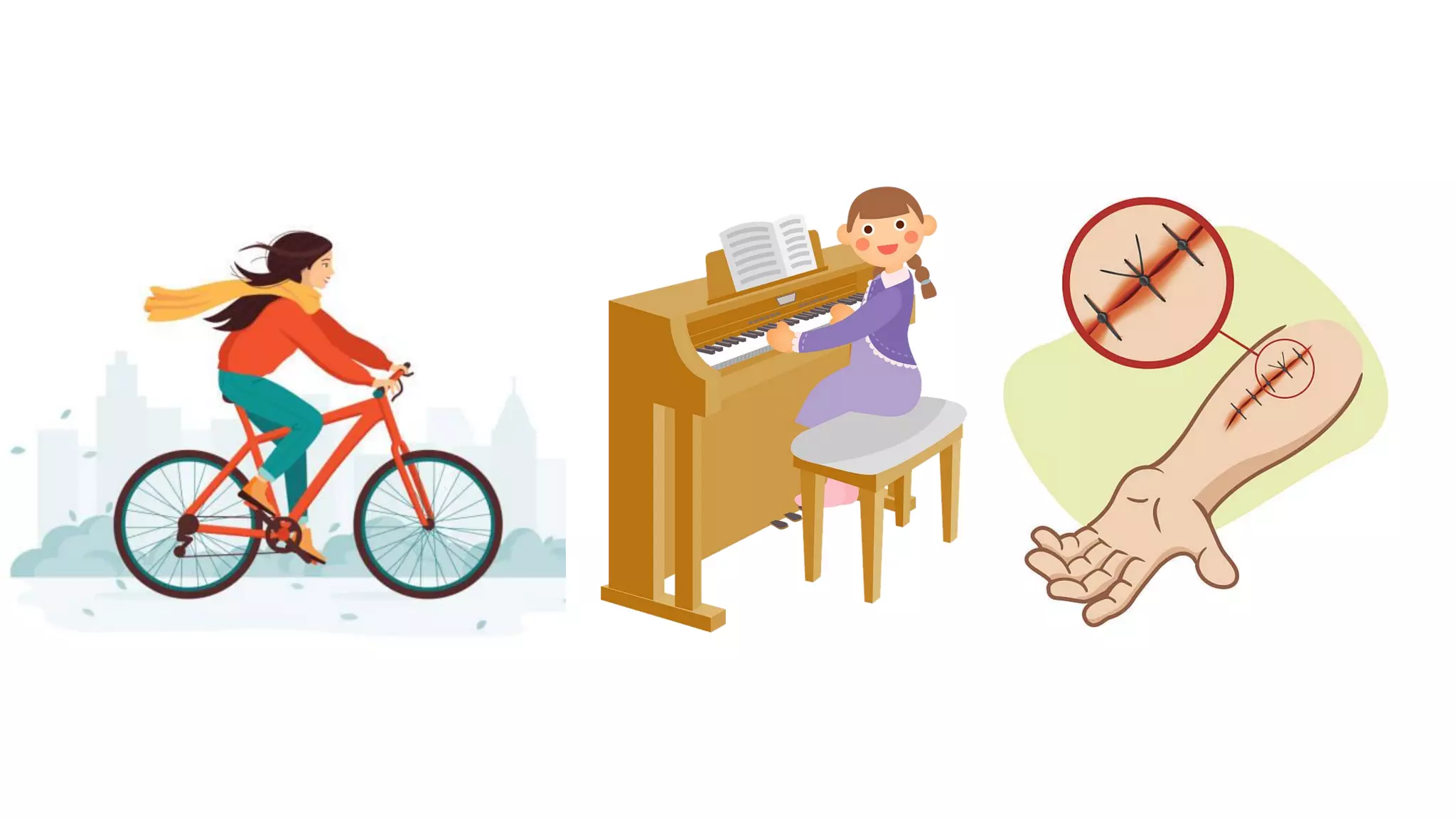
• Does not require hippocampus for processing
• e.g. Motor skills, habits, behavioral reflexes and learning
of certain type of procedures.
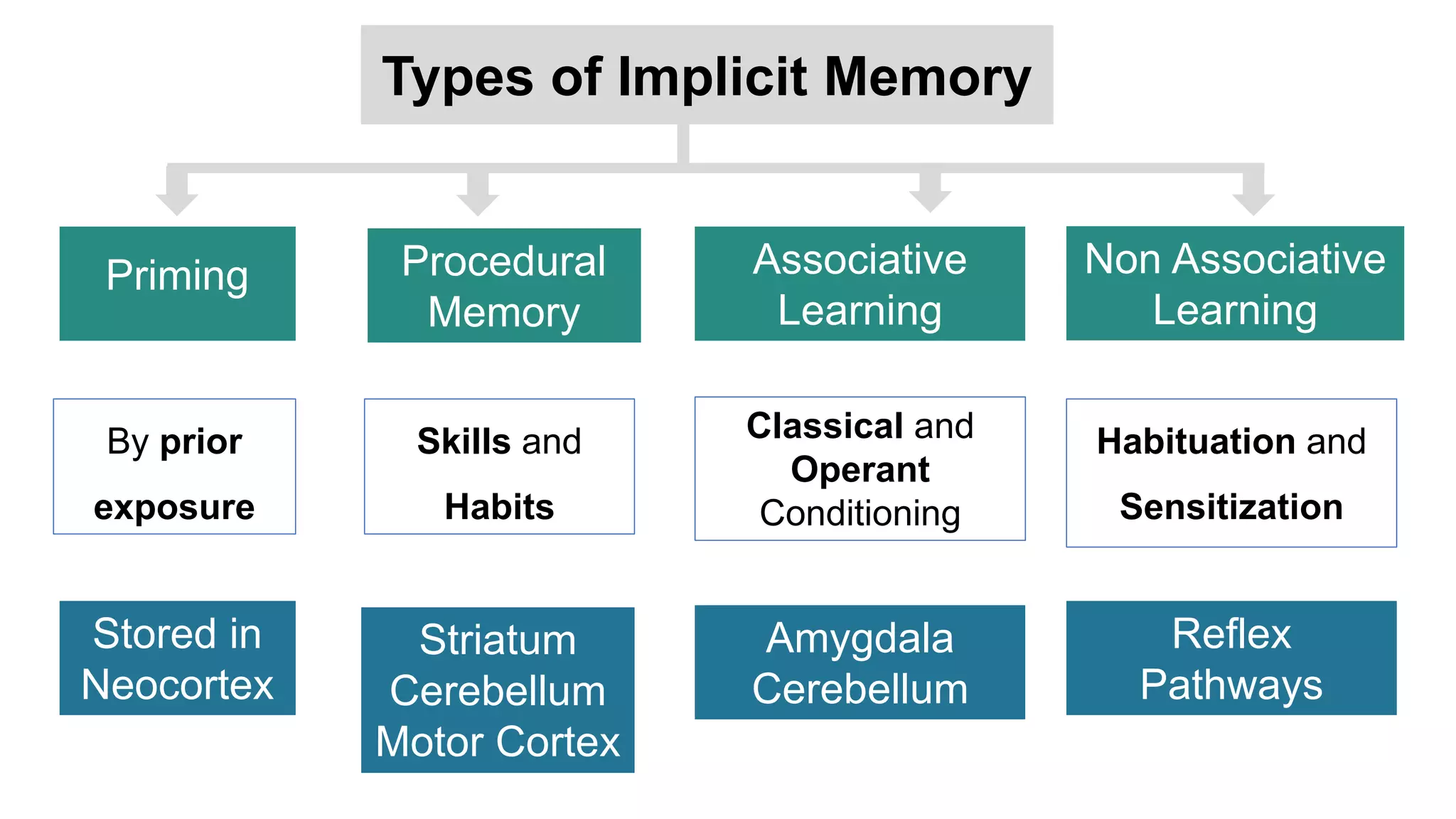
Types of Implicit Memory
Priming Procedural
Memory
Associative
Learning
Non Associative
Learning
Stored in
Neocortex
Striatum
Cerebellum
Motor Cortex
Classical and
Operant
Conditioning
Habituation and
Sensitization
Amygdala
Cerebellum
Reflex
Pathways
Skills and
Habits
By prior
exposure
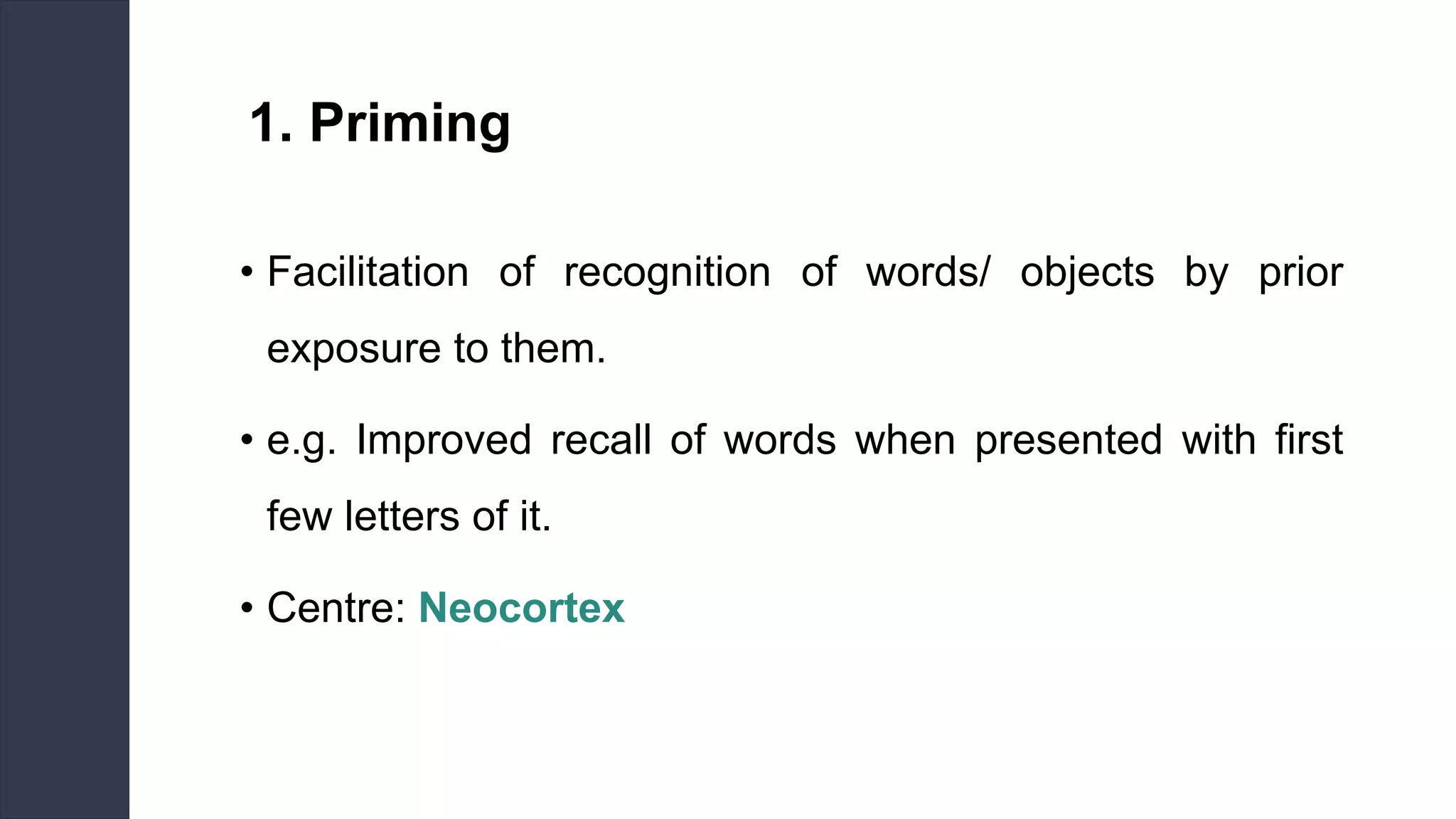
1. Priming
• Facilitation of recognition of words/ objects by prior
exposure to them.
• e.g. Improved recall of words when presented with first
few letters of it.
• Centre: Neocortex
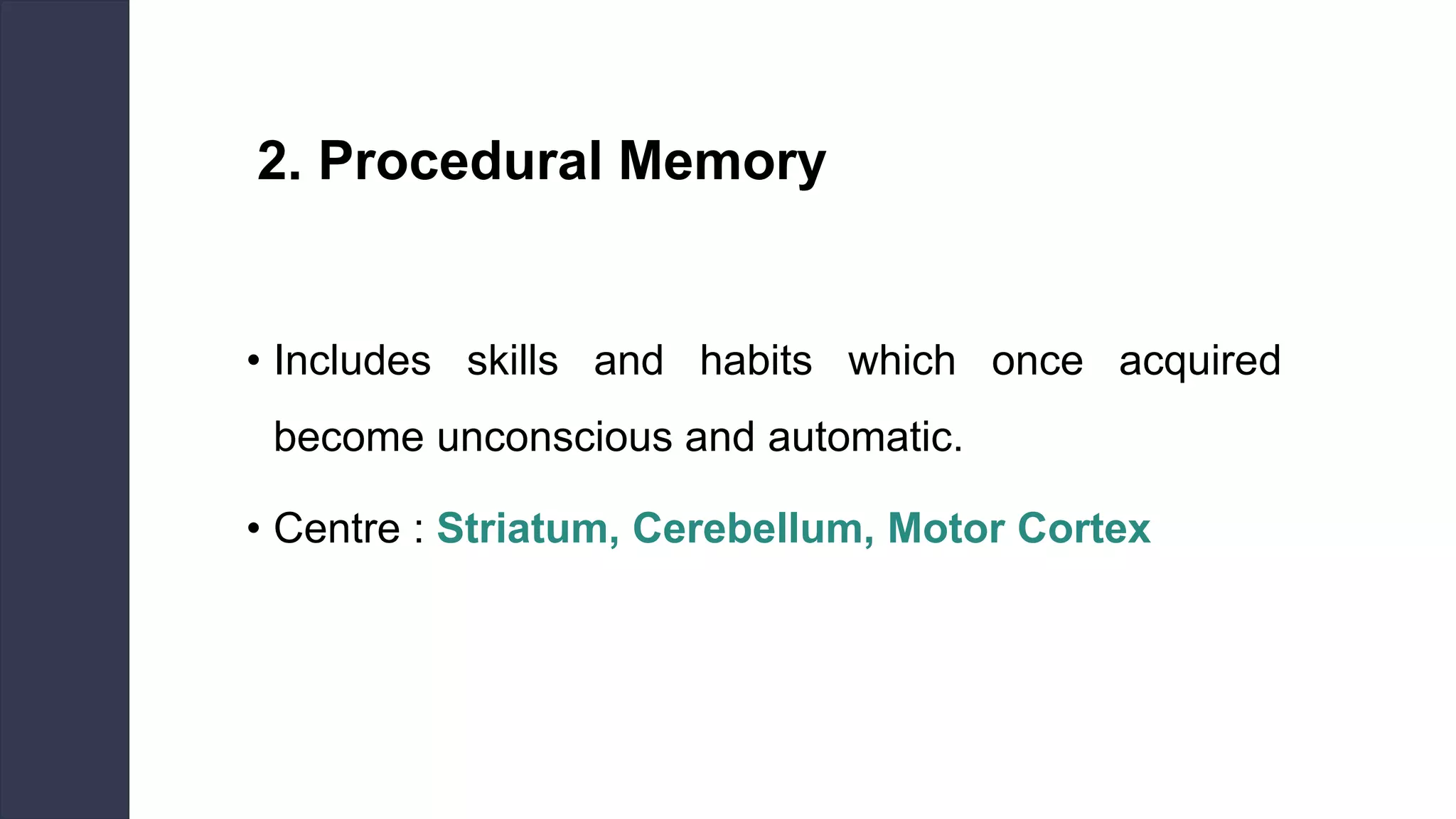
2. Procedural Memory
• Includes skills and habits which once acquired
become unconscious and automatic.
• Centre : Striatum, Cerebellum, Motor Cortex
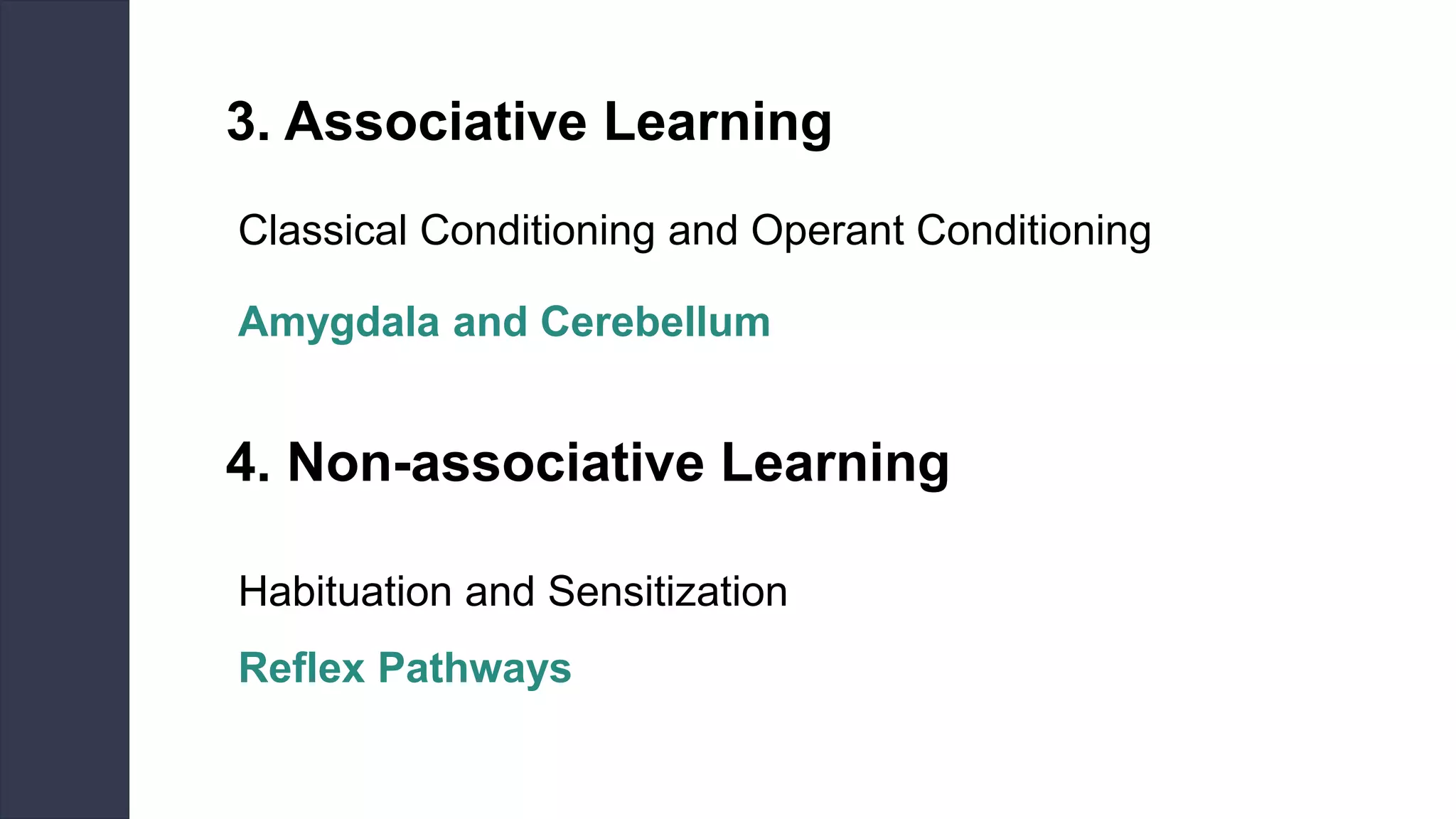
3. Associative Learning
Classical Conditioning and Operant Conditioning
Amygdala and Cerebellum
4. Non-associative Learning
Habituation and Sensitization
Reflex Pathways
Specific Learning Objectives
• Memory and its types
• Implicit Memory
• Explicit Memory
• Neurological Basis of Memory
• Disorders of memory
Explicit Memory
• Declarative/ Recognition memory
• Associated with consciousness/ at least awareness
• Factual knowledge of people, places and things and
what these facts mean
Dependent on hippocampus, medial temporal lobe and
neocortex.
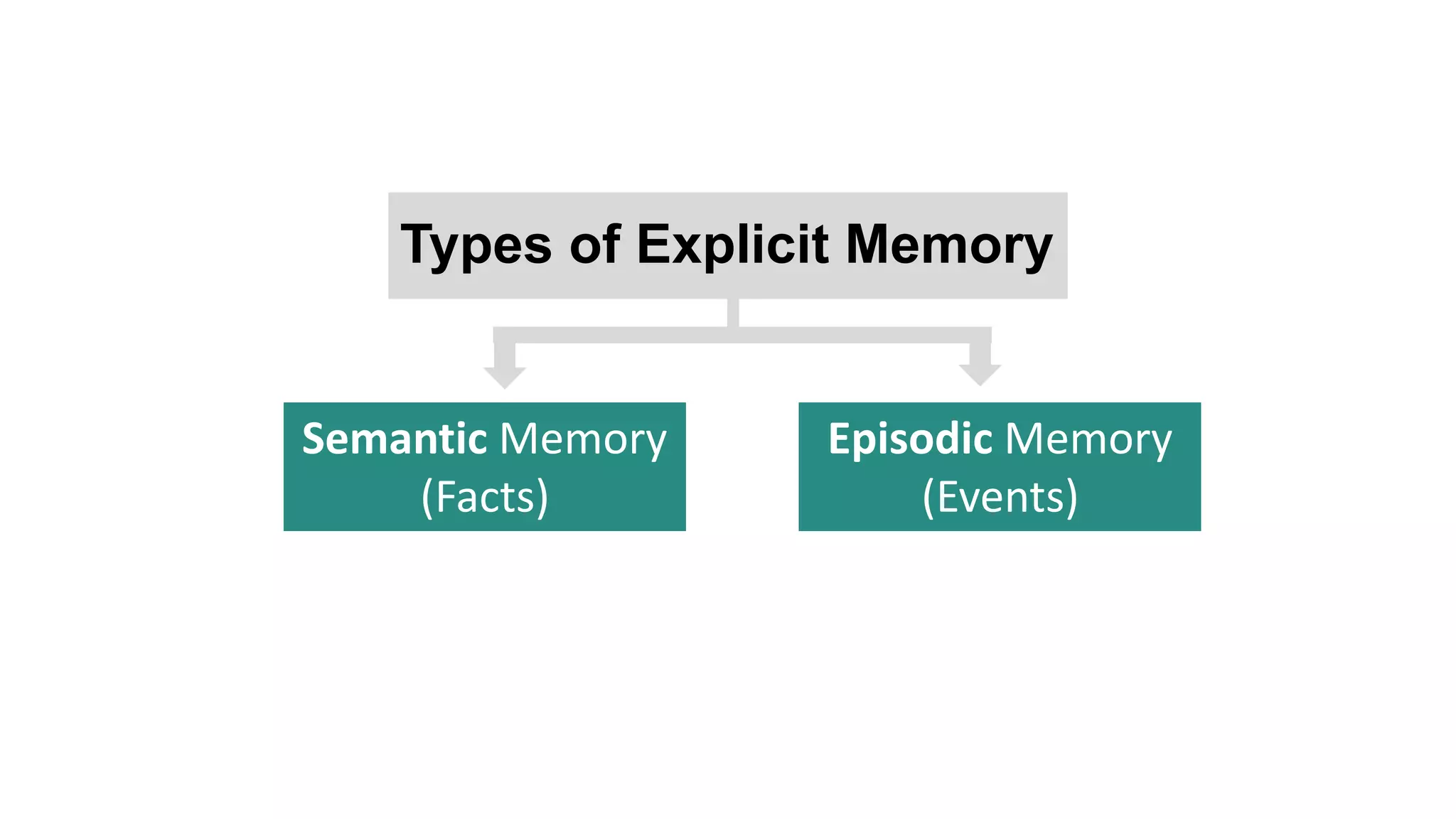
Types of Explicit Memory
Semantic Memory
(Facts)
Episodic Memory
(Events)
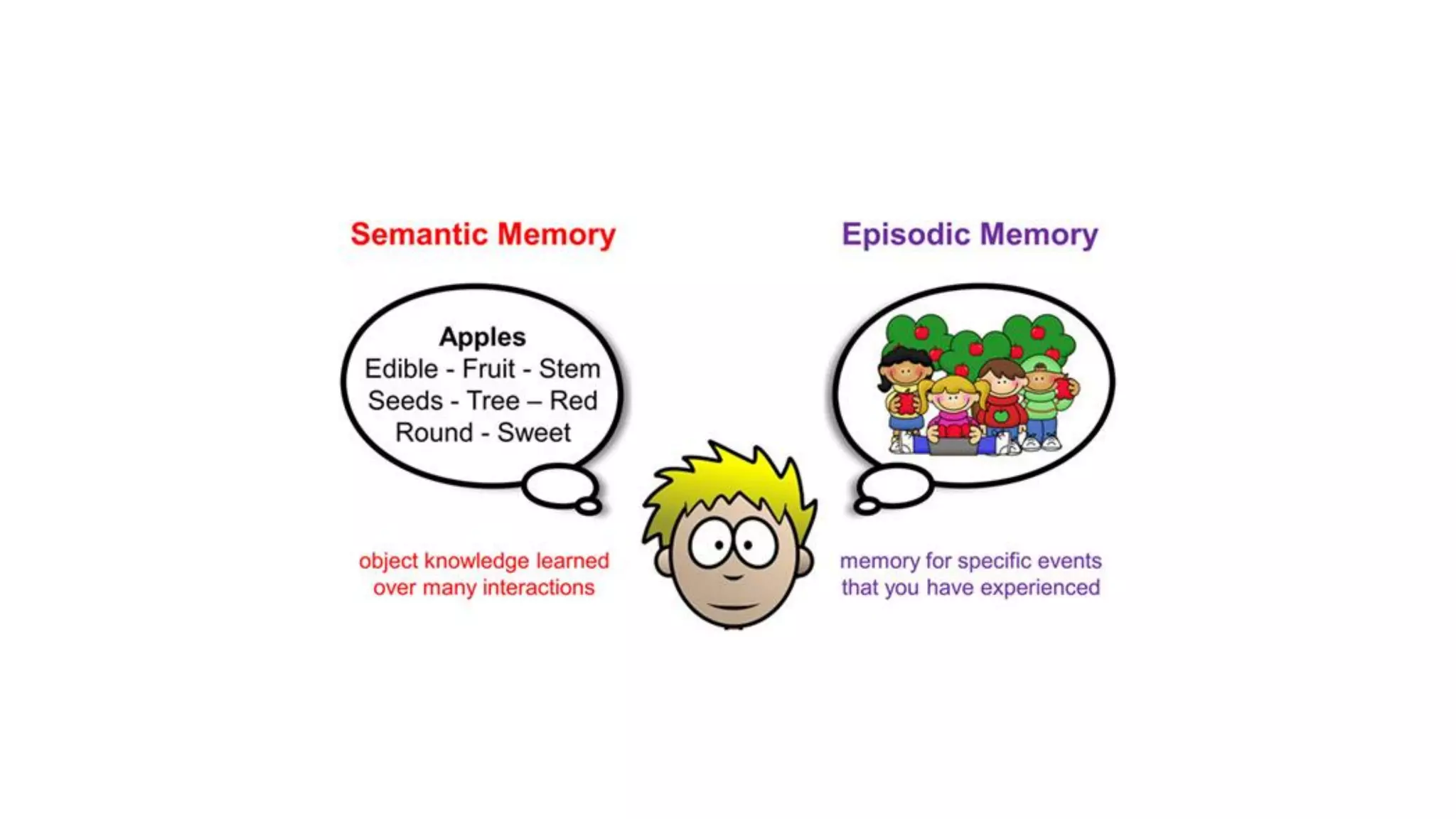
Semantic Memory
• Memory for facts (words, rules, language)
• Stored in different areas in neocortex
• Recall is built up from distinct bits of information
Episodic Memory
• Refers to memory of events and personal experiences
• Stored in association areas of prefrontal cortices
• Helps us to remember when and where a past event
occurred, source information
Specific Learning Objectives
• Memory and its types
• Implicit Memory
• Explicit Memory
• Neurological Basis of Memory
• Disorders of memory
Mechanism of Explicit Memory
Memory is a result of four processes
1. Encoding
2. Consolidation
3. Storage
4. Timely retrieval
1. Encoding
• Process in which newly learned information is
attended, processed and transferred into a stored
mental representation.
• Depends on the hippocampus and the medial
temporal lobe.
• Continuous neural activity in reverberating circuit is
essential for short term memory.
• Key to Memory : Alteration in strength of selected
synaptic connections
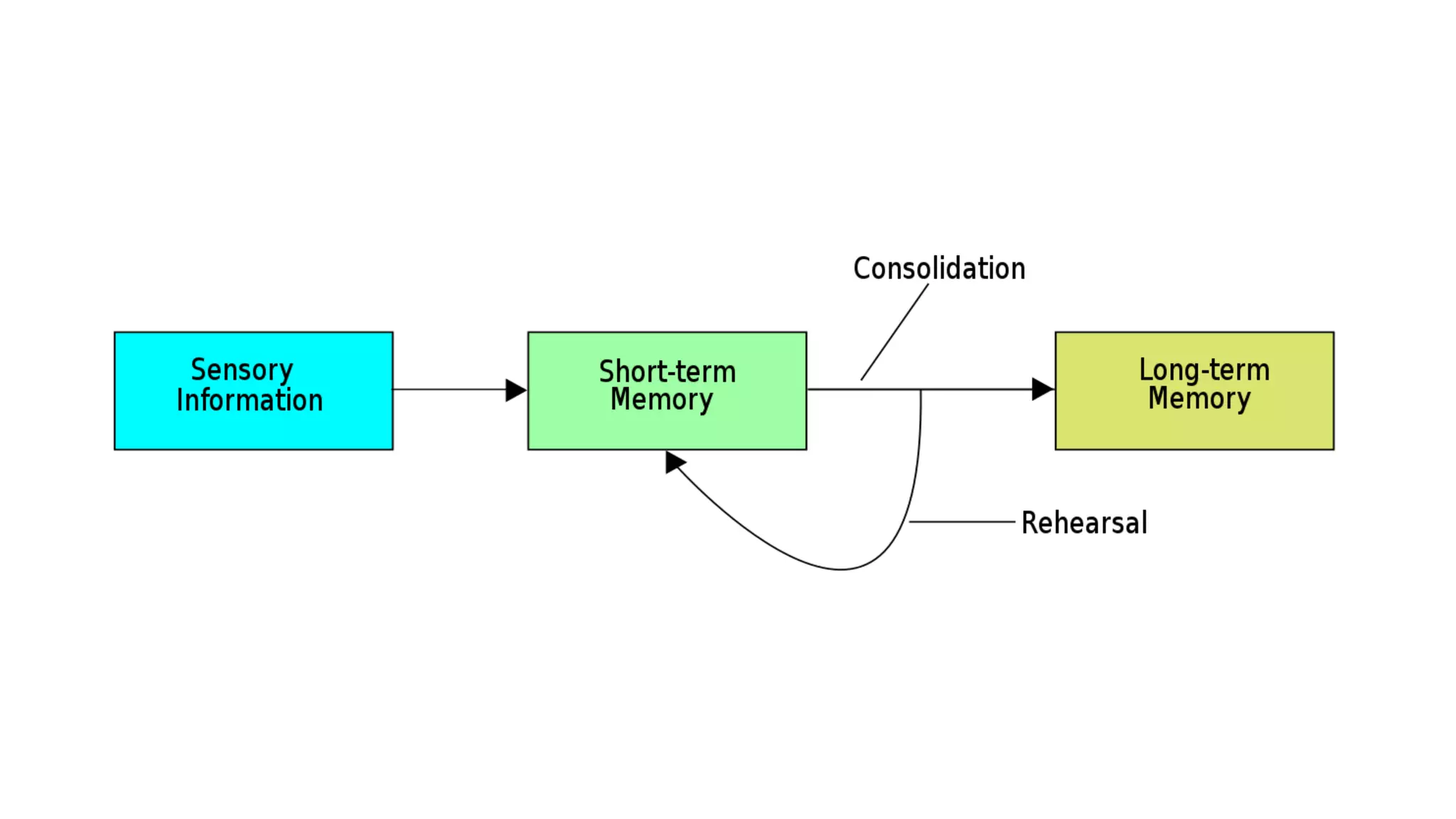
2. Consolidation
• Process by which transient short-term memory is
converted to stable long-term memory
• By mechanisms of rehearsal.
Changes occurring are
• Increase in synaptic vesicles
• Increase in NT release sites
• Increase in size and number of synapses
• Increase in dendrites and dendritic spines
• Increase in conductivity of dendrites
Synaptic Plasticity
• Ability to easily mould/ modify/ change the
effectiveness of chemical synapse
• Strengthening/ weakening of synaptic conduction
• Both for long/ short periods
• Habituation
• Sensitization
• Post tetanic Potentiation
• Long Term Potentiation
• Long Term Depression
Post Tetanic Potentiation
• Enhanced post synaptic potential in response to
stimulation.
• Occurs after brief train of stimuli in the pre-
synaptic neuron
• Enhancement lasts for 60s.
Long Term Potentiation
• Rapidly developing persistent enhancement of post
synaptic potential in response to pre-synaptic
stimulation.
• After a brief period of rapidly repeated stimulation of
presynaptic neuron.
• Prolonged and lasts for days
• Initiated by increase in intracellular Ca in post synaptic
neuron
• Critical for consolidation of memory. (Schaffer’s
Collateral)
• Occurs mainly in hippocampus.
Long Term Depression
• Opposite of LTP.
• Decreased synaptic strength.
• Slower stimulation of presynaptic neuron.
• Smaller rise in intracellular Ca.
3. Storage
• Refers to the mechanism and sites by which
memory is retained over time.
• Long term storage is of unlimited capacity but short-
term working memory is limited.
• Semantic distributed in various association cortices
• Episodic in prefrontal cortex.
4. Retrieval
• Recall and use of stored memory
• A constructive process
• Most effect when it occurs in the same context in which
in the information was acquired.
Specific Learning Objectives
• Memory and its types
• Implicit Memory
• Explicit Memory
• Neurological Basis of Memory
• Disorders of memory
Amnesia
• Refers to loss of memory
• Seen in head injury, degenerative diseases of brain,
chronic alcoholism.
• Two types : Anterograde and Retrograde Amnesia
Anterograde Amnesia
• Inability of an individual to establish new long-term
memories of those types of information that form basis
of intelligence
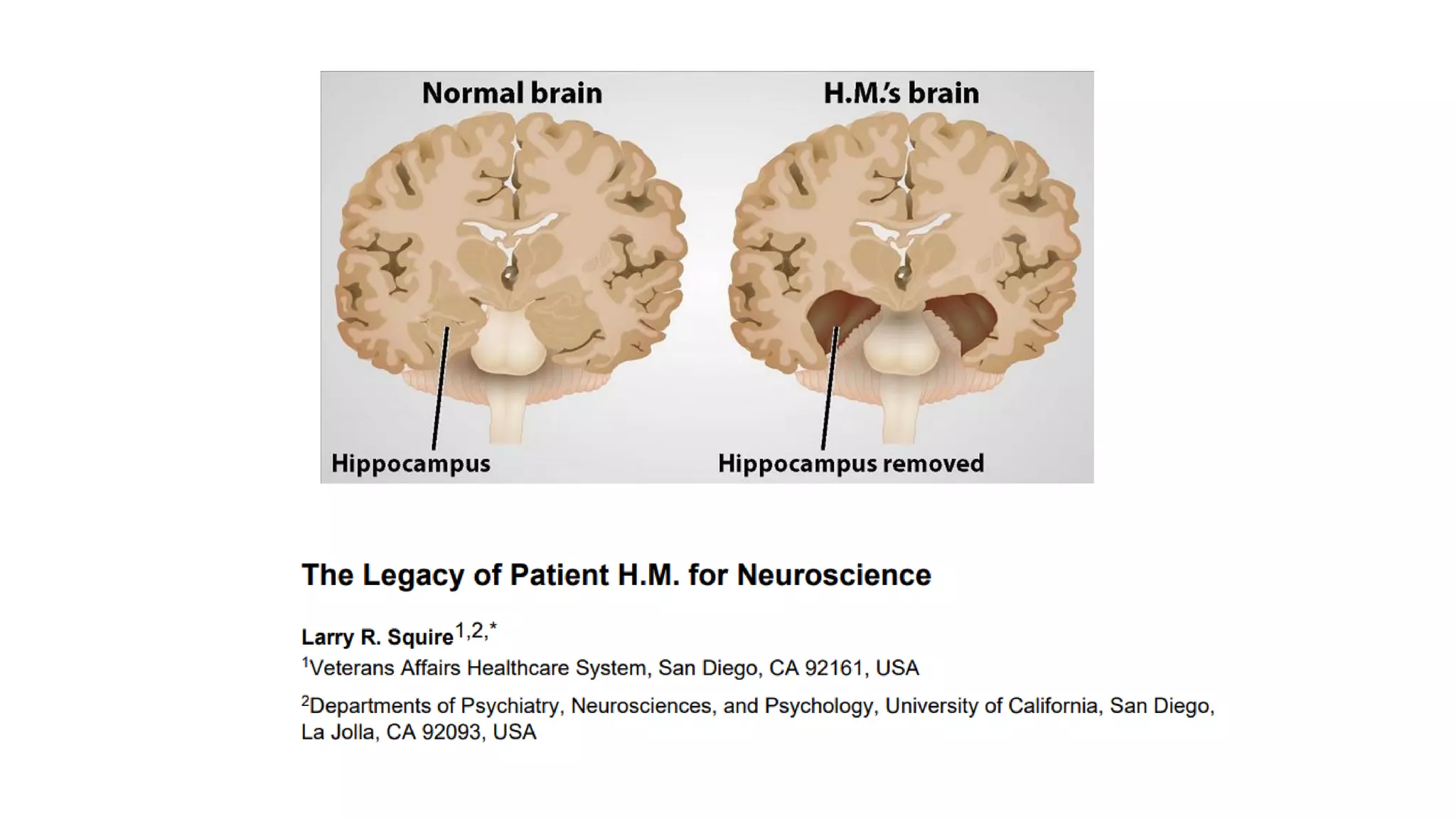
• Lesion: Hippocampus
Retrograde Amnesia
• Inability of an individual to recall past memories
• Amnesia much greater for events of recent past than
for remote past
• Loss of memories immediately preceding brain
concussion/ ECT
• Lesion: Temporal lobe
Dementia
Loss of memory along with
• Loss of intellectual functions
• Behavioral abnormalities
• Personality changes
Alzheimer’s Disease
• Age related neurodegenerative disorder
• Most common cause of senile dementia
• Incidence increases with age
Pathological Changes
• Neuronal degeneration occur
• Progressive loss of episodic and short-term memory,
cognitive and other brain functions
• Agitation
• Depression
Cytohistological hallmarks
1. Intracellular neurofibrillary tangles – hyper
phosphorylated forms of Tau protein
2. Extracellular amyloid plaques core of β amyloid
peptide surrounded by altered nerve fibers and
reactive glial cells
saran.adhoc@gmail.com
DEPT. OF PHYSIOLOGY, GMCM

Learning and Memory

  • 1.
  • 2.
    Specific Learning Objectives •Defintion • Types of Learning
  • 3.
    Learning is theprocess of acquisition of new information, which along with experience is used to alter the individual’s behavior. Memory is the storage of learned information for later recall.
  • 4.
    Learning and memoryform the basis by which individuals adapt their behavior to their particular external circumstances.
  • 5.
    Specific Learning Objectives •Defintion • Types of Learning
  • 6.
    INCIDENTAL LEARNING REFLEXLEARNING ASSOCIATIVE NON-ASSOCIATIVE HABITUATION SENSITISATION CLASSICAL CONDITIONING OPERANT CONDITIONING LEARNING PATTERNS CLASSES FORMS
  • 7.
    1. Incidental Learning •Learning while attending incidentally to a sensory input. • No apparent immediate behavioral change.
  • 8.
    2. Reflex Learning •Learning is associated with behavioral change. • 2 Classes • Non-Associative Learning • Associative Learning
  • 9.
    A. Non-Associative Learning •Learns about the property of a single stimulus. • Occurs when the animal/subject is repeatedly exposed to a single type of stimulus. • 2 forms – Habituation and Sensitization
  • 10.
    Habituation Refers to thedecrease in response to a benign/neutral stimuli, when it is presented repeatedly.
  • 11.
    • 1st timeapplication of a stimulus – Orientation Reflex or ‘What is it?’ response. • Due to habituation, on repeated application of such stimuli – subsequent decreases in response. • Finally, the subject/ animal ignores the stimuli.
  • 13.
    Cellular Mechanisms ofHabituation • Studied in Aplysia • Seminal work by Eric R Kandel • Nobel Prize in Physiology and Medicine 2000 for elucidating the cellular mechanisms of underlying memory.
  • 15.
    Eric R. KandelNobel Prize in Physiology and Medicine 2000 DEPT. OF PHYSIOLOGY, GMCM 21
  • 17.
    Sensitization The prolonged occurrenceof augmented post synaptic responses after a stimulus to which one has become habituated is paired with a noxious stimulus. Opposite of Habituation
  • 21.
    Associative Learning • Subjectlearns the relation between two stimuli or between a stimuli and a behavior. • 2 forms – Classical Conditioning and Operant Conditioning
  • 22.
    Classical Conditioning • Learningthe relationship between two stimuli • Also called as Pavlovian Conditioning
  • 23.
    Ivan Pavlov Nobel Prizein Physiology and Medicine 1904 DEPT. OF PHYSIOLOGY, GMCM 31
  • 25.
    It is areflex response to a stimuli that previously elicited little or no response, acquired by repeatedly pairing the stimulus with another stimulus that normally produces the response.
  • 26.
    Operant Conditioning • Alsocalled as instrumental conditioning. • Associates a specific behavior with a reinforcement event. • 2 types – Reward conditioning and Aversive Conditioning
  • 28.
  • 29.
  • 32.
    Specific Learning Objectives •Memory and its types • Implicit Memory • Explicit Memory • Neurological Basis of Memory • Disorders of memory
  • 33.
    Memory is thestorage of acquired information for later recall.
  • 34.
    Learning and memoryform the basis by which individuals adapt their behavior to their particular external circumstances.
  • 35.
    The neural changeresponsible for retention or storage of knowledge is known as the memory trace.
  • 36.
    Types of Memory Basedon permanency of storage Based on how information is collected and stored EXPLICIT MEMORY IMPLICIT MEMORY SHORT TERM MEMORY INTERMEDIATE TERM LONG TERM MEMORY
  • 37.
    Short Term Memory •Last seconds to hours unless they are converted into long term memory. • Mechanisms : Synaptic facilitation/ inhibition
  • 38.
    Working Memory • Aform of short memory • Information is made available for a very short period during which the individual plans action based on it.
  • 39.
    Intermediate Term Memory •Lasts from days to weeks, but eventually lost. • Chemical or physical changes or both in presynaptic and post synaptic membrane.
  • 40.
    Long Term Memory •Can be recalled for a long time – entire lifetime. • Chemical and structural changes happening at the level of synapse.
  • 42.
    Specific Learning Objectives •Memory and its types • Implicit Memory • Explicit Memory • Neurological Basis of Memory • Disorders of memory
  • 43.
    Implicit Memory • Nondeclarative/ Reflexive memory • Does not involve awareness. • Automatic and unconscious.
  • 45.
    • Does notrequire hippocampus for processing • e.g. Motor skills, habits, behavioral reflexes and learning of certain type of procedures.
  • 46.
    Types of ImplicitMemory Priming Procedural Memory Associative Learning Non Associative Learning Stored in Neocortex Striatum Cerebellum Motor Cortex Classical and Operant Conditioning Habituation and Sensitization Amygdala Cerebellum Reflex Pathways Skills and Habits By prior exposure
  • 47.
    1. Priming • Facilitationof recognition of words/ objects by prior exposure to them. • e.g. Improved recall of words when presented with first few letters of it. • Centre: Neocortex
  • 48.
    2. Procedural Memory •Includes skills and habits which once acquired become unconscious and automatic. • Centre : Striatum, Cerebellum, Motor Cortex
  • 49.
    3. Associative Learning ClassicalConditioning and Operant Conditioning Amygdala and Cerebellum 4. Non-associative Learning Habituation and Sensitization Reflex Pathways
  • 50.
    Specific Learning Objectives •Memory and its types • Implicit Memory • Explicit Memory • Neurological Basis of Memory • Disorders of memory
  • 51.
    Explicit Memory • Declarative/Recognition memory • Associated with consciousness/ at least awareness • Factual knowledge of people, places and things and what these facts mean
  • 52.
    Dependent on hippocampus,medial temporal lobe and neocortex.
  • 53.
    Types of ExplicitMemory Semantic Memory (Facts) Episodic Memory (Events)
  • 55.
    Semantic Memory • Memoryfor facts (words, rules, language) • Stored in different areas in neocortex • Recall is built up from distinct bits of information
  • 56.
    Episodic Memory • Refersto memory of events and personal experiences • Stored in association areas of prefrontal cortices • Helps us to remember when and where a past event occurred, source information
  • 57.
    Specific Learning Objectives •Memory and its types • Implicit Memory • Explicit Memory • Neurological Basis of Memory • Disorders of memory
  • 58.
    Mechanism of ExplicitMemory Memory is a result of four processes 1. Encoding 2. Consolidation 3. Storage 4. Timely retrieval
  • 59.
    1. Encoding • Processin which newly learned information is attended, processed and transferred into a stored mental representation. • Depends on the hippocampus and the medial temporal lobe.
  • 60.
    • Continuous neuralactivity in reverberating circuit is essential for short term memory. • Key to Memory : Alteration in strength of selected synaptic connections
  • 61.
    2. Consolidation • Processby which transient short-term memory is converted to stable long-term memory • By mechanisms of rehearsal.
  • 62.
    Changes occurring are •Increase in synaptic vesicles • Increase in NT release sites • Increase in size and number of synapses • Increase in dendrites and dendritic spines • Increase in conductivity of dendrites
  • 63.
    Synaptic Plasticity • Abilityto easily mould/ modify/ change the effectiveness of chemical synapse • Strengthening/ weakening of synaptic conduction • Both for long/ short periods
  • 64.
    • Habituation • Sensitization •Post tetanic Potentiation • Long Term Potentiation • Long Term Depression
  • 65.
    Post Tetanic Potentiation •Enhanced post synaptic potential in response to stimulation. • Occurs after brief train of stimuli in the pre- synaptic neuron • Enhancement lasts for 60s.
  • 66.
    Long Term Potentiation •Rapidly developing persistent enhancement of post synaptic potential in response to pre-synaptic stimulation. • After a brief period of rapidly repeated stimulation of presynaptic neuron. • Prolonged and lasts for days
  • 67.
    • Initiated byincrease in intracellular Ca in post synaptic neuron • Critical for consolidation of memory. (Schaffer’s Collateral) • Occurs mainly in hippocampus.
  • 68.
    Long Term Depression •Opposite of LTP. • Decreased synaptic strength. • Slower stimulation of presynaptic neuron. • Smaller rise in intracellular Ca.
  • 69.
    3. Storage • Refersto the mechanism and sites by which memory is retained over time. • Long term storage is of unlimited capacity but short- term working memory is limited.
  • 70.
    • Semantic distributedin various association cortices • Episodic in prefrontal cortex.
  • 71.
    4. Retrieval • Recalland use of stored memory • A constructive process • Most effect when it occurs in the same context in which in the information was acquired.
  • 72.
    Specific Learning Objectives •Memory and its types • Implicit Memory • Explicit Memory • Neurological Basis of Memory • Disorders of memory
  • 73.
    Amnesia • Refers toloss of memory • Seen in head injury, degenerative diseases of brain, chronic alcoholism. • Two types : Anterograde and Retrograde Amnesia
  • 74.
    Anterograde Amnesia • Inabilityof an individual to establish new long-term memories of those types of information that form basis of intelligence • Lesion: Hippocampus
  • 75.
    Retrograde Amnesia • Inabilityof an individual to recall past memories • Amnesia much greater for events of recent past than for remote past • Loss of memories immediately preceding brain concussion/ ECT • Lesion: Temporal lobe
  • 76.
    Dementia Loss of memoryalong with • Loss of intellectual functions • Behavioral abnormalities • Personality changes
  • 77.
    Alzheimer’s Disease • Agerelated neurodegenerative disorder • Most common cause of senile dementia • Incidence increases with age
  • 78.
    Pathological Changes • Neuronaldegeneration occur • Progressive loss of episodic and short-term memory, cognitive and other brain functions • Agitation • Depression
  • 79.
    Cytohistological hallmarks 1. Intracellularneurofibrillary tangles – hyper phosphorylated forms of Tau protein 2. Extracellular amyloid plaques core of β amyloid peptide surrounded by altered nerve fibers and reactive glial cells
  • 81.