M.KARTHIKEYAN
ASSISTANT PROFESSOR
DEPARTMENT OF MECHANICAL ENGINEERING
AAA COLLEGE OF ENGINEERING & TECHNOLOGY, SIVAKASI
karthikeyan@aaacet.ac.in
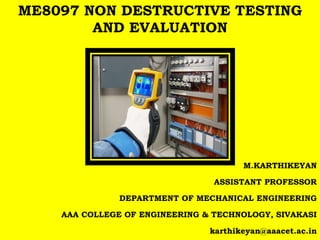
ME8097 NON DESTRUCTIVE TESTING
AND EVALUATION
UNIT III THERMOGRAPHY AND EDDY CURRENT TESTING
(ET)
1. Thermography- Principles,
2. Contact and non contact inspection methods,
3. Techniques for applying liquid crystals, Advantages and
limitation
4. Infrared radiation and infrared detectors, Instrumentations and
methods, applications.
5. Eddy Current Testing-Generation of eddy currents, Properties
of eddy currents,
6. Eddy current sensing elements, Probes,
7. Instrumentation,
8. Types of arrangement,
9. Applications, advantages, Limitations,
Interpretation/Evaluation.
THERMOGRAPHY TESTING
INTRODUCTION:
 Thermography is a non-contact, non-destructive testing method.
 Used in the aerospace, defense and general engineering
industries to detect flaws in a variety of structures.
 Thermographic inspection can be used over a large area.
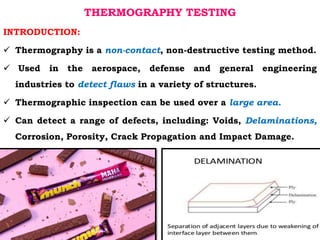
 Can detect a range of defects, including: Voids, Delaminations,
Corrosion, Porosity, Crack Propagation and Impact Damage.
TYPE 1
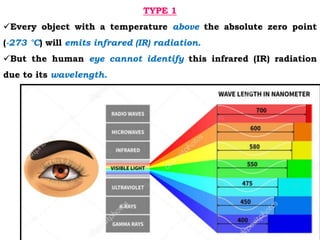
Every object with a temperature above the absolute zero point
(-273 °C) will emits infrared (IR) radiation.
But the human eye cannot identify this infrared (IR) radiation
due to its wavelength.
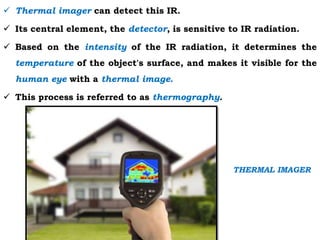
 Thermal imager can detect this IR.
 Its central element, the detector, is sensitive to IR radiation.
 Based on the intensity of the IR radiation, it determines the
temperature of the object's surface, and makes it visible for the
human eye with a thermal image.
 This process is referred to as thermography.
THERMAL IMAGER
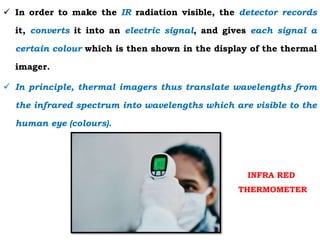
 In order to make the IR radiation visible, the detector records
it, converts it into an electric signal, and gives each signal a
certain colour which is then shown in the display of the thermal
imager.
 In principle, thermal imagers thus translate wavelengths from
the infrared spectrum into wavelengths which are visible to the
human eye (colours).
INFRA RED
THERMOMETER
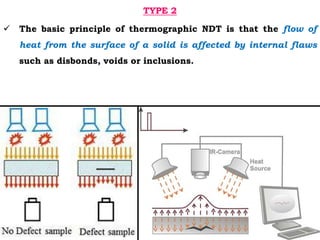
TYPE 2
 The basic principle of thermographic NDT is that the flow of
heat from the surface of a solid is affected by internal flaws
such as disbonds, voids or inclusions.
TYPES
1. PULSED OR FLASH THERMOGRAPHY TEST
2. LOCKIN – THERMOGRPAHY
3. BURST VIBRO THERMOGRAPHY
4. LOCK IN VIBRO RHERMOGRAPHY
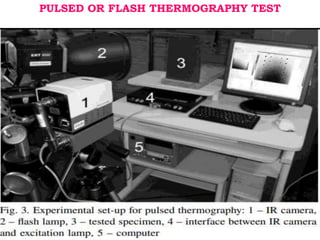
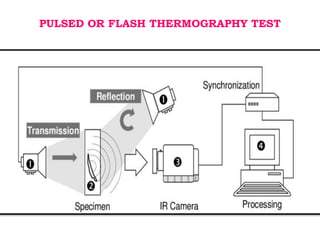
PULSED OR FLASH THERMOGRAPHY TEST
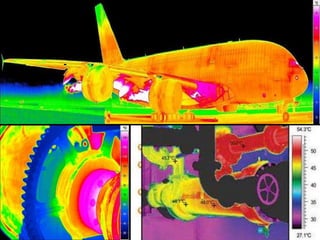
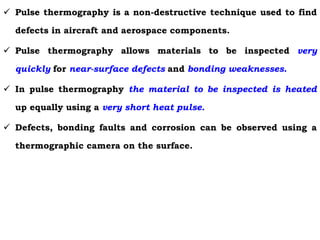
 Pulse thermography is a non-destructive technique used to find
defects in aircraft and aerospace components.
 Pulse thermography allows materials to be inspected very
quickly for near-surface defects and bonding weaknesses.
 In pulse thermography the material to be inspected is heated
up equally using a very short heat pulse.
 Defects, bonding faults and corrosion can be observed using a
thermographic camera on the surface.
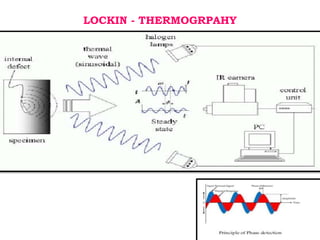
LOCKIN - THERMOGRPAHY
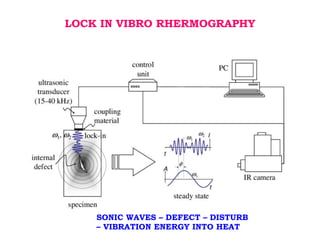
LOCK IN VIBRO RHERMOGRAPHY
SONIC WAVES – DEFECT – DISTURB
– VIBRATION ENERGY INTO HEAT
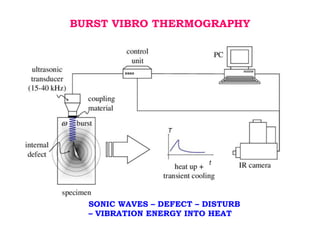
BURST VIBRO THERMOGRAPHY
SONIC WAVES – DEFECT – DISTURB
– VIBRATION ENERGY INTO HEAT
ADVANTAGES
 Large areas can be scanned fast.
 Thermography is an area investigating technique, whereas
most of the other non-destructive methods are either point or
line testing methods.
 This results in major savings in time, people, work and
machinery.
 Thermographic device is risk-free, as it does not emit any
radiation;
 It shows a visual picture so temperatures over a large area can
be compared
 It is capable of catching moving targets in real time.
 It is possible to predict the failure by observing the
temperature.
 It can be used to measure or observe in areas inaccessible or
hazardous for other methods.
 IR cameras are relatively easy to use.
 Large electrical cabinets and whole electrical installations can
be quickly scanned.
 The exact location of the potential problematic point can be
easily determined.
LIMITATIONS
 It is not possible to penetrate in extended depths (only a few
mm's).
 To interpret the results requires a certain experience and
knowledge.
 Quality cameras often have a high price range
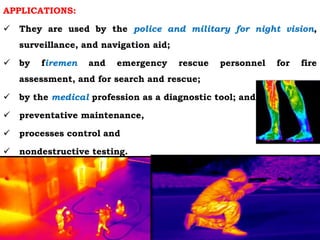
APPLICATIONS:
 They are used by the police and military for night vision,
surveillance, and navigation aid;
 by firemen and emergency rescue personnel for fire
assessment, and for search and rescue;
 by the medical profession as a diagnostic tool; and
 preventative maintenance,
 processes control and
 nondestructive testing.
 defects in composite
 It can be used to find defects in shafts, pipes, and other metal
or plastic parts.
 It can be used to detect objects in dark areas.
 It is capable of catching moving targets in real time.
 It is possible to predict the failure by observing the
temperature.
 It can be used to measure or observe in areas inaccessible or
hazardous for other methods.
 Used in the aerospace, defense and general engineering
industries to detect flaws in a variety of structures.
 Can detect a range of defects, including: Voids, Delaminations,
Corrosion, Porosity, Crack Propagation and Impact Damage.
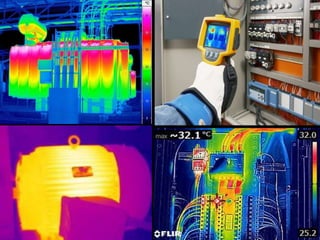
Typical problems in electrical installations that can be detected
with infrared thermography include:
 Connections that are loose, poorly installed, corroded etc.
 Unbalanced loads.
 Defective equipment.
 Undersized conductors.
 Overheated motors.
 Overloaded circuits.
 Potential fire hazards.
 Worn components.
 Thermal abnormalities in batteries.
Infrared Thermography is ..
1. a graphical representation of heat
2. an accurate measurement of temperature
3. a photographic representation of heat
MCQ - 1
Every object with a temperature above …….. will emits
infrared (IR) radiation.
1. 0°C
2. 300°C
3. 100°C
4. -273 °C
MCQ - 2
Wavelength of the is infrared (IR) radiation is
1. 550 nanometer
2. 580 nanometer
3. 600 nanometer
4. 450 nanometer
MCQ - 3
Ultrasonic waves are used in case of
1. LOCKIN – THERMOGRPAHY
2. PULSED OR FLASH THERMOGRAPHY
3. VIBRO THERMOGRAPHY
MCQ - 4
Infrared thermometer is superior to thermal imager
1. True
2. False
MCQ - 5
PART - A
1. Define thermography
2. What are the applications of thermography test?
PART - B
1. What are the methods available for checking in thermography?
Explain any one method
QUESTIONS

L20 thermography principles

  • 1.
    M.KARTHIKEYAN ASSISTANT PROFESSOR DEPARTMENT OFMECHANICAL ENGINEERING AAA COLLEGE OF ENGINEERING & TECHNOLOGY, SIVAKASI karthikeyan@aaacet.ac.in ME8097 NON DESTRUCTIVE TESTING AND EVALUATION
  • 2.
    UNIT III THERMOGRAPHYAND EDDY CURRENT TESTING (ET) 1. Thermography- Principles, 2. Contact and non contact inspection methods, 3. Techniques for applying liquid crystals, Advantages and limitation 4. Infrared radiation and infrared detectors, Instrumentations and methods, applications. 5. Eddy Current Testing-Generation of eddy currents, Properties of eddy currents, 6. Eddy current sensing elements, Probes, 7. Instrumentation, 8. Types of arrangement, 9. Applications, advantages, Limitations, Interpretation/Evaluation.
  • 3.
    THERMOGRAPHY TESTING INTRODUCTION:  Thermographyis a non-contact, non-destructive testing method.  Used in the aerospace, defense and general engineering industries to detect flaws in a variety of structures.  Thermographic inspection can be used over a large area.  Can detect a range of defects, including: Voids, Delaminations, Corrosion, Porosity, Crack Propagation and Impact Damage.
  • 4.
    TYPE 1 Every objectwith a temperature above the absolute zero point (-273 °C) will emits infrared (IR) radiation. But the human eye cannot identify this infrared (IR) radiation due to its wavelength.
  • 5.
     Thermal imagercan detect this IR.  Its central element, the detector, is sensitive to IR radiation.  Based on the intensity of the IR radiation, it determines the temperature of the object's surface, and makes it visible for the human eye with a thermal image.  This process is referred to as thermography. THERMAL IMAGER
  • 6.
     In orderto make the IR radiation visible, the detector records it, converts it into an electric signal, and gives each signal a certain colour which is then shown in the display of the thermal imager.  In principle, thermal imagers thus translate wavelengths from the infrared spectrum into wavelengths which are visible to the human eye (colours). INFRA RED THERMOMETER
  • 9.
    TYPE 2  Thebasic principle of thermographic NDT is that the flow of heat from the surface of a solid is affected by internal flaws such as disbonds, voids or inclusions.
  • 10.
    TYPES 1. PULSED ORFLASH THERMOGRAPHY TEST 2. LOCKIN – THERMOGRPAHY 3. BURST VIBRO THERMOGRAPHY 4. LOCK IN VIBRO RHERMOGRAPHY
  • 11.
    PULSED OR FLASHTHERMOGRAPHY TEST
  • 12.
    PULSED OR FLASHTHERMOGRAPHY TEST
  • 13.
     Pulse thermographyis a non-destructive technique used to find defects in aircraft and aerospace components.  Pulse thermography allows materials to be inspected very quickly for near-surface defects and bonding weaknesses.  In pulse thermography the material to be inspected is heated up equally using a very short heat pulse.  Defects, bonding faults and corrosion can be observed using a thermographic camera on the surface.
  • 14.
  • 15.
    LOCK IN VIBRORHERMOGRAPHY SONIC WAVES – DEFECT – DISTURB – VIBRATION ENERGY INTO HEAT
  • 16.
    BURST VIBRO THERMOGRAPHY SONICWAVES – DEFECT – DISTURB – VIBRATION ENERGY INTO HEAT
  • 17.
    ADVANTAGES  Large areascan be scanned fast.  Thermography is an area investigating technique, whereas most of the other non-destructive methods are either point or line testing methods.  This results in major savings in time, people, work and machinery.  Thermographic device is risk-free, as it does not emit any radiation;  It shows a visual picture so temperatures over a large area can be compared  It is capable of catching moving targets in real time.
  • 18.
     It ispossible to predict the failure by observing the temperature.  It can be used to measure or observe in areas inaccessible or hazardous for other methods.  IR cameras are relatively easy to use.  Large electrical cabinets and whole electrical installations can be quickly scanned.  The exact location of the potential problematic point can be easily determined.
  • 19.
    LIMITATIONS  It isnot possible to penetrate in extended depths (only a few mm's).  To interpret the results requires a certain experience and knowledge.  Quality cameras often have a high price range
  • 20.
    APPLICATIONS:  They areused by the police and military for night vision, surveillance, and navigation aid;  by firemen and emergency rescue personnel for fire assessment, and for search and rescue;  by the medical profession as a diagnostic tool; and  preventative maintenance,  processes control and  nondestructive testing.
  • 21.
     defects incomposite  It can be used to find defects in shafts, pipes, and other metal or plastic parts.  It can be used to detect objects in dark areas.  It is capable of catching moving targets in real time.  It is possible to predict the failure by observing the temperature.  It can be used to measure or observe in areas inaccessible or hazardous for other methods.  Used in the aerospace, defense and general engineering industries to detect flaws in a variety of structures.  Can detect a range of defects, including: Voids, Delaminations, Corrosion, Porosity, Crack Propagation and Impact Damage.
  • 22.
    Typical problems inelectrical installations that can be detected with infrared thermography include:  Connections that are loose, poorly installed, corroded etc.  Unbalanced loads.  Defective equipment.  Undersized conductors.  Overheated motors.  Overloaded circuits.  Potential fire hazards.  Worn components.  Thermal abnormalities in batteries.
  • 23.
    Infrared Thermography is.. 1. a graphical representation of heat 2. an accurate measurement of temperature 3. a photographic representation of heat MCQ - 1
  • 24.
    Every object witha temperature above …….. will emits infrared (IR) radiation. 1. 0°C 2. 300°C 3. 100°C 4. -273 °C MCQ - 2
  • 25.
    Wavelength of theis infrared (IR) radiation is 1. 550 nanometer 2. 580 nanometer 3. 600 nanometer 4. 450 nanometer MCQ - 3
  • 26.
    Ultrasonic waves areused in case of 1. LOCKIN – THERMOGRPAHY 2. PULSED OR FLASH THERMOGRAPHY 3. VIBRO THERMOGRAPHY MCQ - 4
  • 27.
    Infrared thermometer issuperior to thermal imager 1. True 2. False MCQ - 5
  • 28.
    PART - A 1.Define thermography 2. What are the applications of thermography test? PART - B 1. What are the methods available for checking in thermography? Explain any one method QUESTIONS