Course code CME397 Course name Surface Engineering
Year/sem 3/6 Unit no 4
Course Instructor: M.Karthikeyan AP/Mech
Thermal spraying process
Objectives:
Thermal spraying is a technology which improves or restores the surface
of a solid material.
The process can be used to apply coatings to a wide range of materials and
components, to provide resistance to: Wear, erosion, cavitation, corrosion,
abrasion or heat.
Types of thermal spraying process:
 Plasma spraying.
 Detonation spraying.
 Wire arc spraying.
 Flame spraying.
 High velocity oxy-fuel coating spraying (HVOF)
 High velocity air fuel (HVAF)
 Warm spraying.
 Cold spraying.
AAA COLLEGE OF ENGINEERING & TECHNOLOGY
Managed by Panjurajan – Amaravathy Trust and Promoted by Vinayaga- Sony Group of Industries
Accredited by NBA (CSE, ECE, EEE & MECHANICAL), (Accredited by NAAC with “A” grade)
(Approved by AICTE, New Delhi & Affiliated to Anna University, Chennai)
(An ISO 21001: 2018 Certified Institution)
Amathur, Sivakasi - 626 005.
Department of Mechanical Engineering
Coating Material Preparation:
The coating material is typically in the form of powder, wire, or rod.
It can be a wide range of materials including metals, ceramics, polymers, and
composites.
The material is selected based on the desired properties of the coating.
Spray Gun Assembly:
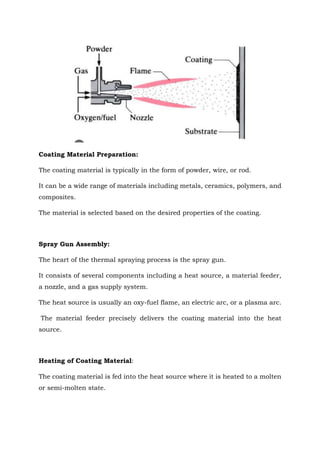
The heart of the thermal spraying process is the spray gun.
It consists of several components including a heat source, a material feeder,
a nozzle, and a gas supply system.
The heat source is usually an oxy-fuel flame, an electric arc, or a plasma arc.
The material feeder precisely delivers the coating material into the heat
source.
Heating of Coating Material:
The coating material is fed into the heat source where it is heated to a molten
or semi-molten state.
The exact temperature depends on the material being sprayed and the chosen
spraying method.
Acceleration and Propulsion:
Once heated, the molten or semi-molten material is propelled towards the
substrate to be coated.
This propulsion is typically achieved by compressed air, inert gas, or a
combination of both.
The velocity and trajectory of the particles are controlled to ensure uniform
coating deposition.
Impact and Solidification:
As the heated material particles travel towards the substrate, they impact its
surface.
Upon impact, the particles flatten and spread out, forming a thin layer.
Rapid cooling and solidification occur as the particles lose heat to the
substrate and surrounding environment, resulting in the formation of a solid
coating.
Repetition and Layering:
To achieve the desired coating thickness, the spraying process is repeated
multiple times, building up successive layers of material.
Each layer bonds to the previous one, forming a cohesive coating structure.
Finishing and Post-Treatment:
After the coating is applied, it may undergo additional processes such as
machining, grinding, or polishing to achieve the desired surface finish.
Some coatings may also require post-treatment steps such as heat treatment
or sealing to enhance their properties further.
Overall, thermal spraying offers a cost-effective and versatile solution for
applying coatings to a wide range of substrates, making it a popular choice in
industries such as aerospace, automotive, energy, and manufacturing.

CME397 THERMAL SPRAYING process (CME397)

  • 1.
    Course code CME397Course name Surface Engineering Year/sem 3/6 Unit no 4 Course Instructor: M.Karthikeyan AP/Mech Thermal spraying process Objectives: Thermal spraying is a technology which improves or restores the surface of a solid material. The process can be used to apply coatings to a wide range of materials and components, to provide resistance to: Wear, erosion, cavitation, corrosion, abrasion or heat. Types of thermal spraying process:  Plasma spraying.  Detonation spraying.  Wire arc spraying.  Flame spraying.  High velocity oxy-fuel coating spraying (HVOF)  High velocity air fuel (HVAF)  Warm spraying.  Cold spraying. AAA COLLEGE OF ENGINEERING & TECHNOLOGY Managed by Panjurajan – Amaravathy Trust and Promoted by Vinayaga- Sony Group of Industries Accredited by NBA (CSE, ECE, EEE & MECHANICAL), (Accredited by NAAC with “A” grade) (Approved by AICTE, New Delhi & Affiliated to Anna University, Chennai) (An ISO 21001: 2018 Certified Institution) Amathur, Sivakasi - 626 005. Department of Mechanical Engineering
  • 2.
    Coating Material Preparation: Thecoating material is typically in the form of powder, wire, or rod. It can be a wide range of materials including metals, ceramics, polymers, and composites. The material is selected based on the desired properties of the coating. Spray Gun Assembly: The heart of the thermal spraying process is the spray gun. It consists of several components including a heat source, a material feeder, a nozzle, and a gas supply system. The heat source is usually an oxy-fuel flame, an electric arc, or a plasma arc. The material feeder precisely delivers the coating material into the heat source. Heating of Coating Material: The coating material is fed into the heat source where it is heated to a molten or semi-molten state.
  • 3.
    The exact temperaturedepends on the material being sprayed and the chosen spraying method. Acceleration and Propulsion: Once heated, the molten or semi-molten material is propelled towards the substrate to be coated. This propulsion is typically achieved by compressed air, inert gas, or a combination of both. The velocity and trajectory of the particles are controlled to ensure uniform coating deposition. Impact and Solidification: As the heated material particles travel towards the substrate, they impact its surface. Upon impact, the particles flatten and spread out, forming a thin layer. Rapid cooling and solidification occur as the particles lose heat to the substrate and surrounding environment, resulting in the formation of a solid coating. Repetition and Layering: To achieve the desired coating thickness, the spraying process is repeated multiple times, building up successive layers of material. Each layer bonds to the previous one, forming a cohesive coating structure. Finishing and Post-Treatment:
  • 4.
    After the coatingis applied, it may undergo additional processes such as machining, grinding, or polishing to achieve the desired surface finish. Some coatings may also require post-treatment steps such as heat treatment or sealing to enhance their properties further. Overall, thermal spraying offers a cost-effective and versatile solution for applying coatings to a wide range of substrates, making it a popular choice in industries such as aerospace, automotive, energy, and manufacturing.