LIQUID
PENETRANT TESTING
Prepared by: Rhythm Upadhyay A
http://alltypeim.blogspot.in/
• Liquid penetrant testing is one of the oldest and simplest NDT
methods.
• This method is used to reveal surface discontinuities by bleed out
of a colored or fluorescent dye from the flaw.
•The advantage that a liquid penetrant inspection offers over an
unaided visual inspection is that it makes defects easier to see for
the inspector .
http://alltypeim.blogspot.in/
Steps of Liquid Penetrant Testing
The exact procedure for liquid penetrant testing can vary from case
to case depending on several factors such as the penetrant system
being used, the size and material of the component being inspected,
the type of discontinuities being expected in the component and the
condition and environment under which the inspection is performed.
However, the general steps can be summarized as follows.
http://alltypeim.blogspot.in/
1.Surface Preparation: One of the most critical
steps of a liquid penetrant testing is the surface
preparation. The surface must be free of oil, grease,
water, or other contaminants that may prevent
penetrant from entering flaws. The sample may also
require etching if mechanical operations such as
machining, sanding, or grit blasting have been
performed. These and other mechanical operations
can smear metal over the flaw opening and prevent
the penetrant from entering.
http://alltypeim.blogspot.in/
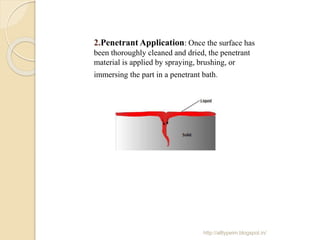
2.Penetrant Application: Once the surface has
been thoroughly cleaned and dried, the penetrant
material is applied by spraying, brushing, or
immersing the part in a penetrant bath.
http://alltypeim.blogspot.in/
3.Penetrant Dwell: The penetrant is left on
the surface for a sufficient time to allow as
much penetrant as possible to be drawn from or
to seep into a defect. Penetrant dwell time is the
total time that the penetrant is in contact with
the part surface. Dwell times are usually
recommended by the penetrant producers
or required by the specification being
followed. The times vary depending on
the application, penetrant materials
used, the material, the form of the
material being inspected, and the type
of discontinuity being inspected for.
Minimum dwell times typically range
from five to 60 minutes. Generally,
there is no harm in using a longer penetrant
dwell time as long as the penetrant is not
allowed to dry. The ideal dwell time is often
determined by experimentation and may be
very specific to a particular application.
http://alltypeim.blogspot.in/
4. Excess Penetrant Removal: This is the
most delicate part of the inspection procedure
because the excess penetrant must be removed
from the surface of the sample while removing
as little penetrant as possible from defects.
http://alltypeim.blogspot.in/
5. Developer Application: A thin layer of
developer is then applied to the sample to draw
penetrant trapped in flaws back to the surface where
it will be visible. Developers come in a variety of
forms that may be applied by dusting (dry powders),
dipping, or spraying (wet developers).
http://alltypeim.blogspot.in/
6. Indication Development: The developer
is allowed to stand on the part surface
for a period of time sufficient to permit
the extraction of the trapped penetrant
out of any surface flaws. This
development time is usually a minimum
of 10 minutes. Significantly longer
times may be necessary for tight cracks.
http://alltypeim.blogspot.in/
7. Inspection: Inspection is then performed under
appropriate lighting to detect indications from any
flaws which may be present.
8. Clean Surface: The final step in the process is to
thoroughly clean the part surface to remove the developer
from the parts that were found to be acceptable.
http://alltypeim.blogspot.in/
Advantages & Disadvantages
Advantages
1. High sensitivity (small discontinuities can be
detected).
2. Few material limitations (metallic and
nonmetallic, magnetic and nonmagnetic, and
conductive and nonconductive materials may be
inspected).
3. Rapid inspection of large areas and volumes.
4. Suitable for parts with complex shapes.
5. Indications are produced directly on the surface of
the part and constitute a visual representation of
the flaw.
6. Portable (materials are available in aerosol spray
cans)
7. Low cost (materials and associated equipment are
relatively inexpensive)
http://alltypeim.blogspot.in/
Disadvantages
1. Only surface breaking defects can be
detected.
2. Only materials with a relatively nonporous
surface can be inspected.
3. Pre-cleaning is critical since contaminants
can mask defects.
4. Metal smearing from machining, grinding,
and grit or vapor blasting must be removed.
5. The inspector must have direct access to the
surface being inspected.
6. Surface finish and roughness can affect
inspection sensitivity.
7. Multiple process operations must be
performed and controlled.
8. Post cleaning of acceptable parts or
materials is required.
9. Chemical handling and proper disposal is
required.
http://alltypeim.blogspot.in/

Liquid penetrant testing

  • 1.
    LIQUID PENETRANT TESTING Prepared by:Rhythm Upadhyay A http://alltypeim.blogspot.in/
  • 2.
    • Liquid penetranttesting is one of the oldest and simplest NDT methods. • This method is used to reveal surface discontinuities by bleed out of a colored or fluorescent dye from the flaw. •The advantage that a liquid penetrant inspection offers over an unaided visual inspection is that it makes defects easier to see for the inspector . http://alltypeim.blogspot.in/
  • 3.
    Steps of LiquidPenetrant Testing The exact procedure for liquid penetrant testing can vary from case to case depending on several factors such as the penetrant system being used, the size and material of the component being inspected, the type of discontinuities being expected in the component and the condition and environment under which the inspection is performed. However, the general steps can be summarized as follows. http://alltypeim.blogspot.in/
  • 4.
    1.Surface Preparation: Oneof the most critical steps of a liquid penetrant testing is the surface preparation. The surface must be free of oil, grease, water, or other contaminants that may prevent penetrant from entering flaws. The sample may also require etching if mechanical operations such as machining, sanding, or grit blasting have been performed. These and other mechanical operations can smear metal over the flaw opening and prevent the penetrant from entering. http://alltypeim.blogspot.in/
  • 5.
    2.Penetrant Application: Oncethe surface has been thoroughly cleaned and dried, the penetrant material is applied by spraying, brushing, or immersing the part in a penetrant bath. http://alltypeim.blogspot.in/
  • 6.
    3.Penetrant Dwell: Thepenetrant is left on the surface for a sufficient time to allow as much penetrant as possible to be drawn from or to seep into a defect. Penetrant dwell time is the total time that the penetrant is in contact with the part surface. Dwell times are usually recommended by the penetrant producers or required by the specification being followed. The times vary depending on the application, penetrant materials used, the material, the form of the material being inspected, and the type of discontinuity being inspected for. Minimum dwell times typically range from five to 60 minutes. Generally, there is no harm in using a longer penetrant dwell time as long as the penetrant is not allowed to dry. The ideal dwell time is often determined by experimentation and may be very specific to a particular application. http://alltypeim.blogspot.in/
  • 7.
    4. Excess PenetrantRemoval: This is the most delicate part of the inspection procedure because the excess penetrant must be removed from the surface of the sample while removing as little penetrant as possible from defects. http://alltypeim.blogspot.in/
  • 8.
    5. Developer Application:A thin layer of developer is then applied to the sample to draw penetrant trapped in flaws back to the surface where it will be visible. Developers come in a variety of forms that may be applied by dusting (dry powders), dipping, or spraying (wet developers). http://alltypeim.blogspot.in/
  • 9.
    6. Indication Development:The developer is allowed to stand on the part surface for a period of time sufficient to permit the extraction of the trapped penetrant out of any surface flaws. This development time is usually a minimum of 10 minutes. Significantly longer times may be necessary for tight cracks. http://alltypeim.blogspot.in/
  • 10.
    7. Inspection: Inspectionis then performed under appropriate lighting to detect indications from any flaws which may be present. 8. Clean Surface: The final step in the process is to thoroughly clean the part surface to remove the developer from the parts that were found to be acceptable. http://alltypeim.blogspot.in/
  • 11.
    Advantages & Disadvantages Advantages 1.High sensitivity (small discontinuities can be detected). 2. Few material limitations (metallic and nonmetallic, magnetic and nonmagnetic, and conductive and nonconductive materials may be inspected). 3. Rapid inspection of large areas and volumes. 4. Suitable for parts with complex shapes. 5. Indications are produced directly on the surface of the part and constitute a visual representation of the flaw. 6. Portable (materials are available in aerosol spray cans) 7. Low cost (materials and associated equipment are relatively inexpensive) http://alltypeim.blogspot.in/
  • 12.
    Disadvantages 1. Only surfacebreaking defects can be detected. 2. Only materials with a relatively nonporous surface can be inspected. 3. Pre-cleaning is critical since contaminants can mask defects. 4. Metal smearing from machining, grinding, and grit or vapor blasting must be removed. 5. The inspector must have direct access to the surface being inspected. 6. Surface finish and roughness can affect inspection sensitivity. 7. Multiple process operations must be performed and controlled. 8. Post cleaning of acceptable parts or materials is required. 9. Chemical handling and proper disposal is required. http://alltypeim.blogspot.in/
  • 13.
  • 14.