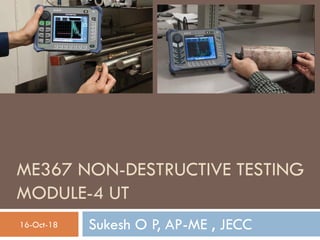
ME367 NON-DESTRUCTIVE TESTING
MODULE-4 UT
Sukesh O P, AP-ME , JECC16-Oct-18
SUKESH O P/ APME/JECC 1
ME357 Non-Destructive Testing
16-Oct-18SUKESH O P/ APME/JECC
2
Introduction to NDT- Visual Inspection- Liquid
Penetrant Inspection- Magnetic Particle
Inspection- Ultrasonic Testing-
Radiography Testing- Eddy Current Testing.
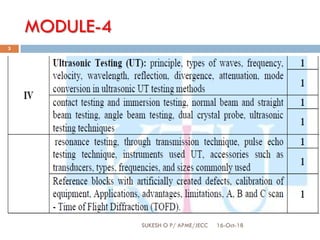
MODULE-4
16-Oct-18SUKESH O P/ APME/JECC
3
16-Oct-18SUKESH O P/ APME/JECC
4
INTRODUCTION
16-Oct-18SUKESH O P/ APME/JECC
5
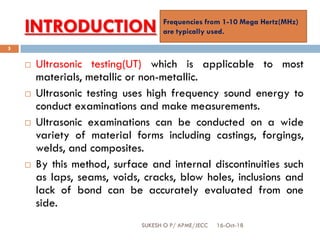
 Ultrasonic testing(UT) which is applicable to most
materials, metallic or non-metallic.
 Ultrasonic testing uses high frequency sound energy to
conduct examinations and make measurements.
 Ultrasonic examinations can be conducted on a wide
variety of material forms including castings, forgings,
welds, and composites.
 By this method, surface and internal discontinuities such
as laps, seams, voids, cracks, blow holes, inclusions and
lack of bond can be accurately evaluated from one
side.
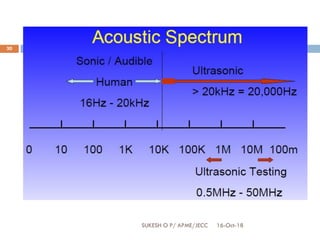
Frequencies from 1-10 Mega Hertz(MHz)
are typically used.
16-Oct-18SUKESH O P/ APME/JECC
6
16-Oct-18SUKESH O P/ APME/JECC
7
16-Oct-18SUKESH O P/ APME/JECC
8
16-Oct-18SUKESH O P/ APME/JECC
9
16-Oct-18SUKESH O P/ APME/JECC
10
Basic Principle of UT
16-Oct-18SUKESH O P/ APME/JECC
11
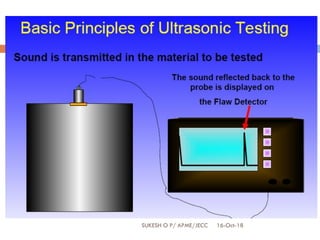
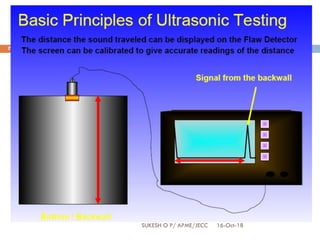
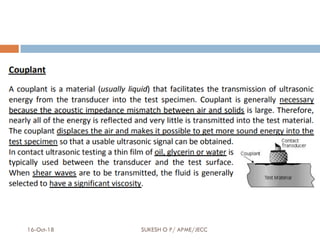
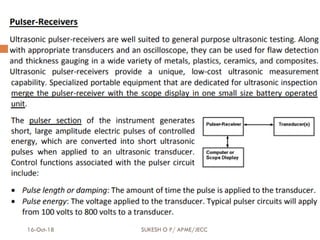
 In ultrasonic testing, ultrasound transducer connected to
a diagnostic machine is passed over the object being
inspected.
 The transducer is typically separated from the test
object by a couplant (such as oil) or by water, as in
immersion testing. However, when ultrasonic testing is
conducted with an Electromagnetic Acoustic Transducer
(EMAT) the use of couplant is not required.
 There are two methods of receiving the ultrasound
waveform: reflection and attenuation
16-Oct-18SUKESH O P/ APME/JECC
12
SOUND
16-Oct-18SUKESH O P/ APME/JECC
13
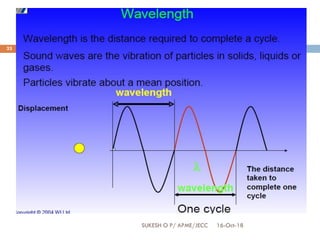
Wavelength :
 The distance required to complete a cycle
– Measured in Meter or mm
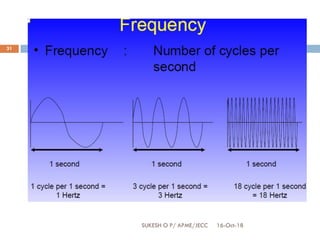
Frequency :
 The number of cycles per unit time
– Measured in Hertz (Hz) or Cycles per second (cps)
Velocity :
 How quick the sound travels
 Distance per unit time
– Measured in meter / second (m / sec)
Basic Principles of Sound
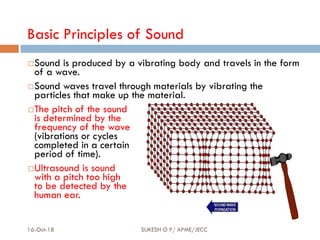
Sound is produced by a vibrating body and travels in the form
of a wave.
Sound waves travel through materials by vibrating the
particles that make up the material.
The pitch of the sound
is determined by the
frequency of the wave
(vibrations or cycles
completed in a certain
period of time).
Ultrasound is sound
with a pitch too high
to be detected by the
human ear.
16-Oct-18 SUKESH O P/ APME/JECC 14
Properties of a sound wave
16-Oct-18SUKESH O P/ APME/JECC
15
 Sound cannot travel in vacuum
 Sound energy to be transmitted / transferred from
one particle to another
Sound waves
16-Oct-18SUKESH O P/ APME/JECC
16
 All sound waves, whether audible or ultrasonic, are
mechanical vibrations involving movement of the
medium in which they are travelling.
 A sound wave may be transmitted through any
material which behaves in an elastic manner.
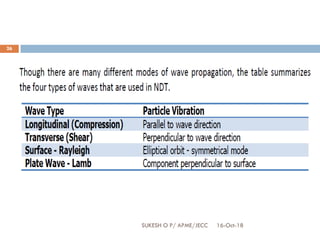
 Longitudinal waves
 Transverse or shear waves
 Surface or Rayleigh waves
Ultrasonic waves
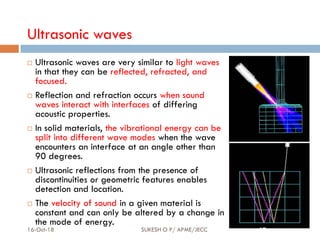
 Ultrasonic waves are very similar to light waves
in that they can be reflected, refracted, and
focused.
 Reflection and refraction occurs when sound
waves interact with interfaces of differing
acoustic properties.
 In solid materials, the vibrational energy can be
split into different wave modes when the wave
encounters an interface at an angle other than
90 degrees.
 Ultrasonic reflections from the presence of
discontinuities or geometric features enables
detection and location.
 The velocity of sound in a given material is
constant and can only be altered by a change in
the mode of energy.
16-Oct-18 SUKESH O P/ APME/JECC 17
Longitudinal waves
16-Oct-18SUKESH O P/ APME/JECC
18
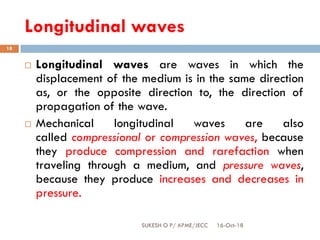
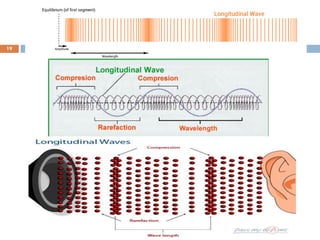
 Longitudinal waves are waves in which the
displacement of the medium is in the same direction
as, or the opposite direction to, the direction of
propagation of the wave.
 Mechanical longitudinal waves are also
called compressional or compression waves, because
they produce compression and rarefaction when
traveling through a medium, and pressure waves,
because they produce increases and decreases in
pressure.
16-Oct-18SUKESH O P/ APME/JECC
19
Transverse or shear wave
16-Oct-18SUKESH O P/ APME/JECC
20
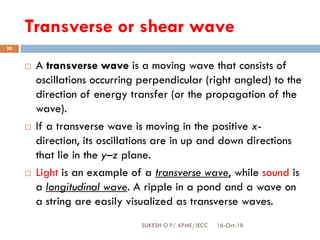
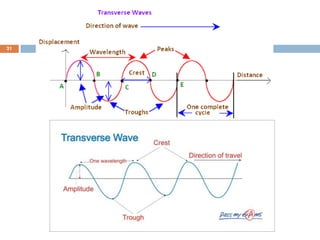
 A transverse wave is a moving wave that consists of
oscillations occurring perpendicular (right angled) to the
direction of energy transfer (or the propagation of the
wave).
 If a transverse wave is moving in the positive x-
direction, its oscillations are in up and down directions
that lie in the y–z plane.
 Light is an example of a transverse wave, while sound is
a longitudinal wave. A ripple in a pond and a wave on
a string are easily visualized as transverse waves.
16-Oct-18SUKESH O P/ APME/JECC
21
Surface or Rayleigh waves
16-Oct-18SUKESH O P/ APME/JECC
22
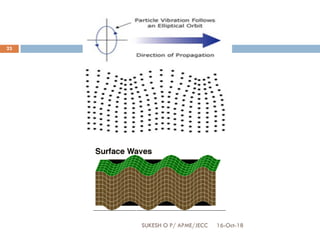
 This type of waves can travel only along surface
bounded on one side by strong elastic forces of the
solid and on the other by nearly nonexistent elastic
forces between gas molecules.
 Surface waves therefore are essentially nonexistent
in a solid immersed in liquid, unless the liquid covers
the solid surface only as a very thin layer.
16-Oct-18SUKESH O P/ APME/JECC
23
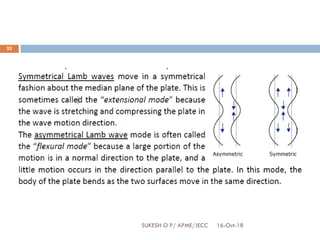
Plate or Lamp waves
16-Oct-18SUKESH O P/ APME/JECC
24
16-Oct-18SUKESH O P/ APME/JECC
25
16-Oct-18SUKESH O P/ APME/JECC
26
VELOCITY
16-Oct-18SUKESH O P/ APME/JECC
27
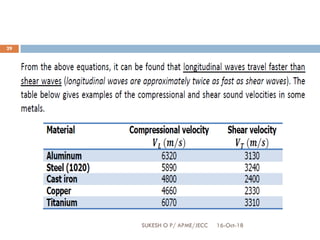
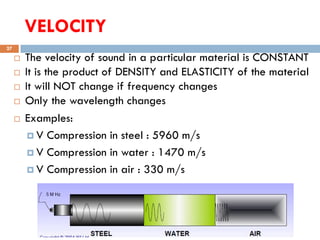
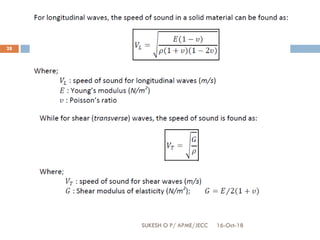
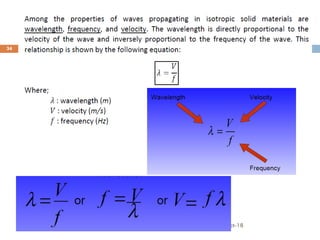
 The velocity of sound in a particular material is CONSTANT
 It is the product of DENSITY and ELASTICITY of the material
 It will NOT change if frequency changes
 Only the wavelength changes
 Examples:
 V Compression in steel : 5960 m/s
 V Compression in water : 1470 m/s
 V Compression in air : 330 m/s
16-Oct-18SUKESH O P/ APME/JECC
28
16-Oct-18SUKESH O P/ APME/JECC
29
16-Oct-18SUKESH O P/ APME/JECC
30
16-Oct-18SUKESH O P/ APME/JECC
31
FREQUENCY
16-Oct-18SUKESH O P/ APME/JECC
32
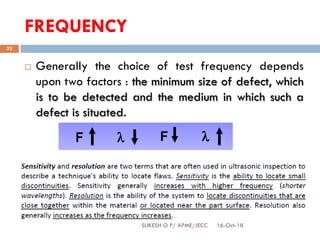
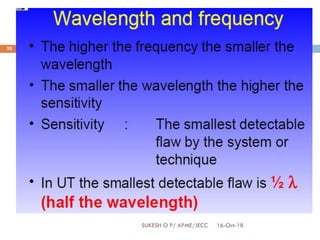
 Generally the choice of test frequency depends
upon two factors : the minimum size of defect, which
is to be detected and the medium in which such a
defect is situated.
16-Oct-18SUKESH O P/ APME/JECC
33
16-Oct-18SUKESH O P/ APME/JECC
34
16-Oct-18SUKESH O P/ APME/JECC
35
Reflection
16-Oct-18SUKESH O P/ APME/JECC
36
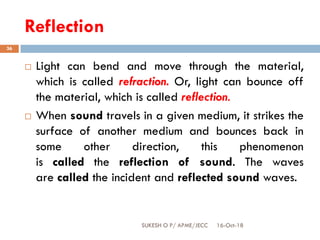
 Light can bend and move through the material,
which is called refraction. Or, light can bounce off
the material, which is called reflection.
 When sound travels in a given medium, it strikes the
surface of another medium and bounces back in
some other direction, this phenomenon
is called the reflection of sound. The waves
are called the incident and reflected sound waves.
Divergence
16-Oct-18SUKESH O P/ APME/JECC
37
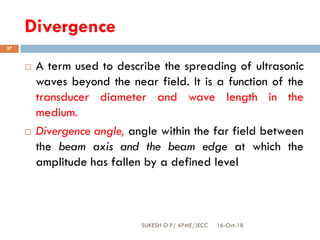
 A term used to describe the spreading of ultrasonic
waves beyond the near field. It is a function of the
transducer diameter and wave length in the
medium.
 Divergence angle, angle within the far field between
the beam axis and the beam edge at which the
amplitude has fallen by a defined level
16-Oct-18SUKESH O P/ APME/JECC
38
 Scattering : it is the reflection of sound beam from
its original direction of propagation.
 Absorption : it is conversion of sound energy from
one form to some another form.
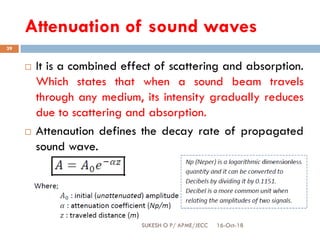
Attenuation of sound waves
16-Oct-18SUKESH O P/ APME/JECC
39
 It is a combined effect of scattering and absorption.
Which states that when a sound beam travels
through any medium, its intensity gradually reduces
due to scattering and absorption.
 Attenaution defines the decay rate of propagated
sound wave.
TEST TECHNIQUES
16-Oct-18SUKESH O P/ APME/JECC
40
 Ultrasonic testing is a very versatile inspection method, and
inspections can be accomplished in a number of different ways.
 Ultrasonic inspection techniques are commonly divided into three
primary classifications.
 Pulse-echo and Through Transmission
- (Relates to whether reflected or transmitted energy is used)
 Normal Beam and Angle Beam
- (Relates to the angle that the sound energy enters the test article)
 Contact and Immersion
- (Relates to the method of coupling the transducer to the test article)
Pulse Echo Method
16-Oct-18SUKESH O P/ APME/JECC
41
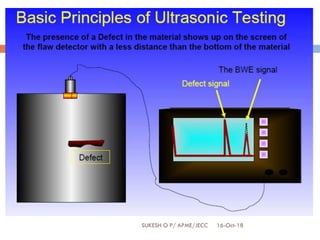
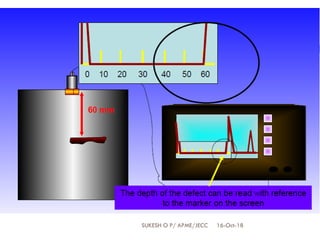
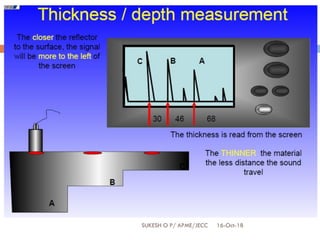
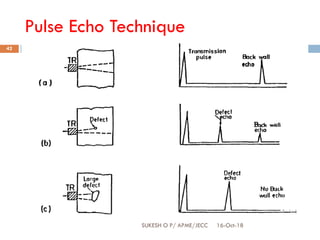
 This is the method most commonly utilized in the
ultrasonic testing of materials. The transmitter and
receiver probes are on the same side of the specimen
and the presence of a defect is indicated by the
reception of an echo before that of the back wall echo.
 The CRT screen is calibrated to show the separation in
distance between the time of arrival of a defect echo
as against that of the back wall echo of the specimen,
therefore, the location of a defect can be assessed
accurately.
Pulse Echo Technique
16-Oct-18SUKESH O P/ APME/JECC
42
Pulse Echo Technique
16-Oct-18SUKESH O P/ APME/JECC
43
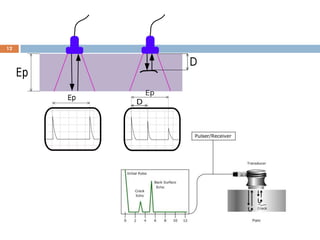
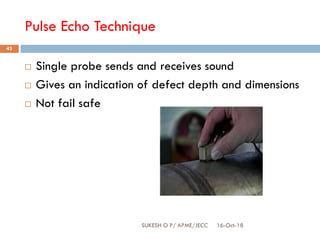
 Single probe sends and receives sound
 Gives an indication of defect depth and dimensions
 Not fail safe
Through Transmission Method
16-Oct-18SUKESH O P/ APME/JECC
44
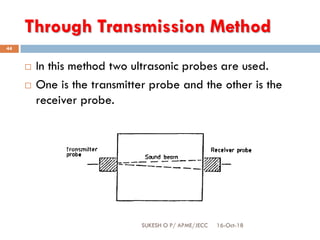
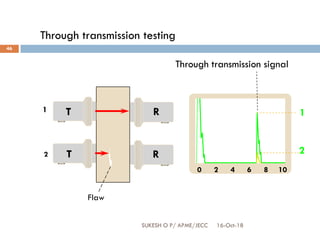
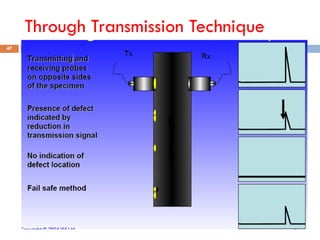
 In this method two ultrasonic probes are used.
 One is the transmitter probe and the other is the
receiver probe.
16-Oct-18SUKESH O P/ APME/JECC
45
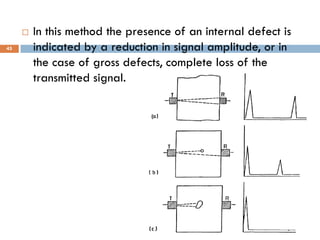
 In this method the presence of an internal defect is
indicated by a reduction in signal amplitude, or in
the case of gross defects, complete loss of the
transmitted signal.
Through transmission testing
0 2 4 6 8 10
Through transmission signal
1
2
1
2
T
T
R
R
Flaw
16-Oct-18SUKESH O P/ APME/JECC
46
Through Transmission Technique
16-Oct-18SUKESH O P/ APME/JECC
47
Through Transmission Technique
16-Oct-18SUKESH O P/ APME/JECC
48
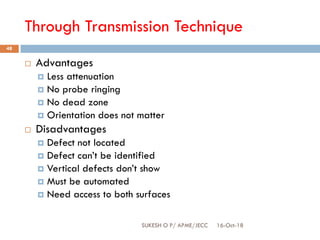
 Advantages
 Less attenuation
 No probe ringing
 No dead zone
 Orientation does not matter
 Disadvantages
 Defect not located
 Defect can’t be identified
 Vertical defects don’t show
 Must be automated
 Need access to both surfaces
16-Oct-18SUKESH O P/ APME/JECC
49
Resonance Method
16-Oct-18SUKESH O P/ APME/JECC
50
 A condition of resonance exists whenever the
thickness of a material equals half the wavelength
of sound or any multiple thereof in that material.
 Control of wavelength in ultrasonics is achieved by
control of frequency.
Resonance Method
16-Oct-18SUKESH O P/ APME/JECC
51
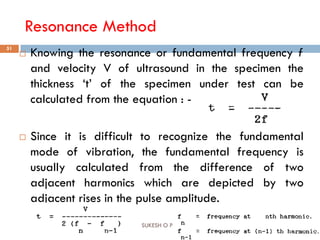
 Knowing the resonance or fundamental frequency f
and velocity V of ultrasound in the specimen the
thickness ‘t’ of the specimen under test can be
calculated from the equation : -
 Since it is difficult to recognize the fundamental
mode of vibration, the fundamental frequency is
usually calculated from the difference of two
adjacent harmonics which are depicted by two
adjacent rises in the pulse amplitude.
Resonance Method
16-Oct-18SUKESH O P/ APME/JECC
52
 This method is used for the inspection of large ingots
and castings particularly when the attenuation is
high and gross defects are present.
 The method does not give the size and location of
the defect. In addition good mechanical coupling
and alignment of the two probes is essential.
16-Oct-18SUKESH O P/ APME/JECC
53
 Techniques of ultrasonic testing are either of the
contact type or the immersion type.
 In the contact type, the probe is placed in direct
contact with the test specimen with a thin liquid film
used as a couplant for better transmission of
ultrasonic waves in to the test specimen.
 In the immersion type, a waterproof probe is used
at some distance from the test specimen and the
ultrasonic beam is transmitted in to the material
through a water path or water column.
Contact Type Techniques
16-Oct-18SUKESH O P/ APME/JECC
54
Normal Beam Techniques:
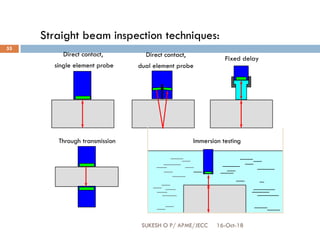
 In the normal beam technique the ultrasonic beam is
projected perpendicularly in to the test specimen.
This technique may use either single, double or SE
normal beam probes.
 With the single probe, the transducer of the probe
acts as both transmitter and receiver.
Straight beam inspection techniques:
Direct contact,
single element probe
Direct contact,
dual element probe
Fixed delay
Immersion testingThrough transmission
16-Oct-18SUKESH O P/ APME/JECC
55
16-Oct-18SUKESH O P/ APME/JECC
56
 Angle Beam Techniques
 The angle beam technique is used to transmit
ultrasonic waves in to a test specimen at a
predetermined angle to the test surface.
 Transverse waves at various angles of refraction
between 35° and 80° are used to locate defects
whose orientation is not suitable for detection by
normal beam techniques.
16-Oct-18SUKESH O P/ APME/JECC
57
 Surface Wave Techniques
 Surface wave techniques have been used very successfully
for a great number of applications, particularly in the
Aircraft Industry.
 The main advantage of surface waves is that they follow
gentle contours and are reflected sharply only by sudden
changes in contour, thus making it a very useful tool for the
examination of complex shaped components.
 The main limitation of these waves is that they are almost
immediately attenuated if the surface finish is rough, is
covered in scale or a liquid (such as the couplant), or if any
pressure is applied by another object (such as the hand of
the operator ).
Immersion Testing Techniques
16-Oct-18SUKESH O P/ APME/JECC
58
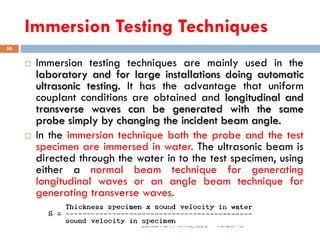
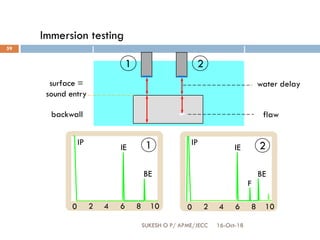
 Immersion testing techniques are mainly used in the
laboratory and for large installations doing automatic
ultrasonic testing. It has the advantage that uniform
couplant conditions are obtained and longitudinal and
transverse waves can be generated with the same
probe simply by changing the incident beam angle.
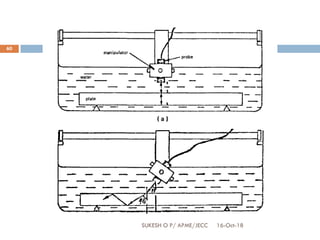
 In the immersion technique both the probe and the test
specimen are immersed in water. The ultrasonic beam is
directed through the water in to the test specimen, using
either a normal beam technique for generating
longitudinal waves or an angle beam technique for
generating transverse waves.
surface =
sound entry
backwall flaw
1 2
water delay
0 2 4 6 8 10 0 2 4 6 8 10
IE IE
IP IP
BE BE
F
1 2
Immersion testing
16-Oct-18SUKESH O P/ APME/JECC
59
16-Oct-18SUKESH O P/ APME/JECC
60
Immersion testing
16-Oct-18SUKESH O P/ APME/JECC
61
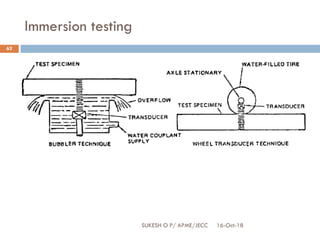
 In the bubbler or squirter technique, the ultrasonic
beam is directed through a water column in to the
test specimen.
 This technique is usually used with an automated
system for high speed scanning of plate, sheet, strip,
cylindrical forms and other regularly shaped forms.
Immersion testing
16-Oct-18SUKESH O P/ APME/JECC
62
Immersion testing
16-Oct-18SUKESH O P/ APME/JECC
63
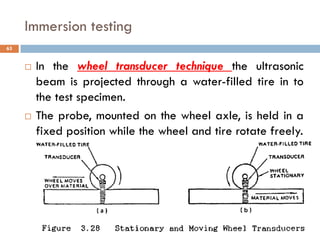
 In the wheel transducer technique the ultrasonic
beam is projected through a water-filled tire in to
the test specimen.
 The probe, mounted on the wheel axle, is held in a
fixed position while the wheel and tire rotate freely.
Equipment
Equipment for ultrasonic testing is very diversified.
Proper selection is important to insure accurate
inspection data as desired for specific applications.
In general, there are three basic components that
comprise an ultrasonic test system:
- Instrumentation
- Transducers
- Calibration Standards
16-Oct-18SUKESH O P/ APME/JECC
64
1. TRANSDUCERS
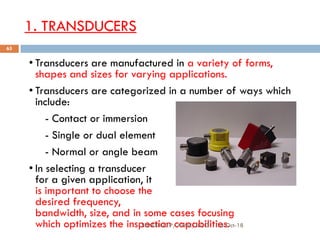
• Transducers are manufactured in a variety of forms,
shapes and sizes for varying applications.
• Transducers are categorized in a number of ways which
include:
- Contact or immersion
- Single or dual element
- Normal or angle beam
• In selecting a transducer
for a given application, it
is important to choose the
desired frequency,
bandwidth, size, and in some cases focusing
which optimizes the inspection capabilities.16-Oct-18SUKESH O P/ APME/JECC
65
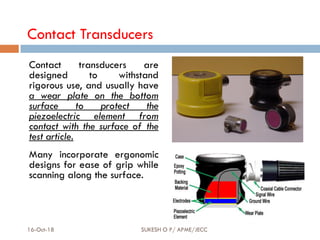
Contact Transducers
Contact transducers are
designed to withstand
rigorous use, and usually have
a wear plate on the bottom
surface to protect the
piezoelectric element from
contact with the surface of the
test article.
Many incorporate ergonomic
designs for ease of grip while
scanning along the surface.
16-Oct-18 SUKESH O P/ APME/JECC 66
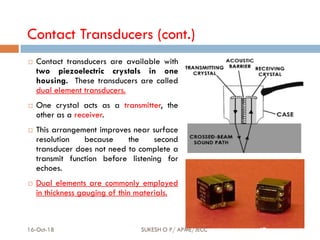
Contact Transducers (cont.)
 Contact transducers are available with
two piezoelectric crystals in one
housing. These transducers are called
dual element transducers.
 One crystal acts as a transmitter, the
other as a receiver.
 This arrangement improves near surface
resolution because the second
transducer does not need to complete a
transmit function before listening for
echoes.
 Dual elements are commonly employed
in thickness gauging of thin materials.
16-Oct-18 SUKESH O P/ APME/JECC 67
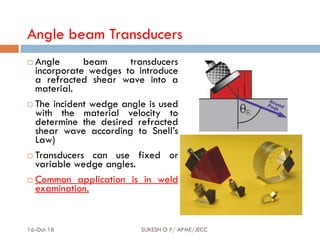
Angle beam Transducers
 Angle beam transducers
incorporate wedges to introduce
a refracted shear wave into a
material.
 The incident wedge angle is used
with the material velocity to
determine the desired refracted
shear wave according to Snell’s
Law)
 Transducers can use fixed or
variable wedge angles.
 Common application is in weld
examination.
16-Oct-18 SUKESH O P/ APME/JECC 68
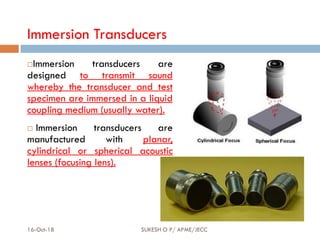
Immersion Transducers
Immersion transducers are
designed to transmit sound
whereby the transducer and test
specimen are immersed in a liquid
coupling medium (usually water).
 Immersion transducers are
manufactured with planar,
cylindrical or spherical acoustic
lenses (focusing lens).
16-Oct-18 SUKESH O P/ APME/JECC 69
7016-Oct-18 SUKESH O P/ APME/JECC
7116-Oct-18 SUKESH O P/ APME/JECC
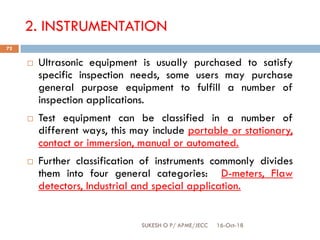
2. INSTRUMENTATION
 Ultrasonic equipment is usually purchased to satisfy
specific inspection needs, some users may purchase
general purpose equipment to fulfill a number of
inspection applications.
 Test equipment can be classified in a number of
different ways, this may include portable or stationary,
contact or immersion, manual or automated.
 Further classification of instruments commonly divides
them into four general categories: D-meters, Flaw
detectors, Industrial and special application.
16-Oct-18SUKESH O P/ APME/JECC
72
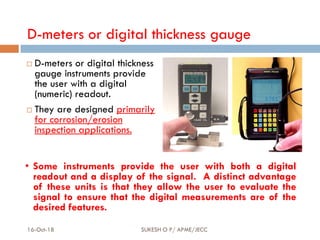
D-meters or digital thickness gauge
 D-meters or digital thickness
gauge instruments provide
the user with a digital
(numeric) readout.
 They are designed primarily
for corrosion/erosion
inspection applications.
• Some instruments provide the user with both a digital
readout and a display of the signal. A distinct advantage
of these units is that they allow the user to evaluate the
signal to ensure that the digital measurements are of the
desired features.
16-Oct-18 SUKESH O P/ APME/JECC 73
3. CALIBRATION STANDARDS
 Calibration is a operation of configuring the ultrasonic test
equipment to known values. This provides the inspector with
a means of comparing test signals to known measurements.
 Calibration standards come in a wide variety of material
types, and configurations due to the diversity of inspection
applications.
 Calibration standards are typically manufactured from
materials of the same acoustic properties as those of the
test articles.
16-Oct-18SUKESH O P/ APME/JECC
74
Calibration Standards (cont.)
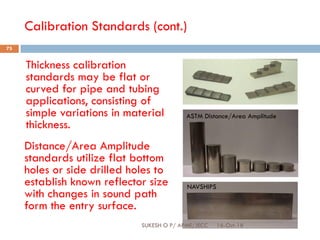
Thickness calibration
standards may be flat or
curved for pipe and tubing
applications, consisting of
simple variations in material
thickness.
Distance/Area Amplitude
standards utilize flat bottom
holes or side drilled holes to
establish known reflector size
with changes in sound path
form the entry surface.
ASTM Distance/Area Amplitude
NAVSHIPS
16-Oct-18SUKESH O P/ APME/JECC
75
Calibration Standards (cont.)
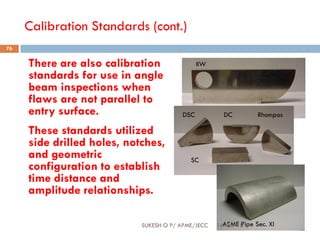
There are also calibration
standards for use in angle
beam inspections when
flaws are not parallel to
entry surface.
These standards utilized
side drilled holes, notches,
and geometric
configuration to establish
time distance and
amplitude relationships.
IIW
DSC DC Rhompas
SC
ASME Pipe Sec. XI16-Oct-18SUKESH O P/ APME/JECC
76
Qualification Standards
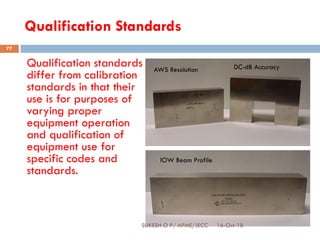
Qualification standards
differ from calibration
standards in that their
use is for purposes of
varying proper
equipment operation
and qualification of
equipment use for
specific codes and
standards.
AWS Resolution
IOW Beam Profile
DC-dB Accuracy
16-Oct-18SUKESH O P/ APME/JECC
77
DATA PRESENTATION
 Information from ultrasonic testing can be presented in a
number of differing formats.
 Three of the more common formats include:
 A-scan
 B-scan
 C-scan
16-Oct-18SUKESH O P/ APME/JECC
78
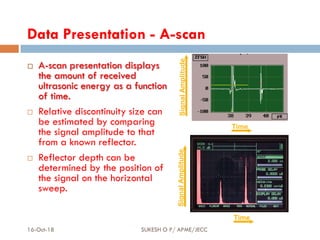
Data Presentation - A-scan
 A-scan presentation displays
the amount of received
ultrasonic energy as a function
of time.
 Relative discontinuity size can
be estimated by comparing
the signal amplitude to that
from a known reflector.
 Reflector depth can be
determined by the position of
the signal on the horizontal
sweep.
Time
SignalAmplitudeSignalAmplitude
Time
16-Oct-18 SUKESH O P/ APME/JECC 79
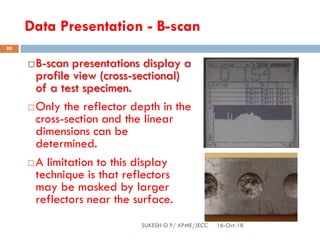
Data Presentation - B-scan
B-scan presentations display a
profile view (cross-sectional)
of a test specimen.
Only the reflector depth in the
cross-section and the linear
dimensions can be
determined.
A limitation to this display
technique is that reflectors
may be masked by larger
reflectors near the surface.
16-Oct-18SUKESH O P/ APME/JECC
80
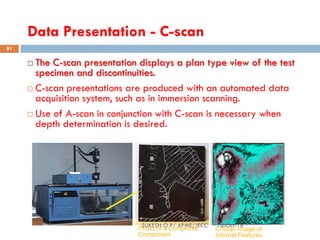
Data Presentation - C-scan
 The C-scan presentation displays a plan type view of the test
specimen and discontinuities.
 C-scan presentations are produced with an automated data
acquisition system, such as in immersion scanning.
 Use of A-scan in conjunction with C-scan is necessary when
depth determination is desired.
Photo of a Composite
Component
C-Scan Image of
Internal Features
16-Oct-18SUKESH O P/ APME/JECC
81
ADVANTAGE OF ULTRASONIC TESTING
 Sensitive to small discontinuities both surface and subsurface.
 Depth of penetration for flaw detection or measurement is superior
to other methods.
 Only single-sided access is needed when pulse-echo technique is
used.
 High accuracy in determining reflector position and estimating size
and shape.
 Minimal part preparation required.
 Electronic equipment provides instantaneous results.
 Detailed images can be produced with automated systems.
 Has other uses such as thickness measurements, in addition to flaw
detection.
16-Oct-18SUKESH O P/ APME/JECC
82
LIMITATIONS OF ULTRASONIC TESTING
 Surface must be accessible to transmit ultrasound.
 Skill and training is more extensive than with some other methods.
 Normally requires a coupling medium to promote transfer of sound
energy into test specimen.
 Materials that are rough, irregular in shape, very small,
exceptionally thin or not homogeneous are difficult to inspect.
 Cast iron and other coarse grained materials are difficult to inspect
due to low sound transmission and high signal noise.
 Linear defects oriented parallel to the sound beam may go
undetected.
 Reference standards are required for both equipment calibration,
and characterization of flaws.
16-Oct-18SUKESH O P/ APME/JECC
83

Ultrasonic Testing (UT)- NDT

  • 1.
    ME367 NON-DESTRUCTIVE TESTING MODULE-4UT Sukesh O P, AP-ME , JECC16-Oct-18 SUKESH O P/ APME/JECC 1
  • 2.
    ME357 Non-Destructive Testing 16-Oct-18SUKESHO P/ APME/JECC 2 Introduction to NDT- Visual Inspection- Liquid Penetrant Inspection- Magnetic Particle Inspection- Ultrasonic Testing- Radiography Testing- Eddy Current Testing.
  • 3.
  • 4.
  • 5.
    INTRODUCTION 16-Oct-18SUKESH O P/APME/JECC 5  Ultrasonic testing(UT) which is applicable to most materials, metallic or non-metallic.  Ultrasonic testing uses high frequency sound energy to conduct examinations and make measurements.  Ultrasonic examinations can be conducted on a wide variety of material forms including castings, forgings, welds, and composites.  By this method, surface and internal discontinuities such as laps, seams, voids, cracks, blow holes, inclusions and lack of bond can be accurately evaluated from one side. Frequencies from 1-10 Mega Hertz(MHz) are typically used.
  • 6.
  • 7.
  • 8.
  • 9.
  • 10.
  • 11.
    Basic Principle ofUT 16-Oct-18SUKESH O P/ APME/JECC 11  In ultrasonic testing, ultrasound transducer connected to a diagnostic machine is passed over the object being inspected.  The transducer is typically separated from the test object by a couplant (such as oil) or by water, as in immersion testing. However, when ultrasonic testing is conducted with an Electromagnetic Acoustic Transducer (EMAT) the use of couplant is not required.  There are two methods of receiving the ultrasound waveform: reflection and attenuation
  • 12.
  • 13.
    SOUND 16-Oct-18SUKESH O P/APME/JECC 13 Wavelength :  The distance required to complete a cycle – Measured in Meter or mm Frequency :  The number of cycles per unit time – Measured in Hertz (Hz) or Cycles per second (cps) Velocity :  How quick the sound travels  Distance per unit time – Measured in meter / second (m / sec)
  • 14.
    Basic Principles ofSound Sound is produced by a vibrating body and travels in the form of a wave. Sound waves travel through materials by vibrating the particles that make up the material. The pitch of the sound is determined by the frequency of the wave (vibrations or cycles completed in a certain period of time). Ultrasound is sound with a pitch too high to be detected by the human ear. 16-Oct-18 SUKESH O P/ APME/JECC 14
  • 15.
    Properties of asound wave 16-Oct-18SUKESH O P/ APME/JECC 15  Sound cannot travel in vacuum  Sound energy to be transmitted / transferred from one particle to another
  • 16.
    Sound waves 16-Oct-18SUKESH OP/ APME/JECC 16  All sound waves, whether audible or ultrasonic, are mechanical vibrations involving movement of the medium in which they are travelling.  A sound wave may be transmitted through any material which behaves in an elastic manner.  Longitudinal waves  Transverse or shear waves  Surface or Rayleigh waves
  • 17.
    Ultrasonic waves  Ultrasonicwaves are very similar to light waves in that they can be reflected, refracted, and focused.  Reflection and refraction occurs when sound waves interact with interfaces of differing acoustic properties.  In solid materials, the vibrational energy can be split into different wave modes when the wave encounters an interface at an angle other than 90 degrees.  Ultrasonic reflections from the presence of discontinuities or geometric features enables detection and location.  The velocity of sound in a given material is constant and can only be altered by a change in the mode of energy. 16-Oct-18 SUKESH O P/ APME/JECC 17
  • 18.
    Longitudinal waves 16-Oct-18SUKESH OP/ APME/JECC 18  Longitudinal waves are waves in which the displacement of the medium is in the same direction as, or the opposite direction to, the direction of propagation of the wave.  Mechanical longitudinal waves are also called compressional or compression waves, because they produce compression and rarefaction when traveling through a medium, and pressure waves, because they produce increases and decreases in pressure.
  • 19.
  • 20.
    Transverse or shearwave 16-Oct-18SUKESH O P/ APME/JECC 20  A transverse wave is a moving wave that consists of oscillations occurring perpendicular (right angled) to the direction of energy transfer (or the propagation of the wave).  If a transverse wave is moving in the positive x- direction, its oscillations are in up and down directions that lie in the y–z plane.  Light is an example of a transverse wave, while sound is a longitudinal wave. A ripple in a pond and a wave on a string are easily visualized as transverse waves.
  • 21.
  • 22.
    Surface or Rayleighwaves 16-Oct-18SUKESH O P/ APME/JECC 22  This type of waves can travel only along surface bounded on one side by strong elastic forces of the solid and on the other by nearly nonexistent elastic forces between gas molecules.  Surface waves therefore are essentially nonexistent in a solid immersed in liquid, unless the liquid covers the solid surface only as a very thin layer.
  • 23.
  • 24.
    Plate or Lampwaves 16-Oct-18SUKESH O P/ APME/JECC 24
  • 25.
  • 26.
  • 27.
    VELOCITY 16-Oct-18SUKESH O P/APME/JECC 27  The velocity of sound in a particular material is CONSTANT  It is the product of DENSITY and ELASTICITY of the material  It will NOT change if frequency changes  Only the wavelength changes  Examples:  V Compression in steel : 5960 m/s  V Compression in water : 1470 m/s  V Compression in air : 330 m/s
  • 28.
  • 29.
  • 30.
  • 31.
  • 32.
    FREQUENCY 16-Oct-18SUKESH O P/APME/JECC 32  Generally the choice of test frequency depends upon two factors : the minimum size of defect, which is to be detected and the medium in which such a defect is situated.
  • 33.
  • 34.
  • 35.
  • 36.
    Reflection 16-Oct-18SUKESH O P/APME/JECC 36  Light can bend and move through the material, which is called refraction. Or, light can bounce off the material, which is called reflection.  When sound travels in a given medium, it strikes the surface of another medium and bounces back in some other direction, this phenomenon is called the reflection of sound. The waves are called the incident and reflected sound waves.
  • 37.
    Divergence 16-Oct-18SUKESH O P/APME/JECC 37  A term used to describe the spreading of ultrasonic waves beyond the near field. It is a function of the transducer diameter and wave length in the medium.  Divergence angle, angle within the far field between the beam axis and the beam edge at which the amplitude has fallen by a defined level
  • 38.
    16-Oct-18SUKESH O P/APME/JECC 38  Scattering : it is the reflection of sound beam from its original direction of propagation.  Absorption : it is conversion of sound energy from one form to some another form.
  • 39.
    Attenuation of soundwaves 16-Oct-18SUKESH O P/ APME/JECC 39  It is a combined effect of scattering and absorption. Which states that when a sound beam travels through any medium, its intensity gradually reduces due to scattering and absorption.  Attenaution defines the decay rate of propagated sound wave.
  • 40.
    TEST TECHNIQUES 16-Oct-18SUKESH OP/ APME/JECC 40  Ultrasonic testing is a very versatile inspection method, and inspections can be accomplished in a number of different ways.  Ultrasonic inspection techniques are commonly divided into three primary classifications.  Pulse-echo and Through Transmission - (Relates to whether reflected or transmitted energy is used)  Normal Beam and Angle Beam - (Relates to the angle that the sound energy enters the test article)  Contact and Immersion - (Relates to the method of coupling the transducer to the test article)
  • 41.
    Pulse Echo Method 16-Oct-18SUKESHO P/ APME/JECC 41  This is the method most commonly utilized in the ultrasonic testing of materials. The transmitter and receiver probes are on the same side of the specimen and the presence of a defect is indicated by the reception of an echo before that of the back wall echo.  The CRT screen is calibrated to show the separation in distance between the time of arrival of a defect echo as against that of the back wall echo of the specimen, therefore, the location of a defect can be assessed accurately.
  • 42.
  • 43.
    Pulse Echo Technique 16-Oct-18SUKESHO P/ APME/JECC 43  Single probe sends and receives sound  Gives an indication of defect depth and dimensions  Not fail safe
  • 44.
    Through Transmission Method 16-Oct-18SUKESHO P/ APME/JECC 44  In this method two ultrasonic probes are used.  One is the transmitter probe and the other is the receiver probe.
  • 45.
    16-Oct-18SUKESH O P/APME/JECC 45  In this method the presence of an internal defect is indicated by a reduction in signal amplitude, or in the case of gross defects, complete loss of the transmitted signal.
  • 46.
    Through transmission testing 02 4 6 8 10 Through transmission signal 1 2 1 2 T T R R Flaw 16-Oct-18SUKESH O P/ APME/JECC 46
  • 47.
  • 48.
    Through Transmission Technique 16-Oct-18SUKESHO P/ APME/JECC 48  Advantages  Less attenuation  No probe ringing  No dead zone  Orientation does not matter  Disadvantages  Defect not located  Defect can’t be identified  Vertical defects don’t show  Must be automated  Need access to both surfaces
  • 49.
  • 50.
    Resonance Method 16-Oct-18SUKESH OP/ APME/JECC 50  A condition of resonance exists whenever the thickness of a material equals half the wavelength of sound or any multiple thereof in that material.  Control of wavelength in ultrasonics is achieved by control of frequency.
  • 51.
    Resonance Method 16-Oct-18SUKESH OP/ APME/JECC 51  Knowing the resonance or fundamental frequency f and velocity V of ultrasound in the specimen the thickness ‘t’ of the specimen under test can be calculated from the equation : -  Since it is difficult to recognize the fundamental mode of vibration, the fundamental frequency is usually calculated from the difference of two adjacent harmonics which are depicted by two adjacent rises in the pulse amplitude.
  • 52.
    Resonance Method 16-Oct-18SUKESH OP/ APME/JECC 52  This method is used for the inspection of large ingots and castings particularly when the attenuation is high and gross defects are present.  The method does not give the size and location of the defect. In addition good mechanical coupling and alignment of the two probes is essential.
  • 53.
    16-Oct-18SUKESH O P/APME/JECC 53  Techniques of ultrasonic testing are either of the contact type or the immersion type.  In the contact type, the probe is placed in direct contact with the test specimen with a thin liquid film used as a couplant for better transmission of ultrasonic waves in to the test specimen.  In the immersion type, a waterproof probe is used at some distance from the test specimen and the ultrasonic beam is transmitted in to the material through a water path or water column.
  • 54.
    Contact Type Techniques 16-Oct-18SUKESHO P/ APME/JECC 54 Normal Beam Techniques:  In the normal beam technique the ultrasonic beam is projected perpendicularly in to the test specimen. This technique may use either single, double or SE normal beam probes.  With the single probe, the transducer of the probe acts as both transmitter and receiver.
  • 55.
    Straight beam inspectiontechniques: Direct contact, single element probe Direct contact, dual element probe Fixed delay Immersion testingThrough transmission 16-Oct-18SUKESH O P/ APME/JECC 55
  • 56.
    16-Oct-18SUKESH O P/APME/JECC 56  Angle Beam Techniques  The angle beam technique is used to transmit ultrasonic waves in to a test specimen at a predetermined angle to the test surface.  Transverse waves at various angles of refraction between 35° and 80° are used to locate defects whose orientation is not suitable for detection by normal beam techniques.
  • 57.
    16-Oct-18SUKESH O P/APME/JECC 57  Surface Wave Techniques  Surface wave techniques have been used very successfully for a great number of applications, particularly in the Aircraft Industry.  The main advantage of surface waves is that they follow gentle contours and are reflected sharply only by sudden changes in contour, thus making it a very useful tool for the examination of complex shaped components.  The main limitation of these waves is that they are almost immediately attenuated if the surface finish is rough, is covered in scale or a liquid (such as the couplant), or if any pressure is applied by another object (such as the hand of the operator ).
  • 58.
    Immersion Testing Techniques 16-Oct-18SUKESHO P/ APME/JECC 58  Immersion testing techniques are mainly used in the laboratory and for large installations doing automatic ultrasonic testing. It has the advantage that uniform couplant conditions are obtained and longitudinal and transverse waves can be generated with the same probe simply by changing the incident beam angle.  In the immersion technique both the probe and the test specimen are immersed in water. The ultrasonic beam is directed through the water in to the test specimen, using either a normal beam technique for generating longitudinal waves or an angle beam technique for generating transverse waves.
  • 59.
    surface = sound entry backwallflaw 1 2 water delay 0 2 4 6 8 10 0 2 4 6 8 10 IE IE IP IP BE BE F 1 2 Immersion testing 16-Oct-18SUKESH O P/ APME/JECC 59
  • 60.
  • 61.
    Immersion testing 16-Oct-18SUKESH OP/ APME/JECC 61  In the bubbler or squirter technique, the ultrasonic beam is directed through a water column in to the test specimen.  This technique is usually used with an automated system for high speed scanning of plate, sheet, strip, cylindrical forms and other regularly shaped forms.
  • 62.
  • 63.
    Immersion testing 16-Oct-18SUKESH OP/ APME/JECC 63  In the wheel transducer technique the ultrasonic beam is projected through a water-filled tire in to the test specimen.  The probe, mounted on the wheel axle, is held in a fixed position while the wheel and tire rotate freely.
  • 64.
    Equipment Equipment for ultrasonictesting is very diversified. Proper selection is important to insure accurate inspection data as desired for specific applications. In general, there are three basic components that comprise an ultrasonic test system: - Instrumentation - Transducers - Calibration Standards 16-Oct-18SUKESH O P/ APME/JECC 64
  • 65.
    1. TRANSDUCERS • Transducersare manufactured in a variety of forms, shapes and sizes for varying applications. • Transducers are categorized in a number of ways which include: - Contact or immersion - Single or dual element - Normal or angle beam • In selecting a transducer for a given application, it is important to choose the desired frequency, bandwidth, size, and in some cases focusing which optimizes the inspection capabilities.16-Oct-18SUKESH O P/ APME/JECC 65
  • 66.
    Contact Transducers Contact transducersare designed to withstand rigorous use, and usually have a wear plate on the bottom surface to protect the piezoelectric element from contact with the surface of the test article. Many incorporate ergonomic designs for ease of grip while scanning along the surface. 16-Oct-18 SUKESH O P/ APME/JECC 66
  • 67.
    Contact Transducers (cont.) Contact transducers are available with two piezoelectric crystals in one housing. These transducers are called dual element transducers.  One crystal acts as a transmitter, the other as a receiver.  This arrangement improves near surface resolution because the second transducer does not need to complete a transmit function before listening for echoes.  Dual elements are commonly employed in thickness gauging of thin materials. 16-Oct-18 SUKESH O P/ APME/JECC 67
  • 68.
    Angle beam Transducers Angle beam transducers incorporate wedges to introduce a refracted shear wave into a material.  The incident wedge angle is used with the material velocity to determine the desired refracted shear wave according to Snell’s Law)  Transducers can use fixed or variable wedge angles.  Common application is in weld examination. 16-Oct-18 SUKESH O P/ APME/JECC 68
  • 69.
    Immersion Transducers Immersion transducersare designed to transmit sound whereby the transducer and test specimen are immersed in a liquid coupling medium (usually water).  Immersion transducers are manufactured with planar, cylindrical or spherical acoustic lenses (focusing lens). 16-Oct-18 SUKESH O P/ APME/JECC 69
  • 70.
  • 71.
  • 72.
    2. INSTRUMENTATION  Ultrasonicequipment is usually purchased to satisfy specific inspection needs, some users may purchase general purpose equipment to fulfill a number of inspection applications.  Test equipment can be classified in a number of different ways, this may include portable or stationary, contact or immersion, manual or automated.  Further classification of instruments commonly divides them into four general categories: D-meters, Flaw detectors, Industrial and special application. 16-Oct-18SUKESH O P/ APME/JECC 72
  • 73.
    D-meters or digitalthickness gauge  D-meters or digital thickness gauge instruments provide the user with a digital (numeric) readout.  They are designed primarily for corrosion/erosion inspection applications. • Some instruments provide the user with both a digital readout and a display of the signal. A distinct advantage of these units is that they allow the user to evaluate the signal to ensure that the digital measurements are of the desired features. 16-Oct-18 SUKESH O P/ APME/JECC 73
  • 74.
    3. CALIBRATION STANDARDS Calibration is a operation of configuring the ultrasonic test equipment to known values. This provides the inspector with a means of comparing test signals to known measurements.  Calibration standards come in a wide variety of material types, and configurations due to the diversity of inspection applications.  Calibration standards are typically manufactured from materials of the same acoustic properties as those of the test articles. 16-Oct-18SUKESH O P/ APME/JECC 74
  • 75.
    Calibration Standards (cont.) Thicknesscalibration standards may be flat or curved for pipe and tubing applications, consisting of simple variations in material thickness. Distance/Area Amplitude standards utilize flat bottom holes or side drilled holes to establish known reflector size with changes in sound path form the entry surface. ASTM Distance/Area Amplitude NAVSHIPS 16-Oct-18SUKESH O P/ APME/JECC 75
  • 76.
    Calibration Standards (cont.) Thereare also calibration standards for use in angle beam inspections when flaws are not parallel to entry surface. These standards utilized side drilled holes, notches, and geometric configuration to establish time distance and amplitude relationships. IIW DSC DC Rhompas SC ASME Pipe Sec. XI16-Oct-18SUKESH O P/ APME/JECC 76
  • 77.
    Qualification Standards Qualification standards differfrom calibration standards in that their use is for purposes of varying proper equipment operation and qualification of equipment use for specific codes and standards. AWS Resolution IOW Beam Profile DC-dB Accuracy 16-Oct-18SUKESH O P/ APME/JECC 77
  • 78.
    DATA PRESENTATION  Informationfrom ultrasonic testing can be presented in a number of differing formats.  Three of the more common formats include:  A-scan  B-scan  C-scan 16-Oct-18SUKESH O P/ APME/JECC 78
  • 79.
    Data Presentation -A-scan  A-scan presentation displays the amount of received ultrasonic energy as a function of time.  Relative discontinuity size can be estimated by comparing the signal amplitude to that from a known reflector.  Reflector depth can be determined by the position of the signal on the horizontal sweep. Time SignalAmplitudeSignalAmplitude Time 16-Oct-18 SUKESH O P/ APME/JECC 79
  • 80.
    Data Presentation -B-scan B-scan presentations display a profile view (cross-sectional) of a test specimen. Only the reflector depth in the cross-section and the linear dimensions can be determined. A limitation to this display technique is that reflectors may be masked by larger reflectors near the surface. 16-Oct-18SUKESH O P/ APME/JECC 80
  • 81.
    Data Presentation -C-scan  The C-scan presentation displays a plan type view of the test specimen and discontinuities.  C-scan presentations are produced with an automated data acquisition system, such as in immersion scanning.  Use of A-scan in conjunction with C-scan is necessary when depth determination is desired. Photo of a Composite Component C-Scan Image of Internal Features 16-Oct-18SUKESH O P/ APME/JECC 81
  • 82.
    ADVANTAGE OF ULTRASONICTESTING  Sensitive to small discontinuities both surface and subsurface.  Depth of penetration for flaw detection or measurement is superior to other methods.  Only single-sided access is needed when pulse-echo technique is used.  High accuracy in determining reflector position and estimating size and shape.  Minimal part preparation required.  Electronic equipment provides instantaneous results.  Detailed images can be produced with automated systems.  Has other uses such as thickness measurements, in addition to flaw detection. 16-Oct-18SUKESH O P/ APME/JECC 82
  • 83.
    LIMITATIONS OF ULTRASONICTESTING  Surface must be accessible to transmit ultrasound.  Skill and training is more extensive than with some other methods.  Normally requires a coupling medium to promote transfer of sound energy into test specimen.  Materials that are rough, irregular in shape, very small, exceptionally thin or not homogeneous are difficult to inspect.  Cast iron and other coarse grained materials are difficult to inspect due to low sound transmission and high signal noise.  Linear defects oriented parallel to the sound beam may go undetected.  Reference standards are required for both equipment calibration, and characterization of flaws. 16-Oct-18SUKESH O P/ APME/JECC 83