Unit-3
THERMOGRAPHY
 Thermography- Principles, Contact and non
contact inspection methods, Techniques for
applying liquid crystals, Advantages and
limitation - infrared radiation and infrared
detectors, Instrumentations and methods,
applications.
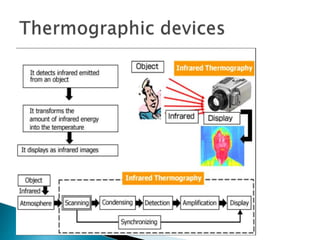
 Infra red thermography is a technique for producing
visible image of invisible infra red radiation emitted object
due to their thermal conditions .
 Infrared thermography is a method, which detects infrared
energy emitted from object, converts it to temperature,
and displays image of temperature distribution. The image
of temperature distribution is called infrared thermograph
and the
method to be called as infrared thermography.
 Every object whose surface temperature is above absolute
zero (0 K) radiates energy at a wavelength corresponding
to its surface temperature. Utilizing our highly sensitive
infrared cameras, it is possible to convert this radiated
energy into a thermal image of the object being surveyed .
After survey findings is provided through the use of two
different types of images.
 Colour Thermo grams (photographs of the infrared image)
and Control Photos are provided of problem areas
uncovered during the inspection.
 A thermal imaging camera consists of five
components:
- optic system
- detector
- amplifier
- signal processing
- display
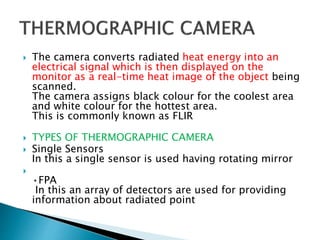
 The camera converts radiated heat energy into an
electrical signal which is then displayed on the
monitor as a real-time heat image of the object being
scanned.
The camera assigns black colour for the coolest area
and white colour for the hottest area.
This is commonly known as FLIR
 TYPES OF THERMOGRAPHIC CAMERA
 Single Sensors
In this a single sensor is used having rotating mirror

•FPA
In this an array of detectors are used for providing
information about radiated point
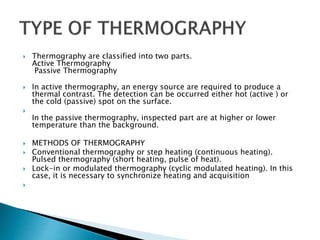
 Thermography are classified into two parts.
Active Thermography
Passive Thermography
 In active thermography, an energy source are required to produce a
thermal contrast. The detection can be occurred either hot (active ) or
the cold (passive) spot on the surface.

In the passive thermography, inspected part are at higher or lower
temperature than the background.
 METHODS OF THERMOGRAPHY
 Conventional thermography or step heating (continuous heating).
Pulsed thermography (short heating, pulse of heat).
 Lock-in or modulated thermography (cyclic modulated heating). In this
case, it is necessary to synchronize heating and acquisition

 Thermal energy detection and measurement equipment comes in a large
variety of forms and levels of sophistication. One way to categorize the
equipment and materials is to separate thermal detectors from quantum
(photon) detectors. The basic distinction between the two is that thermal
detectors depend on a two-step process. The absorption of thermal
energy in these detectors raises the temperature of the device, which in
turn changes some temperature-dependent parameter, such as electrical
conductivity. Quantum devices detect photons from infrared radiation.
Quantum detectors are much more sensitive but require cooling to
operate properly.
 Thermal Detectors:
 Thermal detectors include heat sensitive coatings, thermoelectric
devices and pryoelectric devices. Heat sensitive coatings range from
simple wax-based substances that are blended to melt at certain
temperatures to specially formulated paint and greases that change
color as temperature changes. Heat sensitive coatings are relatively
inexpensive but do not provide good quantitative data.
 Unlike thermal detectors, quantum detectors do not
rely on the conversion of incoming radiation to heat,
but convert incoming photons directly into an
electrical signal. When photons in a particular range
of wavelengths are absorbed by the detector, they
create free electron-hole pairs, which can be detected
as electrical current. The signal output of a quantum
detector is very small and is overshadowed by noise
generated internally to the device at room
temperatures. Since this noise within a
semiconductor is partly proportional to temperature,
quantum detectors are operated at cryogenic
temperatures [i. e. down to 77 K (liquid nitrogen) or 4
K (liquid helium)] to minimize noise.
 It is a non-contact type technique.
Fast, reliable & accurate output.
A large surface area can be scanned in no time.
It is capable of catching moving targets in real
time
Presented in visual & digital form.
Software back-up for image processing and
analysis.
Requires very little skill for monitoring.
It can be used to detect objects in dark areas.
It is able to find deteriorating, i.e., higher
temperature components prior to their failure.
It can be used to measure or observe in areas
inaccessible or hazardous for other methods
 Cost of instrument is relatively high.
 Unable to detect the inside temperature if the medium is
separated by glass/polythenematerial etc.
Accurate temperature measurements are hindered by
differing emissivities and reflections from other surfaces
Most cameras have ±2% accuracy or worse in
measurement of temperature and are not as accurate as
contact methods
Condition of work, depending of the case, can be
drastic:10°C of difference between internal/external,
10km/h of wind maximum, no direct sun, no recent rain,

 Condition monitoring
 Medical imaging
 Veterinary Thermal Imaging
 Night vision
 Surveillance
 Research
 Process control
 Non-destructive testing
 Surveillance in security, law enforcement and
defence
 Chemical imaging
 Volcanology
 Buildings
 A special lens focuses the infrared light emitted by all
of the objects in view.
The focused light is scanned by a phased array of
infrareddetector elements.
 The detector elements create a very detailed
temperature pattern called a thermogram
 The thermogram created by the detector elements is
translated into electric impulses.
 The impulses are sent to a signal-processing unit
that translates the information from the elements
into data for the display.
 Appears as various colours depending on the
intensity of the infrared emission. The combination of
all the impulses from all of the elements creates the
image.

Ndtm 3-thermography

  • 1.
  • 2.
     Thermography- Principles,Contact and non contact inspection methods, Techniques for applying liquid crystals, Advantages and limitation - infrared radiation and infrared detectors, Instrumentations and methods, applications.
  • 3.
     Infra redthermography is a technique for producing visible image of invisible infra red radiation emitted object due to their thermal conditions .  Infrared thermography is a method, which detects infrared energy emitted from object, converts it to temperature, and displays image of temperature distribution. The image of temperature distribution is called infrared thermograph and the method to be called as infrared thermography.  Every object whose surface temperature is above absolute zero (0 K) radiates energy at a wavelength corresponding to its surface temperature. Utilizing our highly sensitive infrared cameras, it is possible to convert this radiated energy into a thermal image of the object being surveyed . After survey findings is provided through the use of two different types of images.  Colour Thermo grams (photographs of the infrared image) and Control Photos are provided of problem areas uncovered during the inspection.
  • 4.
     A thermalimaging camera consists of five components: - optic system - detector - amplifier - signal processing - display
  • 6.
     The cameraconverts radiated heat energy into an electrical signal which is then displayed on the monitor as a real-time heat image of the object being scanned. The camera assigns black colour for the coolest area and white colour for the hottest area. This is commonly known as FLIR  TYPES OF THERMOGRAPHIC CAMERA  Single Sensors In this a single sensor is used having rotating mirror  •FPA In this an array of detectors are used for providing information about radiated point
  • 7.
     Thermography areclassified into two parts. Active Thermography Passive Thermography  In active thermography, an energy source are required to produce a thermal contrast. The detection can be occurred either hot (active ) or the cold (passive) spot on the surface.  In the passive thermography, inspected part are at higher or lower temperature than the background.  METHODS OF THERMOGRAPHY  Conventional thermography or step heating (continuous heating). Pulsed thermography (short heating, pulse of heat).  Lock-in or modulated thermography (cyclic modulated heating). In this case, it is necessary to synchronize heating and acquisition 
  • 8.
     Thermal energydetection and measurement equipment comes in a large variety of forms and levels of sophistication. One way to categorize the equipment and materials is to separate thermal detectors from quantum (photon) detectors. The basic distinction between the two is that thermal detectors depend on a two-step process. The absorption of thermal energy in these detectors raises the temperature of the device, which in turn changes some temperature-dependent parameter, such as electrical conductivity. Quantum devices detect photons from infrared radiation. Quantum detectors are much more sensitive but require cooling to operate properly.  Thermal Detectors:  Thermal detectors include heat sensitive coatings, thermoelectric devices and pryoelectric devices. Heat sensitive coatings range from simple wax-based substances that are blended to melt at certain temperatures to specially formulated paint and greases that change color as temperature changes. Heat sensitive coatings are relatively inexpensive but do not provide good quantitative data.
  • 9.
     Unlike thermaldetectors, quantum detectors do not rely on the conversion of incoming radiation to heat, but convert incoming photons directly into an electrical signal. When photons in a particular range of wavelengths are absorbed by the detector, they create free electron-hole pairs, which can be detected as electrical current. The signal output of a quantum detector is very small and is overshadowed by noise generated internally to the device at room temperatures. Since this noise within a semiconductor is partly proportional to temperature, quantum detectors are operated at cryogenic temperatures [i. e. down to 77 K (liquid nitrogen) or 4 K (liquid helium)] to minimize noise.
  • 10.
     It isa non-contact type technique. Fast, reliable & accurate output. A large surface area can be scanned in no time. It is capable of catching moving targets in real time Presented in visual & digital form. Software back-up for image processing and analysis. Requires very little skill for monitoring. It can be used to detect objects in dark areas. It is able to find deteriorating, i.e., higher temperature components prior to their failure. It can be used to measure or observe in areas inaccessible or hazardous for other methods
  • 11.
     Cost ofinstrument is relatively high.  Unable to detect the inside temperature if the medium is separated by glass/polythenematerial etc. Accurate temperature measurements are hindered by differing emissivities and reflections from other surfaces Most cameras have ±2% accuracy or worse in measurement of temperature and are not as accurate as contact methods Condition of work, depending of the case, can be drastic:10°C of difference between internal/external, 10km/h of wind maximum, no direct sun, no recent rain, 
  • 12.
     Condition monitoring Medical imaging  Veterinary Thermal Imaging  Night vision  Surveillance  Research  Process control  Non-destructive testing  Surveillance in security, law enforcement and defence  Chemical imaging  Volcanology  Buildings
  • 13.
     A speciallens focuses the infrared light emitted by all of the objects in view. The focused light is scanned by a phased array of infrareddetector elements.  The detector elements create a very detailed temperature pattern called a thermogram  The thermogram created by the detector elements is translated into electric impulses.  The impulses are sent to a signal-processing unit that translates the information from the elements into data for the display.  Appears as various colours depending on the intensity of the infrared emission. The combination of all the impulses from all of the elements creates the image.