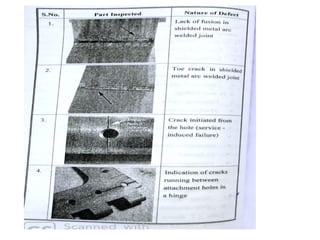
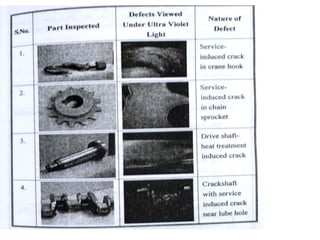
KONGUNADU COLLEGE OF ENGINEERING AND TECHNOLOGY
(AUTONOMOUS)
NAMAKKAL- TRICHY MAIN ROAD, THOTTIAM
DEPARTMENT OF MECHANICAL ENGINEERING
ME8097 NON DESTRUCTIVE TESTING AND EVALUATION
SEVENTH SEMESTER
UNIT-II
PRESENTED BY
M.DINESHKUMAR,
ASSISTANT PROFESSOR,
DEPARTMENT OF MECHANICAL ENGINEERING,
KONGUNADU COLLEGE OF ENGINEERING AND TECHNOLOGY.
ME8097 NON DESTRUCTIVE TESTING AND EVALUATION
OBJECTIVE:
To study and understand the various Non Destructive Evaluation and Testing methods, theory and their industrial applications.
UNIT I OVERVIEW OF NDT 9
NDT Versus Mechanical testing, Overview of the Non Destructive Testing Methods for the detection of manufacturing defects as
well as material characterisation. Relative merits and limitations, Various physical characteristics of materials and their
applications in NDT., Visual inspection –Unaided and aided.
UNIT II SURFACE NDE METHODS 9
Liquid Penetrant Testing - Principles, types and properties of liquid penetrants, developers, advantages and limitations of various
methods, Testing Procedure, Interpretation of results. Magnetic Particle Testing- Theory of magnetism, inspection materials
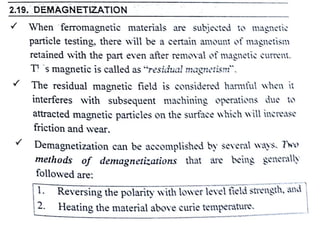
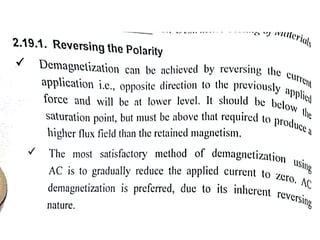
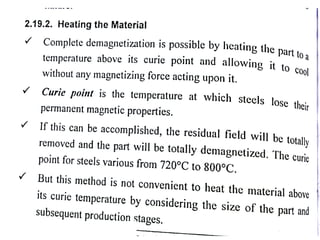
Magnetisation methods, Interpretation and evaluation of test indications, Principles and methods of demagnetization, Residual
magnetism.
UNIT III THERMOGRAPHY AND EDDY CURRENT TESTING (ET) 9
Thermography- Principles, Contact and non contact inspection methods, Techniques for applying liquid crystals, Advantages and
limitation - infrared radiation and infrared detectors, Instrumentations and methods, applications. Eddy Current Testing-Generation
of eddy currents, Properties of eddy currents, Eddy current sensing elements, Probes, Instrumentation, Types of arrangement,
Applications, advantages, Limitations, Interpretation/Evaluation.
UNIT IV ULTRASONIC TESTING (UT) AND ACOUSTIC EMISSION (AE) 9
Ultrasonic Testing-Principle, Transducers, transmission and pulse-echo method, straight beam and angle beam, instrumentation,
data representation, A/Scan, B-scan, C-scan. Phased Array Ultrasound, Time of Flight Diffraction. Acoustic Emission Technique –
Principle, AE parameters, Applications.
UNIT V RADIOGRAPHY (RT) 9
Principle, interaction of X-Ray with matter, imaging, film and film less techniques, types and use of filters and screens, geometric
factors, Inverse square, law, characteristics of films -graininess, density, speed, contrast, characteristic curves, Penetrameters,
Exposure charts, Radiographic equivalence. Fluoroscopy- Xero-Radiography, Computed Radiography, Computed Tomography.
TOTAL : 45 PERIODS
UNIT II SURFACE NDE METHODS
Liquid Penetrant Testing - Principles, types
and properties of liquid penetrants, developers,
advantages and limitations of various methods,
Testing Procedure, Interpretation of results.
Magnetic Particle Testing- Theory of
magnetism, inspection materials Magnetisation
methods, Interpretation and evaluation of test
indications, Principles and methods of
demagnetization, Residual magnetism.
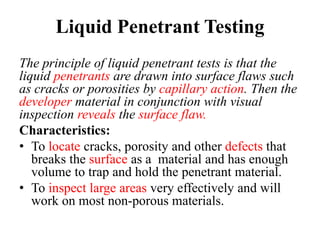
Liquid Penetrant Testing
The principle of liquid penetrant tests is that the
liquid penetrants are drawn into surface flaws such
as cracks or porosities by capillary action. Then the
developer material in conjunction with visual
inspection reveals the surface flaw.
Characteristics:
• To locate cracks, porosity and other defects that
breaks the surface as a material and has enough
volume to trap and hold the penetrant material.
• To inspect large areas very effectively and will
work on most non-porous materials.
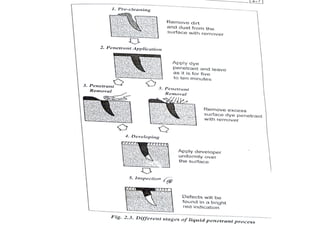
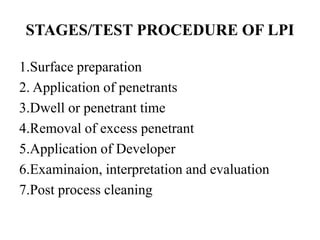
STAGES/TEST PROCEDURE OF LPI
FLOW CHART LPI
STAGES/TEST PROCEDURE OF LPI
1.Surface preparation
2. Application of penetrants
3.Dwell or penetrant time
4.Removal of excess penetrant
5.Application of Developer
6.Examinaion, interpretation and evaluation
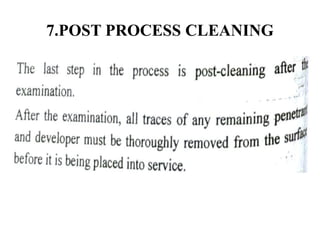
7.Post process cleaning
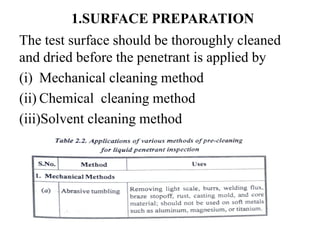
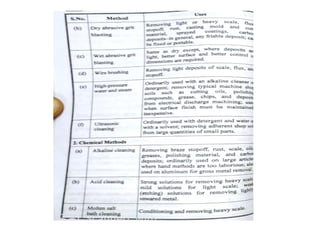
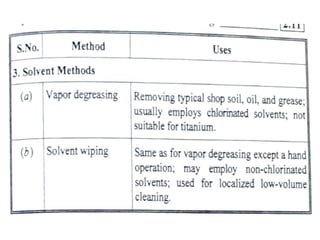
1.SURFACE PREPARATION
The test surface should be thoroughly cleaned
and dried before the penetrant is applied by
(i) Mechanical cleaning method
(ii) Chemical cleaning method
(iii)Solvent cleaning method
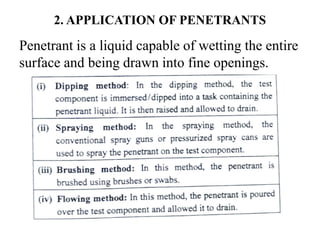
2. APPLICATION OF PENETRANTS
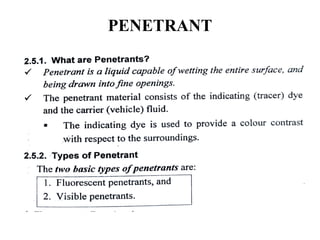
Penetrant is a liquid capable of wetting the entire
surface and being drawn into fine openings.
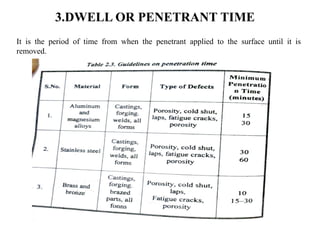
3.DWELL OR PENETRANT TIME
It is the period of time from when the penetrant applied to the surface until it is
removed.
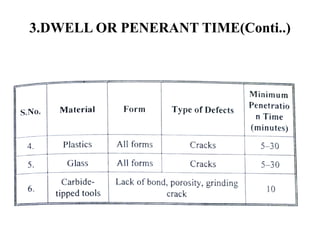
3.DWELL OR PENERANT TIME(Conti..)
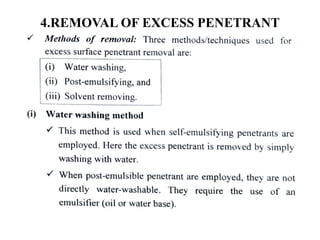
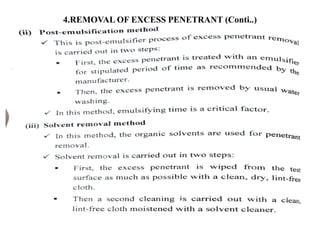
4.REMOVAL OF EXCESS PENETRANT
4.REMOVAL OF EXCESS PENETRANT (Conti..)
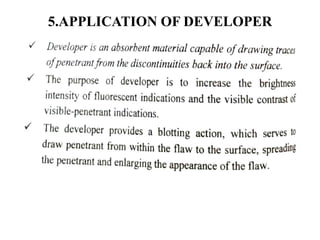
5.APPLICATION OF DEVELOPER
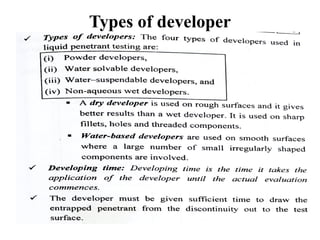
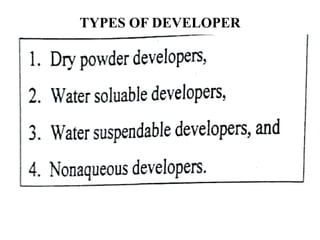
Types of developer
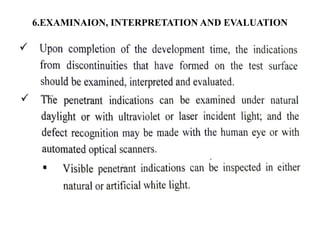
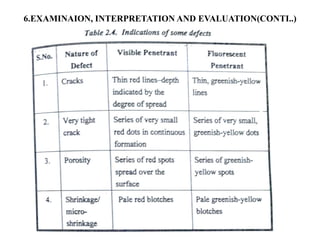
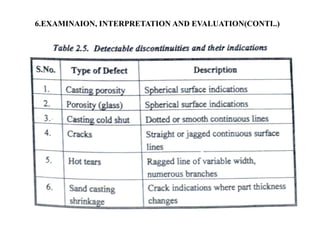
6.EXAMINAION, INTERPRETATION AND EVALUATION
6.EXAMINAION, INTERPRETATION AND EVALUATION(CONTI..)
7.POST PROCESS CLEANING
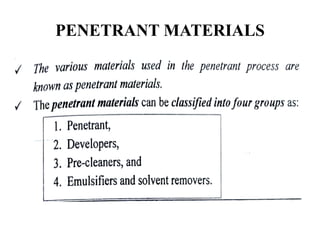
PENETRANT MATERIALS
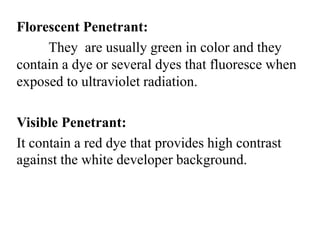
PENETRANT
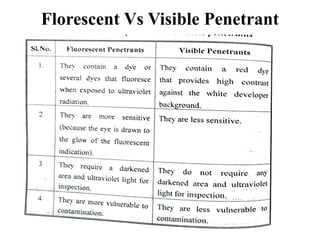
Florescent Penetrant:
They are usually green in color and they
contain a dye or several dyes that fluoresce when
exposed to ultraviolet radiation.
Visible Penetrant:
It contain a red dye that provides high contrast
against the white developer background.
Florescent Vs Visible Penetrant
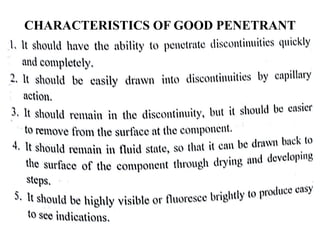
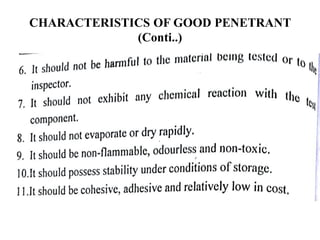
CHARACTERISTICS OF GOOD PENETRANT
(Conti..)
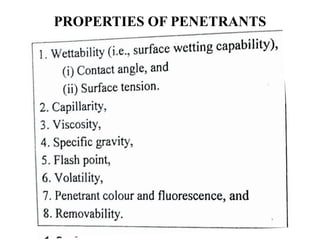
PROPERTIES OF PENETRANTS
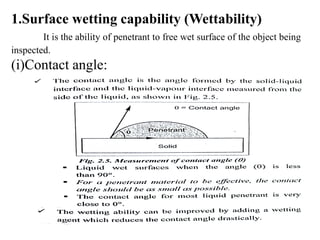
1.Surface wetting capability (Wettability)
It is the ability of penetrant to free wet surface of the object being
inspected.
(i)Contact angle:
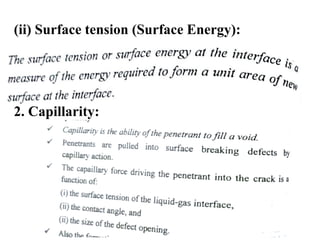
(ii) Surface tension (Surface Energy):
2. Capillarity:
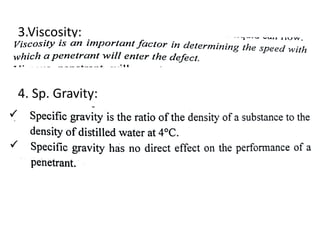
3.Viscosity:
4. Sp. Gravity:
5.Flash point:
6.Volaility:
7.Fluorescent dye thermal stability:
8.Penetrant color and fluorescence:
9.Removability:
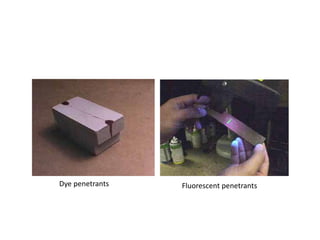
Dye penetrants Fluorescent penetrants
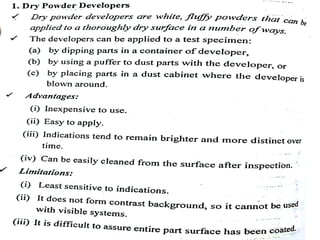
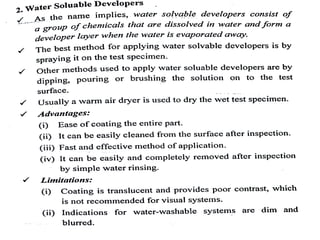
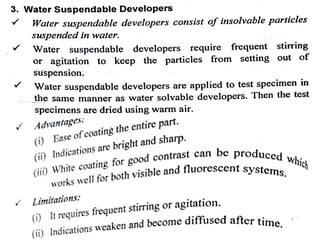
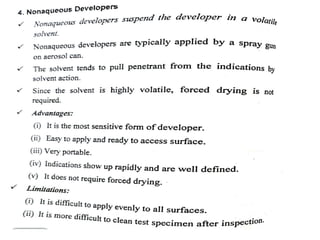
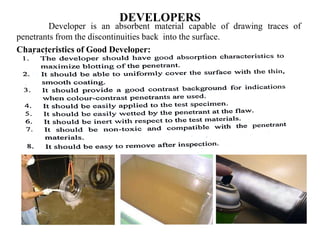
DEVELOPERS
Developer is an absorbent material capable of drawing traces of
penetrants from the discontinuities back into the surface.
Characteristics of Good Developer:
TYPES OF DEVELOPER
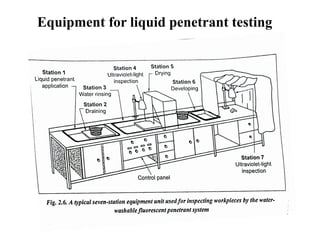
Equipment for liquid penetrant testing
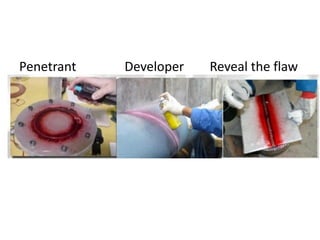
Penetrant Developer Reveal the flaw
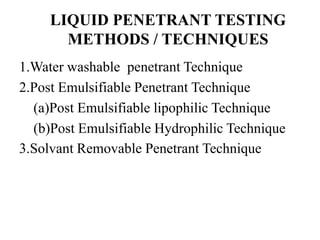
LIQUID PENETRANT TESTING
METHODS / TECHNIQUES
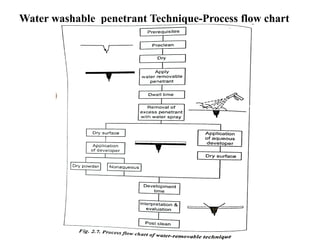
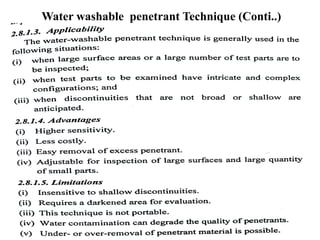
1.Water washable penetrant Technique
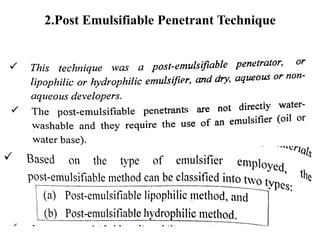
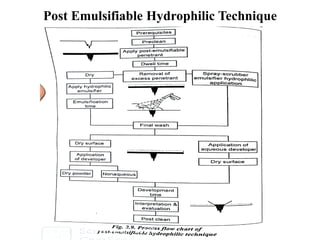
2.Post Emulsifiable Penetrant Technique
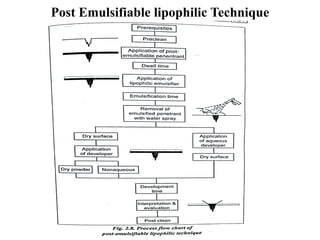
(a)Post Emulsifiable lipophilic Technique
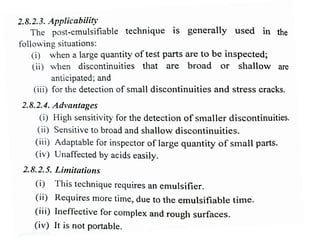
(b)Post Emulsifiable Hydrophilic Technique
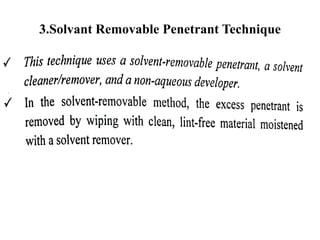
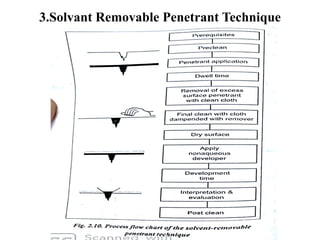
3.Solvant Removable Penetrant Technique
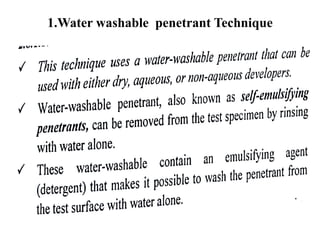
1.Water washable penetrant Technique
Water washable penetrant Technique-Process flow chart
Water washable penetrant Technique (Conti..)
2.Post Emulsifiable Penetrant Technique
Post Emulsifiable lipophilic Technique
Post Emulsifiable Hydrophilic Technique
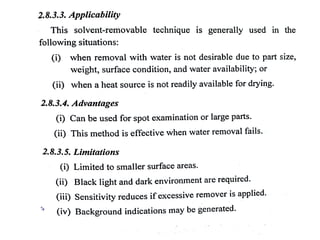
3.Solvant Removable Penetrant Technique
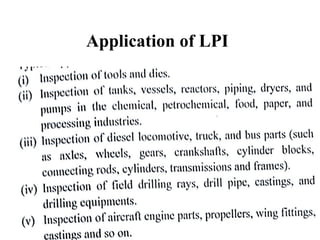
Application of LPI
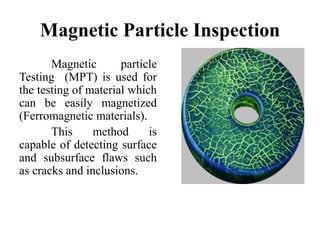
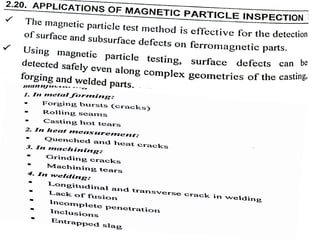
Magnetic Particle Inspection
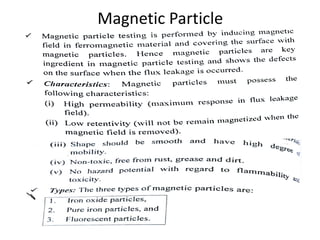
Magnetic particle
Testing (MPT) is used for
the testing of material which
can be easily magnetized
(Ferromagnetic materials).
This method is
capable of detecting surface
and subsurface flaws such
as cracks and inclusions.
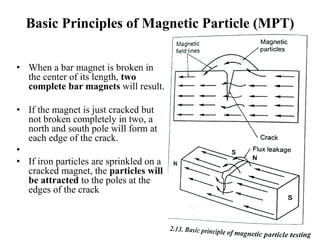
Basic Principles of Magnetic Particle (MPT)
• When a bar magnet is broken in
the center of its length, two
complete bar magnets will result.
• If the magnet is just cracked but
not broken completely in two, a
north and south pole will form at
each edge of the crack.
•
• If iron particles are sprinkled on a
cracked magnet, the particles will
be attracted to the poles at the
edges of the crack
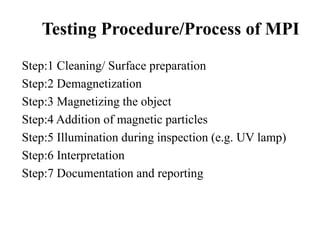
Testing Procedure/Process of MPI
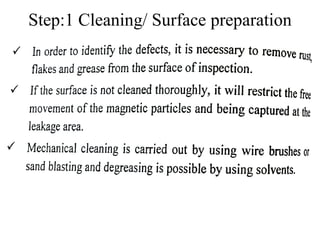
Step:1 Cleaning/ Surface preparation
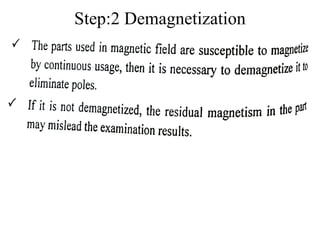
Step:2 Demagnetization
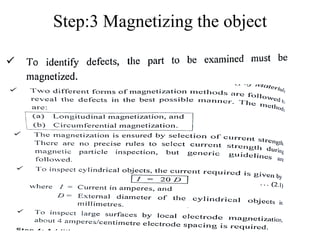
Step:3 Magnetizing the object
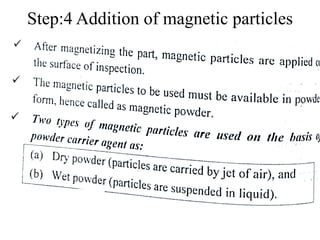
Step:4 Addition of magnetic particles
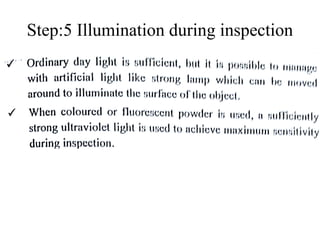
Step:5 Illumination during inspection (e.g. UV lamp)
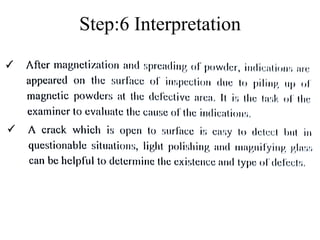
Step:6 Interpretation
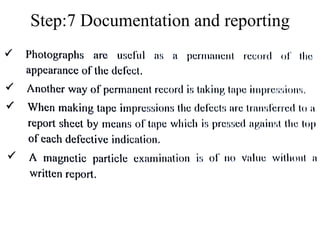
Step:7 Documentation and reporting
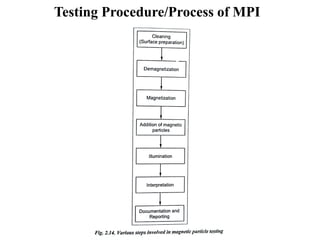
Testing Procedure/Process of MPI
Step:1 Cleaning/ Surface preparation
Step:2 Demagnetization
Step:3 Magnetizing the object
Step:4 Addition of magnetic particles
Step:5 Illumination during inspection
Step:6 Interpretation
Step:7 Documentation and reporting
MPI- INSPECTION TECHNIQUES
• Dry particle inspection technique
• Wet particle inspection technique
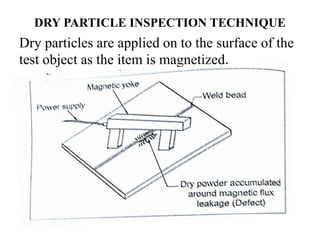
DRY PARTICLE INSPECTION TECHNIQUE
Dry particles are applied on to the surface of the
test object as the item is magnetized.
STEPS IN DRY PARTICLE INSPECTION TECHNIQUE
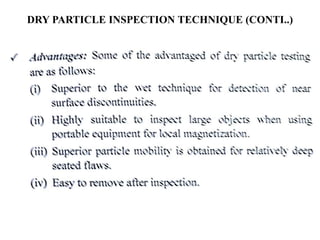
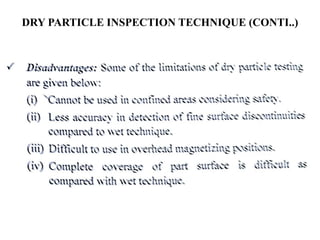
DRY PARTICLE INSPECTION TECHNIQUE (CONTI..)
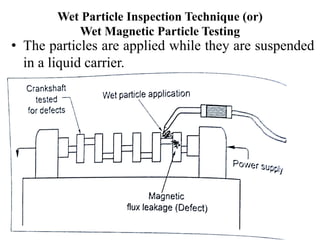
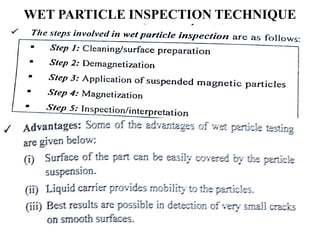
Wet Particle Inspection Technique (or)
Wet Magnetic Particle Testing
• The particles are applied while they are suspended
in a liquid carrier.
WET PARTICLE INSPECTION TECHNIQUE
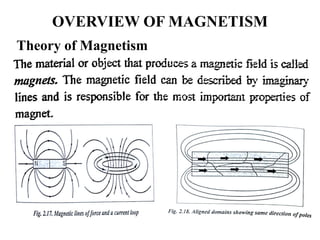
OVERVIEW OF MAGNETISM
Theory of Magnetism
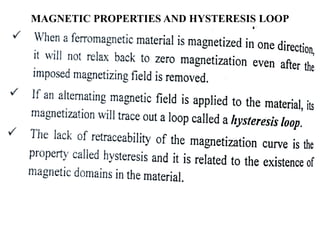
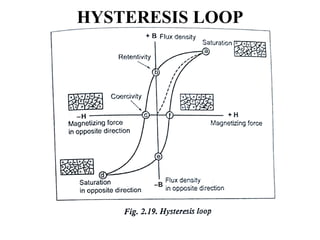
MAGNETIC PROPERTIES AND HYSTERESIS LOOP
HYSTERESIS LOOP
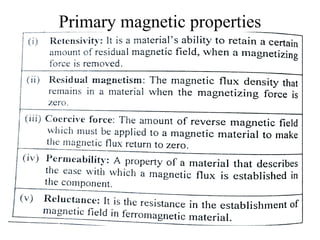
Primary magnetic properties
MAGNETIC FIELD ORIENTATION IN MPI
• In MPI, the orientation of magnetic lines of
forces is important in detection of cracks or
other defects.
• Types of Magnetic field,
– Longitudinal Magnetic field
– Circular Magnetic field
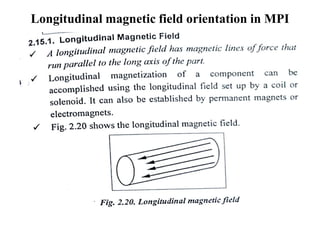
Longitudinal magnetic field orientation in MPI
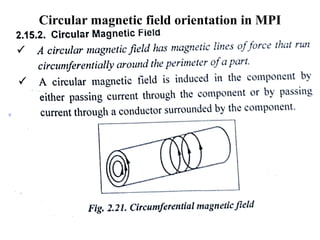
Circular magnetic field orientation in MPI
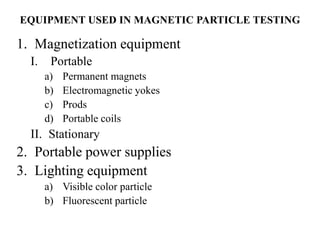
EQUIPMENT USED IN MAGNETIC PARTICLE TESTING
1. Magnetization equipment
I. Portable
a) Permanent magnets
b) Electromagnetic yokes
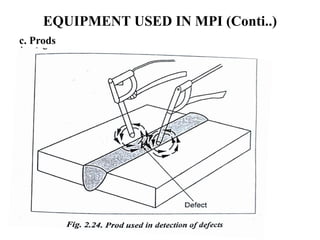
c) Prods
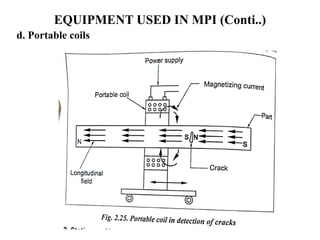
d) Portable coils
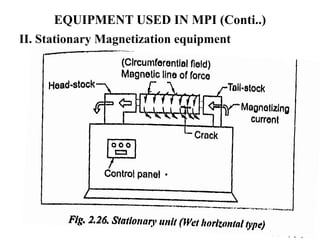
II. Stationary
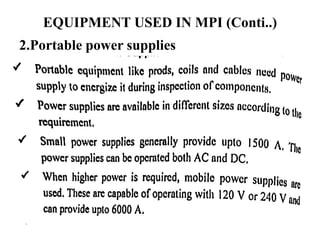
2. Portable power supplies
3. Lighting equipment
a) Visible color particle
b) Fluorescent particle
EQUIPMENT USED IN MPI (Conti..)
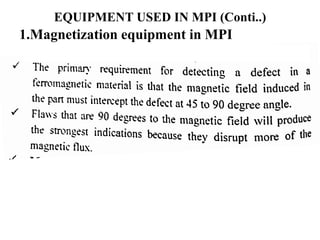
1.Magnetization equipment in MPI
EQUIPMENT USED IN MPI (Conti..)
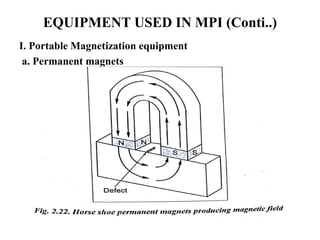
I. Portable Magnetization equipment
a. Permanent magnets
EQUIPMENT USED IN MPI (Conti..)
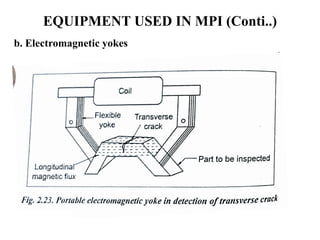
b. Electromagnetic yokes
EQUIPMENT USED IN MPI (Conti..)
c. Prods
EQUIPMENT USED IN MPI (Conti..)
d. Portable coils
EQUIPMENT USED IN MPI (Conti..)
II. Stationary Magnetization equipment
EQUIPMENT USED IN MPI (Conti..)
2.Portable power supplies
EQUIPMENT USED IN MPI (Conti..)
3.Lighting equipment
EQUIPMENT USED IN MPI (Conti..)
3.Lighting equipment
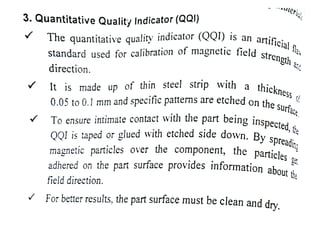
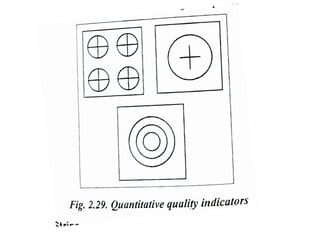
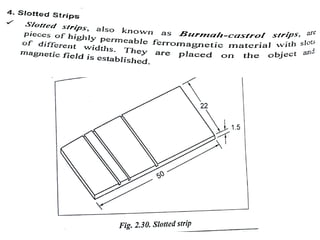
EQUIPMENT USED IN DETERMINATION OF MAGNETIC
FIELD STRENGTH AND DIRECION
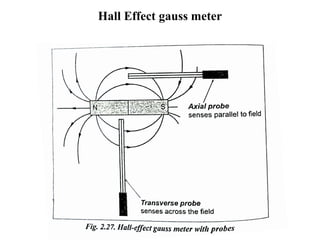
Hall Effect gauss meter
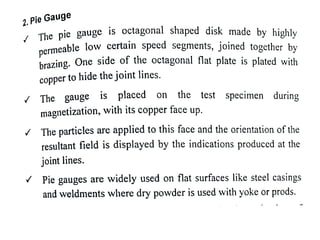
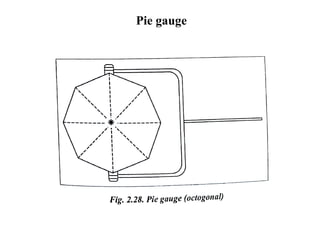
Pie gauge
Magnetic Particle
Unit II SURFACE NDE METHODS

Unit II SURFACE NDE METHODS