M.KARTHIKEYAN AAACET Page 1
UNIT I PRINCIPLES OF SOLAR RADIATION
ROLE OF NEW AND RENEWABLE SOURCE
1. With technological advancements in mass communication, people have now
become aware of the demerits of burning fossil fuels. Renewable energy is
the need of the hour.
2. Scientists and Engineers, around the world, are continuously working and
researching in this domain. They are finding new ways to use these sources
of energy effectively.
3. Fossil fuels are finite. They will certainly end one day. Therefore, before the
crucial stage comes up, experts of energy sectors must maintain a positive
attitude in this regard and should try their level best to replace fossils fuels
with renewable energy sources as the main sources of generating electricity.
4. Renewable energy can make the electricity prices stable. It is because their
cost is dependent only on the initial invested capital and is free of the
fluctuating costs of coal, oil and natural gas.
ECONOMY & JOBS
1. Most renewable energy investments are spent on materials and
workmanship to build and maintain the facilities, rather than on costly
energy imports.
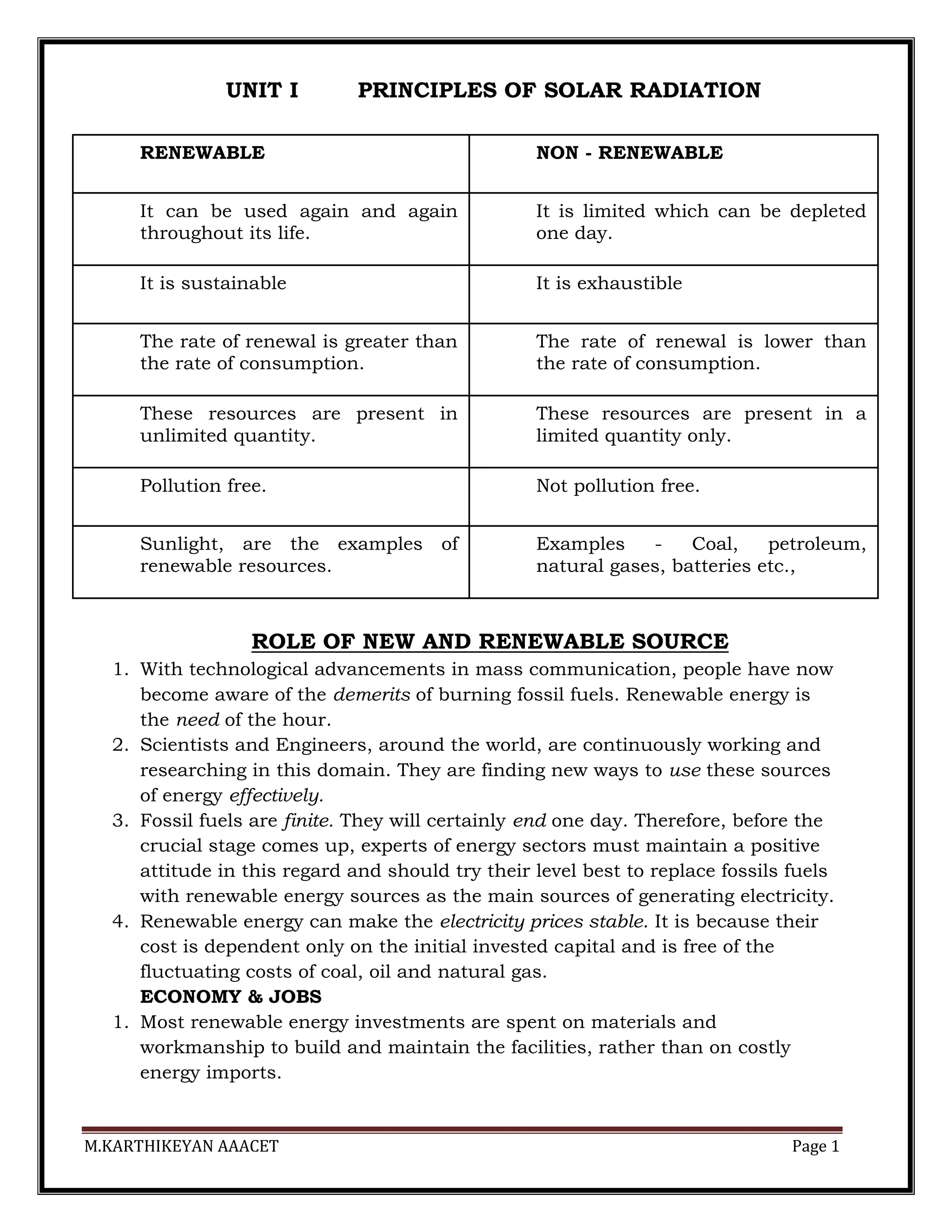
RENEWABLE NON - RENEWABLE
It can be used again and again
throughout its life.
It is limited which can be depleted
one day.
It is sustainable It is exhaustible
The rate of renewal is greater than
the rate of consumption.
The rate of renewal is lower than
the rate of consumption.
These resources are present in
unlimited quantity.
These resources are present in a
limited quantity only.
Pollution free. Not pollution free.
Sunlight, are the examples of
renewable resources.
Examples - Coal, petroleum,
natural gases, batteries etc.,
M.KARTHIKEYAN AAACET Page 2
2. Renewable energy sector is comparatively new in most countries and this
sector can attract a lot of companies to invest in it.
3. It will create more local jobs & increase the nation’s economy.
GREATER INDEPENDENCE
1. The daily price of oil depends on various factors which also includes political
stability in various regions of the globe. In the past, political discords have
caused severe energy crises. Renewable energy can be locally produced and
therefore, it is not vulnerable to distant political disturbances.
2. Armed with solar panels, as well as additional equipment such as SMA
inverters and batteries, every household can produce their own energy.
ADVANTAGES
1. Renewable energy is infinite.
2. Renewable energy technologies are clean sources of energy.
3. Lower environmental impact.
4. It is a safe form of energy.
5. It can be collected in multiple locations simultaneously.
6. It can provide nations with energy independence.
7. It is relatively easy to maintain renewable energy collectors.
8. It can be used to recycle our waste products.
9. Renewable energy sources are available in nature at free of cost.
DISADVANTAGES
1. It has expensive storage costs.
2. It can take a lot of space to install.
3. Depends on nature’s mercy.
POTENTIAL OF NEW AND RENEWABLE SOURCE IN INDIA
 India is running one of the largest and most ambitious renewable capacity
expansion programs in the world.
 In the electricity sector, renewable energy account for 35% of the total
installed power capacity.
 Large hydro installed capacity was 45.399 GW as of 31 March 2019,
contributing to 13% of the total power capacity.
 The remaining renewable energy sources accounted for 22% of the total
installed power capacity (77.641 GW) as of 31 March 2019.
HYDEL POWER CAPACITY
 Hydroelectricity is administered separately by the Ministry of Power and not
included in MNRE targets.
 India is the 7th largest producer of hydroelectric power in the world.
 As of 30 April 2017, India's installed utility-scale hydroelectric capacity was
44,594 MW, or 13% of its total utility power generation capacity.
M.KARTHIKEYAN AAACET Page 3
 Additional smaller hydroelectric power units with a total capacity of 4,380
MW (1.3% of its total utility power generation capacity) have been installed.
 Small hydropower, defined to be generated at facilities with nameplate
capacities up to 25 MW, comes under the ambit of the Ministry of New and
Renewable energy (MNRE); whilst large hydro, defined as above 25 MW,
comes under the ambit of Ministry of Power.
1] SOLAR PHOTOVOLTAIC SYSTEM
 Photovoltaic system, also PV system or solar power system, is a power
system designed to supply solar power by means of photovoltaics.
It consists of
 Solar panels to absorb and convert sunlight into electricity,
 Solar inverter to change the electric current from DC to AC.
M.KARTHIKEYAN AAACET Page 4
2] SOLAR WATER HEATING
 Solar water heating (SWH) is the conversion of sunlight into heat for water
heating using a solar thermal collector.
3] SOLAR THERMAL POWER PLANT
 Solar thermal energy (STE) is a form of energy and a technology for
harnessing solar energy to generate electrical energy for use in industry,
and in the residential and commercial sectors.
M.KARTHIKEYAN AAACET Page 5
4] SOLAR COOKER
EXTRATERRESTRIAL / TERRESTRIAL SOLAR RADIATION
M.KARTHIKEYAN AAACET Page 6
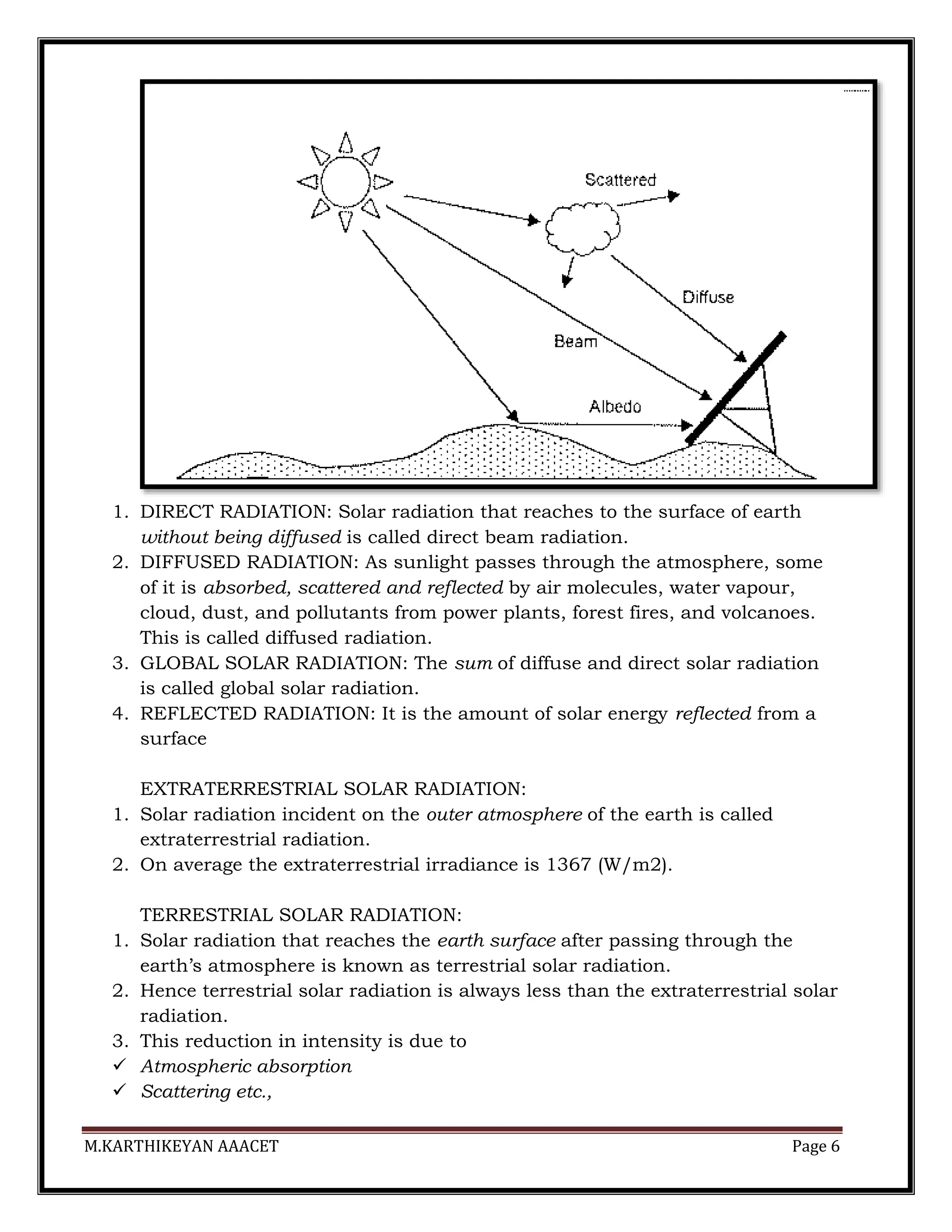
1. DIRECT RADIATION: Solar radiation that reaches to the surface of earth
without being diffused is called direct beam radiation.
2. DIFFUSED RADIATION: As sunlight passes through the atmosphere, some
of it is absorbed, scattered and reflected by air molecules, water vapour,
cloud, dust, and pollutants from power plants, forest fires, and volcanoes.
This is called diffused radiation.
3. GLOBAL SOLAR RADIATION: The sum of diffuse and direct solar radiation
is called global solar radiation.
4. REFLECTED RADIATION: It is the amount of solar energy reflected from a
surface
EXTRATERRESTRIAL SOLAR RADIATION:
1. Solar radiation incident on the outer atmosphere of the earth is called
extraterrestrial radiation.
2. On average the extraterrestrial irradiance is 1367 (W/m2).
TERRESTRIAL SOLAR RADIATION:
1. Solar radiation that reaches the earth surface after passing through the
earth’s atmosphere is known as terrestrial solar radiation.
2. Hence terrestrial solar radiation is always less than the extraterrestrial solar
radiation.
3. This reduction in intensity is due to
 Atmospheric absorption
 Scattering etc.,
M.KARTHIKEYAN AAACET Page 7
INSTRUMENTS FOR MEASURING SOLAR RADIATION
To measure global or diffuse radiation:
I. PYRANOMETER
1. Eppley Pyranometer
2. Yellot solarimeter [photovoltaic cell pyranometer]
3. Moll – Goreczynski Pyranometer
4. Bimetallic Pyranograph
5. Yanishevsky Pyranometer
6. Dirmhirn-Sauberer or Star Pyranometer
To measure beam or direct radiation:
II. PYRHELIOMETER
1. Angstrom pyreheliometer
2. Abbot silver disc pyreheliometer
3. Eppley pyreheliometer
PYRANOMETER
 A pyranometer is used to measure global solar radiation falling on a
horizontal surface.
 Pyranometer also measure diffused radiation by using a shading ring.
 The shading ring will prevent the falling of beam radiation on the sensor.
 Its sensor has a horizontal radiation-sensing surface that absorbs solar
radiation energy from the whole sky and transforms this energy into heat.
 Global solar radiation can be calculated by measuring this heat energy.
 Most pyranometers in general use are now the thermopile type, although
bimetallic pyranometers are occasionally found.
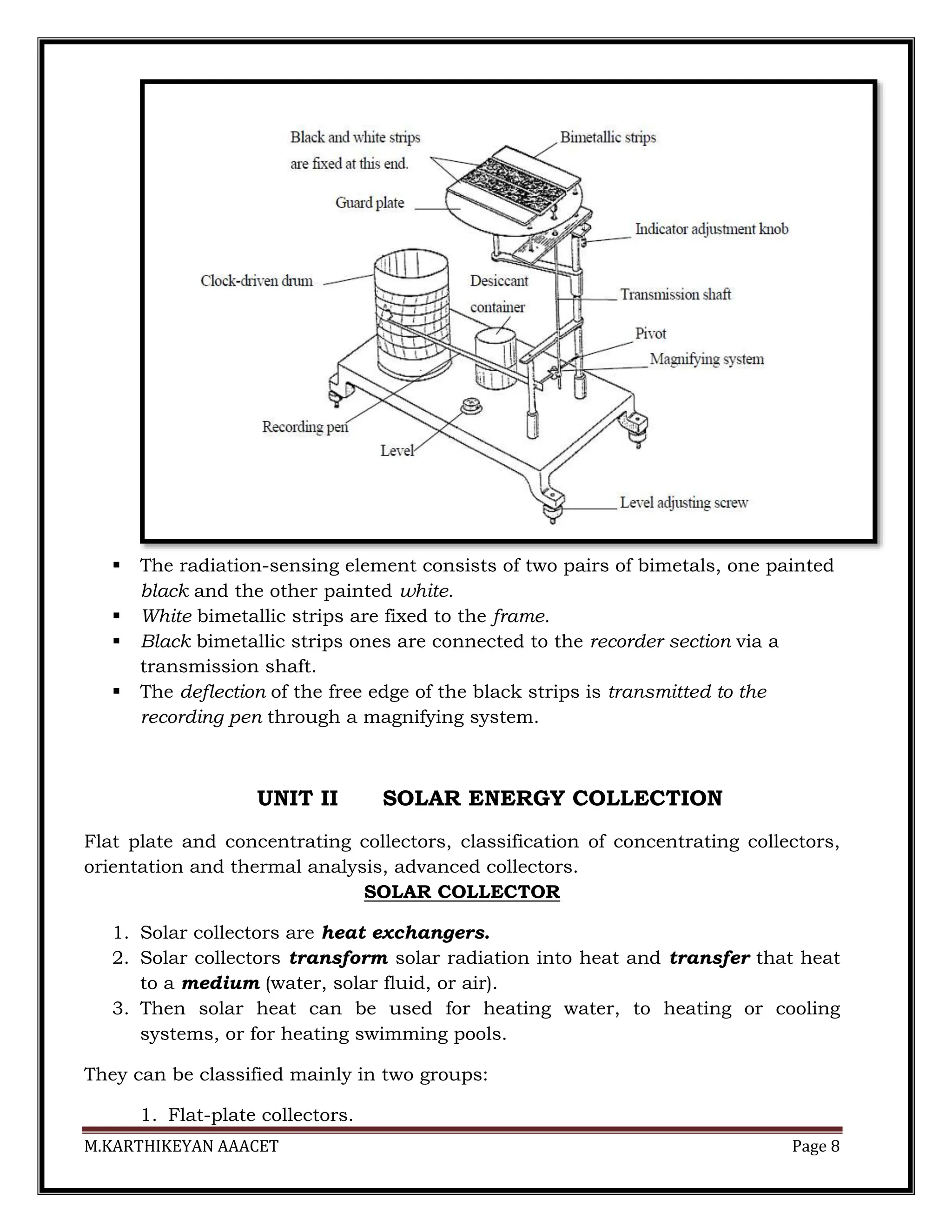
 BIMETALLIC PYRANOGRAPH
 A bimetallic strip is used to convert a temperature change into mechanical
displacement.
 A bimetal strip is made of two thin metal strips that have different
coefficients of expansion.
 The two metal strips are joined by brazing, so that the relative movement
between them is stopped.
M.KARTHIKEYAN AAACET Page 8
 The radiation-sensing element consists of two pairs of bimetals, one painted
black and the other painted white.
 White bimetallic strips are fixed to the frame.
 Black bimetallic strips ones are connected to the recorder section via a
transmission shaft.
 The deflection of the free edge of the black strips is transmitted to the
recording pen through a magnifying system.
UNIT II SOLAR ENERGY COLLECTION
Flat plate and concentrating collectors, classification of concentrating collectors,
orientation and thermal analysis, advanced collectors.
SOLAR COLLECTOR
1. Solar collectors are heat exchangers.
2. Solar collectors transform solar radiation into heat and transfer that heat
to a medium (water, solar fluid, or air).
3. Then solar heat can be used for heating water, to heating or cooling
systems, or for heating swimming pools.
They can be classified mainly in two groups:
1. Flat-plate collectors.
M.KARTHIKEYAN AAACET Page 9
2. Concentrating or focusing collectors.
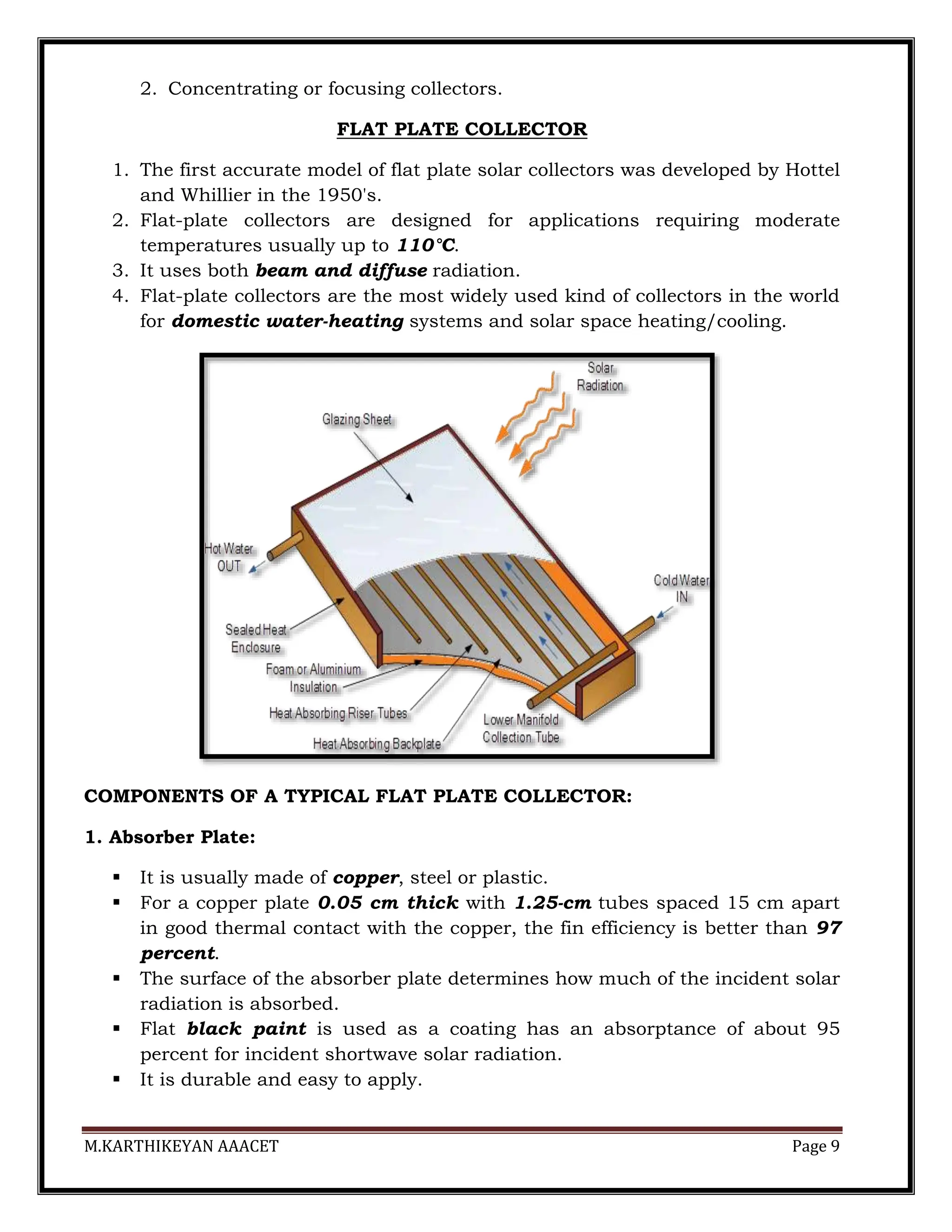
FLAT PLATE COLLECTOR
1. The first accurate model of flat plate solar collectors was developed by Hottel
and Whillier in the 1950's.
2. Flat-plate collectors are designed for applications requiring moderate
temperatures usually up to 110°C.
3. It uses both beam and diffuse radiation.
4. Flat-plate collectors are the most widely used kind of collectors in the world
for domestic water-heating systems and solar space heating/cooling.
COMPONENTS OF A TYPICAL FLAT PLATE COLLECTOR:
1. Absorber Plate:
 It is usually made of copper, steel or plastic.
 For a copper plate 0.05 cm thick with 1.25-cm tubes spaced 15 cm apart
in good thermal contact with the copper, the fin efficiency is better than 97
percent.
 The surface of the absorber plate determines how much of the incident solar
radiation is absorbed.
 Flat black paint is used as a coating has an absorptance of about 95
percent for incident shortwave solar radiation.
 It is durable and easy to apply.
M.KARTHIKEYAN AAACET Page 10
2. Flow passages:
 The flow passages conduct the working fluid through the collector.
 If the working fluid is a liquid , the flow passage is usually a tube that is
attached to or is a part of absorber plate.
 If the working fluid is air , the flow passage should be below the absorber
plate to minimize heat loss.
3. Cover plate:
 To reduce convective and radiative heat losses from the absorber , one or
two transparent covers are generally placed above the absorber plate.
 A cover plate for a collector should have a high transmittance for solar
radiation and should not detoriate with time.
 The material most commonly used is glass.
 A 0.32-cm thick sheet of window glass transmits 85 percent of solar energy
at normal incidence.
 Some plastic materials can be used for collector glazing.
 However, they are not as durable as glass and they often degrade with
exposure to high temperatures.
4. Insulation:
 These are some materials such as fiberglass and they are placed at the
back and sides of the collector to reduce heat losses.
5. Enclosure:
 A box that the collector is enclosed in holds the components together,
protect them from weather, facilitates installation of the collector on a
roof or appropriate frame.
WORKING PRINCIPLE
1. The solar radiations after passing through the transparent cover falls on the
absorber plate.
2. The absorbed radiations partly get transferred to a liquid flowing through
tubes.
3. These copper tubes are fixed to the absorber plate.
4. The liquid most commonly used is water.
5. This energy transfer is the useful gain.
6. The remaining part of the radiation is lost by
 convection and re-radiation from the top surface and by
 conduction through the back and the edges.
 convection and re-radiation loss can be reduced by transparent glass
M.KARTHIKEYAN AAACET Page 11
 conduction loss can be reduced by thermal insulation.
7. In order to reduce the heat lost by re-radiation from the top of the absorber
plate of a flat plate collector, it is usual to put a selective coating on the
plate.
8. The selective coating exhibits the characteristic of a high value of
absorptivity for incoming solar radiation and a low value of
emissivity for outgoing re-radiation.
9. As a result, the collection efficiency of the flat plate collector is improved.
FACTORS AFFECTING THE PERFORMANCE OF SYSTEM ARE
1. Incident Solar Radiation.
2. Number of Cover Plate = More than two cover plate should not be used.
3. Spacing = spacing between absorber and cover plate is kept 2-3 cm.
4. Collector Tilt = optimum tilt angle is kept +/-15 °
5. Inlet Temperature = low temperature fluid absorbs more heat.
6. Dust on cover Plate = Frequent cleaning is required
ADVANTAGES
1. Collect both beam and diffuse radiation
2. Permanently fixed (no sophisticated positioning or tracking equipment is
required)
3. Easy to manufacture
4. Low cost
5. Little maintenance
APPLICATIONS
1. Domestic water heating system.
2. For heating swimming pools.
3. Solar heating dryers.
4. Solarium
TYPES OF FLAT PLATE COLLECTOR
1. Modified Flat Plate Collector
2. Evacuated Tube Collector
3. Solar Air Heater
1.] MODIFIED FLAT PLATE COLLECTOR
M.KARTHIKEYAN AAACET Page 12
CONSTRUCTION & WORKING - refer flat plate collector - In addition to that .,
1. Modified flat plate collector have reflective side faces (mirror) .
2. With the help of mirror higher concentration upto 10 is achieved & higher
temperature of working fluids upto 200°c is achieved.
3. Modified flat plate collector is aligned in East-West direction and it requires
a periodic tilt adjustment.
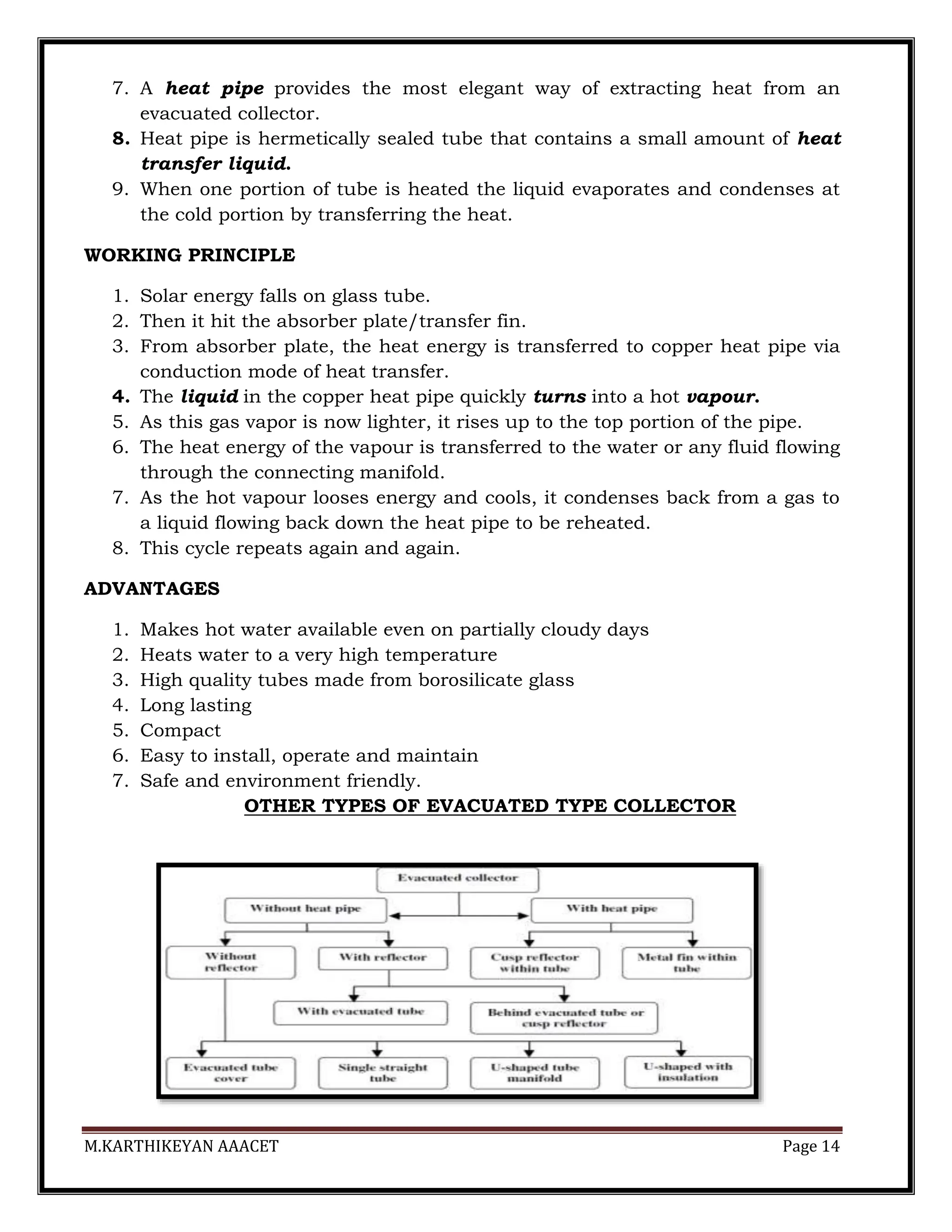
2.] EVACUATED TUBE COLLECTOR
M.KARTHIKEYAN AAACET Page 13
CONSTRUCTION DETAILS
1. The Evacuated tube collector consists of a number of rows of parallel
annealed glass tubes.
2. These glass tubes are cylindrical in shape and they are connected to a
header pipe.
 tube diameter varies from between 1" to 3"
 tube length varies from between 5’′ to 8′’
3. Each tube consists of a thick glass outer tube and a thinner glass inner
tube, which is covered with a special coating that absorbs solar energy
but inhibits heat loss.
4. The insulation properties of the vacuum are so good that while the inner
tube may be as high as 200oC,
5. The tubes are made of borosilicate or soda lime glass, which is strong and
withstand high temperatures.
6. Inside the each glass tube, a flat or curved aluminium or copper fin/ [or
absorber plate] is attached to a metal heat pipe.
M.KARTHIKEYAN AAACET Page 14
7. A heat pipe provides the most elegant way of extracting heat from an
evacuated collector.
8. Heat pipe is hermetically sealed tube that contains a small amount of heat
transfer liquid.
9. When one portion of tube is heated the liquid evaporates and condenses at
the cold portion by transferring the heat.
WORKING PRINCIPLE
1. Solar energy falls on glass tube.
2. Then it hit the absorber plate/transfer fin.
3. From absorber plate, the heat energy is transferred to copper heat pipe via
conduction mode of heat transfer.
4. The liquid in the copper heat pipe quickly turns into a hot vapour.
5. As this gas vapor is now lighter, it rises up to the top portion of the pipe.
6. The heat energy of the vapour is transferred to the water or any fluid flowing
through the connecting manifold.
7. As the hot vapour looses energy and cools, it condenses back from a gas to
a liquid flowing back down the heat pipe to be reheated.
8. This cycle repeats again and again.
ADVANTAGES
1. Makes hot water available even on partially cloudy days
2. Heats water to a very high temperature
3. High quality tubes made from borosilicate glass
4. Long lasting
5. Compact
6. Easy to install, operate and maintain
7. Safe and environment friendly.
OTHER TYPES OF EVACUATED TYPE COLLECTOR
M.KARTHIKEYAN AAACET Page 15
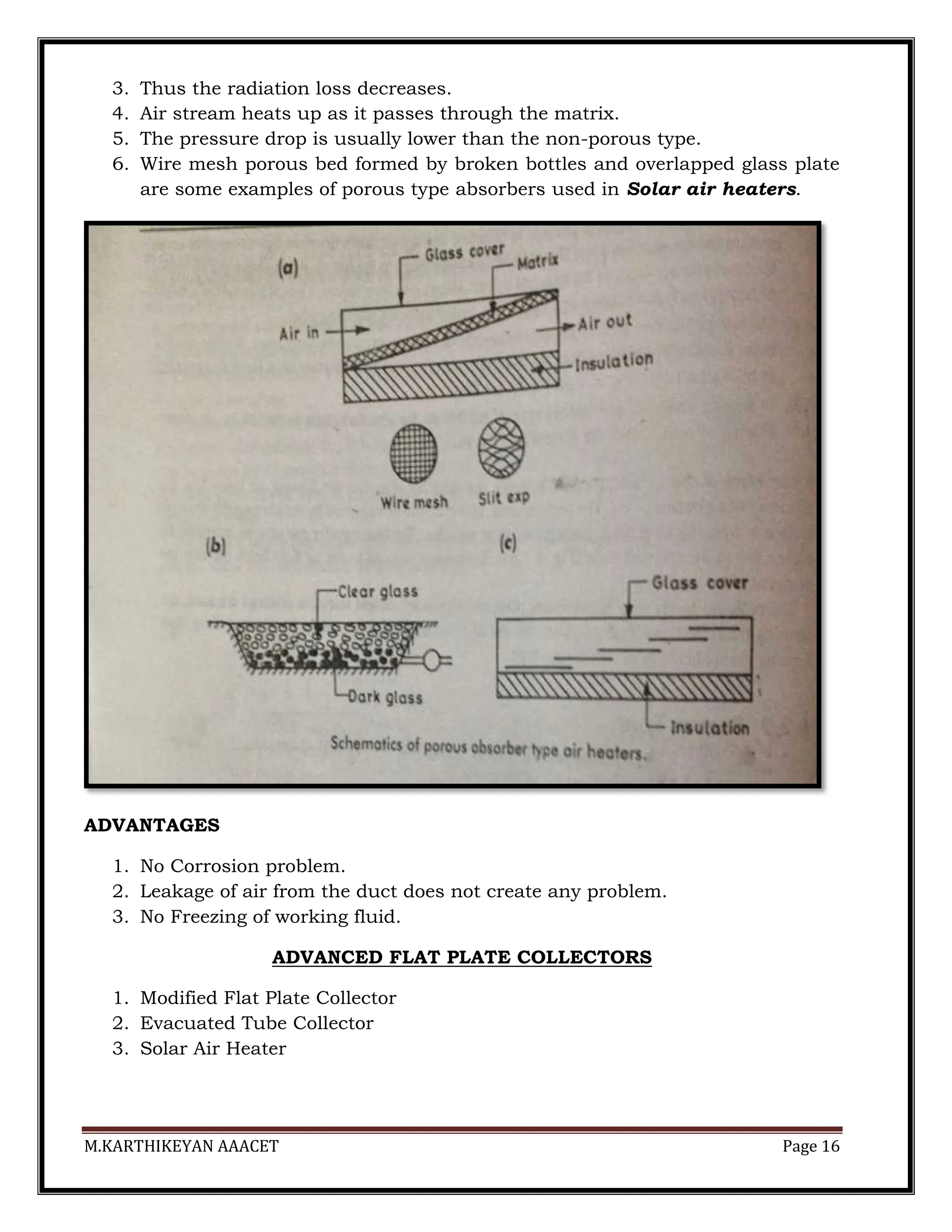
3.] SOLAR AIR HEATER
 Solar air collector consists of a flat, dark metal absorber plate encased in an
airtight, insulated metal frame with glass over the top.
 A solar air heater works in two basic ways.
NON-POROUS TYPE SOLAR AIR HEATER
1. In this type, air stream flows above and/or behind the absorber plate.
2. The cover receives much of the heat and in turn, loses it to the ambient.
3. Thus a substantial amount of heat is lost to the ambient and hence this air
heater is not recommended.
4. The non-porous type with air passage below the absorber is most commonly
used.
 The performance, can be improved by
 roughening the absorber surface or
 by using a vee-corrugated plate.
 Introducing Turbulence
 usage of fin
 selective coatings are used.
POROUS TYPE SOLAR AIR HEATER
1. The porous type of air heaters has porous absorber which may include slit
and expanded metal, overlapped glass plat absorber and transpired
honeycomb.
2. Solar radiation penetrates to a great depth.
M.KARTHIKEYAN AAACET Page 16
3. Thus the radiation loss decreases.
4. Air stream heats up as it passes through the matrix.
5. The pressure drop is usually lower than the non-porous type.
6. Wire mesh porous bed formed by broken bottles and overlapped glass plate
are some examples of porous type absorbers used in Solar air heaters.
ADVANTAGES
1. No Corrosion problem.
2. Leakage of air from the duct does not create any problem.
3. No Freezing of working fluid.
ADVANCED FLAT PLATE COLLECTORS
1. Modified Flat Plate Collector
2. Evacuated Tube Collector
3. Solar Air Heater
M.KARTHIKEYAN AAACET Page 17
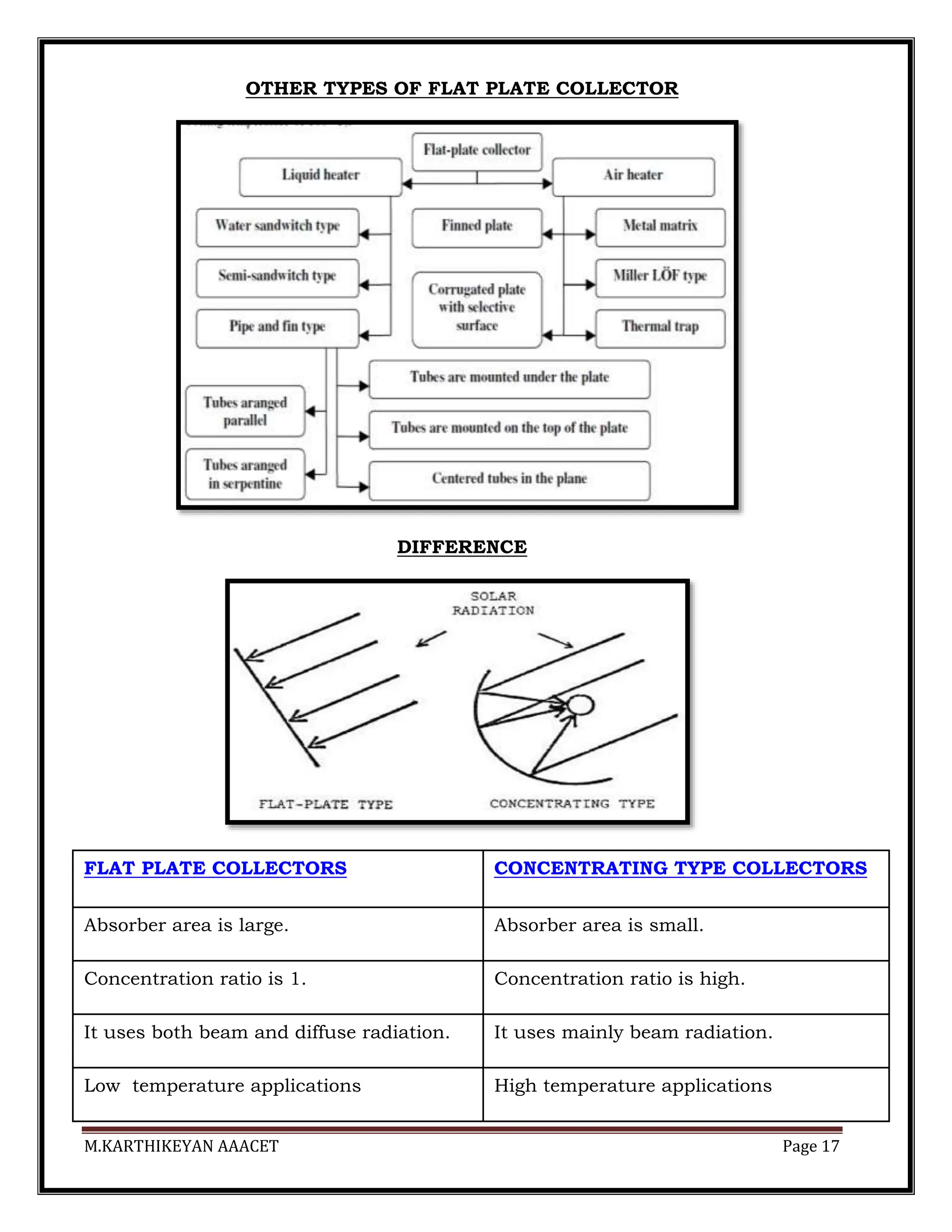
OTHER TYPES OF FLAT PLATE COLLECTOR
DIFFERENCE
FLAT PLATE COLLECTORS CONCENTRATING TYPE COLLECTORS
Absorber area is large. Absorber area is small.
Concentration ratio is 1. Concentration ratio is high.
It uses both beam and diffuse radiation. It uses mainly beam radiation.
Low temperature applications High temperature applications
M.KARTHIKEYAN AAACET Page 18
Due to low temperature, it does not use to
produce power.
Due to high temperature, it can be used
for power generation.
Simple in maintenance. Difficult in maintenance.
Design is easy. Complex design.
This is comparatively low cost. This is costly.
FLAT PLATE COLLECTOR ORIENTATION
Flat plate collectorts are divided in three main groups according to how they
are oriented:
1. Flat-plate collectors facing south at fixed tilt
2. One-axis tracking flat-plate collectors with axis oriented north-south
3. Two-axis tracking flat-plate collectors
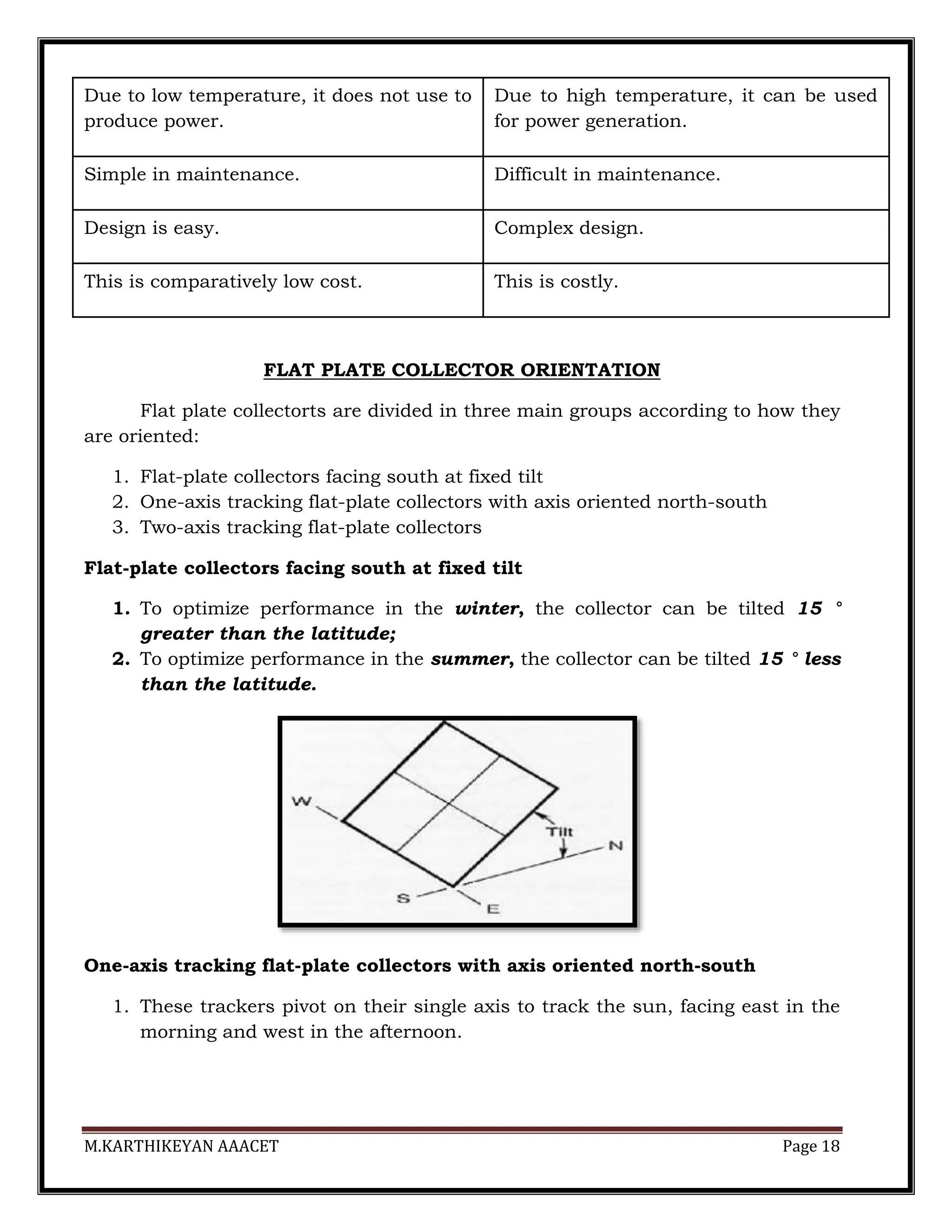
Flat-plate collectors facing south at fixed tilt
1. To optimize performance in the winter, the collector can be tilted 15 °
greater than the latitude;
2. To optimize performance in the summer, the collector can be tilted 15 ° less
than the latitude.
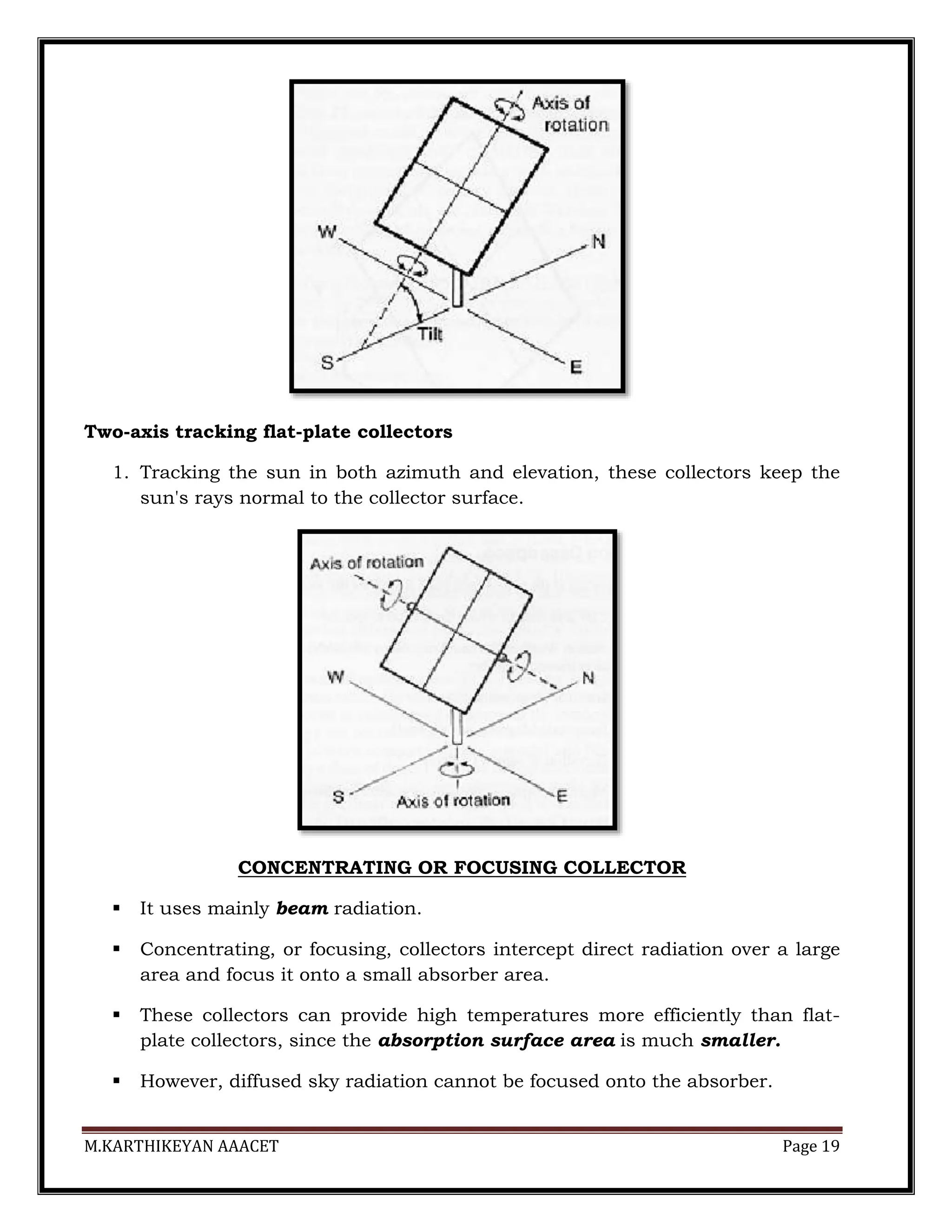
One-axis tracking flat-plate collectors with axis oriented north-south
1. These trackers pivot on their single axis to track the sun, facing east in the
morning and west in the afternoon.
M.KARTHIKEYAN AAACET Page 19
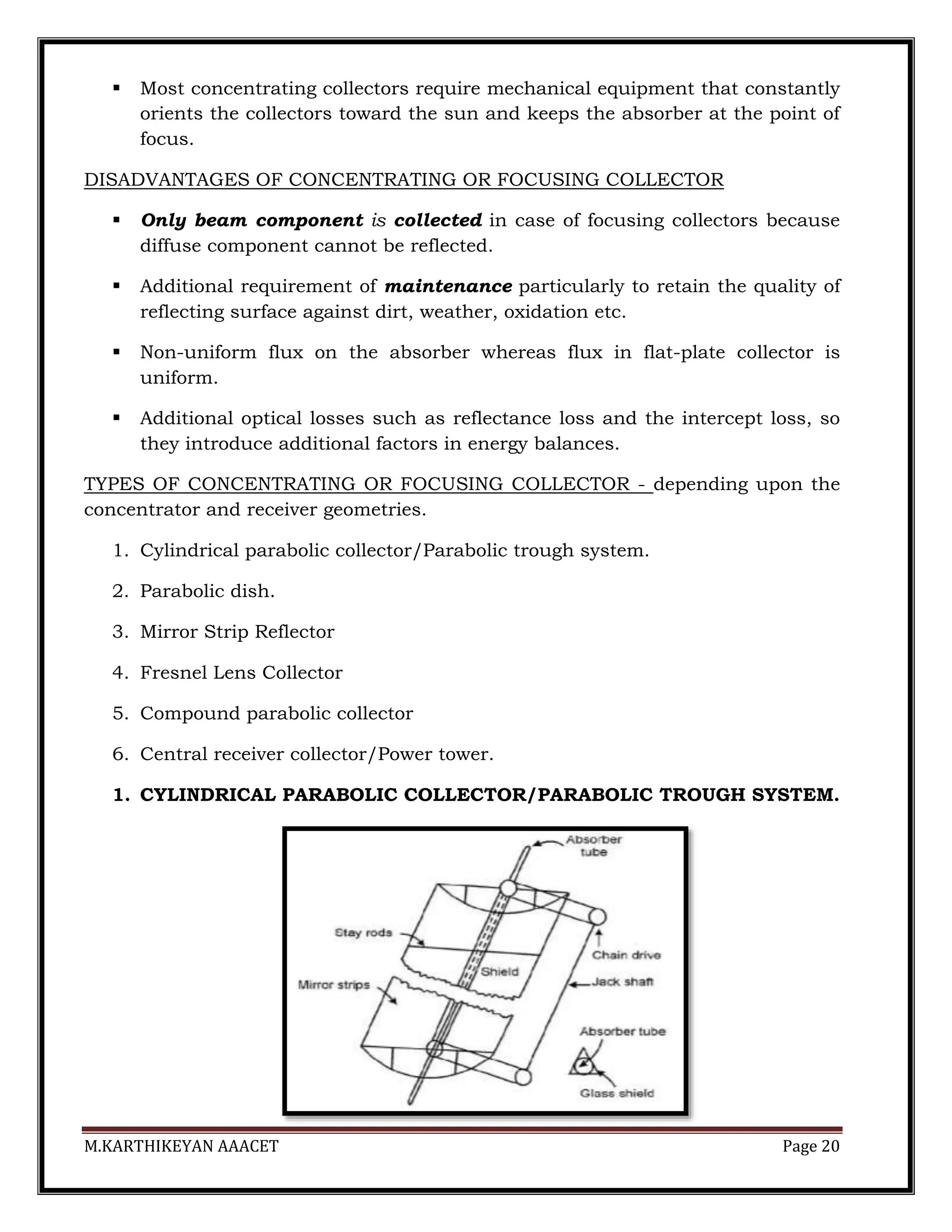
Two-axis tracking flat-plate collectors
1. Tracking the sun in both azimuth and elevation, these collectors keep the
sun's rays normal to the collector surface.
CONCENTRATING OR FOCUSING COLLECTOR
 It uses mainly beam radiation.
 Concentrating, or focusing, collectors intercept direct radiation over a large
area and focus it onto a small absorber area.
 These collectors can provide high temperatures more efficiently than flat-
plate collectors, since the absorption surface area is much smaller.
 However, diffused sky radiation cannot be focused onto the absorber.
M.KARTHIKEYAN AAACET Page 20
 Most concentrating collectors require mechanical equipment that constantly
orients the collectors toward the sun and keeps the absorber at the point of
focus.
DISADVANTAGES OF CONCENTRATING OR FOCUSING COLLECTOR
 Only beam component is collected in case of focusing collectors because
diffuse component cannot be reflected.
 Additional requirement of maintenance particularly to retain the quality of
reflecting surface against dirt, weather, oxidation etc.
 Non-uniform flux on the absorber whereas flux in flat-plate collector is
uniform.
 Additional optical losses such as reflectance loss and the intercept loss, so
they introduce additional factors in energy balances.
TYPES OF CONCENTRATING OR FOCUSING COLLECTOR - depending upon the
concentrator and receiver geometries.
1. Cylindrical parabolic collector/Parabolic trough system.
2. Parabolic dish.
3. Mirror Strip Reflector
4. Fresnel Lens Collector
5. Compound parabolic collector
6. Central receiver collector/Power tower.
1. CYLINDRICAL PARABOLIC COLLECTOR/PARABOLIC TROUGH SYSTEM.
M.KARTHIKEYAN AAACET Page 21
 In order to deliver high temperatures with good efficiency a high
performance solar collector is required.
 Systems with light structures and low cost technology for process heat
applications up to 400°C could be obtained with parabolic through
collectors (PTCs).
 PTCs can effectively produce heat at temperatures between 50°C and 400
°C.
 PTCs are made by bending a sheet of reflective material into a parabolic
shape.
 A metal black tube, covered with a glass tube to reduce heat losses, is
placed along the focal line of the receiver.
 The surface of the receiver is typically plated with selective coating that
has a high absorptance for solar radiation, but a low emittance for thermal
radiation loss.
 When the parabola is pointed towards the sun, parallel rays incident on the
reflector are reflected onto the receiver tube.
 It is sufficient to use a single axis tracking of the sun and thus long
collector modules are produced.
 The collector can be orientated in an east–west direction, tracking the sun
from north to south, or orientated in a north–south direction and tracking
the sun from east to west.
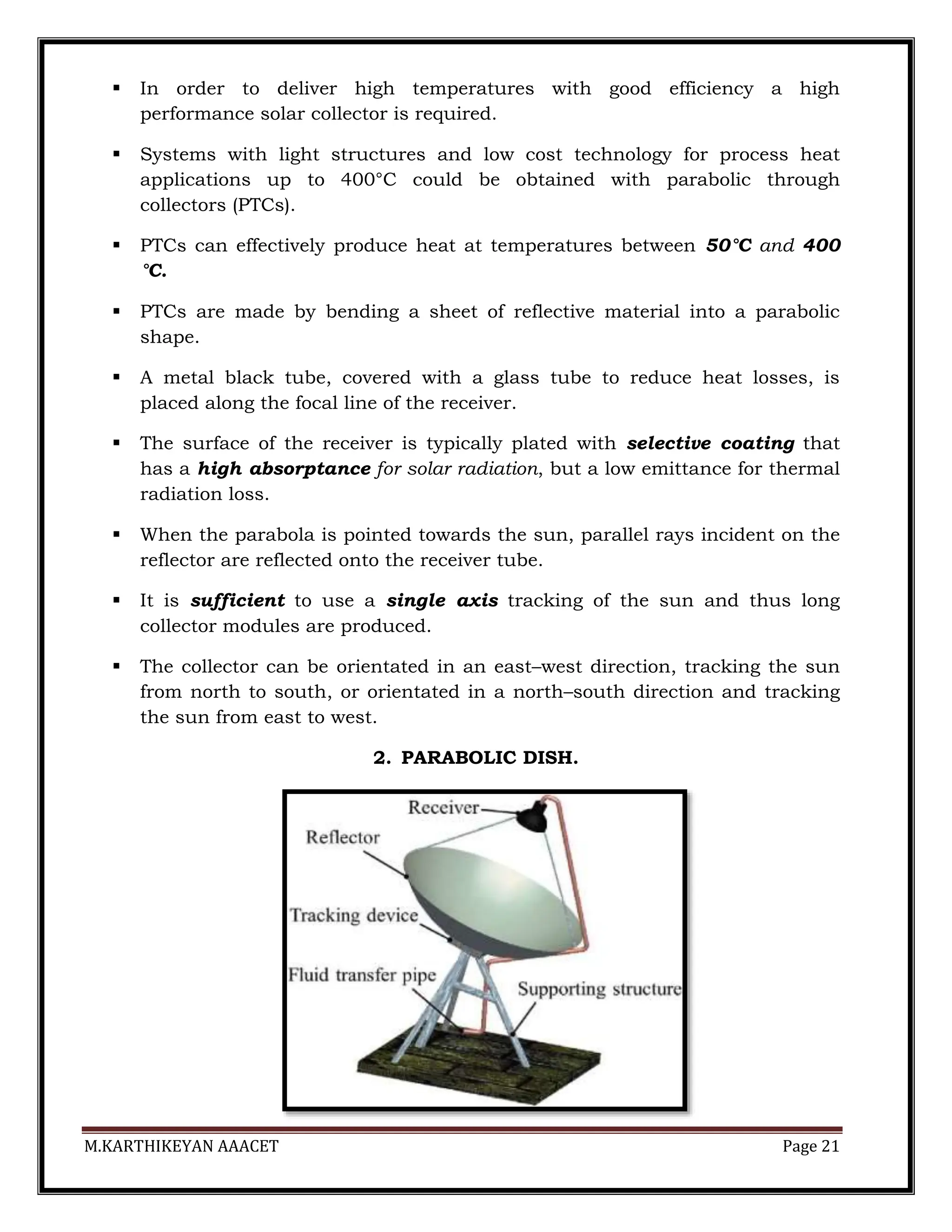
2. PARABOLIC DISH.
M.KARTHIKEYAN AAACET Page 22
 A parabolic dish reflector is a point-focus collector.
 It tracks the sun, concentrating solar energy onto a receiver located at
the focal point of the dish.
 The dish structure must track fully the sun to reflect the beam into the
thermal receiver.
 The receiver absorbs the radiant solar energy, converting it into thermal
energy in a circulating fluid.
 Fluid in turn runs the turbine and generates a power.
 The need to circulate heat transfer fluid throughout the collector field raises
design issues such as piping layout, pumping requirements, and thermal
losses.
 Concentration ratio – 600 to 2000,
 The Stirling engine is the most common type of heat engine used in dish-
engine systems.
 Parabolic dish systems can reach 1000 °C at the receiver, and achieve the
highest efficiencies for converting solar energy to electricity in the small-
power capacity range.
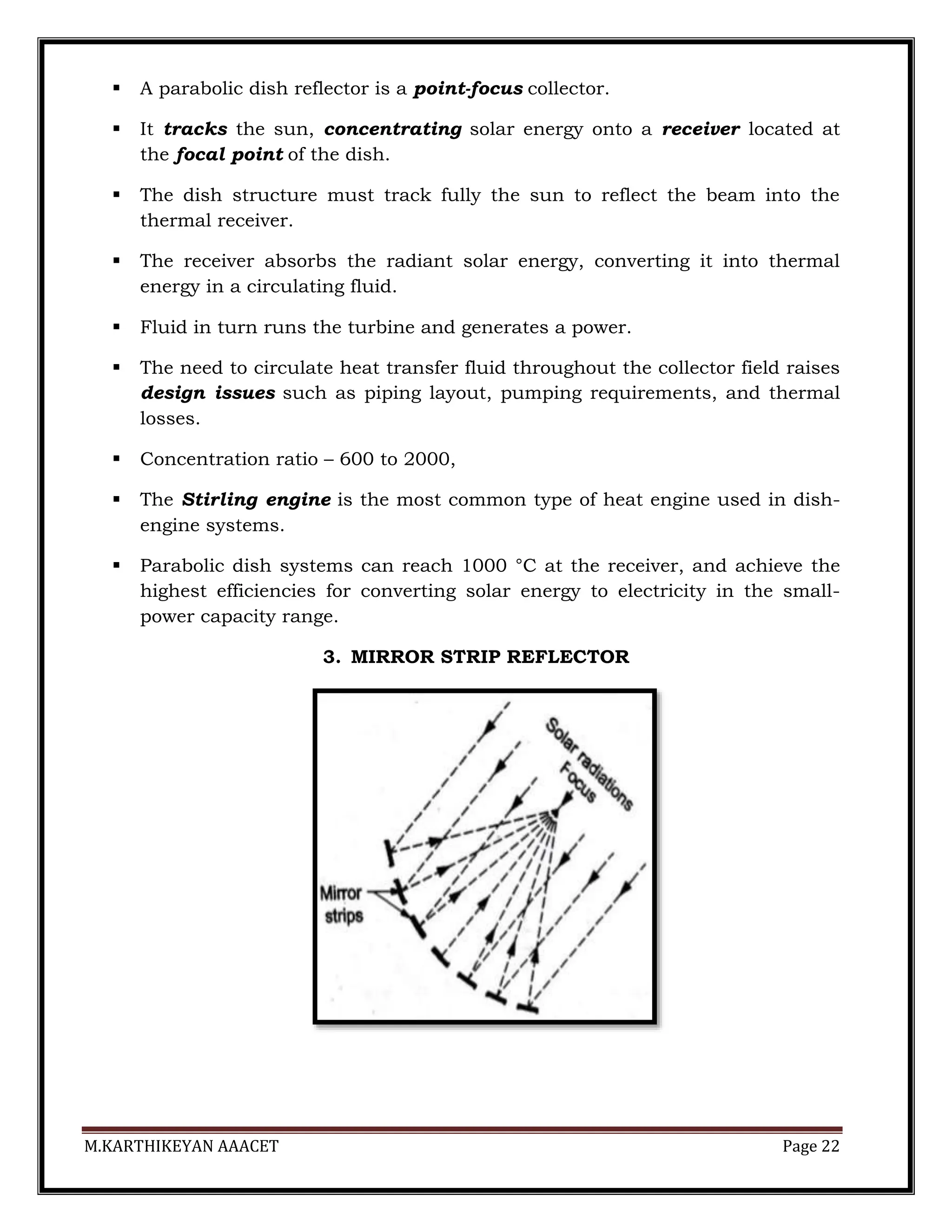
3. MIRROR STRIP REFLECTOR
M.KARTHIKEYAN AAACET Page 23
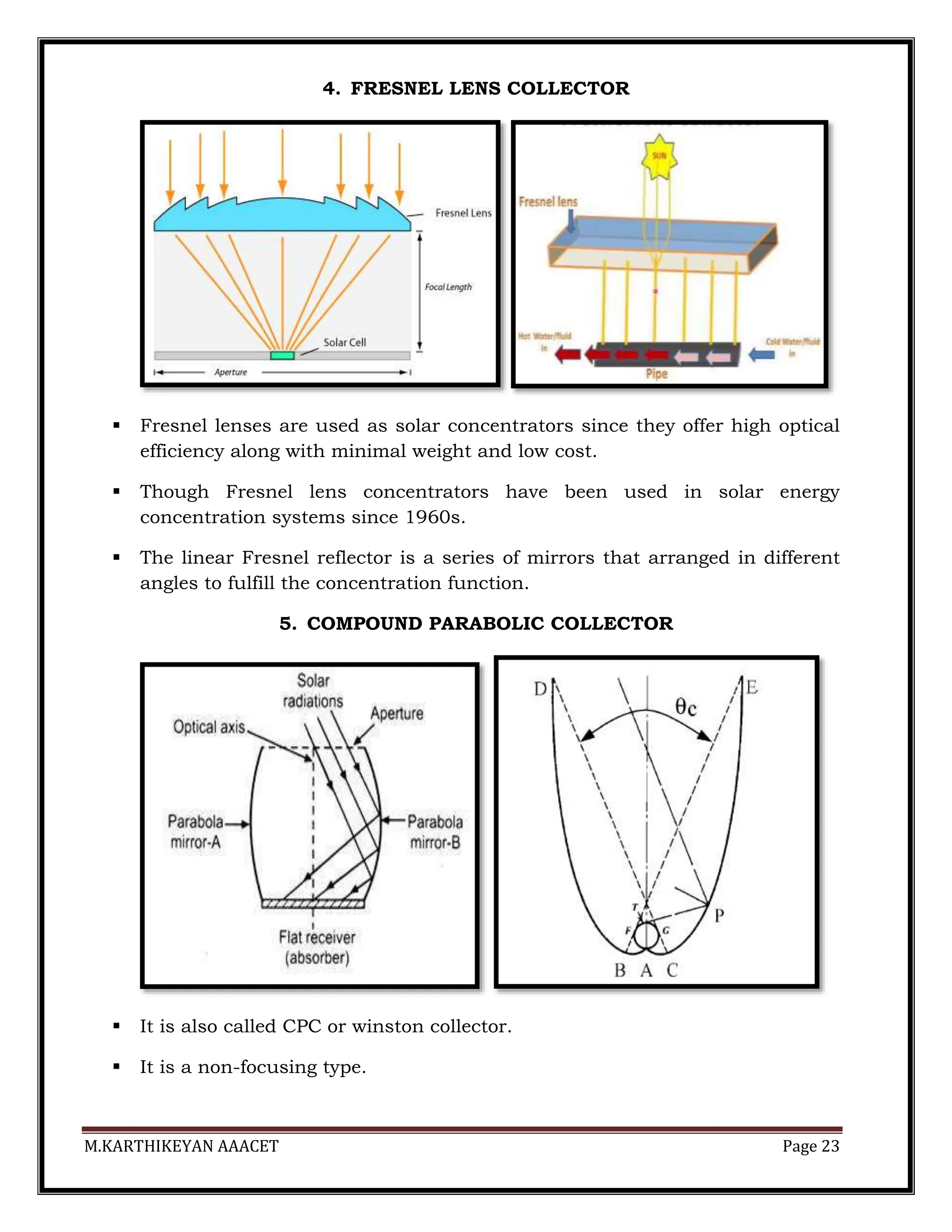
4. FRESNEL LENS COLLECTOR
 Fresnel lenses are used as solar concentrators since they offer high optical
efficiency along with minimal weight and low cost.
 Though Fresnel lens concentrators have been used in solar energy
concentration systems since 1960s.
 The linear Fresnel reflector is a series of mirrors that arranged in different
angles to fulfill the concentration function.
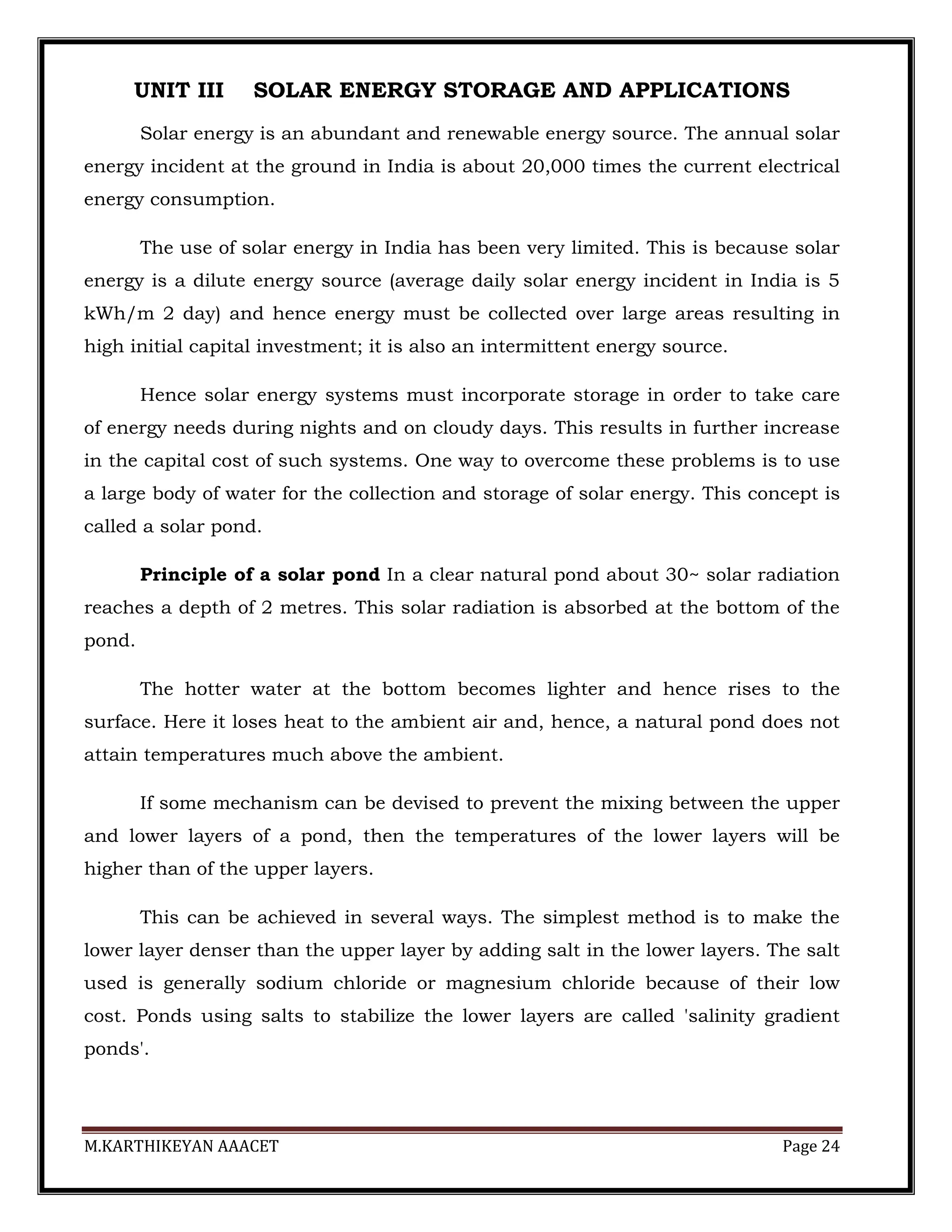
5. COMPOUND PARABOLIC COLLECTOR
 It is also called CPC or winston collector.
 It is a non-focusing type.
M.KARTHIKEYAN AAACET Page 24
UNIT III SOLAR ENERGY STORAGE AND APPLICATIONS
Solar energy is an abundant and renewable energy source. The annual solar
energy incident at the ground in India is about 20,000 times the current electrical
energy consumption.
The use of solar energy in India has been very limited. This is because solar
energy is a dilute energy source (average daily solar energy incident in India is 5
kWh/m 2 day) and hence energy must be collected over large areas resulting in
high initial capital investment; it is also an intermittent energy source.
Hence solar energy systems must incorporate storage in order to take care
of energy needs during nights and on cloudy days. This results in further increase
in the capital cost of such systems. One way to overcome these problems is to use
a large body of water for the collection and storage of solar energy. This concept is
called a solar pond.
Principle of a solar pond In a clear natural pond about 30~ solar radiation
reaches a depth of 2 metres. This solar radiation is absorbed at the bottom of the
pond.
The hotter water at the bottom becomes lighter and hence rises to the
surface. Here it loses heat to the ambient air and, hence, a natural pond does not
attain temperatures much above the ambient.
If some mechanism can be devised to prevent the mixing between the upper
and lower layers of a pond, then the temperatures of the lower layers will be
higher than of the upper layers.
This can be achieved in several ways. The simplest method is to make the
lower layer denser than the upper layer by adding salt in the lower layers. The salt
used is generally sodium chloride or magnesium chloride because of their low
cost. Ponds using salts to stabilize the lower layers are called 'salinity gradient
ponds'.
M.KARTHIKEYAN AAACET Page 25
There are other ways to prevent mixing between the upper and lower layers.
One of them is the use of a transparent honeycomb structure which traps
stagnant air and hence provides good transparency to solar radiation while cutting
down heat loss from the pond.
The honeycomb structure is made of transparent plastic material. Ortabasi
& Dyksterhuis (1985) have discussed in detail the performance of a honeycomb-
stabilized pond.
One can also use a transparent polymer gel as a means of allowing solar
radiation to enter the pond but cutting down the losses from the pond to the
ambient. Wilkins & Lee (1987) have discussed the performance of a gel (cross-
linked polyacrylamide) pond.
In this review we discuss salinity gradient solar ponds as this technology
has made tremendous progress in the last fifteen years. Typical temperature and
density profiles in a large salinity gradient solar pond are shown in figure 1.
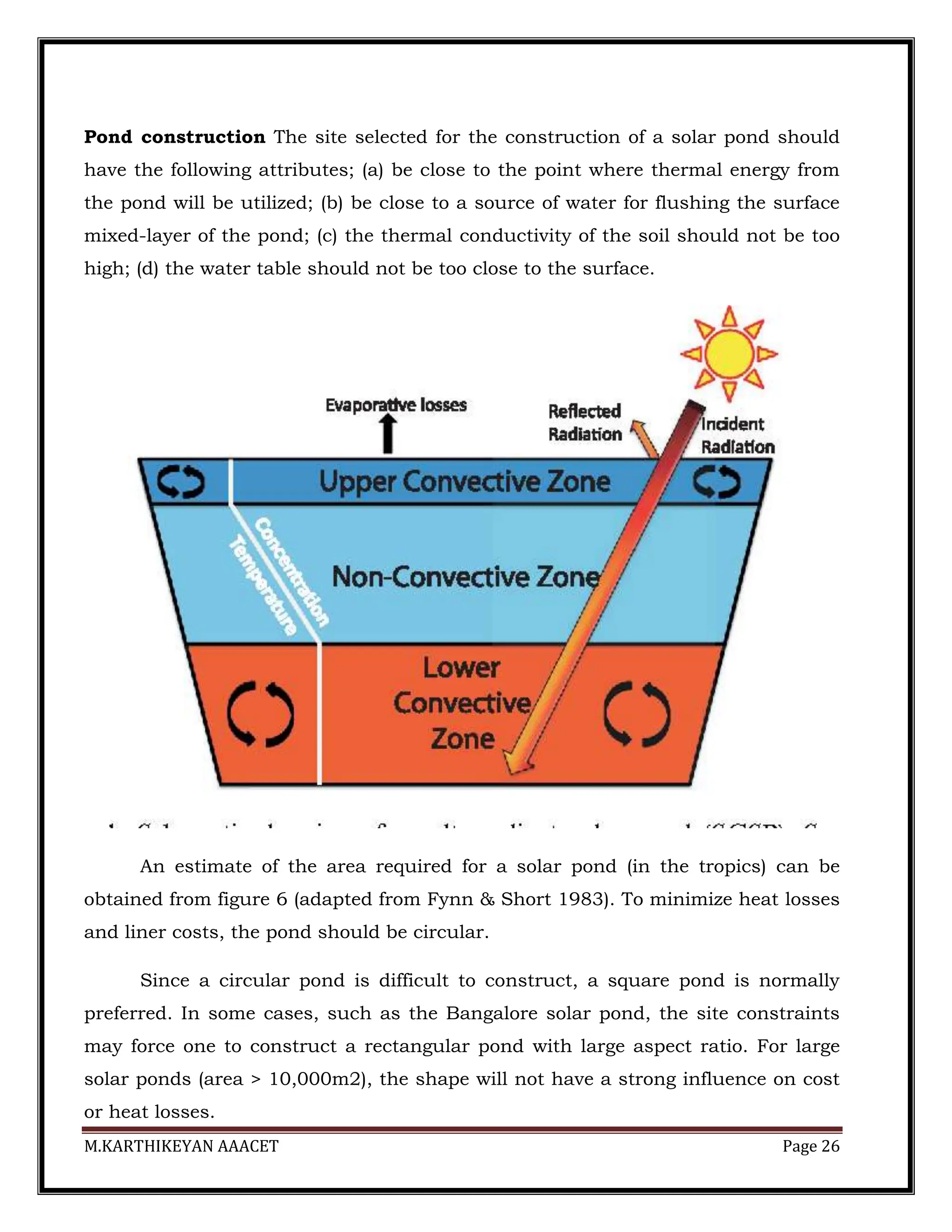
We find that there are three distinct zones in a solar pond. The lower mixed
zone has the highest temperature and density and is the region where solar
radiation is absorbed and stored.
The upper mixed zone has the lowest temperature and density. This zone is
mixed by surface winds, evaporation and nocturnal cooling. The intermediate zone
is called the nonconvective zone (or the gradient zone) because no convection
occurs here.
Temperature and density decrease from the bottom to the top in this layer,
and it acts as a transparent insulator. It permits solar radiation to pass through
but reduces the heat loss from the hot lower convective zone to the cold upper
convective zone.
Heat transfer through this zone is by conduction only. The thicknesses of
the upper mixed layer, the non-convective layer and the lower mixed layer are
usually around 0"5, 1 m and 1 m, respectively.
M.KARTHIKEYAN AAACET Page 26
Pond construction The site selected for the construction of a solar pond should
have the following attributes; (a) be close to the point where thermal energy from
the pond will be utilized; (b) be close to a source of water for flushing the surface
mixed-layer of the pond; (c) the thermal conductivity of the soil should not be too
high; (d) the water table should not be too close to the surface.
An estimate of the area required for a solar pond (in the tropics) can be
obtained from figure 6 (adapted from Fynn & Short 1983). To minimize heat losses
and liner costs, the pond should be circular.
Since a circular pond is difficult to construct, a square pond is normally
preferred. In some cases, such as the Bangalore solar pond, the site constraints
may force one to construct a rectangular pond with large aspect ratio. For large
solar ponds (area > 10,000m2), the shape will not have a strong influence on cost
or heat losses.
M.KARTHIKEYAN AAACET Page 27
The depth of the solar pond must be determined depending on the specific
application. The usual thicknesses of the surface, gradient and storage zone of the
pond are 0.5, 1 and 1 m, respectively.
If a particular site has low winds, one can reduce the thickness of the
surface layer to 30 cm. If the temperature required for process heat applications is
around 40°C (such as hatcheries) then the thickness of the gradient zone can be
reduced to 0"5 m. Storage zone thickness higher than 1 m may be required to take
care of long periods of cloudiness.
The excavation for a solar pond is similar to that for construction of water
reservoirs. The side slope of the pond can vary between 1 : 1 to 1: 3 depending
upon the type of soil. After the excavation and bunding is completed, and before a
liner is laid, one must ensure that the area is free of sharp objects which may
damage the liner when it is being laid.
SOLAR PHOTOVOLTAIC SYSTEM
The special attraction of photovoltaics, as compared to other power
generation technologies, lies in the fact that the solar radiation is converted
directly into electric power by an electronic solid state process.
In general, no moving parts and no specific thermal stresses are involved.
Therefore, photovoltaic systems operate quietly and they can offer extremely high
reliability, low maintenance requirements and a long lifetime.
Due to the nature of the conversion process, one can utilize direct as well as
diffuse radiation, which also allows applications in moderate climates with higher
fractions of diffuse radiation.
Another important advantage of PV is its modularity, permitting a very
flexible system sizing for integration into buildings and for decentral applications
down to very small load demands.
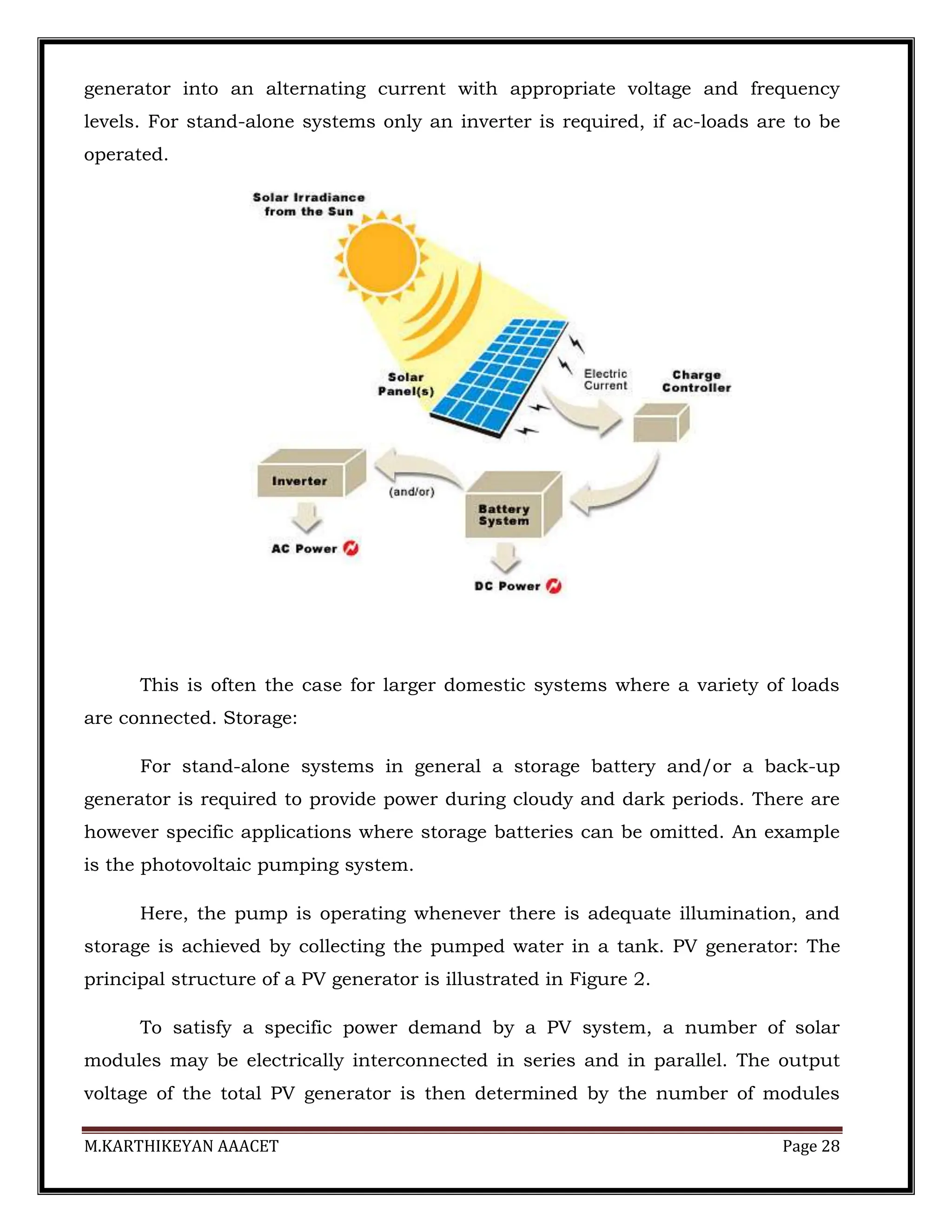
Inverter: For PV systems connected to the public electricity grid an inverter
is always required that converts the direct current and voltage produced by the PV
M.KARTHIKEYAN AAACET Page 28
generator into an alternating current with appropriate voltage and frequency
levels. For stand-alone systems only an inverter is required, if ac-loads are to be
operated.
This is often the case for larger domestic systems where a variety of loads
are connected. Storage:
For stand-alone systems in general a storage battery and/or a back-up
generator is required to provide power during cloudy and dark periods. There are
however specific applications where storage batteries can be omitted. An example
is the photovoltaic pumping system.
Here, the pump is operating whenever there is adequate illumination, and
storage is achieved by collecting the pumped water in a tank. PV generator: The
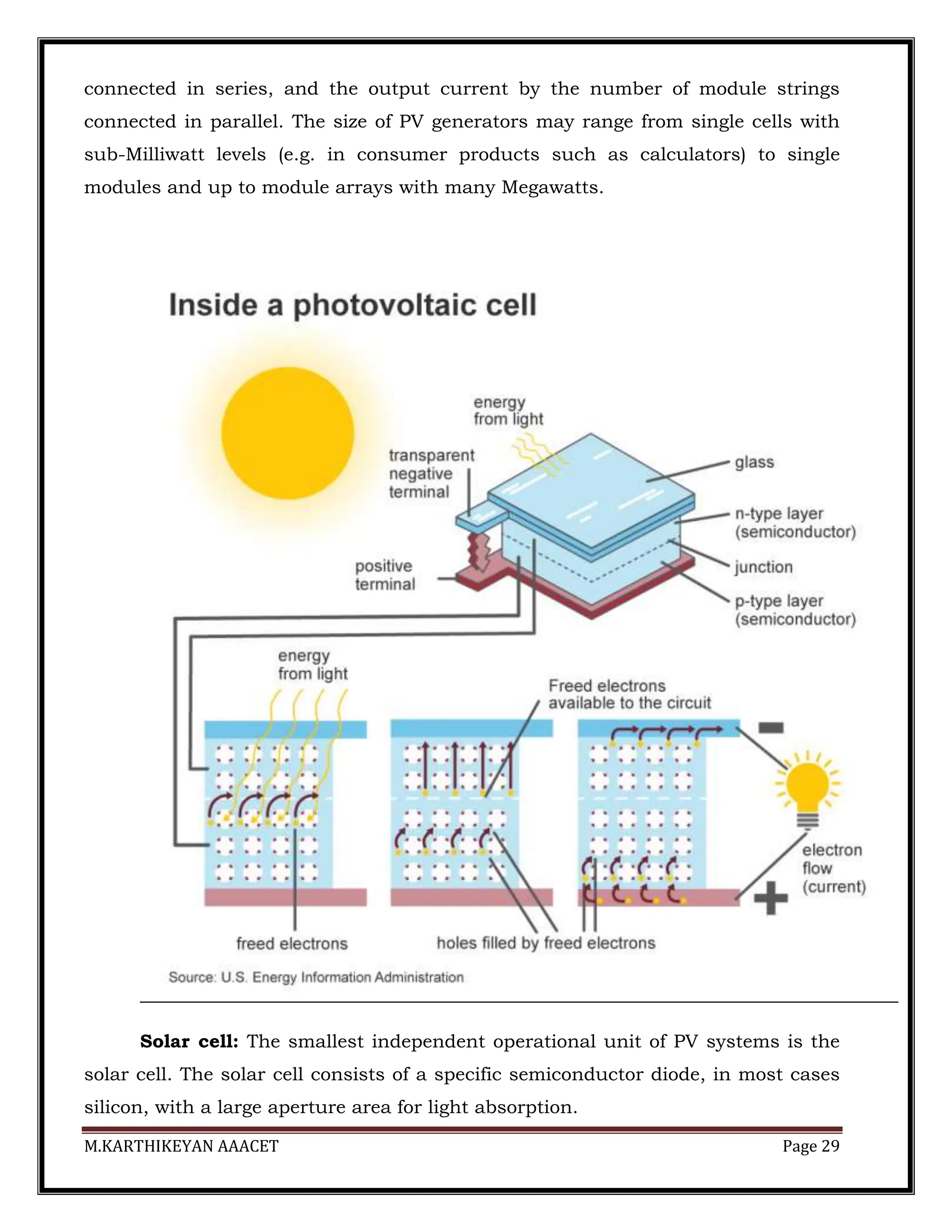
principal structure of a PV generator is illustrated in Figure 2.
To satisfy a specific power demand by a PV system, a number of solar
modules may be electrically interconnected in series and in parallel. The output
voltage of the total PV generator is then determined by the number of modules
M.KARTHIKEYAN AAACET Page 29
connected in series, and the output current by the number of module strings
connected in parallel. The size of PV generators may range from single cells with
sub-Milliwatt levels (e.g. in consumer products such as calculators) to single
modules and up to module arrays with many Megawatts.
Solar cell: The smallest independent operational unit of PV systems is the
solar cell. The solar cell consists of a specific semiconductor diode, in most cases
silicon, with a large aperture area for light absorption.
M.KARTHIKEYAN AAACET Page 30
In the photovoltaic conversion process light is absorbed by the
semiconductor, and the absorbed photons produce free charge carriers (electrons
and holes) which are then separated by the built-in electric field between the n-
and p-type region.
The charge separation produces a difference in electric potential between
the two regions, and an electric current can be drawn through an external load.
Depending on the cell efficiency and cell area, the maximum output power for
single solar cells is on the order of 1 W, and output voltages are in the range of
0.5-1 Volt.
M.KARTHIKEYAN AAACET Page 31
UNIT IV WIND ENERGY
Introduction
• Wind is the roughly roughly horizontal horizontal movement movement of air (as
opposed opposed to an air current) current) caused by uneven heating of the
Earth's surface.
• It occurs at all scales, from local breezes generated by heating of land surfaces
and lasting lasting tens of minutes minutes to global winds resulting resulting
from solar retard heating heating of the Earth.
• The two major influences on the atmospheric circulation are the differential
heating between the equator and the poles and the rotation of the planet (Coriolis
effect).
Winds can be classified either by their scale, the kinds of forces which cause them
(according to the atmospheric equations of motion), or the geographic regions in
which they exist.
• Prevailing winds — the general circulation of the atmosphere
• Seasonal Seasonal winds – winds that only exist during specific specific seasons
seasons
• Synoptic-scale winds; winds associated with large-scale events such as warm
and cold fronts and are part of what makes up everyday weather
• Mesoscale Mesoscale winds; winds that frequently frequently advances advances
ahead of more intense intense thunderstorms and may be sufficiently energetic to
generate local weather of its own
• Microscale Microscale winds; winds that take place over very short durations
durations of time - seconds to minutes - and spatially over only tens to hundreds
of metres.
Why do we need wind turbine?
M.KARTHIKEYAN AAACET Page 32
• Wind energy is abundant, renewable, widely distributed, clean and mitigates the
greenhouse effect if used to replace fossil-fuel-derived electricity.
• Conversion of wind power/energy into more useful forms is done by wind
turbines.
• Wind turbines are usually used to generate power but in certain appli i cat ons
are used as prime movers to pump water (wind mills).
• Wind power is used in large scale wind farms for national electrical grids as well
as in small individual individual turbines turbines for providing providing
electricity electricity to rural residences or grid-isolated locations. In 2005,
worldwide worldwide capacity capacity of wind-powered powered generators
generators was 58,982 megawatts megawatts; although it currently produces less
than 1% of world-wide electricity use, it accounts for 23% of electricity use in
Denmark, 4.3% in Germany and approximately 8% in Spain.
A wind turbine is a machine for converting the kinetic energy in wind into
mechanical energy
If the mechanical energy is used directly by machinery, such as a pump or
grinding stones, the machine is usually called a windmill.
If the mechanical energy is then converted to electricity, the machine is called a
wind generator.
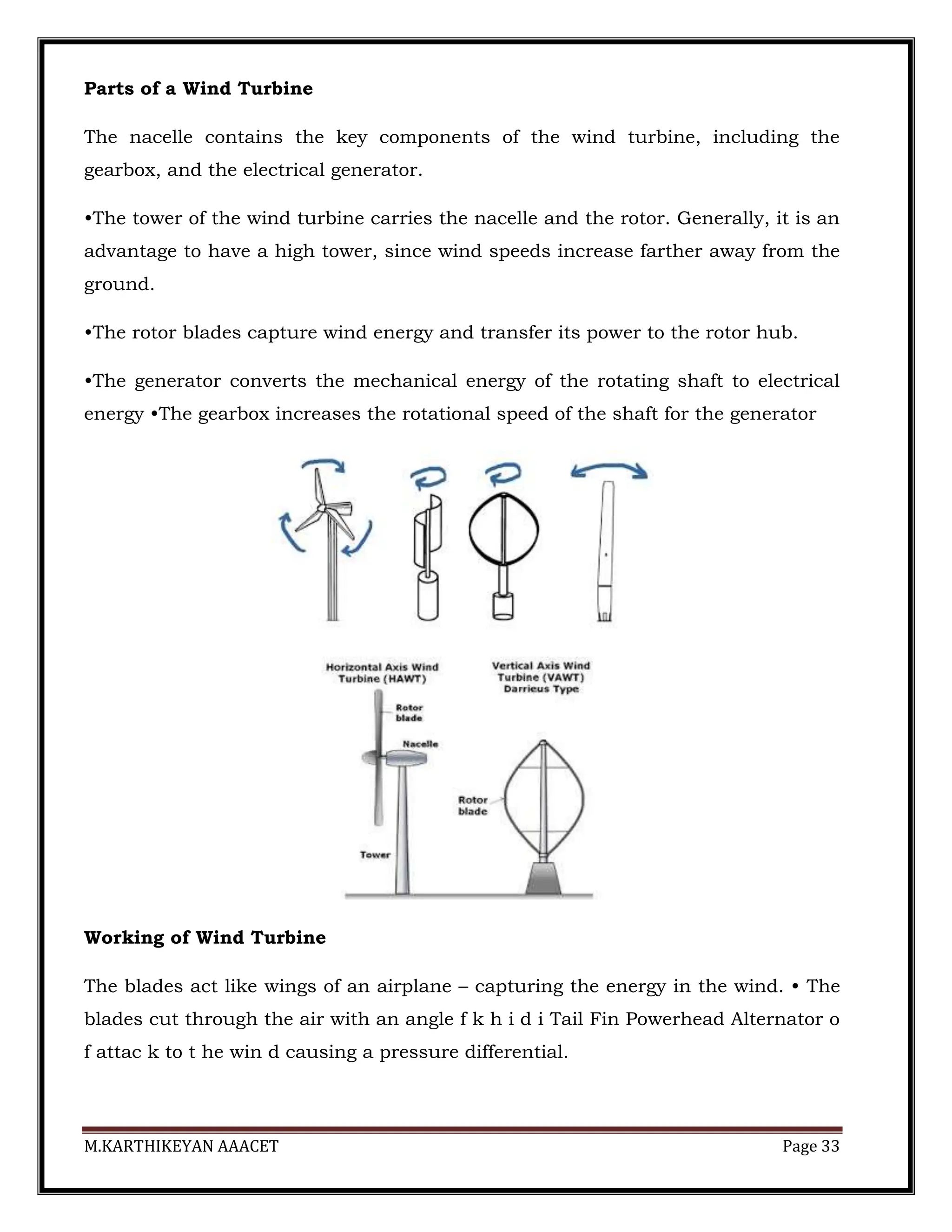
Wind turbines are classified into two general types: horizontal axis and vertical
axis. A horizontal axis machine has its blades rotating on an axis parallel to the
ground.
A vertical axis machine has its blades rotating on an axis perpendicular to the
ground. There are a number of available designs for both and each type has
certain advantages and disadvantages.
However, compared with the horizontal axis type, very few vertical axis machines
are available commercially.
M.KARTHIKEYAN AAACET Page 33
Parts of a Wind Turbine
The nacelle contains the key components of the wind turbine, including the
gearbox, and the electrical generator.
•The tower of the wind turbine carries the nacelle and the rotor. Generally, it is an
advantage to have a high tower, since wind speeds increase farther away from the
ground.
•The rotor blades capture wind energy and transfer its power to the rotor hub.
•The generator converts the mechanical energy of the rotating shaft to electrical
energy •The gearbox increases the rotational speed of the shaft for the generator
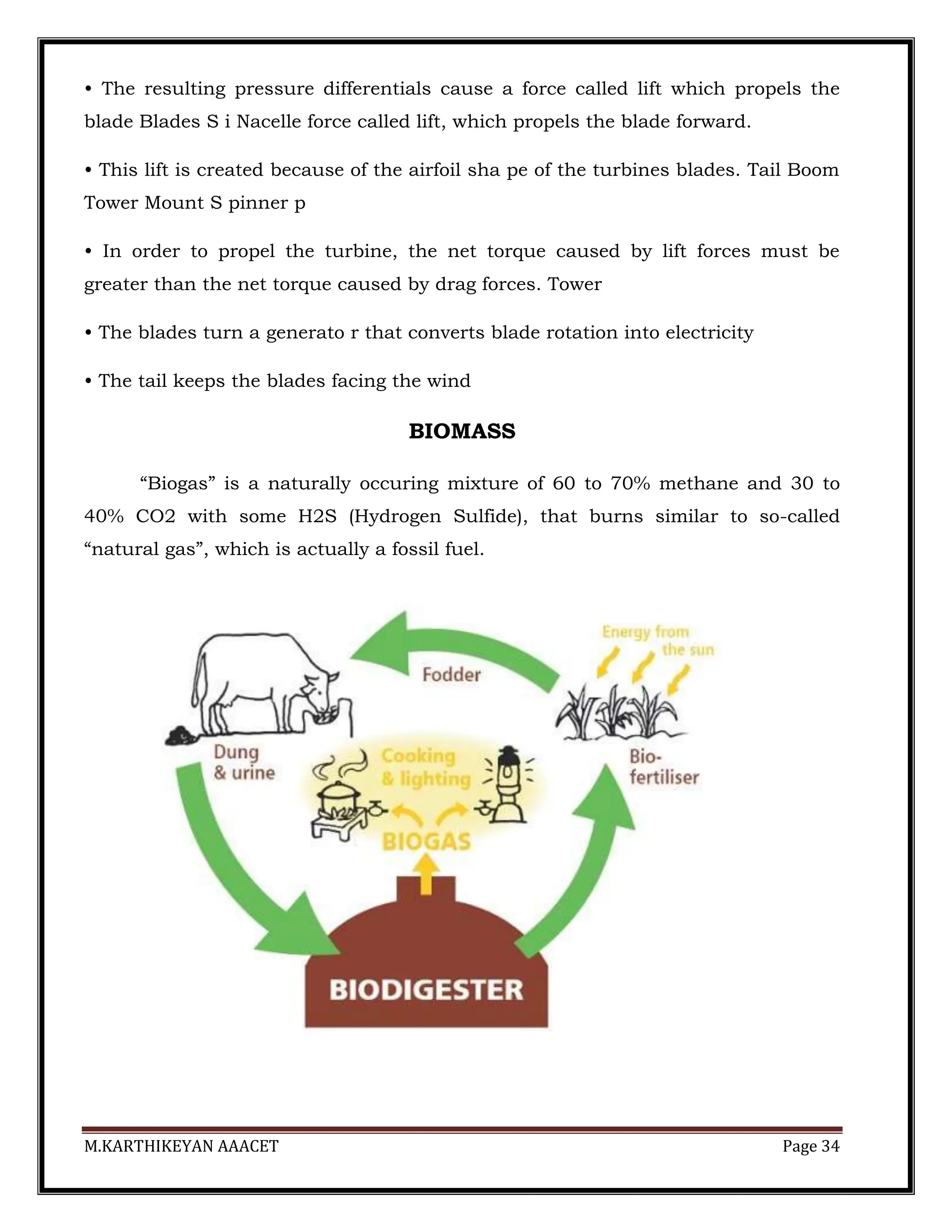
Working of Wind Turbine
The blades act like wings of an airplane – capturing the energy in the wind. • The
blades cut through the air with an angle f k h i d i Tail Fin Powerhead Alternator o
f attac k to t he win d causing a pressure differential.
M.KARTHIKEYAN AAACET Page 34
• The resulting pressure differentials cause a force called lift which propels the
blade Blades S i Nacelle force called lift, which propels the blade forward.
• This lift is created because of the airfoil sha pe of the turbines blades. Tail Boom
Tower Mount S pinner p
• In order to propel the turbine, the net torque caused by lift forces must be
greater than the net torque caused by drag forces. Tower
• The blades turn a generato r that converts blade rotation into electricity
• The tail keeps the blades facing the wind
BIOMASS
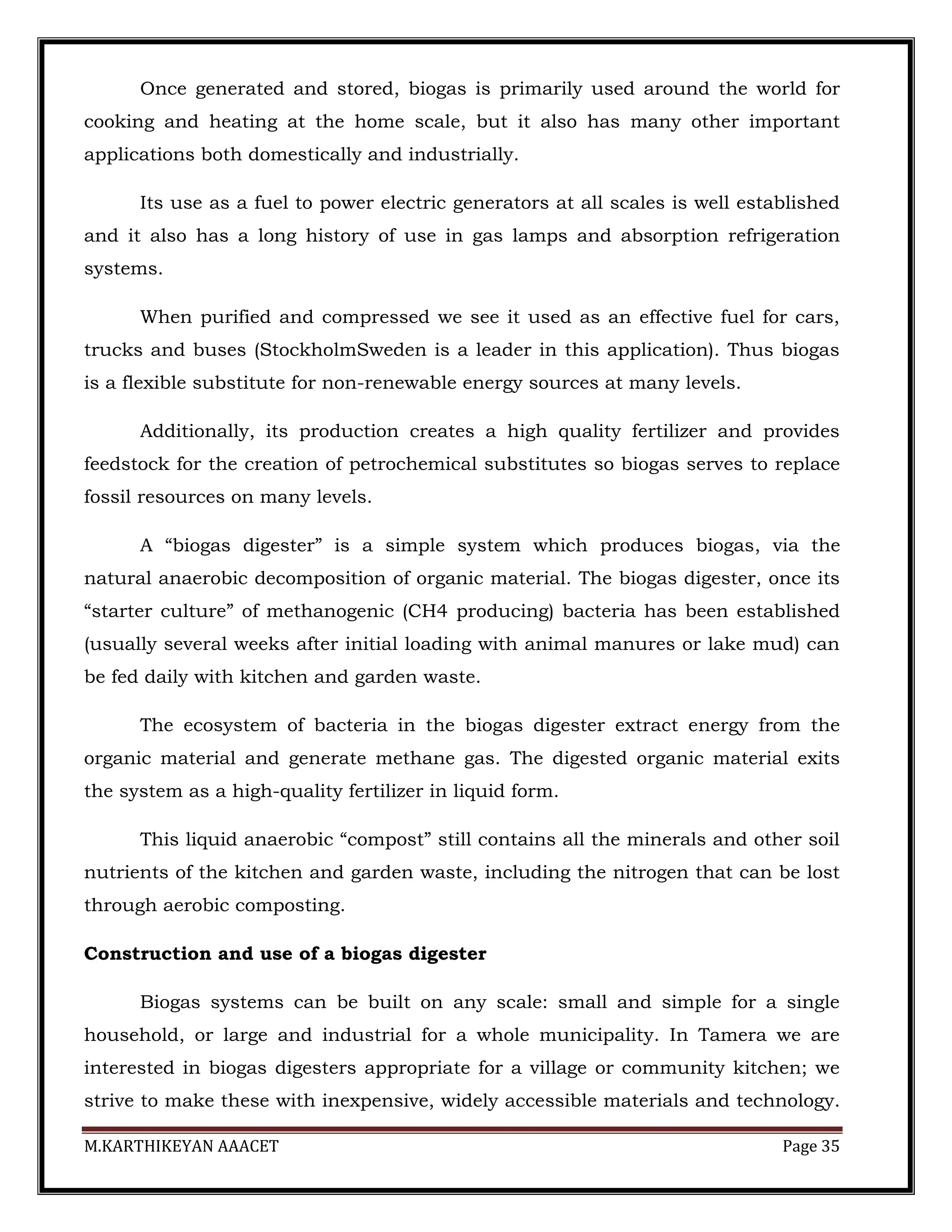
“Biogas” is a naturally occuring mixture of 60 to 70% methane and 30 to
40% CO2 with some H2S (Hydrogen Sulfide), that burns similar to so-called
“natural gas”, which is actually a fossil fuel.
M.KARTHIKEYAN AAACET Page 35
Once generated and stored, biogas is primarily used around the world for
cooking and heating at the home scale, but it also has many other important
applications both domestically and industrially.
Its use as a fuel to power electric generators at all scales is well established
and it also has a long history of use in gas lamps and absorption refrigeration
systems.
When purified and compressed we see it used as an effective fuel for cars,
trucks and buses (StockholmSweden is a leader in this application). Thus biogas
is a flexible substitute for non-renewable energy sources at many levels.
Additionally, its production creates a high quality fertilizer and provides
feedstock for the creation of petrochemical substitutes so biogas serves to replace
fossil resources on many levels.
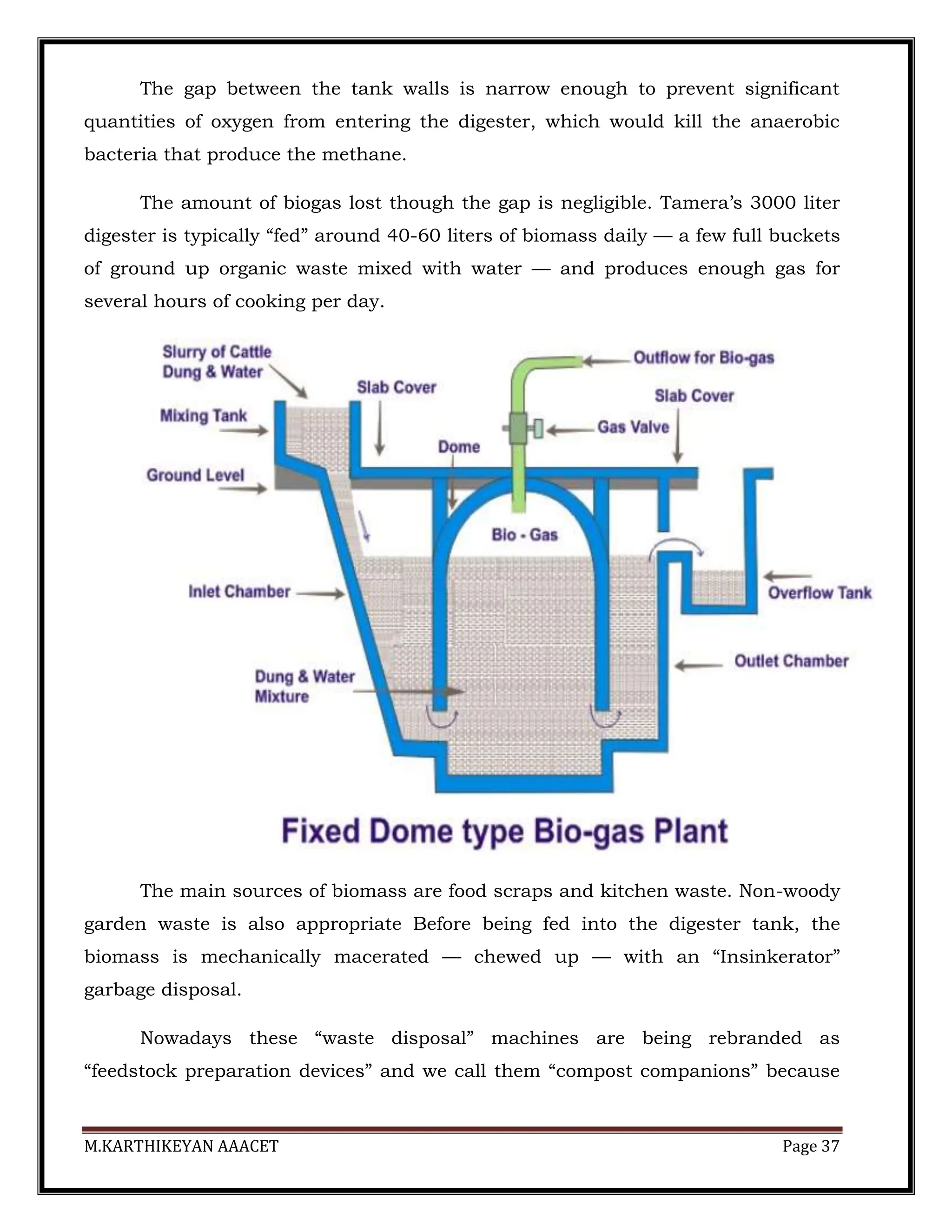
A “biogas digester” is a simple system which produces biogas, via the
natural anaerobic decomposition of organic material. The biogas digester, once its
“starter culture” of methanogenic (CH4 producing) bacteria has been established
(usually several weeks after initial loading with animal manures or lake mud) can
be fed daily with kitchen and garden waste.
The ecosystem of bacteria in the biogas digester extract energy from the
organic material and generate methane gas. The digested organic material exits
the system as a high-quality fertilizer in liquid form.
This liquid anaerobic “compost” still contains all the minerals and other soil
nutrients of the kitchen and garden waste, including the nitrogen that can be lost
through aerobic composting.
Construction and use of a biogas digester
Biogas systems can be built on any scale: small and simple for a single
household, or large and industrial for a whole municipality. In Tamera we are
interested in biogas digesters appropriate for a village or community kitchen; we
strive to make these with inexpensive, widely accessible materials and technology.
M.KARTHIKEYAN AAACET Page 36
As previously stated, biogas consists of about two third methane and one third
CO2, with some water vapor and trace gasses (principally H2S) and as such,
without any alteration or purification, it can be used in all appliances made for
natural gas — for example cookers and water and space heaters and electric
gensets — with minimal modifications.
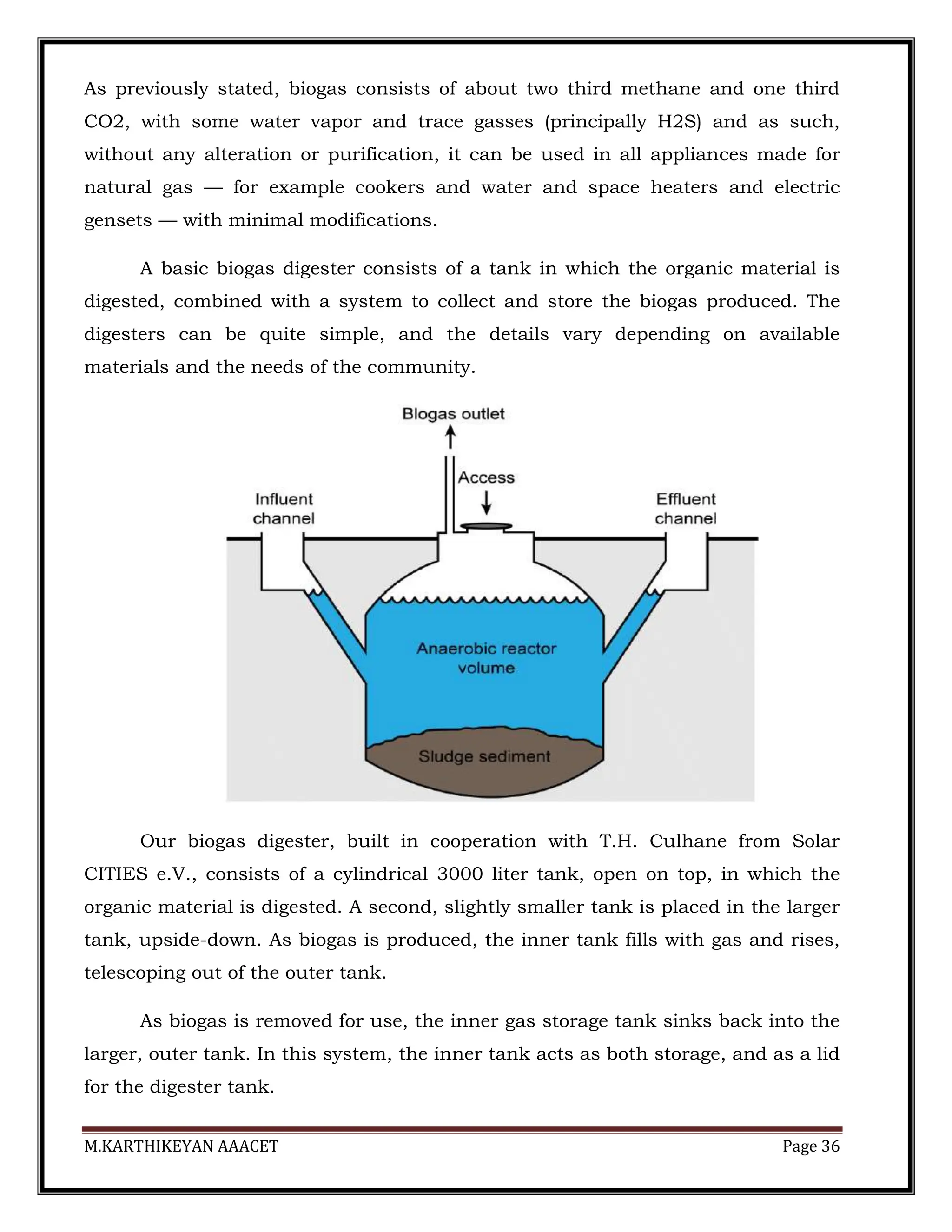
A basic biogas digester consists of a tank in which the organic material is
digested, combined with a system to collect and store the biogas produced. The
digesters can be quite simple, and the details vary depending on available
materials and the needs of the community.
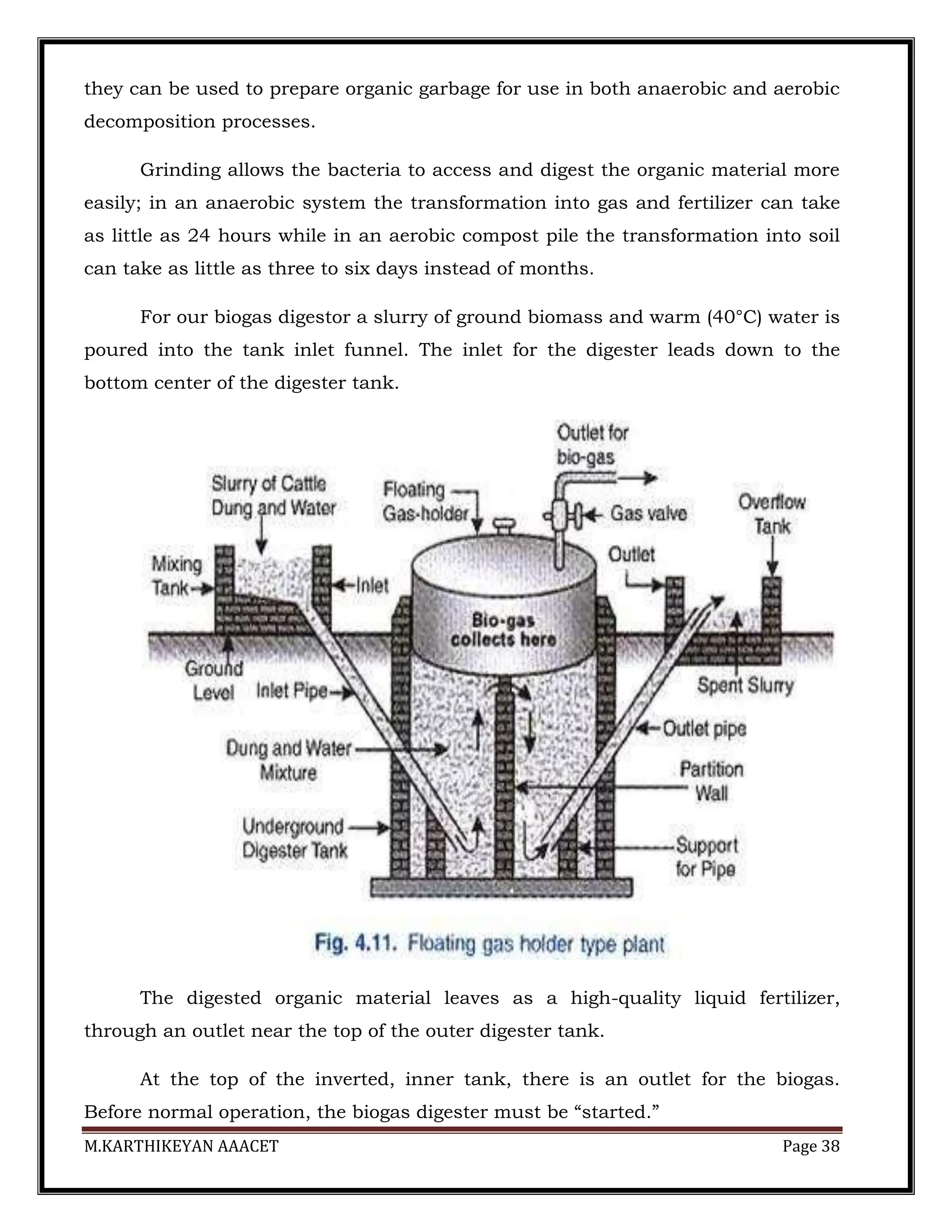
Our biogas digester, built in cooperation with T.H. Culhane from Solar
CITIES e.V., consists of a cylindrical 3000 liter tank, open on top, in which the
organic material is digested. A second, slightly smaller tank is placed in the larger
tank, upside-down. As biogas is produced, the inner tank fills with gas and rises,
telescoping out of the outer tank.
As biogas is removed for use, the inner gas storage tank sinks back into the
larger, outer tank. In this system, the inner tank acts as both storage, and as a lid
for the digester tank.
M.KARTHIKEYAN AAACET Page 37
The gap between the tank walls is narrow enough to prevent significant
quantities of oxygen from entering the digester, which would kill the anaerobic
bacteria that produce the methane.
The amount of biogas lost though the gap is negligible. Tamera’s 3000 liter
digester is typically “fed” around 40-60 liters of biomass daily — a few full buckets
of ground up organic waste mixed with water — and produces enough gas for
several hours of cooking per day.
The main sources of biomass are food scraps and kitchen waste. Non-woody
garden waste is also appropriate Before being fed into the digester tank, the
biomass is mechanically macerated — chewed up — with an “Insinkerator”
garbage disposal.
Nowadays these “waste disposal” machines are being rebranded as
“feedstock preparation devices” and we call them “compost companions” because
M.KARTHIKEYAN AAACET Page 38
they can be used to prepare organic garbage for use in both anaerobic and aerobic
decomposition processes.
Grinding allows the bacteria to access and digest the organic material more
easily; in an anaerobic system the transformation into gas and fertilizer can take
as little as 24 hours while in an aerobic compost pile the transformation into soil
can take as little as three to six days instead of months.
For our biogas digestor a slurry of ground biomass and warm (40°C) water is
poured into the tank inlet funnel. The inlet for the digester leads down to the
bottom center of the digester tank.
The digested organic material leaves as a high-quality liquid fertilizer,
through an outlet near the top of the outer digester tank.
At the top of the inverted, inner tank, there is an outlet for the biogas.
Before normal operation, the biogas digester must be “started.”
M.KARTHIKEYAN AAACET Page 39
This is done by preparing a 1:1 mixture of fresh animal manure and water,
and allowing this to ferment anaerobically for several weeks. The volume of this
mixture should be around 200 liters for a 3000 liter digester or roughly 30-40 kg
of animal manures per cubic meter of digestor tank space.
Less can be used but it would simply take longer to establish the colonies of
bacteria to enable feeding (feeding only starts once first flammable gas is
produced).
The slurry can be prepared in a seperate container or in the digester tank.
The manure contains the naturally-occurring bacteria that digest organic matter
and produce methane. Note that unlike in cheesemaking or yoghurt making
biogas digestors do not rely on one strain of bacteria but depend on a balanced
ecology of many different types of microbes – hydrolytic, acidogenic, acetogenic
and methanogenic.
Fortunately these are all found in animal manure and even lake mud.
Essentially any animal wastes can be used — cow, horse, pig, and others; alone or
mixed.
Human excreta can be used as well, although in this case the fertilizer
output of the digester should only be used on trees, or in other appropriate
applications.
M.KARTHIKEYAN AAACET Page 40
UNIT V GEOTHERMAL ENERGY
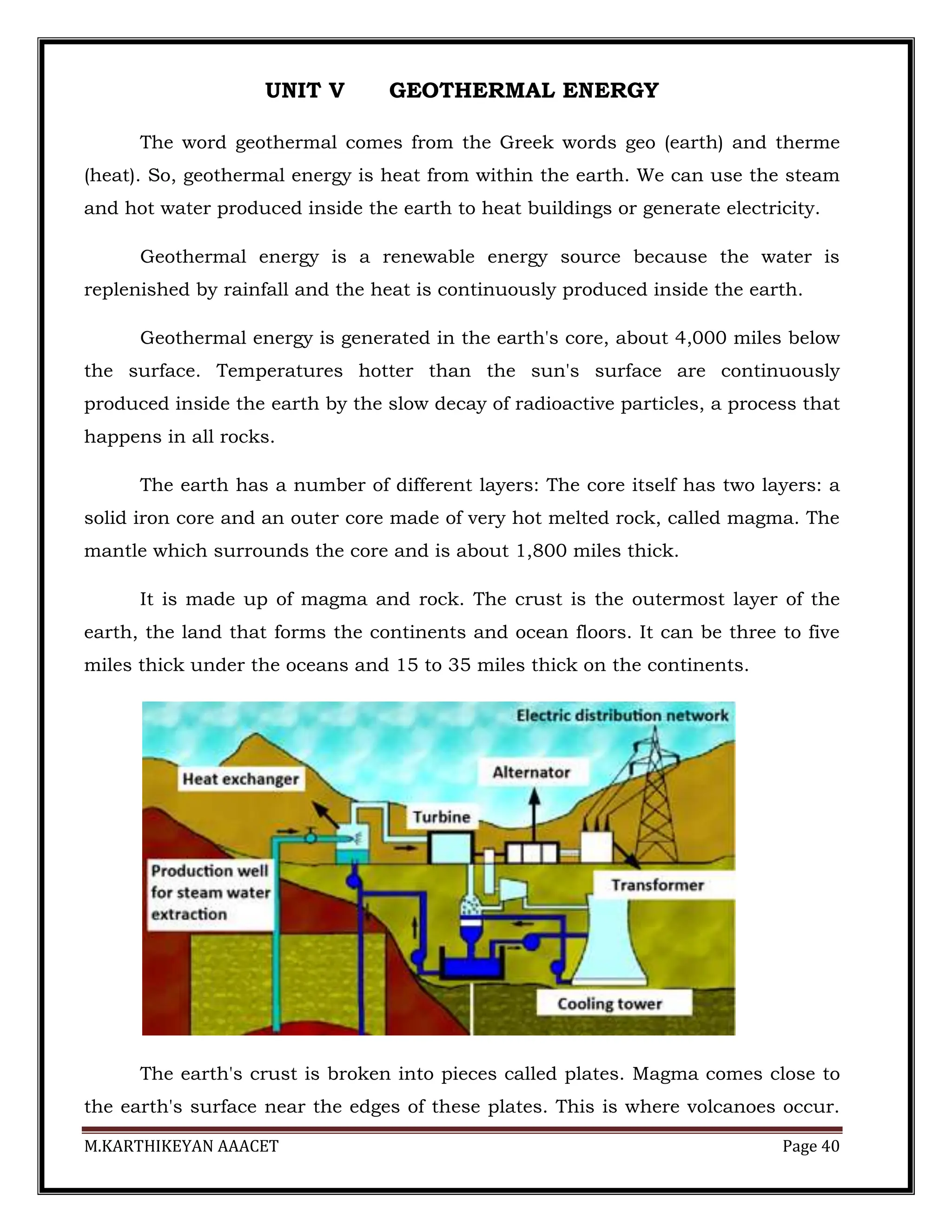
The word geothermal comes from the Greek words geo (earth) and therme
(heat). So, geothermal energy is heat from within the earth. We can use the steam
and hot water produced inside the earth to heat buildings or generate electricity.
Geothermal energy is a renewable energy source because the water is
replenished by rainfall and the heat is continuously produced inside the earth.
Geothermal energy is generated in the earth's core, about 4,000 miles below
the surface. Temperatures hotter than the sun's surface are continuously
produced inside the earth by the slow decay of radioactive particles, a process that
happens in all rocks.
The earth has a number of different layers: The core itself has two layers: a
solid iron core and an outer core made of very hot melted rock, called magma. The
mantle which surrounds the core and is about 1,800 miles thick.
It is made up of magma and rock. The crust is the outermost layer of the
earth, the land that forms the continents and ocean floors. It can be three to five
miles thick under the oceans and 15 to 35 miles thick on the continents.
The earth's crust is broken into pieces called plates. Magma comes close to
the earth's surface near the edges of these plates. This is where volcanoes occur.
M.KARTHIKEYAN AAACET Page 41
The lava that erupts from volcanoes is partly magma. Deep underground, the
rocks and water absorb the heat from this magma.
The temperature of the rocks and water get hotter and hotter as you go
deeper underground. People around the world use geothermal energy to heat their
homes and to produce electricity by digging deep wells and pumping the heated
underground water or steam to the surface. Or, we can make use of the stable
temperatures near the surface of the earth to heat and cool buildings
Condenser The steam-water mixture emitted from the turbine at outlet
contains a significant amount of non condensable gases comprising mainly CO2
(which is usually 95–98% of the total gas content), CH4 and H2S, and is thus
highly acidic.
Since most high-temperature geothermal resources are located in arid or
semi-arid areas far removed from significant freshwater (rivers, lakes) sources, the
condenser cooling choices are mostly limited to either atmospheric cooling towers
or forced ventilation ones.
The application of evaporative cooling of the condensate results in the
condensate containing dissolved oxygen in addition to the non-condensable gases,
which make the condenser fluid highly corrosive and require the condenser to be
clad on the inside with stainless steel; condensate pumps to be made of stainless
steel, and all condensate pipelines either of stainless steel or glass reinforced
plastic.
Addition of caustic soda is required to adjust the pH in the cooling tower
circuit. Make-up water and blow-down is also used to avoid accumulation of salts
in the water caused by evaporation.
A problem sometimes encountered within the condenser is the deposition of
almost pure sulphur on walls and nozzles within the condenser. This scale
deposition must be periodically cleaned by high pressure water spraying etc.
M.KARTHIKEYAN AAACET Page 42
Cooling tower and associated equipment Most high-temperature
geothermal resources are located in arid or semi-arid areas far removed from
significant freshwater (rivers, lakes) sources.
This mostly limits condenser cooling choices to either atmospheric cooling
towers or forced ventilation ones. Freshwater cooling from a river is, however,
used for instance in New Zealand and seawater cooling from wells on Reykjanes,
Iceland. In older power plants the atmospheric versions and/or barometric ones,
the large parabolic ones of concrete, were most often chosen.
Most frequently chosen for modern power plants is the forced ventilation
type because of environmental issues and local proneness to earth quakes. The
modern forced ventilation cooling towers are typically of wooden/plastic
construction comprising several parallel cooling cells erected on top of a lined
concrete condensate pond.
The ventilation fans are normally vertical, reversible flow type and the
cooling water pumped onto a platform at the top of the tower fitted with a large
number of nozzles, through which the hot condensate drips in counterflow to the
airflow onto and through the filling material in the tower and thence into the
condensate pond, whence the cooled condensate is sucked by the condenser
vacuum back into the condenser.
To minimise scaling and corrosion effects the condensate is neutralised
through pH control, principally via addition of sodium carbonate. Three types of
problems are found to be associated with the cooling towers, i.e.
• Icing problems in cold areas.
• Sand blown onto the tower in sandy and arid areas.
• Clogging up by sulphitephylic bacteria.
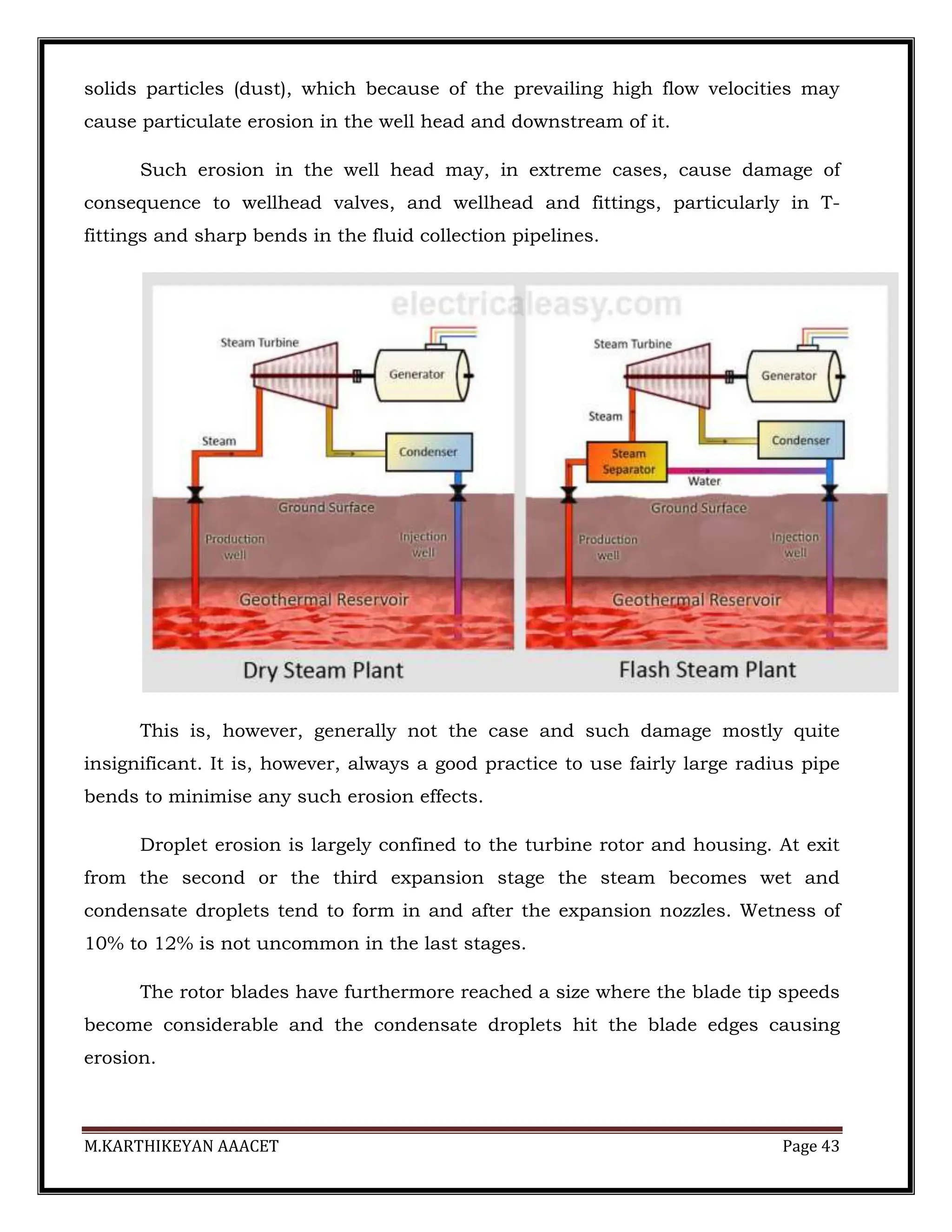
Particulate/droplet erosion and countermeasures Geothermal production
wells in many steam dominated reservoir have entrapped in the well flow minute
M.KARTHIKEYAN AAACET Page 43
solids particles (dust), which because of the prevailing high flow velocities may
cause particulate erosion in the well head and downstream of it.
Such erosion in the well head may, in extreme cases, cause damage of
consequence to wellhead valves, and wellhead and fittings, particularly in T-
fittings and sharp bends in the fluid collection pipelines.
This is, however, generally not the case and such damage mostly quite
insignificant. It is, however, always a good practice to use fairly large radius pipe
bends to minimise any such erosion effects.
Droplet erosion is largely confined to the turbine rotor and housing. At exit
from the second or the third expansion stage the steam becomes wet and
condensate droplets tend to form in and after the expansion nozzles. Wetness of
10% to 12% is not uncommon in the last stages.
The rotor blades have furthermore reached a size where the blade tip speeds
become considerable and the condensate droplets hit the blade edges causing
erosion.
M.KARTHIKEYAN AAACET Page 44
The condensate water which has become acidic from the dissolved non
condensable gas attaches to the blades and is thrown against the housing. This
water has the potential to cause erosion problems.
The most effective countermeasures are to fit the blade edges of the last two
stages with carbide inserts (Stellite) that is resistant to the droplet impingement
and the housing with suitable flow groves that reduce the condensate flow and
thereby potential erosion damage.
In addition to the erosion the blades and rotor are susceptible to stress
corrosion in the H2S environment inside the turbine housing.
The most effective countermeasure is to exercise great care in selecting
rotor, expansion nozzle and rotor blade material that is resistant to hydrogen
sulphite corrosion cracking.
The generally most effective materials for the purpose are high chromium
steels.
OTEC
(OTEC). This is a power cycle that is in turn a heat engine, which powers a
low-pressure turbine. Ammonia will be used as the working fluid in the cycle due
to its low boiling point.
The idea is very simple. Surface water temperature is enough to cause the
working fluid to boil, then cold water from approximately 1000 meters deep will be
pumped to the surface to condense the working fluid. The system analyzed here
will operate in a closed cycle.
There are also open cycle OTEC platforms, which can be beneficial as well.
In the open cycle warm seawater is located in a lowpressure tank and caused to
then boil.
The steam that comes from the low-pressure boiling system is enough to
power a turbine thus creating work. The cold seawater is used to condense the
M.KARTHIKEYAN AAACET Page 45
steam. One benefit to the open cycle is that desalinated water is created in the
cycle as a byproduct.
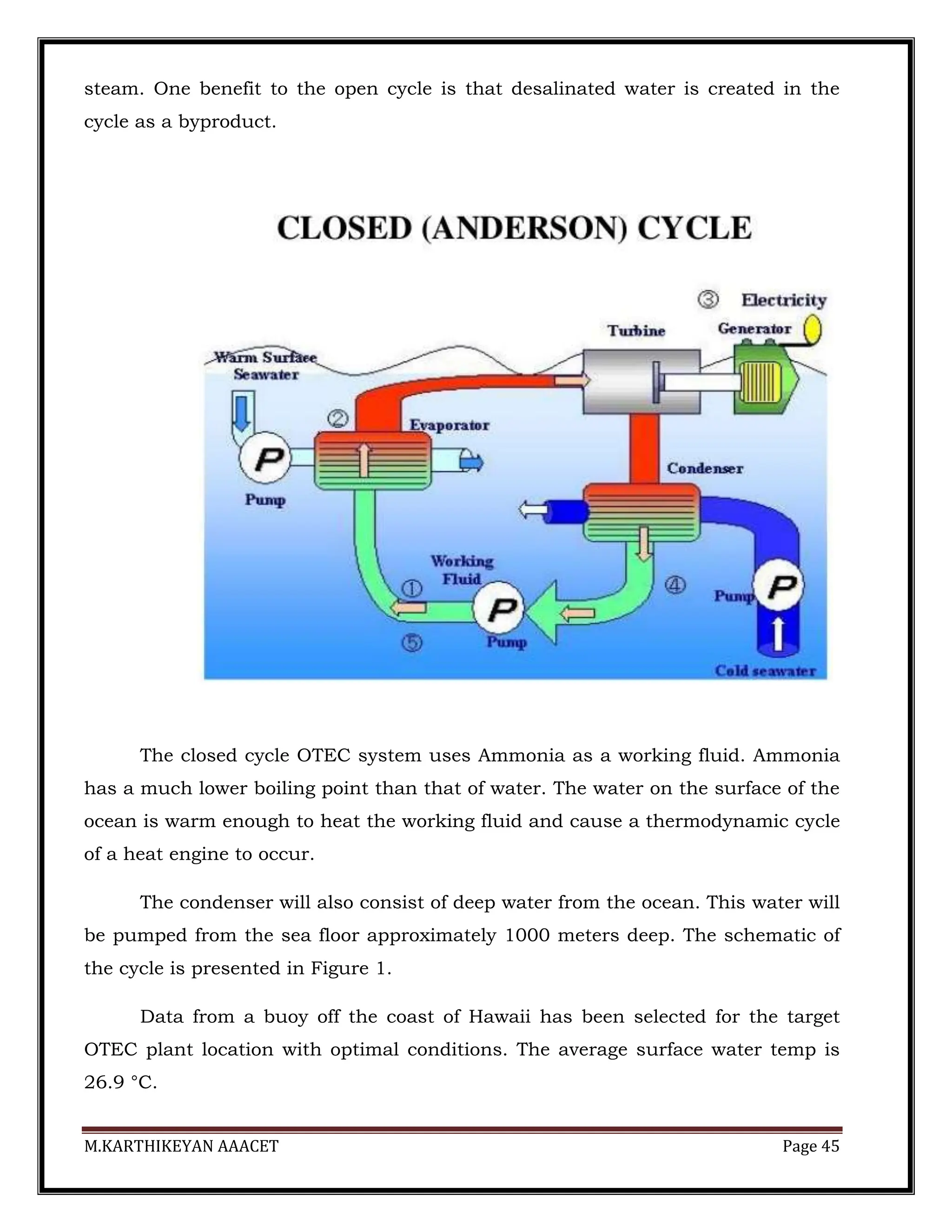
The closed cycle OTEC system uses Ammonia as a working fluid. Ammonia
has a much lower boiling point than that of water. The water on the surface of the
ocean is warm enough to heat the working fluid and cause a thermodynamic cycle
of a heat engine to occur.
The condenser will also consist of deep water from the ocean. This water will
be pumped from the sea floor approximately 1000 meters deep. The schematic of
the cycle is presented in Figure 1.
Data from a buoy off the coast of Hawaii has been selected for the target
OTEC plant location with optimal conditions. The average surface water temp is
26.9 °C.
M.KARTHIKEYAN AAACET Page 46
The depth at this location is 4,919 meters. Water from 1000 meters deep
will be approximately 5 °C. This is just above freezing and will be enough to
condense the working fluid so that it can go through another cycle.
Figures 2 and 3 show a better depiction of this temperature fluctuation.
This location and these parameters will be evaluated and mathematically
analyzed. It will then be determined if the OTEC plant can produce enough power
to sustain itself and provide power output.
The efficiency will be examined in comparison to the Carnot efficiency and
work of the pump and turbine will be examined at as well.
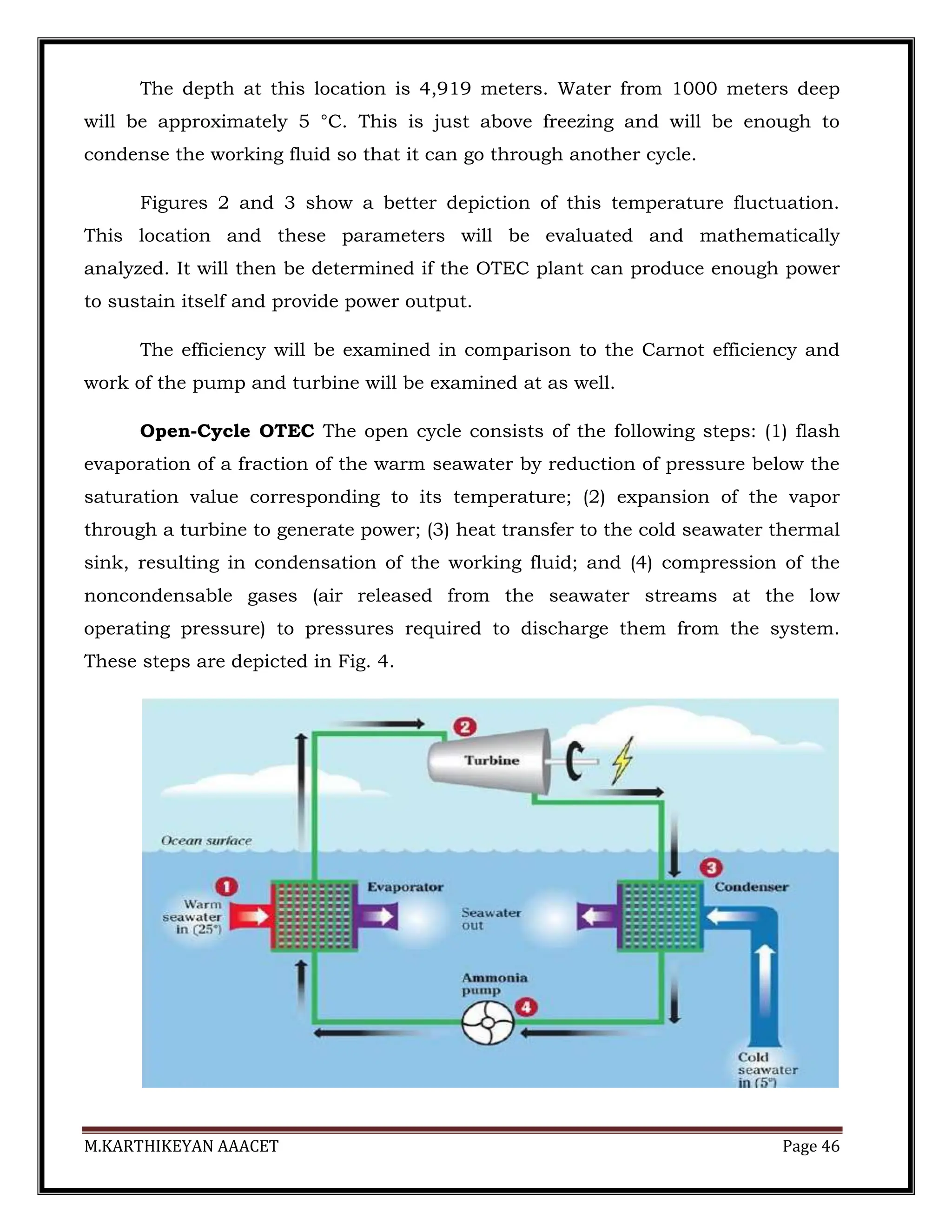
Open-Cycle OTEC The open cycle consists of the following steps: (1) flash
evaporation of a fraction of the warm seawater by reduction of pressure below the
saturation value corresponding to its temperature; (2) expansion of the vapor
through a turbine to generate power; (3) heat transfer to the cold seawater thermal
sink, resulting in condensation of the working fluid; and (4) compression of the
noncondensable gases (air released from the seawater streams at the low
operating pressure) to pressures required to discharge them from the system.
These steps are depicted in Fig. 4.
M.KARTHIKEYAN AAACET Page 47
In the case of a surface condenser, the condensate (desalinated water) must
be compressed to pressures required to discharge it from the power generating
system.
The evaporator, turbine, and condenser operate in partial vacuum ranging
from 3% to 1% atmospheric pressure. This poses a number of practical concerns
that must be addressed.
First, the system must be carefully sealed to prevent in-leakage of
atmospheric air that can severely degrade or shut down operation. Second, the
specific volume of the low-pressure steam is very large compared to that of the
pressurized working fluid used in closed cycle OTEC.
This means that components must have large flow areas to ensure that
steam velocities do not attain excessively high values. Finally, gases such as
oxygen, nitrogen, and carbon dioxide that are dissolved in seawater (essentially
air) come out of solution in a vacuum.
These gases are not condensable and must be exhausted from the system.
In spite of the aforementioned engineering challenges, the Claude cycle enjoys
certain benefits from the selection of water as the working fluid. Water, unlike
ammonia, is nontoxic and environmentally benign.
Moreover, since the evaporator produces desalinated steam, the condenser
can be designed to yield fresh water. In many potential sites in the tropics, potable
water is a highly desired commodity that can be marketed to offset the price of
OTEC-generated electricity.
Flash evaporation is a distinguishing feature of open cycle OTEC. Flash
evaporation involves complex heat and mass transfer processes. In the
configuration tested with the 210 kW OC-OTEC Experimental Apparatus [9, 10]
warm seawater was pumped into a chamber through spouts designed to maximize
the heat-and-mass-transfer surface area by producing a spray of the liquid.
M.KARTHIKEYAN AAACET Page 48
The pressure in the chamber (2.6% of atmospheric) was less than the
saturation pressure of the warm seawater. Exposed to this lowpressure
environment, water in the spray began to boil.
As in thermal desalination plants, the vapor produced was relatively pure
steam. As steam is generated, it carries away with it its heat of vaporization. This
energy comes from the liquid phase and results in a lowering of the liquid
temperature and the cessation of boiling.
Thus, as mentioned above, flash evaporation may be seen as a transfer of
thermal energy from the bulk of the warm seawater to the small fraction of mass
that is vaporized to become the working fluid. Approximately 0.5% of the mass of
warm seawater entering the evaporator is converted into steam.
A large turbine is required to accommodate the relatively large volumetric
flow rates of low-pressure steam needed to generate any practical amount of
electrical power.
Although the last stages of turbines used in conventional steam power
plants can be adapted to OC-OTEC operating conditions, existing technology
limits the power that can be generated by a single turbine module, comprising a
pair of rotors, to about 2.5 MW. Condensation of the low-pressure working fluid
leaving the turbine occurs by heat transfer to the cold seawater.
This heat transfer may occur in a Direct-Contact-Condenser (DCC), in
which the seawater is sprayed directly over the vapor, or in a Surface Condenser
(SC) that does not allow contact between the coolant and the condensate.
DCCs are relatively inexpensive and have good heat transfer characteristics
due to the lack of a solid thermal boundary between the warm and cool fluids.
Although SCs for OTEC applications are relatively expensive to fabricate, they
permit the production of desalinated water.
Desalinated water production with a DCC requires the use of fresh water as
the coolant. In such an arrangement, the cold seawater sink is used to chill the
M.KARTHIKEYAN AAACET Page 49
fresh-water coolant supply using a liquid-to-liquid heat exchanger. Effluent from
the low-pressure condenser must be returned to the environment.
Liquid can be pressurized to ambient conditions at the point of discharge by
means of a pump or, if the elevation of the condenser is suitably high, it can be
compressed hydrostatically.
Noncondensable gases, which include any residual water vapor, dissolved
gases that have come out of solution, and air that may have leaked into the
system, must be pressurized with a compressor.
Although the primary role of the compressor is to discharge exhaust gases,
it usually is perceived as the means to reduce pressure in the system below
atmospheric.
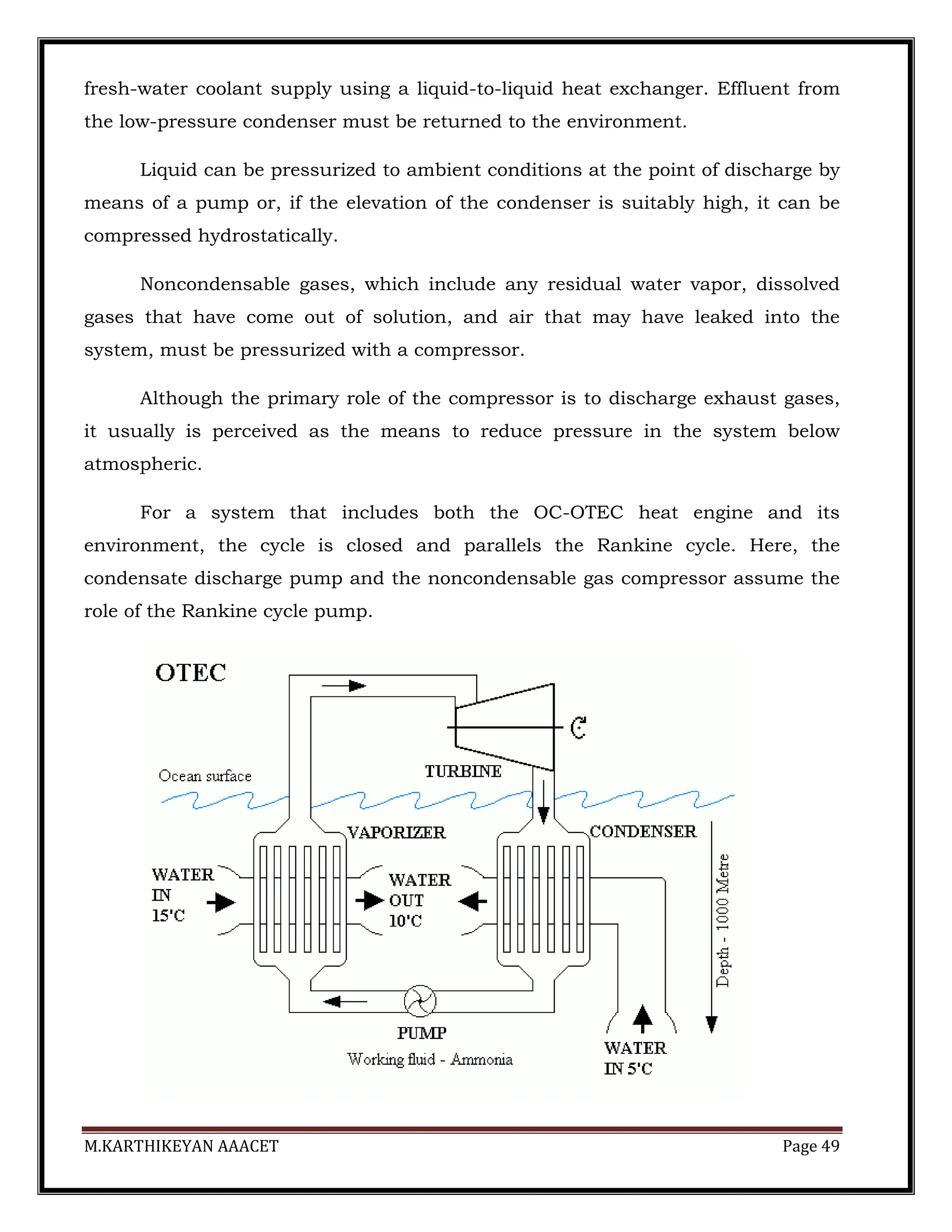
For a system that includes both the OC-OTEC heat engine and its
environment, the cycle is closed and parallels the Rankine cycle. Here, the
condensate discharge pump and the noncondensable gas compressor assume the
role of the Rankine cycle pump.
M.KARTHIKEYAN AAACET Page 50
Closed-Cycle OTEC The operation of a closed-cycle OTEC plant, using anhydrous
ammonia as the working fluid, is modeled with the saturated Rankine cycle.
Figure 7 shows the process flow diagram of the CC-OTEC cycle.
The analysis of the cycle is straightforward. Based on a unit mass flow rate
of ammonia vapor (kg/s) in the saturated cycle where, h is the enthalpy at the
indicated state point. It follows that the heat-added plus the pump-work is equal
to the heat-rejected plus the turbine-work.
Hybrid Cycle The Hybrid-cycle is one that has yet to be tested but uses
principles from both the closed and opencycle OTEC systems to obtain maximum
efficiency.
The Hybrid cycle uses both seawater and another working fluid, usually
designed using ammonia (Takahashi and Trenka, 1996). The fresh water is
initially flashed into steam, similar to the closed-cycle; this occurs in a vacuum
vessel.
In the same vessel the ammonia is evaporated through heat exchange with
the warm water. The ammonia is then physically mixed with the warm seawater in
a two-phase, two-substance mixture.
The evaporated ammonia is then separated from the steam/water and re-
condensed and re-introduced into the closed loop cycle. The phase change of the
water/ammonia vapor turns a turbine producing energy (Thomas, 1993).
Other Uses For OTEC Technology OTEC systems are not just limited to just
producing electricity and because of the unique design of these power stations are
potentially available to tackle other ventures in combination with electricity to
offset some of the expenses associates with OTEC.
A. Fresh water production Desalination is just one of the effective potential
products that could be produced via OTEC technology. Fresh water can be
produced in open-cycle OTEC plants when the warm water is vaporized to turn
the low pressure turbine.
M.KARTHIKEYAN AAACET Page 51
Once the electricity is produced the water vapor is condensed to make fresh
water (Takahashi and Trenka, 1996). This water has been found to be purer then
water offered by most communities as well it is estimated that 1 MW plant could
produce 55 kg of water per second.
This rate of fresh water could supply a small coastal community with
approximately 4000 m3 /day of fresh water (Takahashi and Trenka, 1996). This
water can also be used for irrigation to improve the quality and quantity of food on
coastal regions especially where access to fresh water is scarce.
B. Air conditioning and Refrigeration Once cold water pipes are installed for
an OTEC power plant the cold water being pumped to the surface can be used for
other projects other then to provide the working fluid for the condenser.
One of these uses is air conditioning and refrigeration. Cold water can be
used to circulate through space heat exchangers or can be used to cool the
working fluid within heat exchangers (Takahashi and Trenka, 1996). This
technology can be applied for hotel and home air conditioning as well as for
refrigeration schemes.
C. Aquaculture and Mariculture Another possibility for taking advantage of
OTEC plants is the use of the water pipes to harvest marine plants and animals
for the purpose of food.
This proposition is still under investigation however it is proposed that
seawater life including salmon, abalone, American lobster, flat fish, sea urchin
and edible seaweeds could be harvested for ingestion using the cold water pipes
that would be readily available from the OTEC power plants (Takahashi and
Trenka, 1996).
Mariculture is another possibility that is currently being researched that
would take advantage of the cold deep ocean water being transferred to the oceans
surface.
M.KARTHIKEYAN AAACET Page 52
This water contains phytoplankton and other biological nutrients that serve
as a catalyst for fish and other aquatic populations (Takahashi and Trenka, 1996).
This water could serve to increase native fish populations through the recycling of
trace nutrients that would not be otherwise available.
D. Coldwater Agriculture Because the coastal areas suitable for OTEC are in
tropic regions there is a potential to increase the overall food diversity within an
area using the cold water originating from the deep ocean.
It has been proposed that burying a network of coldwater pipes
underground the temperature of the ground would be ideal for spring type crops
like strawberries and other plants restricted to cooler climates (Takahashi and
Trenka, 1996).
This would not only supply the costal populations with an increased variety
of food but reduce the cost of transport of cooler climate foods that would
otherwise have to be shipped.

ORO551 RENEWABLE ENERGY SOURCES - FULL NOTES

  • 1.
    M.KARTHIKEYAN AAACET Page1 UNIT I PRINCIPLES OF SOLAR RADIATION ROLE OF NEW AND RENEWABLE SOURCE 1. With technological advancements in mass communication, people have now become aware of the demerits of burning fossil fuels. Renewable energy is the need of the hour. 2. Scientists and Engineers, around the world, are continuously working and researching in this domain. They are finding new ways to use these sources of energy effectively. 3. Fossil fuels are finite. They will certainly end one day. Therefore, before the crucial stage comes up, experts of energy sectors must maintain a positive attitude in this regard and should try their level best to replace fossils fuels with renewable energy sources as the main sources of generating electricity. 4. Renewable energy can make the electricity prices stable. It is because their cost is dependent only on the initial invested capital and is free of the fluctuating costs of coal, oil and natural gas. ECONOMY & JOBS 1. Most renewable energy investments are spent on materials and workmanship to build and maintain the facilities, rather than on costly energy imports. RENEWABLE NON - RENEWABLE It can be used again and again throughout its life. It is limited which can be depleted one day. It is sustainable It is exhaustible The rate of renewal is greater than the rate of consumption. The rate of renewal is lower than the rate of consumption. These resources are present in unlimited quantity. These resources are present in a limited quantity only. Pollution free. Not pollution free. Sunlight, are the examples of renewable resources. Examples - Coal, petroleum, natural gases, batteries etc.,
  • 2.
    M.KARTHIKEYAN AAACET Page2 2. Renewable energy sector is comparatively new in most countries and this sector can attract a lot of companies to invest in it. 3. It will create more local jobs & increase the nation’s economy. GREATER INDEPENDENCE 1. The daily price of oil depends on various factors which also includes political stability in various regions of the globe. In the past, political discords have caused severe energy crises. Renewable energy can be locally produced and therefore, it is not vulnerable to distant political disturbances. 2. Armed with solar panels, as well as additional equipment such as SMA inverters and batteries, every household can produce their own energy. ADVANTAGES 1. Renewable energy is infinite. 2. Renewable energy technologies are clean sources of energy. 3. Lower environmental impact. 4. It is a safe form of energy. 5. It can be collected in multiple locations simultaneously. 6. It can provide nations with energy independence. 7. It is relatively easy to maintain renewable energy collectors. 8. It can be used to recycle our waste products. 9. Renewable energy sources are available in nature at free of cost. DISADVANTAGES 1. It has expensive storage costs. 2. It can take a lot of space to install. 3. Depends on nature’s mercy. POTENTIAL OF NEW AND RENEWABLE SOURCE IN INDIA  India is running one of the largest and most ambitious renewable capacity expansion programs in the world.  In the electricity sector, renewable energy account for 35% of the total installed power capacity.  Large hydro installed capacity was 45.399 GW as of 31 March 2019, contributing to 13% of the total power capacity.  The remaining renewable energy sources accounted for 22% of the total installed power capacity (77.641 GW) as of 31 March 2019. HYDEL POWER CAPACITY  Hydroelectricity is administered separately by the Ministry of Power and not included in MNRE targets.  India is the 7th largest producer of hydroelectric power in the world.  As of 30 April 2017, India's installed utility-scale hydroelectric capacity was 44,594 MW, or 13% of its total utility power generation capacity.
  • 3.
    M.KARTHIKEYAN AAACET Page3  Additional smaller hydroelectric power units with a total capacity of 4,380 MW (1.3% of its total utility power generation capacity) have been installed.  Small hydropower, defined to be generated at facilities with nameplate capacities up to 25 MW, comes under the ambit of the Ministry of New and Renewable energy (MNRE); whilst large hydro, defined as above 25 MW, comes under the ambit of Ministry of Power. 1] SOLAR PHOTOVOLTAIC SYSTEM  Photovoltaic system, also PV system or solar power system, is a power system designed to supply solar power by means of photovoltaics. It consists of  Solar panels to absorb and convert sunlight into electricity,  Solar inverter to change the electric current from DC to AC.
  • 4.
    M.KARTHIKEYAN AAACET Page4 2] SOLAR WATER HEATING  Solar water heating (SWH) is the conversion of sunlight into heat for water heating using a solar thermal collector. 3] SOLAR THERMAL POWER PLANT  Solar thermal energy (STE) is a form of energy and a technology for harnessing solar energy to generate electrical energy for use in industry, and in the residential and commercial sectors.
  • 5.
    M.KARTHIKEYAN AAACET Page5 4] SOLAR COOKER EXTRATERRESTRIAL / TERRESTRIAL SOLAR RADIATION
  • 6.
    M.KARTHIKEYAN AAACET Page6 1. DIRECT RADIATION: Solar radiation that reaches to the surface of earth without being diffused is called direct beam radiation. 2. DIFFUSED RADIATION: As sunlight passes through the atmosphere, some of it is absorbed, scattered and reflected by air molecules, water vapour, cloud, dust, and pollutants from power plants, forest fires, and volcanoes. This is called diffused radiation. 3. GLOBAL SOLAR RADIATION: The sum of diffuse and direct solar radiation is called global solar radiation. 4. REFLECTED RADIATION: It is the amount of solar energy reflected from a surface EXTRATERRESTRIAL SOLAR RADIATION: 1. Solar radiation incident on the outer atmosphere of the earth is called extraterrestrial radiation. 2. On average the extraterrestrial irradiance is 1367 (W/m2). TERRESTRIAL SOLAR RADIATION: 1. Solar radiation that reaches the earth surface after passing through the earth’s atmosphere is known as terrestrial solar radiation. 2. Hence terrestrial solar radiation is always less than the extraterrestrial solar radiation. 3. This reduction in intensity is due to  Atmospheric absorption  Scattering etc.,
  • 7.
    M.KARTHIKEYAN AAACET Page7 INSTRUMENTS FOR MEASURING SOLAR RADIATION To measure global or diffuse radiation: I. PYRANOMETER 1. Eppley Pyranometer 2. Yellot solarimeter [photovoltaic cell pyranometer] 3. Moll – Goreczynski Pyranometer 4. Bimetallic Pyranograph 5. Yanishevsky Pyranometer 6. Dirmhirn-Sauberer or Star Pyranometer To measure beam or direct radiation: II. PYRHELIOMETER 1. Angstrom pyreheliometer 2. Abbot silver disc pyreheliometer 3. Eppley pyreheliometer PYRANOMETER  A pyranometer is used to measure global solar radiation falling on a horizontal surface.  Pyranometer also measure diffused radiation by using a shading ring.  The shading ring will prevent the falling of beam radiation on the sensor.  Its sensor has a horizontal radiation-sensing surface that absorbs solar radiation energy from the whole sky and transforms this energy into heat.  Global solar radiation can be calculated by measuring this heat energy.  Most pyranometers in general use are now the thermopile type, although bimetallic pyranometers are occasionally found.  BIMETALLIC PYRANOGRAPH  A bimetallic strip is used to convert a temperature change into mechanical displacement.  A bimetal strip is made of two thin metal strips that have different coefficients of expansion.  The two metal strips are joined by brazing, so that the relative movement between them is stopped.
  • 8.
    M.KARTHIKEYAN AAACET Page8  The radiation-sensing element consists of two pairs of bimetals, one painted black and the other painted white.  White bimetallic strips are fixed to the frame.  Black bimetallic strips ones are connected to the recorder section via a transmission shaft.  The deflection of the free edge of the black strips is transmitted to the recording pen through a magnifying system. UNIT II SOLAR ENERGY COLLECTION Flat plate and concentrating collectors, classification of concentrating collectors, orientation and thermal analysis, advanced collectors. SOLAR COLLECTOR 1. Solar collectors are heat exchangers. 2. Solar collectors transform solar radiation into heat and transfer that heat to a medium (water, solar fluid, or air). 3. Then solar heat can be used for heating water, to heating or cooling systems, or for heating swimming pools. They can be classified mainly in two groups: 1. Flat-plate collectors.
  • 9.
    M.KARTHIKEYAN AAACET Page9 2. Concentrating or focusing collectors. FLAT PLATE COLLECTOR 1. The first accurate model of flat plate solar collectors was developed by Hottel and Whillier in the 1950's. 2. Flat-plate collectors are designed for applications requiring moderate temperatures usually up to 110°C. 3. It uses both beam and diffuse radiation. 4. Flat-plate collectors are the most widely used kind of collectors in the world for domestic water-heating systems and solar space heating/cooling. COMPONENTS OF A TYPICAL FLAT PLATE COLLECTOR: 1. Absorber Plate:  It is usually made of copper, steel or plastic.  For a copper plate 0.05 cm thick with 1.25-cm tubes spaced 15 cm apart in good thermal contact with the copper, the fin efficiency is better than 97 percent.  The surface of the absorber plate determines how much of the incident solar radiation is absorbed.  Flat black paint is used as a coating has an absorptance of about 95 percent for incident shortwave solar radiation.  It is durable and easy to apply.
  • 10.
    M.KARTHIKEYAN AAACET Page10 2. Flow passages:  The flow passages conduct the working fluid through the collector.  If the working fluid is a liquid , the flow passage is usually a tube that is attached to or is a part of absorber plate.  If the working fluid is air , the flow passage should be below the absorber plate to minimize heat loss. 3. Cover plate:  To reduce convective and radiative heat losses from the absorber , one or two transparent covers are generally placed above the absorber plate.  A cover plate for a collector should have a high transmittance for solar radiation and should not detoriate with time.  The material most commonly used is glass.  A 0.32-cm thick sheet of window glass transmits 85 percent of solar energy at normal incidence.  Some plastic materials can be used for collector glazing.  However, they are not as durable as glass and they often degrade with exposure to high temperatures. 4. Insulation:  These are some materials such as fiberglass and they are placed at the back and sides of the collector to reduce heat losses. 5. Enclosure:  A box that the collector is enclosed in holds the components together, protect them from weather, facilitates installation of the collector on a roof or appropriate frame. WORKING PRINCIPLE 1. The solar radiations after passing through the transparent cover falls on the absorber plate. 2. The absorbed radiations partly get transferred to a liquid flowing through tubes. 3. These copper tubes are fixed to the absorber plate. 4. The liquid most commonly used is water. 5. This energy transfer is the useful gain. 6. The remaining part of the radiation is lost by  convection and re-radiation from the top surface and by  conduction through the back and the edges.  convection and re-radiation loss can be reduced by transparent glass
  • 11.
    M.KARTHIKEYAN AAACET Page11  conduction loss can be reduced by thermal insulation. 7. In order to reduce the heat lost by re-radiation from the top of the absorber plate of a flat plate collector, it is usual to put a selective coating on the plate. 8. The selective coating exhibits the characteristic of a high value of absorptivity for incoming solar radiation and a low value of emissivity for outgoing re-radiation. 9. As a result, the collection efficiency of the flat plate collector is improved. FACTORS AFFECTING THE PERFORMANCE OF SYSTEM ARE 1. Incident Solar Radiation. 2. Number of Cover Plate = More than two cover plate should not be used. 3. Spacing = spacing between absorber and cover plate is kept 2-3 cm. 4. Collector Tilt = optimum tilt angle is kept +/-15 ° 5. Inlet Temperature = low temperature fluid absorbs more heat. 6. Dust on cover Plate = Frequent cleaning is required ADVANTAGES 1. Collect both beam and diffuse radiation 2. Permanently fixed (no sophisticated positioning or tracking equipment is required) 3. Easy to manufacture 4. Low cost 5. Little maintenance APPLICATIONS 1. Domestic water heating system. 2. For heating swimming pools. 3. Solar heating dryers. 4. Solarium TYPES OF FLAT PLATE COLLECTOR 1. Modified Flat Plate Collector 2. Evacuated Tube Collector 3. Solar Air Heater 1.] MODIFIED FLAT PLATE COLLECTOR
  • 12.
    M.KARTHIKEYAN AAACET Page12 CONSTRUCTION & WORKING - refer flat plate collector - In addition to that ., 1. Modified flat plate collector have reflective side faces (mirror) . 2. With the help of mirror higher concentration upto 10 is achieved & higher temperature of working fluids upto 200°c is achieved. 3. Modified flat plate collector is aligned in East-West direction and it requires a periodic tilt adjustment. 2.] EVACUATED TUBE COLLECTOR
  • 13.
    M.KARTHIKEYAN AAACET Page13 CONSTRUCTION DETAILS 1. The Evacuated tube collector consists of a number of rows of parallel annealed glass tubes. 2. These glass tubes are cylindrical in shape and they are connected to a header pipe.  tube diameter varies from between 1" to 3"  tube length varies from between 5’′ to 8′’ 3. Each tube consists of a thick glass outer tube and a thinner glass inner tube, which is covered with a special coating that absorbs solar energy but inhibits heat loss. 4. The insulation properties of the vacuum are so good that while the inner tube may be as high as 200oC, 5. The tubes are made of borosilicate or soda lime glass, which is strong and withstand high temperatures. 6. Inside the each glass tube, a flat or curved aluminium or copper fin/ [or absorber plate] is attached to a metal heat pipe.
  • 14.
    M.KARTHIKEYAN AAACET Page14 7. A heat pipe provides the most elegant way of extracting heat from an evacuated collector. 8. Heat pipe is hermetically sealed tube that contains a small amount of heat transfer liquid. 9. When one portion of tube is heated the liquid evaporates and condenses at the cold portion by transferring the heat. WORKING PRINCIPLE 1. Solar energy falls on glass tube. 2. Then it hit the absorber plate/transfer fin. 3. From absorber plate, the heat energy is transferred to copper heat pipe via conduction mode of heat transfer. 4. The liquid in the copper heat pipe quickly turns into a hot vapour. 5. As this gas vapor is now lighter, it rises up to the top portion of the pipe. 6. The heat energy of the vapour is transferred to the water or any fluid flowing through the connecting manifold. 7. As the hot vapour looses energy and cools, it condenses back from a gas to a liquid flowing back down the heat pipe to be reheated. 8. This cycle repeats again and again. ADVANTAGES 1. Makes hot water available even on partially cloudy days 2. Heats water to a very high temperature 3. High quality tubes made from borosilicate glass 4. Long lasting 5. Compact 6. Easy to install, operate and maintain 7. Safe and environment friendly. OTHER TYPES OF EVACUATED TYPE COLLECTOR
  • 15.
    M.KARTHIKEYAN AAACET Page15 3.] SOLAR AIR HEATER  Solar air collector consists of a flat, dark metal absorber plate encased in an airtight, insulated metal frame with glass over the top.  A solar air heater works in two basic ways. NON-POROUS TYPE SOLAR AIR HEATER 1. In this type, air stream flows above and/or behind the absorber plate. 2. The cover receives much of the heat and in turn, loses it to the ambient. 3. Thus a substantial amount of heat is lost to the ambient and hence this air heater is not recommended. 4. The non-porous type with air passage below the absorber is most commonly used.  The performance, can be improved by  roughening the absorber surface or  by using a vee-corrugated plate.  Introducing Turbulence  usage of fin  selective coatings are used. POROUS TYPE SOLAR AIR HEATER 1. The porous type of air heaters has porous absorber which may include slit and expanded metal, overlapped glass plat absorber and transpired honeycomb. 2. Solar radiation penetrates to a great depth.
  • 16.
    M.KARTHIKEYAN AAACET Page16 3. Thus the radiation loss decreases. 4. Air stream heats up as it passes through the matrix. 5. The pressure drop is usually lower than the non-porous type. 6. Wire mesh porous bed formed by broken bottles and overlapped glass plate are some examples of porous type absorbers used in Solar air heaters. ADVANTAGES 1. No Corrosion problem. 2. Leakage of air from the duct does not create any problem. 3. No Freezing of working fluid. ADVANCED FLAT PLATE COLLECTORS 1. Modified Flat Plate Collector 2. Evacuated Tube Collector 3. Solar Air Heater
  • 17.
    M.KARTHIKEYAN AAACET Page17 OTHER TYPES OF FLAT PLATE COLLECTOR DIFFERENCE FLAT PLATE COLLECTORS CONCENTRATING TYPE COLLECTORS Absorber area is large. Absorber area is small. Concentration ratio is 1. Concentration ratio is high. It uses both beam and diffuse radiation. It uses mainly beam radiation. Low temperature applications High temperature applications
  • 18.
    M.KARTHIKEYAN AAACET Page18 Due to low temperature, it does not use to produce power. Due to high temperature, it can be used for power generation. Simple in maintenance. Difficult in maintenance. Design is easy. Complex design. This is comparatively low cost. This is costly. FLAT PLATE COLLECTOR ORIENTATION Flat plate collectorts are divided in three main groups according to how they are oriented: 1. Flat-plate collectors facing south at fixed tilt 2. One-axis tracking flat-plate collectors with axis oriented north-south 3. Two-axis tracking flat-plate collectors Flat-plate collectors facing south at fixed tilt 1. To optimize performance in the winter, the collector can be tilted 15 ° greater than the latitude; 2. To optimize performance in the summer, the collector can be tilted 15 ° less than the latitude. One-axis tracking flat-plate collectors with axis oriented north-south 1. These trackers pivot on their single axis to track the sun, facing east in the morning and west in the afternoon.
  • 19.
    M.KARTHIKEYAN AAACET Page19 Two-axis tracking flat-plate collectors 1. Tracking the sun in both azimuth and elevation, these collectors keep the sun's rays normal to the collector surface. CONCENTRATING OR FOCUSING COLLECTOR  It uses mainly beam radiation.  Concentrating, or focusing, collectors intercept direct radiation over a large area and focus it onto a small absorber area.  These collectors can provide high temperatures more efficiently than flat- plate collectors, since the absorption surface area is much smaller.  However, diffused sky radiation cannot be focused onto the absorber.
  • 20.
    M.KARTHIKEYAN AAACET Page20  Most concentrating collectors require mechanical equipment that constantly orients the collectors toward the sun and keeps the absorber at the point of focus. DISADVANTAGES OF CONCENTRATING OR FOCUSING COLLECTOR  Only beam component is collected in case of focusing collectors because diffuse component cannot be reflected.  Additional requirement of maintenance particularly to retain the quality of reflecting surface against dirt, weather, oxidation etc.  Non-uniform flux on the absorber whereas flux in flat-plate collector is uniform.  Additional optical losses such as reflectance loss and the intercept loss, so they introduce additional factors in energy balances. TYPES OF CONCENTRATING OR FOCUSING COLLECTOR - depending upon the concentrator and receiver geometries. 1. Cylindrical parabolic collector/Parabolic trough system. 2. Parabolic dish. 3. Mirror Strip Reflector 4. Fresnel Lens Collector 5. Compound parabolic collector 6. Central receiver collector/Power tower. 1. CYLINDRICAL PARABOLIC COLLECTOR/PARABOLIC TROUGH SYSTEM.
  • 21.
    M.KARTHIKEYAN AAACET Page21  In order to deliver high temperatures with good efficiency a high performance solar collector is required.  Systems with light structures and low cost technology for process heat applications up to 400°C could be obtained with parabolic through collectors (PTCs).  PTCs can effectively produce heat at temperatures between 50°C and 400 °C.  PTCs are made by bending a sheet of reflective material into a parabolic shape.  A metal black tube, covered with a glass tube to reduce heat losses, is placed along the focal line of the receiver.  The surface of the receiver is typically plated with selective coating that has a high absorptance for solar radiation, but a low emittance for thermal radiation loss.  When the parabola is pointed towards the sun, parallel rays incident on the reflector are reflected onto the receiver tube.  It is sufficient to use a single axis tracking of the sun and thus long collector modules are produced.  The collector can be orientated in an east–west direction, tracking the sun from north to south, or orientated in a north–south direction and tracking the sun from east to west. 2. PARABOLIC DISH.
  • 22.
    M.KARTHIKEYAN AAACET Page22  A parabolic dish reflector is a point-focus collector.  It tracks the sun, concentrating solar energy onto a receiver located at the focal point of the dish.  The dish structure must track fully the sun to reflect the beam into the thermal receiver.  The receiver absorbs the radiant solar energy, converting it into thermal energy in a circulating fluid.  Fluid in turn runs the turbine and generates a power.  The need to circulate heat transfer fluid throughout the collector field raises design issues such as piping layout, pumping requirements, and thermal losses.  Concentration ratio – 600 to 2000,  The Stirling engine is the most common type of heat engine used in dish- engine systems.  Parabolic dish systems can reach 1000 °C at the receiver, and achieve the highest efficiencies for converting solar energy to electricity in the small- power capacity range. 3. MIRROR STRIP REFLECTOR
  • 23.
    M.KARTHIKEYAN AAACET Page23 4. FRESNEL LENS COLLECTOR  Fresnel lenses are used as solar concentrators since they offer high optical efficiency along with minimal weight and low cost.  Though Fresnel lens concentrators have been used in solar energy concentration systems since 1960s.  The linear Fresnel reflector is a series of mirrors that arranged in different angles to fulfill the concentration function. 5. COMPOUND PARABOLIC COLLECTOR  It is also called CPC or winston collector.  It is a non-focusing type.
  • 24.
    M.KARTHIKEYAN AAACET Page24 UNIT III SOLAR ENERGY STORAGE AND APPLICATIONS Solar energy is an abundant and renewable energy source. The annual solar energy incident at the ground in India is about 20,000 times the current electrical energy consumption. The use of solar energy in India has been very limited. This is because solar energy is a dilute energy source (average daily solar energy incident in India is 5 kWh/m 2 day) and hence energy must be collected over large areas resulting in high initial capital investment; it is also an intermittent energy source. Hence solar energy systems must incorporate storage in order to take care of energy needs during nights and on cloudy days. This results in further increase in the capital cost of such systems. One way to overcome these problems is to use a large body of water for the collection and storage of solar energy. This concept is called a solar pond. Principle of a solar pond In a clear natural pond about 30~ solar radiation reaches a depth of 2 metres. This solar radiation is absorbed at the bottom of the pond. The hotter water at the bottom becomes lighter and hence rises to the surface. Here it loses heat to the ambient air and, hence, a natural pond does not attain temperatures much above the ambient. If some mechanism can be devised to prevent the mixing between the upper and lower layers of a pond, then the temperatures of the lower layers will be higher than of the upper layers. This can be achieved in several ways. The simplest method is to make the lower layer denser than the upper layer by adding salt in the lower layers. The salt used is generally sodium chloride or magnesium chloride because of their low cost. Ponds using salts to stabilize the lower layers are called 'salinity gradient ponds'.
  • 25.
    M.KARTHIKEYAN AAACET Page25 There are other ways to prevent mixing between the upper and lower layers. One of them is the use of a transparent honeycomb structure which traps stagnant air and hence provides good transparency to solar radiation while cutting down heat loss from the pond. The honeycomb structure is made of transparent plastic material. Ortabasi & Dyksterhuis (1985) have discussed in detail the performance of a honeycomb- stabilized pond. One can also use a transparent polymer gel as a means of allowing solar radiation to enter the pond but cutting down the losses from the pond to the ambient. Wilkins & Lee (1987) have discussed the performance of a gel (cross- linked polyacrylamide) pond. In this review we discuss salinity gradient solar ponds as this technology has made tremendous progress in the last fifteen years. Typical temperature and density profiles in a large salinity gradient solar pond are shown in figure 1. We find that there are three distinct zones in a solar pond. The lower mixed zone has the highest temperature and density and is the region where solar radiation is absorbed and stored. The upper mixed zone has the lowest temperature and density. This zone is mixed by surface winds, evaporation and nocturnal cooling. The intermediate zone is called the nonconvective zone (or the gradient zone) because no convection occurs here. Temperature and density decrease from the bottom to the top in this layer, and it acts as a transparent insulator. It permits solar radiation to pass through but reduces the heat loss from the hot lower convective zone to the cold upper convective zone. Heat transfer through this zone is by conduction only. The thicknesses of the upper mixed layer, the non-convective layer and the lower mixed layer are usually around 0"5, 1 m and 1 m, respectively.
  • 26.
    M.KARTHIKEYAN AAACET Page26 Pond construction The site selected for the construction of a solar pond should have the following attributes; (a) be close to the point where thermal energy from the pond will be utilized; (b) be close to a source of water for flushing the surface mixed-layer of the pond; (c) the thermal conductivity of the soil should not be too high; (d) the water table should not be too close to the surface. An estimate of the area required for a solar pond (in the tropics) can be obtained from figure 6 (adapted from Fynn & Short 1983). To minimize heat losses and liner costs, the pond should be circular. Since a circular pond is difficult to construct, a square pond is normally preferred. In some cases, such as the Bangalore solar pond, the site constraints may force one to construct a rectangular pond with large aspect ratio. For large solar ponds (area > 10,000m2), the shape will not have a strong influence on cost or heat losses.
  • 27.
    M.KARTHIKEYAN AAACET Page27 The depth of the solar pond must be determined depending on the specific application. The usual thicknesses of the surface, gradient and storage zone of the pond are 0.5, 1 and 1 m, respectively. If a particular site has low winds, one can reduce the thickness of the surface layer to 30 cm. If the temperature required for process heat applications is around 40°C (such as hatcheries) then the thickness of the gradient zone can be reduced to 0"5 m. Storage zone thickness higher than 1 m may be required to take care of long periods of cloudiness. The excavation for a solar pond is similar to that for construction of water reservoirs. The side slope of the pond can vary between 1 : 1 to 1: 3 depending upon the type of soil. After the excavation and bunding is completed, and before a liner is laid, one must ensure that the area is free of sharp objects which may damage the liner when it is being laid. SOLAR PHOTOVOLTAIC SYSTEM The special attraction of photovoltaics, as compared to other power generation technologies, lies in the fact that the solar radiation is converted directly into electric power by an electronic solid state process. In general, no moving parts and no specific thermal stresses are involved. Therefore, photovoltaic systems operate quietly and they can offer extremely high reliability, low maintenance requirements and a long lifetime. Due to the nature of the conversion process, one can utilize direct as well as diffuse radiation, which also allows applications in moderate climates with higher fractions of diffuse radiation. Another important advantage of PV is its modularity, permitting a very flexible system sizing for integration into buildings and for decentral applications down to very small load demands. Inverter: For PV systems connected to the public electricity grid an inverter is always required that converts the direct current and voltage produced by the PV
  • 28.
    M.KARTHIKEYAN AAACET Page28 generator into an alternating current with appropriate voltage and frequency levels. For stand-alone systems only an inverter is required, if ac-loads are to be operated. This is often the case for larger domestic systems where a variety of loads are connected. Storage: For stand-alone systems in general a storage battery and/or a back-up generator is required to provide power during cloudy and dark periods. There are however specific applications where storage batteries can be omitted. An example is the photovoltaic pumping system. Here, the pump is operating whenever there is adequate illumination, and storage is achieved by collecting the pumped water in a tank. PV generator: The principal structure of a PV generator is illustrated in Figure 2. To satisfy a specific power demand by a PV system, a number of solar modules may be electrically interconnected in series and in parallel. The output voltage of the total PV generator is then determined by the number of modules
  • 29.
    M.KARTHIKEYAN AAACET Page29 connected in series, and the output current by the number of module strings connected in parallel. The size of PV generators may range from single cells with sub-Milliwatt levels (e.g. in consumer products such as calculators) to single modules and up to module arrays with many Megawatts. Solar cell: The smallest independent operational unit of PV systems is the solar cell. The solar cell consists of a specific semiconductor diode, in most cases silicon, with a large aperture area for light absorption.
  • 30.
    M.KARTHIKEYAN AAACET Page30 In the photovoltaic conversion process light is absorbed by the semiconductor, and the absorbed photons produce free charge carriers (electrons and holes) which are then separated by the built-in electric field between the n- and p-type region. The charge separation produces a difference in electric potential between the two regions, and an electric current can be drawn through an external load. Depending on the cell efficiency and cell area, the maximum output power for single solar cells is on the order of 1 W, and output voltages are in the range of 0.5-1 Volt.
  • 31.
    M.KARTHIKEYAN AAACET Page31 UNIT IV WIND ENERGY Introduction • Wind is the roughly roughly horizontal horizontal movement movement of air (as opposed opposed to an air current) current) caused by uneven heating of the Earth's surface. • It occurs at all scales, from local breezes generated by heating of land surfaces and lasting lasting tens of minutes minutes to global winds resulting resulting from solar retard heating heating of the Earth. • The two major influences on the atmospheric circulation are the differential heating between the equator and the poles and the rotation of the planet (Coriolis effect). Winds can be classified either by their scale, the kinds of forces which cause them (according to the atmospheric equations of motion), or the geographic regions in which they exist. • Prevailing winds — the general circulation of the atmosphere • Seasonal Seasonal winds – winds that only exist during specific specific seasons seasons • Synoptic-scale winds; winds associated with large-scale events such as warm and cold fronts and are part of what makes up everyday weather • Mesoscale Mesoscale winds; winds that frequently frequently advances advances ahead of more intense intense thunderstorms and may be sufficiently energetic to generate local weather of its own • Microscale Microscale winds; winds that take place over very short durations durations of time - seconds to minutes - and spatially over only tens to hundreds of metres. Why do we need wind turbine?
  • 32.
    M.KARTHIKEYAN AAACET Page32 • Wind energy is abundant, renewable, widely distributed, clean and mitigates the greenhouse effect if used to replace fossil-fuel-derived electricity. • Conversion of wind power/energy into more useful forms is done by wind turbines. • Wind turbines are usually used to generate power but in certain appli i cat ons are used as prime movers to pump water (wind mills). • Wind power is used in large scale wind farms for national electrical grids as well as in small individual individual turbines turbines for providing providing electricity electricity to rural residences or grid-isolated locations. In 2005, worldwide worldwide capacity capacity of wind-powered powered generators generators was 58,982 megawatts megawatts; although it currently produces less than 1% of world-wide electricity use, it accounts for 23% of electricity use in Denmark, 4.3% in Germany and approximately 8% in Spain. A wind turbine is a machine for converting the kinetic energy in wind into mechanical energy If the mechanical energy is used directly by machinery, such as a pump or grinding stones, the machine is usually called a windmill. If the mechanical energy is then converted to electricity, the machine is called a wind generator. Wind turbines are classified into two general types: horizontal axis and vertical axis. A horizontal axis machine has its blades rotating on an axis parallel to the ground. A vertical axis machine has its blades rotating on an axis perpendicular to the ground. There are a number of available designs for both and each type has certain advantages and disadvantages. However, compared with the horizontal axis type, very few vertical axis machines are available commercially.
  • 33.
    M.KARTHIKEYAN AAACET Page33 Parts of a Wind Turbine The nacelle contains the key components of the wind turbine, including the gearbox, and the electrical generator. •The tower of the wind turbine carries the nacelle and the rotor. Generally, it is an advantage to have a high tower, since wind speeds increase farther away from the ground. •The rotor blades capture wind energy and transfer its power to the rotor hub. •The generator converts the mechanical energy of the rotating shaft to electrical energy •The gearbox increases the rotational speed of the shaft for the generator Working of Wind Turbine The blades act like wings of an airplane – capturing the energy in the wind. • The blades cut through the air with an angle f k h i d i Tail Fin Powerhead Alternator o f attac k to t he win d causing a pressure differential.
  • 34.
    M.KARTHIKEYAN AAACET Page34 • The resulting pressure differentials cause a force called lift which propels the blade Blades S i Nacelle force called lift, which propels the blade forward. • This lift is created because of the airfoil sha pe of the turbines blades. Tail Boom Tower Mount S pinner p • In order to propel the turbine, the net torque caused by lift forces must be greater than the net torque caused by drag forces. Tower • The blades turn a generato r that converts blade rotation into electricity • The tail keeps the blades facing the wind BIOMASS “Biogas” is a naturally occuring mixture of 60 to 70% methane and 30 to 40% CO2 with some H2S (Hydrogen Sulfide), that burns similar to so-called “natural gas”, which is actually a fossil fuel.
  • 35.
    M.KARTHIKEYAN AAACET Page35 Once generated and stored, biogas is primarily used around the world for cooking and heating at the home scale, but it also has many other important applications both domestically and industrially. Its use as a fuel to power electric generators at all scales is well established and it also has a long history of use in gas lamps and absorption refrigeration systems. When purified and compressed we see it used as an effective fuel for cars, trucks and buses (StockholmSweden is a leader in this application). Thus biogas is a flexible substitute for non-renewable energy sources at many levels. Additionally, its production creates a high quality fertilizer and provides feedstock for the creation of petrochemical substitutes so biogas serves to replace fossil resources on many levels. A “biogas digester” is a simple system which produces biogas, via the natural anaerobic decomposition of organic material. The biogas digester, once its “starter culture” of methanogenic (CH4 producing) bacteria has been established (usually several weeks after initial loading with animal manures or lake mud) can be fed daily with kitchen and garden waste. The ecosystem of bacteria in the biogas digester extract energy from the organic material and generate methane gas. The digested organic material exits the system as a high-quality fertilizer in liquid form. This liquid anaerobic “compost” still contains all the minerals and other soil nutrients of the kitchen and garden waste, including the nitrogen that can be lost through aerobic composting. Construction and use of a biogas digester Biogas systems can be built on any scale: small and simple for a single household, or large and industrial for a whole municipality. In Tamera we are interested in biogas digesters appropriate for a village or community kitchen; we strive to make these with inexpensive, widely accessible materials and technology.
  • 36.
    M.KARTHIKEYAN AAACET Page36 As previously stated, biogas consists of about two third methane and one third CO2, with some water vapor and trace gasses (principally H2S) and as such, without any alteration or purification, it can be used in all appliances made for natural gas — for example cookers and water and space heaters and electric gensets — with minimal modifications. A basic biogas digester consists of a tank in which the organic material is digested, combined with a system to collect and store the biogas produced. The digesters can be quite simple, and the details vary depending on available materials and the needs of the community. Our biogas digester, built in cooperation with T.H. Culhane from Solar CITIES e.V., consists of a cylindrical 3000 liter tank, open on top, in which the organic material is digested. A second, slightly smaller tank is placed in the larger tank, upside-down. As biogas is produced, the inner tank fills with gas and rises, telescoping out of the outer tank. As biogas is removed for use, the inner gas storage tank sinks back into the larger, outer tank. In this system, the inner tank acts as both storage, and as a lid for the digester tank.
  • 37.
    M.KARTHIKEYAN AAACET Page37 The gap between the tank walls is narrow enough to prevent significant quantities of oxygen from entering the digester, which would kill the anaerobic bacteria that produce the methane. The amount of biogas lost though the gap is negligible. Tamera’s 3000 liter digester is typically “fed” around 40-60 liters of biomass daily — a few full buckets of ground up organic waste mixed with water — and produces enough gas for several hours of cooking per day. The main sources of biomass are food scraps and kitchen waste. Non-woody garden waste is also appropriate Before being fed into the digester tank, the biomass is mechanically macerated — chewed up — with an “Insinkerator” garbage disposal. Nowadays these “waste disposal” machines are being rebranded as “feedstock preparation devices” and we call them “compost companions” because
  • 38.
    M.KARTHIKEYAN AAACET Page38 they can be used to prepare organic garbage for use in both anaerobic and aerobic decomposition processes. Grinding allows the bacteria to access and digest the organic material more easily; in an anaerobic system the transformation into gas and fertilizer can take as little as 24 hours while in an aerobic compost pile the transformation into soil can take as little as three to six days instead of months. For our biogas digestor a slurry of ground biomass and warm (40°C) water is poured into the tank inlet funnel. The inlet for the digester leads down to the bottom center of the digester tank. The digested organic material leaves as a high-quality liquid fertilizer, through an outlet near the top of the outer digester tank. At the top of the inverted, inner tank, there is an outlet for the biogas. Before normal operation, the biogas digester must be “started.”
  • 39.
    M.KARTHIKEYAN AAACET Page39 This is done by preparing a 1:1 mixture of fresh animal manure and water, and allowing this to ferment anaerobically for several weeks. The volume of this mixture should be around 200 liters for a 3000 liter digester or roughly 30-40 kg of animal manures per cubic meter of digestor tank space. Less can be used but it would simply take longer to establish the colonies of bacteria to enable feeding (feeding only starts once first flammable gas is produced). The slurry can be prepared in a seperate container or in the digester tank. The manure contains the naturally-occurring bacteria that digest organic matter and produce methane. Note that unlike in cheesemaking or yoghurt making biogas digestors do not rely on one strain of bacteria but depend on a balanced ecology of many different types of microbes – hydrolytic, acidogenic, acetogenic and methanogenic. Fortunately these are all found in animal manure and even lake mud. Essentially any animal wastes can be used — cow, horse, pig, and others; alone or mixed. Human excreta can be used as well, although in this case the fertilizer output of the digester should only be used on trees, or in other appropriate applications.
  • 40.
    M.KARTHIKEYAN AAACET Page40 UNIT V GEOTHERMAL ENERGY The word geothermal comes from the Greek words geo (earth) and therme (heat). So, geothermal energy is heat from within the earth. We can use the steam and hot water produced inside the earth to heat buildings or generate electricity. Geothermal energy is a renewable energy source because the water is replenished by rainfall and the heat is continuously produced inside the earth. Geothermal energy is generated in the earth's core, about 4,000 miles below the surface. Temperatures hotter than the sun's surface are continuously produced inside the earth by the slow decay of radioactive particles, a process that happens in all rocks. The earth has a number of different layers: The core itself has two layers: a solid iron core and an outer core made of very hot melted rock, called magma. The mantle which surrounds the core and is about 1,800 miles thick. It is made up of magma and rock. The crust is the outermost layer of the earth, the land that forms the continents and ocean floors. It can be three to five miles thick under the oceans and 15 to 35 miles thick on the continents. The earth's crust is broken into pieces called plates. Magma comes close to the earth's surface near the edges of these plates. This is where volcanoes occur.
  • 41.
    M.KARTHIKEYAN AAACET Page41 The lava that erupts from volcanoes is partly magma. Deep underground, the rocks and water absorb the heat from this magma. The temperature of the rocks and water get hotter and hotter as you go deeper underground. People around the world use geothermal energy to heat their homes and to produce electricity by digging deep wells and pumping the heated underground water or steam to the surface. Or, we can make use of the stable temperatures near the surface of the earth to heat and cool buildings Condenser The steam-water mixture emitted from the turbine at outlet contains a significant amount of non condensable gases comprising mainly CO2 (which is usually 95–98% of the total gas content), CH4 and H2S, and is thus highly acidic. Since most high-temperature geothermal resources are located in arid or semi-arid areas far removed from significant freshwater (rivers, lakes) sources, the condenser cooling choices are mostly limited to either atmospheric cooling towers or forced ventilation ones. The application of evaporative cooling of the condensate results in the condensate containing dissolved oxygen in addition to the non-condensable gases, which make the condenser fluid highly corrosive and require the condenser to be clad on the inside with stainless steel; condensate pumps to be made of stainless steel, and all condensate pipelines either of stainless steel or glass reinforced plastic. Addition of caustic soda is required to adjust the pH in the cooling tower circuit. Make-up water and blow-down is also used to avoid accumulation of salts in the water caused by evaporation. A problem sometimes encountered within the condenser is the deposition of almost pure sulphur on walls and nozzles within the condenser. This scale deposition must be periodically cleaned by high pressure water spraying etc.
  • 42.
    M.KARTHIKEYAN AAACET Page42 Cooling tower and associated equipment Most high-temperature geothermal resources are located in arid or semi-arid areas far removed from significant freshwater (rivers, lakes) sources. This mostly limits condenser cooling choices to either atmospheric cooling towers or forced ventilation ones. Freshwater cooling from a river is, however, used for instance in New Zealand and seawater cooling from wells on Reykjanes, Iceland. In older power plants the atmospheric versions and/or barometric ones, the large parabolic ones of concrete, were most often chosen. Most frequently chosen for modern power plants is the forced ventilation type because of environmental issues and local proneness to earth quakes. The modern forced ventilation cooling towers are typically of wooden/plastic construction comprising several parallel cooling cells erected on top of a lined concrete condensate pond. The ventilation fans are normally vertical, reversible flow type and the cooling water pumped onto a platform at the top of the tower fitted with a large number of nozzles, through which the hot condensate drips in counterflow to the airflow onto and through the filling material in the tower and thence into the condensate pond, whence the cooled condensate is sucked by the condenser vacuum back into the condenser. To minimise scaling and corrosion effects the condensate is neutralised through pH control, principally via addition of sodium carbonate. Three types of problems are found to be associated with the cooling towers, i.e. • Icing problems in cold areas. • Sand blown onto the tower in sandy and arid areas. • Clogging up by sulphitephylic bacteria. Particulate/droplet erosion and countermeasures Geothermal production wells in many steam dominated reservoir have entrapped in the well flow minute
  • 43.
    M.KARTHIKEYAN AAACET Page43 solids particles (dust), which because of the prevailing high flow velocities may cause particulate erosion in the well head and downstream of it. Such erosion in the well head may, in extreme cases, cause damage of consequence to wellhead valves, and wellhead and fittings, particularly in T- fittings and sharp bends in the fluid collection pipelines. This is, however, generally not the case and such damage mostly quite insignificant. It is, however, always a good practice to use fairly large radius pipe bends to minimise any such erosion effects. Droplet erosion is largely confined to the turbine rotor and housing. At exit from the second or the third expansion stage the steam becomes wet and condensate droplets tend to form in and after the expansion nozzles. Wetness of 10% to 12% is not uncommon in the last stages. The rotor blades have furthermore reached a size where the blade tip speeds become considerable and the condensate droplets hit the blade edges causing erosion.
  • 44.
    M.KARTHIKEYAN AAACET Page44 The condensate water which has become acidic from the dissolved non condensable gas attaches to the blades and is thrown against the housing. This water has the potential to cause erosion problems. The most effective countermeasures are to fit the blade edges of the last two stages with carbide inserts (Stellite) that is resistant to the droplet impingement and the housing with suitable flow groves that reduce the condensate flow and thereby potential erosion damage. In addition to the erosion the blades and rotor are susceptible to stress corrosion in the H2S environment inside the turbine housing. The most effective countermeasure is to exercise great care in selecting rotor, expansion nozzle and rotor blade material that is resistant to hydrogen sulphite corrosion cracking. The generally most effective materials for the purpose are high chromium steels. OTEC (OTEC). This is a power cycle that is in turn a heat engine, which powers a low-pressure turbine. Ammonia will be used as the working fluid in the cycle due to its low boiling point. The idea is very simple. Surface water temperature is enough to cause the working fluid to boil, then cold water from approximately 1000 meters deep will be pumped to the surface to condense the working fluid. The system analyzed here will operate in a closed cycle. There are also open cycle OTEC platforms, which can be beneficial as well. In the open cycle warm seawater is located in a lowpressure tank and caused to then boil. The steam that comes from the low-pressure boiling system is enough to power a turbine thus creating work. The cold seawater is used to condense the
  • 45.
    M.KARTHIKEYAN AAACET Page45 steam. One benefit to the open cycle is that desalinated water is created in the cycle as a byproduct. The closed cycle OTEC system uses Ammonia as a working fluid. Ammonia has a much lower boiling point than that of water. The water on the surface of the ocean is warm enough to heat the working fluid and cause a thermodynamic cycle of a heat engine to occur. The condenser will also consist of deep water from the ocean. This water will be pumped from the sea floor approximately 1000 meters deep. The schematic of the cycle is presented in Figure 1. Data from a buoy off the coast of Hawaii has been selected for the target OTEC plant location with optimal conditions. The average surface water temp is 26.9 °C.
  • 46.
    M.KARTHIKEYAN AAACET Page46 The depth at this location is 4,919 meters. Water from 1000 meters deep will be approximately 5 °C. This is just above freezing and will be enough to condense the working fluid so that it can go through another cycle. Figures 2 and 3 show a better depiction of this temperature fluctuation. This location and these parameters will be evaluated and mathematically analyzed. It will then be determined if the OTEC plant can produce enough power to sustain itself and provide power output. The efficiency will be examined in comparison to the Carnot efficiency and work of the pump and turbine will be examined at as well. Open-Cycle OTEC The open cycle consists of the following steps: (1) flash evaporation of a fraction of the warm seawater by reduction of pressure below the saturation value corresponding to its temperature; (2) expansion of the vapor through a turbine to generate power; (3) heat transfer to the cold seawater thermal sink, resulting in condensation of the working fluid; and (4) compression of the noncondensable gases (air released from the seawater streams at the low operating pressure) to pressures required to discharge them from the system. These steps are depicted in Fig. 4.
  • 47.
    M.KARTHIKEYAN AAACET Page47 In the case of a surface condenser, the condensate (desalinated water) must be compressed to pressures required to discharge it from the power generating system. The evaporator, turbine, and condenser operate in partial vacuum ranging from 3% to 1% atmospheric pressure. This poses a number of practical concerns that must be addressed. First, the system must be carefully sealed to prevent in-leakage of atmospheric air that can severely degrade or shut down operation. Second, the specific volume of the low-pressure steam is very large compared to that of the pressurized working fluid used in closed cycle OTEC. This means that components must have large flow areas to ensure that steam velocities do not attain excessively high values. Finally, gases such as oxygen, nitrogen, and carbon dioxide that are dissolved in seawater (essentially air) come out of solution in a vacuum. These gases are not condensable and must be exhausted from the system. In spite of the aforementioned engineering challenges, the Claude cycle enjoys certain benefits from the selection of water as the working fluid. Water, unlike ammonia, is nontoxic and environmentally benign. Moreover, since the evaporator produces desalinated steam, the condenser can be designed to yield fresh water. In many potential sites in the tropics, potable water is a highly desired commodity that can be marketed to offset the price of OTEC-generated electricity. Flash evaporation is a distinguishing feature of open cycle OTEC. Flash evaporation involves complex heat and mass transfer processes. In the configuration tested with the 210 kW OC-OTEC Experimental Apparatus [9, 10] warm seawater was pumped into a chamber through spouts designed to maximize the heat-and-mass-transfer surface area by producing a spray of the liquid.
  • 48.
    M.KARTHIKEYAN AAACET Page48 The pressure in the chamber (2.6% of atmospheric) was less than the saturation pressure of the warm seawater. Exposed to this lowpressure environment, water in the spray began to boil. As in thermal desalination plants, the vapor produced was relatively pure steam. As steam is generated, it carries away with it its heat of vaporization. This energy comes from the liquid phase and results in a lowering of the liquid temperature and the cessation of boiling. Thus, as mentioned above, flash evaporation may be seen as a transfer of thermal energy from the bulk of the warm seawater to the small fraction of mass that is vaporized to become the working fluid. Approximately 0.5% of the mass of warm seawater entering the evaporator is converted into steam. A large turbine is required to accommodate the relatively large volumetric flow rates of low-pressure steam needed to generate any practical amount of electrical power. Although the last stages of turbines used in conventional steam power plants can be adapted to OC-OTEC operating conditions, existing technology limits the power that can be generated by a single turbine module, comprising a pair of rotors, to about 2.5 MW. Condensation of the low-pressure working fluid leaving the turbine occurs by heat transfer to the cold seawater. This heat transfer may occur in a Direct-Contact-Condenser (DCC), in which the seawater is sprayed directly over the vapor, or in a Surface Condenser (SC) that does not allow contact between the coolant and the condensate. DCCs are relatively inexpensive and have good heat transfer characteristics due to the lack of a solid thermal boundary between the warm and cool fluids. Although SCs for OTEC applications are relatively expensive to fabricate, they permit the production of desalinated water. Desalinated water production with a DCC requires the use of fresh water as the coolant. In such an arrangement, the cold seawater sink is used to chill the
  • 49.
    M.KARTHIKEYAN AAACET Page49 fresh-water coolant supply using a liquid-to-liquid heat exchanger. Effluent from the low-pressure condenser must be returned to the environment. Liquid can be pressurized to ambient conditions at the point of discharge by means of a pump or, if the elevation of the condenser is suitably high, it can be compressed hydrostatically. Noncondensable gases, which include any residual water vapor, dissolved gases that have come out of solution, and air that may have leaked into the system, must be pressurized with a compressor. Although the primary role of the compressor is to discharge exhaust gases, it usually is perceived as the means to reduce pressure in the system below atmospheric. For a system that includes both the OC-OTEC heat engine and its environment, the cycle is closed and parallels the Rankine cycle. Here, the condensate discharge pump and the noncondensable gas compressor assume the role of the Rankine cycle pump.
  • 50.
    M.KARTHIKEYAN AAACET Page50 Closed-Cycle OTEC The operation of a closed-cycle OTEC plant, using anhydrous ammonia as the working fluid, is modeled with the saturated Rankine cycle. Figure 7 shows the process flow diagram of the CC-OTEC cycle. The analysis of the cycle is straightforward. Based on a unit mass flow rate of ammonia vapor (kg/s) in the saturated cycle where, h is the enthalpy at the indicated state point. It follows that the heat-added plus the pump-work is equal to the heat-rejected plus the turbine-work. Hybrid Cycle The Hybrid-cycle is one that has yet to be tested but uses principles from both the closed and opencycle OTEC systems to obtain maximum efficiency. The Hybrid cycle uses both seawater and another working fluid, usually designed using ammonia (Takahashi and Trenka, 1996). The fresh water is initially flashed into steam, similar to the closed-cycle; this occurs in a vacuum vessel. In the same vessel the ammonia is evaporated through heat exchange with the warm water. The ammonia is then physically mixed with the warm seawater in a two-phase, two-substance mixture. The evaporated ammonia is then separated from the steam/water and re- condensed and re-introduced into the closed loop cycle. The phase change of the water/ammonia vapor turns a turbine producing energy (Thomas, 1993). Other Uses For OTEC Technology OTEC systems are not just limited to just producing electricity and because of the unique design of these power stations are potentially available to tackle other ventures in combination with electricity to offset some of the expenses associates with OTEC. A. Fresh water production Desalination is just one of the effective potential products that could be produced via OTEC technology. Fresh water can be produced in open-cycle OTEC plants when the warm water is vaporized to turn the low pressure turbine.
  • 51.
    M.KARTHIKEYAN AAACET Page51 Once the electricity is produced the water vapor is condensed to make fresh water (Takahashi and Trenka, 1996). This water has been found to be purer then water offered by most communities as well it is estimated that 1 MW plant could produce 55 kg of water per second. This rate of fresh water could supply a small coastal community with approximately 4000 m3 /day of fresh water (Takahashi and Trenka, 1996). This water can also be used for irrigation to improve the quality and quantity of food on coastal regions especially where access to fresh water is scarce. B. Air conditioning and Refrigeration Once cold water pipes are installed for an OTEC power plant the cold water being pumped to the surface can be used for other projects other then to provide the working fluid for the condenser. One of these uses is air conditioning and refrigeration. Cold water can be used to circulate through space heat exchangers or can be used to cool the working fluid within heat exchangers (Takahashi and Trenka, 1996). This technology can be applied for hotel and home air conditioning as well as for refrigeration schemes. C. Aquaculture and Mariculture Another possibility for taking advantage of OTEC plants is the use of the water pipes to harvest marine plants and animals for the purpose of food. This proposition is still under investigation however it is proposed that seawater life including salmon, abalone, American lobster, flat fish, sea urchin and edible seaweeds could be harvested for ingestion using the cold water pipes that would be readily available from the OTEC power plants (Takahashi and Trenka, 1996). Mariculture is another possibility that is currently being researched that would take advantage of the cold deep ocean water being transferred to the oceans surface.
  • 52.
    M.KARTHIKEYAN AAACET Page52 This water contains phytoplankton and other biological nutrients that serve as a catalyst for fish and other aquatic populations (Takahashi and Trenka, 1996). This water could serve to increase native fish populations through the recycling of trace nutrients that would not be otherwise available. D. Coldwater Agriculture Because the coastal areas suitable for OTEC are in tropic regions there is a potential to increase the overall food diversity within an area using the cold water originating from the deep ocean. It has been proposed that burying a network of coldwater pipes underground the temperature of the ground would be ideal for spring type crops like strawberries and other plants restricted to cooler climates (Takahashi and Trenka, 1996). This would not only supply the costal populations with an increased variety of food but reduce the cost of transport of cooler climate foods that would otherwise have to be shipped.