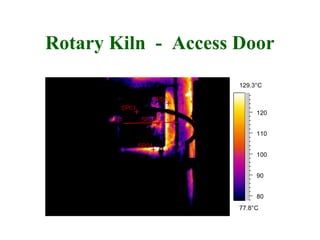
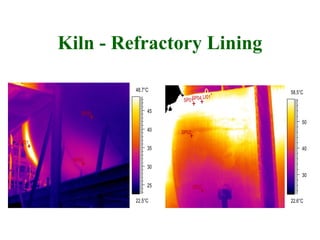
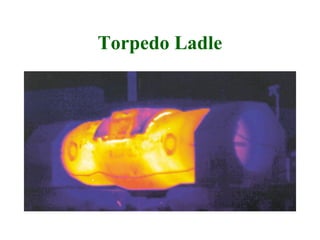
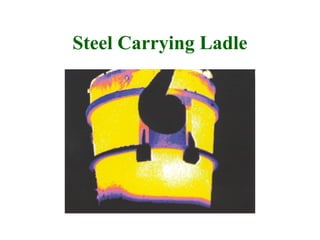
Thermographic testing uses infrared cameras to detect differences in surface temperatures that may indicate issues. It allows non-contact inspection of electrical equipment, buildings, industrial processes, and more. Key advantages are that it is non-destructive, fast, and can detect problems like loose connections, moisture ingress, insulation issues, and more from a distance. Operator experience is important to properly set up the infrared camera and interpret thermal images.
In this document
Powered by AI
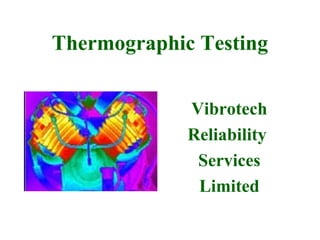
Introduction to Thermographic Testing with Vibrotech Reliability Services Limited.
Thermography explained, its principles, and the electromagnetic spectrum's role. Objectives of thermographic testing detailed, including the necessary testing equipment.
Discusses advantages of thermography such as non-contact testing, alongside its limitations.
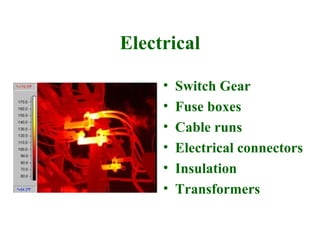
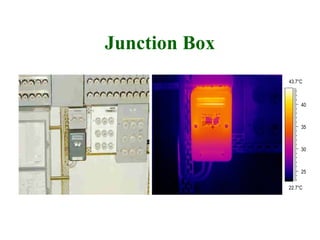
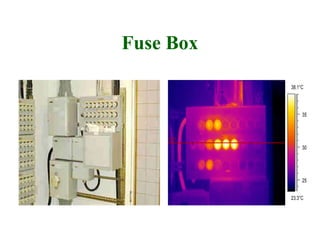
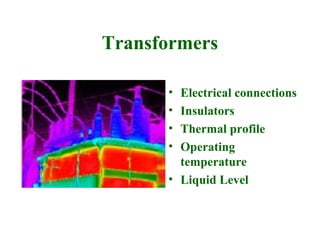
Applications of thermography in electrical settings including junction boxes, transformers, and connections.
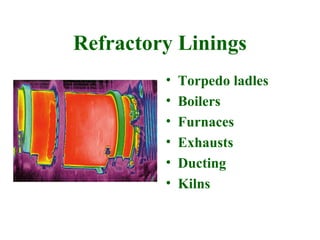
Thermography aims at assessing refractory linings and monitoring steel carrying ladles.
Addressing building surveys for insulation, air infiltration, and moisture detection using thermography.
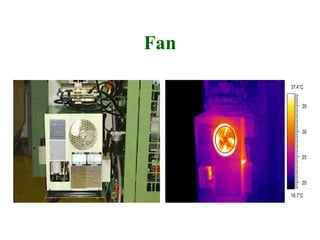
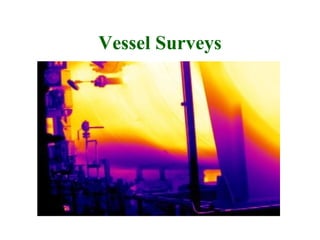
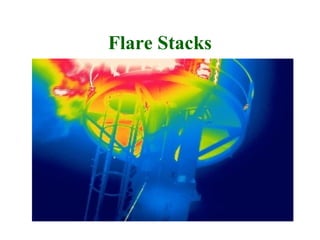
Using thermography in process plants for detecting faults, ensuring operations, and quality control.
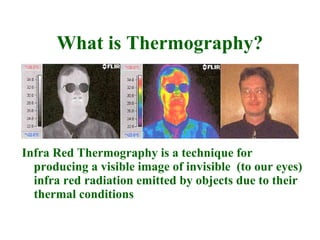
What is Thermography?
InfraRed Thermography is a technique for
producing a visible image of invisible (to our eyes)
infra red radiation emitted by objects due to their
thermal conditions
3.
Thermography
Objectives of Test
• To detect hot or cold area’s
• To determine absolute temperature
• To view Thermal profiles
• To detect temperature loss
4.
Thermography
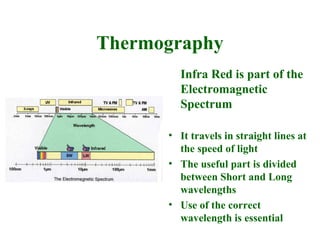
Infra Red is part of the
Electromagnetic
Spectrum
• It travels in straight lines at
the speed of light
• The useful part is divided
between Short and Long
wavelengths
• Use of the correct
wavelength is essential
5.
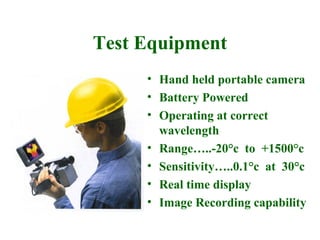
Test Equipment
• Hand held portable camera
• Battery Powered
• Operating at correct
wavelength
• Range…..-20°c to +1500°c
• Sensitivity…..0.1°c at 30°c
• Real time display
• Image Recording capability
6.
Why Thermography?
• NonContact
• Rapid Scanning
• Data can be recorded in differing formats
• Images produced are comprehensive &
reliable
• Is there a viable alternative?
7.
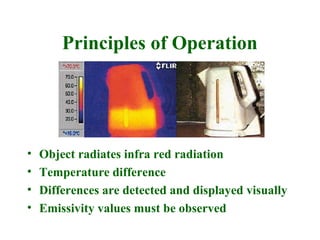
Principles of Operation
• Object radiates infra red radiation
• Temperature difference
• Differences are detected and displayed visually
• Emissivity values must be observed
8.
Advantages
• Non Contact
• Non Intrusive
• Can work at a distance
• Fast and Reliable
• Portable
• Convincing Results
9.
Limitations
• Non Intrinsicallysafe
• There must be a temperature difference for
certain surveys
• Operator experience is essential
• Filters may be needed for certain
applications
• Sensitivity and Resolution reduce with
distance and angle of view
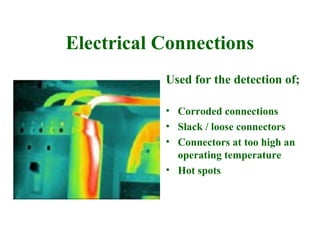
Electrical Connections
Used for the detection of;
• Corroded connections
• Slack / loose connectors
• Connectors at too high an
operating temperature
• Hot spots
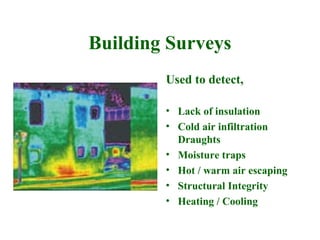
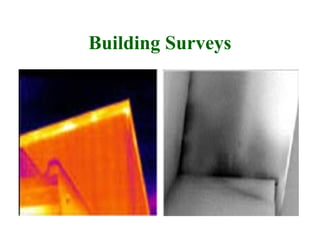
Building Surveys
Used to detect,
• Lack of insulation
• Cold air infiltration
Draughts
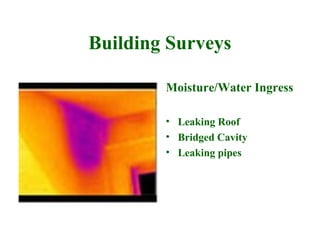
• Moisture traps
• Hot / warm air escaping
• Structural Integrity
• Heating / Cooling
Process Plant
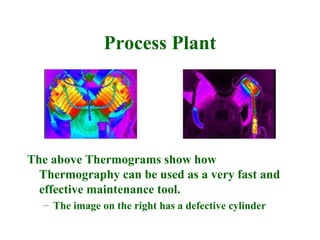
The aboveThermograms show how
Thermography can be used as a very fast and
effective maintenance tool.
– The image on the right has a defective cylinder
28.
Process Plant
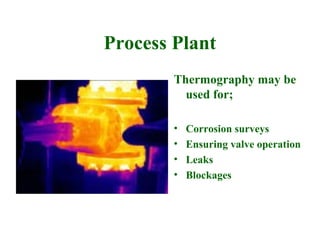
Thermography may be
used for;
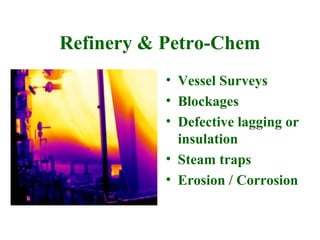
• Corrosion surveys
• Ensuring valve operation
• Leaks
• Blockages
29.
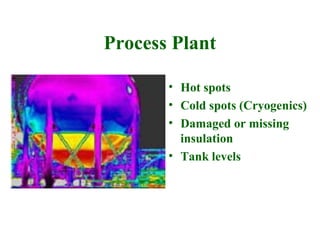
Process Plant
• Hot spots
• Cold spots (Cryogenics)
• Damaged or missing
insulation
• Tank levels
30.
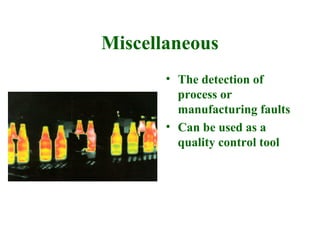
Miscellaneous
• The detection of
process or
manufacturing faults
• Can be used as a
quality control tool