Unit-1 Part A
1 What are the adverse effects of producing very long continuous chips? UN, CO1
 It will affect the surface of workpiece.
 Poor surface finish will be obtained.
 It will also affect the effectiveness of tool.
 Finally, it will decrease the tool life
 Increase the energy consumption
2 Enumerate the function of chip breakers. UN, CO1
 Break the chips into small pieces
 Improve chip control
 Reduce the cutting resistance
 Increase the machining performance
3 List the conditions when continuous chips are produced UN, CO1
Continuous chips are produced when,
 The material is ductile.
 Cutting speed is high.
 Depth of cut is small
 Rake angle is large
 Sufficient lubrication is provided
4 Define tool life RE, CO1
It is defined as “interval of time for which tool works satisfactorily
between the two successive sharpenings”.
5 Deduce the factors that contribute to poor surface finish in cutting UN, CO1
Cutting speed, feed, depth of cut, metal removal rate
6 Write the Taylors tool life equation (or) How is tool life estimated?
VTn =C
V = cutting speed (m/min)
T = tool life (min)
n & C are constants
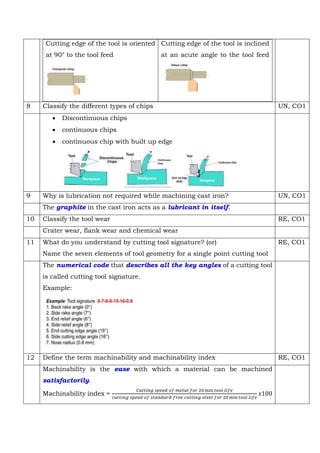
7 Compare orthogonal and oblique cutting UN, CO1
Orthogonal cutting Oblique cutting
It is a 2D cutting It is a 3D cutting
Cutting edge of the tool is oriented
at 90° to the tool feed
Cutting edge of the tool is inclined
at an acute angle to the tool feed
8 Classify the different types of chips UN, CO1
 Discontinuous chips
 continuous chips
 continuous chip with built up edge
9 Why is lubrication not required while machining cast iron? UN, CO1
The graphite in the cast iron acts as a lubricant in itself.
10 Classify the tool wear RE, CO1
Crater wear, flank wear and chemical wear
11 What do you understand by cutting tool signature? (or)
Name the seven elements of tool geometry for a single point cutting tool
RE, CO1
The numerical code that describes all the key angles of a cutting tool
is called cutting tool signature.
Example:
12 Define the term machinability and machinability index RE, CO1
Machinability is the ease with which a material can be machined
satisfactorily.
Machinability index =
𝐶𝑢𝑡𝑡𝑖𝑛𝑔 𝑠𝑝𝑒𝑒𝑑 𝑜𝑓 𝑚𝑒𝑡𝑎𝑙 𝑓𝑜𝑟 20 min 𝑡𝑜𝑜𝑙 𝑙𝑖𝑓𝑒
𝑐𝑢𝑡𝑡𝑖𝑛𝑔 𝑠𝑝𝑒𝑒𝑑 𝑜𝑓 𝑠𝑡𝑎𝑛𝑑𝑎𝑟𝑑 𝑓𝑟𝑒𝑒 𝑐𝑢𝑡𝑡𝑖𝑛𝑔 𝑠𝑡𝑒𝑒𝑙 𝑓𝑜𝑟 20 min 𝑡𝑜𝑜𝑙 𝑙𝑖𝑓𝑒
𝑥100
13 Name the various cutting tool materials RE, CO1
• High speed steel (HSS)
• High carbon steel
• Cemented carbides
• Ceramics
• Stellite
• Diamond
14 Enumerate the functions of cutting fluids UN, CO1
• It will reduce the friction at the tool-chip interface.
• It will reduce the heat at the tool-chip interface
• It prevents adhesion of chips to the tool or workpiece
15 Define tool wear RE, CO1
Tool wear is the gradual breakdown of machine tool as a result of
machining operation.
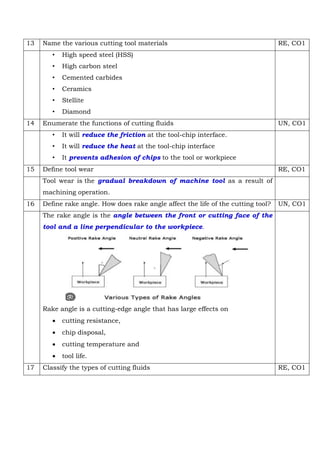
16 Define rake angle. How does rake angle affect the life of the cutting tool? UN, CO1
The rake angle is the angle between the front or cutting face of the
tool and a line perpendicular to the workpiece.
Rake angle is a cutting-edge angle that has large effects on
 cutting resistance,
 chip disposal,
 cutting temperature and
 tool life.
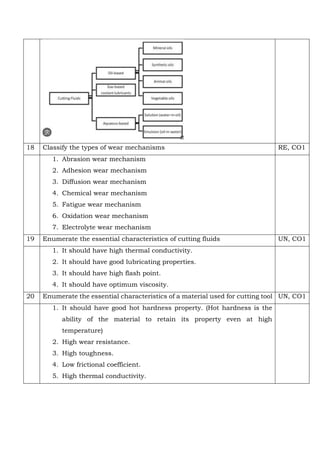
17 Classify the types of cutting fluids RE, CO1
18 Classify the types of wear mechanisms RE, CO1
1. Abrasion wear mechanism
2. Adhesion wear mechanism
3. Diffusion wear mechanism
4. Chemical wear mechanism
5. Fatigue wear mechanism
6. Oxidation wear mechanism
7. Electrolyte wear mechanism
19 Enumerate the essential characteristics of cutting fluids UN, CO1
1. It should have high thermal conductivity.
2. It should have good lubricating properties.
3. It should have high flash point.
4. It should have optimum viscosity.
20 Enumerate the essential characteristics of a material used for cutting tool UN, CO1
1. It should have good hot hardness property. (Hot hardness is the
ability of the material to retain its property even at high
temperature)
2. High wear resistance.
3. High toughness.
4. Low frictional coefficient.
5. High thermal conductivity.

me3493 manufacturing technology unit 1 Part A

  • 1.
    Unit-1 Part A 1What are the adverse effects of producing very long continuous chips? UN, CO1  It will affect the surface of workpiece.  Poor surface finish will be obtained.  It will also affect the effectiveness of tool.  Finally, it will decrease the tool life  Increase the energy consumption 2 Enumerate the function of chip breakers. UN, CO1  Break the chips into small pieces  Improve chip control  Reduce the cutting resistance  Increase the machining performance 3 List the conditions when continuous chips are produced UN, CO1 Continuous chips are produced when,  The material is ductile.  Cutting speed is high.  Depth of cut is small  Rake angle is large  Sufficient lubrication is provided 4 Define tool life RE, CO1 It is defined as “interval of time for which tool works satisfactorily between the two successive sharpenings”. 5 Deduce the factors that contribute to poor surface finish in cutting UN, CO1 Cutting speed, feed, depth of cut, metal removal rate 6 Write the Taylors tool life equation (or) How is tool life estimated? VTn =C V = cutting speed (m/min) T = tool life (min) n & C are constants 7 Compare orthogonal and oblique cutting UN, CO1 Orthogonal cutting Oblique cutting It is a 2D cutting It is a 3D cutting
  • 2.
    Cutting edge ofthe tool is oriented at 90° to the tool feed Cutting edge of the tool is inclined at an acute angle to the tool feed 8 Classify the different types of chips UN, CO1  Discontinuous chips  continuous chips  continuous chip with built up edge 9 Why is lubrication not required while machining cast iron? UN, CO1 The graphite in the cast iron acts as a lubricant in itself. 10 Classify the tool wear RE, CO1 Crater wear, flank wear and chemical wear 11 What do you understand by cutting tool signature? (or) Name the seven elements of tool geometry for a single point cutting tool RE, CO1 The numerical code that describes all the key angles of a cutting tool is called cutting tool signature. Example: 12 Define the term machinability and machinability index RE, CO1 Machinability is the ease with which a material can be machined satisfactorily. Machinability index = 𝐶𝑢𝑡𝑡𝑖𝑛𝑔 𝑠𝑝𝑒𝑒𝑑 𝑜𝑓 𝑚𝑒𝑡𝑎𝑙 𝑓𝑜𝑟 20 min 𝑡𝑜𝑜𝑙 𝑙𝑖𝑓𝑒 𝑐𝑢𝑡𝑡𝑖𝑛𝑔 𝑠𝑝𝑒𝑒𝑑 𝑜𝑓 𝑠𝑡𝑎𝑛𝑑𝑎𝑟𝑑 𝑓𝑟𝑒𝑒 𝑐𝑢𝑡𝑡𝑖𝑛𝑔 𝑠𝑡𝑒𝑒𝑙 𝑓𝑜𝑟 20 min 𝑡𝑜𝑜𝑙 𝑙𝑖𝑓𝑒 𝑥100
  • 3.
    13 Name thevarious cutting tool materials RE, CO1 • High speed steel (HSS) • High carbon steel • Cemented carbides • Ceramics • Stellite • Diamond 14 Enumerate the functions of cutting fluids UN, CO1 • It will reduce the friction at the tool-chip interface. • It will reduce the heat at the tool-chip interface • It prevents adhesion of chips to the tool or workpiece 15 Define tool wear RE, CO1 Tool wear is the gradual breakdown of machine tool as a result of machining operation. 16 Define rake angle. How does rake angle affect the life of the cutting tool? UN, CO1 The rake angle is the angle between the front or cutting face of the tool and a line perpendicular to the workpiece. Rake angle is a cutting-edge angle that has large effects on  cutting resistance,  chip disposal,  cutting temperature and  tool life. 17 Classify the types of cutting fluids RE, CO1
  • 4.
    18 Classify thetypes of wear mechanisms RE, CO1 1. Abrasion wear mechanism 2. Adhesion wear mechanism 3. Diffusion wear mechanism 4. Chemical wear mechanism 5. Fatigue wear mechanism 6. Oxidation wear mechanism 7. Electrolyte wear mechanism 19 Enumerate the essential characteristics of cutting fluids UN, CO1 1. It should have high thermal conductivity. 2. It should have good lubricating properties. 3. It should have high flash point. 4. It should have optimum viscosity. 20 Enumerate the essential characteristics of a material used for cutting tool UN, CO1 1. It should have good hot hardness property. (Hot hardness is the ability of the material to retain its property even at high temperature) 2. High wear resistance. 3. High toughness. 4. Low frictional coefficient. 5. High thermal conductivity.