HYDROFORMING


Presented By,     Seminar Guide:
 Shruchet J       B. G. Prashanth
                  Dept. of I.E. M.
1JS08IM045
                  JSSATE, Bangalore
                               1
OUTLINE:
 What is Hydroforming?
 How and where is Hydroforming used?
 Materials used in Hydroforming processes
 Design Considerations
 Effect of Temperature on HF
 Advantages/Disadvantages
 Economics of Hydroforming
 The Hydroforming Process
 Conclusion
 Bibliography                               2
HYDROFORMING
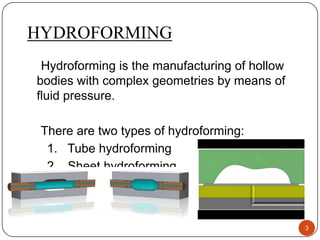
 Hydroforming is the manufacturing of hollow
bodies with complex geometries by means of
fluid pressure.

 There are two types of hydroforming:
  1. Tube hydroforming
  2. Sheet hydroforming


                                               3
TUBE HYDROFORMING
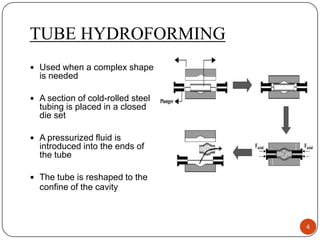
 Used when a complex shape
  is needed

 A section of cold-rolled steel
  tubing is placed in a closed
  die set

 A pressurized fluid is
  introduced into the ends of
  the tube

 The tube is reshaped to the
  confine of the cavity


                                   4
SHEET HYDROFORMING
METHODS:
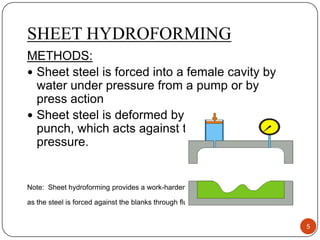
 Sheet steel is forced into a female cavity by
  water under pressure from a pump or by
  press action
 Sheet steel is deformed by a male
  punch, which acts against the fluid under
  pressure.


Note: Sheet hydroforming provides a work-hardening effect

as the steel is forced against the blanks through fluid pressure.


                                                                    5
APPLICATIONS

 Automotive industry


 Sanitary use
   Pipes with varying
                             Chevy SSR Frame
    diameter, T-Joints


 Aerospace
   Lighter, stiffer parts


                                               6
APPLICATIONS: Automotive Industry
1. Body shell
2. Driving shaft
3. Assembled camshaft
4. Exhaust systems
5. Engine cooling system
6. Radiator frame
7. Safety requirements
8. Engine bearer
9. Integral member
10. Cross member
11. Frame structure parts
12. Axle elements
                                    7
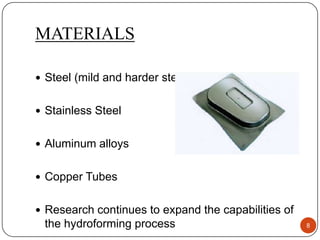
MATERIALS

 Steel (mild and harder steels)


 Stainless Steel


 Aluminum alloys


 Copper Tubes


 Research continues to expand the capabilities of
 the hydroforming process                            8
DESIGN CONSIDERATIONS

 Product               •Tool/Dies            •Equipment
• Geometry, thicknes
  s distribution        •Geometry of tools    •Press capacity
• Dimensional           •Material hardness    •Speed /
  accuracy/tolerance                          production rate
                        •Surface conditions
  s                                           •Force / Pressure
• Surface finish
                        •Stiffness and
                                              capabilities
                        accuracy
• Microstructure, me
                                              •Rigidity and
  chanical and                                accuracy
  metallurgical
  properties, hardnes
  s
                                                                  9
DESIGN CONSIDERATIONS
 Work                              Deformation zone
  piece/Material                   • Deformation mechanics,
                                     model used for analysis
• Material Yield Strength
                                   • Metal flow, velocities, strain
• Surface conditions
                                     rates, strains (kinematics)
• Geometry of tubing ( outside
                                   • Stresses (variation during
  diameter, tube wall thickness,     deformation)
  roundness, properties of
  welding line, etc.)
 Pressure Consideration: The liquid pressure in the die cavity -
 30 to 150 MPa
 •Material Yield Strength
 •Material Wall Thickness
 •Inner radius of sharpest cross-sectional corner                     10
Effect of Temperature on HF
 Formability of the lightweight materials usually increases
  at elevated temperature levels

 Warm forming technology with selective heating enables
  manufacturing of lightweight parts, and also reduces
  number of manufacturing steps and part consolidation.

 The internal stresses are released at high temperatures,
  hence reduces defects and provides better finish of the
  product.

 It uses the tooling and hydraulic medium as means of         11
  transporting heat as well as mechanical/hydraulic force
ADVANTAGES
 Extraordinary Design Flexibility
 Fewer Parts
 Lower tooling cost due to fewer parts
 Weight reduction through more efficient section
    design and tailoring of the wall thickness
   Improved structural strength and stiffness
   Fewer secondary operations
   Tight dimensional tolerances and low spring back
   Reduced scrap


                                                       12
ADVANTAGES (CONT.)
      Compared to conventional steel body structure:


 50% less weight
 45% less parts (less tools, less assembly)
 45% less welding seams
 Tighter tolerances


                                       Volvo Hydroformed Structure concept in
                                       Aluminum, (Schuler Hydroforming 1998)


                                                                                13
DISADVANTAGES

 Slow cycle time


 Expensive equipment and lack of extensive
 knowledge base for process and tool design

 Requires new welding techniques for assembly.


                                                  14
ECONOMICS


            15
CONCLUSION
 Hydroforming is an innovative forming
 process

 Hydroforming is becoming more popular (i.e.
 automotive and aerospace industries)

 The advantages outweigh the limitations


 Material selection is broad and continues to
 increase
                                                 16
BIBLIOGRAPHY
 www.hydroforming.net
 www.vari-form.com
 www.hdt-gti.com
 www.revindustries.com
 www.autosteel.org
 www.schuler-hydroforming.de
 www.kaupp.com/hydro.htm
 www.egr.msu.edu/~aenader
 nsmwww.eng.ohio-state.edu/html/tube_hydroforming.html
 A Study on Warm Hydroforming of Al and Mg Sheet Materials:
  Mechanism and Proper Temperature Conditions, by Ho Choi,
  Muammer Koç, & Jun Ni.
 Automotive component development by means of hydroforming,
                                                               17
  by
Thank
    You


          18
QUESTIONS???


               19

HydroForming

  • 1.
    HYDROFORMING Presented By, Seminar Guide: Shruchet J B. G. Prashanth Dept. of I.E. M. 1JS08IM045 JSSATE, Bangalore 1
  • 2.
    OUTLINE:  What isHydroforming?  How and where is Hydroforming used?  Materials used in Hydroforming processes  Design Considerations  Effect of Temperature on HF  Advantages/Disadvantages  Economics of Hydroforming  The Hydroforming Process  Conclusion  Bibliography 2
  • 3.
    HYDROFORMING Hydroforming isthe manufacturing of hollow bodies with complex geometries by means of fluid pressure. There are two types of hydroforming: 1. Tube hydroforming 2. Sheet hydroforming 3
  • 4.
    TUBE HYDROFORMING  Usedwhen a complex shape is needed  A section of cold-rolled steel tubing is placed in a closed die set  A pressurized fluid is introduced into the ends of the tube  The tube is reshaped to the confine of the cavity 4
  • 5.
    SHEET HYDROFORMING METHODS:  Sheetsteel is forced into a female cavity by water under pressure from a pump or by press action  Sheet steel is deformed by a male punch, which acts against the fluid under pressure. Note: Sheet hydroforming provides a work-hardening effect as the steel is forced against the blanks through fluid pressure. 5
  • 6.
    APPLICATIONS  Automotive industry Sanitary use  Pipes with varying Chevy SSR Frame diameter, T-Joints  Aerospace  Lighter, stiffer parts 6
  • 7.
    APPLICATIONS: Automotive Industry 1.Body shell 2. Driving shaft 3. Assembled camshaft 4. Exhaust systems 5. Engine cooling system 6. Radiator frame 7. Safety requirements 8. Engine bearer 9. Integral member 10. Cross member 11. Frame structure parts 12. Axle elements 7
  • 8.
    MATERIALS  Steel (mildand harder steels)  Stainless Steel  Aluminum alloys  Copper Tubes  Research continues to expand the capabilities of the hydroforming process 8
  • 9.
    DESIGN CONSIDERATIONS  Product •Tool/Dies •Equipment • Geometry, thicknes s distribution •Geometry of tools •Press capacity • Dimensional •Material hardness •Speed / accuracy/tolerance production rate •Surface conditions s •Force / Pressure • Surface finish •Stiffness and capabilities accuracy • Microstructure, me •Rigidity and chanical and accuracy metallurgical properties, hardnes s 9
  • 10.
    DESIGN CONSIDERATIONS  Work  Deformation zone piece/Material • Deformation mechanics, model used for analysis • Material Yield Strength • Metal flow, velocities, strain • Surface conditions rates, strains (kinematics) • Geometry of tubing ( outside • Stresses (variation during diameter, tube wall thickness, deformation) roundness, properties of welding line, etc.) Pressure Consideration: The liquid pressure in the die cavity - 30 to 150 MPa •Material Yield Strength •Material Wall Thickness •Inner radius of sharpest cross-sectional corner 10
  • 11.
    Effect of Temperatureon HF  Formability of the lightweight materials usually increases at elevated temperature levels  Warm forming technology with selective heating enables manufacturing of lightweight parts, and also reduces number of manufacturing steps and part consolidation.  The internal stresses are released at high temperatures, hence reduces defects and provides better finish of the product.  It uses the tooling and hydraulic medium as means of 11 transporting heat as well as mechanical/hydraulic force
  • 12.
    ADVANTAGES  Extraordinary DesignFlexibility  Fewer Parts  Lower tooling cost due to fewer parts  Weight reduction through more efficient section design and tailoring of the wall thickness  Improved structural strength and stiffness  Fewer secondary operations  Tight dimensional tolerances and low spring back  Reduced scrap 12
  • 13.
    ADVANTAGES (CONT.) Compared to conventional steel body structure:  50% less weight  45% less parts (less tools, less assembly)  45% less welding seams  Tighter tolerances Volvo Hydroformed Structure concept in Aluminum, (Schuler Hydroforming 1998) 13
  • 14.
    DISADVANTAGES  Slow cycletime  Expensive equipment and lack of extensive knowledge base for process and tool design  Requires new welding techniques for assembly. 14
  • 15.
  • 16.
    CONCLUSION  Hydroforming isan innovative forming process  Hydroforming is becoming more popular (i.e. automotive and aerospace industries)  The advantages outweigh the limitations  Material selection is broad and continues to increase 16
  • 17.
    BIBLIOGRAPHY  www.hydroforming.net  www.vari-form.com www.hdt-gti.com  www.revindustries.com  www.autosteel.org  www.schuler-hydroforming.de  www.kaupp.com/hydro.htm  www.egr.msu.edu/~aenader  nsmwww.eng.ohio-state.edu/html/tube_hydroforming.html  A Study on Warm Hydroforming of Al and Mg Sheet Materials: Mechanism and Proper Temperature Conditions, by Ho Choi, Muammer Koç, & Jun Ni.  Automotive component development by means of hydroforming, 17 by
  • 18.
    Thank You 18
  • 19.