Infrared & Thermal Testing
(How to find mechanical & electrical system abnormality through temperature syndrome)
What is Infrared ?
• Infra- is a Latin word means Below / Beyond.
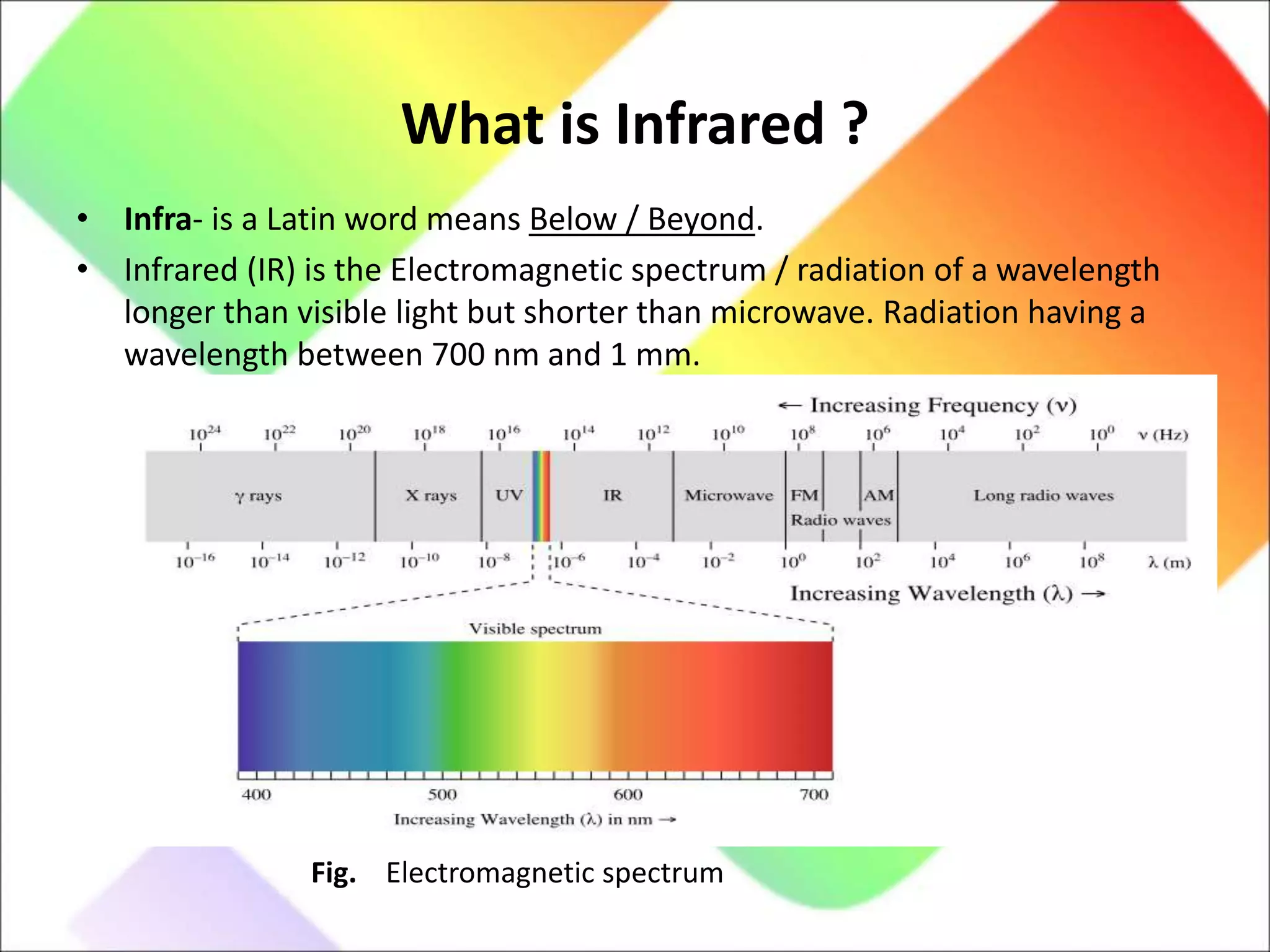
• Infrared (IR) is the Electromagnetic spectrum / radiation of a wavelength
longer than visible light but shorter than microwave. Radiation having a
wavelength between 700 nm and 1 mm.
Fig. Electromagnetic spectrum
Types of infrared
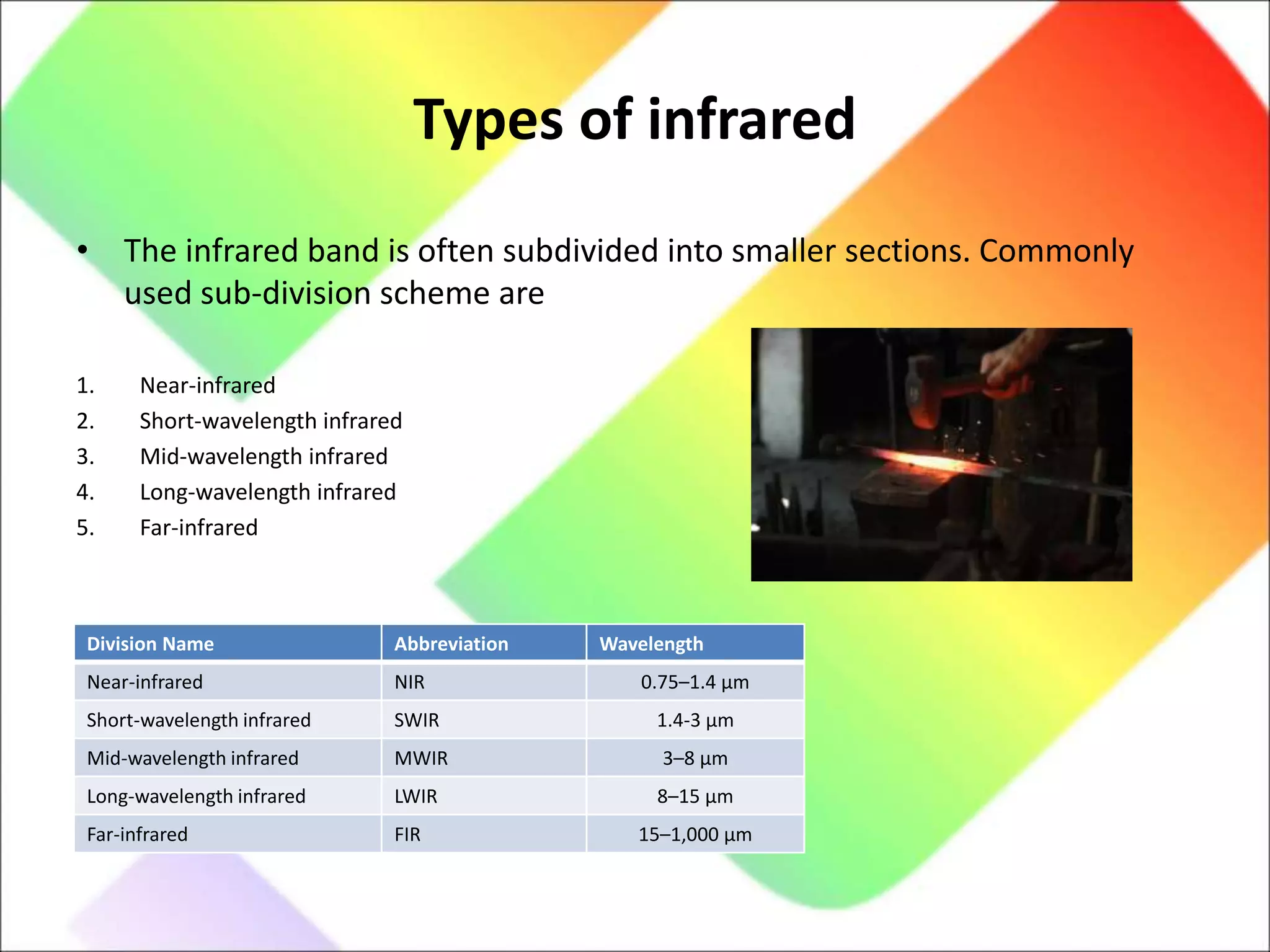
• The infrared band is often subdivided into smaller sections. Commonly
used sub-division scheme are
1. Near-infrared
2. Short-wavelength infrared
3. Mid-wavelength infrared
4. Long-wavelength infrared
5. Far-infrared
Division Name Abbreviation Wavelength
Near-infrared NIR 0.75–1.4 µm
Short-wavelength infrared SWIR 1.4-3 µm
Mid-wavelength infrared MWIR 3–8 µm
Long-wavelength infrared LWIR 8–15 µm
Far-infrared FIR 15–1,000 µm
History & Development
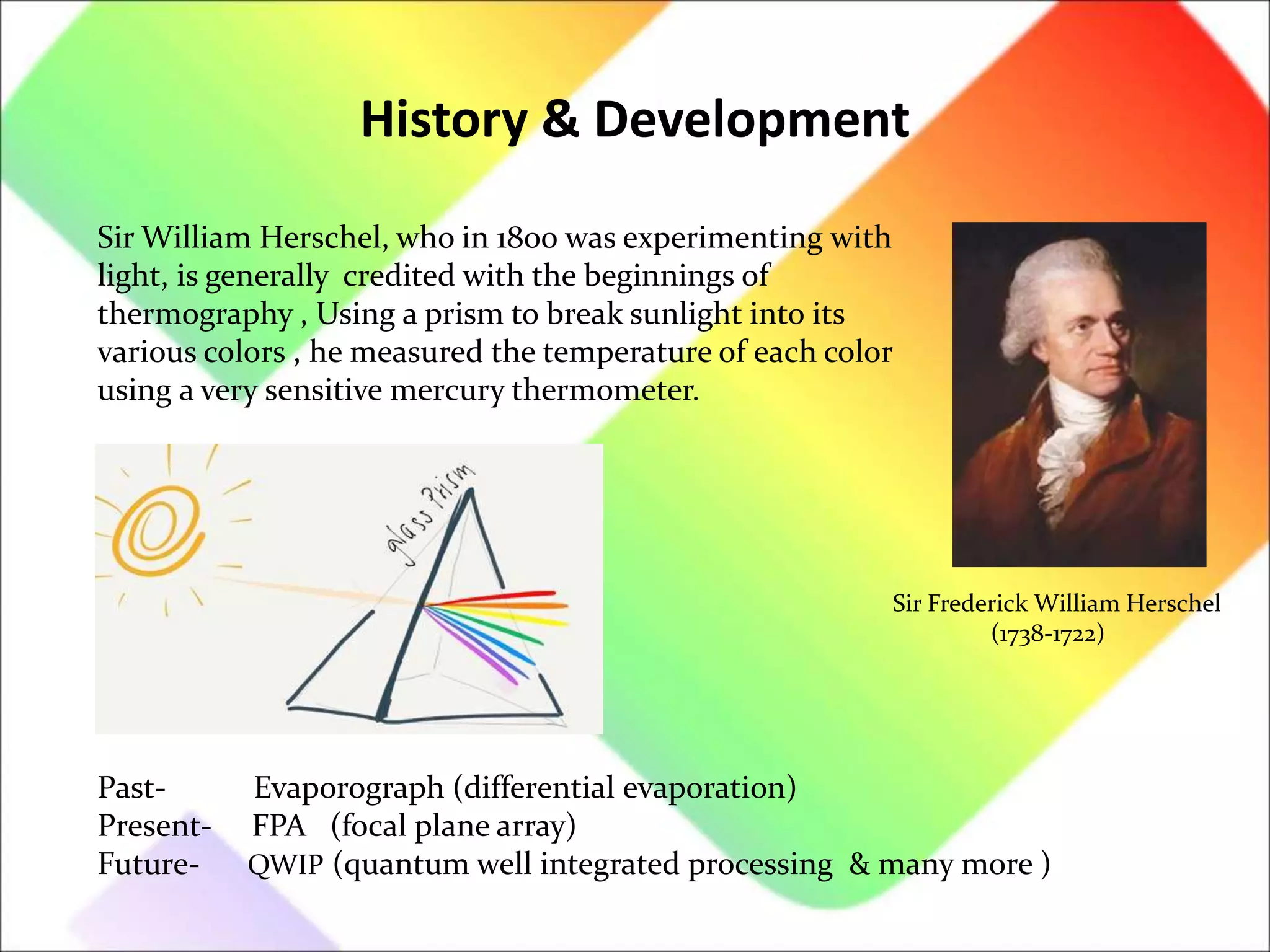
Sir William Herschel, who in 1800 was experimenting with
light, is generally credited with the beginnings of
thermography , Using a prism to break sunlight into its
various colors , he measured the temperature of each color
using a very sensitive mercury thermometer.
Sir Frederick William Herschel
(1738-1722)
Past- Evaporograph (differential evaporation)
Present- FPA (focal plane array)
Future- QWIP (quantum well integrated processing & many more )
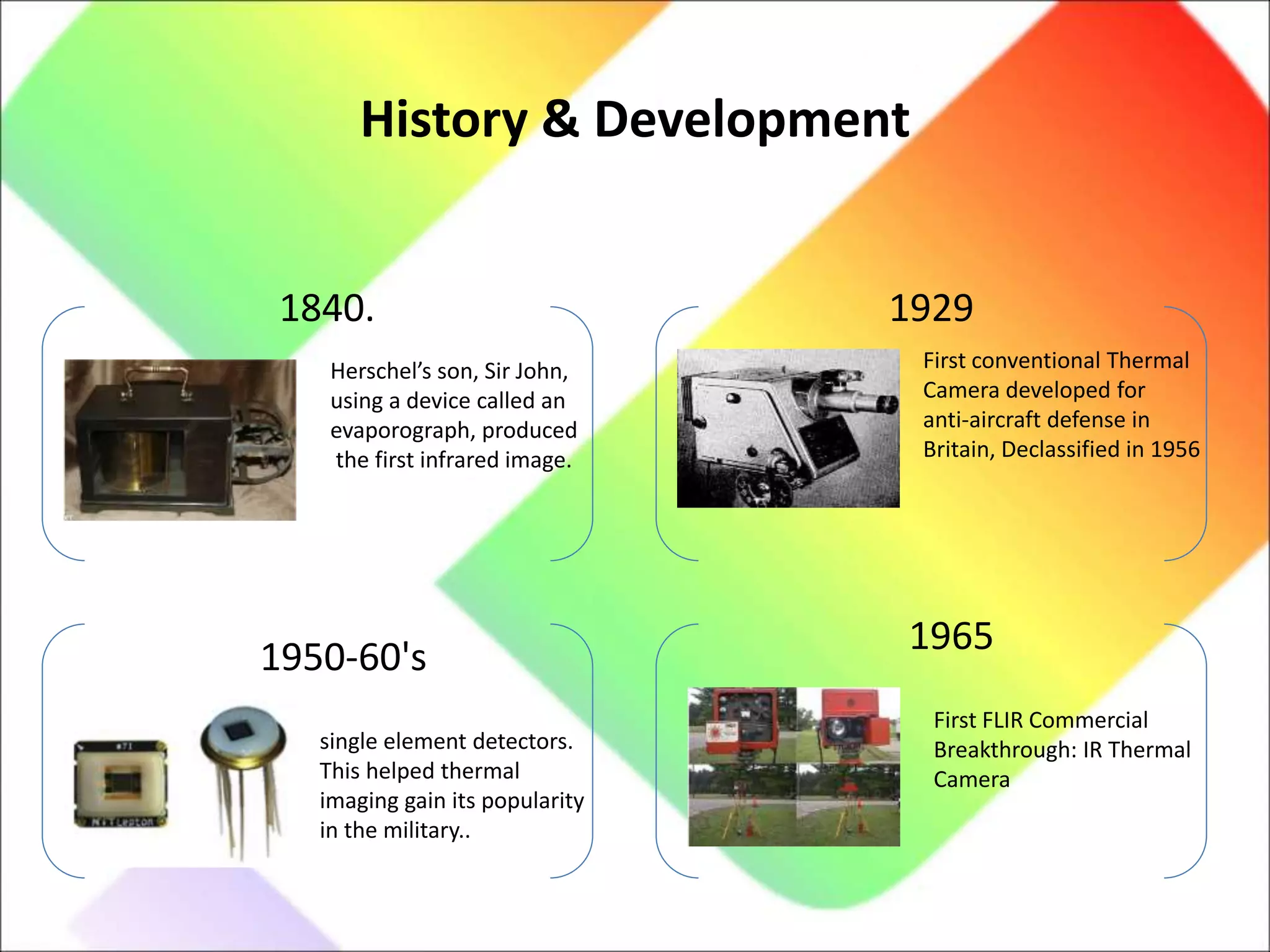
1929
Herschel’s son, Sir John,
using a device called an
evaporograph, produced
the first infrared image.
1950-60's
1965
1840.
First conventional Thermal
Camera developed for
anti-aircraft defense in
Britain, Declassified in 1956
single element detectors.
This helped thermal
imaging gain its popularity
in the military..
First FLIR Commercial
Breakthrough: IR Thermal
Camera
History & Development
IR Method
• All object at temperatures above absolute zero (-273°c) radiate some
energy in form of Infrared .
• Infrared radiation is heat, that is not visible to human eye.
• A method of improving visibility objects
even in a dark environment by detecting the
objects infrared radiation and recreating an
image based on that information.
Image of TP MCCB in a dark environment
IR Method
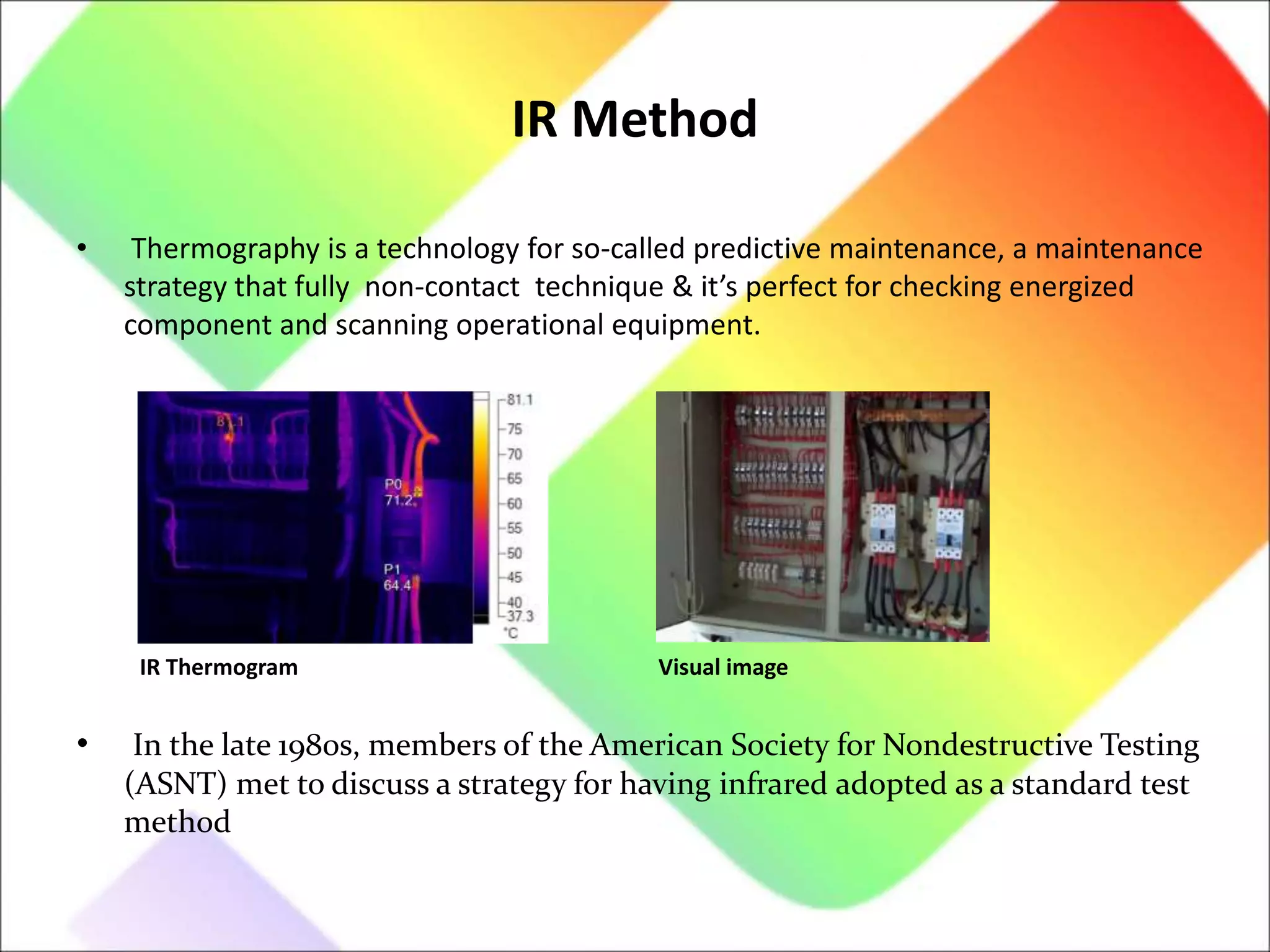
• Thermography is a technology for so-called predictive maintenance, a maintenance
strategy that fully non-contact technique & it’s perfect for checking energized
component and scanning operational equipment.
• In the late 1980s, members of the American Society for Nondestructive Testing
(ASNT) met to discuss a strategy for having infrared adopted as a standard test
method
IR Thermogram Visual image
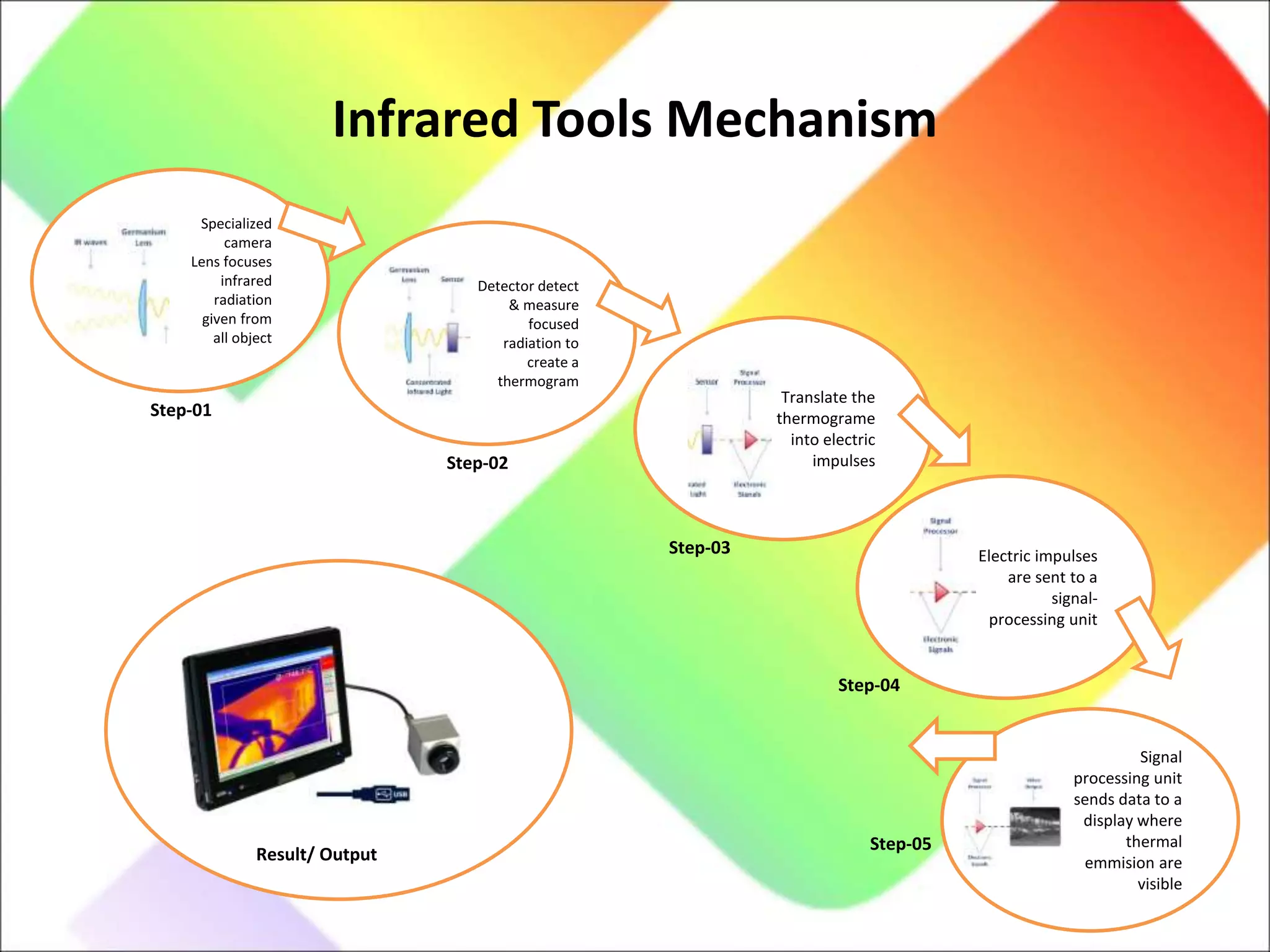
Specialized
camera
Lens focuses
infrared
radiation
given from
all object
Infrared Tools Mechanism
Detector detect
& measure
focused
radiation to
create a
thermogram
Translate the
thermograme
into electric
impulses
Signal
processing unit
sends data to a
display where
thermal
emmision are
visible
Electric impulses
are sent to a
signal-
processing unit
Step-01
Step-02
Step-03
Step-04
Step-05
Result/ Output
Theory & principles
• Thermal or heat energy can be transferred by three modes :
1. Conduction
2. Convection
3. Radiation
• Thermal Infrared radiation is a from of electromagnetic energy
similar to light, radio waves and X-ray. All forms of
Electromagnetic Radiation principle is same as light, they differ
only in there wave length .
Theory & principles
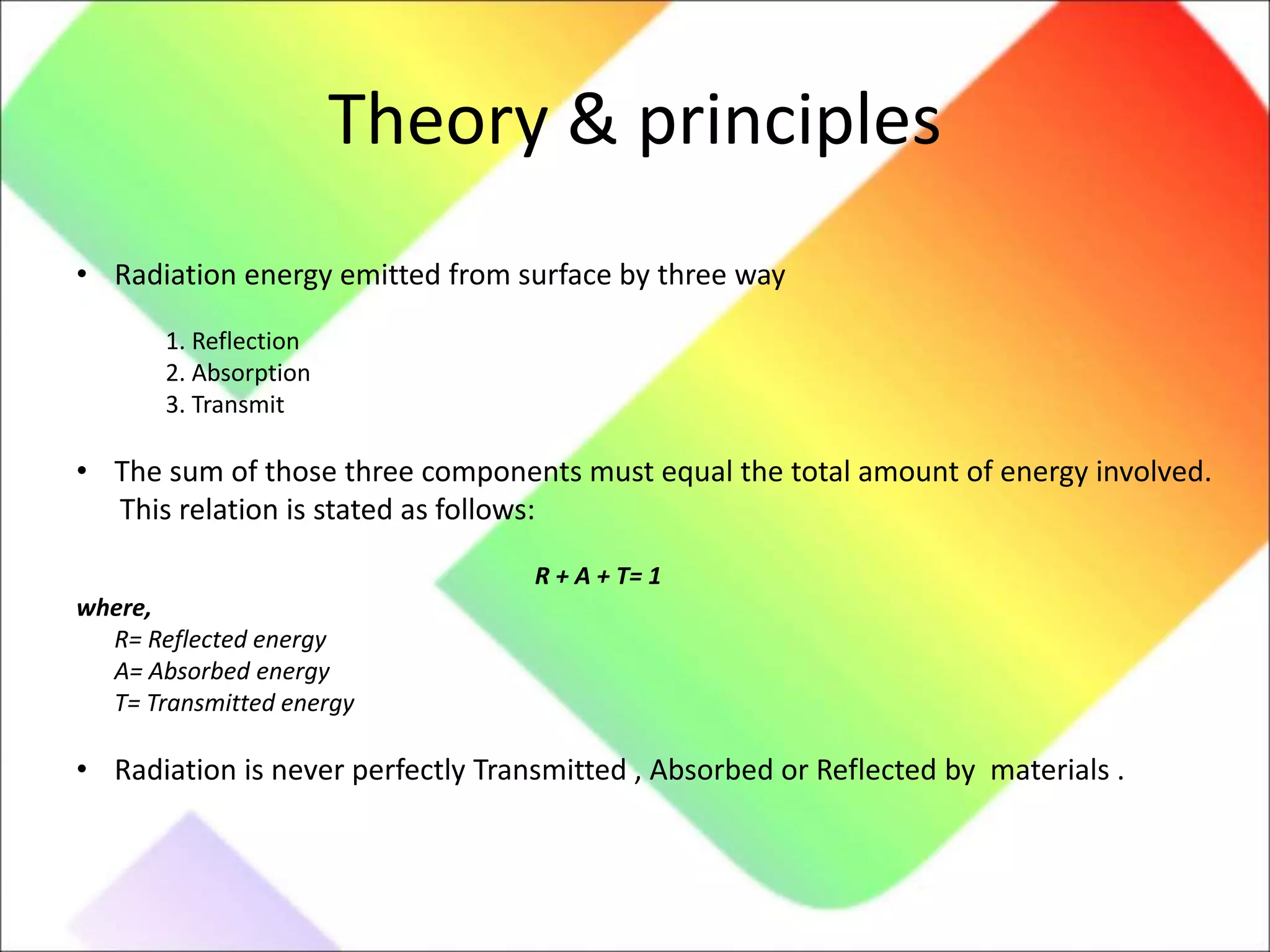
• Radiation energy emitted from surface by three way
1. Reflection
2. Absorption
3. Transmit
• The sum of those three components must equal the total amount of energy involved.
This relation is stated as follows:
R + A + T= 1
where,
R= Reflected energy
A= Absorbed energy
T= Transmitted energy
• Radiation is never perfectly Transmitted , Absorbed or Reflected by materials .
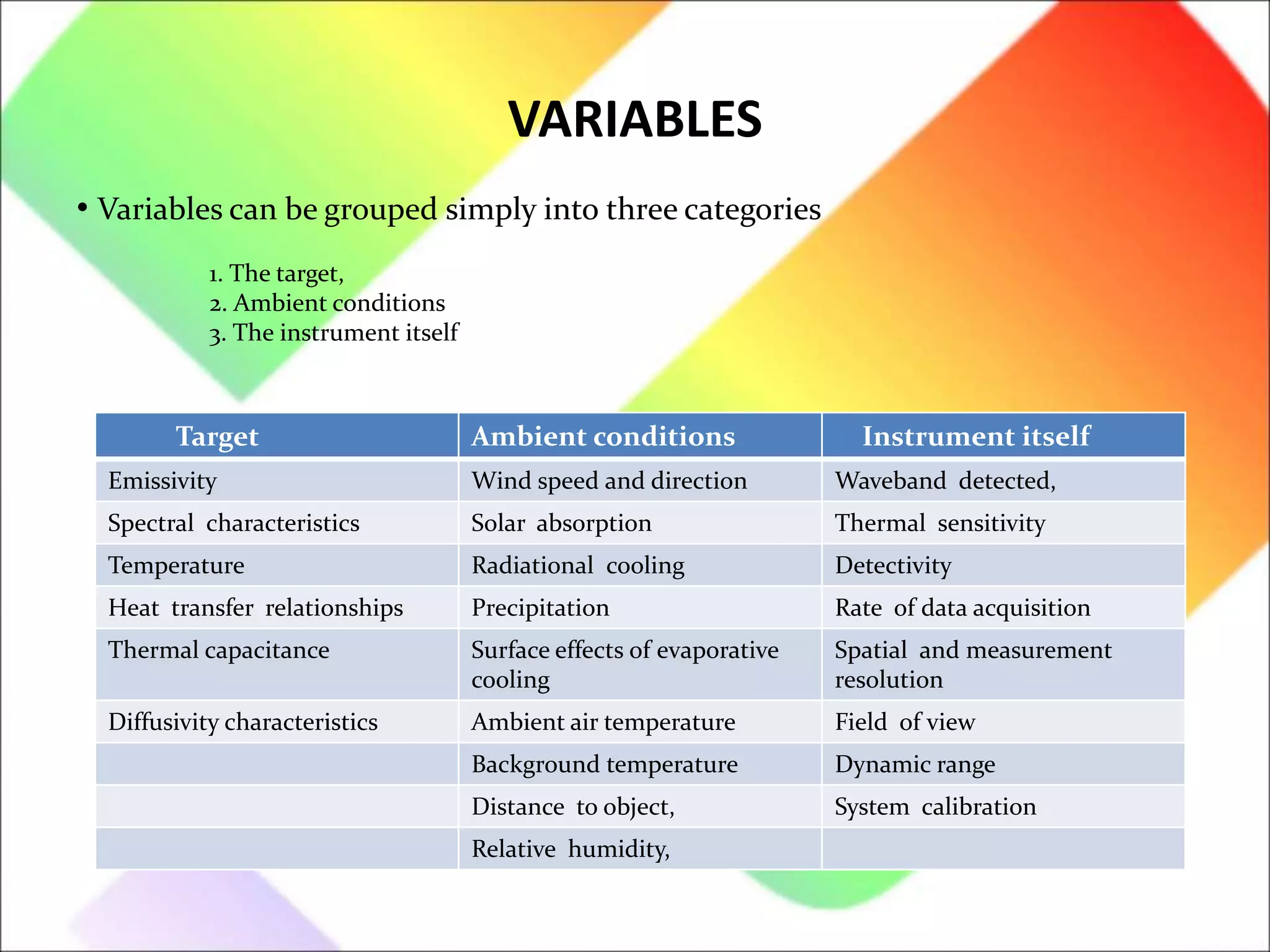
VARIABLES
Target Ambient conditions Instrument itself
Emissivity Wind speed and direction Waveband detected,
Spectral characteristics Solar absorption Thermal sensitivity
Temperature Radiational cooling Detectivity
Heat transfer relationships Precipitation Rate of data acquisition
Thermal capacitance Surface effects of evaporative
cooling
Spatial and measurement
resolution
Diffusivity characteristics Ambient air temperature Field of view
Background temperature Dynamic range
Distance to object, System calibration
Relative humidity,
• Variables can be grouped simply into three categories
1. The target,
2. Ambient conditions
3. The instrument itself
Emissivity
Name of Metal Emissivity Values
Human skin 0.98
Black paint (flat) 0.90
White paint (flat) 0.90
Lead, oxidized 0.40
Copper, oxidized to black 0.65
Paper 0.90
Copper, polished 0.15
Aluminum, polished 0.10
Emissivity is usually the most important. Unless it is very low (below 0.5,
approximately)
Some common metal Emissivity Values
Flaw Detection Techniques
The basic strategy used in many thermal applications is quite simply termed
“comparative thermography”
The comparison will apply with thermal image such as bellow
1. compare with same equipment
2. compare with baseline of this equipment
3. compare with equipment nameplate
In comparative thermography, it is useful to know as much as possible about the sample being tested,
such as its construction, basic operations, known failure mechanisms, direction of heat flow, or
history.
IR Inspection Process
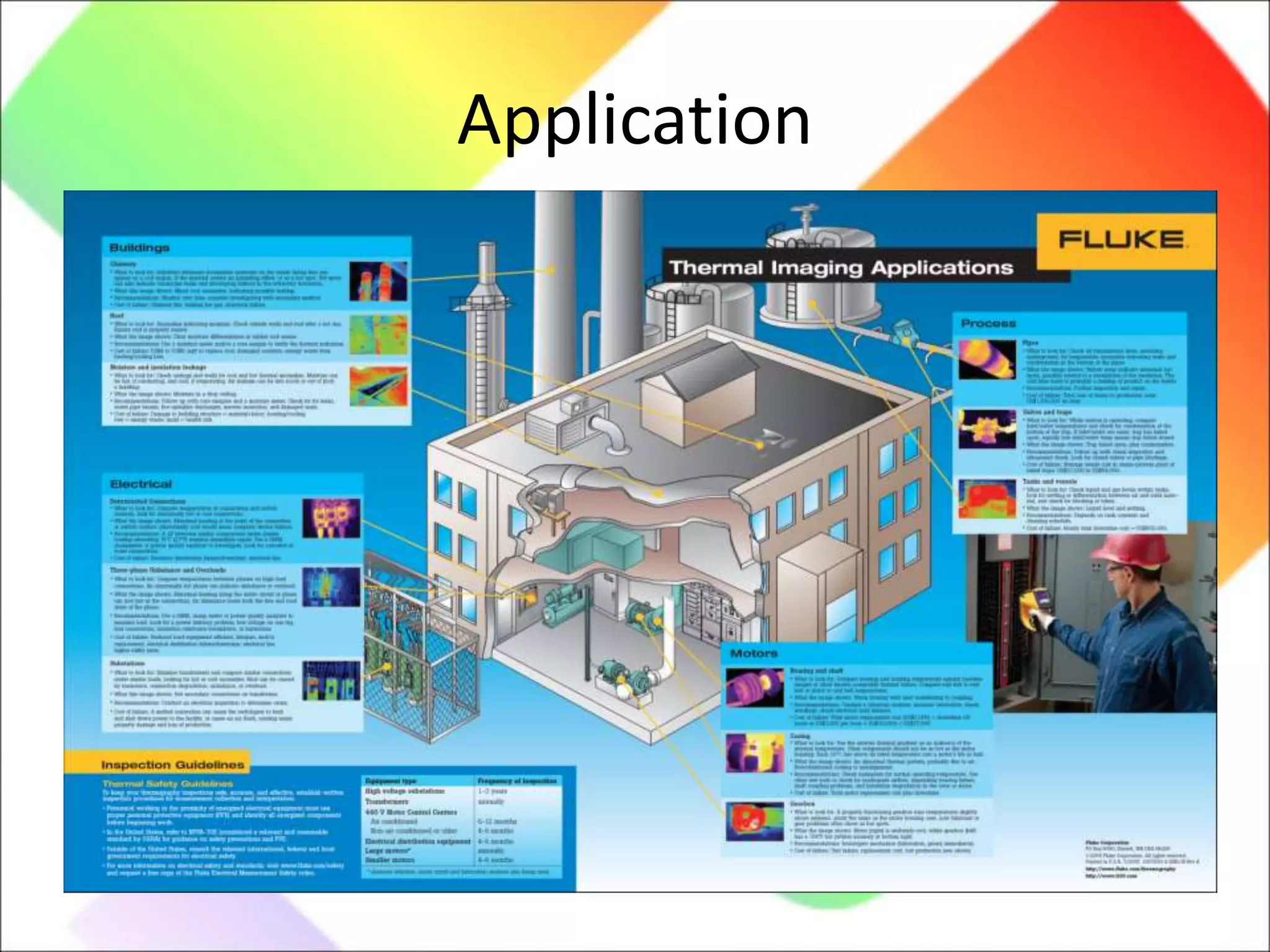
Application
Application
The use of thermography in more traditional NDE/NDT has recently
become more widely accepted. It can be used in both,
Electrical equipment
• Circuit breakers
• Coupling capacitors
• Current transformers
• Distribution panels , Electrical connections
• Exciters and voltage regulators
• Fuses , Lighting
• Generator components, as needed
• Motors and lead boxes
• Potential transformers
• Switches (disconnect), Switchgear
• Power transformers
• Transmission lines
• Arresters, Bushings
• Batteries and connections and chargers
• Buswork, ducts, enclosures, insulators
• Cables, potheads, and stress cones , etc
Mechanical equipment
• Air compressors
• Bearings and seals
• Brakes
• CO2 systems
• Cooling system heat exchangers
• Engines, gasoline and diesel
• Gear boxes
• Heat exchangers
• Motor bearing housings
• Piping
• Pivot pins, hinges, and linkages
• Pumps
• Servomotors
• Valves
• Vessels and tanks , etc
Application
Blocking Radiator
Hot bush connection
Blocking Radiator

Infrared & Thermal Testing

  • 1.
    Infrared & ThermalTesting (How to find mechanical & electrical system abnormality through temperature syndrome)
  • 2.
    What is Infrared? • Infra- is a Latin word means Below / Beyond. • Infrared (IR) is the Electromagnetic spectrum / radiation of a wavelength longer than visible light but shorter than microwave. Radiation having a wavelength between 700 nm and 1 mm. Fig. Electromagnetic spectrum
  • 3.
    Types of infrared •The infrared band is often subdivided into smaller sections. Commonly used sub-division scheme are 1. Near-infrared 2. Short-wavelength infrared 3. Mid-wavelength infrared 4. Long-wavelength infrared 5. Far-infrared Division Name Abbreviation Wavelength Near-infrared NIR 0.75–1.4 µm Short-wavelength infrared SWIR 1.4-3 µm Mid-wavelength infrared MWIR 3–8 µm Long-wavelength infrared LWIR 8–15 µm Far-infrared FIR 15–1,000 µm
  • 4.
    History & Development SirWilliam Herschel, who in 1800 was experimenting with light, is generally credited with the beginnings of thermography , Using a prism to break sunlight into its various colors , he measured the temperature of each color using a very sensitive mercury thermometer. Sir Frederick William Herschel (1738-1722) Past- Evaporograph (differential evaporation) Present- FPA (focal plane array) Future- QWIP (quantum well integrated processing & many more )
  • 5.
    1929 Herschel’s son, SirJohn, using a device called an evaporograph, produced the first infrared image. 1950-60's 1965 1840. First conventional Thermal Camera developed for anti-aircraft defense in Britain, Declassified in 1956 single element detectors. This helped thermal imaging gain its popularity in the military.. First FLIR Commercial Breakthrough: IR Thermal Camera History & Development
  • 6.
    IR Method • Allobject at temperatures above absolute zero (-273°c) radiate some energy in form of Infrared . • Infrared radiation is heat, that is not visible to human eye. • A method of improving visibility objects even in a dark environment by detecting the objects infrared radiation and recreating an image based on that information. Image of TP MCCB in a dark environment
  • 7.
    IR Method • Thermographyis a technology for so-called predictive maintenance, a maintenance strategy that fully non-contact technique & it’s perfect for checking energized component and scanning operational equipment. • In the late 1980s, members of the American Society for Nondestructive Testing (ASNT) met to discuss a strategy for having infrared adopted as a standard test method IR Thermogram Visual image
  • 8.
    Specialized camera Lens focuses infrared radiation given from allobject Infrared Tools Mechanism Detector detect & measure focused radiation to create a thermogram Translate the thermograme into electric impulses Signal processing unit sends data to a display where thermal emmision are visible Electric impulses are sent to a signal- processing unit Step-01 Step-02 Step-03 Step-04 Step-05 Result/ Output
  • 9.
    Theory & principles •Thermal or heat energy can be transferred by three modes : 1. Conduction 2. Convection 3. Radiation • Thermal Infrared radiation is a from of electromagnetic energy similar to light, radio waves and X-ray. All forms of Electromagnetic Radiation principle is same as light, they differ only in there wave length .
  • 10.
    Theory & principles •Radiation energy emitted from surface by three way 1. Reflection 2. Absorption 3. Transmit • The sum of those three components must equal the total amount of energy involved. This relation is stated as follows: R + A + T= 1 where, R= Reflected energy A= Absorbed energy T= Transmitted energy • Radiation is never perfectly Transmitted , Absorbed or Reflected by materials .
  • 11.
    VARIABLES Target Ambient conditionsInstrument itself Emissivity Wind speed and direction Waveband detected, Spectral characteristics Solar absorption Thermal sensitivity Temperature Radiational cooling Detectivity Heat transfer relationships Precipitation Rate of data acquisition Thermal capacitance Surface effects of evaporative cooling Spatial and measurement resolution Diffusivity characteristics Ambient air temperature Field of view Background temperature Dynamic range Distance to object, System calibration Relative humidity, • Variables can be grouped simply into three categories 1. The target, 2. Ambient conditions 3. The instrument itself
  • 12.
    Emissivity Name of MetalEmissivity Values Human skin 0.98 Black paint (flat) 0.90 White paint (flat) 0.90 Lead, oxidized 0.40 Copper, oxidized to black 0.65 Paper 0.90 Copper, polished 0.15 Aluminum, polished 0.10 Emissivity is usually the most important. Unless it is very low (below 0.5, approximately) Some common metal Emissivity Values
  • 13.
    Flaw Detection Techniques Thebasic strategy used in many thermal applications is quite simply termed “comparative thermography” The comparison will apply with thermal image such as bellow 1. compare with same equipment 2. compare with baseline of this equipment 3. compare with equipment nameplate In comparative thermography, it is useful to know as much as possible about the sample being tested, such as its construction, basic operations, known failure mechanisms, direction of heat flow, or history.
  • 14.
  • 15.
  • 16.
    Application The use ofthermography in more traditional NDE/NDT has recently become more widely accepted. It can be used in both, Electrical equipment • Circuit breakers • Coupling capacitors • Current transformers • Distribution panels , Electrical connections • Exciters and voltage regulators • Fuses , Lighting • Generator components, as needed • Motors and lead boxes • Potential transformers • Switches (disconnect), Switchgear • Power transformers • Transmission lines • Arresters, Bushings • Batteries and connections and chargers • Buswork, ducts, enclosures, insulators • Cables, potheads, and stress cones , etc Mechanical equipment • Air compressors • Bearings and seals • Brakes • CO2 systems • Cooling system heat exchangers • Engines, gasoline and diesel • Gear boxes • Heat exchangers • Motor bearing housings • Piping • Pivot pins, hinges, and linkages • Pumps • Servomotors • Valves • Vessels and tanks , etc
  • 17.
    Application Blocking Radiator Hot bushconnection Blocking Radiator