Isolation and Standard
      Precautions
Standard Precautions


o Associates follow Standard Precautions for the care of ALL
   patients.

o Applies to blood, all body fluids, secretions, excretions (except
   sweat), mucous membranes, and non-intact skin.

o All associates wear the appropriate personal protective
   equipment (PPE) to prevent contact of their
   clothes, skin, eyes, or mucous membranes to any substance
   listed above.
Transmission Based
                Precautions

o These precautions are designed for patients known or suspected to be
  infected by highly transmissible or epidemiologically important
  pathogens that require “Standard Precautions plus” to stop their
  spread in the hospital.
o Drug resistant organisms are those with resistant susceptibility to
  antimicrobials such as, but not limited to:
    •   MRSA – Methicillin Resistant Staph Aureus
    •   VRE – Vancomycin Resistant Enterococcus
    •   ESBL – Extended Spectrum Beta-Lactamase
o Patients that have positive cultures for drug resistant organisms are
  placed in the appropriate isolation precautions.
o Patients with draining wounds/abscesses or foot ulcers are placed in
  isolation until culture results are obtained.
Transmission Based
               Precautions

•   Transmission Based Precautions are broken down into four
    types. The isolation codes below print to the patient’s
    armband and display on CPSI screens to alert you to the
    isolation type:
    • Airborne Isolation
    • Droplet Isolation
    • Contact Isolation
    • Protective Isolation
Airborne Precautions


o Airborne Precautions are designed to reduce the risk of
  infection that can be spread through the air.

o Transmission occurs when tiny droplets or dust
  containing the infected agent are suspended in the air for
  long periods.

o The agent can float in the air currents of the facility and
  can be inhaled by or deposited on a susceptible person.
Airborne Precautions


o To stop airborne transmission of an infection, the patient
   should be placed in a specially ventilated room kept under
   negative pressure.

o The air in this room is “changed out” a specific number of
   times an hour and is exhausted outside. It is not re-circulated
   in to the hospital. An ultraviolet light remains on in this room.
   The “isolation” rooms on 3S, 4S, 3N, 4N, ER, CCU, PACU
   and Pre-Op are designed for airborne isolation.
Airborne Precautions


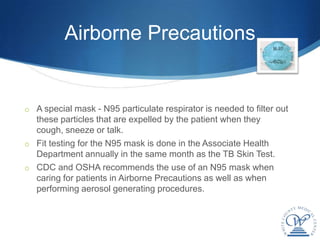
o A special mask - N95 particulate respirator is needed to filter out
  these particles that are expelled by the patient when they
  cough, sneeze or talk.
o Fit testing for the N95 mask is done in the Associate Health
  Department annually in the same month as the TB Skin Test.
o CDC and OSHA recommends the use of an N95 mask when
  caring for patients in Airborne Precautions as well as when
  performing aerosol generating procedures.
Airborne Isolation Precautions


o   Keep both doors of the anti-room         o   Limit visitors
    closed at all times except when
    entering or exiting the room
                                             o   Visitors can be fit tested
o   Keep UV light on at all times
                                             o   Document precautions at least every
o   Wear your appropriately fit tested           shift
    N95 particulate respirator upon
    entering after you fit check it          o   Ventilation check daily to assure
                                                 negative pressure
o   Patient must be placed in negative
    pressure isolation room
                                             o   If negative pressure electronic monitor
o   Patient must wear a surgical mask            is out of range report it immediately to
    if out of his room and only out of the       Engineering
    room is absolutely necessary
Droplet Precautions


o Droplet Precautions are designed to reduce the risk of infection
    that can be spread when the infected droplet contacts the
    eyes, nose or mouth of a susceptible person.
o These are rather large droplets and only travel a short distance
    before falling to the ground, usually about three feet.
o    A regular surgical mask is needed to filter out these particles
    that are expelled by the patient when they sneeze, cough, or
    talk.
o The mask used for droplet precautions is for one time use and
    to be disposed of in the patient room. Do not reuse.
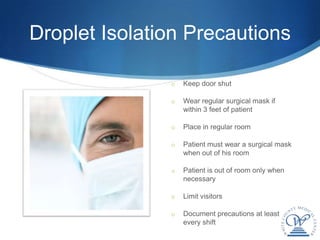
Droplet Isolation Precautions

               o   Keep door shut

               o   Wear regular surgical mask if
                   within 3 feet of patient

               o   Place in regular room

               o   Patient must wear a surgical mask
                   when out of his room

               o   Patient is out of room only when
                   necessary

               o   Limit visitors

               o   Document precautions at least
                   every shift
Contact Precautions


o Contact Precautions are designed to reduce the transmission
  risk of epidemiologically important micro-organisms by direct or
  indirect contact.
o Contact involves dry or moist substances and physical transfer
  of microorganisms to a susceptible person or transfer of the
  organism from an inanimate object to a susceptible person.
o When patient is in contact precautions:
  • Keep door closed
  • Upon entering room don gloves and gown if you might have
       contact with patient or environment
   •   Place in regular room
Contact Isolation Precautions

o   Patient out of room only when   o   Wash hands immediately after
    necessary                           removing gown and gloves (while
                                        still in room) and don’t touch any
o   Trash and linen hamper must         thing before leaving. Organisms that
    be in the patient’s room            require contact precautions can live
                                        for long periods of time outside of
o Use disposable                        the body and can be transferred to
  stethoscope, thermometer, and         any surface
  other non-critical items
o Wash hands with antiseptic    o Disinfect items that are removed
  soap i.e.: Calgon Vestal as     from patient room to be used
  plain soap may not wash these   elsewhere.
  organisms off your hands.
                                o Document precautions at least each
                                  shift
Protective Isolation


o Protective Isolation is designed to reduce the risk of
  infection in an immuno-compromised patient.

o Patients requiring protective isolation can be placed in
  any room with general hospital ventilation and the door
  should be kept closed.

Isolation and standard precautions

  • 1.
  • 2.
    Standard Precautions o Associatesfollow Standard Precautions for the care of ALL patients. o Applies to blood, all body fluids, secretions, excretions (except sweat), mucous membranes, and non-intact skin. o All associates wear the appropriate personal protective equipment (PPE) to prevent contact of their clothes, skin, eyes, or mucous membranes to any substance listed above.
  • 3.
    Transmission Based Precautions o These precautions are designed for patients known or suspected to be infected by highly transmissible or epidemiologically important pathogens that require “Standard Precautions plus” to stop their spread in the hospital. o Drug resistant organisms are those with resistant susceptibility to antimicrobials such as, but not limited to: • MRSA – Methicillin Resistant Staph Aureus • VRE – Vancomycin Resistant Enterococcus • ESBL – Extended Spectrum Beta-Lactamase o Patients that have positive cultures for drug resistant organisms are placed in the appropriate isolation precautions. o Patients with draining wounds/abscesses or foot ulcers are placed in isolation until culture results are obtained.
  • 4.
    Transmission Based Precautions • Transmission Based Precautions are broken down into four types. The isolation codes below print to the patient’s armband and display on CPSI screens to alert you to the isolation type: • Airborne Isolation • Droplet Isolation • Contact Isolation • Protective Isolation
  • 5.
    Airborne Precautions o AirbornePrecautions are designed to reduce the risk of infection that can be spread through the air. o Transmission occurs when tiny droplets or dust containing the infected agent are suspended in the air for long periods. o The agent can float in the air currents of the facility and can be inhaled by or deposited on a susceptible person.
  • 6.
    Airborne Precautions o Tostop airborne transmission of an infection, the patient should be placed in a specially ventilated room kept under negative pressure. o The air in this room is “changed out” a specific number of times an hour and is exhausted outside. It is not re-circulated in to the hospital. An ultraviolet light remains on in this room. The “isolation” rooms on 3S, 4S, 3N, 4N, ER, CCU, PACU and Pre-Op are designed for airborne isolation.
  • 7.
    Airborne Precautions o Aspecial mask - N95 particulate respirator is needed to filter out these particles that are expelled by the patient when they cough, sneeze or talk. o Fit testing for the N95 mask is done in the Associate Health Department annually in the same month as the TB Skin Test. o CDC and OSHA recommends the use of an N95 mask when caring for patients in Airborne Precautions as well as when performing aerosol generating procedures.
  • 8.
    Airborne Isolation Precautions o Keep both doors of the anti-room o Limit visitors closed at all times except when entering or exiting the room o Visitors can be fit tested o Keep UV light on at all times o Document precautions at least every o Wear your appropriately fit tested shift N95 particulate respirator upon entering after you fit check it o Ventilation check daily to assure negative pressure o Patient must be placed in negative pressure isolation room o If negative pressure electronic monitor o Patient must wear a surgical mask is out of range report it immediately to if out of his room and only out of the Engineering room is absolutely necessary
  • 9.
    Droplet Precautions o DropletPrecautions are designed to reduce the risk of infection that can be spread when the infected droplet contacts the eyes, nose or mouth of a susceptible person. o These are rather large droplets and only travel a short distance before falling to the ground, usually about three feet. o A regular surgical mask is needed to filter out these particles that are expelled by the patient when they sneeze, cough, or talk. o The mask used for droplet precautions is for one time use and to be disposed of in the patient room. Do not reuse.
  • 10.
    Droplet Isolation Precautions o Keep door shut o Wear regular surgical mask if within 3 feet of patient o Place in regular room o Patient must wear a surgical mask when out of his room o Patient is out of room only when necessary o Limit visitors o Document precautions at least every shift
  • 11.
    Contact Precautions o ContactPrecautions are designed to reduce the transmission risk of epidemiologically important micro-organisms by direct or indirect contact. o Contact involves dry or moist substances and physical transfer of microorganisms to a susceptible person or transfer of the organism from an inanimate object to a susceptible person. o When patient is in contact precautions: • Keep door closed • Upon entering room don gloves and gown if you might have contact with patient or environment • Place in regular room
  • 12.
    Contact Isolation Precautions o Patient out of room only when o Wash hands immediately after necessary removing gown and gloves (while still in room) and don’t touch any o Trash and linen hamper must thing before leaving. Organisms that be in the patient’s room require contact precautions can live for long periods of time outside of o Use disposable the body and can be transferred to stethoscope, thermometer, and any surface other non-critical items o Wash hands with antiseptic o Disinfect items that are removed soap i.e.: Calgon Vestal as from patient room to be used plain soap may not wash these elsewhere. organisms off your hands. o Document precautions at least each shift
  • 13.
    Protective Isolation o ProtectiveIsolation is designed to reduce the risk of infection in an immuno-compromised patient. o Patients requiring protective isolation can be placed in any room with general hospital ventilation and the door should be kept closed.