BIOMEDICAL
WASTE
MANAGEMENT
Presenter: Aruna Shastri
M.Sc. Nursing 1st Year
introduction
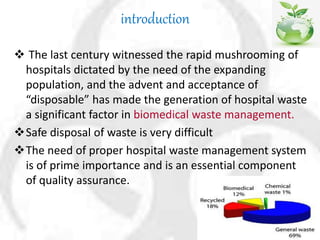
 The last century witnessed the rapid mushrooming of
hospitals dictated by the need of the expanding
population, and the advent and acceptance of
“disposable” has made the generation of hospital waste
a significant factor in biomedical waste management.
Safe disposal of waste is very difficult
The need of proper hospital waste management system
is of prime importance and is an essential component
of quality assurance.
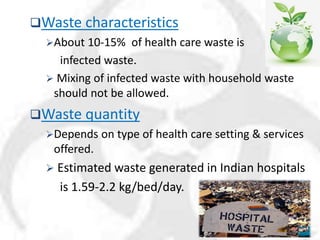
Waste characteristics
About 10-15% of health care waste is
infected waste.
 Mixing of infected waste with household waste
should not be allowed.
Waste quantity
Depends on type of health care setting & services
offered.
 Estimated waste generated in Indian hospitals
is 1.59-2.2 kg/bed/day.
Waste Management in Small Hospitals:
Trouble for Environment
Pant D.
Waste Management Lab
Institute of Biomedical and Natural Science,Dehradun
 A survey was conducted in 100 hospitals present in Dehradun.
 Larger amount of per day per bed waste was found among the
small hospitals(178g compared with 114g in big hospitals),
indicating unskilled waste management practices
 Small hospitals do not follow the proper way for taking care of
segregation of waste generated in the hospital, and most bio-
medical wastes were collected without segregation into
infectious & non-infectious categories.
definition
 Biomedical waste means any waste which is
generated during the diagnosis, treatment or
immunization of human beings or animals or
in research activities pertaining thereto or in
 the production or testing of biological.
(Biomedical Waste Management and Handling Rules1998, India)
Biomedical waste management is sorting of medical
waste in hospital.
PURPOSES of waste management system
 To reduce hazardous nature of waste
 To reduce volume of waste
 To prevent misuse or abuse of waste
 To ensure occupational safety and health
 To consider aesthetics
 To reuse items that can be of repeat utility
PURPOSES CONTD…
To recycle waste where possible for another
utility item
 Maintain order and cleanliness in hospital
 Maintain healthy environment
 Prevent spread of infectious diseases
 Project good impression of management
 Attract more clientele
Sources-health care waste
 Government and Private hospitals
 Nursing homes
 Physician’s office/clinics
 Dispensaries
 Primary Health Centres
 Medical research and training establishments
 Mortuaries
Legislative framework
 Keeping In view inappropriate Biomedical
waste management, the Ministry of
Environment & Forests notified the
“Biomedical Waste(management and
handling) Rules,1998” in July,1998.
Bio Medical Waste(Management and
Handling)Rules,1998
 Objective:
to stop the indiscriminate disposal of hospital waste/
bio-medical waste &
ensure that such waste is handled without any
adverse effect on the human health and environment
 Bio Medical(Management and Handling)Rules
Sources of waste includes:
 Waste generated by the health care facilities
 Research facilities
 Laboratories
Biomedical waste in hospitals:
 85% are non-infectious/ non-hazardous
 10% are infectious
 5% are hazardous
Legislative framework
 Basic principles
Segregation of waste at the health facility level.
 Processing and storage for terminal disposal.
Bio-medical waste shall not be mixed with other
wastes.
Bio-medical waste shall be segregated into
containers/ bags at the point of generation in
accordance with BMW Rules 1998 prior to its storage,
transportation, treatment and disposal.
Basic principles
Color coding to support segregation at source
Untreated bio-medical waste not to be stored beyond
a period of 48 hours.
Transport waste safely to pick up site.
 Identify destination for each type of waste and
ensure safe disposal.
 Every authorised person shall maintain records
related to any form of handling of biomedical waste.
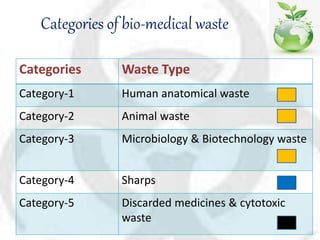
Categories of bio-medical waste
Categories Waste Type
Category-1 Human anatomical waste
Category-2 Animal waste
Category-3 Microbiology & Biotechnology waste
Category-4 Sharps
Category-5 Discarded medicines & cytotoxic
waste
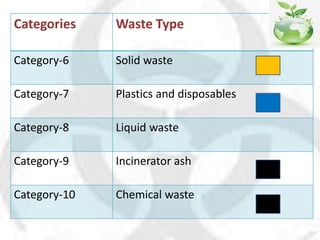
Categories Waste Type
Category-6 Solid waste
Category-7 Plastics and disposables
Category-8 Liquid waste
Category-9 Incinerator ash
Category-10 Chemical waste
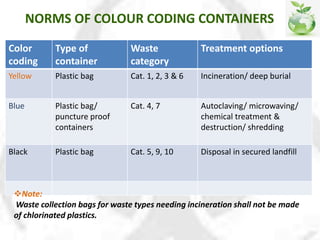
NORMS OF COLOUR CODING CONTAINERS
Color
coding
Type of
container
Waste
category
Treatment options
Yellow Plastic bag Cat. 1, 2, 3 & 6 Incineration/ deep burial
Blue Plastic bag/
puncture proof
containers
Cat. 4, 7 Autoclaving/ microwaving/
chemical treatment &
destruction/ shredding
Black Plastic bag Cat. 5, 9, 10 Disposal in secured landfill
Note:
Waste collection bags for waste types needing incineration shall not be made
of chlorinated plastics.
CLASSIFICATION OF BIOMEDICAL WASTE
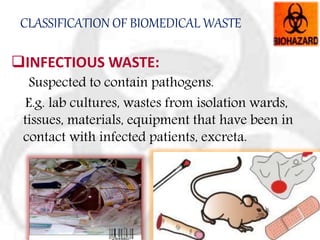
INFECTIOUS WASTE:
Suspected to contain pathogens.
E.g. lab cultures, wastes from isolation wards,
tissues, materials, equipment that have been in
contact with infected patients, excreta.
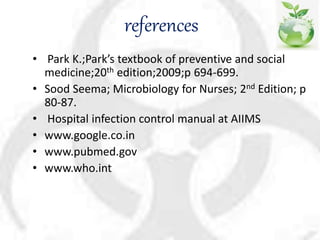
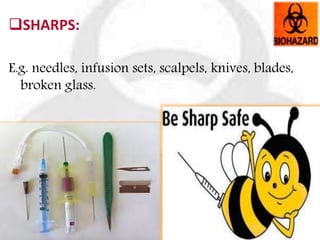
SHARPS:
E.g. needles, infusion sets, scalpels, knives, blades,
broken glass.
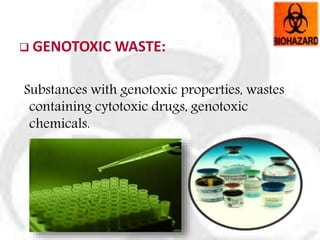
 GENOTOXIC WASTE:
Substances with genotoxic properties, wastes
containing cytotoxic drugs, genotoxic
chemicals.
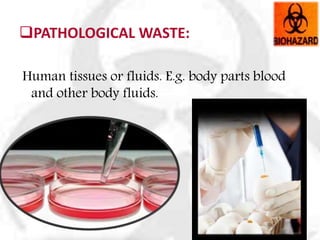
PATHOLOGICAL WASTE:
Human tissues or fluids. E.g. body parts blood
and other body fluids.
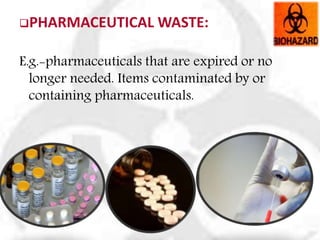
PHARMACEUTICAL WASTE:
E.g.-pharmaceuticals that are expired or no
longer needed. Items contaminated by or
containing pharmaceuticals.
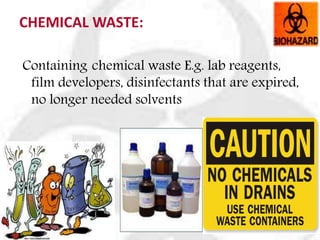
CHEMICAL WASTE:
Containing chemical waste E.g. lab reagents,
film developers, disinfectants that are expired,
no longer needed solvents
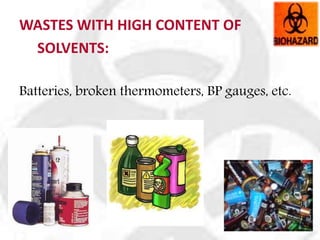
WASTES WITH HIGH CONTENT OF
SOLVENTS:
Batteries, broken thermometers, BP gauges, etc.
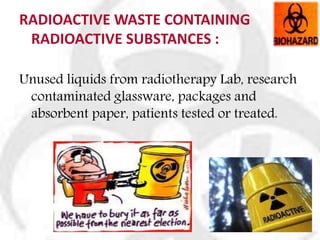
RADIOACTIVE WASTE CONTAINING
RADIOACTIVE SUBSTANCES :
Unused liquids from radiotherapy Lab, research
contaminated glassware, packages and
absorbent paper, patients tested or treated.
Health hazards
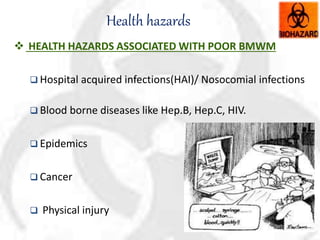
 HEALTH HAZARDS ASSOCIATED WITH POOR BMWM
 Hospital acquired infections(HAI)/ Nosocomial infections
 Blood borne diseases like Hep.B, Hep.C, HIV.
 Epidemics
 Cancer
 Physical injury
HEALTH HAZARDS Contd…
 Injury from sharps to staff and waste handlers associated with
the health care establishment.
 Risk of infection outside the hospital for waste
handlers/scavengers and eventually general public.
 Occupational risk associated with hazardous chemicals, drugs
etc.
 Unauthorised repackaging and sale of disposable items and
unused / date expired drugs
Health hazards
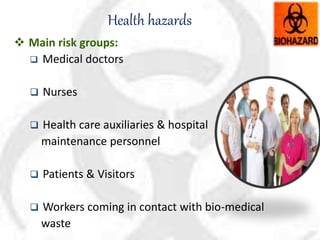
 Main risk groups:
 Medical doctors
 Nurses
 Health care auxiliaries & hospital
maintenance personnel
 Patients & Visitors
 Workers coming in contact with bio-medical
waste
WHAT IS BIOSAFETY?
 Biosafety is essentially a preventive concept and
consists of wide variety of safety precautions that are
to be undertaken, either singly or in combination,
depending on the type of hazard by all medical,
nursing & paramedical workers as well as by patients,
attendants, ancillary staff & administrators in a
hospital.
Biosafety levels
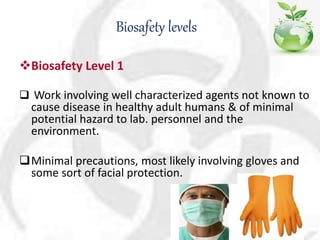
Biosafety Level 1
 Work involving well characterized agents not known to
cause disease in healthy adult humans & of minimal
potential hazard to lab. personnel and the
environment.
Minimal precautions, most likely involving gloves and
some sort of facial protection.
Biosafety Level 2
Work involving agents of moderate potential hazard
to personnel & the environment.
Restricted access, training on the hazards of
infectious agents, sterilization of waste, standard
sharps handling etc.
Immunization, if available.
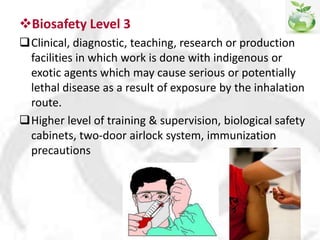
Biosafety Level 3
Clinical, diagnostic, teaching, research or production
facilities in which work is done with indigenous or
exotic agents which may cause serious or potentially
lethal disease as a result of exposure by the inhalation
route.
Higher level of training & supervision, biological safety
cabinets, two-door airlock system, immunization
precautions
Biosafety Level 4
Work with dangerous & exotic agents which pose a high
individual risk of aerosol-transmitted lab. infections &
life-threatening disease. Handled until sufficient data
are obtained to confirm work with them.
Strategies for waste management
 Waste reduction strategy
 Waste assessment strategy
 Waste recycling strategy
 Hospital waste disposal
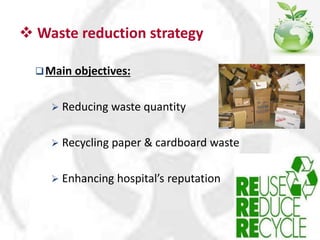
 Waste reduction strategy
Main objectives:
 Reducing waste quantity
 Recycling paper & cardboard waste
 Enhancing hospital’s reputation
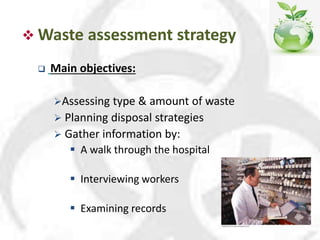
 Waste assessment strategy
 Main objectives:
Assessing type & amount of waste
 Planning disposal strategies
 Gather information by:
 A walk through the hospital
 Interviewing workers
 Examining records
 Waste recycling strategy
Main objectives:
Prolonging life of material
 Helping in cost saving & waste volume
reduction
 Ensuring that reusables are properly sterilized
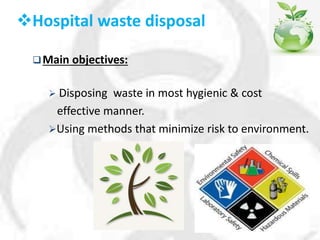
Hospital waste disposal
Main objectives:
 Disposing waste in most hygienic & cost
effective manner.
Using methods that minimize risk to environment.
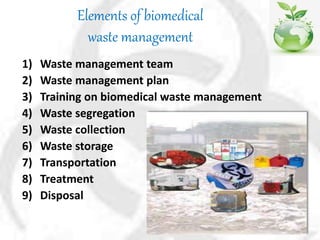
Elements of biomedical
waste management
1) Waste management team
2) Waste management plan
3) Training on biomedical waste management
4) Waste segregation
5) Waste collection
6) Waste storage
7) Transportation
8) Treatment
9) Disposal
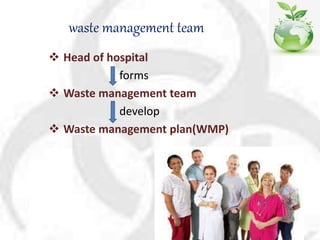
waste management team
 Head of hospital
forms
 Waste management team
develop
 Waste management plan(WMP)
waste management team
The staff typically involves:
Head of hospital(Chairperson)
 Heads of hospital departments
 Infection control officer/nurse
 Chief pharmacist
 Matron or senior nursing officer
 Hospital manager/administrator
 Hospital engineer/technician
waste management team
 A Waste management officer(WMO) is
also appointed
 WMO,s responsibilities:
 Waste management plan formulation
Subsequent day-to-day operation
 Monitoring of waste disposal system
 Produces a draft
waste management team
 The draft address following issues:
 Present situation regarding waste management
 Quantities of waste generated, the points of generation,
the type of waste at each point
 Possibilities for waste minimization, reuse &recycling
 Waste segregation, on-site handling, transport &
storage practices
 Identification & evaluation of waste treatment/disposal
options
 Training
 Estimation of costs relating to BMWM
 Strategy for implementation of plan
Waste management
plan (wmp)
 Comprises of the complete outline of waste
management process
 WMP is reviewed annually
 Periodic auditing & evaluation of waste
management methods is performed
Training on biomedical
waste management
Overall aim of training:
 To develop awareness of health, safety and
environmental issues relating to health care
waste.
 Roles & responsibilities of health care
personnel in overall management program should be
highlighted.
Training on biomedical
waste management
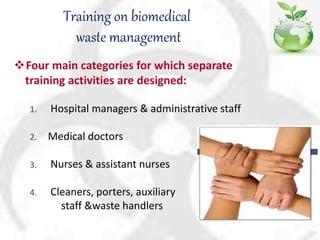
Four main categories for which separate
training activities are designed:
1. Hospital managers & administrative staff
2. Medical doctors
3. Nurses & assistant nurses
4. Cleaners, porters, auxiliary
staff &waste handlers
Training on biomedical
waste management
 Staff education programs
 Information given on:
 All aspects of health care waste policy
 Role & responsibilities of each hospital staff
member.
Relevant technical instructions
Adequate education & training of
health personnel about handling waste
Waste segregation
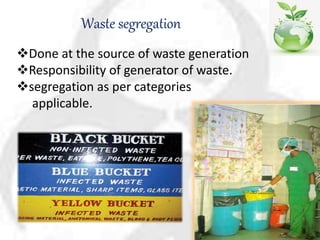
Done at the source of waste generation
Responsibility of generator of waste.
segregation as per categories
applicable.
Waste collection
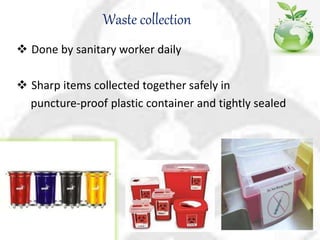
 Done by sanitary worker daily
 Sharp items collected together safely in
puncture-proof plastic container and tightly sealed
Waste collection contd..
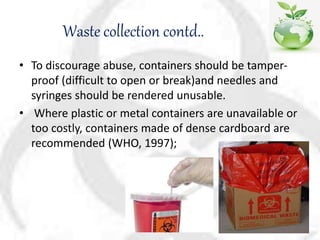
• To discourage abuse, containers should be tamper-
proof (difficult to open or break)and needles and
syringes should be rendered unusable.
• Where plastic or metal containers are unavailable or
too costly, containers made of dense cardboard are
recommended (WHO, 1997);
Collection times
• Wards > Every morning
• Operation theatre (OT)> Each operation / surgical
procedure
• OPD, ICU, Emergency, Laboratories > Each shift
• Pharmacy > Once a day
• Administrative unit and central store> Once a day
• Surrounding premises and garden> Once a day
• Dialysis unit> Each procedure
• Radiation unit> Each procedure
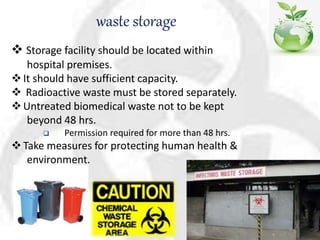
waste storage
 Storage facility should be located within
hospital premises.
It should have sufficient capacity.
 Radioactive waste must be stored separately.
Untreated biomedical waste not to be kept
beyond 48 hrs.
 Permission required for more than 48 hrs.
Take measures for protecting human health &
environment.
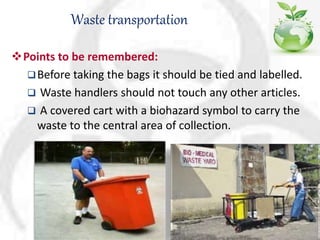
Waste transportation
Points to be remembered:
Before taking the bags it should be tied and labelled.
 Waste handlers should not touch any other articles.
 A covered cart with a biohazard symbol to carry the
waste to the central area of collection.
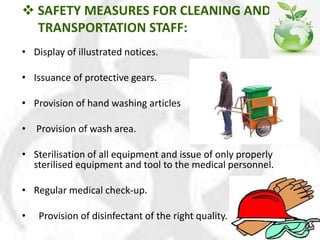
 SAFETY MEASURES FOR CLEANING AND
TRANSPORTATION STAFF:
• Display of illustrated notices.
• Issuance of protective gears.
• Provision of hand washing articles
• Provision of wash area.
• Sterilisation of all equipment and issue of only properly
sterilised equipment and tool to the medical personnel.
• Regular medical check-up.
• Provision of disinfectant of the right quality.
Waste treatment
and disposal
 Available Treatment and Disposal Methods
 Chemical Technology
 Thermal Technology
 Autoclave
 Hydroclave
 Incinerator
 Microwave
 Screw feed
 Mechanical Technology
 Compaction
 Grinding/ Shredding
 Pulverization
 Inertization
Waste treatment and
disposal
 Biological Method
 Plasma torch Technology
 Deep burial
 Land filling
 Open dumps
 Sanitary land fill
 Worm composting
Waste treatmenand disposal
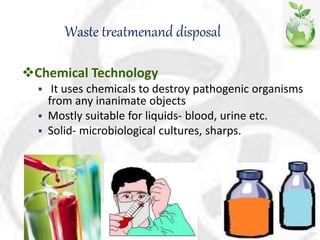
Chemical Technology
 It uses chemicals to destroy pathogenic organisms
from any inanimate objects
 Mostly suitable for liquids- blood, urine etc.
 Solid- microbiological cultures, sharps.
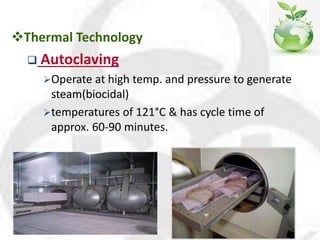
Thermal Technology
 Autoclaving
Operate at high temp. and pressure to generate
steam(biocidal)
temperatures of 121°C & has cycle time of
approx. 60-90 minutes.
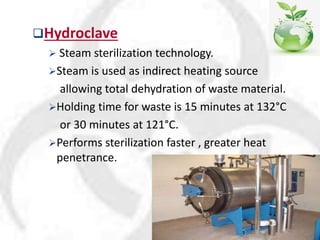
Hydroclave
 Steam sterilization technology.
Steam is used as indirect heating source
allowing total dehydration of waste material.
Holding time for waste is 15 minutes at 132°C
or 30 minutes at 121°C.
Performs sterilization faster , greater heat
penetrance.
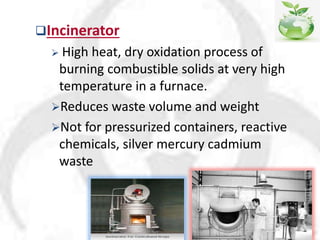
Incinerator
 High heat, dry oxidation process of
burning combustible solids at very high
temperature in a furnace.
Reduces waste volume and weight
Not for pressurized containers, reactive
chemicals, silver mercury cadmium
waste
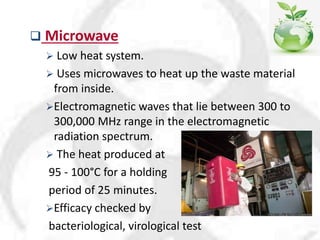
 Microwave
 Low heat system.
 Uses microwaves to heat up the waste material
from inside.
Electromagnetic waves that lie between 300 to
300,000 MHz range in the electromagnetic
radiation spectrum.
 The heat produced at
95 - 100°C for a holding
period of 25 minutes.
Efficacy checked by
bacteriological, virological test
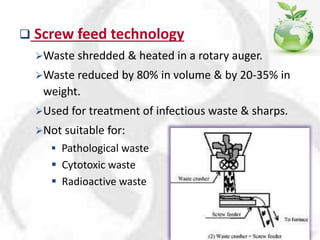
 Screw feed technology
Waste shredded & heated in a rotary auger.
Waste reduced by 80% in volume & by 20-35% in
weight.
Used for treatment of infectious waste & sharps.
Not suitable for:
 Pathological waste
 Cytotoxic waste
 Radioactive waste
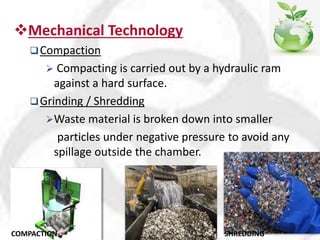
Mechanical Technology
Compaction
 Compacting is carried out by a hydraulic ram
against a hard surface.
Grinding / Shredding
Waste material is broken down into smaller
particles under negative pressure to avoid any
spillage outside the chamber.
COMPACTION SHREDDING
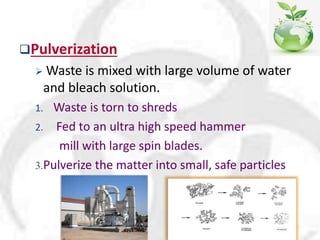
Pulverization
 Waste is mixed with large volume of water
and bleach solution.
1. Waste is torn to shreds
2. Fed to an ultra high speed hammer
mill with large spin blades.
3.Pulverize the matter into small, safe particles
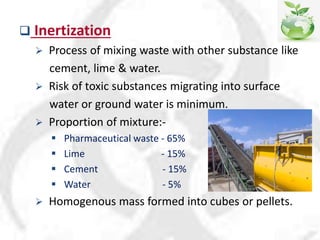
 Inertization
 Process of mixing waste with other substance like
cement, lime & water.
 Risk of toxic substances migrating into surface
water or ground water is minimum.
 Proportion of mixture:-
 Pharmaceutical waste - 65%
 Lime - 15%
 Cement - 15%
 Water - 5%
 Homogenous mass formed into cubes or pellets.
Irradiation Technology
Wastes exposed to ultraviolet or ionizing radiation in
an enclosed chamber.
Require post shredding to render the waste
unrecognizable.
Biological Processes
Use biological enzymes for treating medical waste.
Not only decontaminate the waste but also cause
the destruction of all the organic constituents.
 Plasma torch Technology
 Plasma cutting is a process used to cut steel
& other metals or sometimes other materials
of different thickness using a plasma torch.
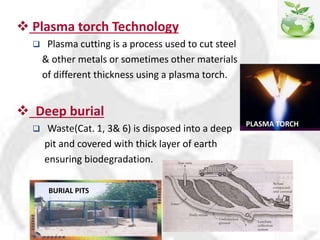
 Deep burial
 Waste(Cat. 1, 3& 6) is disposed into a deep
pit and covered with thick layer of earth
ensuring biodegradation.
PLASMA TORCH
BURIAL PITS
 Land filling
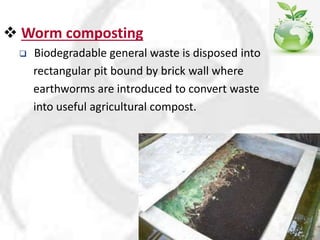
 Disposal of residual solid wastes on land.
 2 types:
 Open dumps
 Health care waste should not be
deposited on or around open dumps.
 Sanitary land fill
 Specially constructed for
disposal of non-biodegradable
Infectious hospital waste.
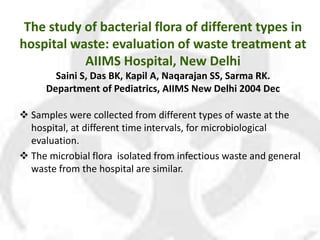
 Worm composting
 Biodegradable general waste is disposed into
rectangular pit bound by brick wall where
earthworms are introduced to convert waste
into useful agricultural compost.
The study of bacterial flora of different types in
hospital waste: evaluation of waste treatment at
AIIMS Hospital, New Delhi
Saini S, Das BK, Kapil A, Naqarajan SS, Sarma RK.
Department of Pediatrics, AIIMS New Delhi 2004 Dec
 Samples were collected from different types of waste at the
hospital, at different time intervals, for microbiological
evaluation.
 The microbial flora isolated from infectious waste and general
waste from the hospital are similar.
Contd…..
 The samples from general waste in this study reveal many types
of pathogens.
 The bacteria present in the waste initially was low in quantity,
but they replicated rapidly over time so that significant numbers
were detected by 24 hours, due to environmental factors which
were favourable for growth during this period.
 This study strongly suggests that waste should be removed from
the hospital within 24 hours of its generation to prevent
environmental contamination caused by any accidental spillage
of waste.
 General waste generated in the hospital should be treated similar
to infectious waste, as it can be equally hazardous.
BIOMEDICAL WASTE MANAGEMENT
AT AIIMS
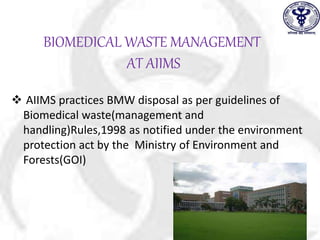
 AIIMS practices BMW disposal as per guidelines of
Biomedical waste(management and
handling)Rules,1998 as notified under the environment
protection act by the Ministry of Environment and
Forests(GOI)
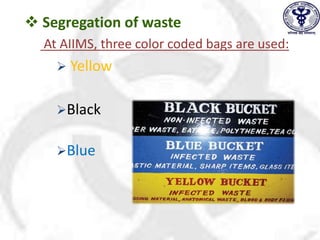
 Segregation of waste
At AIIMS, three color coded bags are used:
 Yellow
Black
Blue
Transportation
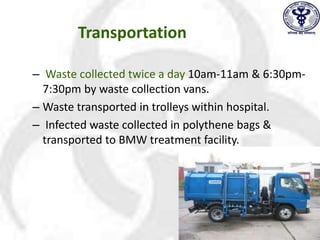
– Waste collected twice a day 10am-11am & 6:30pm-
7:30pm by waste collection vans.
– Waste transported in trolleys within hospital.
– Infected waste collected in polythene bags &
transported to BMW treatment facility.
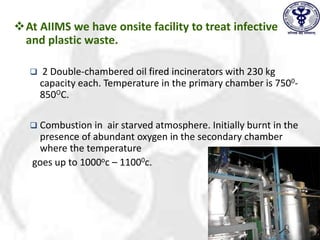
At AIIMS we have onsite facility to treat infective
and plastic waste.
 2 Double-chambered oil fired incinerators with 230 kg
capacity each. Temperature in the primary chamber is 7500-
850OC.
 Combustion in air starved atmosphere. Initially burnt in the
presence of abundant oxygen in the secondary chamber
where the temperature
goes up to 1000oc – 11000c.
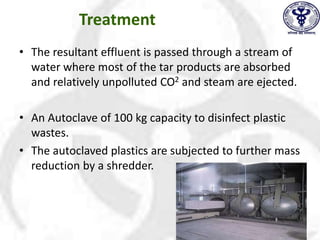
Treatment
• The resultant effluent is passed through a stream of
water where most of the tar products are absorbed
and relatively unpolluted CO2 and steam are ejected.
• An Autoclave of 100 kg capacity to disinfect plastic
wastes.
• The autoclaved plastics are subjected to further mass
reduction by a shredder.
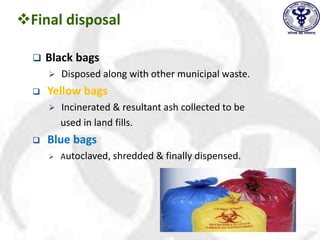
Final disposal
 Black bags
 Disposed along with other municipal waste.
 Yellow bags
 Incinerated & resultant ash collected to be
used in land fills.
 Blue bags
 Autoclaved, shredded & finally dispensed.
STAFF SAFETY CONSIDERATIONS
To ensure the safety of personnel involved in bio
medical waste treatment and disposal AIIMS follows
certain policies and guidelines:
• There are dedicated trolleys for transporting waste
within the hospital
• All workers involved in the work are aware of the
hazardous nature of the work.
• The workers are provided with all protective
equipment
• All workers are immunized against tetanus and
hepatitis B.
Biomedical waste management: incineration vs.
environmental safety.
Gautam V, Thapar R, Sharma M.
Department of Medical Microbiology, PGIMER, Chandigarh.
 Non-incineration treatment technologies are a growing and
developing field. Most medical waste is incinerated. The burning of
solid and medical waste creates many problems.
 Incinerators emit toxic air pollutants and toxic ash residues that are
the major source of dioxins in the environment. International
Agency for Research on Cancer, an arm of WHO, acknowledged
dioxins cancer causing potential and classified it as a human
carcinogen.
 Development of waste management policies, careful waste
segregation and training programs, as well as attention to materials
purchased, are essential in minimizing the environmental and
health impacts of any technology.
Role of nurses and nursing
 ICN Position:
 All nurses’ duty –eliminating negative impact of
medical waste
 ICN supports initiatives including:
 Decisions favoring recycled products
 Proper waste segregation
 Waste treatment choices minimizing toxic
disinfectants & sterilants
 Waste disposal choices reducing
incineration to maximum
 Patient education
 Nursing organizations need to:
 Facilitate nurses’ access to continuing
education programmes.
 Involve direct care nurses in decision-making.
 Advocate for safe waste disposal
mechanisms.
 Develop coalitions with other professions.
 Define & regulate nursing competencies.
Biomedical waste
management issues
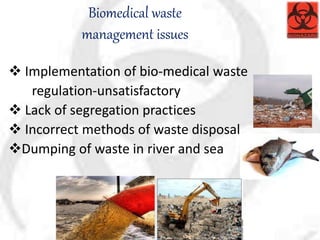
 Implementation of bio-medical waste
regulation-unsatisfactory
 Lack of segregation practices
 Incorrect methods of waste disposal
Dumping of waste in river and sea
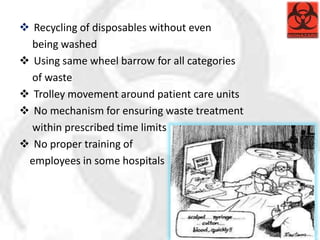
 Recycling of disposables without even
being washed
 Using same wheel barrow for all categories
of waste
 Trolley movement around patient care units
 No mechanism for ensuring waste treatment
within prescribed time limits
 No proper training of
employees in some hospitals
SUMMARY
Biomedical waste(BMW) are potentially dangerous. Sorting of
medical wastes at the site where it is generated is a vital step. Other
forms of waste should not be mixed with biomedical waste as different
rules apply to the treatment of different types of waste. It must be
properly managed to protect the general public, specifically healthcare
and sanitation workers who are regularly exposed to biomedical waste
as an occupational hazard.
Hence, collection and disposal of waste in the proper manner is of
great importance as it can decrease directly and indirectly health risk to
people, and damage to flora, fauna and the environment (Centres for
Disease Control and Prevention, 2001).
CONCLUSION
We need innovative and radical measures to clean up
the distressing picture of lack of civic concern on the
part of hospitals and slackness in government
implementation of bare minimum of rules, as waste
generation particularly biomedical waste imposes
increasing direct and indirect costs on society.
 This is the time to pause and ponder over the matter
because evidence is there for us to understand that
hospital waste management is of great concern.
references
• Park K.;Park’s textbook of preventive and social
medicine;20th edition;2009;p 694-699.
• Sood Seema; Microbiology for Nurses; 2nd Edition; p
80-87.
• Hospital infection control manual at AIIMS
• www.google.co.in
• www.pubmed.gov
• www.who.int
Biomedical waste management

Biomedical waste management

  • 1.
  • 2.
    introduction  The lastcentury witnessed the rapid mushrooming of hospitals dictated by the need of the expanding population, and the advent and acceptance of “disposable” has made the generation of hospital waste a significant factor in biomedical waste management. Safe disposal of waste is very difficult The need of proper hospital waste management system is of prime importance and is an essential component of quality assurance.
  • 3.
    Waste characteristics About 10-15%of health care waste is infected waste.  Mixing of infected waste with household waste should not be allowed. Waste quantity Depends on type of health care setting & services offered.  Estimated waste generated in Indian hospitals is 1.59-2.2 kg/bed/day.
  • 4.
    Waste Management inSmall Hospitals: Trouble for Environment Pant D. Waste Management Lab Institute of Biomedical and Natural Science,Dehradun  A survey was conducted in 100 hospitals present in Dehradun.  Larger amount of per day per bed waste was found among the small hospitals(178g compared with 114g in big hospitals), indicating unskilled waste management practices  Small hospitals do not follow the proper way for taking care of segregation of waste generated in the hospital, and most bio- medical wastes were collected without segregation into infectious & non-infectious categories.
  • 5.
    definition  Biomedical wastemeans any waste which is generated during the diagnosis, treatment or immunization of human beings or animals or in research activities pertaining thereto or in  the production or testing of biological. (Biomedical Waste Management and Handling Rules1998, India) Biomedical waste management is sorting of medical waste in hospital.
  • 6.
    PURPOSES of wastemanagement system  To reduce hazardous nature of waste  To reduce volume of waste  To prevent misuse or abuse of waste  To ensure occupational safety and health  To consider aesthetics  To reuse items that can be of repeat utility
  • 7.
    PURPOSES CONTD… To recyclewaste where possible for another utility item  Maintain order and cleanliness in hospital  Maintain healthy environment  Prevent spread of infectious diseases  Project good impression of management  Attract more clientele
  • 8.
    Sources-health care waste Government and Private hospitals  Nursing homes  Physician’s office/clinics  Dispensaries  Primary Health Centres  Medical research and training establishments  Mortuaries
  • 9.
    Legislative framework  KeepingIn view inappropriate Biomedical waste management, the Ministry of Environment & Forests notified the “Biomedical Waste(management and handling) Rules,1998” in July,1998.
  • 10.
    Bio Medical Waste(Managementand Handling)Rules,1998  Objective: to stop the indiscriminate disposal of hospital waste/ bio-medical waste & ensure that such waste is handled without any adverse effect on the human health and environment
  • 11.
     Bio Medical(Managementand Handling)Rules Sources of waste includes:  Waste generated by the health care facilities  Research facilities  Laboratories Biomedical waste in hospitals:  85% are non-infectious/ non-hazardous  10% are infectious  5% are hazardous
  • 12.
    Legislative framework  Basicprinciples Segregation of waste at the health facility level.  Processing and storage for terminal disposal. Bio-medical waste shall not be mixed with other wastes. Bio-medical waste shall be segregated into containers/ bags at the point of generation in accordance with BMW Rules 1998 prior to its storage, transportation, treatment and disposal.
  • 13.
    Basic principles Color codingto support segregation at source Untreated bio-medical waste not to be stored beyond a period of 48 hours. Transport waste safely to pick up site.  Identify destination for each type of waste and ensure safe disposal.  Every authorised person shall maintain records related to any form of handling of biomedical waste.
  • 14.
    Categories of bio-medicalwaste Categories Waste Type Category-1 Human anatomical waste Category-2 Animal waste Category-3 Microbiology & Biotechnology waste Category-4 Sharps Category-5 Discarded medicines & cytotoxic waste
  • 15.
    Categories Waste Type Category-6Solid waste Category-7 Plastics and disposables Category-8 Liquid waste Category-9 Incinerator ash Category-10 Chemical waste
  • 16.
    NORMS OF COLOURCODING CONTAINERS Color coding Type of container Waste category Treatment options Yellow Plastic bag Cat. 1, 2, 3 & 6 Incineration/ deep burial Blue Plastic bag/ puncture proof containers Cat. 4, 7 Autoclaving/ microwaving/ chemical treatment & destruction/ shredding Black Plastic bag Cat. 5, 9, 10 Disposal in secured landfill Note: Waste collection bags for waste types needing incineration shall not be made of chlorinated plastics.
  • 17.
    CLASSIFICATION OF BIOMEDICALWASTE INFECTIOUS WASTE: Suspected to contain pathogens. E.g. lab cultures, wastes from isolation wards, tissues, materials, equipment that have been in contact with infected patients, excreta.
  • 18.
    SHARPS: E.g. needles, infusionsets, scalpels, knives, blades, broken glass.
  • 19.
     GENOTOXIC WASTE: Substanceswith genotoxic properties, wastes containing cytotoxic drugs, genotoxic chemicals.
  • 20.
    PATHOLOGICAL WASTE: Human tissuesor fluids. E.g. body parts blood and other body fluids.
  • 21.
    PHARMACEUTICAL WASTE: E.g.-pharmaceuticals thatare expired or no longer needed. Items contaminated by or containing pharmaceuticals.
  • 22.
    CHEMICAL WASTE: Containing chemicalwaste E.g. lab reagents, film developers, disinfectants that are expired, no longer needed solvents
  • 23.
    WASTES WITH HIGHCONTENT OF SOLVENTS: Batteries, broken thermometers, BP gauges, etc.
  • 24.
    RADIOACTIVE WASTE CONTAINING RADIOACTIVESUBSTANCES : Unused liquids from radiotherapy Lab, research contaminated glassware, packages and absorbent paper, patients tested or treated.
  • 25.
    Health hazards  HEALTHHAZARDS ASSOCIATED WITH POOR BMWM  Hospital acquired infections(HAI)/ Nosocomial infections  Blood borne diseases like Hep.B, Hep.C, HIV.  Epidemics  Cancer  Physical injury
  • 26.
    HEALTH HAZARDS Contd… Injury from sharps to staff and waste handlers associated with the health care establishment.  Risk of infection outside the hospital for waste handlers/scavengers and eventually general public.  Occupational risk associated with hazardous chemicals, drugs etc.  Unauthorised repackaging and sale of disposable items and unused / date expired drugs
  • 27.
    Health hazards  Mainrisk groups:  Medical doctors  Nurses  Health care auxiliaries & hospital maintenance personnel  Patients & Visitors  Workers coming in contact with bio-medical waste
  • 28.
    WHAT IS BIOSAFETY? Biosafety is essentially a preventive concept and consists of wide variety of safety precautions that are to be undertaken, either singly or in combination, depending on the type of hazard by all medical, nursing & paramedical workers as well as by patients, attendants, ancillary staff & administrators in a hospital.
  • 29.
    Biosafety levels Biosafety Level1  Work involving well characterized agents not known to cause disease in healthy adult humans & of minimal potential hazard to lab. personnel and the environment. Minimal precautions, most likely involving gloves and some sort of facial protection.
  • 30.
    Biosafety Level 2 Workinvolving agents of moderate potential hazard to personnel & the environment. Restricted access, training on the hazards of infectious agents, sterilization of waste, standard sharps handling etc. Immunization, if available.
  • 31.
    Biosafety Level 3 Clinical,diagnostic, teaching, research or production facilities in which work is done with indigenous or exotic agents which may cause serious or potentially lethal disease as a result of exposure by the inhalation route. Higher level of training & supervision, biological safety cabinets, two-door airlock system, immunization precautions
  • 32.
    Biosafety Level 4 Workwith dangerous & exotic agents which pose a high individual risk of aerosol-transmitted lab. infections & life-threatening disease. Handled until sufficient data are obtained to confirm work with them.
  • 33.
    Strategies for wastemanagement  Waste reduction strategy  Waste assessment strategy  Waste recycling strategy  Hospital waste disposal
  • 34.
     Waste reductionstrategy Main objectives:  Reducing waste quantity  Recycling paper & cardboard waste  Enhancing hospital’s reputation
  • 35.
     Waste assessmentstrategy  Main objectives: Assessing type & amount of waste  Planning disposal strategies  Gather information by:  A walk through the hospital  Interviewing workers  Examining records
  • 36.
     Waste recyclingstrategy Main objectives: Prolonging life of material  Helping in cost saving & waste volume reduction  Ensuring that reusables are properly sterilized
  • 37.
    Hospital waste disposal Mainobjectives:  Disposing waste in most hygienic & cost effective manner. Using methods that minimize risk to environment.
  • 38.
    Elements of biomedical wastemanagement 1) Waste management team 2) Waste management plan 3) Training on biomedical waste management 4) Waste segregation 5) Waste collection 6) Waste storage 7) Transportation 8) Treatment 9) Disposal
  • 39.
    waste management team Head of hospital forms  Waste management team develop  Waste management plan(WMP)
  • 40.
    waste management team Thestaff typically involves: Head of hospital(Chairperson)  Heads of hospital departments  Infection control officer/nurse  Chief pharmacist  Matron or senior nursing officer  Hospital manager/administrator  Hospital engineer/technician
  • 41.
    waste management team A Waste management officer(WMO) is also appointed  WMO,s responsibilities:  Waste management plan formulation Subsequent day-to-day operation  Monitoring of waste disposal system  Produces a draft
  • 42.
    waste management team The draft address following issues:  Present situation regarding waste management  Quantities of waste generated, the points of generation, the type of waste at each point  Possibilities for waste minimization, reuse &recycling  Waste segregation, on-site handling, transport & storage practices  Identification & evaluation of waste treatment/disposal options  Training  Estimation of costs relating to BMWM  Strategy for implementation of plan
  • 43.
    Waste management plan (wmp) Comprises of the complete outline of waste management process  WMP is reviewed annually  Periodic auditing & evaluation of waste management methods is performed
  • 44.
    Training on biomedical wastemanagement Overall aim of training:  To develop awareness of health, safety and environmental issues relating to health care waste.  Roles & responsibilities of health care personnel in overall management program should be highlighted.
  • 45.
    Training on biomedical wastemanagement Four main categories for which separate training activities are designed: 1. Hospital managers & administrative staff 2. Medical doctors 3. Nurses & assistant nurses 4. Cleaners, porters, auxiliary staff &waste handlers
  • 46.
    Training on biomedical wastemanagement  Staff education programs  Information given on:  All aspects of health care waste policy  Role & responsibilities of each hospital staff member. Relevant technical instructions Adequate education & training of health personnel about handling waste
  • 47.
    Waste segregation Done atthe source of waste generation Responsibility of generator of waste. segregation as per categories applicable.
  • 48.
    Waste collection  Doneby sanitary worker daily  Sharp items collected together safely in puncture-proof plastic container and tightly sealed
  • 49.
    Waste collection contd.. •To discourage abuse, containers should be tamper- proof (difficult to open or break)and needles and syringes should be rendered unusable. • Where plastic or metal containers are unavailable or too costly, containers made of dense cardboard are recommended (WHO, 1997);
  • 50.
    Collection times • Wards> Every morning • Operation theatre (OT)> Each operation / surgical procedure • OPD, ICU, Emergency, Laboratories > Each shift • Pharmacy > Once a day • Administrative unit and central store> Once a day • Surrounding premises and garden> Once a day • Dialysis unit> Each procedure • Radiation unit> Each procedure
  • 51.
    waste storage  Storagefacility should be located within hospital premises. It should have sufficient capacity.  Radioactive waste must be stored separately. Untreated biomedical waste not to be kept beyond 48 hrs.  Permission required for more than 48 hrs. Take measures for protecting human health & environment.
  • 52.
    Waste transportation Points tobe remembered: Before taking the bags it should be tied and labelled.  Waste handlers should not touch any other articles.  A covered cart with a biohazard symbol to carry the waste to the central area of collection.
  • 53.
     SAFETY MEASURESFOR CLEANING AND TRANSPORTATION STAFF: • Display of illustrated notices. • Issuance of protective gears. • Provision of hand washing articles • Provision of wash area. • Sterilisation of all equipment and issue of only properly sterilised equipment and tool to the medical personnel. • Regular medical check-up. • Provision of disinfectant of the right quality.
  • 54.
    Waste treatment and disposal Available Treatment and Disposal Methods  Chemical Technology  Thermal Technology  Autoclave  Hydroclave  Incinerator  Microwave  Screw feed  Mechanical Technology  Compaction  Grinding/ Shredding  Pulverization  Inertization
  • 55.
    Waste treatment and disposal Biological Method  Plasma torch Technology  Deep burial  Land filling  Open dumps  Sanitary land fill  Worm composting
  • 56.
    Waste treatmenand disposal ChemicalTechnology  It uses chemicals to destroy pathogenic organisms from any inanimate objects  Mostly suitable for liquids- blood, urine etc.  Solid- microbiological cultures, sharps.
  • 57.
    Thermal Technology  Autoclaving Operateat high temp. and pressure to generate steam(biocidal) temperatures of 121°C & has cycle time of approx. 60-90 minutes.
  • 58.
    Hydroclave  Steam sterilizationtechnology. Steam is used as indirect heating source allowing total dehydration of waste material. Holding time for waste is 15 minutes at 132°C or 30 minutes at 121°C. Performs sterilization faster , greater heat penetrance.
  • 59.
    Incinerator  High heat,dry oxidation process of burning combustible solids at very high temperature in a furnace. Reduces waste volume and weight Not for pressurized containers, reactive chemicals, silver mercury cadmium waste
  • 60.
     Microwave  Lowheat system.  Uses microwaves to heat up the waste material from inside. Electromagnetic waves that lie between 300 to 300,000 MHz range in the electromagnetic radiation spectrum.  The heat produced at 95 - 100°C for a holding period of 25 minutes. Efficacy checked by bacteriological, virological test
  • 61.
     Screw feedtechnology Waste shredded & heated in a rotary auger. Waste reduced by 80% in volume & by 20-35% in weight. Used for treatment of infectious waste & sharps. Not suitable for:  Pathological waste  Cytotoxic waste  Radioactive waste
  • 62.
    Mechanical Technology Compaction  Compactingis carried out by a hydraulic ram against a hard surface. Grinding / Shredding Waste material is broken down into smaller particles under negative pressure to avoid any spillage outside the chamber. COMPACTION SHREDDING
  • 63.
    Pulverization  Waste ismixed with large volume of water and bleach solution. 1. Waste is torn to shreds 2. Fed to an ultra high speed hammer mill with large spin blades. 3.Pulverize the matter into small, safe particles
  • 64.
     Inertization  Processof mixing waste with other substance like cement, lime & water.  Risk of toxic substances migrating into surface water or ground water is minimum.  Proportion of mixture:-  Pharmaceutical waste - 65%  Lime - 15%  Cement - 15%  Water - 5%  Homogenous mass formed into cubes or pellets.
  • 65.
    Irradiation Technology Wastes exposedto ultraviolet or ionizing radiation in an enclosed chamber. Require post shredding to render the waste unrecognizable. Biological Processes Use biological enzymes for treating medical waste. Not only decontaminate the waste but also cause the destruction of all the organic constituents.
  • 66.
     Plasma torchTechnology  Plasma cutting is a process used to cut steel & other metals or sometimes other materials of different thickness using a plasma torch.  Deep burial  Waste(Cat. 1, 3& 6) is disposed into a deep pit and covered with thick layer of earth ensuring biodegradation. PLASMA TORCH BURIAL PITS
  • 67.
     Land filling Disposal of residual solid wastes on land.  2 types:  Open dumps  Health care waste should not be deposited on or around open dumps.  Sanitary land fill  Specially constructed for disposal of non-biodegradable Infectious hospital waste.
  • 68.
     Worm composting Biodegradable general waste is disposed into rectangular pit bound by brick wall where earthworms are introduced to convert waste into useful agricultural compost.
  • 69.
    The study ofbacterial flora of different types in hospital waste: evaluation of waste treatment at AIIMS Hospital, New Delhi Saini S, Das BK, Kapil A, Naqarajan SS, Sarma RK. Department of Pediatrics, AIIMS New Delhi 2004 Dec  Samples were collected from different types of waste at the hospital, at different time intervals, for microbiological evaluation.  The microbial flora isolated from infectious waste and general waste from the hospital are similar.
  • 70.
    Contd…..  The samplesfrom general waste in this study reveal many types of pathogens.  The bacteria present in the waste initially was low in quantity, but they replicated rapidly over time so that significant numbers were detected by 24 hours, due to environmental factors which were favourable for growth during this period.  This study strongly suggests that waste should be removed from the hospital within 24 hours of its generation to prevent environmental contamination caused by any accidental spillage of waste.  General waste generated in the hospital should be treated similar to infectious waste, as it can be equally hazardous.
  • 71.
    BIOMEDICAL WASTE MANAGEMENT ATAIIMS  AIIMS practices BMW disposal as per guidelines of Biomedical waste(management and handling)Rules,1998 as notified under the environment protection act by the Ministry of Environment and Forests(GOI)
  • 72.
     Segregation ofwaste At AIIMS, three color coded bags are used:  Yellow Black Blue
  • 73.
    Transportation – Waste collectedtwice a day 10am-11am & 6:30pm- 7:30pm by waste collection vans. – Waste transported in trolleys within hospital. – Infected waste collected in polythene bags & transported to BMW treatment facility.
  • 74.
    At AIIMS wehave onsite facility to treat infective and plastic waste.  2 Double-chambered oil fired incinerators with 230 kg capacity each. Temperature in the primary chamber is 7500- 850OC.  Combustion in air starved atmosphere. Initially burnt in the presence of abundant oxygen in the secondary chamber where the temperature goes up to 1000oc – 11000c.
  • 75.
    Treatment • The resultanteffluent is passed through a stream of water where most of the tar products are absorbed and relatively unpolluted CO2 and steam are ejected. • An Autoclave of 100 kg capacity to disinfect plastic wastes. • The autoclaved plastics are subjected to further mass reduction by a shredder.
  • 76.
    Final disposal  Blackbags  Disposed along with other municipal waste.  Yellow bags  Incinerated & resultant ash collected to be used in land fills.  Blue bags  Autoclaved, shredded & finally dispensed.
  • 77.
    STAFF SAFETY CONSIDERATIONS Toensure the safety of personnel involved in bio medical waste treatment and disposal AIIMS follows certain policies and guidelines: • There are dedicated trolleys for transporting waste within the hospital • All workers involved in the work are aware of the hazardous nature of the work. • The workers are provided with all protective equipment • All workers are immunized against tetanus and hepatitis B.
  • 78.
    Biomedical waste management:incineration vs. environmental safety. Gautam V, Thapar R, Sharma M. Department of Medical Microbiology, PGIMER, Chandigarh.  Non-incineration treatment technologies are a growing and developing field. Most medical waste is incinerated. The burning of solid and medical waste creates many problems.  Incinerators emit toxic air pollutants and toxic ash residues that are the major source of dioxins in the environment. International Agency for Research on Cancer, an arm of WHO, acknowledged dioxins cancer causing potential and classified it as a human carcinogen.  Development of waste management policies, careful waste segregation and training programs, as well as attention to materials purchased, are essential in minimizing the environmental and health impacts of any technology.
  • 79.
    Role of nursesand nursing  ICN Position:  All nurses’ duty –eliminating negative impact of medical waste  ICN supports initiatives including:  Decisions favoring recycled products  Proper waste segregation  Waste treatment choices minimizing toxic disinfectants & sterilants  Waste disposal choices reducing incineration to maximum  Patient education
  • 80.
     Nursing organizationsneed to:  Facilitate nurses’ access to continuing education programmes.  Involve direct care nurses in decision-making.  Advocate for safe waste disposal mechanisms.  Develop coalitions with other professions.  Define & regulate nursing competencies.
  • 81.
    Biomedical waste management issues Implementation of bio-medical waste regulation-unsatisfactory  Lack of segregation practices  Incorrect methods of waste disposal Dumping of waste in river and sea
  • 82.
     Recycling ofdisposables without even being washed  Using same wheel barrow for all categories of waste  Trolley movement around patient care units  No mechanism for ensuring waste treatment within prescribed time limits  No proper training of employees in some hospitals
  • 83.
    SUMMARY Biomedical waste(BMW) arepotentially dangerous. Sorting of medical wastes at the site where it is generated is a vital step. Other forms of waste should not be mixed with biomedical waste as different rules apply to the treatment of different types of waste. It must be properly managed to protect the general public, specifically healthcare and sanitation workers who are regularly exposed to biomedical waste as an occupational hazard. Hence, collection and disposal of waste in the proper manner is of great importance as it can decrease directly and indirectly health risk to people, and damage to flora, fauna and the environment (Centres for Disease Control and Prevention, 2001).
  • 84.
    CONCLUSION We need innovativeand radical measures to clean up the distressing picture of lack of civic concern on the part of hospitals and slackness in government implementation of bare minimum of rules, as waste generation particularly biomedical waste imposes increasing direct and indirect costs on society.  This is the time to pause and ponder over the matter because evidence is there for us to understand that hospital waste management is of great concern.
  • 85.
    references • Park K.;Park’stextbook of preventive and social medicine;20th edition;2009;p 694-699. • Sood Seema; Microbiology for Nurses; 2nd Edition; p 80-87. • Hospital infection control manual at AIIMS • www.google.co.in • www.pubmed.gov • www.who.int