Dr. Satti M. Saleh
Chief of Infectious Diseases
Department
Medical Director MGH
ISOLATION PRECAUTIONS
IN HOSPITAL
Rationale for precautions
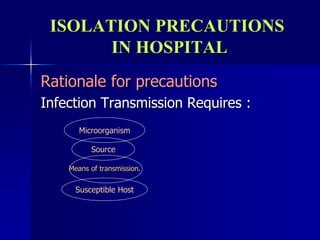
Infection Transmission Requires :
Microorganism
Source
Susceptible Host
Means of transmission.
SOURCE
Patient , personnel , visitors .
Acute cases in incubation .
Colonized Patients .
Endogenous Flora .
Inanimate Environment ( contaminated )
eg; water , food , equipment .
ISOLATION PRECAUTIONS
IN HOSPITALs
HOST
Age
Underlying disease
Treatment :
1 -Antimicrobial.
2 – Corticosteroids.
3 – Immunosuppressive agents.
Weak in first line of defense mechanisms eg;
Surgical operations .
Anesthesia .
Catheters .
ISOLATION PRECAUTIONS
IN HOSPITALS
Transmission
Its main routes :
 Contact a -Direct contacts.
b - Indirect contacts.
c - Droplet transmission ( 3 feet ).
 Common vehicle transmission
Water equipment devices.
 Airborne transmission.
Airborne droplet nuclei ( 5 micrometers or small )
Evaporated droplets or dust particles eg TB , Measles ,
chickenpox.
 Vector borne.
ISOLATION PRECAUTIONS
IN HOSPITALS
 Interruption of transmission of micro-organisms is
directed primarily at transmission.
Disadvantages of isolation.
 Special equipment, environmental modification ,
more cost.
 Patient care may be affected.
 Deprives patient of normal social relationship.
 Disadvantages to be weighed against prevention
values .
Early isolation practices .
ISOLATION PRECAUTIONS
IN HOSPITALS
 1877 Separate facilities.
 1910 Cubical system, separate gown , wash hands, disinfect
objects.
 1950 Infectious disease hospital begin to close.
 1960 T.B Hospitals decreased.
 1970 CDC Isolation manual.
 1983 CDC Guidelines.
1 - Category specific isolation.
Disease specific isolation.
Use guidelines to develop a system .
2- Encourage personnel to make decision on what
precautions to be taken.
3 – Encourage personnel to make decision about the
likelihood of exposure to reduce costs.
ISOLATION PRECAUTIONS
IN HOSPITALS
CATEGORY SPCIFIC ISOLATION
 Strict isolation
 Contact isolation.
 Respiratory isolation
 T.B isolation.
 Enteric precaution
 Drainage , secretion precautions.
 Blood & body fluid precautions.
 Protective isolation.
DISEASE SPECIFIC ISOLATION
ISOLATION PRECAUTIONS
IN HOSPITALS
 Consider epidemiology of each infectious disease.
Highly educated.
To be updated.
 Universal precautions ( 1985 ) :
 Applying blood & body fluid precautions universally
to all people.
 Prevention of needle stick injuries.
 Traditional barriers e.g gloves .
 Eye coverings in certain procedures . Amniotic ,CSF,
semen, & vaginal secretions.
 Not to feces, nasal secretions, sputum, sweat,
&tears.
ISOLATION PRECAUTIONS
IN HOSPITALS
 Body substance isolation ( 1987 ):
 Isolation of all moist &potentially infectious body
substances ( blood, urine, feces, sputum, saliva,
wound drainage, other body fluids regardless of
their presumed infection status ).
 Stop sign alert (( airborne )).
DISADVANTAGES :
 Added costs.
 Overprotection of personnel.
 Difficulty in maintaining routine application.
 Lack of hands washing after gloves removal.
 Droplet infection.
ISOLATION PRECAUTIONS
IN HOSPITALS
New Isolation Guidelines ( 1990 ) :
 Problem of multi-drug resistance T.B.
 Multi-drug resistant of micro organisms.
 New guidelines should :
1- Be epidemiologically sound .
2- Recognize importance of all body secretions.
3- Adequate precautions of airborne, droplets
contact routes.
4- Simple.
5- Use new terms to avoid confusions.
6- In expensive
New Isolation Precautions,
1996
‘’ Standard’’
And
‘’ Transmission – Based Precautions’’
ISOLATION PRECAUTION
IN HOSPITALS
HICPAC Isolation Precautions (1996 )
1 – Standard precautions
a - Blood
b - All body fluids
c - Non intact skin
d - mucous membranes.
( to reduce transmission from organized & unorganized source
of infection.)
2- Transmission based precautions :
( patient documented or suspected to be infectious)
a - Airborne precautions
b - Droplet precautions
c - Contact precautions.
( may be combined for diseases with multiple route of
transmission).
STANDARD PRECAUTIONS
 Consider all patients and their bodily fluids (except sweat) to be
potentially infectious
 Use appropriate barrier precautions when there is a risk of exposure
to blood, body fluids, secretions, excretions, mucous membranes
and non-intact skin.
 Patients with known or suspected infections are NOT to have their
medical records labeled as “infectious”.
 Specimens of patients with known or suspected infections are NOT
to be labeled as “infectious”. All specimens are to be treated in the
same safe manner .
 Used needles and sharps should be disposed of safely ( in puncture
proof sharp boxes ) .
 Needles should NOT be recapped .
 All Health care workers should receive the HBV vaccine .
Transmission-Based
Precautions
. Three categories of
Transmission-based Precautions :
- Contact Precautions .
- Droplet Precautions .
- Airborne Precautions .
AIRBORNE TRANSMISSION
 Airborne spreads upon aerosolization of small
particles (=< 5 micron) of the infectious agent
that can then travel over long distances through
the air .
 Most common nosocomial pathogens transmitted
by this route :
- Mycobacterium tuberculosis .
- Varicella-zoster virus (chickenpox) .
- Measles .
- Smallpox.
- ? SARS .
AIRBORNE
PRECAUTIONS
 Place the patient in a negative pressure
room with at least 6 – 12 air exchanges
per hour .
 Room exhaust must be appropriately
discharged outdoors or passed through a
HEPA ( high – efficiency particulate
aerator ) filter before recirculation within
the hospital .
 The door of the room should be kept
closed .
DROPLET TRANSMISSION
 Respiratory droplets are large particles (>5 micron)
expelled during .
- Coughing .
- Sneezing .
- Talking.
- During procedures such as suctioning and bronchoscope .
 Droplets travel < 1,5 meter from the source patient .
 Example :
• Neisseria meningitides .
• Haemophilus influenza type b ( invasive ) .
• Streptococcus pyogenes (group A Streptococcus) .
• Mycoplasma pneumonia .
DROPLET PRECAUTIONS
 Private room preferred; cohorting allowed
if necessary.
 Special air handling and ventilation are
unnecessary .
 The door of the room may remain open .
 Wear a mask when within 1 meter of the
patient .
 Mask the patient during transport .
DROPLET TRANSMISSION
 Respiratory droplets are large particles (>5 micron)
expelled during .
- Coughing .
- Sneezing .
- Talking.
- During procedures such as suctioning and bronchoscope .
 Droplets travel < 1,5 meter from the source patient .
 Example :
• Neisseria meningitides .
• Haemophilus influenza type b ( invasive ) .
• Streptococcus pyogenes (group A Streptococcus) .
• Mycoplasma pneumonia .
Phlebotomy Handbook: Blood
Collection Essentials, Seventh
Edition
Pearson Education
Copyright 2005
TB Transmission
TRANSMISSIONRequires
1) Pt’s Hands of health care workers .
2) Survive for several minutes .
3) Non or Inadequate hand hygiene .
4) Contaminated Hands Pt’s
ISOLATION PRECAUTION
IN HOSPITALS
 Air borne precautions :
 Dissemination of droplet nuclei .
 Small particle residue of 5 micrometers or less of evaporated
droplets.
 Suspended on the air for long time.
 Dust particles containing the infectious agents.
 Special air handling & ventilation required e.g measles ,
varicella , TB .
 Droplet precautions :
 Large particles droplets
Invasive HI type b.
Invasive N Meningitides.
 Diphtheria , Mycoplasma , sterptococcal infection.
 Viral infections : adenovirus , mumps, rubella .
ISOLATION PRECAUTIONS
IN HOSPITALS
 Contact precautions :
 Patient known or suspected to have serious illness
transmitted by contact.
a - GIT, Respiratory , skin or wound infection with
multi drug resistant bacteria or colonization.
b – Enteric infections : shigella, HIV, E.coli, O157,
117 .
c – Respiratory viruses .
d – Skin infections Diphtheria , Herpes, Cellulitis
Scabies , VHF.
Phlebotomy Handbook: Blood Collection
Essentials, Seventh Edition
Diana Garza • Kathleen Becan-McBride
Pearson Education
Copyright 2005
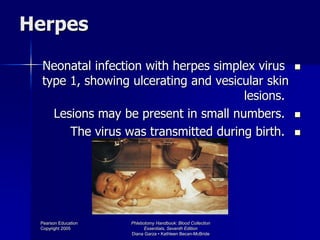
Herpes
Neonatal infection with herpes simplex virus
type 1, showing ulcerating and vesicular skin
lesions.
Lesions may be present in small numbers.
The virus was transmitted during birth.
ISOLATION PRECAUTIONS
IN HOSPITALS
 Additional Emperic Precautions :
Diarrhea Enteric organism contact
Vesicular rash Varicella air borne
Maculopapular rash measles air borne
cough, fever, upper lobe infilterate TB air borne
Risk of multi drug resistant bacteria contact
Abscess draining wound strept, staph contact
FUNDAMENTAL OF ISOLATION PRECAUTIONS
1- Hand washing
After touching blood , body fluid….etc
After removing gloves
Between pt’s contact.
Phlebotomy Handbook: Blood
Collection Essentials, Seventh
Edition
Pearson Education
Copyright 2005
Standard Precautions
Figure 5.9 Rinse Hands in a Downward Motion with Water
ISOLATION PRECAUTIONS
IN HOSPITALS
2- Gloves :
a – for touching blood, body fluid …etc.
b – Mucous membranes .
c – contaminated items
d- a septic procedures .
3 - Patient placing:
a - Private room.
b - Hand wash & other facilities.
c - With appropriate room mate ( cohorting ).
d - Private room with appropriate ventilation e.g T.B.
4- Transport of infected patients :
a – limit movement .
b – Appropriate measure if needed .
Phlebotomy Handbook: Blood
Collection Essentials, Seventh
Edition
Pearson Education
Copyright 2005
Standard Precautions
Figure 5.11 Supplies for Isolation Procedures
Phlebotomy Handbook: Blood Collection
Essentials, Seventh Edition
Diana Garza • Kathleen Becan-McBride
Pearson Education
Copyright 2005
ISOLATION PRECAUTIONS
IN HOSPITALS
c – Notify other departments.
d – Patient education.
5 – Mask respiratory, Eye precautions , Eye shields.
6 – Gowns , boots, shoe covers, leg coverings (
remove gown before leaving). .
7 – Environmental control .
8- linen
9- proper waste disposal ( e.g sharp)
Phlebotomy Handbook: Blood
Collection Essentials, Seventh
Edition
Pearson Education
Copyright 2005
Standard Precautions
4. Face shields
Figure 5.18 Face shields or goggles
may be worn
Phlebotomy Handbook: Blood
Collection Essentials, Seventh
Edition
Pearson Education
Copyright 2005
Standard Precautions
Specific Isolation
Techniques and
Procedural Steps
.2Gowning
Figure 5.13 Gowns should be large
enough to cover all clothing
Phlebotomy Handbook: Blood
Collection Essentials, Seventh
Edition
Pearson Education
Copyright 2005
Standard Precautions
5. Completing the
protection
Figure 5.19 Gloves should be pulled over
the ends of gown sleeves
Precautions Needed for
Cases
 Condition Type Duration
 Pulmonary TB S+A Till sputum Negative
 Chicken Pox S+A Till rash crusted
 M-meningitis S+D 24 Hrs
 HIV S Duration of stay
Clinical Syndromes:
Empiric precautions as per clinical presentation
THANK
YOU
Dr. Satti Mohammed

Isolation precautions

  • 1.
    Dr. Satti M.Saleh Chief of Infectious Diseases Department Medical Director MGH
  • 2.
    ISOLATION PRECAUTIONS IN HOSPITAL Rationalefor precautions Infection Transmission Requires : Microorganism Source Susceptible Host Means of transmission.
  • 3.
    SOURCE Patient , personnel, visitors . Acute cases in incubation . Colonized Patients . Endogenous Flora . Inanimate Environment ( contaminated ) eg; water , food , equipment .
  • 4.
    ISOLATION PRECAUTIONS IN HOSPITALs HOST Age Underlyingdisease Treatment : 1 -Antimicrobial. 2 – Corticosteroids. 3 – Immunosuppressive agents. Weak in first line of defense mechanisms eg; Surgical operations . Anesthesia . Catheters .
  • 5.
    ISOLATION PRECAUTIONS IN HOSPITALS Transmission Itsmain routes :  Contact a -Direct contacts. b - Indirect contacts. c - Droplet transmission ( 3 feet ).  Common vehicle transmission Water equipment devices.  Airborne transmission. Airborne droplet nuclei ( 5 micrometers or small ) Evaporated droplets or dust particles eg TB , Measles , chickenpox.  Vector borne.
  • 6.
    ISOLATION PRECAUTIONS IN HOSPITALS Interruption of transmission of micro-organisms is directed primarily at transmission. Disadvantages of isolation.  Special equipment, environmental modification , more cost.  Patient care may be affected.  Deprives patient of normal social relationship.  Disadvantages to be weighed against prevention values . Early isolation practices .
  • 7.
    ISOLATION PRECAUTIONS IN HOSPITALS 1877 Separate facilities.  1910 Cubical system, separate gown , wash hands, disinfect objects.  1950 Infectious disease hospital begin to close.  1960 T.B Hospitals decreased.  1970 CDC Isolation manual.  1983 CDC Guidelines. 1 - Category specific isolation. Disease specific isolation. Use guidelines to develop a system . 2- Encourage personnel to make decision on what precautions to be taken. 3 – Encourage personnel to make decision about the likelihood of exposure to reduce costs.
  • 8.
    ISOLATION PRECAUTIONS IN HOSPITALS CATEGORYSPCIFIC ISOLATION  Strict isolation  Contact isolation.  Respiratory isolation  T.B isolation.  Enteric precaution  Drainage , secretion precautions.  Blood & body fluid precautions.  Protective isolation. DISEASE SPECIFIC ISOLATION
  • 9.
    ISOLATION PRECAUTIONS IN HOSPITALS Consider epidemiology of each infectious disease. Highly educated. To be updated.  Universal precautions ( 1985 ) :  Applying blood & body fluid precautions universally to all people.  Prevention of needle stick injuries.  Traditional barriers e.g gloves .  Eye coverings in certain procedures . Amniotic ,CSF, semen, & vaginal secretions.  Not to feces, nasal secretions, sputum, sweat, &tears.
  • 10.
    ISOLATION PRECAUTIONS IN HOSPITALS Body substance isolation ( 1987 ):  Isolation of all moist &potentially infectious body substances ( blood, urine, feces, sputum, saliva, wound drainage, other body fluids regardless of their presumed infection status ).  Stop sign alert (( airborne )). DISADVANTAGES :  Added costs.  Overprotection of personnel.  Difficulty in maintaining routine application.  Lack of hands washing after gloves removal.  Droplet infection.
  • 11.
    ISOLATION PRECAUTIONS IN HOSPITALS NewIsolation Guidelines ( 1990 ) :  Problem of multi-drug resistance T.B.  Multi-drug resistant of micro organisms.  New guidelines should : 1- Be epidemiologically sound . 2- Recognize importance of all body secretions. 3- Adequate precautions of airborne, droplets contact routes. 4- Simple. 5- Use new terms to avoid confusions. 6- In expensive
  • 12.
    New Isolation Precautions, 1996 ‘’Standard’’ And ‘’ Transmission – Based Precautions’’
  • 13.
    ISOLATION PRECAUTION IN HOSPITALS HICPACIsolation Precautions (1996 ) 1 – Standard precautions a - Blood b - All body fluids c - Non intact skin d - mucous membranes. ( to reduce transmission from organized & unorganized source of infection.) 2- Transmission based precautions : ( patient documented or suspected to be infectious) a - Airborne precautions b - Droplet precautions c - Contact precautions. ( may be combined for diseases with multiple route of transmission).
  • 14.
    STANDARD PRECAUTIONS  Considerall patients and their bodily fluids (except sweat) to be potentially infectious  Use appropriate barrier precautions when there is a risk of exposure to blood, body fluids, secretions, excretions, mucous membranes and non-intact skin.  Patients with known or suspected infections are NOT to have their medical records labeled as “infectious”.  Specimens of patients with known or suspected infections are NOT to be labeled as “infectious”. All specimens are to be treated in the same safe manner .  Used needles and sharps should be disposed of safely ( in puncture proof sharp boxes ) .  Needles should NOT be recapped .  All Health care workers should receive the HBV vaccine .
  • 15.
    Transmission-Based Precautions . Three categoriesof Transmission-based Precautions : - Contact Precautions . - Droplet Precautions . - Airborne Precautions .
  • 16.
    AIRBORNE TRANSMISSION  Airbornespreads upon aerosolization of small particles (=< 5 micron) of the infectious agent that can then travel over long distances through the air .  Most common nosocomial pathogens transmitted by this route : - Mycobacterium tuberculosis . - Varicella-zoster virus (chickenpox) . - Measles . - Smallpox. - ? SARS .
  • 17.
    AIRBORNE PRECAUTIONS  Place thepatient in a negative pressure room with at least 6 – 12 air exchanges per hour .  Room exhaust must be appropriately discharged outdoors or passed through a HEPA ( high – efficiency particulate aerator ) filter before recirculation within the hospital .  The door of the room should be kept closed .
  • 18.
    DROPLET TRANSMISSION  Respiratorydroplets are large particles (>5 micron) expelled during . - Coughing . - Sneezing . - Talking. - During procedures such as suctioning and bronchoscope .  Droplets travel < 1,5 meter from the source patient .  Example : • Neisseria meningitides . • Haemophilus influenza type b ( invasive ) . • Streptococcus pyogenes (group A Streptococcus) . • Mycoplasma pneumonia .
  • 19.
    DROPLET PRECAUTIONS  Privateroom preferred; cohorting allowed if necessary.  Special air handling and ventilation are unnecessary .  The door of the room may remain open .  Wear a mask when within 1 meter of the patient .  Mask the patient during transport .
  • 20.
    DROPLET TRANSMISSION  Respiratorydroplets are large particles (>5 micron) expelled during . - Coughing . - Sneezing . - Talking. - During procedures such as suctioning and bronchoscope .  Droplets travel < 1,5 meter from the source patient .  Example : • Neisseria meningitides . • Haemophilus influenza type b ( invasive ) . • Streptococcus pyogenes (group A Streptococcus) . • Mycoplasma pneumonia .
  • 21.
    Phlebotomy Handbook: Blood CollectionEssentials, Seventh Edition Pearson Education Copyright 2005 TB Transmission
  • 22.
    TRANSMISSIONRequires 1) Pt’s Handsof health care workers . 2) Survive for several minutes . 3) Non or Inadequate hand hygiene . 4) Contaminated Hands Pt’s
  • 23.
    ISOLATION PRECAUTION IN HOSPITALS Air borne precautions :  Dissemination of droplet nuclei .  Small particle residue of 5 micrometers or less of evaporated droplets.  Suspended on the air for long time.  Dust particles containing the infectious agents.  Special air handling & ventilation required e.g measles , varicella , TB .  Droplet precautions :  Large particles droplets Invasive HI type b. Invasive N Meningitides.  Diphtheria , Mycoplasma , sterptococcal infection.  Viral infections : adenovirus , mumps, rubella .
  • 24.
    ISOLATION PRECAUTIONS IN HOSPITALS Contact precautions :  Patient known or suspected to have serious illness transmitted by contact. a - GIT, Respiratory , skin or wound infection with multi drug resistant bacteria or colonization. b – Enteric infections : shigella, HIV, E.coli, O157, 117 . c – Respiratory viruses . d – Skin infections Diphtheria , Herpes, Cellulitis Scabies , VHF.
  • 25.
    Phlebotomy Handbook: BloodCollection Essentials, Seventh Edition Diana Garza • Kathleen Becan-McBride Pearson Education Copyright 2005 Herpes Neonatal infection with herpes simplex virus type 1, showing ulcerating and vesicular skin lesions. Lesions may be present in small numbers. The virus was transmitted during birth.
  • 26.
    ISOLATION PRECAUTIONS IN HOSPITALS Additional Emperic Precautions : Diarrhea Enteric organism contact Vesicular rash Varicella air borne Maculopapular rash measles air borne cough, fever, upper lobe infilterate TB air borne Risk of multi drug resistant bacteria contact Abscess draining wound strept, staph contact FUNDAMENTAL OF ISOLATION PRECAUTIONS 1- Hand washing After touching blood , body fluid….etc After removing gloves Between pt’s contact.
  • 27.
    Phlebotomy Handbook: Blood CollectionEssentials, Seventh Edition Pearson Education Copyright 2005 Standard Precautions Figure 5.9 Rinse Hands in a Downward Motion with Water
  • 28.
    ISOLATION PRECAUTIONS IN HOSPITALS 2-Gloves : a – for touching blood, body fluid …etc. b – Mucous membranes . c – contaminated items d- a septic procedures . 3 - Patient placing: a - Private room. b - Hand wash & other facilities. c - With appropriate room mate ( cohorting ). d - Private room with appropriate ventilation e.g T.B. 4- Transport of infected patients : a – limit movement . b – Appropriate measure if needed .
  • 29.
    Phlebotomy Handbook: Blood CollectionEssentials, Seventh Edition Pearson Education Copyright 2005 Standard Precautions Figure 5.11 Supplies for Isolation Procedures
  • 30.
    Phlebotomy Handbook: BloodCollection Essentials, Seventh Edition Diana Garza • Kathleen Becan-McBride Pearson Education Copyright 2005
  • 31.
    ISOLATION PRECAUTIONS IN HOSPITALS c– Notify other departments. d – Patient education. 5 – Mask respiratory, Eye precautions , Eye shields. 6 – Gowns , boots, shoe covers, leg coverings ( remove gown before leaving). . 7 – Environmental control . 8- linen 9- proper waste disposal ( e.g sharp)
  • 32.
    Phlebotomy Handbook: Blood CollectionEssentials, Seventh Edition Pearson Education Copyright 2005 Standard Precautions 4. Face shields Figure 5.18 Face shields or goggles may be worn
  • 33.
    Phlebotomy Handbook: Blood CollectionEssentials, Seventh Edition Pearson Education Copyright 2005 Standard Precautions Specific Isolation Techniques and Procedural Steps .2Gowning Figure 5.13 Gowns should be large enough to cover all clothing
  • 34.
    Phlebotomy Handbook: Blood CollectionEssentials, Seventh Edition Pearson Education Copyright 2005 Standard Precautions 5. Completing the protection Figure 5.19 Gloves should be pulled over the ends of gown sleeves
  • 35.
    Precautions Needed for Cases Condition Type Duration  Pulmonary TB S+A Till sputum Negative  Chicken Pox S+A Till rash crusted  M-meningitis S+D 24 Hrs  HIV S Duration of stay Clinical Syndromes: Empiric precautions as per clinical presentation
  • 39.