TYPES OF ISOLATION
Jamilah saad Alqahtani
CNS,MSN,NS,RGN,BSN, OR Specialist
Brain
storming
jamilah saad Alqahtani
2
Isolation
the process or fact of isolating or
being isolated.
Sociology: Social lack of contact
between persons, groups, or whole
societies
Psychology: The failure of an
individual to maintain contact with
others or genuine communication
where interaction with others
persists
• Isolation (health care),
various measures taken
to prevent contagious
diseases from being
spread
jamilah saad Alqahtani
3
OUTLINES
• INTRODUCTRION
• Risk Assessment
• Types of Isolation
• Two TIERS OF PRECAUTIONS
1. Stander Precautions
2. Transmission based precautions
• Standard Requirements of Isolation Room
• Disease requiring contact, Airborne & droplet
precautions
jamilah saad Alqahtani
4
Objectives
• At the end of this lecture student will be able to:
1. Define isolation
2. Understand Rational of isolation
3. Differentiate between the two TIERS of
Precaution
4. Know different types of isolation
5. Know Standard Requirements of Isolation
Room
6. Understand Disease requiring contact,
droplet, airborne precautions
jamilah saad Alqahtani
5
Introduction
• The separation of infected people in order to
prevent the spread of infectious disease is not
new and is mentioned in islam also the same in
bible. The massage was in order to protect
population. It was decided that no one could
inter the city unlit awaiting period of 40 days
had passed.
jamilah saad Alqahtani
6
Cont’
• The advent of the HIV/AID epidemic by the mid
1980s created a panic both amongst the general
public and health care provider. In response, the
term universal precautions for blood and body
fluid was introduced by US CDC for all patients.
This term was ambiguous, leading to universal
confusion in its interpretation. As a result,
inappropriate use of gloves increased
substantially and has contributed to rise in the
incidence of latex allergy amongst HCWs.
jamilah saad Alqahtani
7
CONT’
• The term universal precautions has now
been replaced by standard precautions in the
isolation guidelines and these precautions
should be part of the routine care of all patient.
jamilah saad Alqahtani
8
Risk assessment
• Needed when ever patient considered for isolation
• The disadvantages must weighted against the
benefits
• The placement of patient into isolation should never
be undertaken as matter of convenience.
• Isolation of patients may not only have a
psychological impact on the patient, but
• Putting patient in isolation ward may have adverse
influence the quality of care by distancing the
patient for care specialties .also some patient have
some culture and religious concerns
•
jamilah saad Alqahtani
9
Types of isolation
• Source isolation the aim is to prevent
exogenous infections from infected/colonized
patient to other staff, patients, visitors.
• Protective isolation. The aim is to prevent
transfer of infection from personnel and
inanimate environment to immunosuppressed
patient
jamilah saad Alqahtani
10
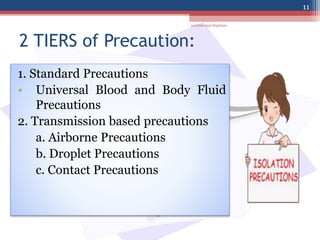
2 TIERS of Precaution:
1. Standard Precautions
• Universal Blood and Body Fluid
Precautions
2. Transmission based precautions
a. Airborne Precautions
b. Droplet Precautions
c. Contact Precautions
jamilah saad Alqahtani
11
The rationale for implementing
standard precautions for the care of
all patients times are:
• Patient may be infectious but show no signs or
symptoms of infection at the time of admission as
s/he may be incubating the infectious disease.
• Patient may be not infectious but show signs or
symptoms of infection as the patient may be an
asymptomatic carrier or colonized with multi
resistant microorganisms.
• Infectious status is often determined by laboratory
test that cannot be completed in time of emergency
• Health care workers should be immunized against
vaccine-preventable diseases both for their own
protection and protection of others
jamilah saad Alqahtani
12
Standard Precautions:
1. Hand washing
2. Gloves
3. Mask, eye protection, face shield
4. Gown
5. Patient care equipment
6. Environmental control
7. Linen
8. Occupational health and blood borne
pathogens
jamilah saad Alqahtani
13
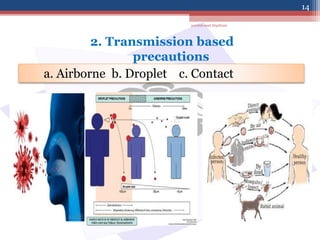
a. Airborne b. Droplet c. Contact
2. Transmission based
precautions
jamilah saad Alqahtani
14
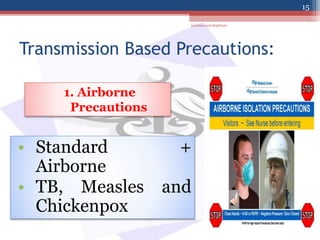
Transmission Based Precautions:
• Standard +
Airborne
• TB, Measles and
Chickenpox
1. Airborne
Precautions
jamilah saad Alqahtani
15
jamilah saad Alqahtani
16
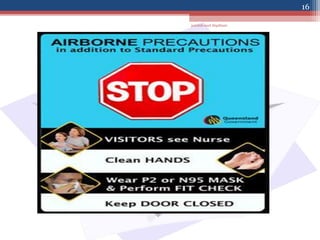
Airborne Precautions:
• Single room
• Negative air pressure
• 6-12 air changes per hour
• Appropriate discharge of air outdoors or
monitored high efficiency filtration of room air
before air is circulated to other areas.
• Keep the room door closed and the patient in
the room.
• No single room, place the patient in a room
with a patient who has active infection with the
same microorganisms.
A. PATIENT PLACEMENT:
jamilah saad Alqahtani
17
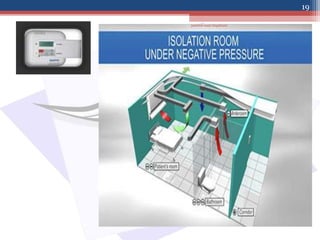
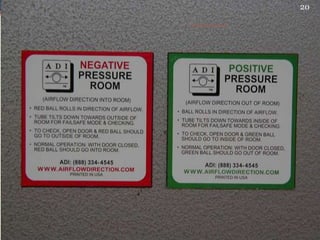
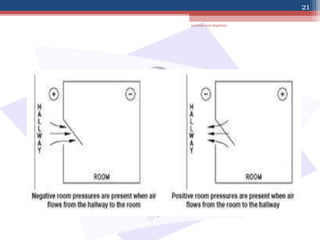
Negative room pressure
• is an isolation technique used in hospitals and
medical centres to prevent CROSS-
CONTAMINATIONS from room to room.[1][2] It
includes a ventilation system that generates
negative pressure to allow air to flow into the
isolation room but not escape from the room, as air
will naturally flow from areas with higher pressure to
areas with lower pressure, thereby preventing
contaminated air from escaping the room. This
technique is used to isolate patients with
airborne contagious diseases such as tuberculosis,
measles, or chickenpox
jamilah saad Alqahtani
18
jamilah saad Alqahtani
19
jamilah saad Alqahtani
20
jamilah saad Alqahtani
21
Airborne Precautions:
• N95 mask
• Susceptible persons should not enter the room
of patients known or suspected to have measles
or varicella (chickenpox)
• If susceptible persons must enter the room of a
patient known or suspected to have measles or
varicella, they should WEAR A MASK.
• Persons immune to MEASLES OR
VARICELLA need not wear a mask.
B. RESPIRATORY PROTECTION
jamilah saad Alqahtani
22
Airborne Precautions:
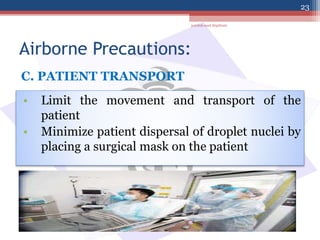
• Limit the movement and transport of the
patient
• Minimize patient dispersal of droplet nuclei by
placing a surgical mask on the patient
C. PATIENT TRANSPORT
jamilah saad Alqahtani
23
Droplet Precautions:
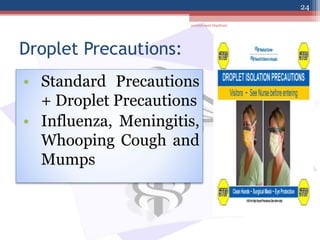
• Standard Precautions
+ Droplet Precautions
• Influenza, Meningitis,
Whooping Cough and
Mumps
jamilah saad Alqahtani
24
Droplet Precautions:
• Place the patient in a SINGLE ROOM
• No single room, place patient in a room
who has active infection with the same
microorganisms
• Maintain spatial separation of at least 3
feet between the infected patient
• Special air handling and ventilation are
not necessary and door may remain
open.
A. PATIENT PLACEMENT
jamilah saad Alqahtani
25
Droplet Precautions:
• Standard Precaution + Mask when working
with three feet of the patient
B. MASK
• Limit the movement and transport of the
patient
• Use mask to patient
C. PATIENT TRANSPORT
jamilah saad Alqahtani
26
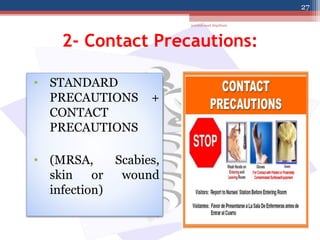
2- Contact Precautions:
• STANDARD
PRECAUTIONS +
CONTACT
PRECAUTIONS
• (MRSA, Scabies,
skin or wound
infection)
jamilah saad Alqahtani
27
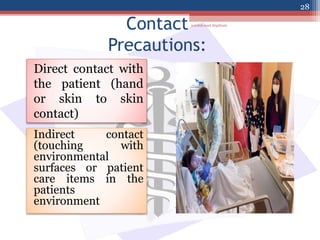
Direct contact with
the patient (hand
or skin to skin
contact)
Indirect contact
(touching with
environmental
surfaces or patient
care items in the
patients
environment
Contact
Precautions:
jamilah saad Alqahtani
28
Contact Precautions:
• Discharge the patient as soon as possible
• Single room
• Corner bed can be used
A. PATIENT PLACEMENT
jamilah saad Alqahtani
29
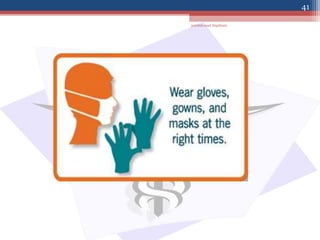
Contact Precautions:
• Standard precautions + wearing gloves
• Change gloves after having contact with
infective material
• Remove gloves before leaving the
patients environment. Wash hands then
antimicrobial agent.
• After glove removal and hand washing,
ensure that hands do not touch
potentially contaminated environmental
surfaces
B. GLOVES and HANDWASHING
jamilah saad Alqahtani
30
Contact Precautions:
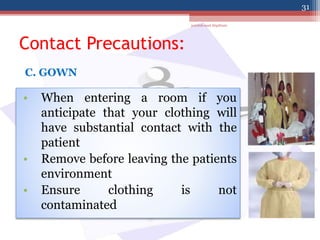
• When entering a room if you
anticipate that your clothing will
have substantial contact with the
patient
• Remove before leaving the patients
environment
• Ensure clothing is not
contaminated
C. GOWN
jamilah saad Alqahtani
31
Contact Precautions:
• Limit movement and transport of the patient
• Ensure precautions are maintained to prevent
transmission
• Put over gown on patient and cover chair with
extra sheet.
• Disinfect chair after use.
D. PATIENT TRANSPORT
jamilah saad Alqahtani
32
Contact Precautions:
• Equipment to a single patient
• Adequately clean and disinfect
before use
• Precautions of spread of MRSA
E. PATIENT CARE EQUIPMENT
jamilah saad Alqahtani
33
Standard Requirements of Isolation
Room:
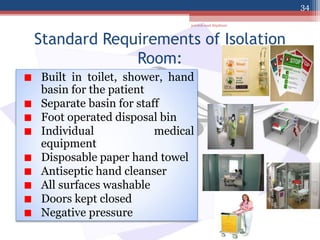
Built in toilet, shower, hand
basin for the patient
Separate basin for staff
Foot operated disposal bin
Individual medical
equipment
Disposable paper hand towel
Antiseptic hand cleanser
All surfaces washable
Doors kept closed
Negative pressure
jamilah saad Alqahtani
34
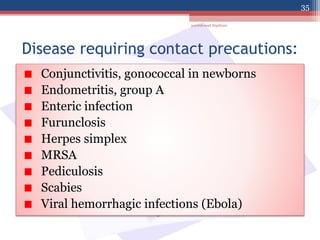
Disease requiring contact precautions:
Conjunctivitis, gonococcal in newborns
Endometritis, group A
Enteric infection
Furunclosis
Herpes simplex
MRSA
Pediculosis
Scabies
Viral hemorrhagic infections (Ebola)
jamilah saad Alqahtani
35
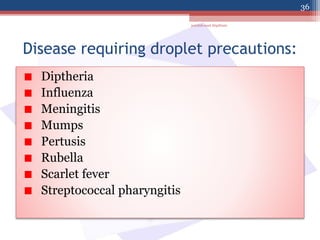
Disease requiring droplet precautions:
Diptheria
Influenza
Meningitis
Mumps
Pertusis
Rubella
Scarlet fever
Streptococcal pharyngitis
jamilah saad Alqahtani
36
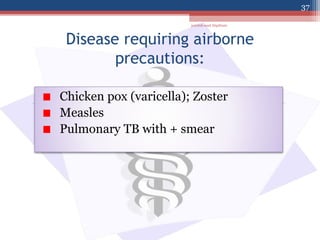
Disease requiring airborne
precautions:
Chicken pox (varicella); Zoster
Measles
Pulmonary TB with + smear
jamilah saad Alqahtani
37
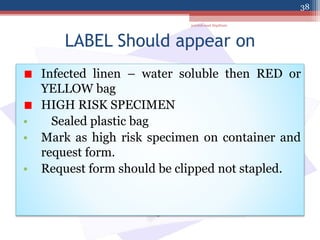
LABEL Should appear on
Infected linen – water soluble then RED or
YELLOW bag
HIGH RISK SPECIMEN
• Sealed plastic bag
• Mark as high risk specimen on container and
request form.
• Request form should be clipped not stapled.
jamilah saad Alqahtani
38
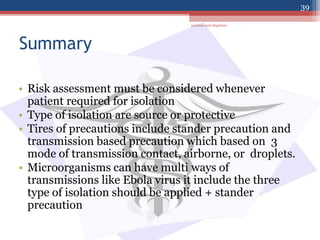
Summary
• Risk assessment must be considered whenever
patient required for isolation
• Type of isolation are source or protective
• Tires of precautions include stander precaution and
transmission based precaution which based on 3
mode of transmission contact, airborne, or droplets.
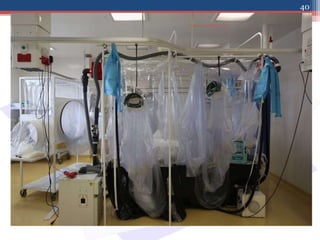
• Microorganisms can have multi ways of
transmissions like Ebola virus it include the three
type of isolation should be applied + stander
precaution
jamilah saad Alqahtani
39
jamilah saad Alqahtani
40
jamilah saad Alqahtani
41
Reference
• Manual of infection prevention and control thrid
edition 2012 by nizam damani OXFORD
• http://www.cdc.gov/
jamilah saad Alqahtani
42
jamilah saad Alqahtani
43

General isolation policy

  • 1.
    TYPES OF ISOLATION Jamilahsaad Alqahtani CNS,MSN,NS,RGN,BSN, OR Specialist
  • 2.
  • 3.
    Isolation the process orfact of isolating or being isolated. Sociology: Social lack of contact between persons, groups, or whole societies Psychology: The failure of an individual to maintain contact with others or genuine communication where interaction with others persists • Isolation (health care), various measures taken to prevent contagious diseases from being spread jamilah saad Alqahtani 3
  • 4.
    OUTLINES • INTRODUCTRION • RiskAssessment • Types of Isolation • Two TIERS OF PRECAUTIONS 1. Stander Precautions 2. Transmission based precautions • Standard Requirements of Isolation Room • Disease requiring contact, Airborne & droplet precautions jamilah saad Alqahtani 4
  • 5.
    Objectives • At theend of this lecture student will be able to: 1. Define isolation 2. Understand Rational of isolation 3. Differentiate between the two TIERS of Precaution 4. Know different types of isolation 5. Know Standard Requirements of Isolation Room 6. Understand Disease requiring contact, droplet, airborne precautions jamilah saad Alqahtani 5
  • 6.
    Introduction • The separationof infected people in order to prevent the spread of infectious disease is not new and is mentioned in islam also the same in bible. The massage was in order to protect population. It was decided that no one could inter the city unlit awaiting period of 40 days had passed. jamilah saad Alqahtani 6
  • 7.
    Cont’ • The adventof the HIV/AID epidemic by the mid 1980s created a panic both amongst the general public and health care provider. In response, the term universal precautions for blood and body fluid was introduced by US CDC for all patients. This term was ambiguous, leading to universal confusion in its interpretation. As a result, inappropriate use of gloves increased substantially and has contributed to rise in the incidence of latex allergy amongst HCWs. jamilah saad Alqahtani 7
  • 8.
    CONT’ • The termuniversal precautions has now been replaced by standard precautions in the isolation guidelines and these precautions should be part of the routine care of all patient. jamilah saad Alqahtani 8
  • 9.
    Risk assessment • Neededwhen ever patient considered for isolation • The disadvantages must weighted against the benefits • The placement of patient into isolation should never be undertaken as matter of convenience. • Isolation of patients may not only have a psychological impact on the patient, but • Putting patient in isolation ward may have adverse influence the quality of care by distancing the patient for care specialties .also some patient have some culture and religious concerns • jamilah saad Alqahtani 9
  • 10.
    Types of isolation •Source isolation the aim is to prevent exogenous infections from infected/colonized patient to other staff, patients, visitors. • Protective isolation. The aim is to prevent transfer of infection from personnel and inanimate environment to immunosuppressed patient jamilah saad Alqahtani 10
  • 11.
    2 TIERS ofPrecaution: 1. Standard Precautions • Universal Blood and Body Fluid Precautions 2. Transmission based precautions a. Airborne Precautions b. Droplet Precautions c. Contact Precautions jamilah saad Alqahtani 11
  • 12.
    The rationale forimplementing standard precautions for the care of all patients times are: • Patient may be infectious but show no signs or symptoms of infection at the time of admission as s/he may be incubating the infectious disease. • Patient may be not infectious but show signs or symptoms of infection as the patient may be an asymptomatic carrier or colonized with multi resistant microorganisms. • Infectious status is often determined by laboratory test that cannot be completed in time of emergency • Health care workers should be immunized against vaccine-preventable diseases both for their own protection and protection of others jamilah saad Alqahtani 12
  • 13.
    Standard Precautions: 1. Handwashing 2. Gloves 3. Mask, eye protection, face shield 4. Gown 5. Patient care equipment 6. Environmental control 7. Linen 8. Occupational health and blood borne pathogens jamilah saad Alqahtani 13
  • 14.
    a. Airborne b.Droplet c. Contact 2. Transmission based precautions jamilah saad Alqahtani 14
  • 15.
    Transmission Based Precautions: •Standard + Airborne • TB, Measles and Chickenpox 1. Airborne Precautions jamilah saad Alqahtani 15
  • 16.
  • 17.
    Airborne Precautions: • Singleroom • Negative air pressure • 6-12 air changes per hour • Appropriate discharge of air outdoors or monitored high efficiency filtration of room air before air is circulated to other areas. • Keep the room door closed and the patient in the room. • No single room, place the patient in a room with a patient who has active infection with the same microorganisms. A. PATIENT PLACEMENT: jamilah saad Alqahtani 17
  • 18.
    Negative room pressure •is an isolation technique used in hospitals and medical centres to prevent CROSS- CONTAMINATIONS from room to room.[1][2] It includes a ventilation system that generates negative pressure to allow air to flow into the isolation room but not escape from the room, as air will naturally flow from areas with higher pressure to areas with lower pressure, thereby preventing contaminated air from escaping the room. This technique is used to isolate patients with airborne contagious diseases such as tuberculosis, measles, or chickenpox jamilah saad Alqahtani 18
  • 19.
  • 20.
  • 21.
  • 22.
    Airborne Precautions: • N95mask • Susceptible persons should not enter the room of patients known or suspected to have measles or varicella (chickenpox) • If susceptible persons must enter the room of a patient known or suspected to have measles or varicella, they should WEAR A MASK. • Persons immune to MEASLES OR VARICELLA need not wear a mask. B. RESPIRATORY PROTECTION jamilah saad Alqahtani 22
  • 23.
    Airborne Precautions: • Limitthe movement and transport of the patient • Minimize patient dispersal of droplet nuclei by placing a surgical mask on the patient C. PATIENT TRANSPORT jamilah saad Alqahtani 23
  • 24.
    Droplet Precautions: • StandardPrecautions + Droplet Precautions • Influenza, Meningitis, Whooping Cough and Mumps jamilah saad Alqahtani 24
  • 25.
    Droplet Precautions: • Placethe patient in a SINGLE ROOM • No single room, place patient in a room who has active infection with the same microorganisms • Maintain spatial separation of at least 3 feet between the infected patient • Special air handling and ventilation are not necessary and door may remain open. A. PATIENT PLACEMENT jamilah saad Alqahtani 25
  • 26.
    Droplet Precautions: • StandardPrecaution + Mask when working with three feet of the patient B. MASK • Limit the movement and transport of the patient • Use mask to patient C. PATIENT TRANSPORT jamilah saad Alqahtani 26
  • 27.
    2- Contact Precautions: •STANDARD PRECAUTIONS + CONTACT PRECAUTIONS • (MRSA, Scabies, skin or wound infection) jamilah saad Alqahtani 27
  • 28.
    Direct contact with thepatient (hand or skin to skin contact) Indirect contact (touching with environmental surfaces or patient care items in the patients environment Contact Precautions: jamilah saad Alqahtani 28
  • 29.
    Contact Precautions: • Dischargethe patient as soon as possible • Single room • Corner bed can be used A. PATIENT PLACEMENT jamilah saad Alqahtani 29
  • 30.
    Contact Precautions: • Standardprecautions + wearing gloves • Change gloves after having contact with infective material • Remove gloves before leaving the patients environment. Wash hands then antimicrobial agent. • After glove removal and hand washing, ensure that hands do not touch potentially contaminated environmental surfaces B. GLOVES and HANDWASHING jamilah saad Alqahtani 30
  • 31.
    Contact Precautions: • Whenentering a room if you anticipate that your clothing will have substantial contact with the patient • Remove before leaving the patients environment • Ensure clothing is not contaminated C. GOWN jamilah saad Alqahtani 31
  • 32.
    Contact Precautions: • Limitmovement and transport of the patient • Ensure precautions are maintained to prevent transmission • Put over gown on patient and cover chair with extra sheet. • Disinfect chair after use. D. PATIENT TRANSPORT jamilah saad Alqahtani 32
  • 33.
    Contact Precautions: • Equipmentto a single patient • Adequately clean and disinfect before use • Precautions of spread of MRSA E. PATIENT CARE EQUIPMENT jamilah saad Alqahtani 33
  • 34.
    Standard Requirements ofIsolation Room: Built in toilet, shower, hand basin for the patient Separate basin for staff Foot operated disposal bin Individual medical equipment Disposable paper hand towel Antiseptic hand cleanser All surfaces washable Doors kept closed Negative pressure jamilah saad Alqahtani 34
  • 35.
    Disease requiring contactprecautions: Conjunctivitis, gonococcal in newborns Endometritis, group A Enteric infection Furunclosis Herpes simplex MRSA Pediculosis Scabies Viral hemorrhagic infections (Ebola) jamilah saad Alqahtani 35
  • 36.
    Disease requiring dropletprecautions: Diptheria Influenza Meningitis Mumps Pertusis Rubella Scarlet fever Streptococcal pharyngitis jamilah saad Alqahtani 36
  • 37.
    Disease requiring airborne precautions: Chickenpox (varicella); Zoster Measles Pulmonary TB with + smear jamilah saad Alqahtani 37
  • 38.
    LABEL Should appearon Infected linen – water soluble then RED or YELLOW bag HIGH RISK SPECIMEN • Sealed plastic bag • Mark as high risk specimen on container and request form. • Request form should be clipped not stapled. jamilah saad Alqahtani 38
  • 39.
    Summary • Risk assessmentmust be considered whenever patient required for isolation • Type of isolation are source or protective • Tires of precautions include stander precaution and transmission based precaution which based on 3 mode of transmission contact, airborne, or droplets. • Microorganisms can have multi ways of transmissions like Ebola virus it include the three type of isolation should be applied + stander precaution jamilah saad Alqahtani 39
  • 40.
  • 41.
  • 42.
    Reference • Manual ofinfection prevention and control thrid edition 2012 by nizam damani OXFORD • http://www.cdc.gov/ jamilah saad Alqahtani 42
  • 43.

Editor's Notes

  • #7 الحديث مروي بألفاظ ، منها : ما رواه البخاري (5776) ومسلم (2224) عَنْ أَنَسِ بْنِ مَالِكٍ رَضِيَ اللَّهُ عَنْهُ عَنْ النَّبِيِّ صَلَّى اللَّهُ عَلَيْهِ وَسَلَّمَ قَال : "َ لا عَدْوَى وَلا طِيَرَةَ وَيُعْجِبُنِي الْفَأْلُ قَالُوا وَمَا الْفَأْلُ قَالَ كَلِمَةٌ طَيِّبَةٌ". ورواه البخاري (5316) عَنْ أَبِي هُرَيْرَةَ رَضِيَ اللَّهُ عَنْهُ عَنْ النَّبِيِّ صَلَّى اللَّهُ عَلَيْهِ وَسَلَّمَ قَالَ : " لا عَدْوَى وَلا طِيَرَةَ وَلا هَامَةَ وَلا صَفَرَ ". وعلى هذا فمعنى قوله صلى الله عليه وسلم : (لا عدوى ) أي أن المرض لا ينتقل من المريض إلى الصحيح بنفسه ، وإنما ينتقل بتقدير الله تعالى ، فمخالطة المريض للصحيح سبب من أسباب انتقال المرض ، ولكن ليس معنى ذلك أنه واقع لا محالة ، بل لا يقع إلا إذا شاء الله ، ولهذا نجد كثيرا ما يخلف المرضى الأصحاء ولا ينتقل إليهم المرض .