Transmission-Based
Precautions
MDRO Management in Long Term Care Facilities Workshop
Louisiana Office of Public Health
Infectious Disease Epidemiology Section
2017
Objectives
By the end of the presentation, attendees will be able to:
• Define contact, droplet and isolation precautions
• Define disinfection
• Define sterilization
This presentation will include a mix of presentation slides and
case studies.
Transmission of Infectious
Agents in Healthcare Settings
Transmission of infectious agents within a healthcare setting
requires three elements: a source of infectious agents, a
susceptible host with a portal of entry receptive to the agent,
and a mode of transmission for the agent.
Sources of
Infectious
Agents
Susceptible
hosts
Mode of
Transmission
Transmission: Direct Contact
• Gastrointestinal, respiratory, skin, and wound infections
• Most agents transmitted by droplets can also be transmitted
by contact
• Transmission through the skin is the third most common mode
of transmission of infection. Penetration through intact skin is
unlikely
• Fecal-Oral
• Excreted by the feces
• Transmitted to the oral portal of entry through contaminated
food, contaminated water, milk, drinks, hands, and flies
• Site of entry: oropharynx for some microorganisms; intestinal
tract for most viruses
Transmission: Droplet
Examples of organisms transmitted through Droplet Transmission:
• Hemophilus influenzae
• Meningococci
• Pneumococcal infections (invasive, resistant)
• Bacterial respiratory infections (Diptheria, Pertussis, pneumonic
plague, pneumonia)
• Viral respiratory infections
• Adenovirus
• Influenza
• Mumps
• Parvovirus
• Any paroxysmal cough
Transmission: Airborne
• Droplet nuclei are droplets of less than 5 in diameter
• Transmission may occur over a long distance
Transmitted by Droplet Nuclei
 Tuberculosis (Infectious)
 Suspects of TB: request sputum smear
 Measles
 Varicella
 Smallpox (hemorrhagic)
Sources of Infectious Material
• Blood
• Internal body fluids
• Genital fluids
• Transplacental
• Secretions
• Excretions
• Mucosal membranes
• Skin, squames
• Tissue
• Bites
Blood, internal fluids
and genital fluids do
contain blood borne
pathogens (HIV,
HBV, HCV, CMV)
Standard Precautions
• Applied to all patients in a healthcare setting
• Treat all patients’ blood or body fluids as if they are infectious
material
• Originated from the Bloodborne Pathogen Standard by OSHA
in 1991
• Group of infection prevention practices that include hand
hygiene and use of gloves, gowns, masks, eye protection, or
face shields depending on anticipated exposure
• Formerly termed “Universal Precautions”
Contact Precautions
• Used for diseases transmitted
by contact with the patient or
the patient’s environment
• Diseases that cause heavy
environmental contamination
require gowns and gloves on
room entry
• Vancomycin-resistant
Enterococci (VRE)
• Methicillin-resistant
Staphylococcus aureus (MRSA)
• Clostridium difficile
• Respiratory Syncytial Virus
(RSV)
Contact Precautions: Patient
Placement
• Single room is preferred
• Patients with the same disease/organism may share a room
• When there is a shortage of rooms, prioritize patient cohorts
by condition that may foster transmission, giving them priority
for single patient room
• Uncontained drainage
• Stool incontinence
• In long term care, Contact Precautions are only needed with
symptomatic, not colonized, patients
Contact Precautions: Personal
Protective Equipment (PPE)
• Wear gown and gloves on room entry
• Change the gown and gloves between patients even if both
patients share a room and/or one or both are on Contact
Precautions
• Use hand hygiene between glove changes
Contact Precautions: Patient
Transport
• Limit patient transport outside the room to medically
necessary purposes
• Inform the receiving department of the Transmission-based
Precaution status of the patient
• Cover or contain potentially infectious body fluids before
transport
• Transporter should discard contaminated PPE before transport
• Don clean PPE to hand the patient at the destination
Contact Precautions: Long-Term
Care Settings
• Patient placement should be handled on a case-by-case basis
• Each facility should make decisions on the basis of infection
risks to other patients in the facility
Example: A patient in a nursing home has had three episodes of loose and
watery stools in a 24 hour period. The facility is setup to where residents
share rooms and a bathroom with roommate. The patient’s roommate is
asymptomatic, but it is noted that one of their neighbors has recently
developed diarrhea too. What should be done?
Answer: Cohort the symptomatic patients into their own room; clean and
disinfect surfaces especially high touch areas; submit stool specimens for
testing; cohort staff that are treating these patients so that the infection is
not spread further.
Contact Precautions:
Environmental Measures
• Clean daily with a focus on high touch areas, e.g. patient
bathrooms and areas close to the patient
• EVS workers should don gown and gloves before room entry
to clean and disinfect the patient’s room
• Use products with a CDIFF inactivation label combined with
adherence to hand hygiene and good laundry practices
• Use of 1:10 bleach solution is recommended
• Bleach may be used as an adjunct to cleaning or as a final wipe
down of frequently touched surfaces
• Processes for room disinfection should be audited, especially
in outbreak scenarios, to ensure compliance
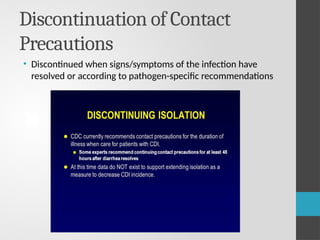
Discontinuation of Contact
Precautions
• Discontinued when signs/symptoms of the infection have
resolved or according to pathogen-specific recommendations
Droplet Precautions
• Prevent transmission of diseases caused by large respiratory
droplets that are generated by coughing, sneezing, or talking
• Examples of diseases transmitted by droplet route:
• Influenza
• Pertussis
• Bacterial meningitis due to Neisseria meningitidis
Droplet Precautions: Patient
Placement
• Single rooms preferred; however, patients with the same
disease may share a room
• Priority should be given to patients with excessive sputum
production when single-patient rooms are in short supply
• Spatially separate patients by at least 6 feet
• Draw privacy curtains between patients
• Avoid placing immunocompromised patients with patients
who are on Droplet Precautions especially if those patients
may have adverse outcomes from infection
Droplet Precautions: PPE and
Patient Transport
• Wear a surgical mask on room entry
• Handle items contaminated with respiratory secretions with
gloves
• Change PPE between patients and perform hand hygiene
• Limit patient transport outside the room to medically
necessary purposes
• If the patient must leave the room, instruct them to wear a
surgical mask and follow respiratory hygiene and cough
etiquette. Patient transporter does not need to wear a surgical
mask.
• Notify the receiving department of the isolation precautions
status.
Droplet Precautions: Long-Term
Care
• Make decisions on patient placement on a case-by-case basis
after considering all options
• All patients should be instructed in the proper use of
respiratory hygiene and cough etiquette
Droplet Precautions: Environmental
Measures and Discontinuation
• Daily cleaning with hospital-approved disinfectant of high-
touch and horizontal surfaces
• Environmental services personnel should don a surgical mask
before room entry
• Discontinue Droplet Precautions after signs and symptoms
have resolved or according to pathogen-specific guidelines
Airborne Precautions
• Used to prevent transmission of infectious organisms that
remain suspended in the air and travel great distances due to
their small size
• Transmission concern is from airflow patterns within the
facility
• Examples
• Measles
• Smallpox
• Chickenpox
• Pulmonary tuberculosis
• Avian influenza
Airborne Precautions:
Environmental Measures
• Routine cleaning of high touch surfaces is standard
• Environmental services should wear an N95 respirator on
room entry
• Room should remain unoccupied for enough time to allow for
complete air exchange to occur (applicable to acute and
ambulatory settings)
Airborne Precautions: Personnel
Restrictions and Discontinuation
• Restrict susceptible HCP from entering rooms of patients
known or suspected to have chickenpox or disseminated
zoster (varicella zoster virus) if other HCP are available
• Immunocompromised and pregnant HCP should also be
restricted from these patients
• Discontinue Airborne Precautions according to pathogen
specific recommendations in the guideline
Other Types of Transmission
• Transmission through skin/mucous membrane
• Blood and tissue exposure:
• skin penetration, mucosal membranes
• Invasive procedures
• Gastrointestinal transmission
• Food/animal host
• Contaminated food product
• Water/natural bacteria or fecal contamination
• Sexual transmission (mucous membrane transmission)
• Perinatal transmission
• Transplacental transmission
• Arthropod-borne transmission
Prevention of Multidrug-
Resistant Organisms
• MDROs are resistant to one or more classes of antimicrobial
agents
• Often resistant to multiple classes of antimicrobial agents and
can remain on environmental surfaces for months
• Control methods for MDROs are based on seven fundamental
elements that include the following:
1. Administrative measures/adherence monitoring
2. MDRO education
3. Judicious use of antimicrobials
4. Surveillance
5. Isolation Precautions
6. Environmental measures
7. Decolonization
MDRO: Administrative
Measures/Adherence Monitoring
• Provide appropriate number of hand-washing sinks and
alcohol gel dispensers
• Maintaining nursing staff levels, having dedicated staff for
patients with MDROs
• Enforcing strict adherence to hand hygiene and Contact
Precautions practices, including cohorting patients with similar
MDROs
• Funding for adequate supplies
MDRO: Education
• Unit-specific education should help facilitate understanding of
MDROs in the facility
• Education should include rates, trends and prevention
strategies
• Create a culture that supports and promotes desired
behaviors, such and hand hygiene and Transmission-based
Precautions and reduction in device usage
• Active communication between facilities when a patient
transfers prevents increased transmission between patients
with facilities
MDRO: Judicious Use of
Antimicrobials
• Evidence-based principles for judicious use of antimicrobials
and tools for implementation are key to controlling MDROs
• Formulary restriction
• Education
• Automatic stop orders
• Antimicrobial cycling
• Prior approval programs
MDRO: Surveillance
• Calculate MDRO incidence (new cases) on the basis of clinical
culture results
• Calculate MDRO infection rates
• Use molecular typing for investigating outbreaks (IDEpi can
help!)
MDRO: Isolation Precautions
• Contact Precautions should be used while the patient is
symptomatic in a long term care facility
• Contact Precautions may reasonably be discontinued after
antimicrobial therapy has ended or the infection has resolved
“3 negative tests” is not an
appropriate protocol for
Clostridium difficile!
MDRO: Environmental
Measures and Decolonization
• There can be a high inoculum of healthcare-associated
pathogens in a cold room with high relative humidity
• Fungi
• Bacteria
• Viruses
• Cleaning and monitoring of adherence to environmental
cleaning practices can determine success in controlling MDROs
• Regimens involving MRSA have sometimes been successful;
however, decolonization regimens are not generally effective
enough to recommend routine use and are not standardized
Inter-facility Transfer
Communication Tool
The Inter-facility Infection Control patient transfer form can
assist in fostering communication during transitions of care. This
tool was developed by the Utah Healthcare-associated Infection
(HAI) working group and shared with Centers for Disease Control
and Prevention (CDC) and state partners. This tool can be
modified and adapted by facilities and other quality
improvement groups engaged in patient safety activities.
Inter-facility Infection Control
Transfer Form: Domains
• Demographics
• Patient’s current infection, colonization, or history of positive
MDRO status
• Patient’s current symptoms and devices
• Patient’s current antibiotic use
• Vaccination history
• Submitter information, date, and contact information
http://www.cdc.gov/hai/pdfs/toolkits/InfectionControlTransfe
rFormExample1.pdf
Education of Employees
• Training related to the cycle of infection and the prevention of
infection
• Explanation of resistant organisms and methods to prevent
transmission, including isolation precautions/techniques
• Training in Standard and Transmission-based Precautions
• Facility policies for sanitation and appropriate linen and trash
handling
• Special emphasis on care of resident’s environment
• Education about the importance of appropriate hand washing
and hand hygiene
Appropriate Disinfection Sterilization
for Common MDROs
Organism Method
Clostridium difficile
(Contact Precautions)
The use of a 10% sodium hypochlorite solution (bleach) mixed
fresh daily (one part household chlorine bleach mixed with nine
parts tap water) has been associated with a reduction in CDI in
some settings.
Tuberculosis
(Airborne Precautions)
Primary environmental controls consist of controlling the source
of infection by using local exhaust ventilation (e.g., hoods, tents,
or booths) and diluting and removing contaminated air by using
general ventilation. Secondary environmental controls consist of
controlling the airflow to prevent contamination of air in areas
adjacent to the source airborne infection isolation (AII) rooms;
and cleaning the air by using high efficiency particulate air (HEPA)
filtration, or ultraviolet germicidal irradiation.
Non-Avian Influenza
(Droplet Precautions)
Standard cleaning and disinfection procedures (e.g., using
cleaners and water to pre-clean surfaces prior to applying
disinfectants to frequently touched surfaces or objects for
indicated contact times) are adequate for influenza virus
environmental control in all settings within the healthcare facility,
including those patient-care areas in which aerosol-generating
procedures are performed.
WOULD YOU RATHER…?
Objective: In teams, choose a person on the following
slide and determine which precautions are necessary
based on their scenario.
Contact
Precautions
Droplet
Precautions
Standard
Precautions
Airborne
Precautions
Would You Rather?
Mildred Arnold Laura
Harold Jenny Doug
Would You Rather?
Mildred
Home
Mildred is a retired educator. After some health
challenges, her family moved her into an assisted living
facility. She generally enjoys group activities and
visiting with her neighbors. Her bridge partner recently
developed diarrheal illness, and a day later she became
ill with loose and watery stools. What should be done?
Answer: They should be placed on Contact Precautions
and excluded from group activities. If their facility does
not have single rooms, they should be cohorted while
they are symptomatic, and staff cohorting should also
be done. Their stool specimens should be submitted
for testing at the facility’s reference laboratory for
identification of the organism.
Would You Rather?
Arnold
Home
Arnold is a retired Navy veteran. He began to feel ill
with fever, chills, and altered mental status at his
nursing facility. He was transferred to the nearest acute
care hospital where he was diagnosed with
Carbapenem-producing Klebsiella pneumoniae. He was
treated with antibiotics and subsequently ordered for
discharge; however, his original facility is refusing to re-
admit him because he has had CRE. What should be
done?
Answer: The infection preventionist at the hospital
should have her medical director call the nursing
facility to explain that the patient has been treated for
the infection and does not pose a threat to other
patients or the staff at the facility. If this doesn’t work,
get IDEpi to assist with communicating to the facility.
Standard Precautions should be used for handling this
patient subsequent to treatment.
Would You Rather?
Laura
Home
Laura is a patient with a known history of Clostridium
difficile. She was placed on antibiotics subsequent to a
urinary tract infection. After being on the medication,
she developed loose and watery stools and was placed
on isolation precautions and treated for her diarrhea.
The stool came back positive for CDIFF toxin A. The
director of nursing is recommending that Laura be
placed on Contact Precautions indefinitely and
separated from other residents. What should be done?
Answer: Explain that Laura is only infectious while she
is symptomatic. Over-isolation can cause depression in
patients. Remove her from Contact Precautions 48
hours after diarrhea has subsided. Review hand
hygiene (soap and water!), environmental cleaning
(1:10 bleach solution), and antibiotic stewardship after
the episode. Laura should be handled with Standard
Precautions while she is asymptomatic.
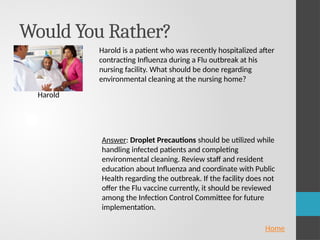
Would You Rather?
Harold
Home
Harold is a patient who was recently hospitalized after
contracting Influenza during a Flu outbreak at his
nursing facility. What should be done regarding
environmental cleaning at the nursing home?
Answer: Droplet Precautions should be utilized while
handling infected patients and completing
environmental cleaning. Review staff and resident
education about Influenza and coordinate with Public
Health regarding the outbreak. If the facility does not
offer the Flu vaccine currently, it should be reviewed
among the Infection Control Committee for future
implementation.
Would You Rather?
Jenny
Home
Jenny became infected with Norovirus and was isolated
from her fellow patients in her long term acute care
hospital. The facility is worried about the potential of
spreading the virus to patients who are uninfected.
What should be done?
Answer: Follow Contact Precautions while handling
Jenny and disposing of her waste. Follow hand hygiene
(soap and water!) and complete staff education about
Norovirus. Cohort one staff person to care for Jenny
during her symptomatic period so that you won’t
spread the infection to other patients. Use EPA-
registered bleach solution when completing
environmental cleaning.
Would You Rather?
Doug
Home
Doug is suspected to have cellulitis. His calf has
become warm to the touch, red/angry, and is beginning
to form a head. He was transferred to an acute care
hospital where he was diagnosed with MRSA. What
should be done?
Answer: Handle Doug with Contact Precautions and
keep the wound (if any) cleaned and covered while
donning PPE and observing hand hygiene. When
transferring him to the acute care hospital, document
that he is suspected of having a skin infection on the
Inter-facility Transfer Tool so that they may place him
on Transmission-Based Precautions upon arrival.
Complete Environmental Cleaning with an EPA-
registered agent.
Resources
• Berends C and Walesa B. Chapter 29 – Isolation precautions
(transmission-based precautions). Association of Infection Control
and Epidemiology Text. 2015.
• Bodily-Bartrum M, Franck J, Spaulding L, and Zeller J. Chapter 61 –
Long-term care. Association of Infection Control and
Epidemiology Text. 2015.
• Centers for Disease Control and Prevention. Infection Control in
Health-Care Settings. Accessed 23 Jan 2017. Available at https://
www.cdc.gov/tb/publications/factsheets/prevention/ichcs.htm.
• Centers for Disease Control and Prevention. Inter-facility infection
control transfer form for states establishing HAI prevention
collaboratives. Accessed 23 Jan 2017. Available at http://
www.cdc.gov/hai/pdfs/toolkits/InfectionControlTransferFormExa
mple1.pdf
.
Contact
Erica Washington, MPH, CPH, CIC, CPHQ
Healthcare-Associated Infections Program Coordinator
Informatics-Training in Place Program (I-TIPP) Fellow
Louisiana Office of Public Health
Infectious Disease Epidemiology Section
1450 Poydras Street, Ste. 1641
New Orleans, LA 70112
Tel: (504) 568-8319 Fax: (504) 568-8290
Thank
you!

Transmission-Based_Precautions_Presentation.pptx

  • 1.
    Transmission-Based Precautions MDRO Management inLong Term Care Facilities Workshop Louisiana Office of Public Health Infectious Disease Epidemiology Section 2017
  • 2.
    Objectives By the endof the presentation, attendees will be able to: • Define contact, droplet and isolation precautions • Define disinfection • Define sterilization This presentation will include a mix of presentation slides and case studies.
  • 3.
    Transmission of Infectious Agentsin Healthcare Settings Transmission of infectious agents within a healthcare setting requires three elements: a source of infectious agents, a susceptible host with a portal of entry receptive to the agent, and a mode of transmission for the agent. Sources of Infectious Agents Susceptible hosts Mode of Transmission
  • 4.
    Transmission: Direct Contact •Gastrointestinal, respiratory, skin, and wound infections • Most agents transmitted by droplets can also be transmitted by contact • Transmission through the skin is the third most common mode of transmission of infection. Penetration through intact skin is unlikely • Fecal-Oral • Excreted by the feces • Transmitted to the oral portal of entry through contaminated food, contaminated water, milk, drinks, hands, and flies • Site of entry: oropharynx for some microorganisms; intestinal tract for most viruses
  • 5.
    Transmission: Droplet Examples oforganisms transmitted through Droplet Transmission: • Hemophilus influenzae • Meningococci • Pneumococcal infections (invasive, resistant) • Bacterial respiratory infections (Diptheria, Pertussis, pneumonic plague, pneumonia) • Viral respiratory infections • Adenovirus • Influenza • Mumps • Parvovirus • Any paroxysmal cough
  • 6.
    Transmission: Airborne • Dropletnuclei are droplets of less than 5 in diameter • Transmission may occur over a long distance Transmitted by Droplet Nuclei  Tuberculosis (Infectious)  Suspects of TB: request sputum smear  Measles  Varicella  Smallpox (hemorrhagic)
  • 7.
    Sources of InfectiousMaterial • Blood • Internal body fluids • Genital fluids • Transplacental • Secretions • Excretions • Mucosal membranes • Skin, squames • Tissue • Bites Blood, internal fluids and genital fluids do contain blood borne pathogens (HIV, HBV, HCV, CMV)
  • 8.
    Standard Precautions • Appliedto all patients in a healthcare setting • Treat all patients’ blood or body fluids as if they are infectious material • Originated from the Bloodborne Pathogen Standard by OSHA in 1991 • Group of infection prevention practices that include hand hygiene and use of gloves, gowns, masks, eye protection, or face shields depending on anticipated exposure • Formerly termed “Universal Precautions”
  • 9.
    Contact Precautions • Usedfor diseases transmitted by contact with the patient or the patient’s environment • Diseases that cause heavy environmental contamination require gowns and gloves on room entry • Vancomycin-resistant Enterococci (VRE) • Methicillin-resistant Staphylococcus aureus (MRSA) • Clostridium difficile • Respiratory Syncytial Virus (RSV)
  • 10.
    Contact Precautions: Patient Placement •Single room is preferred • Patients with the same disease/organism may share a room • When there is a shortage of rooms, prioritize patient cohorts by condition that may foster transmission, giving them priority for single patient room • Uncontained drainage • Stool incontinence • In long term care, Contact Precautions are only needed with symptomatic, not colonized, patients
  • 11.
    Contact Precautions: Personal ProtectiveEquipment (PPE) • Wear gown and gloves on room entry • Change the gown and gloves between patients even if both patients share a room and/or one or both are on Contact Precautions • Use hand hygiene between glove changes
  • 12.
    Contact Precautions: Patient Transport •Limit patient transport outside the room to medically necessary purposes • Inform the receiving department of the Transmission-based Precaution status of the patient • Cover or contain potentially infectious body fluids before transport • Transporter should discard contaminated PPE before transport • Don clean PPE to hand the patient at the destination
  • 13.
    Contact Precautions: Long-Term CareSettings • Patient placement should be handled on a case-by-case basis • Each facility should make decisions on the basis of infection risks to other patients in the facility Example: A patient in a nursing home has had three episodes of loose and watery stools in a 24 hour period. The facility is setup to where residents share rooms and a bathroom with roommate. The patient’s roommate is asymptomatic, but it is noted that one of their neighbors has recently developed diarrhea too. What should be done? Answer: Cohort the symptomatic patients into their own room; clean and disinfect surfaces especially high touch areas; submit stool specimens for testing; cohort staff that are treating these patients so that the infection is not spread further.
  • 14.
    Contact Precautions: Environmental Measures •Clean daily with a focus on high touch areas, e.g. patient bathrooms and areas close to the patient • EVS workers should don gown and gloves before room entry to clean and disinfect the patient’s room • Use products with a CDIFF inactivation label combined with adherence to hand hygiene and good laundry practices • Use of 1:10 bleach solution is recommended • Bleach may be used as an adjunct to cleaning or as a final wipe down of frequently touched surfaces • Processes for room disinfection should be audited, especially in outbreak scenarios, to ensure compliance
  • 15.
    Discontinuation of Contact Precautions •Discontinued when signs/symptoms of the infection have resolved or according to pathogen-specific recommendations
  • 16.
    Droplet Precautions • Preventtransmission of diseases caused by large respiratory droplets that are generated by coughing, sneezing, or talking • Examples of diseases transmitted by droplet route: • Influenza • Pertussis • Bacterial meningitis due to Neisseria meningitidis
  • 17.
    Droplet Precautions: Patient Placement •Single rooms preferred; however, patients with the same disease may share a room • Priority should be given to patients with excessive sputum production when single-patient rooms are in short supply • Spatially separate patients by at least 6 feet • Draw privacy curtains between patients • Avoid placing immunocompromised patients with patients who are on Droplet Precautions especially if those patients may have adverse outcomes from infection
  • 18.
    Droplet Precautions: PPEand Patient Transport • Wear a surgical mask on room entry • Handle items contaminated with respiratory secretions with gloves • Change PPE between patients and perform hand hygiene • Limit patient transport outside the room to medically necessary purposes • If the patient must leave the room, instruct them to wear a surgical mask and follow respiratory hygiene and cough etiquette. Patient transporter does not need to wear a surgical mask. • Notify the receiving department of the isolation precautions status.
  • 19.
    Droplet Precautions: Long-Term Care •Make decisions on patient placement on a case-by-case basis after considering all options • All patients should be instructed in the proper use of respiratory hygiene and cough etiquette
  • 20.
    Droplet Precautions: Environmental Measuresand Discontinuation • Daily cleaning with hospital-approved disinfectant of high- touch and horizontal surfaces • Environmental services personnel should don a surgical mask before room entry • Discontinue Droplet Precautions after signs and symptoms have resolved or according to pathogen-specific guidelines
  • 21.
    Airborne Precautions • Usedto prevent transmission of infectious organisms that remain suspended in the air and travel great distances due to their small size • Transmission concern is from airflow patterns within the facility • Examples • Measles • Smallpox • Chickenpox • Pulmonary tuberculosis • Avian influenza
  • 22.
    Airborne Precautions: Environmental Measures •Routine cleaning of high touch surfaces is standard • Environmental services should wear an N95 respirator on room entry • Room should remain unoccupied for enough time to allow for complete air exchange to occur (applicable to acute and ambulatory settings)
  • 23.
    Airborne Precautions: Personnel Restrictionsand Discontinuation • Restrict susceptible HCP from entering rooms of patients known or suspected to have chickenpox or disseminated zoster (varicella zoster virus) if other HCP are available • Immunocompromised and pregnant HCP should also be restricted from these patients • Discontinue Airborne Precautions according to pathogen specific recommendations in the guideline
  • 24.
    Other Types ofTransmission • Transmission through skin/mucous membrane • Blood and tissue exposure: • skin penetration, mucosal membranes • Invasive procedures • Gastrointestinal transmission • Food/animal host • Contaminated food product • Water/natural bacteria or fecal contamination • Sexual transmission (mucous membrane transmission) • Perinatal transmission • Transplacental transmission • Arthropod-borne transmission
  • 25.
    Prevention of Multidrug- ResistantOrganisms • MDROs are resistant to one or more classes of antimicrobial agents • Often resistant to multiple classes of antimicrobial agents and can remain on environmental surfaces for months • Control methods for MDROs are based on seven fundamental elements that include the following: 1. Administrative measures/adherence monitoring 2. MDRO education 3. Judicious use of antimicrobials 4. Surveillance 5. Isolation Precautions 6. Environmental measures 7. Decolonization
  • 26.
    MDRO: Administrative Measures/Adherence Monitoring •Provide appropriate number of hand-washing sinks and alcohol gel dispensers • Maintaining nursing staff levels, having dedicated staff for patients with MDROs • Enforcing strict adherence to hand hygiene and Contact Precautions practices, including cohorting patients with similar MDROs • Funding for adequate supplies
  • 27.
    MDRO: Education • Unit-specificeducation should help facilitate understanding of MDROs in the facility • Education should include rates, trends and prevention strategies • Create a culture that supports and promotes desired behaviors, such and hand hygiene and Transmission-based Precautions and reduction in device usage • Active communication between facilities when a patient transfers prevents increased transmission between patients with facilities
  • 28.
    MDRO: Judicious Useof Antimicrobials • Evidence-based principles for judicious use of antimicrobials and tools for implementation are key to controlling MDROs • Formulary restriction • Education • Automatic stop orders • Antimicrobial cycling • Prior approval programs
  • 29.
    MDRO: Surveillance • CalculateMDRO incidence (new cases) on the basis of clinical culture results • Calculate MDRO infection rates • Use molecular typing for investigating outbreaks (IDEpi can help!)
  • 30.
    MDRO: Isolation Precautions •Contact Precautions should be used while the patient is symptomatic in a long term care facility • Contact Precautions may reasonably be discontinued after antimicrobial therapy has ended or the infection has resolved “3 negative tests” is not an appropriate protocol for Clostridium difficile!
  • 31.
    MDRO: Environmental Measures andDecolonization • There can be a high inoculum of healthcare-associated pathogens in a cold room with high relative humidity • Fungi • Bacteria • Viruses • Cleaning and monitoring of adherence to environmental cleaning practices can determine success in controlling MDROs • Regimens involving MRSA have sometimes been successful; however, decolonization regimens are not generally effective enough to recommend routine use and are not standardized
  • 32.
    Inter-facility Transfer Communication Tool TheInter-facility Infection Control patient transfer form can assist in fostering communication during transitions of care. This tool was developed by the Utah Healthcare-associated Infection (HAI) working group and shared with Centers for Disease Control and Prevention (CDC) and state partners. This tool can be modified and adapted by facilities and other quality improvement groups engaged in patient safety activities.
  • 33.
    Inter-facility Infection Control TransferForm: Domains • Demographics • Patient’s current infection, colonization, or history of positive MDRO status • Patient’s current symptoms and devices • Patient’s current antibiotic use • Vaccination history • Submitter information, date, and contact information http://www.cdc.gov/hai/pdfs/toolkits/InfectionControlTransfe rFormExample1.pdf
  • 34.
    Education of Employees •Training related to the cycle of infection and the prevention of infection • Explanation of resistant organisms and methods to prevent transmission, including isolation precautions/techniques • Training in Standard and Transmission-based Precautions • Facility policies for sanitation and appropriate linen and trash handling • Special emphasis on care of resident’s environment • Education about the importance of appropriate hand washing and hand hygiene
  • 35.
    Appropriate Disinfection Sterilization forCommon MDROs Organism Method Clostridium difficile (Contact Precautions) The use of a 10% sodium hypochlorite solution (bleach) mixed fresh daily (one part household chlorine bleach mixed with nine parts tap water) has been associated with a reduction in CDI in some settings. Tuberculosis (Airborne Precautions) Primary environmental controls consist of controlling the source of infection by using local exhaust ventilation (e.g., hoods, tents, or booths) and diluting and removing contaminated air by using general ventilation. Secondary environmental controls consist of controlling the airflow to prevent contamination of air in areas adjacent to the source airborne infection isolation (AII) rooms; and cleaning the air by using high efficiency particulate air (HEPA) filtration, or ultraviolet germicidal irradiation. Non-Avian Influenza (Droplet Precautions) Standard cleaning and disinfection procedures (e.g., using cleaners and water to pre-clean surfaces prior to applying disinfectants to frequently touched surfaces or objects for indicated contact times) are adequate for influenza virus environmental control in all settings within the healthcare facility, including those patient-care areas in which aerosol-generating procedures are performed.
  • 36.
    WOULD YOU RATHER…? Objective:In teams, choose a person on the following slide and determine which precautions are necessary based on their scenario. Contact Precautions Droplet Precautions Standard Precautions Airborne Precautions
  • 37.
    Would You Rather? MildredArnold Laura Harold Jenny Doug
  • 38.
    Would You Rather? Mildred Home Mildredis a retired educator. After some health challenges, her family moved her into an assisted living facility. She generally enjoys group activities and visiting with her neighbors. Her bridge partner recently developed diarrheal illness, and a day later she became ill with loose and watery stools. What should be done? Answer: They should be placed on Contact Precautions and excluded from group activities. If their facility does not have single rooms, they should be cohorted while they are symptomatic, and staff cohorting should also be done. Their stool specimens should be submitted for testing at the facility’s reference laboratory for identification of the organism.
  • 39.
    Would You Rather? Arnold Home Arnoldis a retired Navy veteran. He began to feel ill with fever, chills, and altered mental status at his nursing facility. He was transferred to the nearest acute care hospital where he was diagnosed with Carbapenem-producing Klebsiella pneumoniae. He was treated with antibiotics and subsequently ordered for discharge; however, his original facility is refusing to re- admit him because he has had CRE. What should be done? Answer: The infection preventionist at the hospital should have her medical director call the nursing facility to explain that the patient has been treated for the infection and does not pose a threat to other patients or the staff at the facility. If this doesn’t work, get IDEpi to assist with communicating to the facility. Standard Precautions should be used for handling this patient subsequent to treatment.
  • 40.
    Would You Rather? Laura Home Laurais a patient with a known history of Clostridium difficile. She was placed on antibiotics subsequent to a urinary tract infection. After being on the medication, she developed loose and watery stools and was placed on isolation precautions and treated for her diarrhea. The stool came back positive for CDIFF toxin A. The director of nursing is recommending that Laura be placed on Contact Precautions indefinitely and separated from other residents. What should be done? Answer: Explain that Laura is only infectious while she is symptomatic. Over-isolation can cause depression in patients. Remove her from Contact Precautions 48 hours after diarrhea has subsided. Review hand hygiene (soap and water!), environmental cleaning (1:10 bleach solution), and antibiotic stewardship after the episode. Laura should be handled with Standard Precautions while she is asymptomatic.
  • 41.
    Would You Rather? Harold Home Haroldis a patient who was recently hospitalized after contracting Influenza during a Flu outbreak at his nursing facility. What should be done regarding environmental cleaning at the nursing home? Answer: Droplet Precautions should be utilized while handling infected patients and completing environmental cleaning. Review staff and resident education about Influenza and coordinate with Public Health regarding the outbreak. If the facility does not offer the Flu vaccine currently, it should be reviewed among the Infection Control Committee for future implementation.
  • 42.
    Would You Rather? Jenny Home Jennybecame infected with Norovirus and was isolated from her fellow patients in her long term acute care hospital. The facility is worried about the potential of spreading the virus to patients who are uninfected. What should be done? Answer: Follow Contact Precautions while handling Jenny and disposing of her waste. Follow hand hygiene (soap and water!) and complete staff education about Norovirus. Cohort one staff person to care for Jenny during her symptomatic period so that you won’t spread the infection to other patients. Use EPA- registered bleach solution when completing environmental cleaning.
  • 43.
    Would You Rather? Doug Home Dougis suspected to have cellulitis. His calf has become warm to the touch, red/angry, and is beginning to form a head. He was transferred to an acute care hospital where he was diagnosed with MRSA. What should be done? Answer: Handle Doug with Contact Precautions and keep the wound (if any) cleaned and covered while donning PPE and observing hand hygiene. When transferring him to the acute care hospital, document that he is suspected of having a skin infection on the Inter-facility Transfer Tool so that they may place him on Transmission-Based Precautions upon arrival. Complete Environmental Cleaning with an EPA- registered agent.
  • 44.
    Resources • Berends Cand Walesa B. Chapter 29 – Isolation precautions (transmission-based precautions). Association of Infection Control and Epidemiology Text. 2015. • Bodily-Bartrum M, Franck J, Spaulding L, and Zeller J. Chapter 61 – Long-term care. Association of Infection Control and Epidemiology Text. 2015. • Centers for Disease Control and Prevention. Infection Control in Health-Care Settings. Accessed 23 Jan 2017. Available at https:// www.cdc.gov/tb/publications/factsheets/prevention/ichcs.htm. • Centers for Disease Control and Prevention. Inter-facility infection control transfer form for states establishing HAI prevention collaboratives. Accessed 23 Jan 2017. Available at http:// www.cdc.gov/hai/pdfs/toolkits/InfectionControlTransferFormExa mple1.pdf .
  • 45.
    Contact Erica Washington, MPH,CPH, CIC, CPHQ Healthcare-Associated Infections Program Coordinator Informatics-Training in Place Program (I-TIPP) Fellow Louisiana Office of Public Health Infectious Disease Epidemiology Section 1450 Poydras Street, Ste. 1641 New Orleans, LA 70112 Tel: (504) 568-8319 Fax: (504) 568-8290 Thank you!