Ross Ibabao
KJO Hospital
IC Coordinator
Learning Objectives
 Discuss chain of infection and different types of
mode of transmission
 Define isolation precautions and describe
different types isolation precautions.
 Describe contact precautions and conditions
under which to use contact precautions.
 Describe conditions under which to use droplet
precautions.
 Describe conditions under which to use airborne
precautions.
2
Chain of infection
3
Mode of transmission
 A microorganism may be spread by a single or
multiple routes.
 Contact, direct or indirect
 Droplet
 Airborne
 Vector-borne (usually arthropod) and
 Common environmental sources or vehicles -
includes food-borne and waterborne, medications
e.g., contaminated IV fluids
4
Contact Transmission
 Direct-contact
 Direct body surface-to-body surface contact and
 Physical transfer of microorganisms between a
susceptible host and an infected or colonized person
 Indirect-contact
 Contact of a susceptible host with a contaminated
intermediate object, usually inanimate, such as
contaminated instruments, needles, or dressings, or
contaminated hands or gloves
5
Droplet Transmission
 Droplet generation
 coughing,
 sneezing,
 talking,
 procedures such as suctioning and
bronchoscopy
 Droplet deposited on the host’s conjunctivae,
nasal mucosa, or mouth.
6
Airborne Transmission
 Small-particle residue {5µm or smaller} of
evaporated droplets containing microorganisms
 Suspended in the air for long periods of time
 Dispersed by air currents
 Inhaled by a susceptible host within the same
room or over a longer distance
7
Definition of Isolation Precautions
Source: Mosby's Medical Dictionary, 8th edition. © 2009, Elsevier.
 Special precautionary measures, practices, and
procedures used in the care of patients with
contagious or communicable diseases
8
Fundamentals of Isolation
Precautions
 Handwashing and gloving
 Personal protective equipment's:
 Masks, respiratory protection, eye protection, face shields, gowns
and protective apparel
 Patient-care equipment and articles
 Linen and laundry
 Routine and terminal cleaning
 Patient placement
 Transport of infected patients
9
10
Isolation
Precautions
Patient
Transport
Linen & laundry
Patient care equipment
And articles
Routine and
Terminal
Cleaning
PPE
Hand hygiene
Patient
placement
Isolation Precautions
Types of Isolation Precautions
 Standard Precautions
 Transmission-based precautions
 Contact precautions
 Airborne precautions
 Droplet precautions
11
TRANSMISSION-BASED PRECAUTIONS
Patient Placement
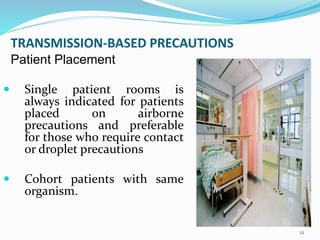
 Single patient rooms is
always indicated for patients
placed on airborne
precautions and preferable
for those who require contact
or droplet precautions
 Cohort patients with same
organism.
12
TRANSMISSION-BASED
PRECAUTIONS
Management of Visitors
 Visitors as sources of healthcare associated infections
– e.g., pertussis, influenza, tuberculosis
 Cough etiquette
 Isolation Logbook
 Use of barrier precautions by visitors
 Educate patients and family members
 Follow signs for isolation precautions
13
TRANSMISSION-BASED PRECAUTIONS
Contact Precautions
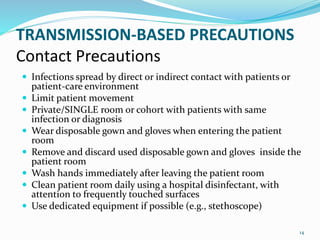
 Infections spread by direct or indirect contact with patients or
patient-care environment
 Limit patient movement
 Private/SINGLE room or cohort with patients with same
infection or diagnosis
 Wear disposable gown and gloves when entering the patient
room
 Remove and discard used disposable gown and gloves inside the
patient room
 Wash hands immediately after leaving the patient room
 Clean patient room daily using a hospital disinfectant, with
attention to frequently touched surfaces
 Use dedicated equipment if possible (e.g., stethoscope)
14
Contact Precautions cont.
GLOVES
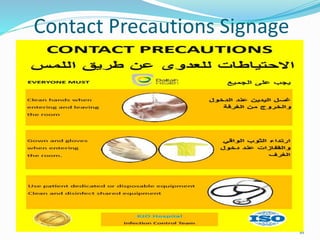
 Use gloves when entering the room.
 Change gloves after contact with infective material.
 Remove gloves before leaving the room.
 Wash hands or use appropriate gel after glove removal.
 Do not touch infective material or surfaces with hands.
 Clean, non-sterile gloves are usually adequate.
GOWN
 Use protective gown when entering the room if
 direct contact with patient or
 potentially contaminated surfaces or
 equipment near patient is anticipated or
 if the patient has diarrhea or
 colostomy or wound drainage that is not covered by a dressing.
15
Contact Precautions Signage
16
Droplet Precautions
Reduce the risk of transmission by large particle
droplets (larger than 5 m in size).
Requires close contact between the source person
and the recipient
Droplets usually travel 3 feet or less
17
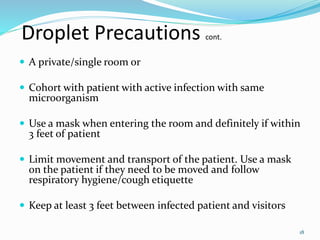
Droplet Precautions cont.
 A private/single room or
 Cohort with patient with active infection with same
microorganism
 Use a mask when entering the room and definitely if within
3 feet of patient
 Limit movement and transport of the patient. Use a mask
on the patient if they need to be moved and follow
respiratory hygiene/cough etiquette
 Keep at least 3 feet between infected patient and visitors
18
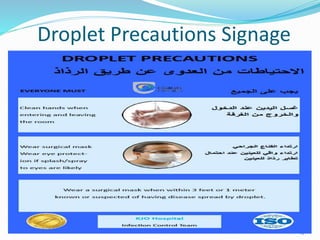
Droplet Precautions Signage
19
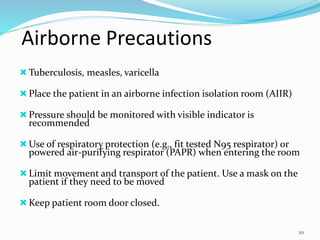
Airborne Precautions
Tuberculosis, measles, varicella
Place the patient in an airborne infection isolation room (AIIR)
Pressure should be monitored with visible indicator is
recommended
Use of respiratory protection (e.g., fit tested N95 respirator) or
powered air-purifying respirator (PAPR) when entering the room
Limit movement and transport of the patient. Use a mask on the
patient if they need to be moved
Keep patient room door closed.
20
Airborne Precautions Signage
21
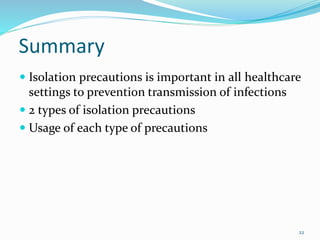
Summary
 Isolation precautions is important in all healthcare
settings to prevention transmission of infections
 2 types of isolation precautions
 Usage of each type of precautions
22
References
 2007 Guideline for isolation precautions: preventing
transmission of infectious agents in healthcare settings:
http://www.cdc.gov/hicpac/2007IP/2007isolationPrecautio
ns.html
 CDC guidelines for isolation precautions in hospitals 1996,
Hospital Infection Control Practices Advisory Committee
(HICPAC):
http://wonder.cdc.gov/wonder/prevguid/p0000419/p0000
419.asp
 Principles of Epidemiology in public health practice, 3rd
edition
23

Isolation Precaution

  • 1.
  • 2.
    Learning Objectives  Discusschain of infection and different types of mode of transmission  Define isolation precautions and describe different types isolation precautions.  Describe contact precautions and conditions under which to use contact precautions.  Describe conditions under which to use droplet precautions.  Describe conditions under which to use airborne precautions. 2
  • 3.
  • 4.
    Mode of transmission A microorganism may be spread by a single or multiple routes.  Contact, direct or indirect  Droplet  Airborne  Vector-borne (usually arthropod) and  Common environmental sources or vehicles - includes food-borne and waterborne, medications e.g., contaminated IV fluids 4
  • 5.
    Contact Transmission  Direct-contact Direct body surface-to-body surface contact and  Physical transfer of microorganisms between a susceptible host and an infected or colonized person  Indirect-contact  Contact of a susceptible host with a contaminated intermediate object, usually inanimate, such as contaminated instruments, needles, or dressings, or contaminated hands or gloves 5
  • 6.
    Droplet Transmission  Dropletgeneration  coughing,  sneezing,  talking,  procedures such as suctioning and bronchoscopy  Droplet deposited on the host’s conjunctivae, nasal mucosa, or mouth. 6
  • 7.
    Airborne Transmission  Small-particleresidue {5µm or smaller} of evaporated droplets containing microorganisms  Suspended in the air for long periods of time  Dispersed by air currents  Inhaled by a susceptible host within the same room or over a longer distance 7
  • 8.
    Definition of IsolationPrecautions Source: Mosby's Medical Dictionary, 8th edition. © 2009, Elsevier.  Special precautionary measures, practices, and procedures used in the care of patients with contagious or communicable diseases 8
  • 9.
    Fundamentals of Isolation Precautions Handwashing and gloving  Personal protective equipment's:  Masks, respiratory protection, eye protection, face shields, gowns and protective apparel  Patient-care equipment and articles  Linen and laundry  Routine and terminal cleaning  Patient placement  Transport of infected patients 9
  • 10.
    10 Isolation Precautions Patient Transport Linen & laundry Patientcare equipment And articles Routine and Terminal Cleaning PPE Hand hygiene Patient placement Isolation Precautions
  • 11.
    Types of IsolationPrecautions  Standard Precautions  Transmission-based precautions  Contact precautions  Airborne precautions  Droplet precautions 11
  • 12.
    TRANSMISSION-BASED PRECAUTIONS Patient Placement Single patient rooms is always indicated for patients placed on airborne precautions and preferable for those who require contact or droplet precautions  Cohort patients with same organism. 12
  • 13.
    TRANSMISSION-BASED PRECAUTIONS Management of Visitors Visitors as sources of healthcare associated infections – e.g., pertussis, influenza, tuberculosis  Cough etiquette  Isolation Logbook  Use of barrier precautions by visitors  Educate patients and family members  Follow signs for isolation precautions 13
  • 14.
    TRANSMISSION-BASED PRECAUTIONS Contact Precautions Infections spread by direct or indirect contact with patients or patient-care environment  Limit patient movement  Private/SINGLE room or cohort with patients with same infection or diagnosis  Wear disposable gown and gloves when entering the patient room  Remove and discard used disposable gown and gloves inside the patient room  Wash hands immediately after leaving the patient room  Clean patient room daily using a hospital disinfectant, with attention to frequently touched surfaces  Use dedicated equipment if possible (e.g., stethoscope) 14
  • 15.
    Contact Precautions cont. GLOVES Use gloves when entering the room.  Change gloves after contact with infective material.  Remove gloves before leaving the room.  Wash hands or use appropriate gel after glove removal.  Do not touch infective material or surfaces with hands.  Clean, non-sterile gloves are usually adequate. GOWN  Use protective gown when entering the room if  direct contact with patient or  potentially contaminated surfaces or  equipment near patient is anticipated or  if the patient has diarrhea or  colostomy or wound drainage that is not covered by a dressing. 15
  • 16.
  • 17.
    Droplet Precautions Reduce therisk of transmission by large particle droplets (larger than 5 m in size). Requires close contact between the source person and the recipient Droplets usually travel 3 feet or less 17
  • 18.
    Droplet Precautions cont. A private/single room or  Cohort with patient with active infection with same microorganism  Use a mask when entering the room and definitely if within 3 feet of patient  Limit movement and transport of the patient. Use a mask on the patient if they need to be moved and follow respiratory hygiene/cough etiquette  Keep at least 3 feet between infected patient and visitors 18
  • 19.
  • 20.
    Airborne Precautions Tuberculosis, measles,varicella Place the patient in an airborne infection isolation room (AIIR) Pressure should be monitored with visible indicator is recommended Use of respiratory protection (e.g., fit tested N95 respirator) or powered air-purifying respirator (PAPR) when entering the room Limit movement and transport of the patient. Use a mask on the patient if they need to be moved Keep patient room door closed. 20
  • 21.
  • 22.
    Summary  Isolation precautionsis important in all healthcare settings to prevention transmission of infections  2 types of isolation precautions  Usage of each type of precautions 22
  • 23.
    References  2007 Guidelinefor isolation precautions: preventing transmission of infectious agents in healthcare settings: http://www.cdc.gov/hicpac/2007IP/2007isolationPrecautio ns.html  CDC guidelines for isolation precautions in hospitals 1996, Hospital Infection Control Practices Advisory Committee (HICPAC): http://wonder.cdc.gov/wonder/prevguid/p0000419/p0000 419.asp  Principles of Epidemiology in public health practice, 3rd edition 23