1
“Isolation is the separation of a patient from contact with
others in order to control the spread of an infectious or
communicable disease.”
Need Of Isolation
 Isolation aimed controlling and preventing the spread of
infection.
 Isolation precautions are designed(like-rooms/wards) to
minimize the transmission of infection in the hospital by
using updated and skilled technology.
 Isolation helps to protect patients, family members,
visitors and health care workers from the spread of
infection. 2
3
TYPES OF ISOLATION
 Some signs are used to identify types of isolation
 some hospital signs are disease specific and some are
category specific.
 The sign is removed when isolation is no longer
required.
 A checklist is also placed on the door. This list indicates
whether masks , gowns, gloves etc… are required for
persons entering the room. Any other pertinent
information is also on this sign.
4
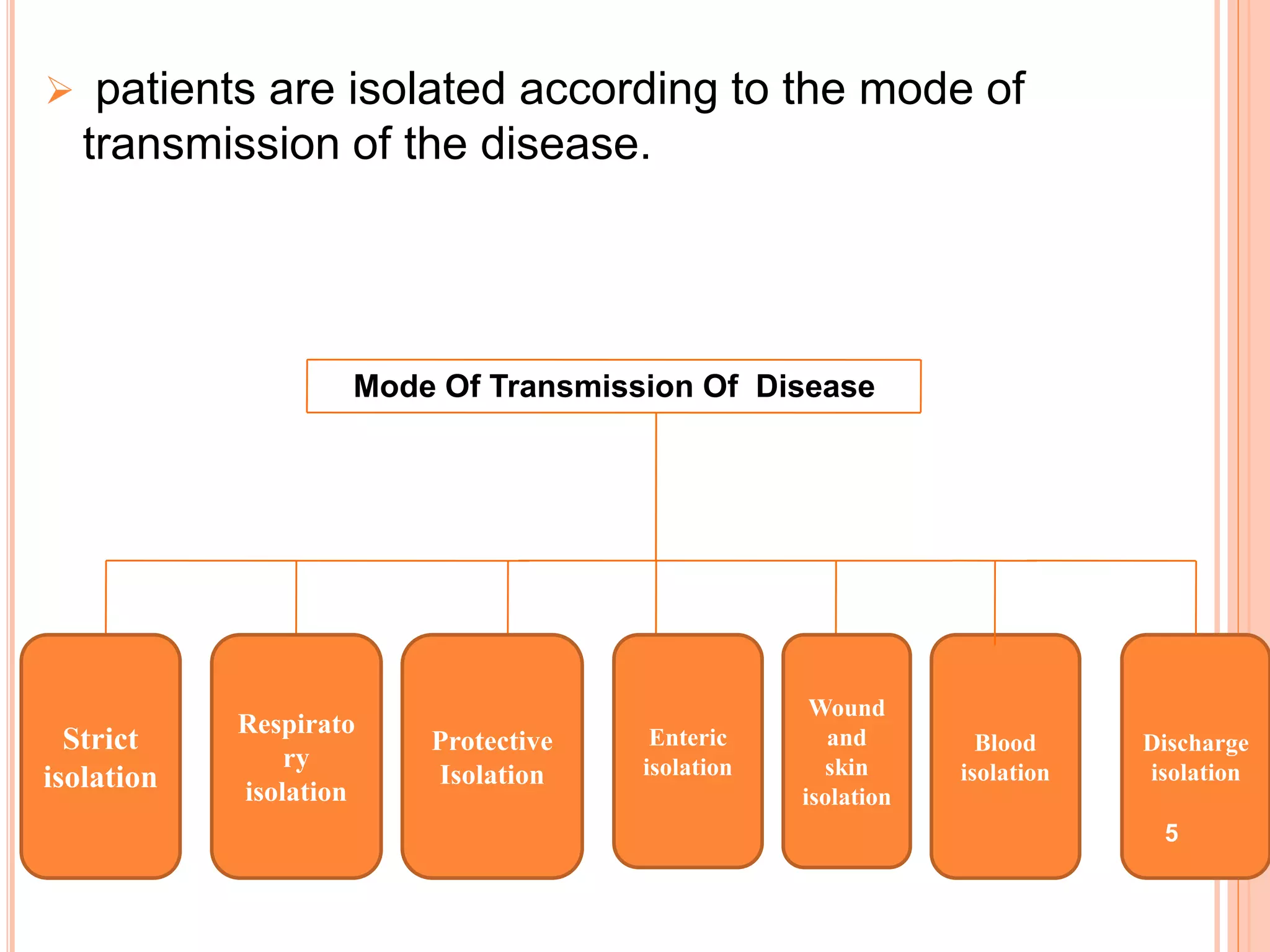
 patients are isolated according to the mode of
transmission of the disease.
Enteric
isolation
Wound
and
skin
isolation
Blood
isolation
Protective
Isolation
Respirato
ry
isolation
Strict
isolation
Discharge
isolation
5
Mode Of Transmission Of Disease
Modes of Isolation
1) Strict Isolation
Used to prevent the transmission of all highly
communicable disease that are spread by both contact and
airborne routes of transmission. Eg. Chickenpox ,Rabies.
2) Respiratory Isolation
Used to prevent transmission of organisms by means of
droplets that are sneezed or breathed into the environment.
Eg. Influenza and tuberculosis.
3) Protective Isolation
Used to prevent contact between potentially pathogenic
micro- organisms and uninfected persons who have seriously
impaired resistance.
Eg. Leukemia, who are on certain therapeutic regimens.
6
4) Enteric Isolation
 Used to control diseases that can be transmitted through direct or
indirect oral contact with infected feces or contaminated articles.
 Transmission of infection depends on ingestion of the pathogens . Eg
Hepatitis, Dysentery.
5) Wound and Skin Isolation
 Used to prevent the spread of micro - organisms found in infected
wounds (including burns and open sores) and heavily contaminated
articles.
 Diseases that required precautions include
 e.g.Herpes, Impetigo and ringworm.
6) Blood Isolation
 Used to prevent acquisition of infection by patients and personnel
from contact with blood or items contaminated with blood .
 Eg Hepatitis B virus , H.I.V/ A.I.D.S
7
7) Discharge Isolation
A ) Secretion Precautions lesions
 Used to prevent acquisition of infection by personnel and
patients from direct contact with wounds and secretion
contaminated articles.
Eg Conjunctivitis, Gonorrhea and Syphilis.
B) Secretion Precautions Oral
 Used to prevent acquisition of infection by personnel from direct
contact with oral secretions.
Eg Herpes Areolas and Scarlet Fever.
C) Excretion Precautions
 Used to prevent acquisition of infection by personnel and
patients from direct contact with fecal excretions.
Eg Polio myelitis and Staphylococcal food poisoning 8
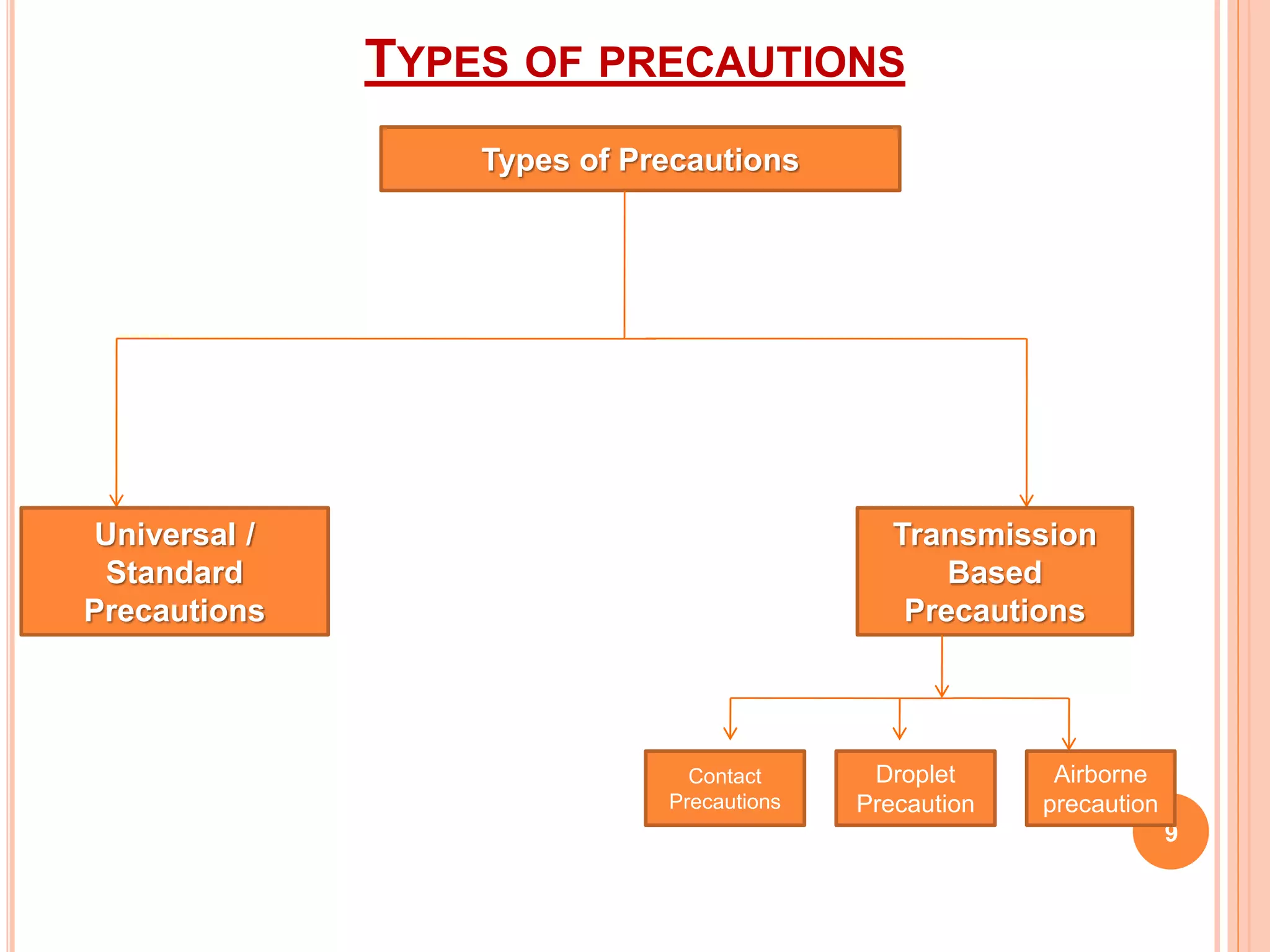
TYPES OF PRECAUTIONS
9
Types of Precautions
Universal /
Standard
Precautions
Transmission
Based
Precautions
Contact
Precautions
Droplet
Precaution
Airborne
precaution
Universal / standard precautions
 Follow standard precautions with all
patients
 When we are close to or handling
blood, bodily fluids, tissues, mucous
membrane or areas of open skin we
,must use personal protective
equipments (PPE).
 Depending on the anticipated exposure
types of PPE required include – gloves,
mask and goggles, aprons/gowns, shoe
covers.
 It is also important to properly clean up
after ward. 10
Transmission based precautions
 Transmission based precautions are followed in
addition to standard precautions
 Some infections required more than one type of
transmission based precautions
 Patient should stay in their rooms as much as
possible
 They may need to wear a mask when they leave
their rooms
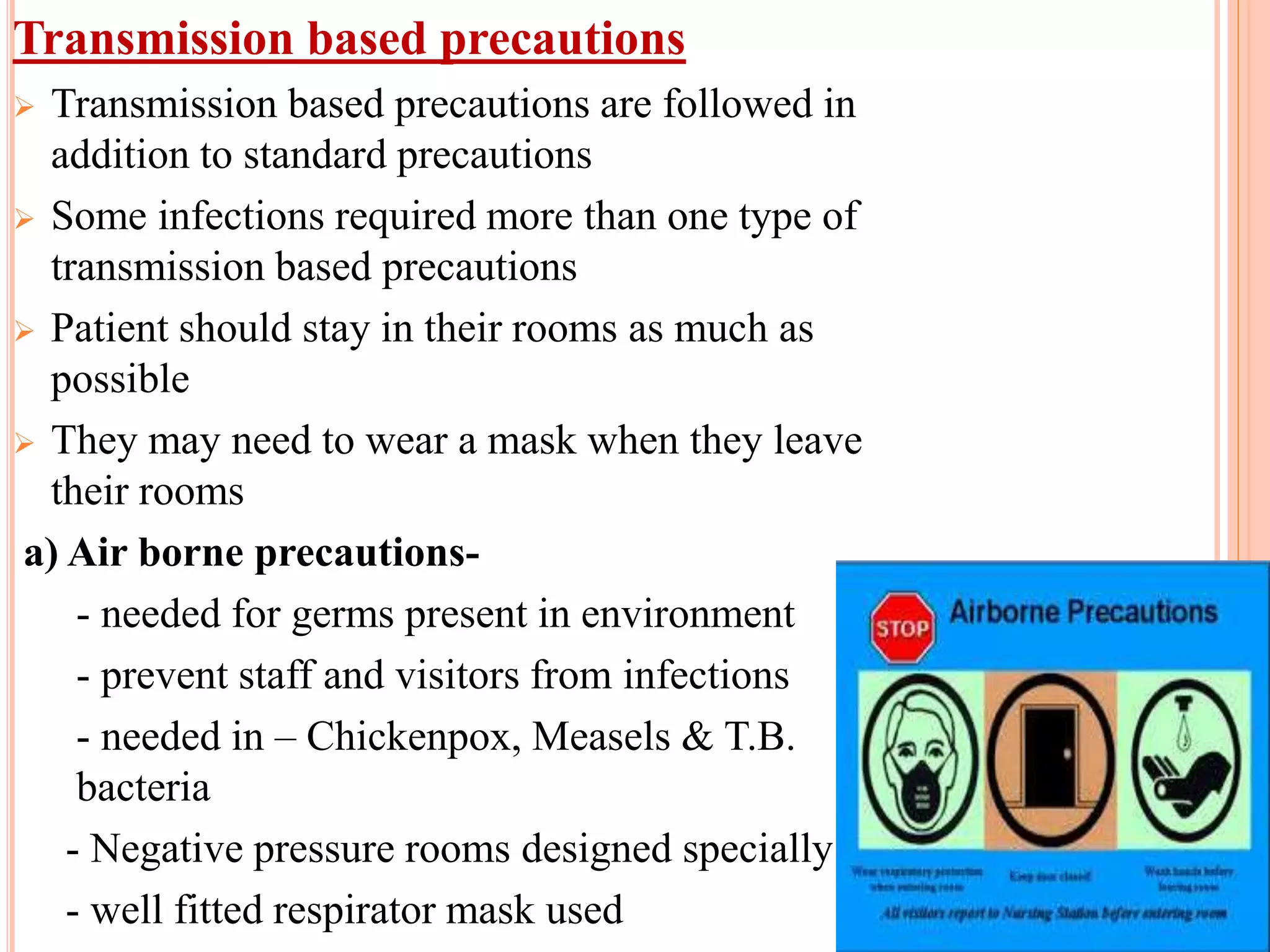
a) Air borne precautions-
- needed for germs present in environment
- prevent staff and visitors from infections
- needed in – Chickenpox, Measels & T.B.
bacteria
- Negative pressure rooms designed specially
- well fitted respirator mask used
11
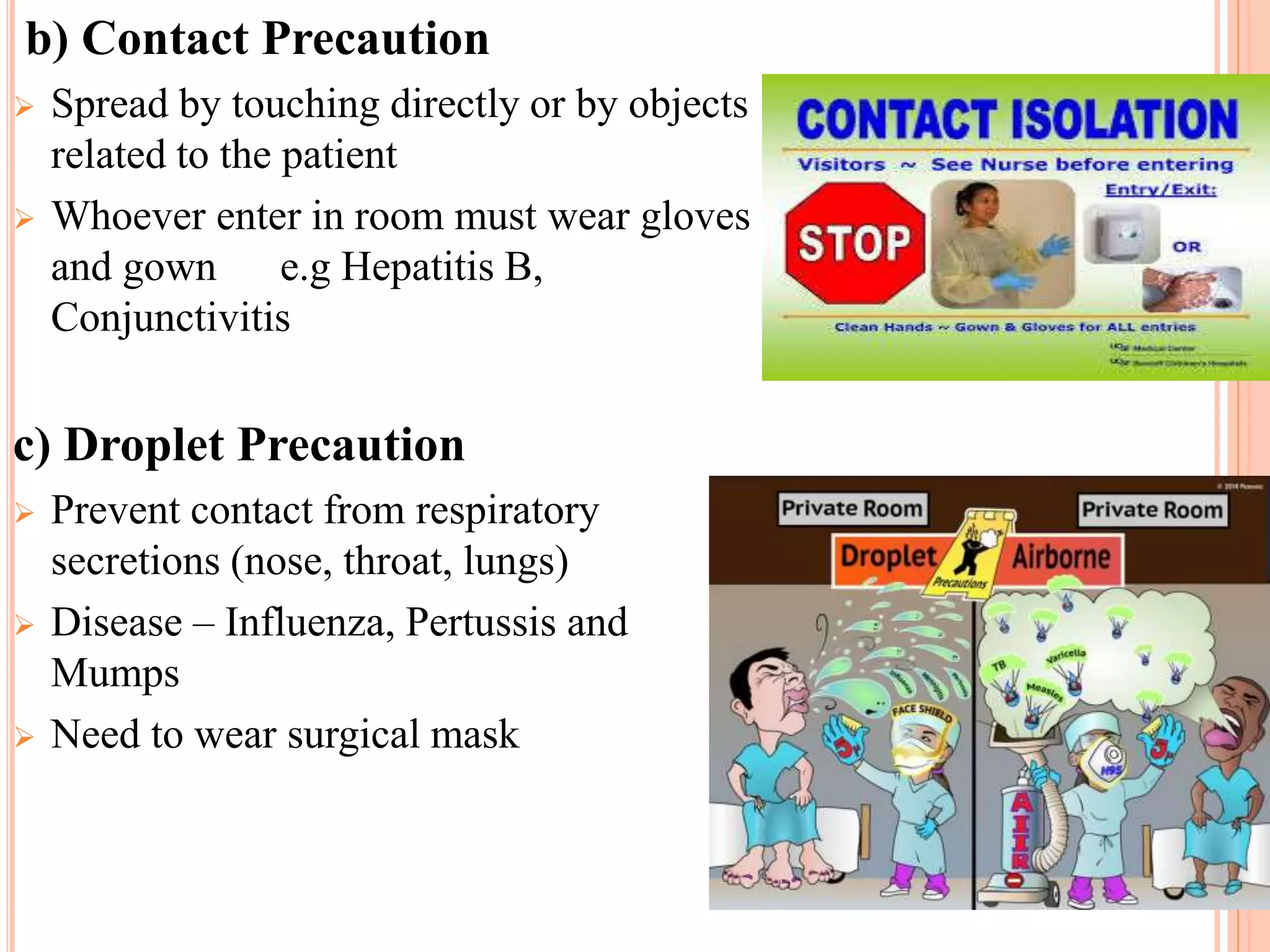
b) Contact Precaution
 Spread by touching directly or by objects
related to the patient
 Whoever enter in room must wear gloves
and gown e.g Hepatitis B,
Conjunctivitis
c) Droplet Precaution
 Prevent contact from respiratory
secretions (nose, throat, lungs)
 Disease – Influenza, Pertussis and
Mumps
 Need to wear surgical mask
12
Advantages of Isolation
 Containment of infection risk.
 Protection of other Patients, Visitors & staff.
 Provision of a focus for training measures in respect of specific
risk of patient .
 Provision of a focus to allow easier implementation of control
measures.
 Source of Privacy, Dignity and Solace to some Patient.
 Better sleep due to lack of disturbance.
 Improved contact for families & careers.
 More flexibility – rooms can be used any gender, age or clinical
condition.
 24 hours admission without disruption to other patient.
 More personalized contact with patients. 13
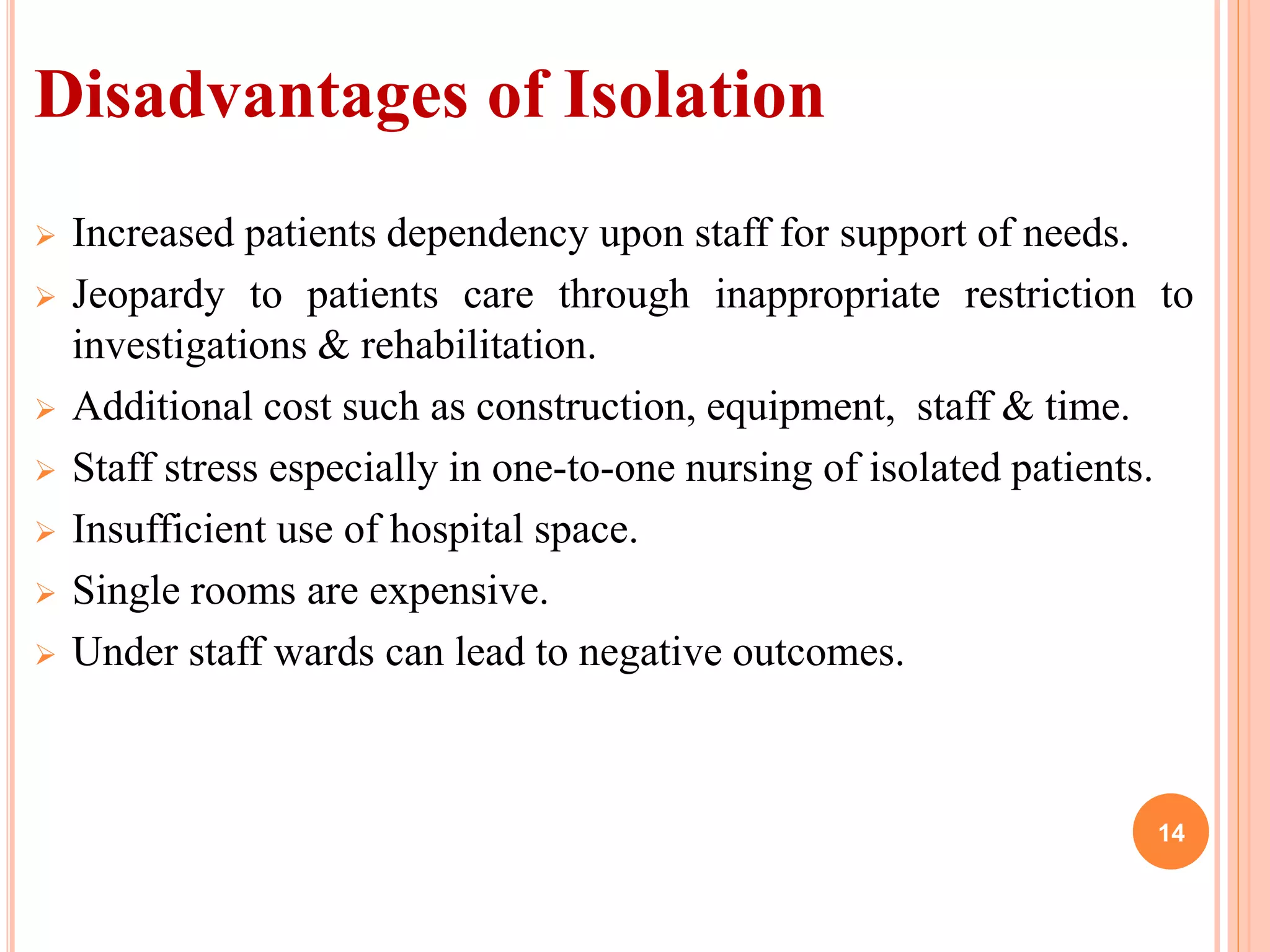
Disadvantages of Isolation
 Increased patients dependency upon staff for support of needs.
 Jeopardy to patients care through inappropriate restriction to
investigations & rehabilitation.
 Additional cost such as construction, equipment, staff & time.
 Staff stress especially in one-to-one nursing of isolated patients.
 Insufficient use of hospital space.
 Single rooms are expensive.
 Under staff wards can lead to negative outcomes.
14
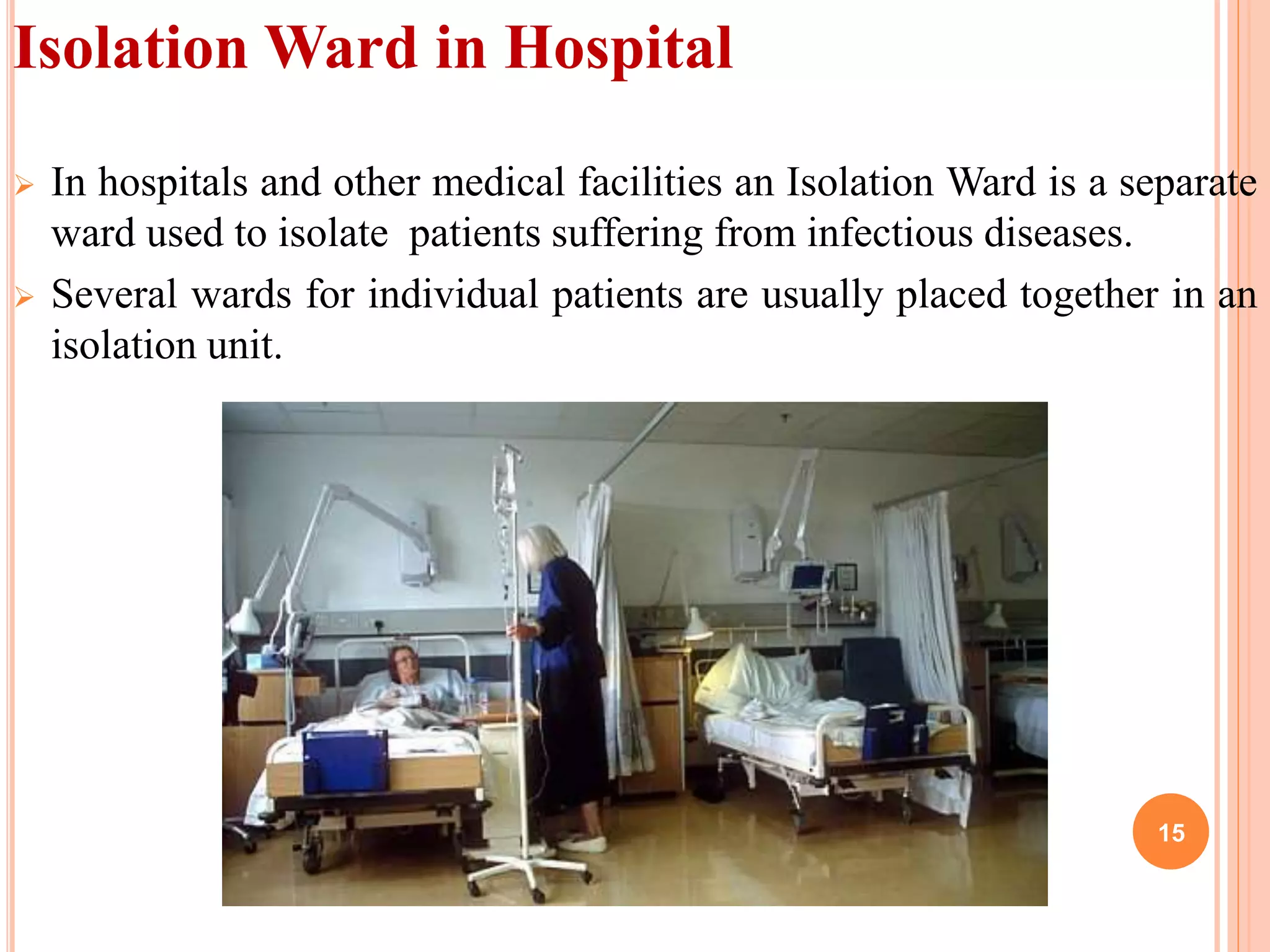
Isolation Ward in Hospital
 In hospitals and other medical facilities an Isolation Ward is a separate
ward used to isolate patients suffering from infectious diseases.
 Several wards for individual patients are usually placed together in an
isolation unit.
15
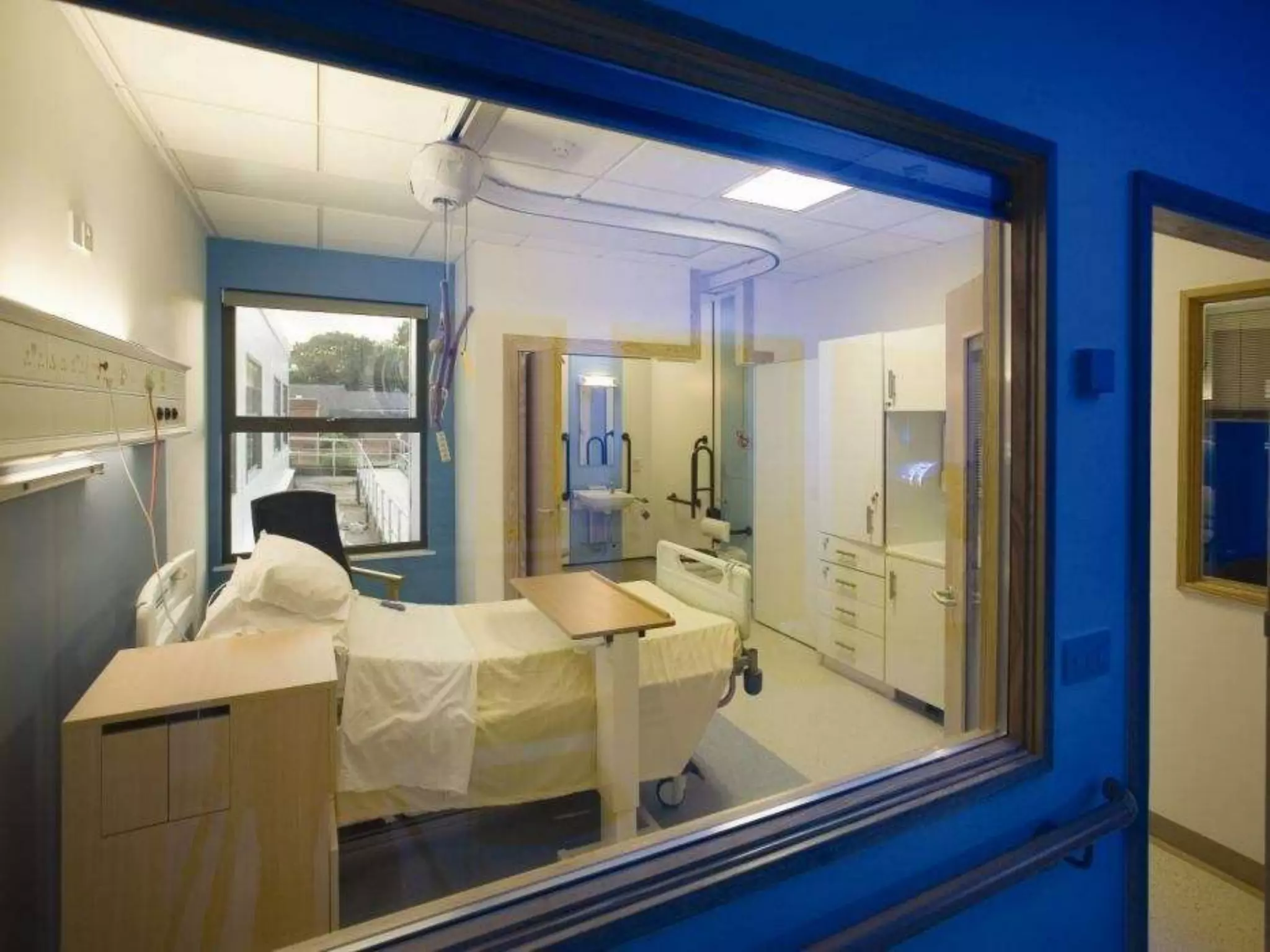
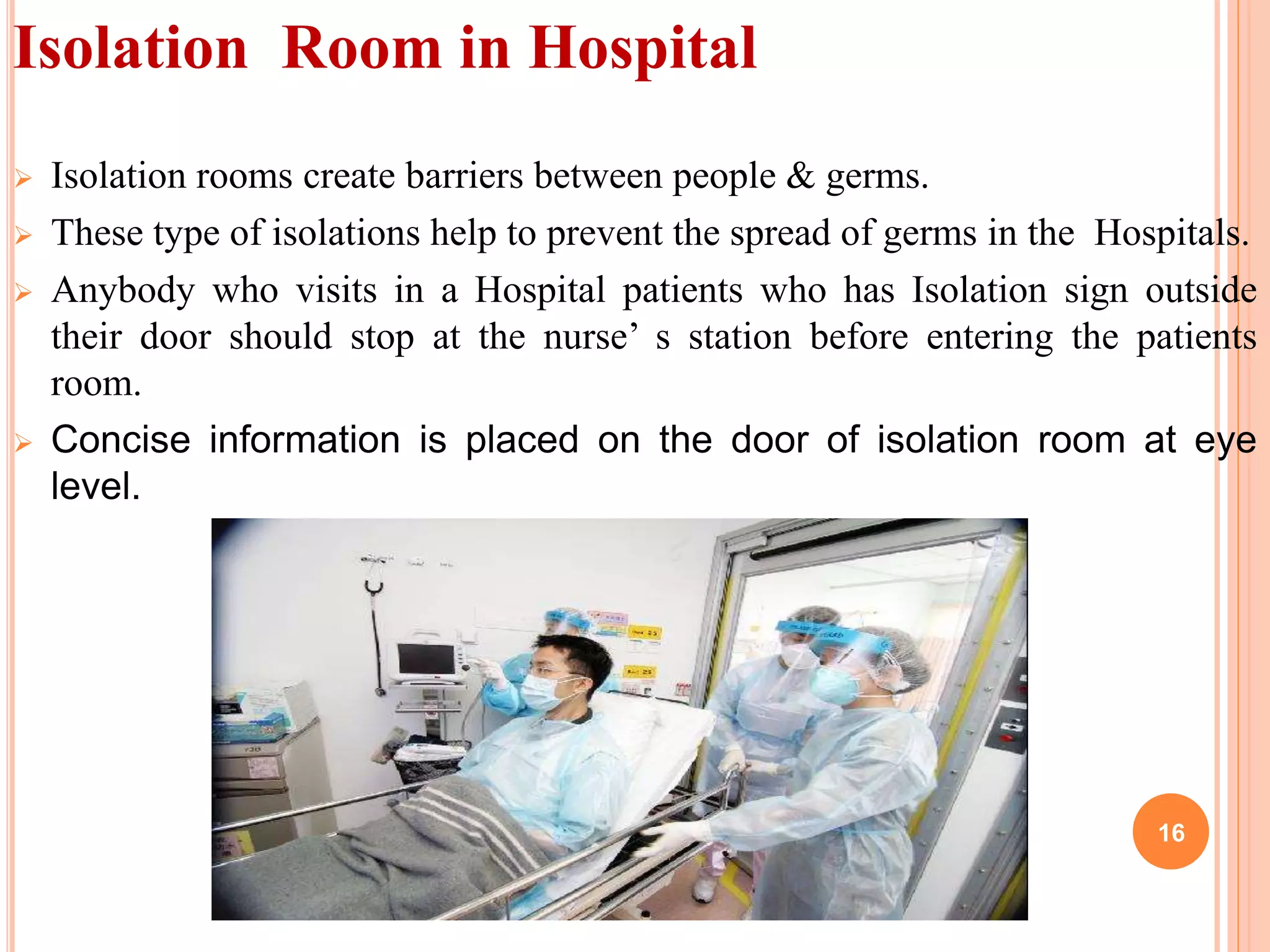
Isolation Room in Hospital
 Isolation rooms create barriers between people & germs.
 These type of isolations help to prevent the spread of germs in the Hospitals.
 Anybody who visits in a Hospital patients who has Isolation sign outside
their door should stop at the nurse’ s station before entering the patients
room.
 Concise information is placed on the door of isolation room at eye
level.
16
DISEASE WISE PERIODS OF ISOLATION RECOMMENDED
Diseases Duration of Isolation
1) Chicken Pox Until all lesions crusted usually about
6 days onset of rash
2) Measles From onset of catarrhal stage through
3rd day of rash
3) German Measles None, except that in the Ist trimester or
sexually actives, non – immune women
in child bearing years not using
contraceptive measures should not be
exposed.
17
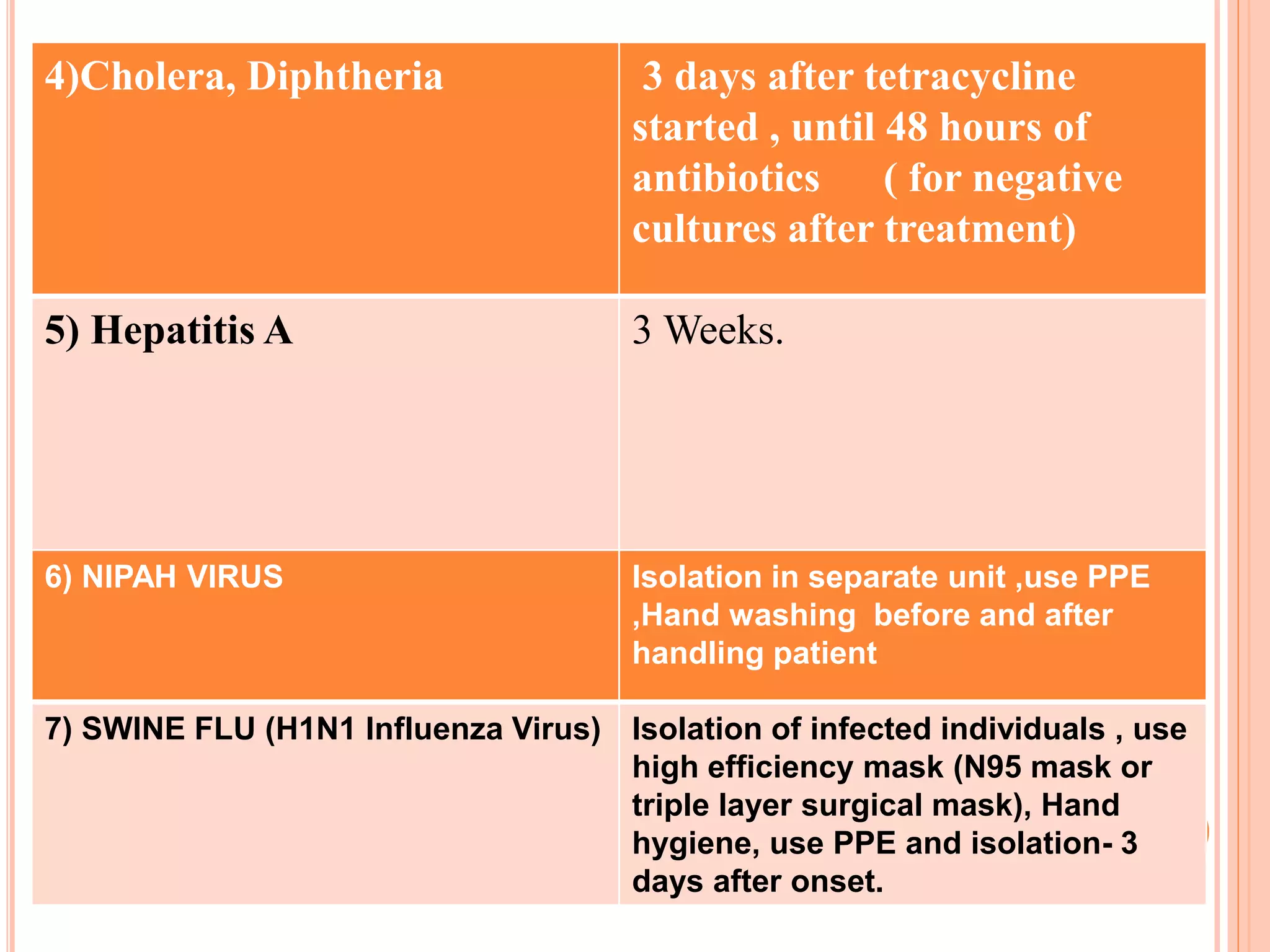
4)Cholera, Diphtheria 3 days after tetracycline
started , until 48 hours of
antibiotics ( for negative
cultures after treatment)
5) Hepatitis A 3 Weeks.
18
6) NIPAH VIRUS Isolation in separate unit ,use PPE
,Hand washing before and after
handling patient
7) SWINE FLU (H1N1 Influenza Virus) Isolation of infected individuals , use
high efficiency mask (N95 mask or
triple layer surgical mask), Hand
hygiene, use PPE and isolation- 3
days after onset.
8) Influenza 3 days after onset
9) Polio 2 weeks adults, 6 weeks pediatric .
10) Tuberculosis(sputum+) Until 3 weeks of effective
chemotherapy.
11) Herpes Zoster 6 days after onset of rash.
12) Mumps Until swelling subsides.
13) Pertussis 4 weeks or until paroxysms.
14) Meningitis
15) Streptococcal
16) Pharyngitis
17) Meningococcal
Until the first 6 hours of effective
antibiotic therapy are completed.
19
AYURVEDIC VIEW
 Ála³xkn~ xk=laLi”kkZfUu”oklkRlgHkkstukr~A
lg”k¸;k∙∙lukPpkfi oL=ekY;kuqysiukr~ AA
dq’Ba TojÜp “kks’kÜp us=kfHk’;Un ,o p A
vkSilfxZdjksxkÜp l³~dzkefUr ujkUuje~ AA
¼ lq- fu- 6@32&33½
 Ála³xkn~ ----------vuqysiukr~AA
d.Mwdq’Bksina”kkÜp HkwrksUeknoz.kTojk% A
vkSilfxZdjksxkÜp l³~dzkefUr ujkUuje~ AA
¼Hkk- ç-54@49½
20
ISOLATION IN ANCIENT ERA
 For pregnant / child birth
 For intake of Rasayana (Trigarbha Kuti)
 For injured person (Dhupana etc)

21
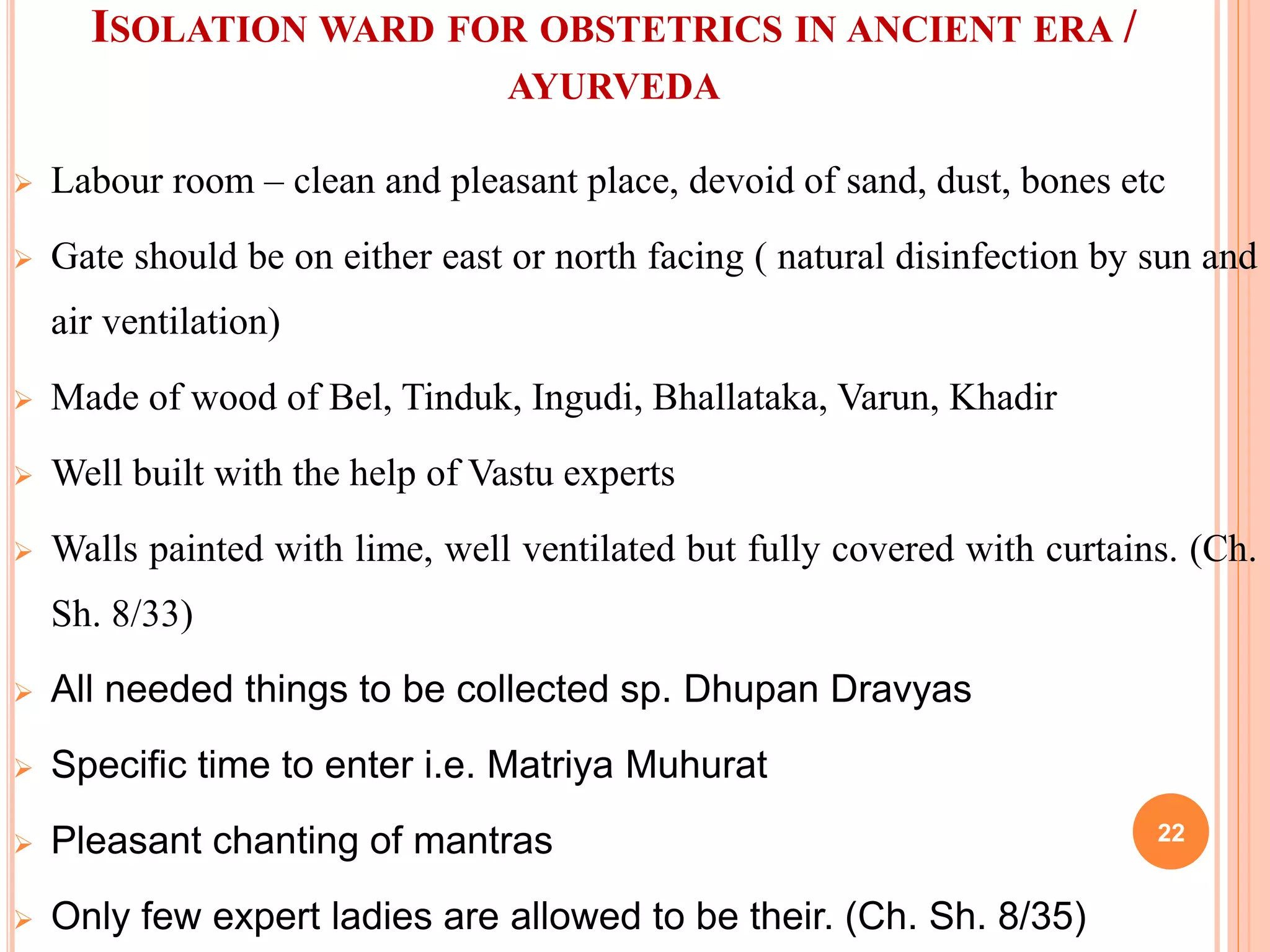
ISOLATION WARD FOR OBSTETRICS IN ANCIENT ERA /
AYURVEDA
 Labour room – clean and pleasant place, devoid of sand, dust, bones etc
 Gate should be on either east or north facing ( natural disinfection by sun and
air ventilation)
 Made of wood of Bel, Tinduk, Ingudi, Bhallataka, Varun, Khadir
 Well built with the help of Vastu experts
 Walls painted with lime, well ventilated but fully covered with curtains. (Ch.
Sh. 8/33)
 All needed things to be collected sp. Dhupan Dravyas
 Specific time to enter i.e. Matriya Muhurat
 Pleasant chanting of mantras
 Only few expert ladies are allowed to be their. (Ch. Sh. 8/35)
22
ISOLATION OF PEDIATRICS WARD
 Dispersion of Sarshap,Atsi,Tandul, Kanika upto Namkaran (10
days) twice daily
 Kept wooded logs (Musal) on door
 Regular litting of fire inside room with wood of kankantaka, tinduka
 Hanging of Vacha etc Rakshoghana drayava on door
 Post partum female and baby shouldn’t be kept alone, 10-12
expert ladies were allowed to enter in the room to maintain them.
 With constant chanting of mantras of Atharvaveda. (Ch. Sh. 8/47)
23
Room Designing
I. Negative Pressure Room-patients who have air borne
infection should be in special rooms where the air is
gently suck out and not allowed to flow into the hallway.
II. Positive Pressure Room – used to protect patients with
weakened immune system from airborne contaminants.
24
CONCLUSION
 Isolation precautions are considered an important public health
intervention. However it may adversely affect the isolated
individual, higher costs and increased hospital readmissions .
 But for complete eradication isolation is mandatory e.g.In
Ayurveda Leprosy/ Kustha was counted as Mahagada but when it
was taken as infectious disease and isolation advocated only then
it was possible to eradicate , similar for T.B.
 Isolation wards can play an important role for research and data
collection also.
 Motive of WHO (Health for all) can only be achieved by
Isolation , precaution and preventive measures
25
26
27
28
29
30
31
32
33
34

Isolation ward in hospital.ppt

  • 1.
  • 2.
    “Isolation is theseparation of a patient from contact with others in order to control the spread of an infectious or communicable disease.” Need Of Isolation  Isolation aimed controlling and preventing the spread of infection.  Isolation precautions are designed(like-rooms/wards) to minimize the transmission of infection in the hospital by using updated and skilled technology.  Isolation helps to protect patients, family members, visitors and health care workers from the spread of infection. 2
  • 3.
  • 4.
    TYPES OF ISOLATION Some signs are used to identify types of isolation  some hospital signs are disease specific and some are category specific.  The sign is removed when isolation is no longer required.  A checklist is also placed on the door. This list indicates whether masks , gowns, gloves etc… are required for persons entering the room. Any other pertinent information is also on this sign. 4
  • 5.
     patients areisolated according to the mode of transmission of the disease. Enteric isolation Wound and skin isolation Blood isolation Protective Isolation Respirato ry isolation Strict isolation Discharge isolation 5 Mode Of Transmission Of Disease
  • 6.
    Modes of Isolation 1)Strict Isolation Used to prevent the transmission of all highly communicable disease that are spread by both contact and airborne routes of transmission. Eg. Chickenpox ,Rabies. 2) Respiratory Isolation Used to prevent transmission of organisms by means of droplets that are sneezed or breathed into the environment. Eg. Influenza and tuberculosis. 3) Protective Isolation Used to prevent contact between potentially pathogenic micro- organisms and uninfected persons who have seriously impaired resistance. Eg. Leukemia, who are on certain therapeutic regimens. 6
  • 7.
    4) Enteric Isolation Used to control diseases that can be transmitted through direct or indirect oral contact with infected feces or contaminated articles.  Transmission of infection depends on ingestion of the pathogens . Eg Hepatitis, Dysentery. 5) Wound and Skin Isolation  Used to prevent the spread of micro - organisms found in infected wounds (including burns and open sores) and heavily contaminated articles.  Diseases that required precautions include  e.g.Herpes, Impetigo and ringworm. 6) Blood Isolation  Used to prevent acquisition of infection by patients and personnel from contact with blood or items contaminated with blood .  Eg Hepatitis B virus , H.I.V/ A.I.D.S 7
  • 8.
    7) Discharge Isolation A) Secretion Precautions lesions  Used to prevent acquisition of infection by personnel and patients from direct contact with wounds and secretion contaminated articles. Eg Conjunctivitis, Gonorrhea and Syphilis. B) Secretion Precautions Oral  Used to prevent acquisition of infection by personnel from direct contact with oral secretions. Eg Herpes Areolas and Scarlet Fever. C) Excretion Precautions  Used to prevent acquisition of infection by personnel and patients from direct contact with fecal excretions. Eg Polio myelitis and Staphylococcal food poisoning 8
  • 9.
    TYPES OF PRECAUTIONS 9 Typesof Precautions Universal / Standard Precautions Transmission Based Precautions Contact Precautions Droplet Precaution Airborne precaution
  • 10.
    Universal / standardprecautions  Follow standard precautions with all patients  When we are close to or handling blood, bodily fluids, tissues, mucous membrane or areas of open skin we ,must use personal protective equipments (PPE).  Depending on the anticipated exposure types of PPE required include – gloves, mask and goggles, aprons/gowns, shoe covers.  It is also important to properly clean up after ward. 10
  • 11.
    Transmission based precautions Transmission based precautions are followed in addition to standard precautions  Some infections required more than one type of transmission based precautions  Patient should stay in their rooms as much as possible  They may need to wear a mask when they leave their rooms a) Air borne precautions- - needed for germs present in environment - prevent staff and visitors from infections - needed in – Chickenpox, Measels & T.B. bacteria - Negative pressure rooms designed specially - well fitted respirator mask used 11
  • 12.
    b) Contact Precaution Spread by touching directly or by objects related to the patient  Whoever enter in room must wear gloves and gown e.g Hepatitis B, Conjunctivitis c) Droplet Precaution  Prevent contact from respiratory secretions (nose, throat, lungs)  Disease – Influenza, Pertussis and Mumps  Need to wear surgical mask 12
  • 13.
    Advantages of Isolation Containment of infection risk.  Protection of other Patients, Visitors & staff.  Provision of a focus for training measures in respect of specific risk of patient .  Provision of a focus to allow easier implementation of control measures.  Source of Privacy, Dignity and Solace to some Patient.  Better sleep due to lack of disturbance.  Improved contact for families & careers.  More flexibility – rooms can be used any gender, age or clinical condition.  24 hours admission without disruption to other patient.  More personalized contact with patients. 13
  • 14.
    Disadvantages of Isolation Increased patients dependency upon staff for support of needs.  Jeopardy to patients care through inappropriate restriction to investigations & rehabilitation.  Additional cost such as construction, equipment, staff & time.  Staff stress especially in one-to-one nursing of isolated patients.  Insufficient use of hospital space.  Single rooms are expensive.  Under staff wards can lead to negative outcomes. 14
  • 15.
    Isolation Ward inHospital  In hospitals and other medical facilities an Isolation Ward is a separate ward used to isolate patients suffering from infectious diseases.  Several wards for individual patients are usually placed together in an isolation unit. 15
  • 16.
    Isolation Room inHospital  Isolation rooms create barriers between people & germs.  These type of isolations help to prevent the spread of germs in the Hospitals.  Anybody who visits in a Hospital patients who has Isolation sign outside their door should stop at the nurse’ s station before entering the patients room.  Concise information is placed on the door of isolation room at eye level. 16
  • 17.
    DISEASE WISE PERIODSOF ISOLATION RECOMMENDED Diseases Duration of Isolation 1) Chicken Pox Until all lesions crusted usually about 6 days onset of rash 2) Measles From onset of catarrhal stage through 3rd day of rash 3) German Measles None, except that in the Ist trimester or sexually actives, non – immune women in child bearing years not using contraceptive measures should not be exposed. 17
  • 18.
    4)Cholera, Diphtheria 3days after tetracycline started , until 48 hours of antibiotics ( for negative cultures after treatment) 5) Hepatitis A 3 Weeks. 18 6) NIPAH VIRUS Isolation in separate unit ,use PPE ,Hand washing before and after handling patient 7) SWINE FLU (H1N1 Influenza Virus) Isolation of infected individuals , use high efficiency mask (N95 mask or triple layer surgical mask), Hand hygiene, use PPE and isolation- 3 days after onset.
  • 19.
    8) Influenza 3days after onset 9) Polio 2 weeks adults, 6 weeks pediatric . 10) Tuberculosis(sputum+) Until 3 weeks of effective chemotherapy. 11) Herpes Zoster 6 days after onset of rash. 12) Mumps Until swelling subsides. 13) Pertussis 4 weeks or until paroxysms. 14) Meningitis 15) Streptococcal 16) Pharyngitis 17) Meningococcal Until the first 6 hours of effective antibiotic therapy are completed. 19
  • 20.
    AYURVEDIC VIEW  Ála³xkn~xk=laLi”kkZfUu”oklkRlgHkkstukr~A lg”k¸;k∙∙lukPpkfi oL=ekY;kuqysiukr~ AA dq’Ba TojÜp “kks’kÜp us=kfHk’;Un ,o p A vkSilfxZdjksxkÜp l³~dzkefUr ujkUuje~ AA ¼ lq- fu- 6@32&33½  Ála³xkn~ ----------vuqysiukr~AA d.Mwdq’Bksina”kkÜp HkwrksUeknoz.kTojk% A vkSilfxZdjksxkÜp l³~dzkefUr ujkUuje~ AA ¼Hkk- ç-54@49½ 20
  • 21.
    ISOLATION IN ANCIENTERA  For pregnant / child birth  For intake of Rasayana (Trigarbha Kuti)  For injured person (Dhupana etc)  21
  • 22.
    ISOLATION WARD FOROBSTETRICS IN ANCIENT ERA / AYURVEDA  Labour room – clean and pleasant place, devoid of sand, dust, bones etc  Gate should be on either east or north facing ( natural disinfection by sun and air ventilation)  Made of wood of Bel, Tinduk, Ingudi, Bhallataka, Varun, Khadir  Well built with the help of Vastu experts  Walls painted with lime, well ventilated but fully covered with curtains. (Ch. Sh. 8/33)  All needed things to be collected sp. Dhupan Dravyas  Specific time to enter i.e. Matriya Muhurat  Pleasant chanting of mantras  Only few expert ladies are allowed to be their. (Ch. Sh. 8/35) 22
  • 23.
    ISOLATION OF PEDIATRICSWARD  Dispersion of Sarshap,Atsi,Tandul, Kanika upto Namkaran (10 days) twice daily  Kept wooded logs (Musal) on door  Regular litting of fire inside room with wood of kankantaka, tinduka  Hanging of Vacha etc Rakshoghana drayava on door  Post partum female and baby shouldn’t be kept alone, 10-12 expert ladies were allowed to enter in the room to maintain them.  With constant chanting of mantras of Atharvaveda. (Ch. Sh. 8/47) 23
  • 24.
    Room Designing I. NegativePressure Room-patients who have air borne infection should be in special rooms where the air is gently suck out and not allowed to flow into the hallway. II. Positive Pressure Room – used to protect patients with weakened immune system from airborne contaminants. 24
  • 25.
    CONCLUSION  Isolation precautionsare considered an important public health intervention. However it may adversely affect the isolated individual, higher costs and increased hospital readmissions .  But for complete eradication isolation is mandatory e.g.In Ayurveda Leprosy/ Kustha was counted as Mahagada but when it was taken as infectious disease and isolation advocated only then it was possible to eradicate , similar for T.B.  Isolation wards can play an important role for research and data collection also.  Motive of WHO (Health for all) can only be achieved by Isolation , precaution and preventive measures 25
  • 26.
  • 27.
  • 28.
  • 29.
  • 30.
  • 31.
  • 32.
  • 33.
  • 34.