Personal Protective
Equipment (PPE)
University of Perpetual Help DALTAMddPinas City 1
DR.SHARI.S.R
IST YR MDS
DEPT.OF PROSTHODONTICS
GOVT.DENTAL COLLEGE
TVM
Personal Protective Equipment (PPE)
Definition
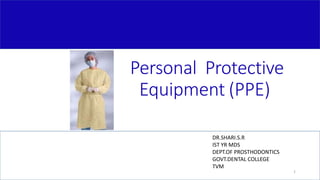
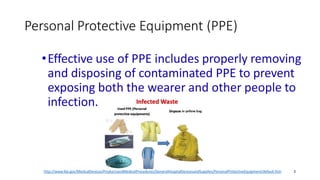
•Refers to protective clothing,
helmets, gloves, face shields,
goggles, facemasks and/or
respirators or other equipment
designed to protect the wearer from
injury or the spread of infection or
illness.
http://www.fda.gov/MedicalDevices/ProductsandMedicalProcedures/GeneralHospitalDevicesandSupplies/PersonalProtectiveEquipment/default.htm 2
Personal Protective Equipment (PPE)
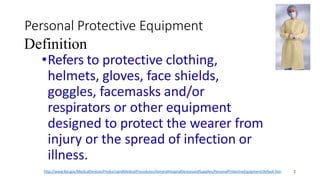
•Effective use of PPE includes properly removing
and disposing of contaminated PPE to prevent
exposing both the wearer and other people to
infection.
http://www.fda.gov/MedicalDevices/ProductsandMedicalProcedures/GeneralHospitalDevicesandSupplies/PersonalProtectiveEquipment/default.htm 3
Types of PPE Used in Healthcare Settings
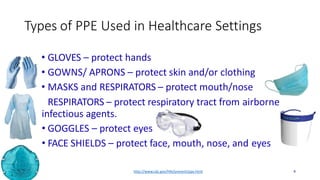
• GLOVES – protect hands
• GOWNS/ APRONS – protect skin and/or clothing
• MASKS and RESPIRATORS – protect mouth/nose
RESPIRATORS – protect respiratory tract from airborne
infectious agents.
• GOGGLES – protect eyes
• FACE SHIELDS – protect face, mouth, nose, and eyes
http://www.cdc.gov/HAI/prevent/ppe.html 4
Factors Influencing PPE Selection
•Type of exposure anticipated
- Splash/spray versus touch
- Category of isolation precautions
•Durability and appropriateness for the
task
•Fit
http://www.cdc.gov/HAI/prevent/ppe.html 5
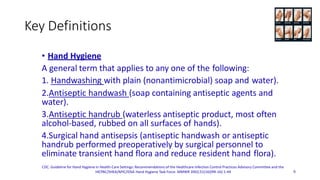
Key Definitions
• Hand Hygiene
A general term that applies to any one of the following:
1. Handwashing with plain (nonantimicrobial) soap and water).
2.Antiseptic handwash (soap containing antiseptic agents and
water).
3.Antiseptic handrub (waterless antiseptic product, most often
alcohol-based, rubbed on all surfaces of hands).
4.Surgical hand antisepsis (antiseptic handwash or antiseptic
handrub performed preoperatively by surgical personnel to
eliminate transient hand flora and reduce resident hand flora).
CDC. Guideline for Hand Hygiene in Health-Care Settings: Recommendations of the Healthcare Infection Control Practices Advisory Committee and the
HICPAC/SHEA/APIC/IDSA Hand Hygiene Task Force. MMWR 2002;51(16)(RR-16):1-44 6
Key Definitions
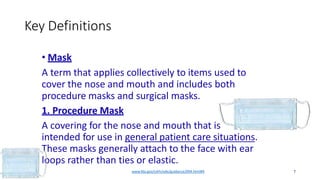
• Mask
A term that applies collectively to items used to
cover the nose and mouth and includes both
procedure masks and surgical masks.
1. Procedure Mask
A covering for the nose and mouth that is
intended for use in general patient care situations.
These masks generally attach to the face with ear
loops rather than ties or elastic.
www.fda.gov/cdrh/ode/guidance/094.html#4 7
Key Definitions
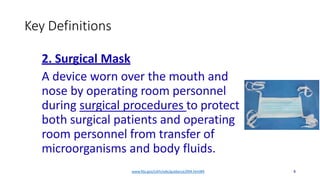
2. Surgical Mask
A device worn over the mouth and
nose by operating room personnel
during surgical procedures to protect
both surgical patients and operating
room personnel from transfer of
microorganisms and body fluids.
www.fda.gov/cdrh/ode/guidance/094.html#4 8
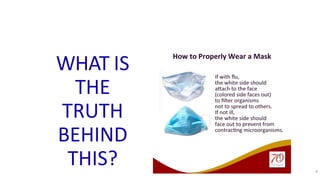
WHAT IS
THE
TRUTH
BEHIND
THIS? 9
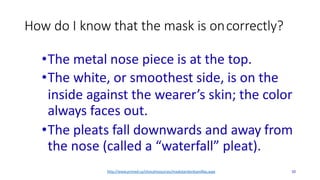
How do I know that the mask is oncorrectly?
•The metal nose piece is at the top.
•The white, or smoothest side, is on the
inside against the wearer’s skin; the color
always faces out.
•The pleats fall downwards and away from
the nose (called a “waterfall” pleat).
http://www.primed.ca/clinicalresources/maskstandardsandfaq.aspx 10
Key Definitions
•
•
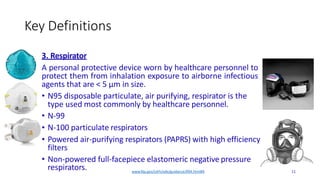
3. Respirator
A personal protective device worn by healthcare personnel to
protect them from inhalation exposure to airborne infectious
agents that are < 5 μm in size.
• N95 disposable particulate, air purifying, respirator is the
type used most commonly by healthcare personnel.
• N-99
N-100 particulate respirators
Powered air-purifying respirators (PAPRS) with high efficiency
filters
• Non-powered full-facepiece elastomeric negative pressure
respirators. www.fda.gov/cdrh/ode/guidance/094.html#4 11
12
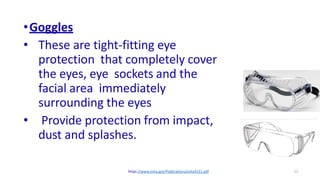
•Goggles
• These are tight-fitting eye
protection that completely cover
the eyes, eye sockets and the
facial area immediately
surrounding the eyes
• Provide protection from impact,
dust and splashes.
https://www.osha.gov/Publications/osha3151.pdf
13
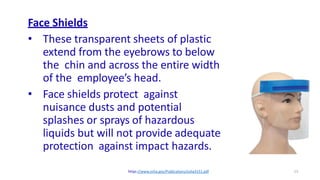
Face Shields
• These transparent sheets of plastic
extend from the eyebrows to below
the chin and across the entire width
of the employee’s head.
• Face shields protect against
nuisance dusts and potential
splashes or sprays of hazardous
liquids but will not provide adequate
protection against impact hazards.
https://www.osha.gov/Publications/osha3151.pdf
Facts about Eye Protection
•Eye protection can be in the form of goggles,
safety glasses, or face shields.
• Personal eyeglasses and contact lenses
provide some but not complete protection
and are not considered adequate eye
protection.
•Reusable eye protection should be cleaned
according to the manufacturer’s instructions.
14
https://smah.uow.edu.au/content/groups/public/@web/@health/documents/doc/uow137337.pdf
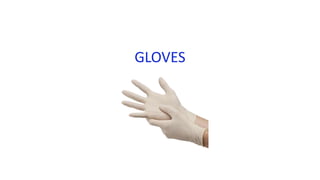
GLOVES
16
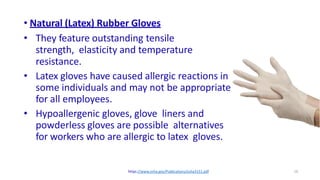
• Natural (Latex) Rubber Gloves
• They feature outstanding tensile
strength, elasticity and temperature
resistance.
• Latex gloves have caused allergic reactions in
some individuals and may not be appropriate
for all employees.
• Hypoallergenic gloves, glove liners and
powderless gloves are possible alternatives
for workers who are allergic to latex gloves.
https://www.osha.gov/Publications/osha3151.pdf
17
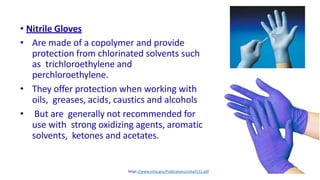
• Nitrile Gloves
• Are made of a copolymer and provide
protection from chlorinated solvents such
as trichloroethylene and
perchloroethylene.
• They offer protection when working with
oils, greases, acids, caustics and alcohols
• But are generally not recommended for
use with strong oxidizing agents, aromatic
solvents, ketones and acetates.
https://www.osha.gov/Publications/osha3151.pdf
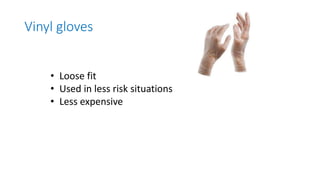
Vinyl gloves
• Loose fit
• Used in less risk situations
• Less expensive
Facts about Gloves
19
https://smah.uow.edu.au/content/groups/public/@web/@health/documents/doc/uow137337.pdf
•Although gloves do not prevent needlestick or
sharps injuries, studies have demonstrated that
the transmission of blood-borne pathogens may
be significantly reduced due to the ‘cleaning’
effect the material of the glove has on the
instrument as it passes through the glove. Gloves
may also reduce the injured person’s contact time
with the source’s blood.
Facts about Gloves
20
https://smah.uow.edu.au/content/groups/public/@web/@health/documents/doc/uow137337.pdf
•Prolonged and indiscriminate use of gloves
should be avoided as they may cause adverse
reactions and skin sensitivity.
•In countries with limited resources and an
inadequate supply of gloves, used sterile
gloves may be washed, sterilized and reused
for hygiene purposes only – not for invasive
procedures.
Key Definitions
21
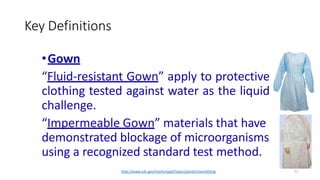
•Gown
“Fluid-resistant Gown” apply to protective
clothing tested against water as the liquid
challenge.
“Impermeable Gown” materials that have
demonstrated blockage of microorganisms
using a recognized standard test method.
http://www.cdc.gov/niosh/npptl/topics/protectiveclothing
GOWN vs. COVERALL
22
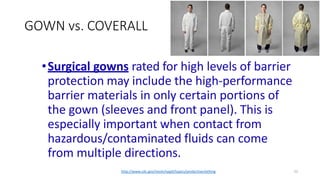
•Surgical gowns rated for high levels of barrier
protection may include the high-performance
barrier materials in only certain portions of
the gown (sleeves and front panel). This is
especially important when contact from
hazardous/contaminated fluids can come
from multiple directions.
http://www.cdc.gov/niosh/npptl/topics/protectiveclothing
GOWN vs. COVERALL
23
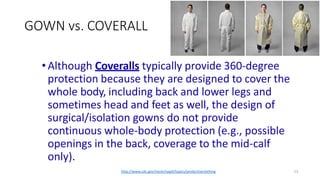
•Although Coveralls typically provide 360-degree
protection because they are designed to cover the
whole body, including back and lower legs and
sometimes head and feet as well, the design of
surgical/isolation gowns do not provide
continuous whole-body protection (e.g., possible
openings in the back, coverage to the mid-calf
only).
http://www.cdc.gov/niosh/npptl/topics/protectiveclothing
Facts about Gowns or Aprons
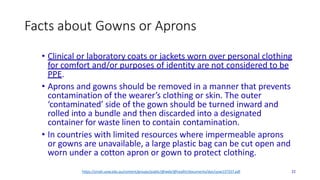
• Clinical or laboratory coats or jackets worn over personal clothing
for comfort and/or purposes of identity are not considered to be
PPE.
• Aprons and gowns should be removed in a manner that prevents
contamination of the wearer’s clothing or skin. The outer
‘contaminated’ side of the gown should be turned inward and
rolled into a bundle and then discarded into a designated
container for waste linen to contain contamination.
• In countries with limited resources where impermeable aprons
or gowns are unavailable, a large plastic bag can be cut open and
worn under a cotton apron or gown to protect clothing.
https://smah.uow.edu.au/content/groups/public/@web/@health/documents/doc/uow137337.pdf 22
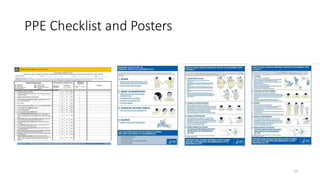
PPE Checklist and Posters
25
Proper DONNING of PPE
26
General Considerations (Donning of PPE)
•Keep hands away from face.
•Limit surfaces touched.
•Change when torn or heavily
contaminated.
•Work from clean to dirty.
http://www.cdc.gov/hicpac/pdf/isolation/Isolation2007.pdf 26
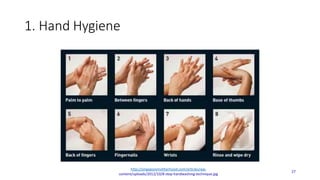
1. Hand Hygiene
27
http://singaporemotherhood.com/articles/wp-
content/uploads/2012/10/8-step-handwashing-technique.jpg
Sequence* for Donning PPE
•Gown first
•Mask or respirator
•Goggles or face shield
•Gloves
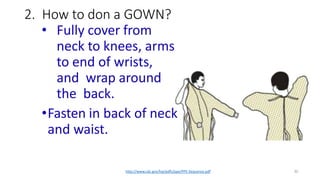
2. How to don a GOWN?
• Fully cover from
neck to knees, arms
to end of wrists,
and wrap around
the back.
•Fasten in back of neck
and waist.
http://www.cdc.gov/hai/pdfs/ppe/PPE-Sequence.pdf 30
• If gown is too small, use two
gowns
1. Gown #1 ties in front
2. Gown #2 ties in back
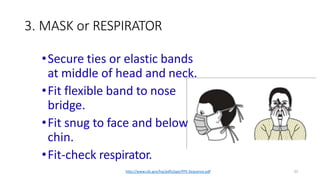
3. MASK or RESPIRATOR
32
•Secure ties or elastic bands
at middle of head and neck.
•Fit flexible band to nose
bridge.
•Fit snug to face and below
chin.
•Fit-check respirator.
http://www.cdc.gov/hai/pdfs/ppe/PPE-Sequence.pdf
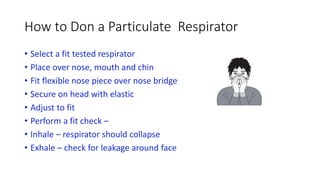
How to Don a Particulate Respirator
• Select a fit tested respirator
• Place over nose, mouth and chin
• Fit flexible nose piece over nose bridge
• Secure on head with elastic
• Adjust to fit
• Perform a fit check –
• Inhale – respirator should collapse
• Exhale – check for leakage around face
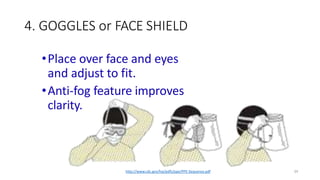
4. GOGGLES or FACE SHIELD
34
•Place over face and eyes
and adjust to fit.
•Anti-fog feature improves
clarity.
http://www.cdc.gov/hai/pdfs/ppe/PPE-Sequence.pdf
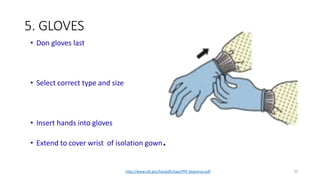
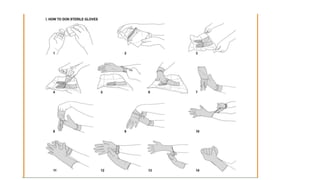
5. GLOVES
35
• Don gloves last
• Select correct type and size
• Insert hands into gloves
• Extend to cover wrist of isolation gown.
http://www.cdc.gov/hai/pdfs/ppe/PPE-Sequence.pdf
Proper DOFFING of PPE
37
Contaminated” and “Clean” Areas of PPE
Contaminated – outside front
Areas of PPE that have or are likely to have been
in contact with body sites, materials, or
environmental surfaces where the infectious
organism may reside
Clean – inside, outside back, ties on head and
back
Areas of PPE that are not likely to have been in
contact with the infectious organism
General Considerations (Doffing PPE)
•Remove all PPE before exiting the patient
room except a respirator, if worn.
•Perform Hand Hygiene between steps if
hands become contaminated and
immediately after removing all PPE.
http://www.cdc.gov/hicpac/pdf/isolation/Isolation2007.pdf 39
Sequence for Removing PPE
Gloves
Face shield or goggles
Gown
Mask or respirator
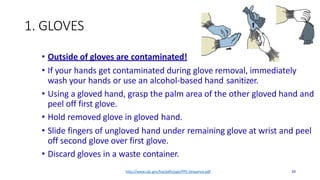
1. GLOVES
• Outside of gloves are contaminated!
• If your hands get contaminated during glove removal, immediately
wash your hands or use an alcohol-based hand sanitizer.
• Using a gloved hand, grasp the palm area of the other gloved hand and
peel off first glove.
• Hold removed glove in gloved hand.
• Slide fingers of ungloved hand under remaining glove at wrist and peel
off second glove over first glove.
• Discard gloves in a waste container.
http://www.cdc.gov/hai/pdfs/ppe/PPE-Sequence.pdf 34
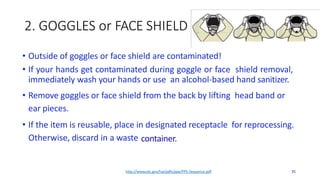
2. GOGGLES or FACE SHIELD
• Outside of goggles or face shield are contaminated!
• If your hands get contaminated during goggle or face shield removal,
immediately wash your hands or use an alcohol-based hand sanitizer.
• Remove goggles or face shield from the back by lifting head band or
ear pieces.
• If the item is reusable, place in designated receptacle for reprocessing.
Otherwise, discard in a waste container.
http://www.cdc.gov/hai/pdfs/ppe/PPE-Sequence.pdf 35
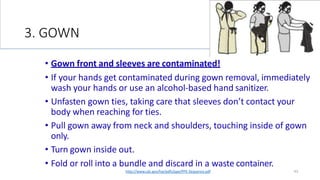
3. GOWN
43
• Gown front and sleeves are contaminated!
• If your hands get contaminated during gown removal, immediately
wash your hands or use an alcohol-based hand sanitizer.
• Unfasten gown ties, taking care that sleeves don’t contact your
body when reaching for ties.
• Pull gown away from neck and shoulders, touching inside of gown
only.
• Turn gown inside out.
• Fold or roll into a bundle and discard in a waste container.
http://www.cdc.gov/hai/pdfs/ppe/PPE-Sequence.pdf
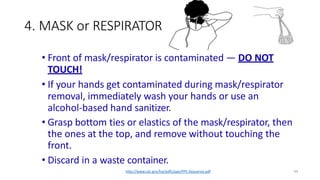
4. MASK or RESPIRATOR
44
• Front of mask/respirator is contaminated — DO NOT
TOUCH!
• If your hands get contaminated during mask/respirator
removal, immediately wash your hands or use an
alcohol-based hand sanitizer.
• Grasp bottom ties or elastics of the mask/respirator, then
the ones at the top, and remove without touching the
front.
• Discard in a waste container.
http://www.cdc.gov/hai/pdfs/ppe/PPE-Sequence.pdf
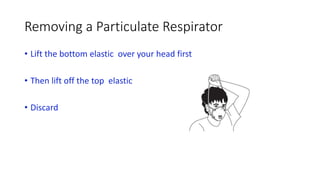
Removing a Particulate Respirator
• Lift the bottom elastic over your head first
• Then lift off the top elastic
• Discard
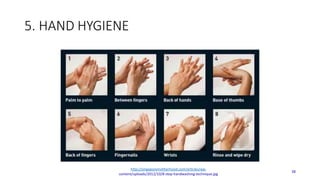
5. HAND HYGIENE
38
http://singaporemotherhood.com/articles/wp-
content/uploads/2012/10/8-step-handwashing-technique.jpg
PPE Use in Healthcare Settings: When to Use PPE
Standard and Expanded Isolation Precautions
Standard Precautions
• Previously called Universal Precautions
• Assumes blood and body fluid of ANY patient could be infectious
• Recommends PPE and other infection control practices to prevent
transmission in any healthcare setting
• Decisions about PPE use determined by type of clinical interaction
with patient
PPE for Standard Precautions
• Gloves – Use when touching blood, body fluids, secretions,
excretions, contaminated items; for touching mucus membranes and
nonintact skin
• Gowns – Use during procedures and patient care activities when
contact of clothing/ exposed skin with blood/body fluids, secretions,
or excretions is anticipated
PPE for Standard Precautions (2)
• Mask and goggles or a face shield – Use during patient care activities
likely to generate splashes or sprays of blood, body fluids, secretions,
or excretions
What Type of PPE Would You Wear
• Giving a bed bath?
Generally none
• Suctioning oral secretions?
Gloves and mask/goggles or a face shield – sometimes gown
• Transporting a patient in a wheel chair?
Generally none required
• Responding to an emergency where blood is spurting?
Gloves, fluid-resistant gown, mask/goggles or a face shield
• Drawing blood from a vein?
Gloves
• Cleaning an incontinent patient with diarrhea?
Gloves w/wo gown
• Irrigating a wound?
Gloves, gown, mask/goggles or a face shield
• Taking vital signs?
Generally none
PPE for Expanded Precautions
Expanded Precautions include
• Contact Precautions
• Droplet Precautions
• Airborne Infection Isolation
Use of PPE for Expanded Precautions
• Contact Precautions – Gown and gloves for contact with patient or
environment of care (e.g., medical equipment, environmental
surfaces)
In some instances these are required for entering patient’s environment
• Droplet Precautions – Surgical masks within 3 feet of patient
• Airborne Infection isolation – Particulate respirator*
• Negative pressure isolation room also required
CONCLUSION
• PPE is available to protect you from exposure to infectious agents in
the healthcare workplace
• Know what type of PPE is necessary for the duties you perform and
use it correctly
THANK YOU FOR YOUR KIND
ATTENTION…
40
Infection Prevention and
Control Unit (IPCU)

DONNING AND DOFFING

  • 1.
    Personal Protective Equipment (PPE) Universityof Perpetual Help DALTAMddPinas City 1 DR.SHARI.S.R IST YR MDS DEPT.OF PROSTHODONTICS GOVT.DENTAL COLLEGE TVM
  • 2.
    Personal Protective Equipment(PPE) Definition •Refers to protective clothing, helmets, gloves, face shields, goggles, facemasks and/or respirators or other equipment designed to protect the wearer from injury or the spread of infection or illness. http://www.fda.gov/MedicalDevices/ProductsandMedicalProcedures/GeneralHospitalDevicesandSupplies/PersonalProtectiveEquipment/default.htm 2
  • 3.
    Personal Protective Equipment(PPE) •Effective use of PPE includes properly removing and disposing of contaminated PPE to prevent exposing both the wearer and other people to infection. http://www.fda.gov/MedicalDevices/ProductsandMedicalProcedures/GeneralHospitalDevicesandSupplies/PersonalProtectiveEquipment/default.htm 3
  • 4.
    Types of PPEUsed in Healthcare Settings • GLOVES – protect hands • GOWNS/ APRONS – protect skin and/or clothing • MASKS and RESPIRATORS – protect mouth/nose RESPIRATORS – protect respiratory tract from airborne infectious agents. • GOGGLES – protect eyes • FACE SHIELDS – protect face, mouth, nose, and eyes http://www.cdc.gov/HAI/prevent/ppe.html 4
  • 5.
    Factors Influencing PPESelection •Type of exposure anticipated - Splash/spray versus touch - Category of isolation precautions •Durability and appropriateness for the task •Fit http://www.cdc.gov/HAI/prevent/ppe.html 5
  • 6.
    Key Definitions • HandHygiene A general term that applies to any one of the following: 1. Handwashing with plain (nonantimicrobial) soap and water). 2.Antiseptic handwash (soap containing antiseptic agents and water). 3.Antiseptic handrub (waterless antiseptic product, most often alcohol-based, rubbed on all surfaces of hands). 4.Surgical hand antisepsis (antiseptic handwash or antiseptic handrub performed preoperatively by surgical personnel to eliminate transient hand flora and reduce resident hand flora). CDC. Guideline for Hand Hygiene in Health-Care Settings: Recommendations of the Healthcare Infection Control Practices Advisory Committee and the HICPAC/SHEA/APIC/IDSA Hand Hygiene Task Force. MMWR 2002;51(16)(RR-16):1-44 6
  • 7.
    Key Definitions • Mask Aterm that applies collectively to items used to cover the nose and mouth and includes both procedure masks and surgical masks. 1. Procedure Mask A covering for the nose and mouth that is intended for use in general patient care situations. These masks generally attach to the face with ear loops rather than ties or elastic. www.fda.gov/cdrh/ode/guidance/094.html#4 7
  • 8.
    Key Definitions 2. SurgicalMask A device worn over the mouth and nose by operating room personnel during surgical procedures to protect both surgical patients and operating room personnel from transfer of microorganisms and body fluids. www.fda.gov/cdrh/ode/guidance/094.html#4 8
  • 9.
  • 10.
    How do Iknow that the mask is oncorrectly? •The metal nose piece is at the top. •The white, or smoothest side, is on the inside against the wearer’s skin; the color always faces out. •The pleats fall downwards and away from the nose (called a “waterfall” pleat). http://www.primed.ca/clinicalresources/maskstandardsandfaq.aspx 10
  • 11.
    Key Definitions • • 3. Respirator Apersonal protective device worn by healthcare personnel to protect them from inhalation exposure to airborne infectious agents that are < 5 μm in size. • N95 disposable particulate, air purifying, respirator is the type used most commonly by healthcare personnel. • N-99 N-100 particulate respirators Powered air-purifying respirators (PAPRS) with high efficiency filters • Non-powered full-facepiece elastomeric negative pressure respirators. www.fda.gov/cdrh/ode/guidance/094.html#4 11
  • 12.
    12 •Goggles • These aretight-fitting eye protection that completely cover the eyes, eye sockets and the facial area immediately surrounding the eyes • Provide protection from impact, dust and splashes. https://www.osha.gov/Publications/osha3151.pdf
  • 13.
    13 Face Shields • Thesetransparent sheets of plastic extend from the eyebrows to below the chin and across the entire width of the employee’s head. • Face shields protect against nuisance dusts and potential splashes or sprays of hazardous liquids but will not provide adequate protection against impact hazards. https://www.osha.gov/Publications/osha3151.pdf
  • 14.
    Facts about EyeProtection •Eye protection can be in the form of goggles, safety glasses, or face shields. • Personal eyeglasses and contact lenses provide some but not complete protection and are not considered adequate eye protection. •Reusable eye protection should be cleaned according to the manufacturer’s instructions. 14 https://smah.uow.edu.au/content/groups/public/@web/@health/documents/doc/uow137337.pdf
  • 15.
  • 16.
    16 • Natural (Latex)Rubber Gloves • They feature outstanding tensile strength, elasticity and temperature resistance. • Latex gloves have caused allergic reactions in some individuals and may not be appropriate for all employees. • Hypoallergenic gloves, glove liners and powderless gloves are possible alternatives for workers who are allergic to latex gloves. https://www.osha.gov/Publications/osha3151.pdf
  • 17.
    17 • Nitrile Gloves •Are made of a copolymer and provide protection from chlorinated solvents such as trichloroethylene and perchloroethylene. • They offer protection when working with oils, greases, acids, caustics and alcohols • But are generally not recommended for use with strong oxidizing agents, aromatic solvents, ketones and acetates. https://www.osha.gov/Publications/osha3151.pdf
  • 18.
    Vinyl gloves • Loosefit • Used in less risk situations • Less expensive
  • 19.
    Facts about Gloves 19 https://smah.uow.edu.au/content/groups/public/@web/@health/documents/doc/uow137337.pdf •Althoughgloves do not prevent needlestick or sharps injuries, studies have demonstrated that the transmission of blood-borne pathogens may be significantly reduced due to the ‘cleaning’ effect the material of the glove has on the instrument as it passes through the glove. Gloves may also reduce the injured person’s contact time with the source’s blood.
  • 20.
    Facts about Gloves 20 https://smah.uow.edu.au/content/groups/public/@web/@health/documents/doc/uow137337.pdf •Prolongedand indiscriminate use of gloves should be avoided as they may cause adverse reactions and skin sensitivity. •In countries with limited resources and an inadequate supply of gloves, used sterile gloves may be washed, sterilized and reused for hygiene purposes only – not for invasive procedures.
  • 21.
    Key Definitions 21 •Gown “Fluid-resistant Gown”apply to protective clothing tested against water as the liquid challenge. “Impermeable Gown” materials that have demonstrated blockage of microorganisms using a recognized standard test method. http://www.cdc.gov/niosh/npptl/topics/protectiveclothing
  • 22.
    GOWN vs. COVERALL 22 •Surgicalgowns rated for high levels of barrier protection may include the high-performance barrier materials in only certain portions of the gown (sleeves and front panel). This is especially important when contact from hazardous/contaminated fluids can come from multiple directions. http://www.cdc.gov/niosh/npptl/topics/protectiveclothing
  • 23.
    GOWN vs. COVERALL 23 •AlthoughCoveralls typically provide 360-degree protection because they are designed to cover the whole body, including back and lower legs and sometimes head and feet as well, the design of surgical/isolation gowns do not provide continuous whole-body protection (e.g., possible openings in the back, coverage to the mid-calf only). http://www.cdc.gov/niosh/npptl/topics/protectiveclothing
  • 24.
    Facts about Gownsor Aprons • Clinical or laboratory coats or jackets worn over personal clothing for comfort and/or purposes of identity are not considered to be PPE. • Aprons and gowns should be removed in a manner that prevents contamination of the wearer’s clothing or skin. The outer ‘contaminated’ side of the gown should be turned inward and rolled into a bundle and then discarded into a designated container for waste linen to contain contamination. • In countries with limited resources where impermeable aprons or gowns are unavailable, a large plastic bag can be cut open and worn under a cotton apron or gown to protect clothing. https://smah.uow.edu.au/content/groups/public/@web/@health/documents/doc/uow137337.pdf 22

  • 25.
  • 26.
  • 27.
    General Considerations (Donningof PPE) •Keep hands away from face. •Limit surfaces touched. •Change when torn or heavily contaminated. •Work from clean to dirty. http://www.cdc.gov/hicpac/pdf/isolation/Isolation2007.pdf 26
  • 28.
  • 29.
    Sequence* for DonningPPE •Gown first •Mask or respirator •Goggles or face shield •Gloves
  • 30.
    2. How todon a GOWN? • Fully cover from neck to knees, arms to end of wrists, and wrap around the back. •Fasten in back of neck and waist. http://www.cdc.gov/hai/pdfs/ppe/PPE-Sequence.pdf 30
  • 31.
    • If gownis too small, use two gowns 1. Gown #1 ties in front 2. Gown #2 ties in back
  • 32.
    3. MASK orRESPIRATOR 32 •Secure ties or elastic bands at middle of head and neck. •Fit flexible band to nose bridge. •Fit snug to face and below chin. •Fit-check respirator. http://www.cdc.gov/hai/pdfs/ppe/PPE-Sequence.pdf
  • 33.
    How to Dona Particulate Respirator • Select a fit tested respirator • Place over nose, mouth and chin • Fit flexible nose piece over nose bridge • Secure on head with elastic • Adjust to fit • Perform a fit check – • Inhale – respirator should collapse • Exhale – check for leakage around face
  • 34.
    4. GOGGLES orFACE SHIELD 34 •Place over face and eyes and adjust to fit. •Anti-fog feature improves clarity. http://www.cdc.gov/hai/pdfs/ppe/PPE-Sequence.pdf
  • 35.
    5. GLOVES 35 • Dongloves last • Select correct type and size • Insert hands into gloves • Extend to cover wrist of isolation gown. http://www.cdc.gov/hai/pdfs/ppe/PPE-Sequence.pdf
  • 37.
  • 38.
    Contaminated” and “Clean”Areas of PPE Contaminated – outside front Areas of PPE that have or are likely to have been in contact with body sites, materials, or environmental surfaces where the infectious organism may reside Clean – inside, outside back, ties on head and back Areas of PPE that are not likely to have been in contact with the infectious organism
  • 39.
    General Considerations (DoffingPPE) •Remove all PPE before exiting the patient room except a respirator, if worn. •Perform Hand Hygiene between steps if hands become contaminated and immediately after removing all PPE. http://www.cdc.gov/hicpac/pdf/isolation/Isolation2007.pdf 39
  • 40.
    Sequence for RemovingPPE Gloves Face shield or goggles Gown Mask or respirator
  • 41.
    1. GLOVES • Outsideof gloves are contaminated! • If your hands get contaminated during glove removal, immediately wash your hands or use an alcohol-based hand sanitizer. • Using a gloved hand, grasp the palm area of the other gloved hand and peel off first glove. • Hold removed glove in gloved hand. • Slide fingers of ungloved hand under remaining glove at wrist and peel off second glove over first glove. • Discard gloves in a waste container. http://www.cdc.gov/hai/pdfs/ppe/PPE-Sequence.pdf 34
  • 42.
    2. GOGGLES orFACE SHIELD • Outside of goggles or face shield are contaminated! • If your hands get contaminated during goggle or face shield removal, immediately wash your hands or use an alcohol-based hand sanitizer. • Remove goggles or face shield from the back by lifting head band or ear pieces. • If the item is reusable, place in designated receptacle for reprocessing. Otherwise, discard in a waste container. http://www.cdc.gov/hai/pdfs/ppe/PPE-Sequence.pdf 35
  • 43.
    3. GOWN 43 • Gownfront and sleeves are contaminated! • If your hands get contaminated during gown removal, immediately wash your hands or use an alcohol-based hand sanitizer. • Unfasten gown ties, taking care that sleeves don’t contact your body when reaching for ties. • Pull gown away from neck and shoulders, touching inside of gown only. • Turn gown inside out. • Fold or roll into a bundle and discard in a waste container. http://www.cdc.gov/hai/pdfs/ppe/PPE-Sequence.pdf
  • 44.
    4. MASK orRESPIRATOR 44 • Front of mask/respirator is contaminated — DO NOT TOUCH! • If your hands get contaminated during mask/respirator removal, immediately wash your hands or use an alcohol-based hand sanitizer. • Grasp bottom ties or elastics of the mask/respirator, then the ones at the top, and remove without touching the front. • Discard in a waste container. http://www.cdc.gov/hai/pdfs/ppe/PPE-Sequence.pdf
  • 45.
    Removing a ParticulateRespirator • Lift the bottom elastic over your head first • Then lift off the top elastic • Discard
  • 46.
  • 47.
    PPE Use inHealthcare Settings: When to Use PPE
  • 48.
    Standard and ExpandedIsolation Precautions
  • 49.
    Standard Precautions • Previouslycalled Universal Precautions • Assumes blood and body fluid of ANY patient could be infectious • Recommends PPE and other infection control practices to prevent transmission in any healthcare setting • Decisions about PPE use determined by type of clinical interaction with patient
  • 50.
    PPE for StandardPrecautions • Gloves – Use when touching blood, body fluids, secretions, excretions, contaminated items; for touching mucus membranes and nonintact skin • Gowns – Use during procedures and patient care activities when contact of clothing/ exposed skin with blood/body fluids, secretions, or excretions is anticipated
  • 51.
    PPE for StandardPrecautions (2) • Mask and goggles or a face shield – Use during patient care activities likely to generate splashes or sprays of blood, body fluids, secretions, or excretions
  • 52.
    What Type ofPPE Would You Wear • Giving a bed bath? Generally none • Suctioning oral secretions? Gloves and mask/goggles or a face shield – sometimes gown • Transporting a patient in a wheel chair? Generally none required • Responding to an emergency where blood is spurting? Gloves, fluid-resistant gown, mask/goggles or a face shield
  • 53.
    • Drawing bloodfrom a vein? Gloves • Cleaning an incontinent patient with diarrhea? Gloves w/wo gown • Irrigating a wound? Gloves, gown, mask/goggles or a face shield • Taking vital signs? Generally none
  • 54.
    PPE for ExpandedPrecautions Expanded Precautions include • Contact Precautions • Droplet Precautions • Airborne Infection Isolation
  • 55.
    Use of PPEfor Expanded Precautions • Contact Precautions – Gown and gloves for contact with patient or environment of care (e.g., medical equipment, environmental surfaces) In some instances these are required for entering patient’s environment • Droplet Precautions – Surgical masks within 3 feet of patient • Airborne Infection isolation – Particulate respirator* • Negative pressure isolation room also required
  • 56.
    CONCLUSION • PPE isavailable to protect you from exposure to infectious agents in the healthcare workplace • Know what type of PPE is necessary for the duties you perform and use it correctly
  • 57.
    THANK YOU FORYOUR KIND ATTENTION… 40 Infection Prevention and Control Unit (IPCU)