Infection Control
Measures
General Control Measures
Prevention of Airborne Contamination
• Cover mouth and nose ( coughing or sneezing)
• Limit number of persons in a room
• Removal of dirt and dust
• Open room to fresh air and sunlight
• Roll linens together
• Remove bacteria from the air (air filters)
Handling of Food and Eating Utensils
• Use high quality foods
• Proper refrigeration and storage of food
• Proper washing, preparing, and cooking of food
• Proper disposal of uneaten food
• Proper hand washing
• Proper disposal of oral and nasal secretion
• Cover hair and wear clean clothes and apron
• Provide periodic health exam for kitchen workers
• Keep cutting boards clean
• Prohibit anyone with respiratory or GIT disease from handling food
• Rinse and wash utensils with a temperature above 80°C
Handling of Fomites
• Use disposable equipment's
• Sterilize or disinfect equipment
• Use individual equipment for each patient
• Use single use thermometers
• Empty bedpans and urinals properly and wash with hot water, store in dry
,clean area or storage
• Place used linens and personal care equipments, and soiled laundry in a bag
Medical Asepsis
• Clean technique: Involves procedures and practices that reduce the
number and transfer of pathogens
• Will exclude pathogens ONLY
• Attained by:
• Frequent and thorough hand washing
• Personal grooming
• Proper cleaning of supplies and equipment
• Disinfection
• Proper disposal of needles, contaminated materials and infectious waste
• Sterilization
Surgical Asepsis
• STERILE TECHNIQUE : Practices used to render and keep objects and
areas sterile
• Exclude ALL microorganism
• Attained by:
• Use strict aseptic precautions for invasive procedures
• Scrub hands and fingernails before entering O.R.
• Use sterile gloves, masks, gowns and shoe covers
• Use sterile solutions and dressings
• Use sterile drapes and create an sterile field
• Heat –sterilized surgical instruments
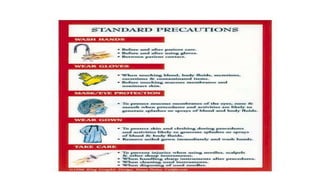
Universal Precaution (Standard Precaution)
• Defined by center for disease control (CDC) 1996
• Primary strategy for reducing the risk of & controlling Nosocomial
infections
• Used for care of all hospitalized patients, regardless of diagnosis and are
presumed infectious
• Protect healthcare workers from contamination and infection ( i.e. HIV,
HBV)
• Hand Washing
• Routine: Plain (non microbial) soap
• Outbreak Control: Antimicrobial/Antiseptic Agent
• Wash After:
• 1.touching blood and other body fluids
• 2. touch contaminated items
• 3. removal of gloves
• 4. between patient contact, task, procedure
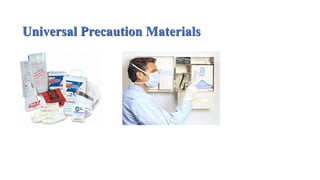
Universal Precaution Materials
Gloves
• Must be worn when touching blood, body fluids, secretions, excretions and
contaminated items, mucous membranes and non- intact skin
• Change gloves between tasks or procedures
• Remove gloves after use and before going to another patient
Masks, Eye Protection, Face Shields, Gowns
• Wear in procedures that can generate splashes or sprays of blood, body fluids,
secretions or excretions or cause soiling of clothing
Environmental Control
• Routine care, cleaning and disinfection of environmental surfaces
Patient Care Equipment
• Prevent contaminating yourself or transfer microbes to others
• Properly clean, disinfect or sterilize
• Dispose single – use items
Linens
• Handled, transported and processed to prevent contamination and transfer
of microorganisms
Occupational Health and Blood –borne Pathogens
• Never recap used needles
• Puncture – resistant containers
Revised C.D.C. Isolation Precaution
( centers for disease control)
2. Transmission-Based Precautions
The second tier of precaution
Precaution are instituted for patients who are known to be or suspected of
being infected with highly transmissible infection.
THREE TYPES OF TRANSMISSION-BASED PRECAUTIONS:
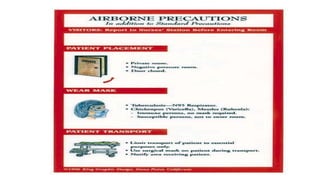
1. Airborne precautions
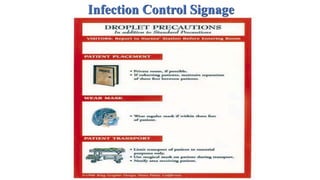
2.Droplet precautions
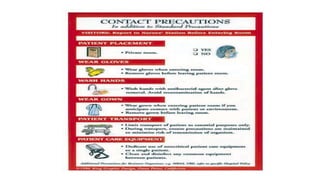
3.Contact precautions
Infection Control Signage
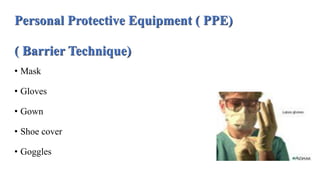
Personal Protective Equipment ( PPE)
( Barrier Technique)
• Mask
• Gloves
• Gown
• Shoe cover
• Goggles
Isolation
• is a protective procedure that limits the spread of infectious diseases
among hospitalized clients, hospital personnel, and visitors. It is the
separation from other persons of an individual suffering from a
communicable disease.
• - other terms are: protective aseptic technique or barrier technique
• Quarantine - is the limitation of freedom of movement of
persons or animals which have been exposed to communicable
disease / s for a period of time equivalent to the longest incubation
period of that disease
Seven categories recommended in isolation
1. Strict isolation
-Use mask , gown and gloves (MUST)
- Private room
- For highly contagious or virulent infections
2. Contact isolation
3. Respiratory isolation
4. TB isolation
5. Enteric isolation
6. Drainage/secretion precaution
7. Universal precaution when handling blood and body fluids
• Type : STRICT
• Purpose: Prevent Transmission of highly contagious or virulent infections spread by
air and contact
• Specification: Private Room – necessary
• Hand Washing – X
• Gown – X
• Masks – X
• Gloves – X
• Articles – Discard or bag and label and send for
decontamination and reprocessing.
• Diseases requiring Isolation – Diphtheria (pharyngeal), Lassa fever, Smallpox , Varicella.
• Type : Contact
• Purpose: Prevent Transmission of highly transmissible infections that
do not require strict isolation.
• Specification: Private Room – necessary
-Hand Washing – X
-Gown – wear if soiling is likely
-Masks – wear in close contact with client
-Gloves – wear if touching infective material.
-Articles – Discard or bag and label and send
• for decontamination and reprocessing.
• Diseases requiring Isolation – Acute Resp. infection in infant and
young children, Herpes simplex, Impetigo, multiple resistant bacterial
infection.
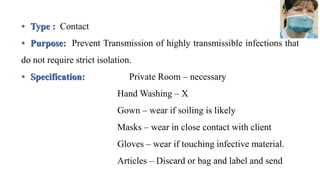
• Type : Contact
• Purpose: Prevent Transmission of highly transmissible infections that
do not require strict isolation.
• Specification: Private Room – necessary
Hand Washing – X
Gown – wear if soiling is likely
Masks – wear in close contact with client
Gloves – wear if touching infective material.
Articles – Discard or bag and label and send
• for decontamination and reprocessing.
• Diseases requiring Isolation – Acute Resp. infection in infant and young
children, Herpes simplex, Impetigo, multiple resistant bacterial infection.
Type : Tuberculosis
Purpose: For client with PTB who has positive sputum or chest x-ray
that indicates active disease
Specification: Private Room – necessary
Hand Washing – X
Gown – Wear if soiling is likely
Masks – wear if client is coughing and does
not consistently cover mouth
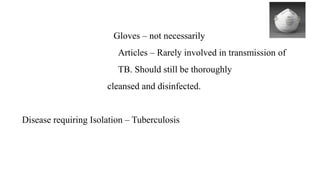
Gloves – not necessarily
Articles – Rarely involved in transmission of
TB. Should still be thoroughly
cleansed and disinfected.
Disease requiring Isolation – Tuberculosis
Type : Enteric Precautions
Purpose: To prevent infections that are transmitted by direct or indirect contact with
feces.
Specification: Private Room – Indicated if client’s hygiene is poor and
there is risk of contamination with infective materials.
Hand Washing – X
Gown – wear if soiling is likely
Masks – not necessary
Gloves – wear if touching infective material
Articles – Discard or bag and label and send
for decontamination and reprocessing.
Disease requiring Isolation – Hepatitis, viral (type A),Gastroenteritis
caused by highly infectious organism cholera, Diarrhea, acute with
infectious etiology.
Type : Drainage- secretion precautions
Purpose: To prevent infections that are transmitted by direct or
indirect contact with purulent material or drainage from infected site.
Specification: Private Room – not necessary
Hand Washing – X
Gown – wear if soiling is likely
Masks – not necessary
Gloves – wear if touching infective material
Articles – Discard or bag and label and send for decontamination and
reprocessing.
.
Disease requiring Isolation – Abscess, Burn infection, conjunctivitis,
decubitus- ulcer skin or wound infection
Type : Blood- body fluid precaution
Purpose: To prevent infections that are transmitted by direct or indirect contact with
blood or body fluid.
Specification: Private Room – Only if client’s hygiene is poor
Hand Washing – X
Gown – Wear if soiling with blood or body fluid is likely
Masks – not necessary
Gloves – wear if touching blood or body fluid.
Articles – Discard or bag and label and send
for decontamination and reprocessing.
Disease requiring Isolation – AIDS, Hepatitis, viral (Type B), Malaria,
Syphilis, primary and secondary.
Reverse Isolation
 Protective or neutropenic isolation
 Used for patients with severe burns, leukemia, transplant, immuno
deficient persons, receiving radiation treatment, leukopenic patients
 Those that enter the room must wear masks and sterile gowns to prevent
from introducing microorganisms to the room.
AFB ISOLATION
VISITORS - report to nurses’ station before entering the room
- MASKS – worn in patients room
- GOWNS – prevent clothing contamination
- GLOVES – for body fluids and non intact skin
- HANDWASHING - after touching patient or potentially contaminated articles
and after removing gloves
- articles discarded, cleaned or sent for decontamination and reprocessing
- room remains closed
- patients wear masks during transport
Additional Pointers
Regarding Disposal Precaution
Secretion: Patient should be instructed to expectorate into tissue held close to mouth.
Suction catheters and gloves should be disposed of in impervious, sealed bags.
Excretion: Strict attention should be paid to careful hand washing; disease can be
spread by oral- fecal route.
Blood: needles and syringes should be disposable. Used needles should not be
recapped. They should be placed in a puncture-resistant container that is prominently
labeled “ Isolation “ Specimens should be labeled “ Blood Precaution”.
Environmental Control
Routine care, cleaning and disinfection of environmental surfaces
Precautions for invasive procedures:
wear gloves during all invasive procedure + goggles + mask
Work Practice Precaution
Prevent injuries caused by needles, scalpels and other sharps instrument or
devices when cleaning used instrument, when disposing of used needles
Do not recap used needles, bend , break nor remove them from disposable
syringes or manipulate them.
Place sharps in puncture resistant containers If gloves tears or a needle-stick
or other injury occurs, REMOVE the gloves, wash hands, and wash sites of the
needle stick thoroughly then put new glove Report injuries and mucous
membrane exposure to appropriate infection control officer.
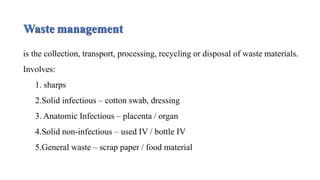
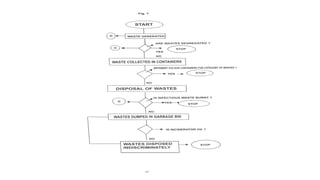
Waste management
is the collection, transport, processing, recycling or disposal of waste materials.
Involves:
1. sharps
2.Solid infectious – cotton swab, dressing
3. Anatomic Infectious – placenta / organ
4.Solid non-infectious – used IV / bottle IV
5.General waste – scrap paper / food material
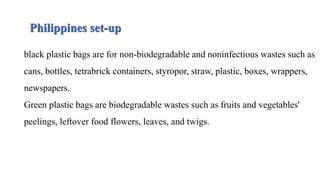
black plastic bags are for non-biodegradable and noninfectious wastes such as
cans, bottles, tetrabrick containers, styropor, straw, plastic, boxes, wrappers,
newspapers.
Green plastic bags are biodegradable wastes such as fruits and vegetables'
peelings, leftover food flowers, leaves, and twigs.
Philippines set-up
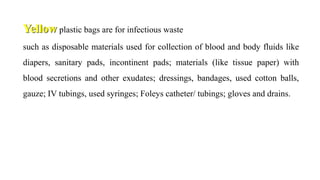
Yellow plastic bags are for infectious waste
such as disposable materials used for collection of blood and body fluids like
diapers, sanitary pads, incontinent pads; materials (like tissue paper) with
blood secretions and other exudates; dressings, bandages, used cotton balls,
gauze; IV tubings, used syringes; Foleys catheter/ tubings; gloves and drains.
Means of controlling the spread of CD
1. Elimination of the source of infection
2. Interruption of transmission
3. Protection of susceptible host.
Infection Control Measures.pdf communicable

Infection Control Measures.pdf communicable

  • 1.
  • 2.
    General Control Measures Preventionof Airborne Contamination • Cover mouth and nose ( coughing or sneezing) • Limit number of persons in a room • Removal of dirt and dust • Open room to fresh air and sunlight • Roll linens together • Remove bacteria from the air (air filters)
  • 3.
    Handling of Foodand Eating Utensils • Use high quality foods • Proper refrigeration and storage of food • Proper washing, preparing, and cooking of food • Proper disposal of uneaten food • Proper hand washing • Proper disposal of oral and nasal secretion
  • 4.
    • Cover hairand wear clean clothes and apron • Provide periodic health exam for kitchen workers • Keep cutting boards clean • Prohibit anyone with respiratory or GIT disease from handling food • Rinse and wash utensils with a temperature above 80°C
  • 5.
    Handling of Fomites •Use disposable equipment's • Sterilize or disinfect equipment • Use individual equipment for each patient • Use single use thermometers • Empty bedpans and urinals properly and wash with hot water, store in dry ,clean area or storage • Place used linens and personal care equipments, and soiled laundry in a bag
  • 6.
    Medical Asepsis • Cleantechnique: Involves procedures and practices that reduce the number and transfer of pathogens • Will exclude pathogens ONLY • Attained by: • Frequent and thorough hand washing • Personal grooming • Proper cleaning of supplies and equipment
  • 7.
    • Disinfection • Properdisposal of needles, contaminated materials and infectious waste • Sterilization
  • 8.
    Surgical Asepsis • STERILETECHNIQUE : Practices used to render and keep objects and areas sterile • Exclude ALL microorganism • Attained by: • Use strict aseptic precautions for invasive procedures • Scrub hands and fingernails before entering O.R. • Use sterile gloves, masks, gowns and shoe covers • Use sterile solutions and dressings
  • 9.
    • Use steriledrapes and create an sterile field • Heat –sterilized surgical instruments
  • 10.
    Universal Precaution (StandardPrecaution) • Defined by center for disease control (CDC) 1996 • Primary strategy for reducing the risk of & controlling Nosocomial infections • Used for care of all hospitalized patients, regardless of diagnosis and are presumed infectious • Protect healthcare workers from contamination and infection ( i.e. HIV, HBV) • Hand Washing
  • 11.
    • Routine: Plain(non microbial) soap • Outbreak Control: Antimicrobial/Antiseptic Agent • Wash After: • 1.touching blood and other body fluids • 2. touch contaminated items • 3. removal of gloves • 4. between patient contact, task, procedure
  • 13.
  • 14.
    Gloves • Must beworn when touching blood, body fluids, secretions, excretions and contaminated items, mucous membranes and non- intact skin • Change gloves between tasks or procedures • Remove gloves after use and before going to another patient Masks, Eye Protection, Face Shields, Gowns • Wear in procedures that can generate splashes or sprays of blood, body fluids, secretions or excretions or cause soiling of clothing Environmental Control • Routine care, cleaning and disinfection of environmental surfaces
  • 15.
    Patient Care Equipment •Prevent contaminating yourself or transfer microbes to others • Properly clean, disinfect or sterilize • Dispose single – use items Linens • Handled, transported and processed to prevent contamination and transfer of microorganisms Occupational Health and Blood –borne Pathogens • Never recap used needles • Puncture – resistant containers
  • 16.
    Revised C.D.C. IsolationPrecaution ( centers for disease control) 2. Transmission-Based Precautions The second tier of precaution Precaution are instituted for patients who are known to be or suspected of being infected with highly transmissible infection. THREE TYPES OF TRANSMISSION-BASED PRECAUTIONS: 1. Airborne precautions 2.Droplet precautions 3.Contact precautions
  • 18.
  • 20.
    Personal Protective Equipment( PPE) ( Barrier Technique) • Mask • Gloves • Gown • Shoe cover • Goggles
  • 21.
    Isolation • is aprotective procedure that limits the spread of infectious diseases among hospitalized clients, hospital personnel, and visitors. It is the separation from other persons of an individual suffering from a communicable disease. • - other terms are: protective aseptic technique or barrier technique
  • 22.
    • Quarantine -is the limitation of freedom of movement of persons or animals which have been exposed to communicable disease / s for a period of time equivalent to the longest incubation period of that disease
  • 23.
    Seven categories recommendedin isolation 1. Strict isolation -Use mask , gown and gloves (MUST) - Private room - For highly contagious or virulent infections 2. Contact isolation 3. Respiratory isolation 4. TB isolation 5. Enteric isolation 6. Drainage/secretion precaution 7. Universal precaution when handling blood and body fluids
  • 24.
    • Type :STRICT • Purpose: Prevent Transmission of highly contagious or virulent infections spread by air and contact • Specification: Private Room – necessary • Hand Washing – X • Gown – X • Masks – X • Gloves – X • Articles – Discard or bag and label and send for decontamination and reprocessing. • Diseases requiring Isolation – Diphtheria (pharyngeal), Lassa fever, Smallpox , Varicella.
  • 25.
    • Type :Contact • Purpose: Prevent Transmission of highly transmissible infections that do not require strict isolation. • Specification: Private Room – necessary -Hand Washing – X -Gown – wear if soiling is likely -Masks – wear in close contact with client -Gloves – wear if touching infective material. -Articles – Discard or bag and label and send
  • 26.
    • for decontaminationand reprocessing. • Diseases requiring Isolation – Acute Resp. infection in infant and young children, Herpes simplex, Impetigo, multiple resistant bacterial infection.
  • 27.
    • Type :Contact • Purpose: Prevent Transmission of highly transmissible infections that do not require strict isolation. • Specification: Private Room – necessary Hand Washing – X Gown – wear if soiling is likely Masks – wear in close contact with client Gloves – wear if touching infective material. Articles – Discard or bag and label and send
  • 28.
    • for decontaminationand reprocessing. • Diseases requiring Isolation – Acute Resp. infection in infant and young children, Herpes simplex, Impetigo, multiple resistant bacterial infection.
  • 29.
    Type : Tuberculosis Purpose:For client with PTB who has positive sputum or chest x-ray that indicates active disease Specification: Private Room – necessary Hand Washing – X Gown – Wear if soiling is likely Masks – wear if client is coughing and does not consistently cover mouth
  • 30.
    Gloves – notnecessarily Articles – Rarely involved in transmission of TB. Should still be thoroughly cleansed and disinfected. Disease requiring Isolation – Tuberculosis
  • 31.
    Type : EntericPrecautions Purpose: To prevent infections that are transmitted by direct or indirect contact with feces. Specification: Private Room – Indicated if client’s hygiene is poor and there is risk of contamination with infective materials. Hand Washing – X Gown – wear if soiling is likely Masks – not necessary Gloves – wear if touching infective material Articles – Discard or bag and label and send
  • 32.
    for decontamination andreprocessing. Disease requiring Isolation – Hepatitis, viral (type A),Gastroenteritis caused by highly infectious organism cholera, Diarrhea, acute with infectious etiology.
  • 33.
    Type : Drainage-secretion precautions Purpose: To prevent infections that are transmitted by direct or indirect contact with purulent material or drainage from infected site. Specification: Private Room – not necessary Hand Washing – X Gown – wear if soiling is likely Masks – not necessary Gloves – wear if touching infective material Articles – Discard or bag and label and send for decontamination and reprocessing. .
  • 34.
    Disease requiring Isolation– Abscess, Burn infection, conjunctivitis, decubitus- ulcer skin or wound infection
  • 35.
    Type : Blood-body fluid precaution Purpose: To prevent infections that are transmitted by direct or indirect contact with blood or body fluid. Specification: Private Room – Only if client’s hygiene is poor Hand Washing – X Gown – Wear if soiling with blood or body fluid is likely Masks – not necessary Gloves – wear if touching blood or body fluid. Articles – Discard or bag and label and send for decontamination and reprocessing.
  • 36.
    Disease requiring Isolation– AIDS, Hepatitis, viral (Type B), Malaria, Syphilis, primary and secondary.
  • 37.
    Reverse Isolation  Protectiveor neutropenic isolation  Used for patients with severe burns, leukemia, transplant, immuno deficient persons, receiving radiation treatment, leukopenic patients  Those that enter the room must wear masks and sterile gowns to prevent from introducing microorganisms to the room.
  • 38.
    AFB ISOLATION VISITORS -report to nurses’ station before entering the room - MASKS – worn in patients room - GOWNS – prevent clothing contamination - GLOVES – for body fluids and non intact skin - HANDWASHING - after touching patient or potentially contaminated articles and after removing gloves - articles discarded, cleaned or sent for decontamination and reprocessing - room remains closed - patients wear masks during transport
  • 39.
    Additional Pointers Regarding DisposalPrecaution Secretion: Patient should be instructed to expectorate into tissue held close to mouth. Suction catheters and gloves should be disposed of in impervious, sealed bags. Excretion: Strict attention should be paid to careful hand washing; disease can be spread by oral- fecal route. Blood: needles and syringes should be disposable. Used needles should not be recapped. They should be placed in a puncture-resistant container that is prominently labeled “ Isolation “ Specimens should be labeled “ Blood Precaution”.
  • 40.
    Environmental Control Routine care,cleaning and disinfection of environmental surfaces Precautions for invasive procedures: wear gloves during all invasive procedure + goggles + mask
  • 41.
    Work Practice Precaution Preventinjuries caused by needles, scalpels and other sharps instrument or devices when cleaning used instrument, when disposing of used needles Do not recap used needles, bend , break nor remove them from disposable syringes or manipulate them. Place sharps in puncture resistant containers If gloves tears or a needle-stick or other injury occurs, REMOVE the gloves, wash hands, and wash sites of the needle stick thoroughly then put new glove Report injuries and mucous membrane exposure to appropriate infection control officer.
  • 42.
    Waste management is thecollection, transport, processing, recycling or disposal of waste materials. Involves: 1. sharps 2.Solid infectious – cotton swab, dressing 3. Anatomic Infectious – placenta / organ 4.Solid non-infectious – used IV / bottle IV 5.General waste – scrap paper / food material
  • 44.
    black plastic bagsare for non-biodegradable and noninfectious wastes such as cans, bottles, tetrabrick containers, styropor, straw, plastic, boxes, wrappers, newspapers. Green plastic bags are biodegradable wastes such as fruits and vegetables' peelings, leftover food flowers, leaves, and twigs. Philippines set-up
  • 45.
    Yellow plastic bagsare for infectious waste such as disposable materials used for collection of blood and body fluids like diapers, sanitary pads, incontinent pads; materials (like tissue paper) with blood secretions and other exudates; dressings, bandages, used cotton balls, gauze; IV tubings, used syringes; Foleys catheter/ tubings; gloves and drains.
  • 46.
    Means of controllingthe spread of CD 1. Elimination of the source of infection 2. Interruption of transmission 3. Protection of susceptible host.