HOSPITAL ACQUIRED
    INFECTION
"Not what you want to hear,
but what you need to know"
Nosocomial Infections
      Hospital Acquired Infections


Infection in a hospitalized patient who was
admitted for a reason other than that infection
Not present or incubating on admission
 Occurring up to 30 days after discharge
Some Statistics for HAI:

•Affects approximately 10% of all in-patients
• Delays discharge
• Costs two times more than if there is no infection
• Direct cause of deaths
MRSA
     Methicillin-Resistant
    StaphylococcusAureus

 Hosptial Acquired Infections
             And
Community Acquired Infections
MRSA


How it is Spread
MRSA


What it Causes
KlebsiellaPneumoniae

  Lastest Outbreak
KlebsiellaPneumoniae


     Statistics
KlebsiellaPneumoniae

  How it is Spread
KlebsiellaPneumo
       niae

 What it Causes
How to Avoid Infections


Do not go to the hospital
       unless you
   Are badly injured
       or very ill
How to Avoid Infections


Do not go to the hospital
    Unless someone
Who is dependent on You
     For assistance
     Is hospitalized
How to Avoid Infections


   LIMIT VISITORS

         OR

    NO VISITORS
How to Avoid Infections


If you go to a hospital
    For any reason,
  Take a shower and
 Change your clothes
 When you get home
How to Avoid Infections


Insist on Handwashing
       By Visitors
        By Staff
     By Physicians
Predisposing Factors
            To Get an HAI
Age
Sex (Females after cardiac surgery)
Severity of Illness
Other medical conditions
Immunosuppressive Compromised
Malnutrition
Obesity
Other Factors
      That Increase Risk of an HAI

More sick patients are admitted
More invasive procedures
New microorganisms
Increasing bacterial resistance to
antibiotics
The problem of HAI
USA
  – Urinary tract infections: 2.4 per 100 admissions
  – Pneumonia: 1 case per 100 admissions
  – Surgical site infections: 2.8 per 100 operations
  – One death every 6 minutes

Norway
  – One of 19 patients admitted will develop a HAI
Cost of NCI

Extra days in hospital:

  Urinary tract infections: 6
  Pneumonia:                12
  Surgical site infections: 7
HAI


30 % of HAI’s are Preventable!
Where do the
 microbes
come from?
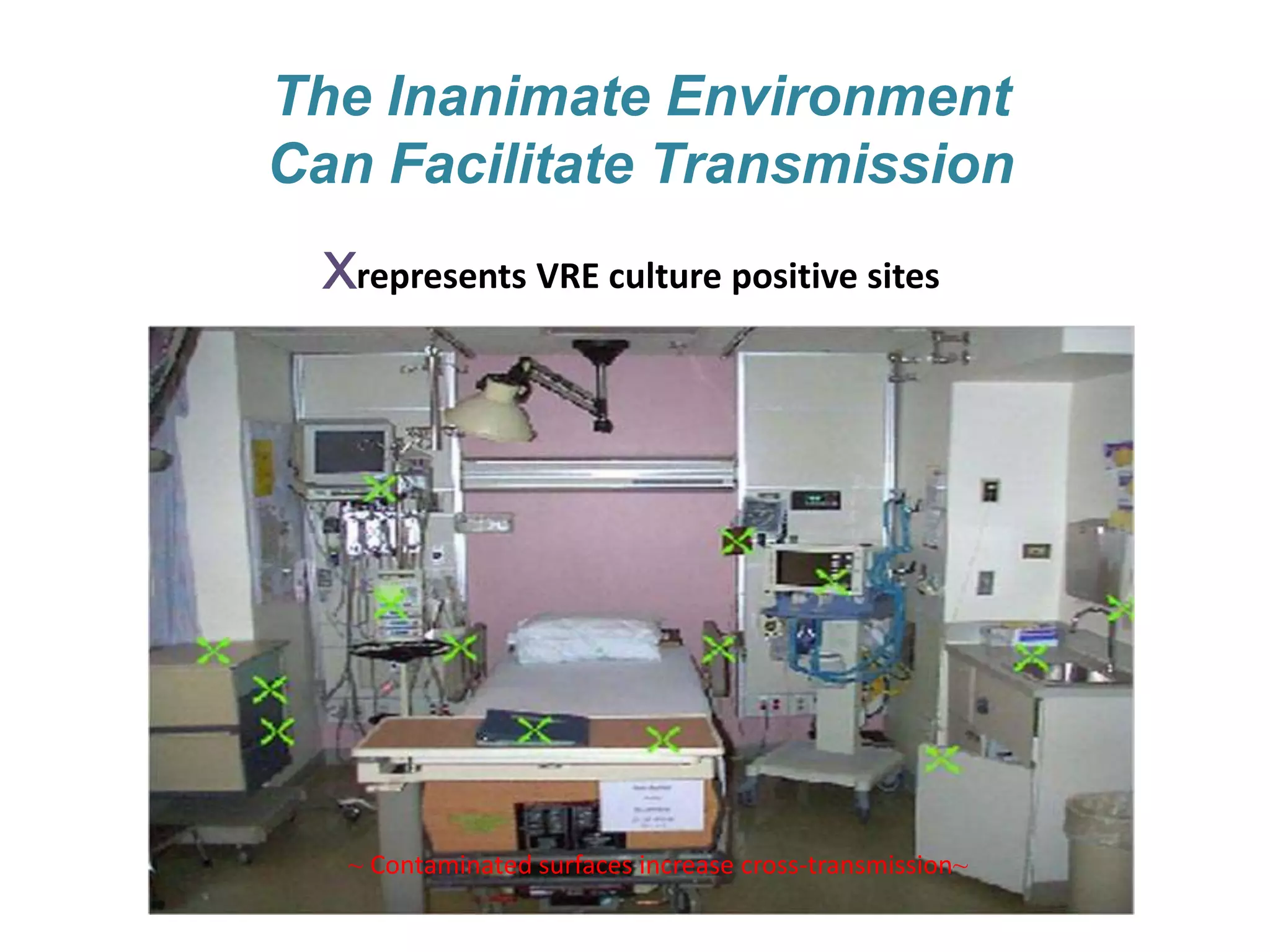
The Inanimate Environment
Can Facilitate Transmission
  Xrepresents VRE culture positive sites


   ~ Contaminated surfaces increase cross-transmission~
Where Do The
        Microbes Come From?

 patient's own flora
 cross infection from medical personnel
 cross infection from patient to patient
 hospital environment- inanimate objects
  -
Spread of Infection
          Airborne
Sneezing
 Coughing
 Air ventilation systems
 Air conditioners
Sometimes an illness is passed to others by a carrier, or a person who has been
infected by a germ but does not look or feel sick. This person may carry the germ
in their nose, throat, or stomach. They can pass the germ to others by coughing,
sneezing, or by not washing their hands properly.
Spread of Infection
       Direct Contact
Hands
 Clothing
 Clinical Equipment
Spread of Infection
      Indirect Contact
Bedpans, Urinals
 Remember the X’s on previous photo
HAI Urinary Tract Infections
            Prevention

Limit length of time to have catheter

       Drink plenty of water

When walking with catheter hold or
 keep the bag mid-thigh or lower
HAI Post-Operative
      Prevention

        Cough

Deep Breathing Exercises

Get out of bed and WALK
HAI IV Catheter
        Prevention

Immediately contact the nurse:
          Redness
          Burning
            Pain
        Hot to touch
       Cold to touch
    Swelling at the site
Many People Don’t Realize When
      They Have Germs on Their Hands

• You can get 100s to 1000s of bacteria on your
  hands by doing simple tasks like:
  –   Assisting patients up in bed
  –   Touching hands
  –   Touching any object in the room
  –   Touching the patient’s gown or bed sheets
  –   Do Not forget Door Knobs
Hand Washing is Important
Because…
           • 80% of disease is spread by your hands.

           • Hand washing is the most effective way to
              prevent the spread of respiratory illness.

           • Some germs can live on dry surfaces for
              several hours and moist surfaces
              like, sinks for 3 days.
Hand Hygiene
  is the single most
effective intervention
     to reduce the
cross transmission of
   HAI infections
Visible soiling

Hands that are visibly soiled or
potentially grossly contaminated
with dirt or organic material
MUST by washed with liquid
soap and water
Alcohol Hand Rubs
•   Require less time
•   Can be strategically placed
•   Readily accessible
•   Multiple sites
•   All patient care areas
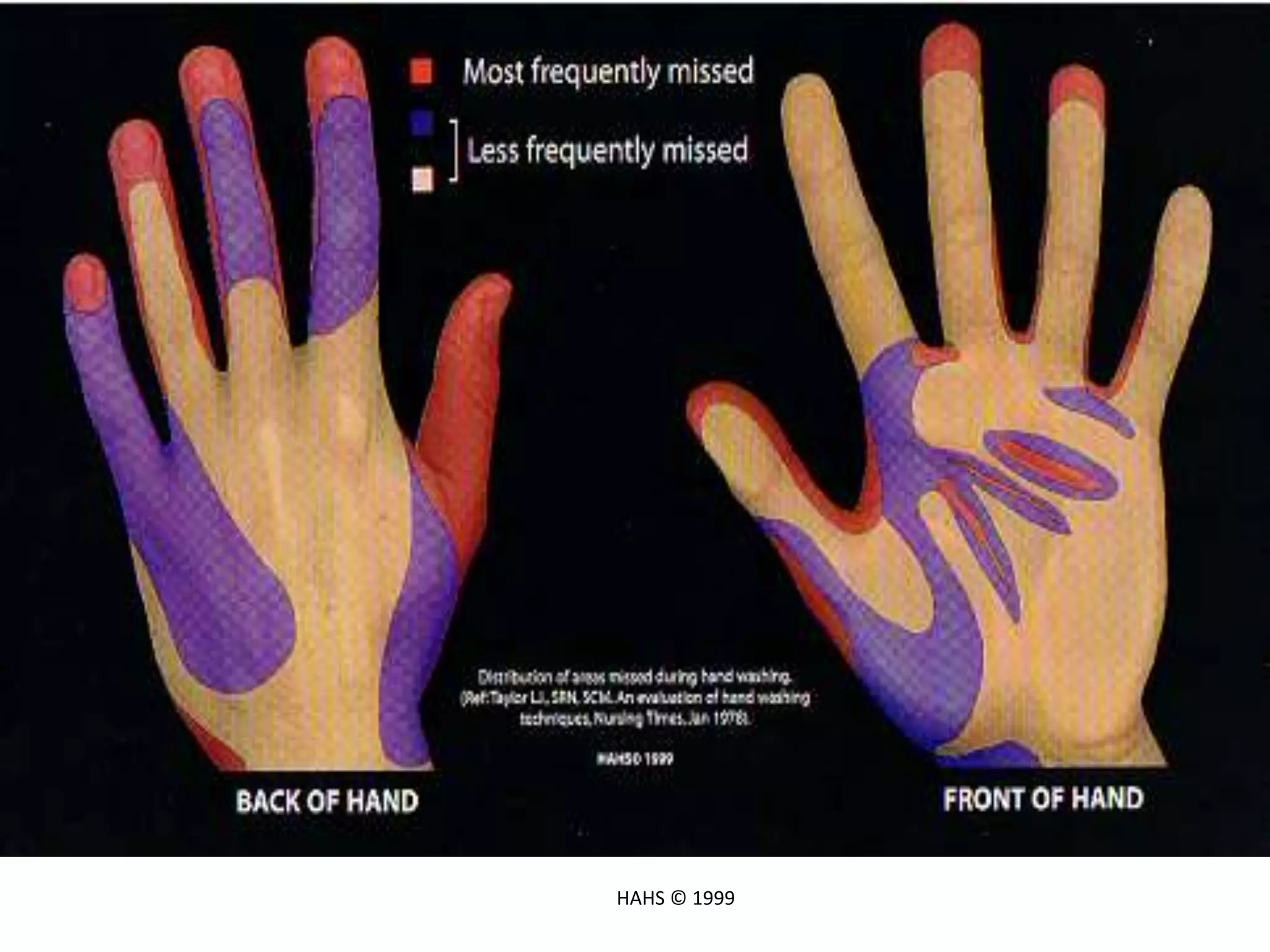
Areas Most Frequently Missed


             HAHS © 1999
Hand hygiene is the
simplest, most effective
measure for preventing
   hospital-acquired
      infections.
BE YOUR OWN ADVOCATE

When it comes to our health care, we patients
must be sure we understand exactly what the
risks and benefits are to any form of test or
treatment before we give consent.

Begin with, “Doctor, let me make sure I
understand….” Then restate what the doctor
just told you. If the doctor corrects you, then
restate it again until you know you have it right.
BE YOUR OWN ADVOCATE


You will need to be able to:

             Listen and take notes
            Research your condition
            Ask intelligent questions

      If you are not able to advocate for yourself,
       don’t be too embarrassed to ask for help.
BE YOUR OWN ADVOCATE


Don't wait to be asked.

Most patients are too overcome to think about what
they need.

They may not know what they need, and they may
feel embarrassed.
BE YOUR OWN ADVOCATE


Ask questions politely:

Ask for staff to use another needle if they have
  already poked you with it.

Ask staff to wash their hands before they help you.

Ask staff to wear gloves.
BE YOUR OWN ADVOCATE


Ask questions politely:
Ask for your room or bathroom to be cleaned. Be specific
  if there is a problem.

Ask for a blanket to be placed on the wheelchair before
  you sit in it.

Ask for a blanket to be placed in the chair in your room
  before you sit on the chair.
BE YOUR OWN ADVOCATE


Get copies of all tests.

  Before you leave, be sure ask the doctor for copies of
  all tests. They won't offer them, so you need to ask.
  Having them is tremendously helpful when visiting
  other doctors.

In Panama, you are responsible to get all of your
  laboratory, x-rays and other test results. They are not
  automatically sent to your physician.
WHAT IS THE CONNECTION OF
       ANTIBIOTIC USE TO HAI?

• High prevalence of resistant bacterial
  strains present in the hospital
• High capacity of bacteria to mutate to
  resistant strains
• Misuse and overuse of antibiotics
Viruses

• cause most common respiratory
  illnesses, such as colds and coughs
• cause a variety of infections
• may take 2-3 weeks to resolve completely
• some viruses can be prevented by vaccines
  and immunizations
• antibiotics do not work for viruses
Bacteria

• make you sick when they are where they
  don’t belong or grow more rapidly than
  normal
• live in your mouth, nose and throat
• are necessary for normal body functions like
  digestion
• are one of the oldest living things on Earth
Antibiotic Resistant
  Bacteria Are:
Bacteria that mutate and are able to
resist the antibiotics that are meant to
kill them.
This is a normal process speeded up by
the overuse and misuse of antibiotics.

                                           8
Why is Antibiotic Misuse
   a Problem?
1. Antibiotics become less effective and may not
   work the next time you use them.
2. Improper use of antibiotics leads to more
   antibiotic resistant bacteria.
3. Antibiotic resistant bacteria can be spread
   throughout the community and from person to
   person.


                                                   7
Support Appropriate
Antibiotic Use In Panama!
Everyone Can Help Keep Antibiotics Working


• By using antibiotics only when needed
• Following good hygiene practices
What to Expect When You Are Ready
     To Be Discharged from the Hospital


Without all of the professional medical help
you have a better chance of recovery

You will be home with all of your familiar
germs
At Home Prevention Tips
            for After Surgery:

Take a Good Multivitamin
 Drink lots of water
 Eat lots of protein if there is no
contraindication
 Fruits and Veggies are helpful to prevent
problems with constipation
At Home Prevention Tips
           for After Surgery:

Get Plenty of Rest
 ASAP & with MDs ok – Get up and do
some walking around the house
 Limit your VISITORS
At Home Prevention Tips
           for After Surgery:

Take your pain medication as prescribed by
your physician
 DO NOT try to be brave and hold back
from controlling your pain
 It takes more medicine to control pain if
you wait too long
Warning Signs of a
            Possible Infection:

Fever
 Redness at the surgical site or injury
 Heat at the surgical site or inury
Warning Signs of a
          Possible Infection:

Shortness of Breath
 Nausea and Vomiting
 Generalized weakness
What to Do if You Think
        You Have and Infection:

Contact your physician
What to Do if You Think
          You Have and Infection:

• Always take antibiotics exactly as prescribed
• Finish the whole prescription - do not stop when
  you feel better
• Never save antibiotics for a future illness – or
  share with others
• Do not take your friends pills or any old
  antibiotics hanging around your home. They
  may not work for that specific germ.

                                                     10
What to Do if You Think
         You Have and Infection:


Take a marker and outline the borders of
  the redness noted.


This will allow you to see if your antibiotic
 is working.


                                                10
Summary


Hospital   Pathogen       Unhappy    Unhappy
                          patients   director


Hospital   Surveillance   Happy      Happy
                          Patients   director
Questions?
THANK YOU &

Hospital acquired infection presentation

  • 1.
  • 2.
    "Not what youwant to hear, but what you need to know"
  • 3.
    Nosocomial Infections Hospital Acquired Infections Infection in a hospitalized patient who was admitted for a reason other than that infection Not present or incubating on admission  Occurring up to 30 days after discharge
  • 4.
    Some Statistics forHAI: •Affects approximately 10% of all in-patients • Delays discharge • Costs two times more than if there is no infection • Direct cause of deaths
  • 7.
    MRSA Methicillin-Resistant StaphylococcusAureus Hosptial Acquired Infections And Community Acquired Infections
  • 8.
  • 9.
  • 10.
  • 11.
  • 12.
  • 13.
    KlebsiellaPneumo niae What it Causes
  • 14.
    How to AvoidInfections Do not go to the hospital unless you Are badly injured or very ill
  • 15.
    How to AvoidInfections Do not go to the hospital Unless someone Who is dependent on You For assistance Is hospitalized
  • 17.
    How to AvoidInfections LIMIT VISITORS OR NO VISITORS
  • 18.
    How to AvoidInfections If you go to a hospital For any reason, Take a shower and Change your clothes When you get home
  • 19.
    How to AvoidInfections Insist on Handwashing By Visitors By Staff By Physicians
  • 21.
    Predisposing Factors To Get an HAI Age Sex (Females after cardiac surgery) Severity of Illness Other medical conditions Immunosuppressive Compromised Malnutrition Obesity
  • 22.
    Other Factors That Increase Risk of an HAI More sick patients are admitted More invasive procedures New microorganisms Increasing bacterial resistance to antibiotics
  • 23.
    The problem ofHAI USA – Urinary tract infections: 2.4 per 100 admissions – Pneumonia: 1 case per 100 admissions – Surgical site infections: 2.8 per 100 operations – One death every 6 minutes Norway – One of 19 patients admitted will develop a HAI
  • 24.
    Cost of NCI Extradays in hospital: Urinary tract infections: 6 Pneumonia: 12 Surgical site infections: 7
  • 25.
    HAI 30 % ofHAI’s are Preventable!
  • 26.
    Where do the microbes come from?
  • 27.
    The Inanimate Environment CanFacilitate Transmission Xrepresents VRE culture positive sites ~ Contaminated surfaces increase cross-transmission~
  • 28.
    Where Do The Microbes Come From?  patient's own flora  cross infection from medical personnel  cross infection from patient to patient  hospital environment- inanimate objects -
  • 29.
    Spread of Infection Airborne Sneezing  Coughing  Air ventilation systems  Air conditioners
  • 30.
    Sometimes an illnessis passed to others by a carrier, or a person who has been infected by a germ but does not look or feel sick. This person may carry the germ in their nose, throat, or stomach. They can pass the germ to others by coughing, sneezing, or by not washing their hands properly.
  • 31.
    Spread of Infection Direct Contact Hands  Clothing  Clinical Equipment
  • 32.
    Spread of Infection Indirect Contact Bedpans, Urinals  Remember the X’s on previous photo
  • 33.
    HAI Urinary TractInfections Prevention Limit length of time to have catheter Drink plenty of water When walking with catheter hold or keep the bag mid-thigh or lower
  • 34.
    HAI Post-Operative Prevention Cough Deep Breathing Exercises Get out of bed and WALK
  • 35.
    HAI IV Catheter Prevention Immediately contact the nurse: Redness Burning Pain Hot to touch Cold to touch Swelling at the site
  • 36.
    Many People Don’tRealize When They Have Germs on Their Hands • You can get 100s to 1000s of bacteria on your hands by doing simple tasks like: – Assisting patients up in bed – Touching hands – Touching any object in the room – Touching the patient’s gown or bed sheets – Do Not forget Door Knobs
  • 37.
    Hand Washing isImportant Because… • 80% of disease is spread by your hands. • Hand washing is the most effective way to prevent the spread of respiratory illness. • Some germs can live on dry surfaces for several hours and moist surfaces like, sinks for 3 days.
  • 38.
    Hand Hygiene is the single most effective intervention to reduce the cross transmission of HAI infections
  • 39.
    Visible soiling Hands thatare visibly soiled or potentially grossly contaminated with dirt or organic material MUST by washed with liquid soap and water
  • 40.
    Alcohol Hand Rubs • Require less time • Can be strategically placed • Readily accessible • Multiple sites • All patient care areas
  • 41.
    Areas Most FrequentlyMissed HAHS © 1999
  • 42.
    Hand hygiene isthe simplest, most effective measure for preventing hospital-acquired infections.
  • 44.
    BE YOUR OWNADVOCATE When it comes to our health care, we patients must be sure we understand exactly what the risks and benefits are to any form of test or treatment before we give consent. Begin with, “Doctor, let me make sure I understand….” Then restate what the doctor just told you. If the doctor corrects you, then restate it again until you know you have it right.
  • 46.
    BE YOUR OWNADVOCATE You will need to be able to: Listen and take notes Research your condition Ask intelligent questions If you are not able to advocate for yourself, don’t be too embarrassed to ask for help.
  • 47.
    BE YOUR OWNADVOCATE Don't wait to be asked. Most patients are too overcome to think about what they need. They may not know what they need, and they may feel embarrassed.
  • 48.
    BE YOUR OWNADVOCATE Ask questions politely: Ask for staff to use another needle if they have already poked you with it. Ask staff to wash their hands before they help you. Ask staff to wear gloves.
  • 49.
    BE YOUR OWNADVOCATE Ask questions politely: Ask for your room or bathroom to be cleaned. Be specific if there is a problem. Ask for a blanket to be placed on the wheelchair before you sit in it. Ask for a blanket to be placed in the chair in your room before you sit on the chair.
  • 50.
    BE YOUR OWNADVOCATE Get copies of all tests. Before you leave, be sure ask the doctor for copies of all tests. They won't offer them, so you need to ask. Having them is tremendously helpful when visiting other doctors. In Panama, you are responsible to get all of your laboratory, x-rays and other test results. They are not automatically sent to your physician.
  • 51.
    WHAT IS THECONNECTION OF ANTIBIOTIC USE TO HAI? • High prevalence of resistant bacterial strains present in the hospital • High capacity of bacteria to mutate to resistant strains • Misuse and overuse of antibiotics
  • 52.
    Viruses • cause mostcommon respiratory illnesses, such as colds and coughs • cause a variety of infections • may take 2-3 weeks to resolve completely • some viruses can be prevented by vaccines and immunizations • antibiotics do not work for viruses
  • 53.
    Bacteria • make yousick when they are where they don’t belong or grow more rapidly than normal • live in your mouth, nose and throat • are necessary for normal body functions like digestion • are one of the oldest living things on Earth
  • 54.
    Antibiotic Resistant Bacteria Are: Bacteria that mutate and are able to resist the antibiotics that are meant to kill them. This is a normal process speeded up by the overuse and misuse of antibiotics. 8
  • 55.
    Why is AntibioticMisuse a Problem? 1. Antibiotics become less effective and may not work the next time you use them. 2. Improper use of antibiotics leads to more antibiotic resistant bacteria. 3. Antibiotic resistant bacteria can be spread throughout the community and from person to person. 7
  • 56.
    Support Appropriate Antibiotic UseIn Panama! Everyone Can Help Keep Antibiotics Working • By using antibiotics only when needed • Following good hygiene practices
  • 58.
    What to ExpectWhen You Are Ready To Be Discharged from the Hospital Without all of the professional medical help you have a better chance of recovery You will be home with all of your familiar germs
  • 59.
    At Home PreventionTips for After Surgery: Take a Good Multivitamin  Drink lots of water  Eat lots of protein if there is no contraindication  Fruits and Veggies are helpful to prevent problems with constipation
  • 60.
    At Home PreventionTips for After Surgery: Get Plenty of Rest  ASAP & with MDs ok – Get up and do some walking around the house  Limit your VISITORS
  • 61.
    At Home PreventionTips for After Surgery: Take your pain medication as prescribed by your physician  DO NOT try to be brave and hold back from controlling your pain  It takes more medicine to control pain if you wait too long
  • 63.
    Warning Signs ofa Possible Infection: Fever  Redness at the surgical site or injury  Heat at the surgical site or inury
  • 64.
    Warning Signs ofa Possible Infection: Shortness of Breath  Nausea and Vomiting  Generalized weakness
  • 65.
    What to Doif You Think You Have and Infection: Contact your physician
  • 66.
    What to Doif You Think You Have and Infection: • Always take antibiotics exactly as prescribed • Finish the whole prescription - do not stop when you feel better • Never save antibiotics for a future illness – or share with others • Do not take your friends pills or any old antibiotics hanging around your home. They may not work for that specific germ. 10
  • 67.
    What to Doif You Think You Have and Infection: Take a marker and outline the borders of the redness noted. This will allow you to see if your antibiotic is working. 10
  • 69.
    Summary Hospital Pathogen Unhappy Unhappy patients director Hospital Surveillance Happy Happy Patients director
  • 70.
  • 71.