KINGDOM PLANTAE
CLASSIFYING PLANTS
• The terrestrial members of the Plant Kingdom are
generally divided into 2 groups
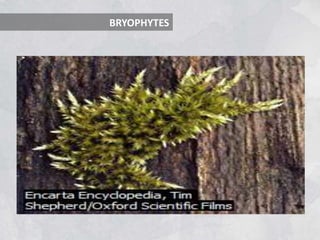
1. Non Vascular or Bryophytes
- lack specialized tissues for conduction of
water
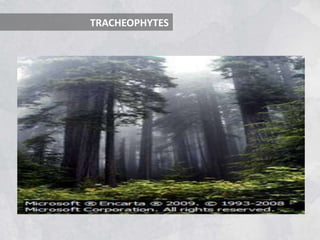
2. Vascular or Tracheopytes
-have specialized tissues
for transporting water and
nutrients
TRACHEOPHYTES
BRYOPHYTES
CLASSIFYING PLANTS
TWO SYSTEMS OF PLANT CLASSIFICATION
1.Natural System
- Based on evolutionary relationships among
plants
2. Artificial System
- based mainly on size,
water requirement, ability
to manufacture food,
habitat and life span
Bases of Artificial System
1. Size
a. Microscopic
- Those that are not visible to the
unaided eye
b. Macroscopic
-those that can be seen with the
unaided eye
Bases of Artificial System
2. Water requirement
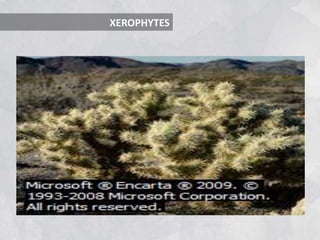
a. Xerophytes
-live in places with little amount of water
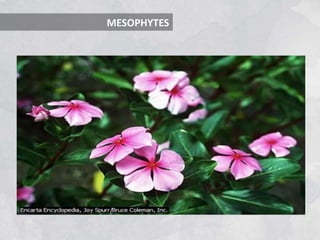
b. Mesophytes
-require a moderate amount
of water
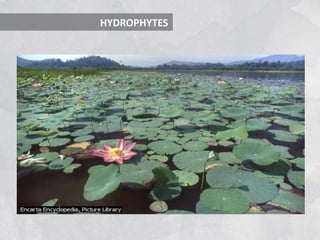
c. Hydrophytes
-live in habitats with
abundant water
XEROPHYTES
MESOPHYTES
HYDROPHYTES
Bases of Artificial System
3. Ability to manufacture food
a. Autotrophic
-plants that manufacture their own food
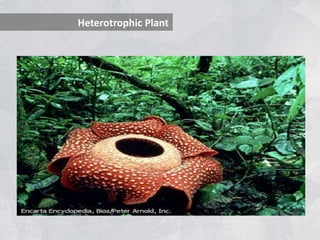
b. Heterotrophic
-plants that depend on other organisms or
dead organic matter for food
Heterotrophic Plant
Bases of Artificial System
4. Habitat
a. Aquatic
- plants live in water
b. Terrestrial
- plants live on land
c. Aerial
- plants live above the
ground
Bases of Artificial System
5. Life Span
a. Annual
- live for one growing season
ex. Onions, garlic, patola
b. Biennials
- complete their life cycle
in 2 years
ex. Okra, parsley,
sunflower
c. Perennials
- live for many years
Bases of Artificial System
6. Habit – refers to body appearance
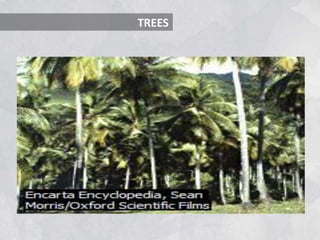
a. Trees- woody perennial plants
with a single stem or trunk
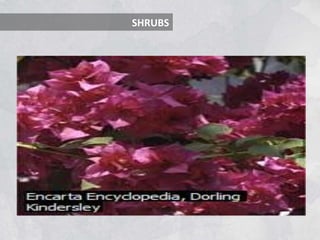
b. Shrubs – plants with several
main stems arising at or
near the ground
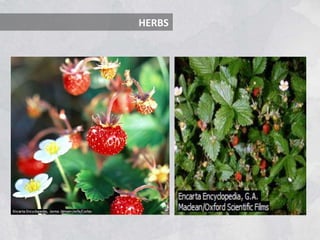
c. Herbs-come with soft
stem
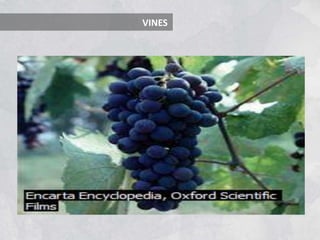
d. Vines- climbing plants
TREES
VINES
HERBS
SHRUBS
NONVASCULAR PLANTS
• They live in moist and damp places since they do not
have xylem and phloem to move water from one part
to another
• They are usually small in size due to this missing part
• Bryophytes do not have true roots, stem
and leaves
NONVASCULAR PLANTS
• They are called thalloid plants
• These plants grow from spores
• Composed of mosses, liverworts and hornworts
• they are regarded as the “amphibians” of
the plant world since they need a lot of
water even if they are terrestrial in habitat
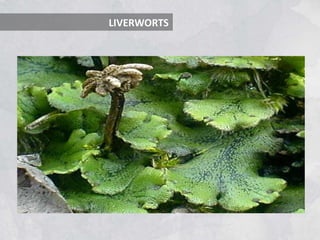
LIVERWORTS
NONVASCULAR PLANTS
1. LIVERWORTS
- liver because of its liver shape
appearance and wort, which means plant or herb
-2 types of gametophyte
1. Antheridium- male
reproductive that produces
the sperm cell
2. Archaegonium- female
reproductive that produces
the egg cell
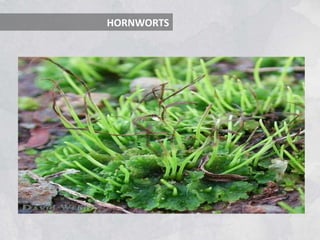
HORNWORTS
NONVASCULAR PLANTS
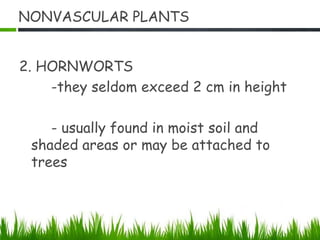
2. HORNWORTS
-they seldom exceed 2 cm in height
- usually found in moist soil and
shaded areas or may be attached to
trees
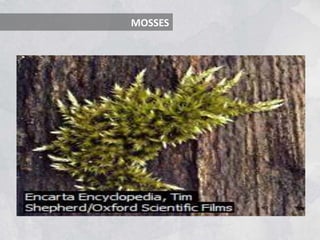
MOSSES
NONVASCULAR PLANTS
3. MOSSES
- are of 2 types; the gametophyte
and the sporophyte
- they differ from any
other plants because
of the absence of
mesophyll tissues,
stomata and veins
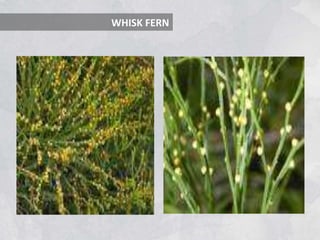
WHISK FERN
VASCULAR PLANTS
1. WHISK FERNS
- small plants with fork like branches that
look like a broom
- they are considered the
simplest of all living
vascular plants
CLUB MOSSES
VASCULAR PLANTS
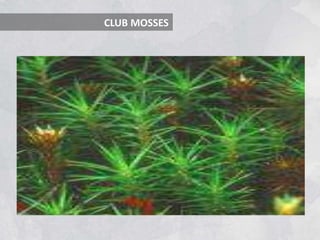
2. CLUB MOSSES
- they just grow wildly and luxuriantly
along the roadside specially during rainy
season
- the spores are found on
their tips
HORSETAIL
VASCULAR PLANTS
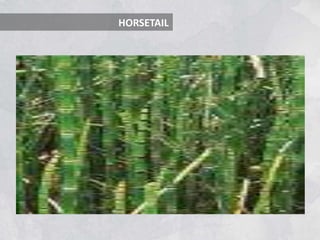
3. HORSETAILS
- its stem are rough with silica
crystals, Thus, it is ideal for scrubbing
pots and dirty kettles
FERNS
VASCULAR PLANTS
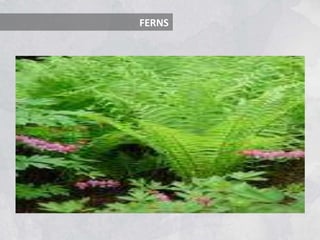
4. FERNS
- the largest group of seedless vascular
plants
- they may reach 3 to 5 meters in height
- they have vascular
tissues and strong
roots
GYMNOSPERMS
• Came from the Greek word ‘gymnos’ meaning
naked and ‘sperma’ seed or naked seeds
• They are cone bearing plants
• They grow very well in
temperate region
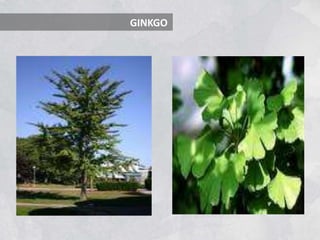
GINKGO
GYMNOSPERMS
1. Ginkgos
- Ginkgo biloba as its popular name
- Large tree with numerous spreading branches
- Leaves are fan shape
that gives off a pungent
odor
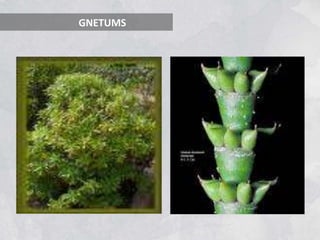
GNETUMS
GYMNOSPERMS
2. GNETUMS
- believe to be the ancestor of the flowering
plants
- have cones that resembles a flower
- smaller than ginkgo. Not
common in the Philippines
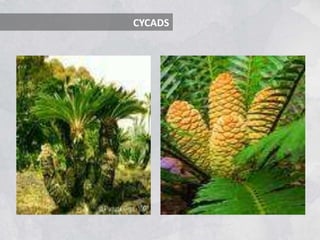
CYCADS
GYMNOSPERMS
3. CYCADS
-second largest group of gymnosperms
-leaves are compound and composed of several
leaf-like parts
-they grow well in tropical
countries
CONIFERS
GYMNOSPERMS
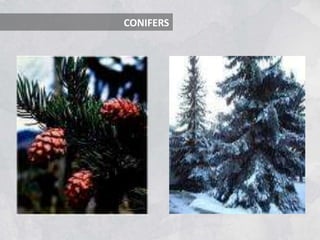
4. CONIFERS
- biggest group of gymnosperms found in most
part of the world
- large, tall trees with highly
branched stems
- leaves are usually
long, scaly, and needle-like
ANGIOSPERMS
• Vascular plants that bear flowers and produced fruits
with seeds that are usually found inside the fruit
• There are two kinds of flowering plants based on the
number of cotyledons.
A.Monocotyledon
B.Dicotyledon

Kingdom plantae

  • 1.
  • 2.
    CLASSIFYING PLANTS • Theterrestrial members of the Plant Kingdom are generally divided into 2 groups 1. Non Vascular or Bryophytes - lack specialized tissues for conduction of water 2. Vascular or Tracheopytes -have specialized tissues for transporting water and nutrients
  • 3.
  • 4.
  • 5.
    CLASSIFYING PLANTS TWO SYSTEMSOF PLANT CLASSIFICATION 1.Natural System - Based on evolutionary relationships among plants 2. Artificial System - based mainly on size, water requirement, ability to manufacture food, habitat and life span
  • 6.
    Bases of ArtificialSystem 1. Size a. Microscopic - Those that are not visible to the unaided eye b. Macroscopic -those that can be seen with the unaided eye
  • 7.
    Bases of ArtificialSystem 2. Water requirement a. Xerophytes -live in places with little amount of water b. Mesophytes -require a moderate amount of water c. Hydrophytes -live in habitats with abundant water
  • 8.
  • 9.
  • 10.
  • 11.
    Bases of ArtificialSystem 3. Ability to manufacture food a. Autotrophic -plants that manufacture their own food b. Heterotrophic -plants that depend on other organisms or dead organic matter for food
  • 12.
  • 13.
    Bases of ArtificialSystem 4. Habitat a. Aquatic - plants live in water b. Terrestrial - plants live on land c. Aerial - plants live above the ground
  • 14.
    Bases of ArtificialSystem 5. Life Span a. Annual - live for one growing season ex. Onions, garlic, patola b. Biennials - complete their life cycle in 2 years ex. Okra, parsley, sunflower c. Perennials - live for many years
  • 15.
    Bases of ArtificialSystem 6. Habit – refers to body appearance a. Trees- woody perennial plants with a single stem or trunk b. Shrubs – plants with several main stems arising at or near the ground c. Herbs-come with soft stem d. Vines- climbing plants
  • 16.
  • 17.
  • 18.
  • 19.
  • 20.
    NONVASCULAR PLANTS • Theylive in moist and damp places since they do not have xylem and phloem to move water from one part to another • They are usually small in size due to this missing part • Bryophytes do not have true roots, stem and leaves
  • 21.
    NONVASCULAR PLANTS • Theyare called thalloid plants • These plants grow from spores • Composed of mosses, liverworts and hornworts • they are regarded as the “amphibians” of the plant world since they need a lot of water even if they are terrestrial in habitat
  • 22.
  • 23.
    NONVASCULAR PLANTS 1. LIVERWORTS -liver because of its liver shape appearance and wort, which means plant or herb -2 types of gametophyte 1. Antheridium- male reproductive that produces the sperm cell 2. Archaegonium- female reproductive that produces the egg cell
  • 24.
  • 25.
    NONVASCULAR PLANTS 2. HORNWORTS -theyseldom exceed 2 cm in height - usually found in moist soil and shaded areas or may be attached to trees
  • 26.
  • 27.
    NONVASCULAR PLANTS 3. MOSSES -are of 2 types; the gametophyte and the sporophyte - they differ from any other plants because of the absence of mesophyll tissues, stomata and veins
  • 28.
  • 29.
    VASCULAR PLANTS 1. WHISKFERNS - small plants with fork like branches that look like a broom - they are considered the simplest of all living vascular plants
  • 30.
  • 31.
    VASCULAR PLANTS 2. CLUBMOSSES - they just grow wildly and luxuriantly along the roadside specially during rainy season - the spores are found on their tips
  • 32.
  • 33.
    VASCULAR PLANTS 3. HORSETAILS -its stem are rough with silica crystals, Thus, it is ideal for scrubbing pots and dirty kettles
  • 34.
  • 35.
    VASCULAR PLANTS 4. FERNS -the largest group of seedless vascular plants - they may reach 3 to 5 meters in height - they have vascular tissues and strong roots
  • 36.
    GYMNOSPERMS • Came fromthe Greek word ‘gymnos’ meaning naked and ‘sperma’ seed or naked seeds • They are cone bearing plants • They grow very well in temperate region
  • 37.
  • 38.
    GYMNOSPERMS 1. Ginkgos - Ginkgobiloba as its popular name - Large tree with numerous spreading branches - Leaves are fan shape that gives off a pungent odor
  • 39.
  • 40.
    GYMNOSPERMS 2. GNETUMS - believeto be the ancestor of the flowering plants - have cones that resembles a flower - smaller than ginkgo. Not common in the Philippines
  • 41.
  • 42.
    GYMNOSPERMS 3. CYCADS -second largestgroup of gymnosperms -leaves are compound and composed of several leaf-like parts -they grow well in tropical countries
  • 43.
  • 44.
    GYMNOSPERMS 4. CONIFERS - biggestgroup of gymnosperms found in most part of the world - large, tall trees with highly branched stems - leaves are usually long, scaly, and needle-like
  • 45.
    ANGIOSPERMS • Vascular plantsthat bear flowers and produced fruits with seeds that are usually found inside the fruit • There are two kinds of flowering plants based on the number of cotyledons. A.Monocotyledon B.Dicotyledon