Plant Structure and function
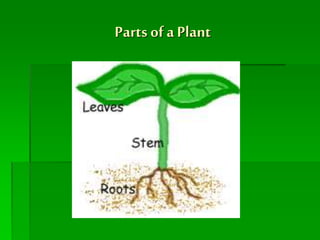
Parts of a Plant
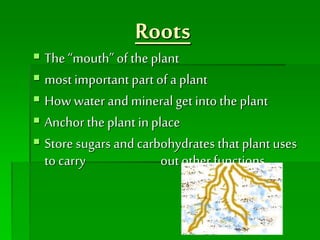
Roots
 The “mouth”of the plant
 most importantpart of aplant
 How water and mineralget intothe plant
 Anchorthe plant inplace
 Store sugars and carbohydrates that plant uses
to carry outother functions
http://plantsinmotion.bio.indi
ana.edu/plantmotion/vegetati
ve/veg.html
Watch roots growth
http://plantsinmotion.bio.indi
ana.edu/plantmotion/vegetati
ve/veg.html
Watch roots growth
Stem
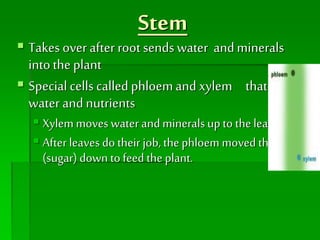
 Takes over after root sends water andminerals
intothe plant
 Specialcells called phloemand xylem that move
water and nutrients
 Xylem moves water andmineralsupto the leaves
 After leaves do their job, the phloem moved the food
(sugar) down tofeed the plant.
Stem
 Stems also providesupport forthe plant allowing
the leaves to reach the sunlightthatthey need to
producefood
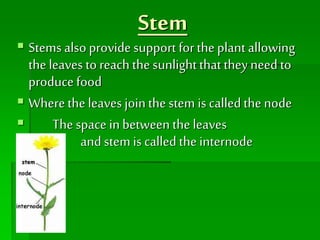
 Wherethe leaves jointhe stem is calledthe node
 The space inbetween the leaves
and stem is calledthe internode
http://plantsinmotion.bio.indi
ana.edu/plantmotion/vegetati
ve/veg.html
Watch a plant wilt
Leaves
 The foodfactory
 Come inmany differentshapes andsizes
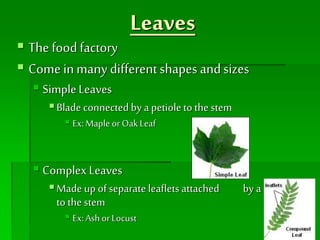
 SimpleLeaves
Blade connected by a petioleto the stem
 Ex: Maple or OakLeaf
 Complex Leaves
Made up of separate leafletsattached by a pertiole
to the stem
 Ex: Ash or Locust
Leaves
 Leaves are made to catch lightand have openings
to allow water and air to come and go
 Outer layer has waxy coating called acuticle
whichprotects the leaves.
 Veins carry water and nutrients within the leaf
Leaves
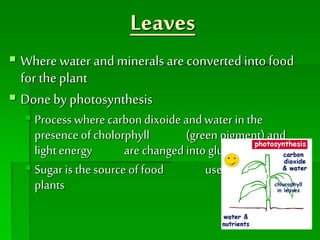
 Where water andminerals are converted intofood
for the plant
 Doneby photosynthesis
 Process where carbondixoideandwater in the
presence of cholorphyll (green pigment) and
lightenergy are changed intoglucose (sugar)
 Sugar is the source of food used by most
plants
Photosynthesis Rap
 http://www.youtube.com/watch?v=pE82qt
KSSH4
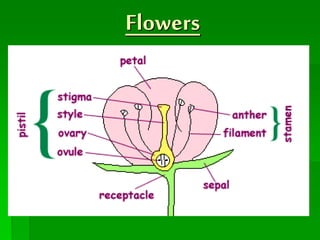
Flowers
 Importantinmaking seeds
 Fertilization is the process to make seeds
 Petals attract pollinators such as bees,butterflies,
and bats.
Flowers
Why do Plants Adapt?
Protection
Reproduction
Climate and Location
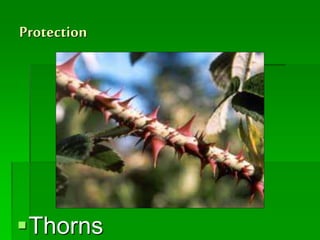
Protection
Thorns
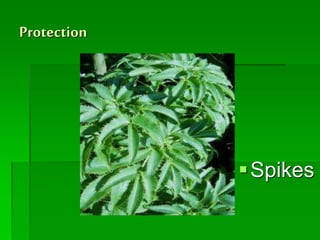
Protection
Spikes
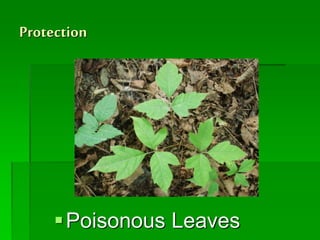
Protection
Poisonous Leaves
Reproduction
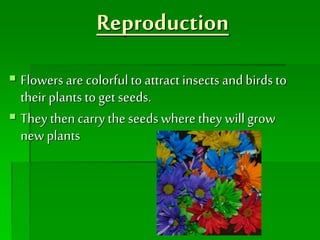
 Flowers are colorfulto attract insects and birdsto
their plants to get seeds.
 They then carry the seeds where they will grow
new plants
Reproduction
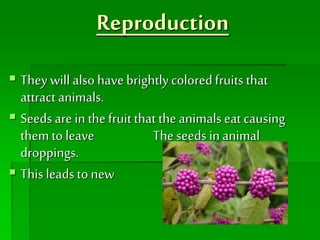
 They will also have brightlycoloredfruits that
attract animals.
 Seeds are in the fruit that the animals eat causing
them to leave The seeds inanimal
droppings.
 This leads to new plants.
Reproduction
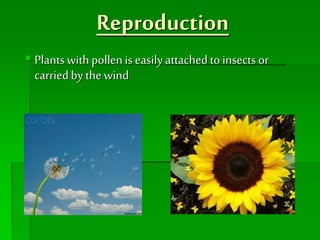
 Plantswith polleniseasilyattachedto insects or
carriedby the wind
Climate and Location
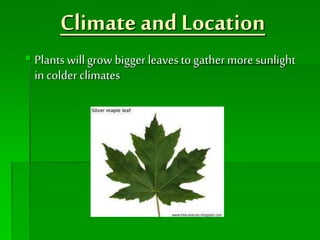
 Plantswillgrow bigger leaves to gather more sunlight
in colder climates
Climate and Location
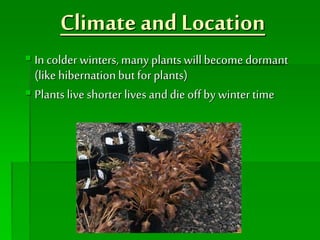
 In colder winters, many plantswillbecome dormant
(like hibernationbutfor plants)
 Plantslive shorter lives and die offby wintertime
Climate and Location
 In Dry climates
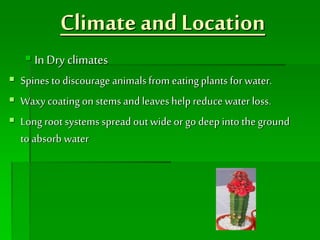
 Spines to discourage animalsfrom eatingplants for water.
 Waxy coating on stems and leaves helpreduce water loss.
 Long root systems spread outwideor go deep into theground
to absorb water
Climate and Location
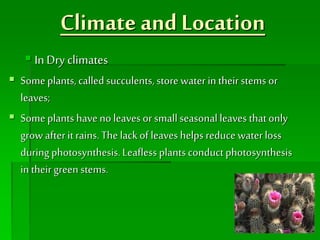
 In Dry climates
 Some plants, called succulents, store water in their stems or
leaves;
 Some plants have no leaves or smallseasonal leaves thatonly
grow after it rains. The lackof leaves helps reduce water loss
during photosynthesis.Leafless plants conduct photosynthesis
in theirgreen stems.

Plant structure and function powerpoint