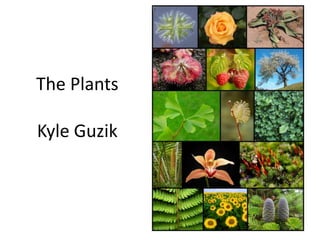
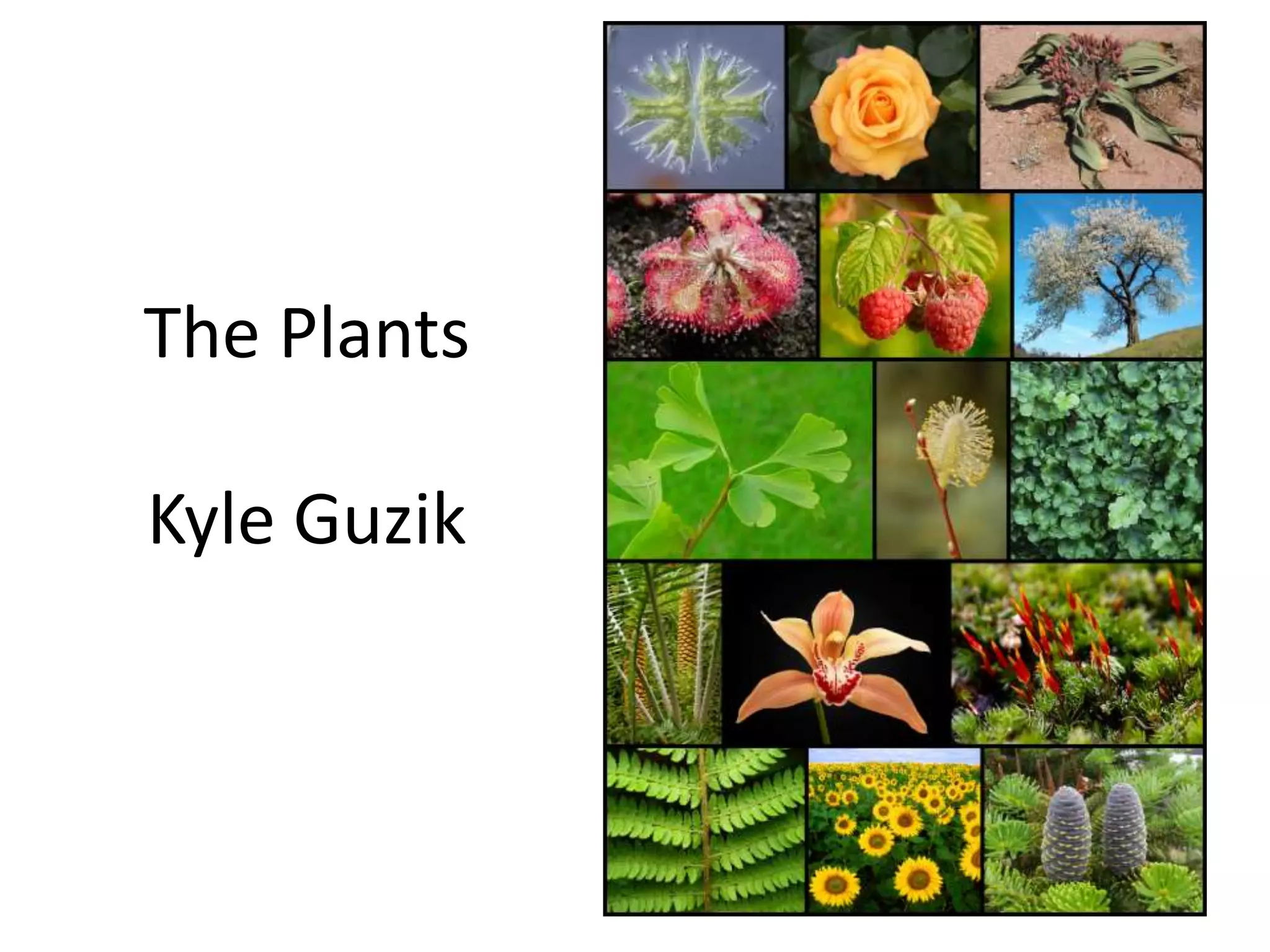
The Plants
Kyle Guzik
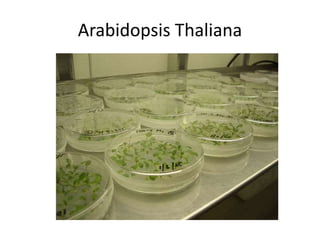
Arabidopsis Thaliana
The BSLC Greenhouse
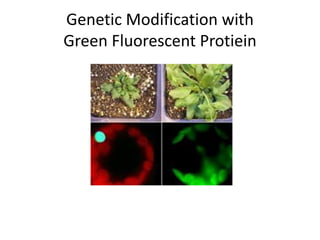
Genetic Modification with
Green Fluorescent Protiein
Kingdom Plantae
• Plants are multicellular eukaryotes with well-
developed tissues.
• Plants live in a wide variety of terrestrial
environments.
• There are also aquatic plants.
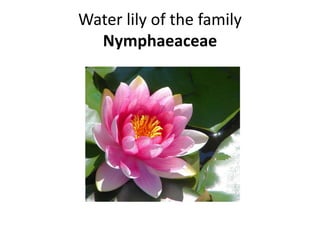
Water lily of the family
Nymphaeaceae
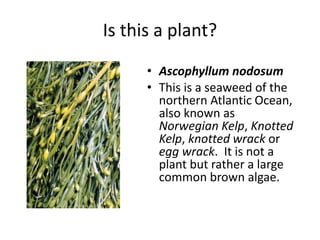
Is this a plant?
• Ascophyllum nodosum
• This is a seaweed of the
northern Atlantic Ocean,
also known as
Norwegian Kelp, Knotted
Kelp, knotted wrack or
egg wrack. It is not a
plant but rather a large
common brown algae.
Land vs. Water
• Land existence makes photosynthesis more
effective. Water filters light.
• Carbon dioxide and oxygen are in higher
concentrations and diffuse more rapidly in air.
• Land plants have adaptations to reduce the loss
of water.
• Leaves are covered with a waxy cuticle that holds
in water.
• The leaves have openings know as stomata that
open and close to regulate gas and water
exchange.
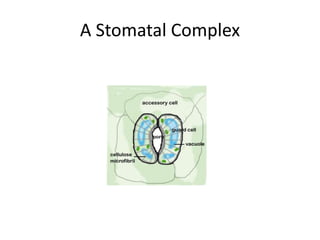
A Stomatal Complex
Relationship to Algae
• Plants are believed to be closely related to
green algae.
• Both use chlorophylls a and b.
• Both use starch as the food reserve.
• The cell walls of both contains cellulose.
• Both form a cell plate during cell division.
• Unlike green algae, plants have sex organs
with an outer layer of reproductive cells.
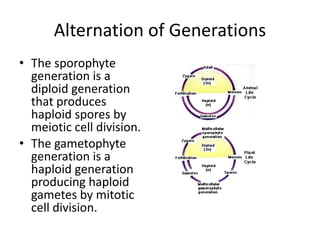
Alternation of Generations
• The sporophyte
generation is a
diploid generation
that produces
haploid spores by
meiotic cell division.
• The gametophyte
generation is a
haploid generation
producing haploid
gametes by mitotic
cell division.
Nonvascular plants
• Plants are divided into two main groups: non
vascular and vascular plants
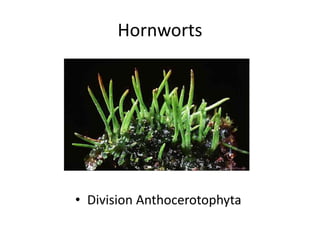
Hornworts
• Division Anthocerotophyta
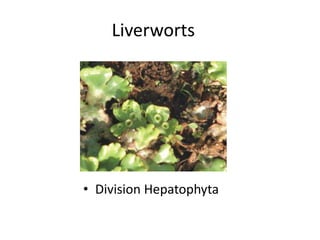
Liverworts
• Division Hepatophyta
Liverworts
• The division hepatophyta contains 10,000 species
of liverworts.
• This name comes from the liver shaped lobes of
the plant.
• Marchantia, for example has a flat lobed thallus
about a centimeter in length. The upper surface
of the thallus is smooth the lower surface bears
numerous rhizoids projecting into the soil.
• It reproduces sexually and asexually.
Liverworts
• Rhizoids are the rootlike hairs that anchor the
bryophytes and absorb water and minerals
from the soil.
• Asexual reproduction involves gemmae in
gemmae cups on the upper surface of the
thallus.
Liverworts
• Sexual reproduction depends on antheridia and
archegonia
• Antheridia are on disk-headed stalks and produce
flagellated sperm.
• Archegonia are on umbrella-headed stalks and
produce eggs.
• A Zygote develops into a tiny sporophyte
composed of a foot, short stalk, and capsule.
• Spores produced within the capsule of the
gametophyte are disseminated by the wind.
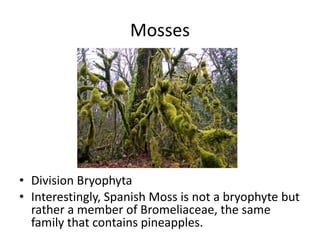
Mosses
• Division Bryophyta
• Interestingly, Spanish Moss is not a bryophyte but
rather a member of Bromeliaceae, the same
family that contains pineapples.
Mosses
• There are about 12,000 species of mosses in the
division bryophyta.
• Mosses are found in the Arctic through the
tropics to parts of the Antarctic.
• Moss prefers damp shaded localities; however
some survive in desserts while others live in bogs
and streams.
• Mosses can store large quantities of water in
their cells. When dried out they become
dormant, but turn green again after some rain.
Mosses
• Most mosses can reproduce asexually by fragmentation.
• The moss life cycle begins with an algalike protenema developing
from germination of a haploid spore.
• Three days of favorable growing conditions produce uprights shoots
covered with leafy structures.
• Rhizoids anchor the protonema, to which the shoots are attached.
• The shoots bear antheridia and archegonia at their tips.
• Antheridia produce flagellated sperm which need external water to
reach eggs in archegonia.
• Fertilization results in a diploid zygote that undergoes mitotic
division to develop a sporophyte.
• The sporophyte consists of a foot, stalk, and upper capusle
(sporangium) where spores are produced.
• The sporophyte is initially green and photosynthetic; at maturity it
is brown and non-photosynthetic.
Nonvascular Plants
• Lack specialized tissues for transporting water,
minerals, and organic nutrients
• They lack true roots, stems, and leaves, although
they have rootlike, stemlike, or leaflike structures.
• The gametophyte is the dominant generation.
• Flagellated sperm swims to the vicinity of the egg
in a continuous film of water.
• The sporophyte is attached to and derives
nourishments form the photosynthetic
gametophyte.
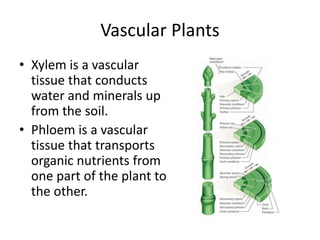
Vascular Plants
• Xylem is a vascular
tissue that conducts
water and minerals up
from the soil.
• Phloem is a vascular
tissue that transports
organic nutrients from
one part of the plant to
the other.
Organs of Vascular Plants
• Roots absorb water and minerals from the soil
• Stems conduct water and mineral to leaves
and conduct organic nutrients from leaves to
the roots.
• Leaves are adapted to maximize
photosynthetic activity; they are covered by a
waxy cuticle.
• Leaves have openings (stomates) that open
and close to regulate water and gas exchange.
Reproduction of Vascular Plants
• The diploid sporophyte generation is
dominant; this is the generation that has
vascular tissue.
• Seedless vascular plants (ferns and their allies)
disperse their species by producing
windblown spores.
• In seed plants there is a separate
microgametophyte (male) and
megagametophyte (female)
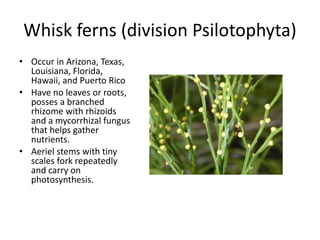
Whisk ferns (division Psilotophyta)
• Occur in Arizona, Texas,
Louisiana, Florida,
Hawaii, and Puerto Rico
• Have no leaves or roots,
posses a branched
rhizome with rhizoids
and a mycorrhizal fungus
that helps gather
nutrients.
• Aeriel stems with tiny
scales fork repeatedly
and carry on
photosynthesis.
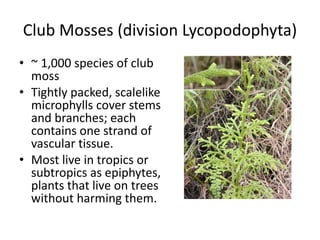
Club Mosses (division Lycopodophyta)
• ~ 1,000 species of club
moss
• Tightly packed, scalelike
microphylls cover stems
and branches; each
contains one strand of
vascular tissue.
• Most live in tropics or
subtropics as epiphytes,
plants that live on trees
without harming them.
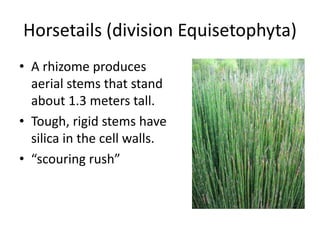
Horsetails (division Equisetophyta)
• A rhizome produces
aerial stems that stand
about 1.3 meters tall.
• Tough, rigid stems have
silica in the cell walls.
• “scouring rush”
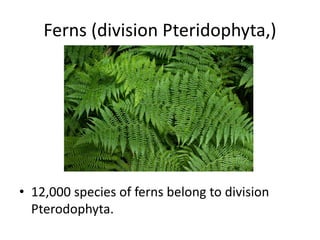
Ferns (division Pteridophyta,)
• 12,000 species of ferns belong to division
Pterodophyta.
The plants

The plants

  • 1.
  • 2.
  • 3.
  • 4.
    Genetic Modification with GreenFluorescent Protiein
  • 5.
    Kingdom Plantae • Plantsare multicellular eukaryotes with well- developed tissues. • Plants live in a wide variety of terrestrial environments. • There are also aquatic plants.
  • 6.
    Water lily ofthe family Nymphaeaceae
  • 7.
    Is this aplant? • Ascophyllum nodosum • This is a seaweed of the northern Atlantic Ocean, also known as Norwegian Kelp, Knotted Kelp, knotted wrack or egg wrack. It is not a plant but rather a large common brown algae.
  • 8.
    Land vs. Water •Land existence makes photosynthesis more effective. Water filters light. • Carbon dioxide and oxygen are in higher concentrations and diffuse more rapidly in air. • Land plants have adaptations to reduce the loss of water. • Leaves are covered with a waxy cuticle that holds in water. • The leaves have openings know as stomata that open and close to regulate gas and water exchange.
  • 9.
  • 10.
    Relationship to Algae •Plants are believed to be closely related to green algae. • Both use chlorophylls a and b. • Both use starch as the food reserve. • The cell walls of both contains cellulose. • Both form a cell plate during cell division. • Unlike green algae, plants have sex organs with an outer layer of reproductive cells.
  • 11.
    Alternation of Generations •The sporophyte generation is a diploid generation that produces haploid spores by meiotic cell division. • The gametophyte generation is a haploid generation producing haploid gametes by mitotic cell division.
  • 12.
    Nonvascular plants • Plantsare divided into two main groups: non vascular and vascular plants
  • 13.
  • 14.
  • 15.
    Liverworts • The divisionhepatophyta contains 10,000 species of liverworts. • This name comes from the liver shaped lobes of the plant. • Marchantia, for example has a flat lobed thallus about a centimeter in length. The upper surface of the thallus is smooth the lower surface bears numerous rhizoids projecting into the soil. • It reproduces sexually and asexually.
  • 16.
    Liverworts • Rhizoids arethe rootlike hairs that anchor the bryophytes and absorb water and minerals from the soil. • Asexual reproduction involves gemmae in gemmae cups on the upper surface of the thallus.
  • 17.
    Liverworts • Sexual reproductiondepends on antheridia and archegonia • Antheridia are on disk-headed stalks and produce flagellated sperm. • Archegonia are on umbrella-headed stalks and produce eggs. • A Zygote develops into a tiny sporophyte composed of a foot, short stalk, and capsule. • Spores produced within the capsule of the gametophyte are disseminated by the wind.
  • 18.
    Mosses • Division Bryophyta •Interestingly, Spanish Moss is not a bryophyte but rather a member of Bromeliaceae, the same family that contains pineapples.
  • 19.
    Mosses • There areabout 12,000 species of mosses in the division bryophyta. • Mosses are found in the Arctic through the tropics to parts of the Antarctic. • Moss prefers damp shaded localities; however some survive in desserts while others live in bogs and streams. • Mosses can store large quantities of water in their cells. When dried out they become dormant, but turn green again after some rain.
  • 20.
    Mosses • Most mossescan reproduce asexually by fragmentation. • The moss life cycle begins with an algalike protenema developing from germination of a haploid spore. • Three days of favorable growing conditions produce uprights shoots covered with leafy structures. • Rhizoids anchor the protonema, to which the shoots are attached. • The shoots bear antheridia and archegonia at their tips. • Antheridia produce flagellated sperm which need external water to reach eggs in archegonia. • Fertilization results in a diploid zygote that undergoes mitotic division to develop a sporophyte. • The sporophyte consists of a foot, stalk, and upper capusle (sporangium) where spores are produced. • The sporophyte is initially green and photosynthetic; at maturity it is brown and non-photosynthetic.
  • 21.
    Nonvascular Plants • Lackspecialized tissues for transporting water, minerals, and organic nutrients • They lack true roots, stems, and leaves, although they have rootlike, stemlike, or leaflike structures. • The gametophyte is the dominant generation. • Flagellated sperm swims to the vicinity of the egg in a continuous film of water. • The sporophyte is attached to and derives nourishments form the photosynthetic gametophyte.
  • 22.
    Vascular Plants • Xylemis a vascular tissue that conducts water and minerals up from the soil. • Phloem is a vascular tissue that transports organic nutrients from one part of the plant to the other.
  • 23.
    Organs of VascularPlants • Roots absorb water and minerals from the soil • Stems conduct water and mineral to leaves and conduct organic nutrients from leaves to the roots. • Leaves are adapted to maximize photosynthetic activity; they are covered by a waxy cuticle. • Leaves have openings (stomates) that open and close to regulate water and gas exchange.
  • 24.
    Reproduction of VascularPlants • The diploid sporophyte generation is dominant; this is the generation that has vascular tissue. • Seedless vascular plants (ferns and their allies) disperse their species by producing windblown spores. • In seed plants there is a separate microgametophyte (male) and megagametophyte (female)
  • 25.
    Whisk ferns (divisionPsilotophyta) • Occur in Arizona, Texas, Louisiana, Florida, Hawaii, and Puerto Rico • Have no leaves or roots, posses a branched rhizome with rhizoids and a mycorrhizal fungus that helps gather nutrients. • Aeriel stems with tiny scales fork repeatedly and carry on photosynthesis.
  • 26.
    Club Mosses (divisionLycopodophyta) • ~ 1,000 species of club moss • Tightly packed, scalelike microphylls cover stems and branches; each contains one strand of vascular tissue. • Most live in tropics or subtropics as epiphytes, plants that live on trees without harming them.
  • 27.
    Horsetails (division Equisetophyta) •A rhizome produces aerial stems that stand about 1.3 meters tall. • Tough, rigid stems have silica in the cell walls. • “scouring rush”
  • 28.
    Ferns (division Pteridophyta,) •12,000 species of ferns belong to division Pterodophyta.