Economic
botany
UNIT- X
Definition
» Economic botany is the study ofthe relationship between people
and plants for food, medicines and otheruses.
» Economic botany intersects many fields suchasagronomy,
anthropology, archaeology, chemistry, trade andcommerce.
Economic
botany
Relationship between
humans andplants
Relationship between humans and
plants co-existed several hundreds
of years ago selecting many wild
plants by trial and error, which have
led to the development of the
humans and their civilization in
many ways.
Economic
botany
Domestication of plants
» Domestication is the process of bringing wild plant into cultivation
through careful selection and genetic alteration to provide food
and other benefits tohuman.
Economic
botany
Origin ofAgriculture
According to the archeological
evidence agriculture initiated from the
fertile crescent region in and around
Tigris and Euphrates river valleys,
approximately about 12,000 yearsago.
Theophrastus, Dioscorides, Pliny
elder and Galen laid down
Greek and Roman naturalists like
the
the
scientific foundation in understanding
origin and domestication of cultivated
plants.
Economic
botany
Economic
botany1807
1868
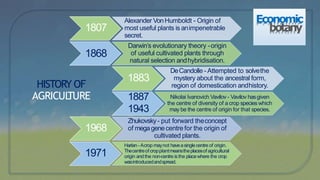
Alexander VonHumboldt - Origin of
most useful plants is animpenetrable
secret.
Darwin’s evolutionary theory -origin
of useful cultivated plants through
natural selection andhybridisation.
1883
1887
1943
DeCandolle - Attempted to solvethe
mystery about the ancestral form,
region of domestication andhistory.
Nikolai Ivanovich Vavilov - Vavilov hasgiven
the centre of diversity of acrop species which
may be the centre of origin for that species.
1968
1971
Zhukovsky- put forward theconcept
of megagenecentre for the origin of
cultivated plants.
Harlan- Acrop maynot haveasinglecentre of origin.
Thecentreofcropplantmeanstheplacesofagricultural
origin andthe non-centre isthe placewhere the crop
wasintroducedandspread.
HISTORY OF
AGRICULTURE
Economic
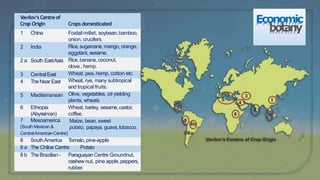
botanyFoxtail millet, soybean,bamboo,
onion, crucifers.
Rice,sugarcane,mango, orange,
eggplant, sesame.
Rice,banana,coconut,
clove , hemp.
Wheat, pea, hemp, cotton etc.
Wheat, rye, many subtropical
and tropical fruits.
Olive, vegetables, oil yielding
plants, wheats
6 Ethiopia
(Abyssinian)
Wheat, barley, sesame,castor,
coffee.
Maize, bean, sweet
potato, papaya, guava,tobacco.
7 Mesoamerica
(South Mexican &
CentralAmericanCentre)
8 SouthAmerica Tomato, pine-apple
8 a The Chiloe Centre Potato
8 b TheBrazilian- ParaguayanCentre Groundnut,
cashew nut, pine apple,peppers,
rubber.
Vavilov’s Centreof
Crop Origin
1 China
2 India
2 a South EastAsia
3 CentralEast
4 TheNear East
5 Mediterranean
Crops domesticated
» Organic farming in an alternative agricultural system torapidly
changing farming practices.
» Itsustains the health of the soils, ecosystems and people.
Organic Agriculture
Economic
botany
» Biofertilizers are defined aspreparations containing living cells or
latent cells of efficient strains of microorganisms that help crop
plants in fixing nitrogen, solubilisingphosphate and decomposing
cellulose.
» Theyare eco-friendly organic agro inputs and are moreefficient
and cost effective than chemicalfertilizers.
Biofertilizers
Economic
botany
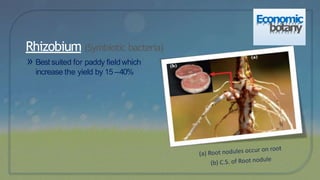
Rhizobium (Symbiotic bacteria)
» Best suited for paddy fieldwhich
increase the yield by 15 –40%
Economic
botany
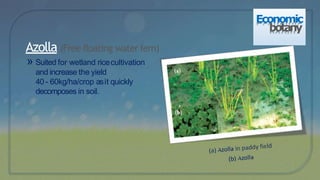
» Suited for wetland ricecultivation
and increase the yield
40 - 60kg/ha/crop asit quickly
decomposes in soil.
Azolla (Free floating waterfern)
Economic
botany
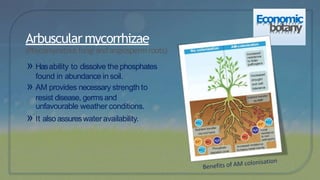
Arbuscular mycorrhizae
(Phycomycetousfungi and angiosperm roots)
» Hasability to dissolve the phosphates
found in abundance insoil.
» AM provides necessary strength to
resist disease, germsand
unfavourable weather conditions.
» It also assureswateravailability.
Economic
botany
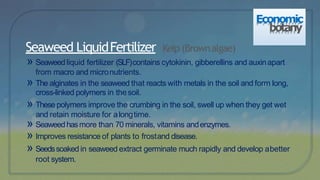
» Seaweedliquid fertilizer (SLF)contains cytokinin, gibberellins and auxinapart
from macro and micronutrients.
» The alginates in the seaweed that reacts with metals in the soil and form long,
cross-linked polymers in thesoil.
» These polymers improve the crumbing in the soil, swell up when they get wet
and retain moisture for alongtime.
» Seaweedhasmore than 70 minerals, vitamins andenzymes.
» Improves resistance of plants to frostand disease.
» Seedssoaked in seaweed extract germinate much rapidly and develop abetter
root system.
Seaweed LiquidFertilizer Kelp (Brownalgae)
Economic
botany
» Bio-pesticides are biologically basedagents
used for the control ofplant pests.
» Theyare in high usedue to their
non-toxic, cheaper andeco-friendly
characteristics ascompared to chemicalor
synthetic pesticides.
» Bio-pesticides have become an integral
component of pest management interms
of the environmental and healthissues
attributed to the useof chemicals in
agriculture.
Bio-Pesticides
Economic
botany
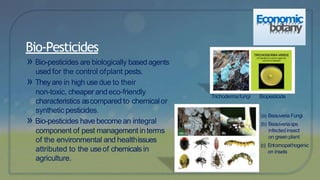
Trichodermafungi Biopesticide
(a) Beauveria Fungi
(b) Beauveriasps
infected insect
on greenplant
(c) Entomopathogenic
on insets
» Green manuring is defined asthe growing ofgreen manure crops directly in the
field byploughing.
» Oneof the main objectives of the green manuring is to increase the content of
nitrogen and improve the structure and physical properties of the soil.
» Themost important green manure crops are Crotalaria juncea,Tephrosia
purpurea, Indigofera tinctoria.
» Thegreen manuring can be practised asGreen in-situ manuring or Greenleaf
manuring.
GreenManuring
Economic
botany
» Plant breeding is the science of improvement of crop varieties with higher yield,
better quality, resistance to diseases and shorter durations which are suitable to
particular environment.
» In early days,plant breeding activities were based mainly on skills and abilityof
person involved.
» But asthe principles of genetics and cytogenetics have elucidatedbreeding
methods such asselection, introduction, hybridization, ploidy, mutation, tissue
culture and biotechnology techniques were designed todevelop improved crop
varieties.
PlantBreeding
Economic
botany
» Toincrease yield, vigour and fertility of thecrop
» Toincrease tolerance to environmental condition, salinity,
temperature anddrought.
» Toprevent the premature falling of buds, fruitsetc.
» Toimprove synchronousmaturity.
» Todevelop resistance to pathogens and pests.
» Todevelop photosensitive and thermos-sensitivevarieties.
Objectives of PlantBreeding
Economic
botany
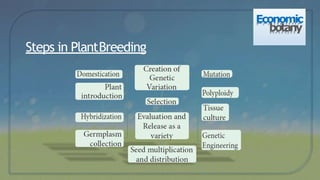
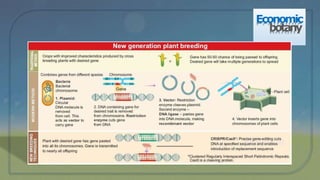
Steps in PlantBreeding
Economic
botany
Economic
botany
ConventionalPlantBreedingMethods
PlantIntroduction
PrimaryIntroduction
Secondary Introduction
Selection
Natural
Artificial
Mass
Pureline
Clonal
Hydridisation
Intravarietal
Intervarietal
Heterosis
Interspecific
Intergeneric
Mutational
Euheterosis
Balanced
Psuedoheterosis
Mutation
Breeding
Polyploidy
Breeding
GreenRevolution
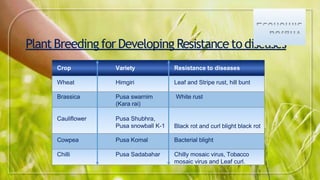
Plant Breedingfor Developing Resistanceto diseases
Economic
botany
Crop Variety Resistance to diseases
Wheat Himgiri Leaf and Stripe rust, hill bunt
Brassica Pusa swarnim
(Kara rai)
White rust
Cauliflower Pusa Shubhra,
Pusa snowball K-1 Black rot and curl blight black rot
Cowpea Pusa Komal Bacterial blight
Chilli Pusa Sadabahar Chilly mosaic virus, Tobacco
mosaic virus and Leaf curl.
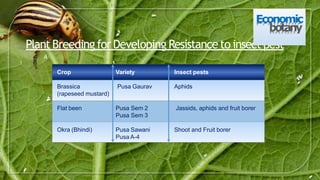
PlantBreedingfor Developing Resistanceto insect pest
Economic
botany
Crop Variety Insect pests
Pusa Gaurav AphidsBrassica
(rapeseed mustard)
Flat been Jassids, aphids and fruit borerPusa Sem 2
Pusa Sem 3
Okra (Bhindi) Shoot and Fruit borerPusa Sawani
Pusa A-4
Economic
botany
Economic
botany
» Indian Plant Breeders
» National Bureau of plantGenetic
Resources (NBPGR)
» GammaGarden or AtomicGarden
» NORIN10
» Father of greenrevolution
Norman E.Borlaug
» Father of green revolution inINDIA
Dr.M.S.Swaminathan.
» Nel Jayaraman
Economic
botany
Economic
botany

Chapter 9 plant breeding

  • 1.
  • 2.
    Definition » Economic botanyis the study ofthe relationship between people and plants for food, medicines and otheruses. » Economic botany intersects many fields suchasagronomy, anthropology, archaeology, chemistry, trade andcommerce. Economic botany
  • 3.
    Relationship between humans andplants Relationshipbetween humans and plants co-existed several hundreds of years ago selecting many wild plants by trial and error, which have led to the development of the humans and their civilization in many ways. Economic botany
  • 4.
    Domestication of plants »Domestication is the process of bringing wild plant into cultivation through careful selection and genetic alteration to provide food and other benefits tohuman. Economic botany
  • 5.
    Origin ofAgriculture According tothe archeological evidence agriculture initiated from the fertile crescent region in and around Tigris and Euphrates river valleys, approximately about 12,000 yearsago. Theophrastus, Dioscorides, Pliny elder and Galen laid down Greek and Roman naturalists like the the scientific foundation in understanding origin and domestication of cultivated plants. Economic botany
  • 6.
    Economic botany1807 1868 Alexander VonHumboldt -Origin of most useful plants is animpenetrable secret. Darwin’s evolutionary theory -origin of useful cultivated plants through natural selection andhybridisation. 1883 1887 1943 DeCandolle - Attempted to solvethe mystery about the ancestral form, region of domestication andhistory. Nikolai Ivanovich Vavilov - Vavilov hasgiven the centre of diversity of acrop species which may be the centre of origin for that species. 1968 1971 Zhukovsky- put forward theconcept of megagenecentre for the origin of cultivated plants. Harlan- Acrop maynot haveasinglecentre of origin. Thecentreofcropplantmeanstheplacesofagricultural origin andthe non-centre isthe placewhere the crop wasintroducedandspread. HISTORY OF AGRICULTURE
  • 7.
    Economic botanyFoxtail millet, soybean,bamboo, onion,crucifers. Rice,sugarcane,mango, orange, eggplant, sesame. Rice,banana,coconut, clove , hemp. Wheat, pea, hemp, cotton etc. Wheat, rye, many subtropical and tropical fruits. Olive, vegetables, oil yielding plants, wheats 6 Ethiopia (Abyssinian) Wheat, barley, sesame,castor, coffee. Maize, bean, sweet potato, papaya, guava,tobacco. 7 Mesoamerica (South Mexican & CentralAmericanCentre) 8 SouthAmerica Tomato, pine-apple 8 a The Chiloe Centre Potato 8 b TheBrazilian- ParaguayanCentre Groundnut, cashew nut, pine apple,peppers, rubber. Vavilov’s Centreof Crop Origin 1 China 2 India 2 a South EastAsia 3 CentralEast 4 TheNear East 5 Mediterranean Crops domesticated
  • 8.
    » Organic farmingin an alternative agricultural system torapidly changing farming practices. » Itsustains the health of the soils, ecosystems and people. Organic Agriculture Economic botany
  • 9.
    » Biofertilizers aredefined aspreparations containing living cells or latent cells of efficient strains of microorganisms that help crop plants in fixing nitrogen, solubilisingphosphate and decomposing cellulose. » Theyare eco-friendly organic agro inputs and are moreefficient and cost effective than chemicalfertilizers. Biofertilizers Economic botany
  • 10.
    Rhizobium (Symbiotic bacteria) »Best suited for paddy fieldwhich increase the yield by 15 –40% Economic botany
  • 11.
    » Suited forwetland ricecultivation and increase the yield 40 - 60kg/ha/crop asit quickly decomposes in soil. Azolla (Free floating waterfern) Economic botany
  • 12.
    Arbuscular mycorrhizae (Phycomycetousfungi andangiosperm roots) » Hasability to dissolve the phosphates found in abundance insoil. » AM provides necessary strength to resist disease, germsand unfavourable weather conditions. » It also assureswateravailability. Economic botany
  • 13.
    » Seaweedliquid fertilizer(SLF)contains cytokinin, gibberellins and auxinapart from macro and micronutrients. » The alginates in the seaweed that reacts with metals in the soil and form long, cross-linked polymers in thesoil. » These polymers improve the crumbing in the soil, swell up when they get wet and retain moisture for alongtime. » Seaweedhasmore than 70 minerals, vitamins andenzymes. » Improves resistance of plants to frostand disease. » Seedssoaked in seaweed extract germinate much rapidly and develop abetter root system. Seaweed LiquidFertilizer Kelp (Brownalgae) Economic botany
  • 14.
    » Bio-pesticides arebiologically basedagents used for the control ofplant pests. » Theyare in high usedue to their non-toxic, cheaper andeco-friendly characteristics ascompared to chemicalor synthetic pesticides. » Bio-pesticides have become an integral component of pest management interms of the environmental and healthissues attributed to the useof chemicals in agriculture. Bio-Pesticides Economic botany Trichodermafungi Biopesticide (a) Beauveria Fungi (b) Beauveriasps infected insect on greenplant (c) Entomopathogenic on insets
  • 15.
    » Green manuringis defined asthe growing ofgreen manure crops directly in the field byploughing. » Oneof the main objectives of the green manuring is to increase the content of nitrogen and improve the structure and physical properties of the soil. » Themost important green manure crops are Crotalaria juncea,Tephrosia purpurea, Indigofera tinctoria. » Thegreen manuring can be practised asGreen in-situ manuring or Greenleaf manuring. GreenManuring Economic botany
  • 16.
    » Plant breedingis the science of improvement of crop varieties with higher yield, better quality, resistance to diseases and shorter durations which are suitable to particular environment. » In early days,plant breeding activities were based mainly on skills and abilityof person involved. » But asthe principles of genetics and cytogenetics have elucidatedbreeding methods such asselection, introduction, hybridization, ploidy, mutation, tissue culture and biotechnology techniques were designed todevelop improved crop varieties. PlantBreeding Economic botany
  • 17.
    » Toincrease yield,vigour and fertility of thecrop » Toincrease tolerance to environmental condition, salinity, temperature anddrought. » Toprevent the premature falling of buds, fruitsetc. » Toimprove synchronousmaturity. » Todevelop resistance to pathogens and pests. » Todevelop photosensitive and thermos-sensitivevarieties. Objectives of PlantBreeding Economic botany
  • 18.
  • 19.
  • 20.
    Plant Breedingfor DevelopingResistanceto diseases Economic botany Crop Variety Resistance to diseases Wheat Himgiri Leaf and Stripe rust, hill bunt Brassica Pusa swarnim (Kara rai) White rust Cauliflower Pusa Shubhra, Pusa snowball K-1 Black rot and curl blight black rot Cowpea Pusa Komal Bacterial blight Chilli Pusa Sadabahar Chilly mosaic virus, Tobacco mosaic virus and Leaf curl.
  • 21.
    PlantBreedingfor Developing Resistancetoinsect pest Economic botany Crop Variety Insect pests Pusa Gaurav AphidsBrassica (rapeseed mustard) Flat been Jassids, aphids and fruit borerPusa Sem 2 Pusa Sem 3 Okra (Bhindi) Shoot and Fruit borerPusa Sawani Pusa A-4
  • 22.
  • 23.
    Economic botany » Indian PlantBreeders » National Bureau of plantGenetic Resources (NBPGR) » GammaGarden or AtomicGarden » NORIN10 » Father of greenrevolution Norman E.Borlaug » Father of green revolution inINDIA Dr.M.S.Swaminathan. » Nel Jayaraman
  • 24.
  • 25.