Introduction to peer review
Peer review workshop, Wageningen Graduate Schools
Wouter Gerritsma
Contents
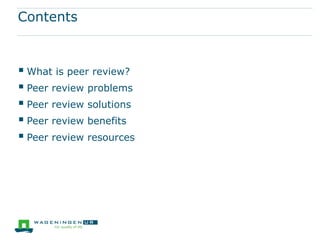
 What is peer review?
 Peer review problems
 Peer review solutions
 Peer review benefits
 Peer review resources
Nature editorial Februari 19th, 2015
http://dx.doi.org/10.1038/518274b
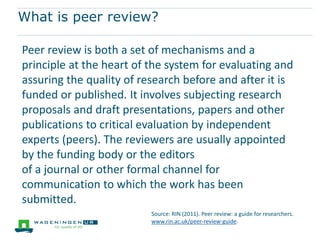
What is peer review?
Peer review is both a set of mechanisms and a
principle at the heart of the system for evaluating and
assuring the quality of research before and after it is
funded or published. It involves subjecting research
proposals and draft presentations, papers and other
publications to critical evaluation by independent
experts (peers). The reviewers are usually appointed
by the funding body or the editors
of a journal or other formal channel for
communication to which the work has been
submitted.
Source: RIN (2011). Peer review: a guide for researchers.
www.rin.ac.uk/peer-review-guide.
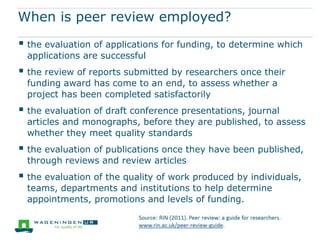
When is peer review employed?
 the evaluation of applications for funding, to determine which
applications are successful
 the review of reports submitted by researchers once their
funding award has come to an end, to assess whether a
project has been completed satisfactorily
 the evaluation of draft conference presentations, journal
articles and monographs, before they are published, to assess
whether they meet quality standards
 the evaluation of publications once they have been published,
through reviews and review articles
 the evaluation of the quality of work produced by individuals,
teams, departments and institutions to help determine
appointments, promotions and levels of funding.
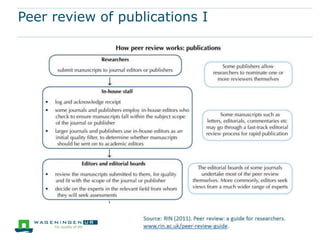
Peer review of publications I
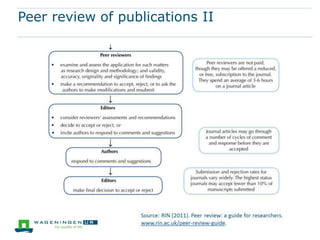
Peer review of publications II
Which editor?
 Roles of 113 WageningenUR researchers with 71 Elsevier
journals
● Editor in chief
● Editor
● Reviews editor
● Associate editor
● Editorial board
● Section editor
● Topic editor
● Editorial advisory board
● Book review editor
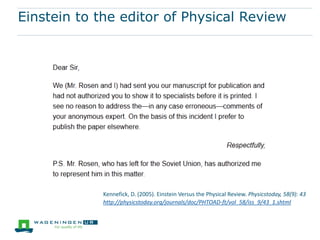
Einstein to the editor of Physical Review
Kennefick, D. (2005). Einstein Versus the Physical Review. Physicstoday, 58(9): 43
http://physicstoday.org/journals/doc/PHTOAD-ft/vol_58/iss_9/43_1.shtml
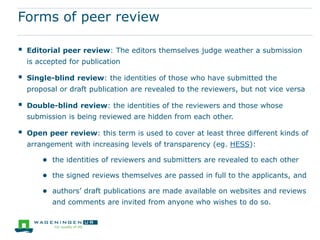
Forms of peer review
 Editorial peer review: The editors themselves judge weather a submission
is accepted for publication
 Single-blind review: the identities of those who have submitted the
proposal or draft publication are revealed to the reviewers, but not vice versa
 Double-blind review: the identities of the reviewers and those whose
submission is being reviewed are hidden from each other.
 Open peer review: this term is used to cover at least three different kinds of
arrangement with increasing levels of transparency (eg. HESS):
● the identities of reviewers and submitters are revealed to each other
● the signed reviews themselves are passed in full to the applicants, and
● authors’ draft publications are made available on websites and reviews
and comments are invited from anyone who wishes to do so.
Effectiveness of different types of peer review
Types of peer review % agree
(n=4037)
Peer review could be replaced by usage
statistics
15%
Supplementing peer review with post
publication review
47%
Open and published peer review 25%
Open peer review 20%
Double blind peer review 76%
Single blind peer review 45%
Mulligan, A., Hall, L., & Raphael, E. (2013). Peer review in a changing
world: An international study measuring the attitudes of researchers.
JASIST, 64(1), 132-161. http://dx.doi.org/10.1002/asi.22798
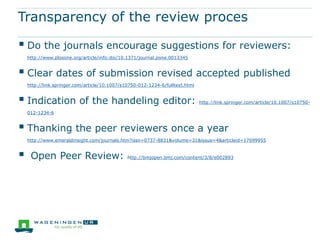
Transparency of the review proces
 Do the journals encourage suggestions for reviewers:
http://www.plosone.org/article/info:doi/10.1371/journal.pone.0013345
 Clear dates of submission revised accepted published
http://link.springer.com/article/10.1007/s10750-012-1234-6/fulltext.html
 Indication of the handeling editor http://link.springer.com/article/10.1007/s10750-
012-1234-6
 Thanking the peer reviewers once a year
http://journals.plos.org/plosone/article?id=10.1371/journal.pone.0121093
 Open Peer Review: http://bmjopen.bmj.com/content/3/9/e003272
Predatory journals
 They don't look all like Antarctica Journal of Mathematics
 Fake editorial boards (are they credible scientists?)
 Very quick/consistent period from submission to
acceptance (no date for revision!)
 No language editing/poor English
 Quality of the articles
 Beall's list of predatory publishers
http://scholarlyoa.com/publishers
Recent developments
Post publication peer review
 PubPeer https://pubpeer.com/publications/20129177
 F1000 Prime http://f1000.com/prime/recommendations
PeerJ, marrying publishing and peer review
Cascading peer review
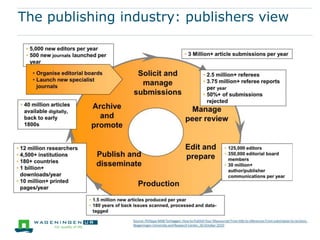
The publishing industry: publishers view
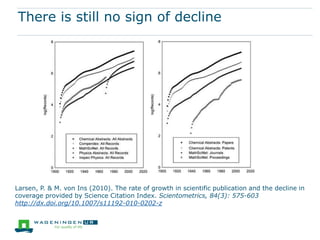
There is still no sign of decline
Larsen, P. & M. von Ins (2010). The rate of growth in scientific publication and the decline in
coverage provided by Science Citation Index. Scientometrics, 84(3): 575-603
http://dx.doi.org/10.1007/s11192-010-0202-z
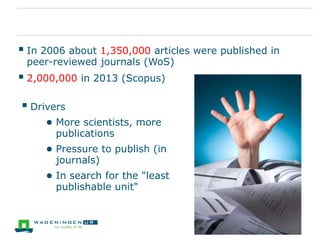
 In 2006 about 1,350,000 articles were published in
peer-reviewed journals (WoS)
 2,000,000 in 2013 (Scopus)
 Drivers
● More scientists, more
publications
● Pressure to publish (in
journals)
● In search for the "least
publishable unit"
Other criticism
 Not always effective at detecting falsification, fabrication
and plagiarism (FFP)
 Brings delay in the research an innovation cycle
 Selection of reviewers brings bias
 Judgement subjective and inconsistent
 Tends toward conservatism and stifles innovation
 Disadvantageous to interdisciplinary research
 Imposes increasing and unsupportable burdens on
reviewers
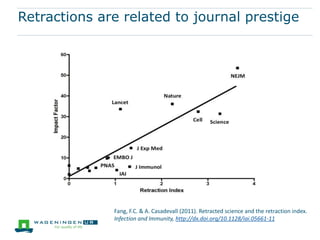
Retractions are related to journal prestige
Fang, F.C. & A. Casadevall (2011). Retracted science and the retraction index.
Infection and Immunity, http://dx.doi.org/10.1128/iai.05661-11
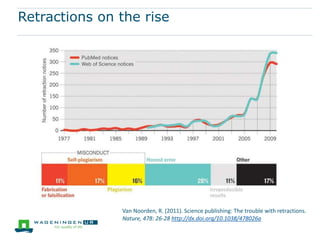
Retractions on the rise
Van Noorden, R. (2011). Science publishing: The trouble with retractions.
Nature, 478: 26-28 http://dx.doi.org/10.1038/478026a
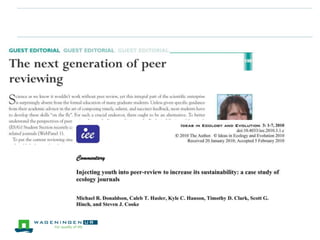
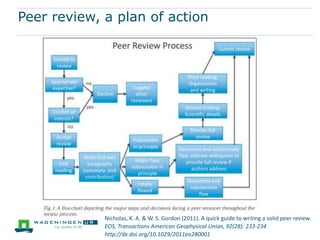
Peer review, a plan of action
Nicholas, K. A. & W. S. Gordon (2011). A quick guide to writing a solid peer review.
EOS, Transactions American Geophysical Union, 92(28): 233-234
http://dx.doi.org/10.1029/2011eo280001
Considering a reviewing request
 Do you have the expertise?
 Is there a conflict of interest?
 Do you have time?
After the review process
 You should be informed on the editor's decision
● If the editor makes a decision on the manuscript
counter to the direction you recommended in your
review, you may request an explanation.
 You should not reveal to the author or authors after
review that you were a reviewer
 Do not make public the contents of the manuscript nor
use any information in the manuscript until it is
published.
Why should you take part?
 New peer reviewers badly needed
 You can benefit from peer review
● Critical reading
● Expressing your opinion
● Improve you own writing
● Expand your professional network
Some resources
 BMJ peer reviewers: resources
http://www.bmj.com/about-bmj/resources-reviewers
 Elsevier's reviewers home
http://www.elsevier.com/wps/find/reviewershome.reviewers
 Springer peer review academy
http://www.springer.com/authors/journal+authors/peer-review-academy
 Nature peer review debate
http://www.nature.com/nature/peerreview/debate/index.html
 British Ecological Society http://www.britishecologicalsociety.org/wp-
content/uploads/Publ_Peer-Review-Booklet.pdf
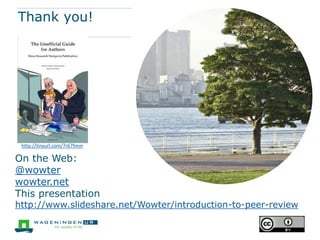
Thank you!
On the Web:
@wowter
wowter.net
This presentation
http://www.slideshare.net/Wowter/introduction-to-peer-review
http://tinyurl.com/7r67fmm

Introduction to Peer review, updated 2015-03-05

  • 1.
    Introduction to peerreview Peer review workshop, Wageningen Graduate Schools Wouter Gerritsma
  • 2.
    Contents  What ispeer review?  Peer review problems  Peer review solutions  Peer review benefits  Peer review resources
  • 3.
    Nature editorial Februari19th, 2015 http://dx.doi.org/10.1038/518274b
  • 4.
    What is peerreview? Peer review is both a set of mechanisms and a principle at the heart of the system for evaluating and assuring the quality of research before and after it is funded or published. It involves subjecting research proposals and draft presentations, papers and other publications to critical evaluation by independent experts (peers). The reviewers are usually appointed by the funding body or the editors of a journal or other formal channel for communication to which the work has been submitted. Source: RIN (2011). Peer review: a guide for researchers. www.rin.ac.uk/peer-review-guide.
  • 5.
    When is peerreview employed?  the evaluation of applications for funding, to determine which applications are successful  the review of reports submitted by researchers once their funding award has come to an end, to assess whether a project has been completed satisfactorily  the evaluation of draft conference presentations, journal articles and monographs, before they are published, to assess whether they meet quality standards  the evaluation of publications once they have been published, through reviews and review articles  the evaluation of the quality of work produced by individuals, teams, departments and institutions to help determine appointments, promotions and levels of funding.
  • 6.
    Peer review ofpublications I
  • 7.
    Peer review ofpublications II
  • 8.
    Which editor?  Rolesof 113 WageningenUR researchers with 71 Elsevier journals ● Editor in chief ● Editor ● Reviews editor ● Associate editor ● Editorial board ● Section editor ● Topic editor ● Editorial advisory board ● Book review editor
  • 9.
    Einstein to theeditor of Physical Review Kennefick, D. (2005). Einstein Versus the Physical Review. Physicstoday, 58(9): 43 http://physicstoday.org/journals/doc/PHTOAD-ft/vol_58/iss_9/43_1.shtml
  • 10.
    Forms of peerreview  Editorial peer review: The editors themselves judge weather a submission is accepted for publication  Single-blind review: the identities of those who have submitted the proposal or draft publication are revealed to the reviewers, but not vice versa  Double-blind review: the identities of the reviewers and those whose submission is being reviewed are hidden from each other.  Open peer review: this term is used to cover at least three different kinds of arrangement with increasing levels of transparency (eg. HESS): ● the identities of reviewers and submitters are revealed to each other ● the signed reviews themselves are passed in full to the applicants, and ● authors’ draft publications are made available on websites and reviews and comments are invited from anyone who wishes to do so.
  • 11.
    Effectiveness of differenttypes of peer review Types of peer review % agree (n=4037) Peer review could be replaced by usage statistics 15% Supplementing peer review with post publication review 47% Open and published peer review 25% Open peer review 20% Double blind peer review 76% Single blind peer review 45% Mulligan, A., Hall, L., & Raphael, E. (2013). Peer review in a changing world: An international study measuring the attitudes of researchers. JASIST, 64(1), 132-161. http://dx.doi.org/10.1002/asi.22798
  • 12.
    Transparency of thereview proces  Do the journals encourage suggestions for reviewers: http://www.plosone.org/article/info:doi/10.1371/journal.pone.0013345  Clear dates of submission revised accepted published http://link.springer.com/article/10.1007/s10750-012-1234-6/fulltext.html  Indication of the handeling editor http://link.springer.com/article/10.1007/s10750- 012-1234-6  Thanking the peer reviewers once a year http://journals.plos.org/plosone/article?id=10.1371/journal.pone.0121093  Open Peer Review: http://bmjopen.bmj.com/content/3/9/e003272
  • 13.
    Predatory journals  Theydon't look all like Antarctica Journal of Mathematics  Fake editorial boards (are they credible scientists?)  Very quick/consistent period from submission to acceptance (no date for revision!)  No language editing/poor English  Quality of the articles  Beall's list of predatory publishers http://scholarlyoa.com/publishers
  • 14.
    Recent developments Post publicationpeer review  PubPeer https://pubpeer.com/publications/20129177  F1000 Prime http://f1000.com/prime/recommendations PeerJ, marrying publishing and peer review Cascading peer review
  • 15.
    The publishing industry:publishers view
  • 16.
    There is stillno sign of decline Larsen, P. & M. von Ins (2010). The rate of growth in scientific publication and the decline in coverage provided by Science Citation Index. Scientometrics, 84(3): 575-603 http://dx.doi.org/10.1007/s11192-010-0202-z
  • 17.
     In 2006about 1,350,000 articles were published in peer-reviewed journals (WoS)  2,000,000 in 2013 (Scopus)  Drivers ● More scientists, more publications ● Pressure to publish (in journals) ● In search for the "least publishable unit"
  • 18.
    Other criticism  Notalways effective at detecting falsification, fabrication and plagiarism (FFP)  Brings delay in the research an innovation cycle  Selection of reviewers brings bias  Judgement subjective and inconsistent  Tends toward conservatism and stifles innovation  Disadvantageous to interdisciplinary research  Imposes increasing and unsupportable burdens on reviewers
  • 19.
    Retractions are relatedto journal prestige Fang, F.C. & A. Casadevall (2011). Retracted science and the retraction index. Infection and Immunity, http://dx.doi.org/10.1128/iai.05661-11
  • 20.
    Retractions on therise Van Noorden, R. (2011). Science publishing: The trouble with retractions. Nature, 478: 26-28 http://dx.doi.org/10.1038/478026a
  • 22.
    Peer review, aplan of action Nicholas, K. A. & W. S. Gordon (2011). A quick guide to writing a solid peer review. EOS, Transactions American Geophysical Union, 92(28): 233-234 http://dx.doi.org/10.1029/2011eo280001
  • 23.
    Considering a reviewingrequest  Do you have the expertise?  Is there a conflict of interest?  Do you have time?
  • 24.
    After the reviewprocess  You should be informed on the editor's decision ● If the editor makes a decision on the manuscript counter to the direction you recommended in your review, you may request an explanation.  You should not reveal to the author or authors after review that you were a reviewer  Do not make public the contents of the manuscript nor use any information in the manuscript until it is published.
  • 25.
    Why should youtake part?  New peer reviewers badly needed  You can benefit from peer review ● Critical reading ● Expressing your opinion ● Improve you own writing ● Expand your professional network
  • 26.
    Some resources  BMJpeer reviewers: resources http://www.bmj.com/about-bmj/resources-reviewers  Elsevier's reviewers home http://www.elsevier.com/wps/find/reviewershome.reviewers  Springer peer review academy http://www.springer.com/authors/journal+authors/peer-review-academy  Nature peer review debate http://www.nature.com/nature/peerreview/debate/index.html  British Ecological Society http://www.britishecologicalsociety.org/wp- content/uploads/Publ_Peer-Review-Booklet.pdf
  • 27.
    Thank you! On theWeb: @wowter wowter.net This presentation http://www.slideshare.net/Wowter/introduction-to-peer-review http://tinyurl.com/7r67fmm