Approaches to Peer Review
Martyn Rittman, January 2015
Peer Review
Aims: Look at some of the issues with peer review and proposed
solutions. Finally, what problem is peer review trying to solve and
how can this improve our decision-making criteria?
Outline:
A very brief history of peer review
Current views of peer review
Models of peer review
What is peer review for
Conclusion and open questions
A (very) brief history of peer review
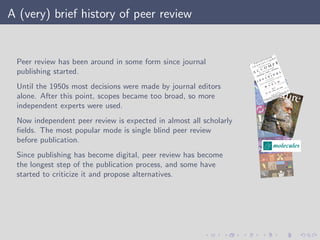
Peer review has been around in some form since journal
publishing started.
Until the 1950s most decisions were made by journal editors
alone. After this point, scopes became too broad, so more
independent experts were used.
Now independent peer review is expected in almost all scholarly
fields. The most popular mode is single blind peer review
before publication.
Since publishing has become digital, peer review has become
the longest step of the publication process, and some have
started to criticize it and propose alternatives.
Current Views of Peer Review
Some recent quotes and research about peer review
There is a problem with peer review
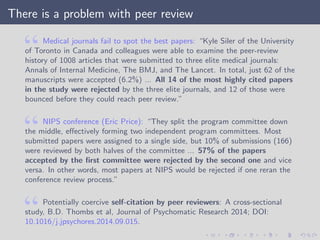
Medical journals fail to spot the best papers: “Kyle Siler of the University
of Toronto in Canada and colleagues were able to examine the peer-review
history of 1008 articles that were submitted to three elite medical journals:
Annals of Internal Medicine, The BMJ, and The Lancet. In total, just 62 of the
manuscripts were accepted (6.2%) ... All 14 of the most highly cited papers
in the study were rejected by the three elite journals, and 12 of those were
bounced before they could reach peer review.”
NIPS conference (Eric Price): “They split the program committee down
the middle, effectively forming two independent program committees. Most
submitted papers were assigned to a single side, but 10% of submissions (166)
were reviewed by both halves of the committee ... 57% of the papers
accepted by the first committee were rejected by the second one and vice
versa. In other words, most papers at NIPS would be rejected if one reran the
conference review process.”
Potentially coercive self-citation by peer reviewers: A cross-sectional
study, B.D. Thombs et al, Journal of Psychomatic Research 2014; DOI:
10.1016/j.jpsychores.2014.09.015.
Alternative approaches to peer review
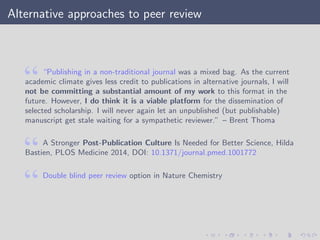
“Publishing in a non-traditional journal was a mixed bag. As the current
academic climate gives less credit to publications in alternative journals, I will
not be committing a substantial amount of my work to this format in the
future. However, I do think it is a viable platform for the dissemination of
selected scholarship. I will never again let an unpublished (but publishable)
manuscript get stale waiting for a sympathetic reviewer.” – Brent Thoma
A Stronger Post-Publication Culture Is Needed for Better Science, Hilda
Bastien, PLOS Medicine 2014, DOI: 10.1371/journal.pmed.1001772
Double blind peer review option in Nature Chemistry
Other peer review issues
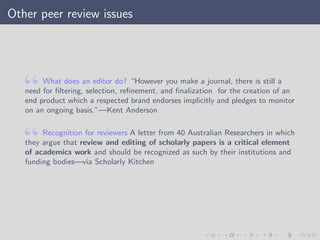
What does an editor do? “However you make a journal, there is still a
need for filtering, selection, refinement, and finalization for the creation of an
end product which a respected brand endorses implicitly and pledges to monitor
on an ongoing basis.”—Kent Anderson
Recognition for reviewers A letter from 40 Australian Researchers in which
they argue that review and editing of scholarly papers is a critical element
of academics work and should be recognized as such by their institutions and
funding bodies—via Scholarly Kitchen
MDPI Single Blind Review
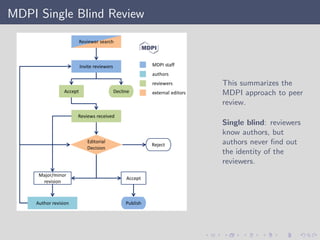
This summarizes the
MDPI approach to peer
review.
Single blind: reviewers
know authors, but
authors never find out
the identity of the
reviewers.
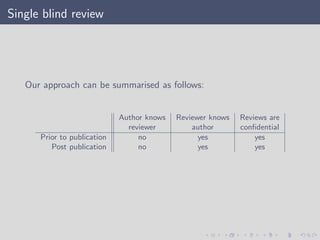
Single blind review
Our approach can be summarised as follows:
Author knows Reviewer knows Reviews are
reviewer author confidential
Prior to publication no yes yes
Post publication no yes yes
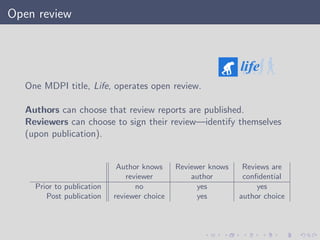
Open review
One MDPI title, Life, operates open review.
Authors can choose that review reports are published.
Reviewers can choose to sign their review—identify themselves
(upon publication).
Author knows Reviewer knows Reviews are
reviewer author confidential
Prior to publication no yes yes
Post publication reviewer choice yes author choice
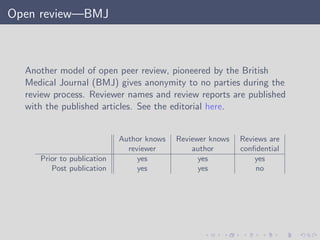
Open review—BMJ
Another model of open peer review, pioneered by the British
Medical Journal (BMJ) gives anonymity to no parties during the
review process. Reviewer names and review reports are published
with the published articles. See the editorial here.
Author knows Reviewer knows Reviews are
reviewer author confidential
Prior to publication yes yes yes
Post publication yes yes no
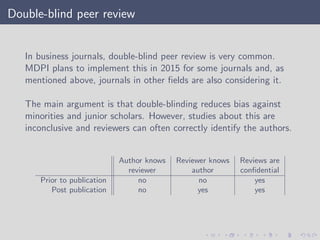
Double-blind peer review
In business journals, double-blind peer review is very common.
MDPI plans to implement this in 2015 for some journals and, as
mentioned above, journals in other fields are also considering it.
The main argument is that double-blinding reduces bias against
minorities and junior scholars. However, studies about this are
inconclusive and reviewers can often correctly identify the authors.
Author knows Reviewer knows Reviews are
reviewer author confidential
Prior to publication no no yes
Post publication no yes yes
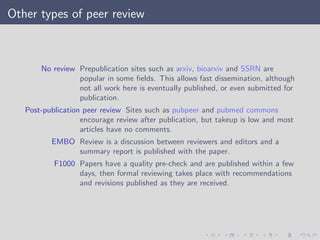
Other types of peer review
No review Prepublication sites such as arxiv, bioarxiv and SSRN are
popular in some fields. This allows fast dissemination, although
not all work here is eventually published, or even submitted for
publication.
Post-publication peer review Sites such as pubpeer and pubmed commons
encourage review after publication, but takeup is low and most
articles have no comments.
EMBO Review is a discussion between reviewers and editors and a
summary report is published with the paper.
F1000 Papers have a quality pre-check and are published within a few
days, then formal reviewing takes place with recommendations
and revisions published as they are received.
What is Peer Review For?
What should peer review achieve?
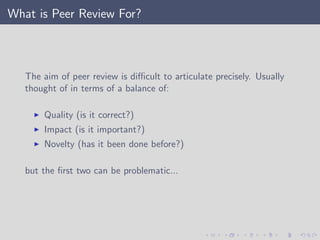
What is Peer Review For?
The aim of peer review is difficult to articulate precisely. Usually
thought of in terms of a balance of:
Quality (is it correct?)
Impact (is it important?)
Novelty (has it been done before?)
but the first two can be problematic...
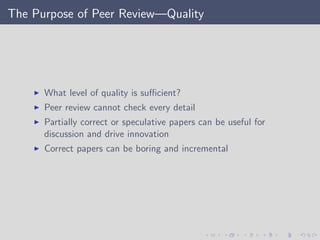
The Purpose of Peer Review—Quality
What level of quality is sufficient?
Peer review cannot check every detail
Partially correct or speculative papers can be useful for
discussion and drive innovation
Correct papers can be boring and incremental
The Purpose of Peer Review—Impact
It’s not always easy to tell what will have impact when it’s
published
Impact is a bigger issue for print journals with limited space,
less so in the digital age
Has been taken out of the equation by many online/open
access journals
The Purpose of Peer Review—The Scientific Process
Peer Review should support the scientific
process of discovery
Check that conclusions are supported
Encourage novelty
Ask ‘will this research lead to other interesting discoveries’
Conclusion
The models presented above all use the same underlying process to
achieve the same end, which relies on independent review and the
judgment of editors.
The differences are in openness, process accountability, and time to
publication.
A fair system should take account of the needs of authors,
reviewers, editors, and readers.
Open questions
What is the most frustrating aspect of conventional peer
review? Can any of the other models solve this?
Can review happen faster while maintaining quality?
What can be done to motivate and recognise reviewer
contribution?

Approaches to Peer Review

  • 1.
    Approaches to PeerReview Martyn Rittman, January 2015
  • 2.
    Peer Review Aims: Lookat some of the issues with peer review and proposed solutions. Finally, what problem is peer review trying to solve and how can this improve our decision-making criteria? Outline: A very brief history of peer review Current views of peer review Models of peer review What is peer review for Conclusion and open questions
  • 3.
    A (very) briefhistory of peer review Peer review has been around in some form since journal publishing started. Until the 1950s most decisions were made by journal editors alone. After this point, scopes became too broad, so more independent experts were used. Now independent peer review is expected in almost all scholarly fields. The most popular mode is single blind peer review before publication. Since publishing has become digital, peer review has become the longest step of the publication process, and some have started to criticize it and propose alternatives.
  • 4.
    Current Views ofPeer Review Some recent quotes and research about peer review
  • 5.
    There is aproblem with peer review Medical journals fail to spot the best papers: “Kyle Siler of the University of Toronto in Canada and colleagues were able to examine the peer-review history of 1008 articles that were submitted to three elite medical journals: Annals of Internal Medicine, The BMJ, and The Lancet. In total, just 62 of the manuscripts were accepted (6.2%) ... All 14 of the most highly cited papers in the study were rejected by the three elite journals, and 12 of those were bounced before they could reach peer review.” NIPS conference (Eric Price): “They split the program committee down the middle, effectively forming two independent program committees. Most submitted papers were assigned to a single side, but 10% of submissions (166) were reviewed by both halves of the committee ... 57% of the papers accepted by the first committee were rejected by the second one and vice versa. In other words, most papers at NIPS would be rejected if one reran the conference review process.” Potentially coercive self-citation by peer reviewers: A cross-sectional study, B.D. Thombs et al, Journal of Psychomatic Research 2014; DOI: 10.1016/j.jpsychores.2014.09.015.
  • 6.
    Alternative approaches topeer review “Publishing in a non-traditional journal was a mixed bag. As the current academic climate gives less credit to publications in alternative journals, I will not be committing a substantial amount of my work to this format in the future. However, I do think it is a viable platform for the dissemination of selected scholarship. I will never again let an unpublished (but publishable) manuscript get stale waiting for a sympathetic reviewer.” – Brent Thoma A Stronger Post-Publication Culture Is Needed for Better Science, Hilda Bastien, PLOS Medicine 2014, DOI: 10.1371/journal.pmed.1001772 Double blind peer review option in Nature Chemistry
  • 7.
    Other peer reviewissues What does an editor do? “However you make a journal, there is still a need for filtering, selection, refinement, and finalization for the creation of an end product which a respected brand endorses implicitly and pledges to monitor on an ongoing basis.”—Kent Anderson Recognition for reviewers A letter from 40 Australian Researchers in which they argue that review and editing of scholarly papers is a critical element of academics work and should be recognized as such by their institutions and funding bodies—via Scholarly Kitchen
  • 8.
    MDPI Single BlindReview This summarizes the MDPI approach to peer review. Single blind: reviewers know authors, but authors never find out the identity of the reviewers.
  • 9.
    Single blind review Ourapproach can be summarised as follows: Author knows Reviewer knows Reviews are reviewer author confidential Prior to publication no yes yes Post publication no yes yes
  • 10.
    Open review One MDPItitle, Life, operates open review. Authors can choose that review reports are published. Reviewers can choose to sign their review—identify themselves (upon publication). Author knows Reviewer knows Reviews are reviewer author confidential Prior to publication no yes yes Post publication reviewer choice yes author choice
  • 11.
    Open review—BMJ Another modelof open peer review, pioneered by the British Medical Journal (BMJ) gives anonymity to no parties during the review process. Reviewer names and review reports are published with the published articles. See the editorial here. Author knows Reviewer knows Reviews are reviewer author confidential Prior to publication yes yes yes Post publication yes yes no
  • 12.
    Double-blind peer review Inbusiness journals, double-blind peer review is very common. MDPI plans to implement this in 2015 for some journals and, as mentioned above, journals in other fields are also considering it. The main argument is that double-blinding reduces bias against minorities and junior scholars. However, studies about this are inconclusive and reviewers can often correctly identify the authors. Author knows Reviewer knows Reviews are reviewer author confidential Prior to publication no no yes Post publication no yes yes
  • 13.
    Other types ofpeer review No review Prepublication sites such as arxiv, bioarxiv and SSRN are popular in some fields. This allows fast dissemination, although not all work here is eventually published, or even submitted for publication. Post-publication peer review Sites such as pubpeer and pubmed commons encourage review after publication, but takeup is low and most articles have no comments. EMBO Review is a discussion between reviewers and editors and a summary report is published with the paper. F1000 Papers have a quality pre-check and are published within a few days, then formal reviewing takes place with recommendations and revisions published as they are received.
  • 14.
    What is PeerReview For? What should peer review achieve?
  • 15.
    What is PeerReview For? The aim of peer review is difficult to articulate precisely. Usually thought of in terms of a balance of: Quality (is it correct?) Impact (is it important?) Novelty (has it been done before?) but the first two can be problematic...
  • 16.
    The Purpose ofPeer Review—Quality What level of quality is sufficient? Peer review cannot check every detail Partially correct or speculative papers can be useful for discussion and drive innovation Correct papers can be boring and incremental
  • 17.
    The Purpose ofPeer Review—Impact It’s not always easy to tell what will have impact when it’s published Impact is a bigger issue for print journals with limited space, less so in the digital age Has been taken out of the equation by many online/open access journals
  • 18.
    The Purpose ofPeer Review—The Scientific Process Peer Review should support the scientific process of discovery Check that conclusions are supported Encourage novelty Ask ‘will this research lead to other interesting discoveries’
  • 19.
    Conclusion The models presentedabove all use the same underlying process to achieve the same end, which relies on independent review and the judgment of editors. The differences are in openness, process accountability, and time to publication. A fair system should take account of the needs of authors, reviewers, editors, and readers.
  • 20.
    Open questions What isthe most frustrating aspect of conventional peer review? Can any of the other models solve this? Can review happen faster while maintaining quality? What can be done to motivate and recognise reviewer contribution?