Data management plan format

Wouter Gerritsma, Wageningen UR Library
Data management plan

 A data management plan is a formal document you

develop at the start of your research project which
outlines all aspects of your data (i.e., what you will do
with your data during and after your research project).

 Data management plan is not a static document, but
needs adjustment at regular intervals
Data management policies

 Currently there are not many funder requirements for
data management in the Netherlands.

 Data management policies are discussed by NWO and EC
● NWO is on the brink to implement DM policies

 Data management policies become mandatory for PhD's
of Wageningen Graduate Schools per 04/2014
WGS format for a Data Management Plan

 Format consists of 9 questions

(http://www.wageningenur.nl/library/dmp)

 The template assists you to go trough all these questions
with explanation

 Questions are illustrated with example from Lucy
Vermeulen (PhD cadidate, ESA)
1. Organizational Context

 A data management belongs to a researcher, part of a

group, and should have a file name to identify it on you
computer.
1. Organizational Context

 A data management belongs to a researcher, part of a

group, and should have a file name to identify it on you
computer.
2. Give a short description of your work

 There is no need to repeat what is in you research plan,
but a short description to give some context to the
reader is sufficient.

 Give two or three lines to explain what is not obvious
from the title
Short description of your research

 Give two or three lines to explain what is not obvious
from the title
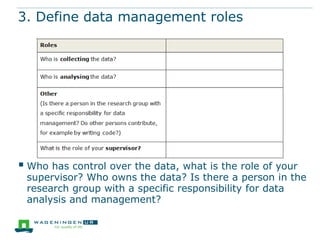
3. Define data management roles

 Who has control over the data, what is the role of your

supervisor? Who owns the data? Is there a person in the
research group with a specific responsibility for data
analysis and management?
3. Define data management roles

 Who has control over the data, what is the role of your

supervisor? Who owns the data? Is there a person in the
research group with a specific responsibility for data
analysis and management?
4. Give an overview of expected type of
research data, software choices, data size
& growth

 Identifying your possible research data before you

actually start collecting those data, makes sure no
research output is overlooked.
5. Short term storage solutions
6. Structuring your data and information
7. Documentation and metadata

 Describe how you are going to document your data

collection process, what the resulting data files comprise
and how they will be processed further. Think about
documenting the:

1. content (what does your dataset contain?)
2. context (who, what, why, where and how will the
data be collected and analysed)

3. process (are there specific processes and does it
make sense to organise notes by process?)
7. Documentation and metadata

 Describe how you are going to document your data

collection process, what the resulting data files comprise
and how they will be processed further. Think about
documenting the:

1. content (what does your dataset contain?)
2. context (who, what, why, where and how will the
data be collected and analysed)

3. process (are there specific processes and does it
make sense to organise notes by process?)
8. Sharing and ownership

 Do you expect that others may be interested to re-use

you data, and do you have plans to share it with them?

 How are you going to make sure your data files will be
accessible once you leave the department?

 Are there specific funder’s requirements to share you
data, or to impose an embargo?

 If other parties (outside your group or outside

Wageningen UR) are involved in this research, are there
agreements how the data will be used and shared?

 Are there privacy or security issues, and if there are,
how are you dealing with them?
8. Sharing and ownership

 Do you expect that others may be interested to re-use

you data, and do you have plans to share it with them?

 How are you going to make sure your data files will be
accessible once you leave the department?

 Are there specific funder’s requirements to share you
data, or to impose an embargo?

 If other parties (outside your group or outside

Wageningen UR) are involved in this research, are there
agreements how the data will be used and shared?

 Are there privacy or security issues, and if there are,
how are you dealing with them?
9. Long term storage

 Which part of your research data has value for long term
storage?

 Do you intend to preserve these data for the long term?
 If not, argue why.
 Is there a common practice in your field or do you intend
to use the services provided by Wageningen UR?
9. Long term storage

 Which part of your research data has value for long term
storage?

 Do you intend to preserve these data for the long term?
 If not, argue why.
 Is there a common practice in your field or do you intend
to use the services provided by Wageningen UR?
Examples of long term storage

 http://library.wur.nl/WebQuery/wurpubs?A170=dat
Thank you!

Courtesy to Lucy Vermeulen who
allowed us to share parts of her
DMP

The input of Marina Noordegraaf
@insearch4data and Hugo
Besemer is acknowledged

On the Web:

@wowter
wowter.net
http://www.slideshare.net/wowter

Data management plan format

  • 1.
    Data management planformat Wouter Gerritsma, Wageningen UR Library
  • 2.
    Data management plan A data management plan is a formal document you develop at the start of your research project which outlines all aspects of your data (i.e., what you will do with your data during and after your research project).  Data management plan is not a static document, but needs adjustment at regular intervals
  • 3.
    Data management policies Currently there are not many funder requirements for data management in the Netherlands.  Data management policies are discussed by NWO and EC ● NWO is on the brink to implement DM policies  Data management policies become mandatory for PhD's of Wageningen Graduate Schools per 04/2014
  • 4.
    WGS format fora Data Management Plan  Format consists of 9 questions (http://www.wageningenur.nl/library/dmp)  The template assists you to go trough all these questions with explanation  Questions are illustrated with example from Lucy Vermeulen (PhD cadidate, ESA)
  • 5.
    1. Organizational Context A data management belongs to a researcher, part of a group, and should have a file name to identify it on you computer.
  • 6.
    1. Organizational Context A data management belongs to a researcher, part of a group, and should have a file name to identify it on you computer.
  • 7.
    2. Give ashort description of your work  There is no need to repeat what is in you research plan, but a short description to give some context to the reader is sufficient.  Give two or three lines to explain what is not obvious from the title
  • 8.
    Short description ofyour research  Give two or three lines to explain what is not obvious from the title
  • 9.
    3. Define datamanagement roles  Who has control over the data, what is the role of your supervisor? Who owns the data? Is there a person in the research group with a specific responsibility for data analysis and management?
  • 10.
    3. Define datamanagement roles  Who has control over the data, what is the role of your supervisor? Who owns the data? Is there a person in the research group with a specific responsibility for data analysis and management?
  • 11.
    4. Give anoverview of expected type of research data, software choices, data size & growth  Identifying your possible research data before you actually start collecting those data, makes sure no research output is overlooked.
  • 14.
    5. Short termstorage solutions
  • 15.
    5. Short termstorage solutions
  • 16.
    5. Short termstorage solutions
  • 17.
    6. Structuring yourdata and information
  • 18.
    7. Documentation andmetadata  Describe how you are going to document your data collection process, what the resulting data files comprise and how they will be processed further. Think about documenting the: 1. content (what does your dataset contain?) 2. context (who, what, why, where and how will the data be collected and analysed) 3. process (are there specific processes and does it make sense to organise notes by process?)
  • 19.
    7. Documentation andmetadata  Describe how you are going to document your data collection process, what the resulting data files comprise and how they will be processed further. Think about documenting the: 1. content (what does your dataset contain?) 2. context (who, what, why, where and how will the data be collected and analysed) 3. process (are there specific processes and does it make sense to organise notes by process?)
  • 20.
    8. Sharing andownership  Do you expect that others may be interested to re-use you data, and do you have plans to share it with them?  How are you going to make sure your data files will be accessible once you leave the department?  Are there specific funder’s requirements to share you data, or to impose an embargo?  If other parties (outside your group or outside Wageningen UR) are involved in this research, are there agreements how the data will be used and shared?  Are there privacy or security issues, and if there are, how are you dealing with them?
  • 21.
    8. Sharing andownership  Do you expect that others may be interested to re-use you data, and do you have plans to share it with them?  How are you going to make sure your data files will be accessible once you leave the department?  Are there specific funder’s requirements to share you data, or to impose an embargo?  If other parties (outside your group or outside Wageningen UR) are involved in this research, are there agreements how the data will be used and shared?  Are there privacy or security issues, and if there are, how are you dealing with them?
  • 22.
    9. Long termstorage  Which part of your research data has value for long term storage?  Do you intend to preserve these data for the long term?  If not, argue why.  Is there a common practice in your field or do you intend to use the services provided by Wageningen UR?
  • 23.
    9. Long termstorage  Which part of your research data has value for long term storage?  Do you intend to preserve these data for the long term?  If not, argue why.  Is there a common practice in your field or do you intend to use the services provided by Wageningen UR?
  • 24.
    Examples of longterm storage  http://library.wur.nl/WebQuery/wurpubs?A170=dat
  • 29.
    Thank you! Courtesy toLucy Vermeulen who allowed us to share parts of her DMP The input of Marina Noordegraaf @insearch4data and Hugo Besemer is acknowledged On the Web: @wowter wowter.net http://www.slideshare.net/wowter