Research-Based Analysis, Cont.
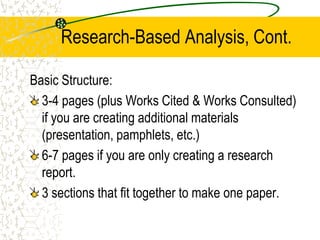
Basic Structure:
3-4 pages (plus Works Cited & Works Consulted)
if you are creating additional materials
(presentation, pamphlets, etc.)
6-7 pages if you are only creating a research
report.
3 sections that fit together to make one paper.
Research-Based Analysis, Cont.
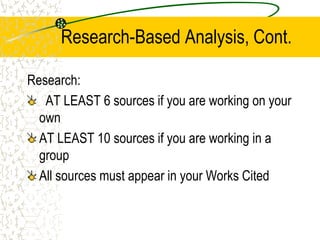
Research:
AT LEAST 6 sources if you are working on your
own
AT LEAST 10 sources if you are working in a
group
All sources must appear in your Works Cited
Research-Based Analysis, Cont.
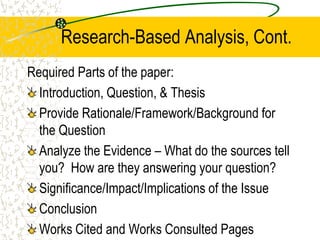
Required Parts of the paper:
Introduction, Question, & Thesis
Provide Rationale/Framework/Background for
the Question
Analyze the Evidence – What do the sources tell
you? How are they answering your question?
Significance/Impact/Implications of the Issue
Conclusion
Works Cited and Works Consulted Pages
Research-Based Analysis, Cont.
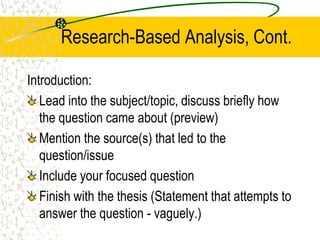
Introduction:
Lead into the subject/topic, discuss briefly how
the question came about (preview)
Mention the source(s) that led to the
question/issue
Include your focused question
Finish with the thesis (Statement that attempts to
answer the question - vaguely.)
Research-Based Analysis, Cont.
Sample Inquiry Question – Draft #1:
Why are girls so obsessed with weddings?
Research-Based Analysis, Cont.
Do not be afraid to revise your question. In fact,
it will probably be necessary to continue to draft
and develop this question as your paper grows
more complicated by the research.
Research-Based Analysis, Cont.
Revised Inquiry Question – Final Draft:
Why, in times of cohabitation before marriage,
economic instability, unemployment, and debt,
are the American popular media and brides-tobe obsessed with extravagant weddings?
Research-Based Analysis, Cont.
Notice how the final draft of this sample question
grew more complicated. As the student learned
more from the research, he/she began to think
about other factors which made the issue more
astounding.
I should see your question grow and evolve in
much the same way.
Research-Based Analysis, Cont.
Thesis:
Provides a larger context for analysis in
terms of an inquiry focus.
Research-Based Analysis, Cont.
Rationale/Framework/Background:
Give background information or sources which
led to your question.
Introduce or Summarize (very briefly) what those
sources said to lead you to the question.
Explain what other information may exist that
provides background on this issue.
Define terms, explain concepts, etc.
You will be using citations from your sources.
Research-Based Analysis, Cont.
Analysis and Support:
What does the research reveal?
How is your question being answered by the support?
Allow sources to support, complicate, or extend your
question.
This section should be divided into various claims which
attempt to answer the preliminary question and
organized accordingly. I should not see one neverending section here… there should be logical
organization based on your claims.
Research-Based Analysis, Cont.
Analysis and Support, Cont.:
– If you are creating additional materials, those will
take the place of this section of your paper.
– All projects, whether written, presented, or filmed,
must adequately cite sources.
– Remember that images and film clips require proper
citation, too
– DO NOT PLAGIARIZE – better to over-cite
Research-Based Analysis, Cont.
Significance/Impact/Implications:
Sets up and asks the question, “So What?”
“So what?” applies to the answers… why is this worth
anyone’s time and consideration?
Most important questions of the paper: “How has this
affected our society?” “How will it affect us later?”
“What impact does this have?” Are there dangers?
“Why is this worth looking at?”
Research-Based Analysis, Cont.
Conclusion:
Summarize your findings/answers to the
question
Importance of the trend (significance)
Gaps or areas that may require further research
Works Cited
This is a list of the sources you actually
referenced and used in your paper.
Works Consulted
This is a list of all of the sources you found
for your paper, regardless of whether or not
they were actually used.

Research paper structure

  • 1.
    Research-Based Analysis, Cont. BasicStructure: 3-4 pages (plus Works Cited & Works Consulted) if you are creating additional materials (presentation, pamphlets, etc.) 6-7 pages if you are only creating a research report. 3 sections that fit together to make one paper.
  • 2.
    Research-Based Analysis, Cont. Research: ATLEAST 6 sources if you are working on your own AT LEAST 10 sources if you are working in a group All sources must appear in your Works Cited
  • 3.
    Research-Based Analysis, Cont. RequiredParts of the paper: Introduction, Question, & Thesis Provide Rationale/Framework/Background for the Question Analyze the Evidence – What do the sources tell you? How are they answering your question? Significance/Impact/Implications of the Issue Conclusion Works Cited and Works Consulted Pages
  • 4.
    Research-Based Analysis, Cont. Introduction: Leadinto the subject/topic, discuss briefly how the question came about (preview) Mention the source(s) that led to the question/issue Include your focused question Finish with the thesis (Statement that attempts to answer the question - vaguely.)
  • 5.
    Research-Based Analysis, Cont. SampleInquiry Question – Draft #1: Why are girls so obsessed with weddings?
  • 6.
    Research-Based Analysis, Cont. Donot be afraid to revise your question. In fact, it will probably be necessary to continue to draft and develop this question as your paper grows more complicated by the research.
  • 7.
    Research-Based Analysis, Cont. RevisedInquiry Question – Final Draft: Why, in times of cohabitation before marriage, economic instability, unemployment, and debt, are the American popular media and brides-tobe obsessed with extravagant weddings?
  • 8.
    Research-Based Analysis, Cont. Noticehow the final draft of this sample question grew more complicated. As the student learned more from the research, he/she began to think about other factors which made the issue more astounding. I should see your question grow and evolve in much the same way.
  • 9.
    Research-Based Analysis, Cont. Thesis: Providesa larger context for analysis in terms of an inquiry focus.
  • 10.
    Research-Based Analysis, Cont. Rationale/Framework/Background: Givebackground information or sources which led to your question. Introduce or Summarize (very briefly) what those sources said to lead you to the question. Explain what other information may exist that provides background on this issue. Define terms, explain concepts, etc. You will be using citations from your sources.
  • 11.
    Research-Based Analysis, Cont. Analysisand Support: What does the research reveal? How is your question being answered by the support? Allow sources to support, complicate, or extend your question. This section should be divided into various claims which attempt to answer the preliminary question and organized accordingly. I should not see one neverending section here… there should be logical organization based on your claims.
  • 12.
    Research-Based Analysis, Cont. Analysisand Support, Cont.: – If you are creating additional materials, those will take the place of this section of your paper. – All projects, whether written, presented, or filmed, must adequately cite sources. – Remember that images and film clips require proper citation, too – DO NOT PLAGIARIZE – better to over-cite
  • 13.
    Research-Based Analysis, Cont. Significance/Impact/Implications: Setsup and asks the question, “So What?” “So what?” applies to the answers… why is this worth anyone’s time and consideration? Most important questions of the paper: “How has this affected our society?” “How will it affect us later?” “What impact does this have?” Are there dangers? “Why is this worth looking at?”
  • 14.
    Research-Based Analysis, Cont. Conclusion: Summarizeyour findings/answers to the question Importance of the trend (significance) Gaps or areas that may require further research
  • 15.
    Works Cited This isa list of the sources you actually referenced and used in your paper. Works Consulted This is a list of all of the sources you found for your paper, regardless of whether or not they were actually used.