OPEN ACCESS
INTIATIVES
Dr.Ningappa.N.Arabagonda
Selection Grade librarian
Govt First Grade College,
BYADAGI-581106
INTRODUCTION
 An old tradition and a new technology have converged to
make possible an unprecedented public good. The old
tradition is the willingness of scientists and scholars to
publish the fruits of their research in scholarly journals
without payment, for the sake of inquiry and knowledge.
The new technology is the internet. The public good they
make possible is the world-wide electronic distribution
of the peer-reviewed journal literature and completely
free and unrestricted access to it by all scientists,
scholars, teachers, students, and other curious minds.
 Important developments to be noted in this regard are the Budapest
Open Access Initiative of 2002, Berlin Declaration on Open Access to
Knowledge in the Sciences and Humanities of 2003, Bethesda
Statement on Open Access Publishing of 2003, and the Salvador
Declaration on Open Access of 2005. All these developments have
focussed on the role that Open Access initiative. Participants from all
around the world, representing researchers, publishers, universities,
libraries, journals, institutions, learned societies, and other
related Open Access initiatives attended these meetings to examine
the issues surrounding Open Access movement. They discussed many
points of view on the most affordable and effective policies to
implement the Open Access movement across the scientific world.
They also explored the different strategies to unite all Open Access
initiatives under one roof and work together to achieve faster, in-depth
success. Finally, they also discussed how to efficiently use resources
that aid in the transition to Open Access and make Open Access
publishing economically self-sustaining.
The Open Access initiative has also been supported by
UNESCO for the benefit of global science and the
progress of mankind. A clear mandate has been given
by UNESCO, stating that UNESCO should 'maintain,
increase and diffuse knowledge, by assuring the
conservation and protection of the world's inheritance
of books, works of art and monuments of history and
science.
In this regard, OMICS publishing group, an Open
Access publication model strongly supports the Open
Access initiative and the Bethesda Statement on Open
Access publishing. Abstracts and full texts (HTML,
XML and PDF format) of all articles published by
OMICS publishing group are freely accessible to
everyone immediately after publication.
DEFINITATION
 By "open access" to this literature, we mean its free
availability on the public internet, permitting any users to
read, download, copy, distribute, print, search, or link to
the full texts of these articles, pass them as data to
software, or use them for any other lawful purpose,
without financial, legal, or technical barriers other than
those inseparable from gaining access to the internet
itself. The only constraint on reproduction and
distribution, and the only role for copyright in this
domain, should be to give authors control over the
integrity of their work and the right to be properly
acknowledged and cited.
BUDAPEST OPEN ACCESS INITIATIVE
IN RESPONSE TO THE GROWING DEMAND TO MAKE RESEARCH FREE AND
AVAILABLE TO ANYONE WITH A COMPUTER AND AN INTERNET
CONNECTION, A DIVERSE COALITION HAS ISSUED NEW GUIDELINES THAT
COULD USHER IN HUGE ADVANCES IN THE SCIENCES, MEDICINE, AND
HEALTH.
THE RECOMMENDATIONS WERE DEVELOPED BY LEADERS OF THE OPEN
ACCESS MOVEMENT, WHICH HAS WORKED FOR THE PAST DECADE TO
PROVIDE THE PUBLIC WITH UNRESTRICTED, FREE ACCESS TO
SCHOLARLY RESEARCH—MUCH OF WHICH IS PUBLICLY FUNDED.
MAKING THE RESEARCH PUBLICLY AVAILABLE TO EVERYONE—FREE OF
CHARGE AND WITHOUT MOST COPYRIGHT AND LICENSING
RESTRICTIONS—WILL ACCELERATE SCIENTIFIC RESEARCH EFFORTS AND
ALLOW AUTHORS TO REACH A LARGER NUMBER OF READERS.
The recommendations are the result of a meeting organized
by the Open Society Foundations to mark the tenth
anniversary of Budapest Open Access Initiative, which first
defined Open Access. The recommendations include the
development of Open Access policies in institutions of higher
education and in funding agencies, the open licensing of
scholarly works, the development of infrastructure such as
Open Access repositories and creating standards of
professional conduct for Open Access publishing. The
recommendations also establish a new goal of achieving Open
Access as the default method for distributing new peer-
reviewed research in every field and in every country within
ten years time.
IS OPEN ACCESS COMPATIBLE WITH
COPYRIGHT?
The short answer is that copyright law gives
the copyright holder the right to make access
open or restricted, and the BOAI seeks to put
copyright in the hands of authors or institutions
that will consent to make access open. The long
answer depends on whether we are talking
about self-archiving or open access journals
Self - Archiving
Authors of preprints hold the copyright to them and may post
them to open access archives with no copyright problems whatever. If
the preprint is later accepted for publication in a journal that requires
authors to transfer copyright to the publisher, then the journal may or
may not give permission for the refereed postprint to be posted to an
open access archive. If permission is granted, then again there is no
copyright problem. If permission is denied, then the preprint may
remain in the open access archive because it is a different work from
the postprint and the author never transferred the copyright on the
preprint. Moreover, the author may post to the archive a list of
corrigenda, or differences between the preprint and postprint. This is
not quite as convenient for readers as seeing the whole postprint online,
but it provides them with the equivalent of the full text of the postprint
and is infinitely more useful than no free access at all.
Journals
Open access journals will either let authors
retain copyright or ask authors to transfer copyright to
the publisher. In either case, the copyright holder will
consent to open access for the published work. When
the publisher holds the copyright, it will consent to
open access directly. When authors hold the copyright,
they will insure open access by signing a license to the
publisher authorizing open access. Publishers of open-
access journals will have such licenses already
prepared for authors. There are many ways to write
such a license. For example, see the licence written by
the Public Library of Science.
I would like to launch a new open-access journal. How do I do it?
Launching an open-access journal has much in common
with launching a print journal. Apart from the people and the
funding, there is the niche to fill, its size, its coverage by
other journals, and the risk of failing to attract enough
authors or readers. But if you have decided to move
forward, and have competent, experienced, and energetic
people ready to serve as editor and editorial board, and
committed to open access, then you should examine
the software packages available to automate most of the
tasks of operating an online journal. Some offer a turn-key
solution. For more specific and detailed help, see the links
and advice collected on the following web pages
(alphabetical by sponsoring organization).
 Availability of Scientific PublicationsTaking Your Journal
Online, from the Canadian Association of Learned Journals
 Publishing Support Initiatives, from the International Network
for the
 Electronic Publishing: Guide to Best Practices for Canadian
Publishers, from the National Library of Canada
 Guide to Business Planning for Launching a New Open Access
Journal, from the Open Society Institute
 Gaining Independence: A Manual for Planning the Launch of
a Nonprofit Electronic Publishing Venture, from SPARC.
 Tools and Resources for Online Journal Editing and
Publishing, from the University of Nevada at Reno Libraries.
The 13 original signatories of the BudapestOpen Access Initiative
included some of the world's early leaders in the open access
movement: Leslie Chan of Bioline International; Darius
Cuplinskas, Melissa Hagemann, Rima Kupryte and István Rév of Open
Society Institute; Michael Eisen of the Public Library of Science; Fred
Friend of the University College London; Yana Genova of Next Page
Foundation; Jean-Claude Guédon of the Université de
Montréal and Open Society Institute; Stevan Harnad of the University
of Southampton/Université du Québec à Montréal;Rick
Johnson[disambiguation needed] of the Scholarly Publishing and Academic
Resources Coalition (SPARC); Manfredi La Manna of the Electronic
Society for Social Scientists; Monika Segbert,Electronic Information
for Libraries (eIFL.net) Project consultant; Sidnei de Souza, Informatics
Director at CRIA, Bioline International; Peter Suber, Professor of
Philosophy, Earlham College andThe Free Online Scholarship
Newsletter; Jan Velterop of BioMed Central.
FUNDING
The initiative was
sponsored with a USD
$3 million grant from
the Soros Foundation.
 http://www.mysciencework.com/en/
 Scientific network
 Scientific publications
 MyScienceNews
 MyScienceWork is a scientific social network for the dissemination of
scientific knowledge in open access.
 Advanced search
 Login | Register
 JOIN THE WORLD SCIENTIFIC COMMUNITY
 MSW IN 5 KEY WORDS
 MULTIDISCIPLINARY…
MY SCIENCE WORK COVERAGE
 Anthropology
 Archaeology
 Astronomy
 Biology
 Chemistry
 Communication
 Computer Science
 Criminology
 Design
 Earth Science
 Ecology
 Economics
 Education
 Engineering
 Geography
 History
 Law
 Linguistics
 Literature
 Logic
 Mathematics
 Medicine
 Musicology
 Pharmacology
 Philosophy
 Physics
 Political Science
 Psychology
 Religious Science
 Social Sciences
LANGUAGES
Chinese
English
French
German
Hindi
Italian
Japanese
Korean
Russian
Spanish
DOAJ COVERED
Journals Covered
01. Agriculture & Food Sciences- 205
02. Arts and Architecture- 95
03. Biology and Life Sciences- 384
04. Business and Economics- 141
05. Chemistry- 83
06. Earth and Environmental Sciences- 256
07. General Works- 51
08. Health Sciences- 1070
09. History and Archaeology- 135
10. Languages and Literatures- 228
11. Law and Political Science- 161
12. Mathematics and Statistics- 150
13. Philosophy and Religion- 141
14. Physics and Astronomy- 84
15. Science (General)- 41
16. Social Sciences- 835
17. Technology and Engineering- 340
Grand Total:4,430
Source: http//www.doaj.org
OPEN J-GATE
 The Open J-Gate (OJ) was started by Informatics (India)
Limited, Bangalore and developed in to a largest
database for OA Journals. It was started as a database
tool and E-Journal gateway for searching and accessing
articles online available Journals. Currently, J-Gate
indexes articles from more than 16,000 English language
journals, out of which over 10,000 are in scholarly
domain. As on today, J-Gate covers 4,230 OA Journals
covering both scholarly and popular Journals from 2001
onwards.
SALIENT FEATURES
 The salient features of OJ are mentioned below:
 It is a subscription product, which restricts access to
OA Journals.
 Indexes articles from 4,230 academic, research and
industry Journals in English language.
 The number of 1 million is increasing by adding more
than 3,00,000 new articles being added every year.
Full text links are regularly validated.
 Updated almost daily.
 Journals are classified in a hierarchical system to
provide for better relevancy in search results.
 Users can browse Table of Contents both from
archieve as well as current titles.
 Database allows Quick search. Advanced search and
Browse by Journal.
SUBJECT COVERAGE
THE BROAD SUBJECTS COVERED UNDER JGATE AND
APPROXIMATE NUMBER OF JOURNALS COVERED UNDER
EACH OF THE SUBJECTS ARE SHOWN BELOW
01 Agriculture and Biological Sciences 618
02 Art and Humanities 821
03 Basic Sciences 1,151
04 Biomedical Sciences 1,480
05 Engineering and Technology 1,228
06 Library and Information Science 71
07 Social and Management Sciences 1,242
Total: 6,611
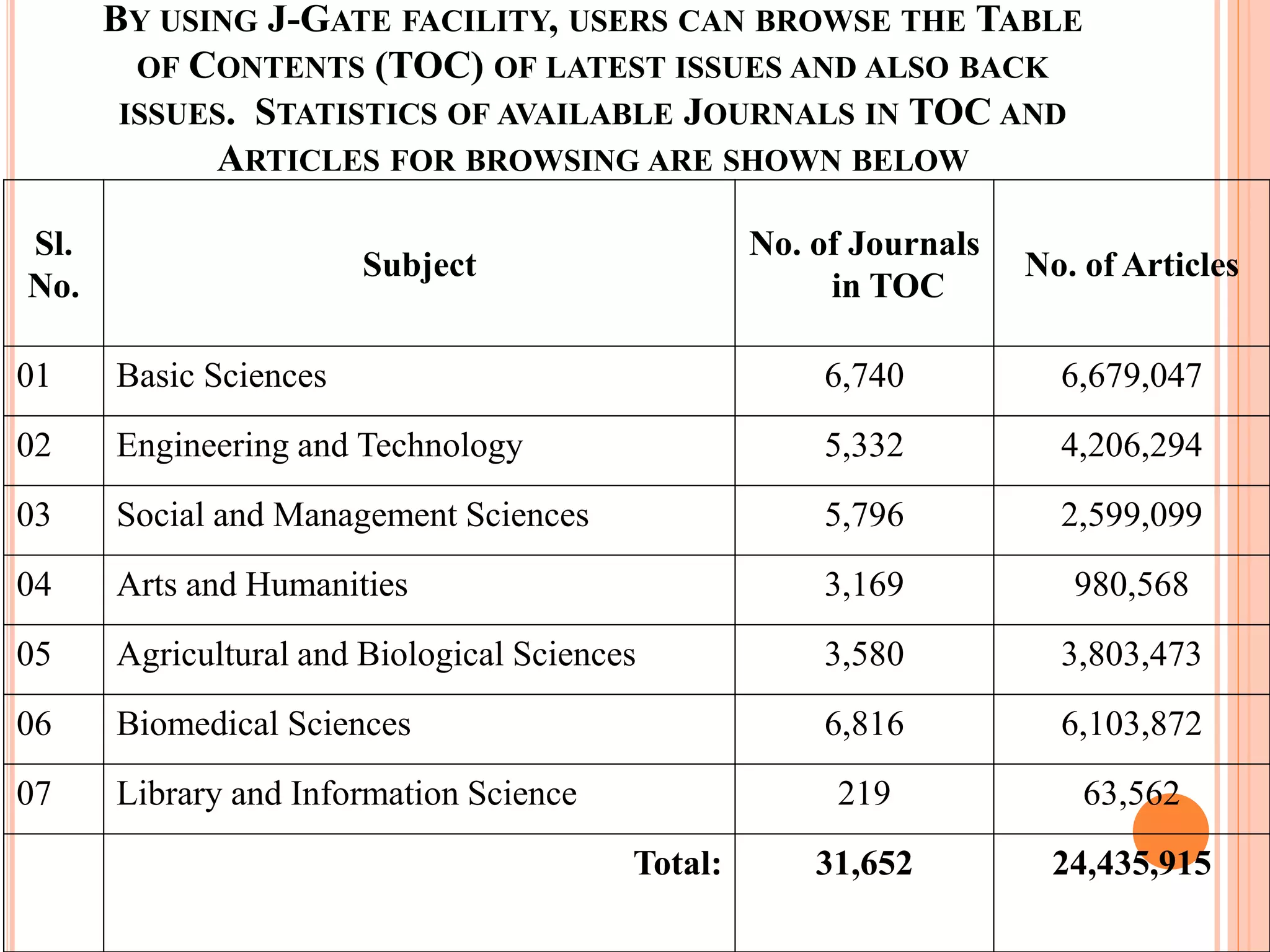
BY USING J-GATE FACILITY, USERS CAN BROWSE THE TABLE
OF CONTENTS (TOC) OF LATEST ISSUES AND ALSO BACK
ISSUES. STATISTICS OF AVAILABLE JOURNALS IN TOC AND
ARTICLES FOR BROWSING ARE SHOWN BELOW
Sl.
No.
Subject
No. of Journals
in TOC
No. of Articles
01 Basic Sciences 6,740 6,679,047
02 Engineering and Technology 5,332 4,206,294
03 Social and Management Sciences 5,796 2,599,099
04 Arts and Humanities 3,169 980,568
05 Agricultural and Biological Sciences 3,580 3,803,473
06 Biomedical Sciences 6,816 6,103,872
07 Library and Information Science 219 63,562
Total: 31,652 24,435,915
ANALYSIS & INTERPRETATIONS
S.N. Facilities DOAJ OJ
01 Type of Portal Free Subscription based
02 Searchable up to Article level
free-of-cost
Abstract level free-of-
cost
03 No. of Subject areas covered 8 7
04 No. of Journals listed 3,569 4,350
05 Covering of Popular and Trade-
press Journals
No Yes
06 Peer-reviewed Journals 3,569 2,200
07 Journals from which articles are
indexed
1,225 4,350
08 No. of Articles indexed 199,325 1,232,000
 With help of above mentioned data, following interpretations are made:
 Both DOAJ and OJ are OA Portals. DOAJ is a free Portal and
OJ is a Subscription based one.
 Subject areas covered are almost same in both Portals except
addition of Library and Information Science in OJ.
 Number of Journals listed are slightly high in case of OJ when
compare to DOAJ.
 Peer-reviewed Journals are more in DOAJ when compare to OJ.
 Number of Journals covered for indexing are very high in OJ
when compare to DOAJ.
 Number of Articles indexed are very high in OJ when compare
to DOAJ.
 Popular and Trade-press Journals are covered by OJ but not by
DOAJ.
 In view of the above, it is suggested that any Library for that matter, may start
using DOAJ at first, as it is a free Portal. After utilizing it fully, then may consider to
subscribe to Portals such as OJ, if financial Provisions permit for the same.
INDIAN OPEN ACCESS JOURNALS
S.N Publisher No. of
titles
URL
01 Indian Academy of
Science
11 www.ias.ac.in
02 Indian National
Science Academy
04 www.iasa.ac.in
03 Indian Medicals Center
of NIC
39 http://www.in.sa.ac.in
04 Medknow Publications 45 www.medknow.com
05 Indian Journals.com 12 www.ind.jol.com
OPEN ACCESS PUBLISHERS
A selected list of Open Access Publishers is given below:
•Bentham Open Access.
•BioMed Central.
•Hindawi (98 full open access STM journals).
•Indian Academy of Sciences.
•Ivyspring International Publisher.
•Libertas Academica (60+fully open access journals, mainly biological
sciences and clinical medicine).
•Medknow Publications (Publishers of Biomedical Journal from India).
•MDPI (Molecular Diversity Preservation International (MDPI), Basel,
Switzerland) (Some journals content only open access).
•Public Library of Science.
•Scholarly E
•xchange.
•Istituto Italiano di Antropologia.
CONCLUSION
It is impossible for any individual or any Library to
subscribe to all the Journals relevant to their subject
interest, due to mushrooming number of Journals and their
high cost. Hence, it is obvious to find alternative sources
for Journals which are free or cost effective. To this effect,
the latest development of Open Access Source Journals
facility seems to be an alternative, which may satisfy the
interests of the users, at least to some extent. All the
Libraries should tap the potential of all the Open Sources
of Journals to the optimum extent. Afterwards, may go for
subscribing to other relevant Journals which the Open
Sources does not cover
Open Access Initiatives

Open Access Initiatives

  • 1.
    OPEN ACCESS INTIATIVES Dr.Ningappa.N.Arabagonda Selection Gradelibrarian Govt First Grade College, BYADAGI-581106
  • 2.
    INTRODUCTION  An oldtradition and a new technology have converged to make possible an unprecedented public good. The old tradition is the willingness of scientists and scholars to publish the fruits of their research in scholarly journals without payment, for the sake of inquiry and knowledge. The new technology is the internet. The public good they make possible is the world-wide electronic distribution of the peer-reviewed journal literature and completely free and unrestricted access to it by all scientists, scholars, teachers, students, and other curious minds.
  • 3.
     Important developmentsto be noted in this regard are the Budapest Open Access Initiative of 2002, Berlin Declaration on Open Access to Knowledge in the Sciences and Humanities of 2003, Bethesda Statement on Open Access Publishing of 2003, and the Salvador Declaration on Open Access of 2005. All these developments have focussed on the role that Open Access initiative. Participants from all around the world, representing researchers, publishers, universities, libraries, journals, institutions, learned societies, and other related Open Access initiatives attended these meetings to examine the issues surrounding Open Access movement. They discussed many points of view on the most affordable and effective policies to implement the Open Access movement across the scientific world. They also explored the different strategies to unite all Open Access initiatives under one roof and work together to achieve faster, in-depth success. Finally, they also discussed how to efficiently use resources that aid in the transition to Open Access and make Open Access publishing economically self-sustaining.
  • 4.
    The Open Accessinitiative has also been supported by UNESCO for the benefit of global science and the progress of mankind. A clear mandate has been given by UNESCO, stating that UNESCO should 'maintain, increase and diffuse knowledge, by assuring the conservation and protection of the world's inheritance of books, works of art and monuments of history and science. In this regard, OMICS publishing group, an Open Access publication model strongly supports the Open Access initiative and the Bethesda Statement on Open Access publishing. Abstracts and full texts (HTML, XML and PDF format) of all articles published by OMICS publishing group are freely accessible to everyone immediately after publication.
  • 5.
    DEFINITATION  By "openaccess" to this literature, we mean its free availability on the public internet, permitting any users to read, download, copy, distribute, print, search, or link to the full texts of these articles, pass them as data to software, or use them for any other lawful purpose, without financial, legal, or technical barriers other than those inseparable from gaining access to the internet itself. The only constraint on reproduction and distribution, and the only role for copyright in this domain, should be to give authors control over the integrity of their work and the right to be properly acknowledged and cited.
  • 6.
    BUDAPEST OPEN ACCESSINITIATIVE IN RESPONSE TO THE GROWING DEMAND TO MAKE RESEARCH FREE AND AVAILABLE TO ANYONE WITH A COMPUTER AND AN INTERNET CONNECTION, A DIVERSE COALITION HAS ISSUED NEW GUIDELINES THAT COULD USHER IN HUGE ADVANCES IN THE SCIENCES, MEDICINE, AND HEALTH. THE RECOMMENDATIONS WERE DEVELOPED BY LEADERS OF THE OPEN ACCESS MOVEMENT, WHICH HAS WORKED FOR THE PAST DECADE TO PROVIDE THE PUBLIC WITH UNRESTRICTED, FREE ACCESS TO SCHOLARLY RESEARCH—MUCH OF WHICH IS PUBLICLY FUNDED. MAKING THE RESEARCH PUBLICLY AVAILABLE TO EVERYONE—FREE OF CHARGE AND WITHOUT MOST COPYRIGHT AND LICENSING RESTRICTIONS—WILL ACCELERATE SCIENTIFIC RESEARCH EFFORTS AND ALLOW AUTHORS TO REACH A LARGER NUMBER OF READERS.
  • 7.
    The recommendations arethe result of a meeting organized by the Open Society Foundations to mark the tenth anniversary of Budapest Open Access Initiative, which first defined Open Access. The recommendations include the development of Open Access policies in institutions of higher education and in funding agencies, the open licensing of scholarly works, the development of infrastructure such as Open Access repositories and creating standards of professional conduct for Open Access publishing. The recommendations also establish a new goal of achieving Open Access as the default method for distributing new peer- reviewed research in every field and in every country within ten years time.
  • 8.
    IS OPEN ACCESSCOMPATIBLE WITH COPYRIGHT? The short answer is that copyright law gives the copyright holder the right to make access open or restricted, and the BOAI seeks to put copyright in the hands of authors or institutions that will consent to make access open. The long answer depends on whether we are talking about self-archiving or open access journals
  • 9.
    Self - Archiving Authorsof preprints hold the copyright to them and may post them to open access archives with no copyright problems whatever. If the preprint is later accepted for publication in a journal that requires authors to transfer copyright to the publisher, then the journal may or may not give permission for the refereed postprint to be posted to an open access archive. If permission is granted, then again there is no copyright problem. If permission is denied, then the preprint may remain in the open access archive because it is a different work from the postprint and the author never transferred the copyright on the preprint. Moreover, the author may post to the archive a list of corrigenda, or differences between the preprint and postprint. This is not quite as convenient for readers as seeing the whole postprint online, but it provides them with the equivalent of the full text of the postprint and is infinitely more useful than no free access at all.
  • 10.
    Journals Open access journalswill either let authors retain copyright or ask authors to transfer copyright to the publisher. In either case, the copyright holder will consent to open access for the published work. When the publisher holds the copyright, it will consent to open access directly. When authors hold the copyright, they will insure open access by signing a license to the publisher authorizing open access. Publishers of open- access journals will have such licenses already prepared for authors. There are many ways to write such a license. For example, see the licence written by the Public Library of Science.
  • 11.
    I would liketo launch a new open-access journal. How do I do it? Launching an open-access journal has much in common with launching a print journal. Apart from the people and the funding, there is the niche to fill, its size, its coverage by other journals, and the risk of failing to attract enough authors or readers. But if you have decided to move forward, and have competent, experienced, and energetic people ready to serve as editor and editorial board, and committed to open access, then you should examine the software packages available to automate most of the tasks of operating an online journal. Some offer a turn-key solution. For more specific and detailed help, see the links and advice collected on the following web pages (alphabetical by sponsoring organization).
  • 12.
     Availability ofScientific PublicationsTaking Your Journal Online, from the Canadian Association of Learned Journals  Publishing Support Initiatives, from the International Network for the  Electronic Publishing: Guide to Best Practices for Canadian Publishers, from the National Library of Canada  Guide to Business Planning for Launching a New Open Access Journal, from the Open Society Institute  Gaining Independence: A Manual for Planning the Launch of a Nonprofit Electronic Publishing Venture, from SPARC.  Tools and Resources for Online Journal Editing and Publishing, from the University of Nevada at Reno Libraries.
  • 13.
    The 13 originalsignatories of the BudapestOpen Access Initiative included some of the world's early leaders in the open access movement: Leslie Chan of Bioline International; Darius Cuplinskas, Melissa Hagemann, Rima Kupryte and István Rév of Open Society Institute; Michael Eisen of the Public Library of Science; Fred Friend of the University College London; Yana Genova of Next Page Foundation; Jean-Claude Guédon of the Université de Montréal and Open Society Institute; Stevan Harnad of the University of Southampton/Université du Québec à Montréal;Rick Johnson[disambiguation needed] of the Scholarly Publishing and Academic Resources Coalition (SPARC); Manfredi La Manna of the Electronic Society for Social Scientists; Monika Segbert,Electronic Information for Libraries (eIFL.net) Project consultant; Sidnei de Souza, Informatics Director at CRIA, Bioline International; Peter Suber, Professor of Philosophy, Earlham College andThe Free Online Scholarship Newsletter; Jan Velterop of BioMed Central.
  • 14.
    FUNDING The initiative was sponsoredwith a USD $3 million grant from the Soros Foundation.
  • 15.
     http://www.mysciencework.com/en/  Scientificnetwork  Scientific publications  MyScienceNews  MyScienceWork is a scientific social network for the dissemination of scientific knowledge in open access.  Advanced search  Login | Register  JOIN THE WORLD SCIENTIFIC COMMUNITY  MSW IN 5 KEY WORDS  MULTIDISCIPLINARY…
  • 16.
    MY SCIENCE WORKCOVERAGE  Anthropology  Archaeology  Astronomy  Biology  Chemistry  Communication  Computer Science  Criminology  Design  Earth Science  Ecology  Economics  Education  Engineering  Geography  History  Law  Linguistics  Literature  Logic  Mathematics  Medicine  Musicology  Pharmacology  Philosophy  Physics  Political Science  Psychology  Religious Science  Social Sciences
  • 17.
  • 19.
    DOAJ COVERED Journals Covered 01.Agriculture & Food Sciences- 205 02. Arts and Architecture- 95 03. Biology and Life Sciences- 384 04. Business and Economics- 141 05. Chemistry- 83 06. Earth and Environmental Sciences- 256 07. General Works- 51 08. Health Sciences- 1070
  • 20.
    09. History andArchaeology- 135 10. Languages and Literatures- 228 11. Law and Political Science- 161 12. Mathematics and Statistics- 150 13. Philosophy and Religion- 141 14. Physics and Astronomy- 84 15. Science (General)- 41 16. Social Sciences- 835 17. Technology and Engineering- 340 Grand Total:4,430 Source: http//www.doaj.org
  • 21.
    OPEN J-GATE  TheOpen J-Gate (OJ) was started by Informatics (India) Limited, Bangalore and developed in to a largest database for OA Journals. It was started as a database tool and E-Journal gateway for searching and accessing articles online available Journals. Currently, J-Gate indexes articles from more than 16,000 English language journals, out of which over 10,000 are in scholarly domain. As on today, J-Gate covers 4,230 OA Journals covering both scholarly and popular Journals from 2001 onwards.
  • 22.
    SALIENT FEATURES  Thesalient features of OJ are mentioned below:  It is a subscription product, which restricts access to OA Journals.  Indexes articles from 4,230 academic, research and industry Journals in English language.  The number of 1 million is increasing by adding more than 3,00,000 new articles being added every year. Full text links are regularly validated.  Updated almost daily.  Journals are classified in a hierarchical system to provide for better relevancy in search results.  Users can browse Table of Contents both from archieve as well as current titles.  Database allows Quick search. Advanced search and Browse by Journal.
  • 23.
    SUBJECT COVERAGE THE BROADSUBJECTS COVERED UNDER JGATE AND APPROXIMATE NUMBER OF JOURNALS COVERED UNDER EACH OF THE SUBJECTS ARE SHOWN BELOW 01 Agriculture and Biological Sciences 618 02 Art and Humanities 821 03 Basic Sciences 1,151 04 Biomedical Sciences 1,480 05 Engineering and Technology 1,228 06 Library and Information Science 71 07 Social and Management Sciences 1,242 Total: 6,611
  • 24.
    BY USING J-GATEFACILITY, USERS CAN BROWSE THE TABLE OF CONTENTS (TOC) OF LATEST ISSUES AND ALSO BACK ISSUES. STATISTICS OF AVAILABLE JOURNALS IN TOC AND ARTICLES FOR BROWSING ARE SHOWN BELOW Sl. No. Subject No. of Journals in TOC No. of Articles 01 Basic Sciences 6,740 6,679,047 02 Engineering and Technology 5,332 4,206,294 03 Social and Management Sciences 5,796 2,599,099 04 Arts and Humanities 3,169 980,568 05 Agricultural and Biological Sciences 3,580 3,803,473 06 Biomedical Sciences 6,816 6,103,872 07 Library and Information Science 219 63,562 Total: 31,652 24,435,915
  • 25.
    ANALYSIS & INTERPRETATIONS S.N.Facilities DOAJ OJ 01 Type of Portal Free Subscription based 02 Searchable up to Article level free-of-cost Abstract level free-of- cost 03 No. of Subject areas covered 8 7 04 No. of Journals listed 3,569 4,350 05 Covering of Popular and Trade- press Journals No Yes 06 Peer-reviewed Journals 3,569 2,200 07 Journals from which articles are indexed 1,225 4,350 08 No. of Articles indexed 199,325 1,232,000
  • 26.
     With helpof above mentioned data, following interpretations are made:  Both DOAJ and OJ are OA Portals. DOAJ is a free Portal and OJ is a Subscription based one.  Subject areas covered are almost same in both Portals except addition of Library and Information Science in OJ.  Number of Journals listed are slightly high in case of OJ when compare to DOAJ.  Peer-reviewed Journals are more in DOAJ when compare to OJ.  Number of Journals covered for indexing are very high in OJ when compare to DOAJ.  Number of Articles indexed are very high in OJ when compare to DOAJ.  Popular and Trade-press Journals are covered by OJ but not by DOAJ.  In view of the above, it is suggested that any Library for that matter, may start using DOAJ at first, as it is a free Portal. After utilizing it fully, then may consider to subscribe to Portals such as OJ, if financial Provisions permit for the same.
  • 27.
    INDIAN OPEN ACCESSJOURNALS S.N Publisher No. of titles URL 01 Indian Academy of Science 11 www.ias.ac.in 02 Indian National Science Academy 04 www.iasa.ac.in 03 Indian Medicals Center of NIC 39 http://www.in.sa.ac.in 04 Medknow Publications 45 www.medknow.com 05 Indian Journals.com 12 www.ind.jol.com
  • 28.
    OPEN ACCESS PUBLISHERS Aselected list of Open Access Publishers is given below: •Bentham Open Access. •BioMed Central. •Hindawi (98 full open access STM journals). •Indian Academy of Sciences. •Ivyspring International Publisher. •Libertas Academica (60+fully open access journals, mainly biological sciences and clinical medicine). •Medknow Publications (Publishers of Biomedical Journal from India). •MDPI (Molecular Diversity Preservation International (MDPI), Basel, Switzerland) (Some journals content only open access). •Public Library of Science. •Scholarly E •xchange. •Istituto Italiano di Antropologia.
  • 29.
    CONCLUSION It is impossiblefor any individual or any Library to subscribe to all the Journals relevant to their subject interest, due to mushrooming number of Journals and their high cost. Hence, it is obvious to find alternative sources for Journals which are free or cost effective. To this effect, the latest development of Open Access Source Journals facility seems to be an alternative, which may satisfy the interests of the users, at least to some extent. All the Libraries should tap the potential of all the Open Sources of Journals to the optimum extent. Afterwards, may go for subscribing to other relevant Journals which the Open Sources does not cover