WOUTER GERRITSMA, VU UNIVERSITY AMSTERDAM
@WOWTER
PUBLISHING FOR IMPACT
CHANGING THEMES IN SCIENCE
Was: Publish or perish
Is: Publish be cited or perish
2 Publishing for Impact
CONTENTS
• What is article impact?
• Write reviews
• Journals with impact
• Collaborate
• Reference lists
3 Publishing for Impact
Beeldvullende foto met titel
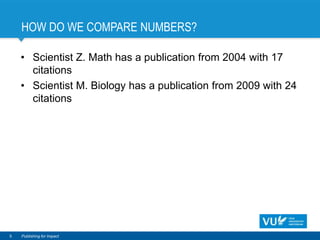
HOW DO WE COMPARE NUMBERS?
• Scientist Z. Math has a publication from 2004 with 17
citations
• Scientist M. Biology has a publication from 2009 with 24
citations
5 Publishing for Impact
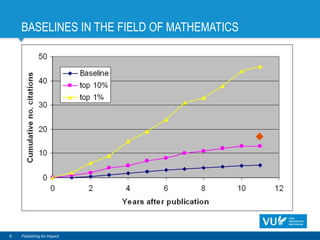
BASELINES IN THE FIELD OF MATHEMATICS
6 Publishing for Impact
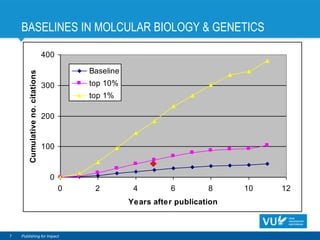
BASELINES IN MOLCULAR BIOLOGY & GENETICS
7 Publishing for Impact
0
100
200
300
400
0 2 4 6 8 10 12
Years after publication
Cumulativeno.citations
Baseline
top 10%
top 1%
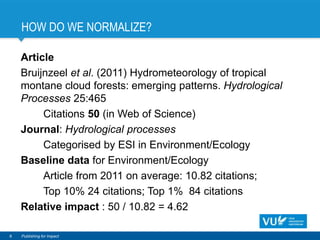
HOW DO WE NORMALIZE?
Article
Bruijnzeel et al. (2011) Hydrometeorology of tropical
montane cloud forests: emerging patterns. Hydrological
Processes 25:465
Citations 50 (in Web of Science)
Journal: Hydrological processes
Categorised by ESI in Environment/Ecology
Baseline data for Environment/Ecology
Article from 2011 on average: 10.82 citations;
Top 10% 24 citations; Top 1% 84 citations
Relative impact : 50 / 10.82 = 4.62
8 Publishing for Impact
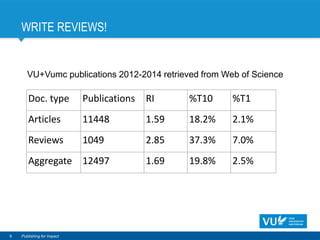
WRITE REVIEWS!
9 Publishing for Impact
Doc. type Publications RI %T10 %T1
Articles 11448 1.59 18.2% 2.1%
Reviews 1049 2.85 37.3% 7.0%
Aggregate 12497 1.69 19.8% 2.5%
VU+Vumc publications 2012-2014 retrieved from Web of Science
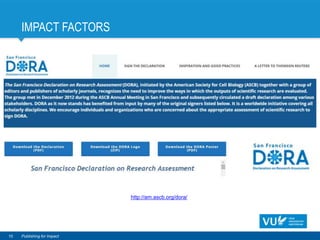
IMPACT FACTORS
10 Publishing for Impact
http://am.ascb.org/dora/
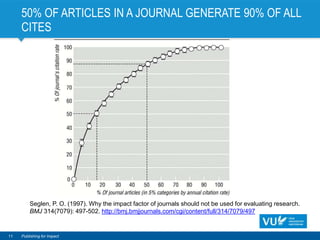
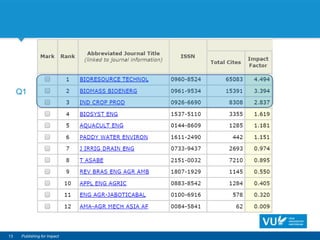
50% OF ARTICLES IN A JOURNAL GENERATE 90% OF ALL
CITES
11 Publishing for Impact
Seglen, P. O. (1997). Why the impact factor of journals should not be used for evaluating research.
BMJ 314(7079): 497-502. http://bmj.bmjjournals.com/cgi/content/full/314/7079/497
12 Publishing for Impact
13 Publishing for Impact
Q1
14 Publishing for Impact
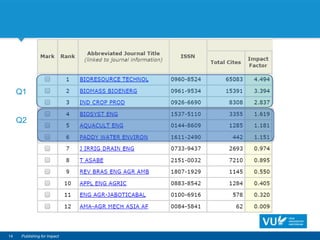
Q1
Q2
15 Publishing for Impact
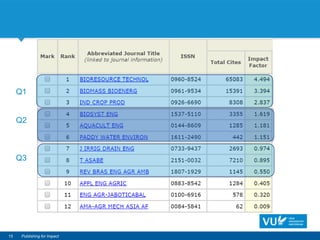
Q1
Q2
Q3
16 Publishing for Impact
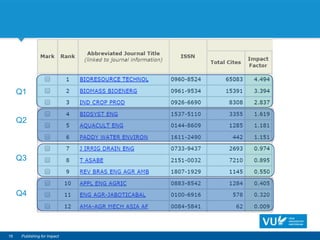
Q1
Q2
Q3
Q4
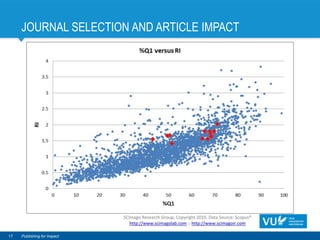
JOURNAL SELECTION AND ARTICLE IMPACT
17 Publishing for Impact
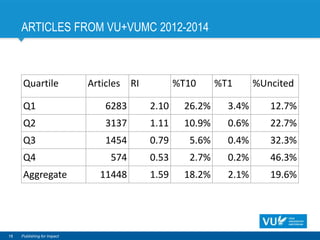
ARTICLES FROM VU+VUMC 2012-2014
18 Publishing for Impact
Quartile Articles RI %T10 %T1 %Uncited
Q1 6283 2.10 26.2% 3.4% 12.7%
Q2 3137 1.11 10.9% 0.6% 22.7%
Q3 1454 0.79 5.6% 0.4% 32.3%
Q4 574 0.53 2.7% 0.2% 46.3%
Aggregate 11448 1.59 18.2% 2.1% 19.6%
THE IMPACT FACTOR MATTHEW EFFECT
"The journal in which papers are published have a strong
influence on their citation rates, as duplicate papers
published in high-impact journals obtain, on average, twice
as many citations as their identical counterparts published in
journals with lower impact factors."
19 Publishing for Impact
Larivière, V. and Y. Gingras (2010). The impact factor's Matthew Effect: A natural experiment in
bibliometrics. Journal of the American Society for Information Science and Technology 61(2): 424-
427. http://dx.doi.org/10.1002/asi.21232
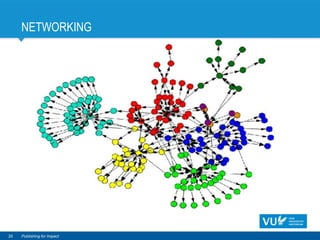
NETWORKING
20 Publishing for Impact
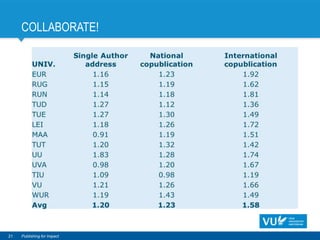
COLLABORATE!
21 Publishing for Impact
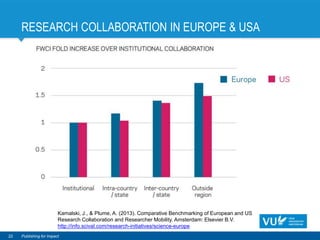
RESEARCH COLLABORATION IN EUROPE & USA
22 Publishing for Impact
Kamalski, J., & Plume, A. (2013). Comparative Benchmarking of European and US
Research Collaboration and Researcher Mobility. Amsterdam: Elsevier B.V.
http://info.scival.com/research-initiatives/science-europe
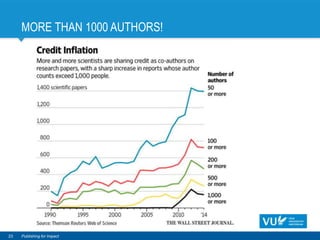
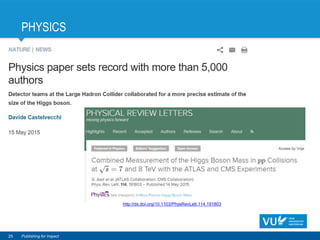
MORE THAN 1000 AUTHORS!
23 Publishing for Impact
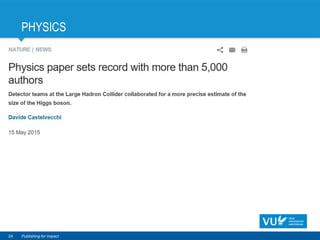
PHYSICS
24 Publishing for Impact
PHYSICS
25 Publishing for Impact
http://dx.doi.org/10.1103/PhysRevLett.114.191803
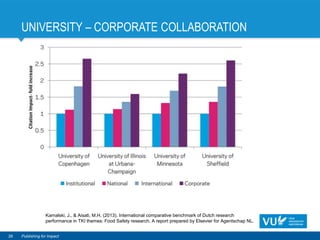
UNIVERSITY – CORPORATE COLLABORATION
26 Publishing for Impact
Kamalski, J., & Aisati, M.H. (2013). International comparative benchmark of Dutch research
performance in TKI themes: Food Safety research. A report prepared by Elsevier for Agentschap NL.
UNIVERSITY – CORPORATE COLLABORATION
27 Publishing for Impact
"The average scientific impact of university-industry
papers is significantly above that of both university-
only papers and industry-only papers"
Lebeau, L. M., Laframboise, M. C., Larivière, V., & Gingras, Y. (2008). The effect of university-industry
collaboration on the scientific impact of publications: The Canadian case, 1980-2005. Research
Evaluation, 17(3), 227-232. http://dx.doi.org/10.3152/095820208x331685
OPEN ACCESS CITATION ADVANTAGE
Based on a study of “Nature Communications”
• Open access articles are downloaded more than closed
access articles
• Open access articles are cited slightly more closed
access articles
Based on Finish research
• Open access articles more shared on Twitter and
Facebook
28 Publishing for Impact
OPEN ACCESS PUBLISHING
29 Publishing for Impact
Golden Road: PLoS, BMC, SpringerOpen, Sage Open
• Directory of open access journals DOAJ (currently 10,000+
journals)
• 25% of these are author pays model and 75% publish your
article for free
Green Road: Self-archiving in repositories e.g. VU-Dare
• Most publishers allow uploading final peer reviewed author’s
version to be uploaded.
• Check Sherpa-Romeo
PUBLISH YOUR DATA
30 Publishing for Impact
Henneken et al. (2011) "articles with links to data result in
higher citation rates than articles without such links"
http://arxiv.org/abs/1111.3618
Piwowar et al. (2007) "Sharing detailed research data is
associated with increased citation rate
http://dx.doi.org/10.1371/journal.pone.0000308
Apart from archiving data, according to the code of conduct,
sharing data increases visibility and citations to articles
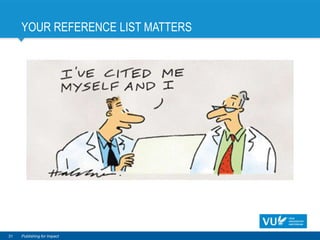
YOUR REFERENCE LIST MATTERS
31 Publishing for Impact
YOUR REFERENCE LIST MATTERS
32 Publishing for Impact
Articles that cite more references are in turn cited
more themselves
Webster, G. D., P. K. Jonason, et al. (2009). Hot Topics and Popular Papers in Evolutionary Psychology:
Analyses of Title Words and Citation Counts in Evolution and Human Behavior, 1979 – 2008. Evolutionary
Psychology 7(3): 348-362. http://www.epjournal.net/filestore/ep07348362.pdf
To be the best, cite the best
Borrowed from: Corbyn, Z. (2010). "To be the best, cite the best." Nature News, 13 October 2010,
http://dx.doi.org/10.1038/news.2010.539 Reporting on the publication of Bornmann, L., F. de Moya Anegón, et
al. (2010). Do Scientific Advancements Lean on the Shoulders of Giants? A Bibliometric Investigation of the
Ortega Hypothesis. PLoS ONE 5(10): e13327 DOI: http://dx.doi.org/10.1371/journal.pone.0013327.
The Price index, recency measure of references, was
found to be the strongest influencing factor on
citations
Onodera, N., and F. Yoshikane. 2014. Factors affecting citation rates of research articles. Journal of the
Association for Information Science and Technology: n/a-n/a. http://dx.doi.org/10.1002/asi.23209
ADVERTISE YOUR WORK
• Be active at conferences
• Have at least your Google Scholar profile, ResearcherId
and up to date
• Claim your ORCiD
• Make use of social networking tools (LinkedIn,
Researchgate, Mendeley, Academia.edu etc.)
• Write, or expand, articles in the Wikipedia and refer to
your thesis
• Blog or tweet about your research and thesis research
33 Publishing for Impact
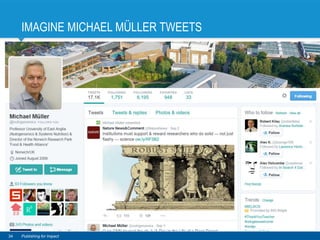
IMAGINE MICHAEL MÜLLER TWEETS
34 Publishing for Impact
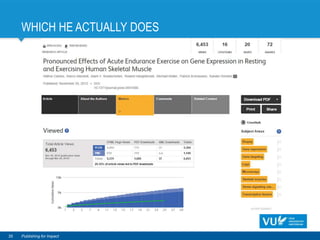
WHICH HE ACTUALLY DOES
35 Publishing for Impact
TAKE HOME MESSAGES
• Select your journal carefully
• Collaborate
• Advertise your work
36 Publishing for Impact
Universiteitsbibliotheek VU
THANK YOU
University Library VU University Amsterdam37 Publishing for Impact
http://www.slideshare.net/wowter

Publishing for impact

  • 1.
    WOUTER GERRITSMA, VUUNIVERSITY AMSTERDAM @WOWTER PUBLISHING FOR IMPACT
  • 2.
    CHANGING THEMES INSCIENCE Was: Publish or perish Is: Publish be cited or perish 2 Publishing for Impact
  • 3.
    CONTENTS • What isarticle impact? • Write reviews • Journals with impact • Collaborate • Reference lists 3 Publishing for Impact
  • 4.
  • 5.
    HOW DO WECOMPARE NUMBERS? • Scientist Z. Math has a publication from 2004 with 17 citations • Scientist M. Biology has a publication from 2009 with 24 citations 5 Publishing for Impact
  • 6.
    BASELINES IN THEFIELD OF MATHEMATICS 6 Publishing for Impact
  • 7.
    BASELINES IN MOLCULARBIOLOGY & GENETICS 7 Publishing for Impact 0 100 200 300 400 0 2 4 6 8 10 12 Years after publication Cumulativeno.citations Baseline top 10% top 1%

  • 8.
    HOW DO WENORMALIZE? Article Bruijnzeel et al. (2011) Hydrometeorology of tropical montane cloud forests: emerging patterns. Hydrological Processes 25:465 Citations 50 (in Web of Science) Journal: Hydrological processes Categorised by ESI in Environment/Ecology Baseline data for Environment/Ecology Article from 2011 on average: 10.82 citations; Top 10% 24 citations; Top 1% 84 citations Relative impact : 50 / 10.82 = 4.62 8 Publishing for Impact
  • 9.
    WRITE REVIEWS! 9 Publishingfor Impact Doc. type Publications RI %T10 %T1 Articles 11448 1.59 18.2% 2.1% Reviews 1049 2.85 37.3% 7.0% Aggregate 12497 1.69 19.8% 2.5% VU+Vumc publications 2012-2014 retrieved from Web of Science
  • 10.
    IMPACT FACTORS 10 Publishingfor Impact http://am.ascb.org/dora/
  • 11.
    50% OF ARTICLESIN A JOURNAL GENERATE 90% OF ALL CITES 11 Publishing for Impact Seglen, P. O. (1997). Why the impact factor of journals should not be used for evaluating research. BMJ 314(7079): 497-502. http://bmj.bmjjournals.com/cgi/content/full/314/7079/497
  • 12.
  • 13.
  • 14.
    14 Publishing forImpact Q1 Q2
  • 15.
    15 Publishing forImpact Q1 Q2 Q3
  • 16.
    16 Publishing forImpact Q1 Q2 Q3 Q4
  • 17.
    JOURNAL SELECTION ANDARTICLE IMPACT 17 Publishing for Impact
  • 18.
    ARTICLES FROM VU+VUMC2012-2014 18 Publishing for Impact Quartile Articles RI %T10 %T1 %Uncited Q1 6283 2.10 26.2% 3.4% 12.7% Q2 3137 1.11 10.9% 0.6% 22.7% Q3 1454 0.79 5.6% 0.4% 32.3% Q4 574 0.53 2.7% 0.2% 46.3% Aggregate 11448 1.59 18.2% 2.1% 19.6%
  • 19.
    THE IMPACT FACTORMATTHEW EFFECT "The journal in which papers are published have a strong influence on their citation rates, as duplicate papers published in high-impact journals obtain, on average, twice as many citations as their identical counterparts published in journals with lower impact factors." 19 Publishing for Impact Larivière, V. and Y. Gingras (2010). The impact factor's Matthew Effect: A natural experiment in bibliometrics. Journal of the American Society for Information Science and Technology 61(2): 424- 427. http://dx.doi.org/10.1002/asi.21232
  • 20.
  • 21.
  • 22.
    RESEARCH COLLABORATION INEUROPE & USA 22 Publishing for Impact Kamalski, J., & Plume, A. (2013). Comparative Benchmarking of European and US Research Collaboration and Researcher Mobility. Amsterdam: Elsevier B.V. http://info.scival.com/research-initiatives/science-europe
  • 23.
    MORE THAN 1000AUTHORS! 23 Publishing for Impact
  • 24.
  • 25.
    PHYSICS 25 Publishing forImpact http://dx.doi.org/10.1103/PhysRevLett.114.191803
  • 26.
    UNIVERSITY – CORPORATECOLLABORATION 26 Publishing for Impact Kamalski, J., & Aisati, M.H. (2013). International comparative benchmark of Dutch research performance in TKI themes: Food Safety research. A report prepared by Elsevier for Agentschap NL.
  • 27.
    UNIVERSITY – CORPORATECOLLABORATION 27 Publishing for Impact "The average scientific impact of university-industry papers is significantly above that of both university- only papers and industry-only papers" Lebeau, L. M., Laframboise, M. C., Larivière, V., & Gingras, Y. (2008). The effect of university-industry collaboration on the scientific impact of publications: The Canadian case, 1980-2005. Research Evaluation, 17(3), 227-232. http://dx.doi.org/10.3152/095820208x331685
  • 28.
    OPEN ACCESS CITATIONADVANTAGE Based on a study of “Nature Communications” • Open access articles are downloaded more than closed access articles • Open access articles are cited slightly more closed access articles Based on Finish research • Open access articles more shared on Twitter and Facebook 28 Publishing for Impact
  • 29.
    OPEN ACCESS PUBLISHING 29Publishing for Impact Golden Road: PLoS, BMC, SpringerOpen, Sage Open • Directory of open access journals DOAJ (currently 10,000+ journals) • 25% of these are author pays model and 75% publish your article for free Green Road: Self-archiving in repositories e.g. VU-Dare • Most publishers allow uploading final peer reviewed author’s version to be uploaded. • Check Sherpa-Romeo
  • 30.
    PUBLISH YOUR DATA 30Publishing for Impact Henneken et al. (2011) "articles with links to data result in higher citation rates than articles without such links" http://arxiv.org/abs/1111.3618 Piwowar et al. (2007) "Sharing detailed research data is associated with increased citation rate http://dx.doi.org/10.1371/journal.pone.0000308 Apart from archiving data, according to the code of conduct, sharing data increases visibility and citations to articles
  • 31.
    YOUR REFERENCE LISTMATTERS 31 Publishing for Impact
  • 32.
    YOUR REFERENCE LISTMATTERS 32 Publishing for Impact Articles that cite more references are in turn cited more themselves Webster, G. D., P. K. Jonason, et al. (2009). Hot Topics and Popular Papers in Evolutionary Psychology: Analyses of Title Words and Citation Counts in Evolution and Human Behavior, 1979 – 2008. Evolutionary Psychology 7(3): 348-362. http://www.epjournal.net/filestore/ep07348362.pdf To be the best, cite the best Borrowed from: Corbyn, Z. (2010). "To be the best, cite the best." Nature News, 13 October 2010, http://dx.doi.org/10.1038/news.2010.539 Reporting on the publication of Bornmann, L., F. de Moya Anegón, et al. (2010). Do Scientific Advancements Lean on the Shoulders of Giants? A Bibliometric Investigation of the Ortega Hypothesis. PLoS ONE 5(10): e13327 DOI: http://dx.doi.org/10.1371/journal.pone.0013327. The Price index, recency measure of references, was found to be the strongest influencing factor on citations Onodera, N., and F. Yoshikane. 2014. Factors affecting citation rates of research articles. Journal of the Association for Information Science and Technology: n/a-n/a. http://dx.doi.org/10.1002/asi.23209
  • 33.
    ADVERTISE YOUR WORK •Be active at conferences • Have at least your Google Scholar profile, ResearcherId and up to date • Claim your ORCiD • Make use of social networking tools (LinkedIn, Researchgate, Mendeley, Academia.edu etc.) • Write, or expand, articles in the Wikipedia and refer to your thesis • Blog or tweet about your research and thesis research 33 Publishing for Impact
  • 34.
    IMAGINE MICHAEL MÜLLERTWEETS 34 Publishing for Impact
  • 35.
    WHICH HE ACTUALLYDOES 35 Publishing for Impact
  • 36.
    TAKE HOME MESSAGES •Select your journal carefully • Collaborate • Advertise your work 36 Publishing for Impact
  • 37.
    Universiteitsbibliotheek VU THANK YOU UniversityLibrary VU University Amsterdam37 Publishing for Impact http://www.slideshare.net/wowter