REQUIREMENTS ENGINEERING


               Developing & Managing
               Requirements


                          Requirements Engineering
1                         Benoy R Nair 27-Aug-2009
Objectives
     To understand the different processes in the realm of
     ‘Requirements Engineering’.
     To see the challenges in requirements development
     and the importance of getting requirements right in
     an IT project.
     To understand the different techniques used in
     different phases and processes of requirements
     development and management.


                                           Requirements Engineering
2                                          Benoy R Nair 27-Aug-2009
REQUIREMENT

                  Requirements Engineering
3                 Benoy R Nair 27-Aug-2009
What is a ‘Requirement’?


                               Requirements Engineering
4                              Benoy R Nair 27-Aug-2009
What is a ‘Requirement’?
       “A condition or capability to which a system must
       conform.”

    It can be any one of the following:
         – A capability needed by a customer or user to solve a
           problem or achieve an objective.
         – A capability that must be met or possessed by a system to
           satisfy a contract, standard, specification, regulation, or
           other formally imposed document.
         – A restriction imposed by a stakeholder.


                                                      Requirements Engineering
5                                                     Benoy R Nair 27-Aug-2009
From Needs to Requirements

                         PROBLEM
                          DOMAIN


                                SOLUTION
                                DOMAIN
                          Requirements Engineering
6                         Benoy R Nair 27-Aug-2009
Requirement Categories (1)
     Functional Requirements
     Non Functional Requirements (NFRs)
      –   Performance
      –   Security
      –   Logging
      –   Reliability


                                          Requirements Engineering
7                                         Benoy R Nair 27-Aug-2009
Requirement Categories (2)
     Functional Requirements
     Technical Requirements
     Operational Requirements
     Transitional Requirements


                                 Requirements Engineering
8                                Benoy R Nair 27-Aug-2009
Why do we need requirements?
     Project scoping
     Cost estimating
     Budgeting
     Project scheduling
     Software design
     Software testing
     Documentation and training manuals


                                          Requirements Engineering
9                                         Benoy R Nair 27-Aug-2009
Why is it important to get the
     requirements right?


                               Requirements Engineering
10                             Benoy R Nair 27-Aug-2009
Why is it important to get the
     requirements right?

        Phase in which fixed             Relative Cost

     Requirements              1

     Design                    3–6

     Coding                    10

     Development Testing       15 – 40

     Acceptance Testing        30 – 70

     Operations                40 – 1000


                                                    Requirements Engineering
11                                                  Benoy R Nair 27-Aug-2009
What are the factors that cause
     projects to be challenged?
                Factors           Percentage of Responses
     Lack of User Input          12.8%
     Incomplete Requirements     12.3%
     Changing Requirements       11.8%
     Lack of Executive Support   7.5%
     Technology Incompetence     7.0%
     Lack of Resources           6.4%
     Unrealistic Expectations    5.9%
     Unclear Objectives          5.3%
     Unrealistic Time Frames     3.7%
     Other                       23.0%
                                                  Requirements Engineering
12                                                Benoy R Nair 27-Aug-2009
Why projects are impaired and
     ultimately cancelled?
                Factors           Percentage of Responses
     Incomplete Requirements     13.1%
     Lack of User Involvement    12.4%
     Lack of Resources           10.6%
     Unrealistic Expectations    9.9%
     Lack of Executive Support   9.3%
     Changing Requirements       8.7%
     Lack of Planning            8.1%
     Didn’t need it any longer   7.5%
     Lack of IT Management       4.3%
     Technology Illiteracy       9.9%
                                                  Requirements Engineering
13                                                Benoy R Nair 27-Aug-2009
Characteristics of a Good
     Requirement
      Correct                 Atomic
      Clear                   Necessary
      Understandable          Implementation-free
      Unambiguous             Consistent
      Testable (Verifiable)   Complete
      Feasible                Non-redundant
      Independent


                                      Requirements Engineering
14                                    Benoy R Nair 27-Aug-2009
REQUIREMENTS
     ENGINEERING
                    Requirements Engineering
15                  Benoy R Nair 27-Aug-2009
Requirements Engineering


                           Requirements Engineering
16                         Benoy R Nair 27-Aug-2009
Requirements Development


                           Requirements Engineering
17                         Benoy R Nair 27-Aug-2009
Requirements Development

     REQUIREMENTS ELICITATION

                                Requirements Engineering
18                              Benoy R Nair 27-Aug-2009
What is Requirements Elicitation?


                             Requirements Engineering
19                           Benoy R Nair 27-Aug-2009
What is Requirements Elicitation?
      The process of discovering the requirements for a
      system by communication with customers, system
      users and others who have a stake in the system
      development.


                                           Requirements Engineering
20                                         Benoy R Nair 27-Aug-2009
So how do we elicit requirements?
      Identify relevant requirements sources.
      Ask them appropriate questions to understand their
      needs.
      Look for implications, inconsistencies, and
      unresolved issues in gathered information.
      Confirm your understanding of requirements with the
      users.
      Synthesize appropriate statements of the
      requirements.

                                           Requirements Engineering
21                                         Benoy R Nair 27-Aug-2009
Requirements Elicitation Problems
      Problems of Scope
       –   The requirements may address too little or too much
           information
      Problems of Understanding
       –   Wrong/ different understanding of the requirements within
           and between groups
      Problems of Volatility
       –   Changing nature of requirements


                                                     Requirements Engineering
22                                                   Benoy R Nair 27-Aug-2009
Problems of Scope
     1.   The boundary of the system is ill-defined
     2.   Unnecessary design information may be given


                                             Requirements Engineering
23                                           Benoy R Nair 27-Aug-2009
Problems of Understanding
      Users have incomplete understanding of their needs.
      Users have poor understanding of computer
      capabilities and limitations.
      Analysts have poor knowledge of problem domain.
      User and analyst speak different languages.
      Ease of omitting “obvious” information.
      Conflicting views of different users.
      Requirements are often vague and un-testable, e.g.,
      “user friendly” and “robust”.
                                           Requirements Engineering
24                                         Benoy R Nair 27-Aug-2009
Problems of Volatility
      Requirements evolve over time


                                      Requirements Engineering
25                                    Benoy R Nair 27-Aug-2009
Challenges of Requirements Elicitation
      “Yes, but…” syndrome
       –   Stems from human nature and the users’ inability to experience
           the software as they might experience a physical device.
      The Undiscovered Ruins
       –   The more you find, the more you realize still remain.
      “User and Developer” syndrome
       –   Reflects the profound difference between the two, making
           communication difficult.
      “Living with the sins of your predecessors” syndrome
       –   No trust between the groups based on previous interactions and
           earlier experiences.

                                                           Requirements Engineering
26                                                         Benoy R Nair 27-Aug-2009
Requirements Elicitation Techniques

      Questionnaire
      Interviewing
      Requirements Workshops
      Brain storming
      Use cases
      Role Playing
      Prototyping
      Story boards

                                Requirements Engineering
27                              Benoy R Nair 27-Aug-2009
Requirements Development

     REQUIREMENTS ANALYSIS

                                Requirements Engineering
28                              Benoy R Nair 27-Aug-2009
What is Requirements Analysis?


                            Requirements Engineering
29                          Benoy R Nair 27-Aug-2009
What is Requirements Analysis?
       The process of breaking down user requirements
       into their components and studying these to develop
       a set of system requirements.

     The three major goals of this process are:
        – Achieve agreement among developers and customers.
        – Provide a basis for design.
        – Provide a basis for Verification and Validation (V&V)


                                                   Requirements Engineering
30                                                 Benoy R Nair 27-Aug-2009
Process Model
      Work Flow Diagramming
      Model Flow Chart Diagramming
      Customer Event Diagramming
      Use Case Diagramming
      Activity Diagrams
      Decision Trees


31
Process Modeling (Sample diagrams)


                               Requirements Engineering
32                             Benoy R Nair 27-Aug-2009
Process Modeling (Sample diagrams)


                               Requirements Engineering
33                             Benoy R Nair 27-Aug-2009
Logical Data Model
      Entity Relationship Diagramming
      Data Normalization/ De-Normalization


34
Requirements Development

     REQUIREMENTS
     SPECIFICATION
                                Requirements Engineering
35                              Benoy R Nair 27-Aug-2009
What is Requirements Specification?


                                Requirements Engineering
36                              Benoy R Nair 27-Aug-2009
What is Requirements Specification?

       “Complete description of the behavior of the system
       to be developed.

       Requirements document is a reference document.
       Contract between stakeholders
       Must be maintained over the life of the project


                                           Requirements Engineering
37                                         Benoy R Nair 27-Aug-2009
Software Requirement Specification
     Objectives

       Establish agreement between stakeholders
       Firm foundation for design
       Reduce development effort
       Provide a basis for estimating cost and schedule
       Reduce rework effort and cost of quality
       Provide a baseline for validation and verification
       Facilitate transfer
       Serve as a basis for enhancement

                                             Requirements Engineering
38                                           Benoy R Nair 27-Aug-2009
SRS Document

      Known as ‘Black-box specification’
      Concentrates on
       –   ‘What’ needs to be done
       –   Carefully avoids the ‘how to do’ aspects
      Serves as a contract


                                                      Requirements Engineering
39                                                    Benoy R Nair 27-Aug-2009
Issues SRS writer must address

       Functionality
       External Interfaces
       Performance
       Attributes
       Design Constraints


                             Requirements Engineering
40                           Benoy R Nair 27-Aug-2009
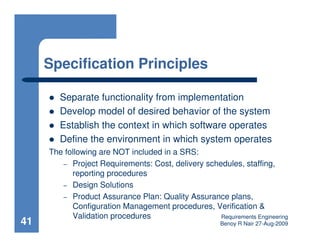
Specification Principles

        Separate functionality from implementation
        Develop model of desired behavior of the system
        Establish the context in which software operates
        Define the environment in which system operates
     The following are NOT included in a SRS:
        – Project Requirements: Cost, delivery schedules, staffing,
           reporting procedures
        – Design Solutions
        – Product Assurance Plan: Quality Assurance plans,
           Configuration Management procedures, Verification &
           Validation procedures                   Requirements Engineering
41                                                     Benoy R Nair 27-Aug-2009
Requirements Development

     REQUIREMENTS
     VERIFICATION & VALIDATION
                                Requirements Engineering
42                              Benoy R Nair 27-Aug-2009
What is Requirements Verification &
     Validation?


                                Requirements Engineering
43                              Benoy R Nair 27-Aug-2009
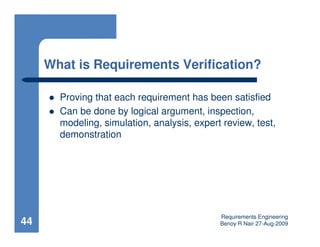
What is Requirements Verification?

       Proving that each requirement has been satisfied
       Can be done by logical argument, inspection,
       modeling, simulation, analysis, expert review, test,
       demonstration


                                             Requirements Engineering
44                                           Benoy R Nair 27-Aug-2009
What is Requirements Validation?

       Ensuring that the set of requirements is correct,
       complete & consistent.
       Ensuring that a model can be created that satisfies
       the requirements.
       Ensuring that a real-world solution can be built and
       tested to prove that it satisfies the requirements.


                                             Requirements Engineering
45                                           Benoy R Nair 27-Aug-2009
Requirements V & V: Objectives

       Certify that the requirements document is an
       acceptable description of the system to be
       implemented
       Check requirements document for:
       –   Correctness, completeness and consistency
       –   Conformance to standards
       –   Requirement conflicts
       –   Technical errors
       –   Ambiguous requirements

                                                 Requirements Engineering
46                                               Benoy R Nair 27-Aug-2009
Requirements: Analysis & Validation

       Analysis works with raw requirements as elicited
       from the system stakeholders.
        –   “Have we got the right requirements?” is the key question to
            be answered at this stage.
       Validation works with final draft of the requirements
       document i.e. with negotiated and agreed
       requirements.
        –   “Have we got the requirements right?” is the key question to
            be answered at this stage.


                                                     Requirements Engineering
47                                                   Benoy R Nair 27-Aug-2009
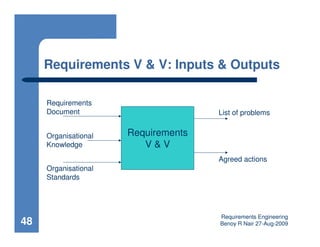
Requirements V & V: Inputs & Outputs

     Requirements
     Document                        List of problems


     Organisational   Requirements
     Knowledge           V&V
                                     Agreed actions
     Organisational
     Standards


                                     Requirements Engineering
48                                   Benoy R Nair 27-Aug-2009
Requirements Management


                          Requirements Engineering
49                        Benoy R Nair 27-Aug-2009
What is Requirements Management?


                             Requirements Engineering
50                           Benoy R Nair 27-Aug-2009
What is Requirements Management


                              Requirements Engineering
51                            Benoy R Nair 27-Aug-2009
Requirements Management: Key
     Activities

       Understand relationships among key stakeholders
       and involve them
       Identify change in requirements
       Managing & controlling requirements changes
       Identify and track requirements attributes
       Trace requirements


                                          Requirements Engineering
52                                        Benoy R Nair 27-Aug-2009
Requirements Management Plan

       A component of Project Management Plan
       Details the plans and processes for managing
       requirements through out the entire project life cycle.

        Requirements
       Management Plan


                                              Requirements Engineering
53                                            Benoy R Nair 27-Aug-2009
Requirement Management Metrics

       To measure and improve effectiveness of the
       requirements processes.

     Typical metrics collected:
         – Number of Requirement defects
         – Requirement Review efforts
         – Changes raised


                                           Requirements Engineering
54                                         Benoy R Nair 27-Aug-2009
Requirements Traceability

       ‘The ability to describe and follow the life of a requirement, in
       both forwards and backwards direction (i.e. from its origins,
       through its development and specification, to its subsequent
       deployment and use, and through all periods of on-going
       refinement and iteration in any of these phases’

        –   To ensure the object of the requirements conforms to the
            requirements by associating each requirement with the
            object via the traceability matrix.
        –   Concerned with documenting the life of a requirement.
        –   To find the origin of each requirement and track every
            change which was made to this requirement
                                                       Requirements Engineering
55                                                     Benoy R Nair 27-Aug-2009
Requirements Change Management

       Process to manage changes in requirements (over
       the entire project life cycle)
       Key elements:
       –   Change Process
       –   Change Tracking System


                                         Requirements Engineering
56                                       Benoy R Nair 27-Aug-2009

Requirements Engineering

  • 1.
    REQUIREMENTS ENGINEERING Developing & Managing Requirements Requirements Engineering 1 Benoy R Nair 27-Aug-2009
  • 2.
    Objectives To understand the different processes in the realm of ‘Requirements Engineering’. To see the challenges in requirements development and the importance of getting requirements right in an IT project. To understand the different techniques used in different phases and processes of requirements development and management. Requirements Engineering 2 Benoy R Nair 27-Aug-2009
  • 3.
    REQUIREMENT Requirements Engineering 3 Benoy R Nair 27-Aug-2009
  • 4.
    What is a‘Requirement’? Requirements Engineering 4 Benoy R Nair 27-Aug-2009
  • 5.
    What is a‘Requirement’? “A condition or capability to which a system must conform.” It can be any one of the following: – A capability needed by a customer or user to solve a problem or achieve an objective. – A capability that must be met or possessed by a system to satisfy a contract, standard, specification, regulation, or other formally imposed document. – A restriction imposed by a stakeholder. Requirements Engineering 5 Benoy R Nair 27-Aug-2009
  • 6.
    From Needs toRequirements PROBLEM DOMAIN SOLUTION DOMAIN Requirements Engineering 6 Benoy R Nair 27-Aug-2009
  • 7.
    Requirement Categories (1) Functional Requirements Non Functional Requirements (NFRs) – Performance – Security – Logging – Reliability Requirements Engineering 7 Benoy R Nair 27-Aug-2009
  • 8.
    Requirement Categories (2) Functional Requirements Technical Requirements Operational Requirements Transitional Requirements Requirements Engineering 8 Benoy R Nair 27-Aug-2009
  • 9.
    Why do weneed requirements? Project scoping Cost estimating Budgeting Project scheduling Software design Software testing Documentation and training manuals Requirements Engineering 9 Benoy R Nair 27-Aug-2009
  • 10.
    Why is itimportant to get the requirements right? Requirements Engineering 10 Benoy R Nair 27-Aug-2009
  • 11.
    Why is itimportant to get the requirements right? Phase in which fixed Relative Cost Requirements 1 Design 3–6 Coding 10 Development Testing 15 – 40 Acceptance Testing 30 – 70 Operations 40 – 1000 Requirements Engineering 11 Benoy R Nair 27-Aug-2009
  • 12.
    What are thefactors that cause projects to be challenged? Factors Percentage of Responses Lack of User Input 12.8% Incomplete Requirements 12.3% Changing Requirements 11.8% Lack of Executive Support 7.5% Technology Incompetence 7.0% Lack of Resources 6.4% Unrealistic Expectations 5.9% Unclear Objectives 5.3% Unrealistic Time Frames 3.7% Other 23.0% Requirements Engineering 12 Benoy R Nair 27-Aug-2009
  • 13.
    Why projects areimpaired and ultimately cancelled? Factors Percentage of Responses Incomplete Requirements 13.1% Lack of User Involvement 12.4% Lack of Resources 10.6% Unrealistic Expectations 9.9% Lack of Executive Support 9.3% Changing Requirements 8.7% Lack of Planning 8.1% Didn’t need it any longer 7.5% Lack of IT Management 4.3% Technology Illiteracy 9.9% Requirements Engineering 13 Benoy R Nair 27-Aug-2009
  • 14.
    Characteristics of aGood Requirement Correct Atomic Clear Necessary Understandable Implementation-free Unambiguous Consistent Testable (Verifiable) Complete Feasible Non-redundant Independent Requirements Engineering 14 Benoy R Nair 27-Aug-2009
  • 15.
    REQUIREMENTS ENGINEERING Requirements Engineering 15 Benoy R Nair 27-Aug-2009
  • 16.
    Requirements Engineering Requirements Engineering 16 Benoy R Nair 27-Aug-2009
  • 17.
    Requirements Development Requirements Engineering 17 Benoy R Nair 27-Aug-2009
  • 18.
    Requirements Development REQUIREMENTS ELICITATION Requirements Engineering 18 Benoy R Nair 27-Aug-2009
  • 19.
    What is RequirementsElicitation? Requirements Engineering 19 Benoy R Nair 27-Aug-2009
  • 20.
    What is RequirementsElicitation? The process of discovering the requirements for a system by communication with customers, system users and others who have a stake in the system development. Requirements Engineering 20 Benoy R Nair 27-Aug-2009
  • 21.
    So how dowe elicit requirements? Identify relevant requirements sources. Ask them appropriate questions to understand their needs. Look for implications, inconsistencies, and unresolved issues in gathered information. Confirm your understanding of requirements with the users. Synthesize appropriate statements of the requirements. Requirements Engineering 21 Benoy R Nair 27-Aug-2009
  • 22.
    Requirements Elicitation Problems Problems of Scope – The requirements may address too little or too much information Problems of Understanding – Wrong/ different understanding of the requirements within and between groups Problems of Volatility – Changing nature of requirements Requirements Engineering 22 Benoy R Nair 27-Aug-2009
  • 23.
    Problems of Scope 1. The boundary of the system is ill-defined 2. Unnecessary design information may be given Requirements Engineering 23 Benoy R Nair 27-Aug-2009
  • 24.
    Problems of Understanding Users have incomplete understanding of their needs. Users have poor understanding of computer capabilities and limitations. Analysts have poor knowledge of problem domain. User and analyst speak different languages. Ease of omitting “obvious” information. Conflicting views of different users. Requirements are often vague and un-testable, e.g., “user friendly” and “robust”. Requirements Engineering 24 Benoy R Nair 27-Aug-2009
  • 25.
    Problems of Volatility Requirements evolve over time Requirements Engineering 25 Benoy R Nair 27-Aug-2009
  • 26.
    Challenges of RequirementsElicitation “Yes, but…” syndrome – Stems from human nature and the users’ inability to experience the software as they might experience a physical device. The Undiscovered Ruins – The more you find, the more you realize still remain. “User and Developer” syndrome – Reflects the profound difference between the two, making communication difficult. “Living with the sins of your predecessors” syndrome – No trust between the groups based on previous interactions and earlier experiences. Requirements Engineering 26 Benoy R Nair 27-Aug-2009
  • 27.
    Requirements Elicitation Techniques Questionnaire Interviewing Requirements Workshops Brain storming Use cases Role Playing Prototyping Story boards Requirements Engineering 27 Benoy R Nair 27-Aug-2009
  • 28.
    Requirements Development REQUIREMENTS ANALYSIS Requirements Engineering 28 Benoy R Nair 27-Aug-2009
  • 29.
    What is RequirementsAnalysis? Requirements Engineering 29 Benoy R Nair 27-Aug-2009
  • 30.
    What is RequirementsAnalysis? The process of breaking down user requirements into their components and studying these to develop a set of system requirements. The three major goals of this process are: – Achieve agreement among developers and customers. – Provide a basis for design. – Provide a basis for Verification and Validation (V&V) Requirements Engineering 30 Benoy R Nair 27-Aug-2009
  • 31.
    Process Model Work Flow Diagramming Model Flow Chart Diagramming Customer Event Diagramming Use Case Diagramming Activity Diagrams Decision Trees 31
  • 32.
    Process Modeling (Samplediagrams) Requirements Engineering 32 Benoy R Nair 27-Aug-2009
  • 33.
    Process Modeling (Samplediagrams) Requirements Engineering 33 Benoy R Nair 27-Aug-2009
  • 34.
    Logical Data Model Entity Relationship Diagramming Data Normalization/ De-Normalization 34
  • 35.
    Requirements Development REQUIREMENTS SPECIFICATION Requirements Engineering 35 Benoy R Nair 27-Aug-2009
  • 36.
    What is RequirementsSpecification? Requirements Engineering 36 Benoy R Nair 27-Aug-2009
  • 37.
    What is RequirementsSpecification? “Complete description of the behavior of the system to be developed. Requirements document is a reference document. Contract between stakeholders Must be maintained over the life of the project Requirements Engineering 37 Benoy R Nair 27-Aug-2009
  • 38.
    Software Requirement Specification Objectives Establish agreement between stakeholders Firm foundation for design Reduce development effort Provide a basis for estimating cost and schedule Reduce rework effort and cost of quality Provide a baseline for validation and verification Facilitate transfer Serve as a basis for enhancement Requirements Engineering 38 Benoy R Nair 27-Aug-2009
  • 39.
    SRS Document Known as ‘Black-box specification’ Concentrates on – ‘What’ needs to be done – Carefully avoids the ‘how to do’ aspects Serves as a contract Requirements Engineering 39 Benoy R Nair 27-Aug-2009
  • 40.
    Issues SRS writermust address Functionality External Interfaces Performance Attributes Design Constraints Requirements Engineering 40 Benoy R Nair 27-Aug-2009
  • 41.
    Specification Principles Separate functionality from implementation Develop model of desired behavior of the system Establish the context in which software operates Define the environment in which system operates The following are NOT included in a SRS: – Project Requirements: Cost, delivery schedules, staffing, reporting procedures – Design Solutions – Product Assurance Plan: Quality Assurance plans, Configuration Management procedures, Verification & Validation procedures Requirements Engineering 41 Benoy R Nair 27-Aug-2009
  • 42.
    Requirements Development REQUIREMENTS VERIFICATION & VALIDATION Requirements Engineering 42 Benoy R Nair 27-Aug-2009
  • 43.
    What is RequirementsVerification & Validation? Requirements Engineering 43 Benoy R Nair 27-Aug-2009
  • 44.
    What is RequirementsVerification? Proving that each requirement has been satisfied Can be done by logical argument, inspection, modeling, simulation, analysis, expert review, test, demonstration Requirements Engineering 44 Benoy R Nair 27-Aug-2009
  • 45.
    What is RequirementsValidation? Ensuring that the set of requirements is correct, complete & consistent. Ensuring that a model can be created that satisfies the requirements. Ensuring that a real-world solution can be built and tested to prove that it satisfies the requirements. Requirements Engineering 45 Benoy R Nair 27-Aug-2009
  • 46.
    Requirements V &V: Objectives Certify that the requirements document is an acceptable description of the system to be implemented Check requirements document for: – Correctness, completeness and consistency – Conformance to standards – Requirement conflicts – Technical errors – Ambiguous requirements Requirements Engineering 46 Benoy R Nair 27-Aug-2009
  • 47.
    Requirements: Analysis &Validation Analysis works with raw requirements as elicited from the system stakeholders. – “Have we got the right requirements?” is the key question to be answered at this stage. Validation works with final draft of the requirements document i.e. with negotiated and agreed requirements. – “Have we got the requirements right?” is the key question to be answered at this stage. Requirements Engineering 47 Benoy R Nair 27-Aug-2009
  • 48.
    Requirements V &V: Inputs & Outputs Requirements Document List of problems Organisational Requirements Knowledge V&V Agreed actions Organisational Standards Requirements Engineering 48 Benoy R Nair 27-Aug-2009
  • 49.
    Requirements Management Requirements Engineering 49 Benoy R Nair 27-Aug-2009
  • 50.
    What is RequirementsManagement? Requirements Engineering 50 Benoy R Nair 27-Aug-2009
  • 51.
    What is RequirementsManagement Requirements Engineering 51 Benoy R Nair 27-Aug-2009
  • 52.
    Requirements Management: Key Activities Understand relationships among key stakeholders and involve them Identify change in requirements Managing & controlling requirements changes Identify and track requirements attributes Trace requirements Requirements Engineering 52 Benoy R Nair 27-Aug-2009
  • 53.
    Requirements Management Plan A component of Project Management Plan Details the plans and processes for managing requirements through out the entire project life cycle. Requirements Management Plan Requirements Engineering 53 Benoy R Nair 27-Aug-2009
  • 54.
    Requirement Management Metrics To measure and improve effectiveness of the requirements processes. Typical metrics collected: – Number of Requirement defects – Requirement Review efforts – Changes raised Requirements Engineering 54 Benoy R Nair 27-Aug-2009
  • 55.
    Requirements Traceability ‘The ability to describe and follow the life of a requirement, in both forwards and backwards direction (i.e. from its origins, through its development and specification, to its subsequent deployment and use, and through all periods of on-going refinement and iteration in any of these phases’ – To ensure the object of the requirements conforms to the requirements by associating each requirement with the object via the traceability matrix. – Concerned with documenting the life of a requirement. – To find the origin of each requirement and track every change which was made to this requirement Requirements Engineering 55 Benoy R Nair 27-Aug-2009
  • 56.
    Requirements Change Management Process to manage changes in requirements (over the entire project life cycle) Key elements: – Change Process – Change Tracking System Requirements Engineering 56 Benoy R Nair 27-Aug-2009