Journal Impact Factors
  and Citation Analysis
    The Ranking of Journals and
             Articles

Rebecca Payne, Memorial Library                  Ariel Neff, Chemistry Library


            University of Wisconsin-Madison Libraries • Madison, WI 53706
                     Phone: (608) 262-3193 • www.library.wisc.edu
Overview
• Introductions
• Measuring the importance of journals,
  articles, and authors – Why?
• Types of Measurements & Tools
  – Purpose, usage, and bias
• Altmetrics
Why Measure Impact?
•   Hiring, advancement, tenure
•   Grant applications
•   Locating publications to publish in
•   Identifying seminal research
•   Identifying researchers whose work is
    getting attention
Article Metrics
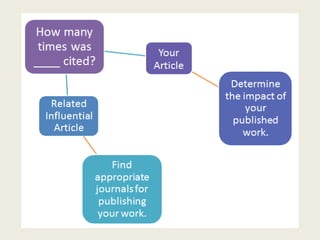
• Number of times an article has been cited.
• Cited Reference Search - Search for journal
  articles, books, proceedings, and other published
  works that have cited a previously published work.
• Discover who is citing your research and the
  impact of your work.
• Discover which journals have appropriate focus for
  your research.
• “Cited by” links
Tools for Article Impact
• Web of Knowledge
  – Library resource
• Google Scholar
• Scopus
  – Library does not have subscription.
  – Released in 2004; Citation tracking from 1996.
• Other Databases
Web of Knowledge
• Science, Social Science and Humanities
  Citation Indexes in one database; coverage
  better for sciences
• Citations from 10,000+ journals
• Books and conference proceedings too
• One of the first to offer Cited Reference
  Searching and most widely known
Web of Knowledge: Tips
• Use first cited author
• Search author last name initials
• Use preferred journal title abbreviations and
  potential variants of journal title or publication
• Use volume, issue, and page fields with caution
• Look for cited reference variations (sometimes
  different pages of the same article are cited or
  papers are cited incorrectly).
Google Scholar
• Articles, theses, books, preprints, abstracts,
  and technical reports
• If article has been cited by others, Cited by
  link will be part of the record. Link to other
  articles in Google Scholar.
• Better international coverage than Web of
  Knowledge
Other Databases
• Certain disciplines, journals, and document types may not
  be well represented in major tools for citation analysis.
• Examples of other databases:
   – ACM Digital Library
   – ProQuest databases (e.g., EconLit, Sociological
     Abstracts)
   – EBSCOhost databases (e.g., CINAHL, PsycINFO) –
     Cited References in navigation bar at top
   – Full Text Journal Collections (e.g., JSTOR)
   – PubMed
   – SciFinder Scholar
Cautions/Limitations
• No one database is comprehensive.
• No one database covers all journals.
• No one database includes all publication
  formats.
• Publication dates affect your results.
• Results can be misleading.
• All impact measures are controversial.
        Source: http://researchguides.library.wisc.edu/publishingresearch
Individual Metrics
• H-Index
  – Variations
H-Index

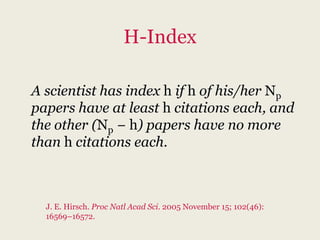
A scientist has index h if h of his/her Np
papers have at least h citations each, and
the other (Np − h) papers have no more
than h citations each.


  J. E. Hirsch. Proc Natl Acad Sci. 2005 November 15; 102(46):
  16569–16572.
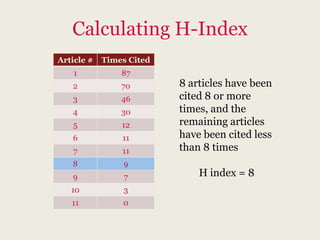
Calculating H-Index
Article #   Times Cited
    1           87
   2            70        8 articles have been
   3            46        cited 8 or more
   4            30        times, and the
   5            12        remaining articles
   6            11        have been cited less
   7            11        than 8 times
   8            9
   9             7            H index = 8
   10            3
   11           0
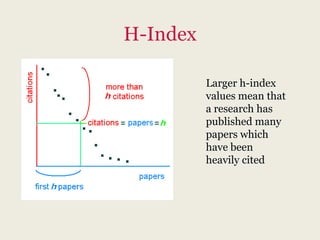
H-Index

          Larger h-index
          values mean that
          a research has
          published many
          papers which
          have been
          heavily cited
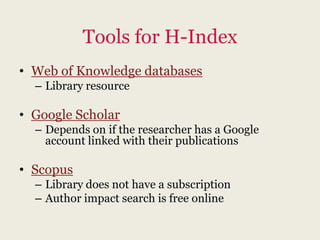
Tools for H-Index
• Web of Knowledge databases
  – Library resource

• Google Scholar
  – Depends on if the researcher has a Google
    account linked with their publications

• Scopus
  – Library does not have a subscription
  – Author impact search is free online
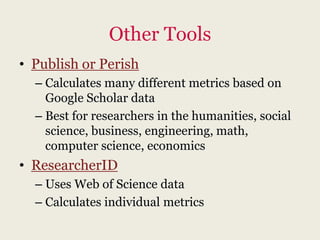
Other Tools
• Publish or Perish
  – Calculates many different metrics based on
    Google Scholar data
  – Best for researchers in the humanities, social
    science, business, engineering, math,
    computer science, economics
• ResearcherID
  – Uses Web of Science data
  – Calculates individual metrics
Problems with H-Index
• Does not account for coauthors
    – Favors large groups of authors (usually
      experimental science over theoretical)
•   Can be influenced by self-citation
•   Cannot account for „first authors‟
•   Dependant on career length
•   All types of citations are weighted the
    same
    – Reviews, books, primary research
H-Index Alternates
• M-Quotient = h/n
  – n is the individual‟s number of active years
  – Better for young researchers
• G-Index = h-index for an averaged citations
  count
  – Weights heavily cited papers
  – Egghe L., Theory and practice of the g-index,
    Scientometrics, 69(2006),No 1,p.131–52
• Many other variations – see handout for
  citations
Journal Impact
• ISI Journal Impact Factor
• Eigenfactor
• SJR: SCImago Journal Rank
Journal Impact Factor
• Average number of times articles from the
  journal published in the past two years have
  been cited in the Journal Citation Report
  (JCR) year.
• Calculated by dividing the number of
  citations in the JCR year by the total number
  of articles published in the two previous
  years. An Impact Factor of 1.0 means that, on
  average, the articles published one or two
  year ago have been cited one time.
    Source: http://admin-apps.webofknowledge.com.ezproxy.library.wisc.edu/JCR/help/h_impfact.htm
Journal Citation Reports (JCR)
• Compares and evaluates 10,600 journals in
  science, technology and social sciences.
• Two editions available:
  – Science Edition
  – Social Sciences Edition
• No Arts and Humanities edition
• Compare impact factors of journals within
  the same discipline; impact factors vary by
  discipline.
• Provides a means of determining the core
  journals of a subject.
Immediacy Index
• Average number of times an article is cited
  in the year it is published.
• Indicates how quickly articles in a journal
  are cited.
• Calculated by dividing the number of
  citations to articles published in a given
  year by the number of articles published in
  that year.
  Source: http://admin-apps.webofknowledge.com.ezproxy.library.wisc.edu/JCR/help/h_immedindex.htm
Cited Half-Life
• Median age of the articles that were cited in the
  JCR year. Half of a journal's cited articles were
  published more recently than the cited half-life.
• For example, in JCR 2001 the journal Crystal
  Research and Technology has a cited half-life of
  7.0. That means that articles published in Crystal
  Research and Technology between 1995-2001
  (inclusive) account for 50% of all citations to
  articles from that journal in 2001.
• Only journals cited 100 or more times in the JCR
  year have a cited half-life.
   Source: http://admin-apps.webofknowledge.com.ezproxy.library.wisc.edu/JCR/help/h_ctdhl.htm
5-Year Impact Factor
• Average number of times articles from the
  journal published in the past five years
  have been cited in the JCR year.
• Calculated by dividing the number of
  citations in the JCR year by the total
  number of articles published in the five
  previous years.


   Source: http://admin-apps.webofknowledge.com.ezproxy.library.wisc.edu/JCR/help/h_impfact.htm
Cautions/Limitations
• Do not rely only on JCR for journal evaluations.
• Not intended to replace informed peer review.
• Careful attention should be paid to the conditions that
  can influence citation rates: language, journal history
  and format, publication schedule, and subject specialty.
• Articles include mostly original research and review
  articles; other kinds of articles excluded.
• Journals published in non-English languages or using
  non-Roman alphabets may be less accessible to
  researchers worldwide.
• Other factors to consider when evaluating journals:
  audience, peer review, journal indexing, circulation
  count, acceptance rate, editor and editorial board
   Source: http://admin-apps.webofknowledge.com.ezproxy.library.wisc.edu/JCR/help/h_using.htm
Eigenfactor
• Developed by University of Washington
  – Uses data from journals in ISI Web of Science
  – Free to use
  – Cuts across science/social science
• Calculation is based on the number of times
  articles from the journal published in the past
  five years have been cited in the JCR year
  – highly cited journals will influence the network
    more than lesser cited journals
  – Journal self-citations are removed
Problems with Eigenfactor

• Studies have shown that Eigenfactor
  values usually correlate with IF numbers
  – So why have another metric?


• Has similar biases as IF
SJR: SCImago Journal Rank
• Based on the PageRank algorithm used by
  Google
  – Accounts for both the number of citations
    received by a journal and the prestige of the
    journals where such citations originated
• Data drawn from Scopus
• Free and open source
  – Great alternative to IF for those without
    access
Problems with SJR
• Uses Scopus – citations only from 1996-
  present
• Divides the prestige gained by a journal,
  through the citations of its articles, to the
  total number of articles included, rather
  than to the number of citable articles
  – Plays down letters to editor, news, etc.
Altmetrics
• Systems which use social media data to
  rank authors and journals rather than just
  traditional citation methods
  – Tracking “likes,” comments, tweets, and other
    postings
Altmetrics
• ImpactStory
  – Compiles data on how scholars and the public use
    articles in social media; includes citation manager
    saves, Facebook and Twitter mentions, F1000
    recommendations, and more
• PLOS Article-Level Metrics
  – Altmetrics collected and compiled for every
    article published in PLOS
• This is a very new field – expect growth!

Journal Impact Factors and Citation Analysis

  • 1.
    Journal Impact Factors and Citation Analysis The Ranking of Journals and Articles Rebecca Payne, Memorial Library Ariel Neff, Chemistry Library University of Wisconsin-Madison Libraries • Madison, WI 53706 Phone: (608) 262-3193 • www.library.wisc.edu
  • 2.
    Overview • Introductions • Measuringthe importance of journals, articles, and authors – Why? • Types of Measurements & Tools – Purpose, usage, and bias • Altmetrics
  • 3.
    Why Measure Impact? • Hiring, advancement, tenure • Grant applications • Locating publications to publish in • Identifying seminal research • Identifying researchers whose work is getting attention
  • 4.
    Article Metrics • Numberof times an article has been cited. • Cited Reference Search - Search for journal articles, books, proceedings, and other published works that have cited a previously published work. • Discover who is citing your research and the impact of your work. • Discover which journals have appropriate focus for your research. • “Cited by” links
  • 6.
    Tools for ArticleImpact • Web of Knowledge – Library resource • Google Scholar • Scopus – Library does not have subscription. – Released in 2004; Citation tracking from 1996. • Other Databases
  • 7.
    Web of Knowledge •Science, Social Science and Humanities Citation Indexes in one database; coverage better for sciences • Citations from 10,000+ journals • Books and conference proceedings too • One of the first to offer Cited Reference Searching and most widely known
  • 8.
    Web of Knowledge:Tips • Use first cited author • Search author last name initials • Use preferred journal title abbreviations and potential variants of journal title or publication • Use volume, issue, and page fields with caution • Look for cited reference variations (sometimes different pages of the same article are cited or papers are cited incorrectly).
  • 9.
    Google Scholar • Articles,theses, books, preprints, abstracts, and technical reports • If article has been cited by others, Cited by link will be part of the record. Link to other articles in Google Scholar. • Better international coverage than Web of Knowledge
  • 10.
    Other Databases • Certaindisciplines, journals, and document types may not be well represented in major tools for citation analysis. • Examples of other databases: – ACM Digital Library – ProQuest databases (e.g., EconLit, Sociological Abstracts) – EBSCOhost databases (e.g., CINAHL, PsycINFO) – Cited References in navigation bar at top – Full Text Journal Collections (e.g., JSTOR) – PubMed – SciFinder Scholar
  • 11.
    Cautions/Limitations • No onedatabase is comprehensive. • No one database covers all journals. • No one database includes all publication formats. • Publication dates affect your results. • Results can be misleading. • All impact measures are controversial. Source: http://researchguides.library.wisc.edu/publishingresearch
  • 12.
  • 13.
    H-Index A scientist hasindex h if h of his/her Np papers have at least h citations each, and the other (Np − h) papers have no more than h citations each. J. E. Hirsch. Proc Natl Acad Sci. 2005 November 15; 102(46): 16569–16572.
  • 14.
    Calculating H-Index Article # Times Cited 1 87 2 70 8 articles have been 3 46 cited 8 or more 4 30 times, and the 5 12 remaining articles 6 11 have been cited less 7 11 than 8 times 8 9 9 7 H index = 8 10 3 11 0
  • 15.
    H-Index Larger h-index values mean that a research has published many papers which have been heavily cited
  • 16.
    Tools for H-Index •Web of Knowledge databases – Library resource • Google Scholar – Depends on if the researcher has a Google account linked with their publications • Scopus – Library does not have a subscription – Author impact search is free online
  • 17.
    Other Tools • Publishor Perish – Calculates many different metrics based on Google Scholar data – Best for researchers in the humanities, social science, business, engineering, math, computer science, economics • ResearcherID – Uses Web of Science data – Calculates individual metrics
  • 18.
    Problems with H-Index •Does not account for coauthors – Favors large groups of authors (usually experimental science over theoretical) • Can be influenced by self-citation • Cannot account for „first authors‟ • Dependant on career length • All types of citations are weighted the same – Reviews, books, primary research
  • 19.
    H-Index Alternates • M-Quotient= h/n – n is the individual‟s number of active years – Better for young researchers • G-Index = h-index for an averaged citations count – Weights heavily cited papers – Egghe L., Theory and practice of the g-index, Scientometrics, 69(2006),No 1,p.131–52 • Many other variations – see handout for citations
  • 20.
    Journal Impact • ISIJournal Impact Factor • Eigenfactor • SJR: SCImago Journal Rank
  • 21.
    Journal Impact Factor •Average number of times articles from the journal published in the past two years have been cited in the Journal Citation Report (JCR) year. • Calculated by dividing the number of citations in the JCR year by the total number of articles published in the two previous years. An Impact Factor of 1.0 means that, on average, the articles published one or two year ago have been cited one time. Source: http://admin-apps.webofknowledge.com.ezproxy.library.wisc.edu/JCR/help/h_impfact.htm
  • 22.
    Journal Citation Reports(JCR) • Compares and evaluates 10,600 journals in science, technology and social sciences. • Two editions available: – Science Edition – Social Sciences Edition • No Arts and Humanities edition • Compare impact factors of journals within the same discipline; impact factors vary by discipline. • Provides a means of determining the core journals of a subject.
  • 23.
    Immediacy Index • Averagenumber of times an article is cited in the year it is published. • Indicates how quickly articles in a journal are cited. • Calculated by dividing the number of citations to articles published in a given year by the number of articles published in that year. Source: http://admin-apps.webofknowledge.com.ezproxy.library.wisc.edu/JCR/help/h_immedindex.htm
  • 24.
    Cited Half-Life • Medianage of the articles that were cited in the JCR year. Half of a journal's cited articles were published more recently than the cited half-life. • For example, in JCR 2001 the journal Crystal Research and Technology has a cited half-life of 7.0. That means that articles published in Crystal Research and Technology between 1995-2001 (inclusive) account for 50% of all citations to articles from that journal in 2001. • Only journals cited 100 or more times in the JCR year have a cited half-life. Source: http://admin-apps.webofknowledge.com.ezproxy.library.wisc.edu/JCR/help/h_ctdhl.htm
  • 25.
    5-Year Impact Factor •Average number of times articles from the journal published in the past five years have been cited in the JCR year. • Calculated by dividing the number of citations in the JCR year by the total number of articles published in the five previous years. Source: http://admin-apps.webofknowledge.com.ezproxy.library.wisc.edu/JCR/help/h_impfact.htm
  • 26.
    Cautions/Limitations • Do notrely only on JCR for journal evaluations. • Not intended to replace informed peer review. • Careful attention should be paid to the conditions that can influence citation rates: language, journal history and format, publication schedule, and subject specialty. • Articles include mostly original research and review articles; other kinds of articles excluded. • Journals published in non-English languages or using non-Roman alphabets may be less accessible to researchers worldwide. • Other factors to consider when evaluating journals: audience, peer review, journal indexing, circulation count, acceptance rate, editor and editorial board Source: http://admin-apps.webofknowledge.com.ezproxy.library.wisc.edu/JCR/help/h_using.htm
  • 27.
    Eigenfactor • Developed byUniversity of Washington – Uses data from journals in ISI Web of Science – Free to use – Cuts across science/social science • Calculation is based on the number of times articles from the journal published in the past five years have been cited in the JCR year – highly cited journals will influence the network more than lesser cited journals – Journal self-citations are removed
  • 28.
    Problems with Eigenfactor •Studies have shown that Eigenfactor values usually correlate with IF numbers – So why have another metric? • Has similar biases as IF
  • 29.
    SJR: SCImago JournalRank • Based on the PageRank algorithm used by Google – Accounts for both the number of citations received by a journal and the prestige of the journals where such citations originated • Data drawn from Scopus • Free and open source – Great alternative to IF for those without access
  • 30.
    Problems with SJR •Uses Scopus – citations only from 1996- present • Divides the prestige gained by a journal, through the citations of its articles, to the total number of articles included, rather than to the number of citable articles – Plays down letters to editor, news, etc.
  • 31.
    Altmetrics • Systems whichuse social media data to rank authors and journals rather than just traditional citation methods – Tracking “likes,” comments, tweets, and other postings
  • 32.
    Altmetrics • ImpactStory – Compiles data on how scholars and the public use articles in social media; includes citation manager saves, Facebook and Twitter mentions, F1000 recommendations, and more • PLOS Article-Level Metrics – Altmetrics collected and compiled for every article published in PLOS • This is a very new field – expect growth!