

How to deal with the unsettling 
realities of bibliometric services in 
universities 
Erasmus University Rotterdam, University Library 
Gert Goris, Gusta Drenthe & Judith Gulpers 
Wageningen UR Library 
Wouter Gerritsma 
5 September 2014
Proposed agenda 
• Short introduction 
• Statements 
• Breaking up in groups 
• Plenary discussion > best practices
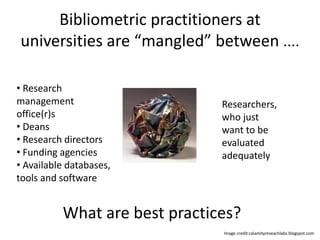
Bibliometric practitioners at 
universities are “mangled” between .... 
• Research 
management 
office(r)s 
• Deans 
• Research directors 
• Funding agencies 
• Available databases, 
tools and software 
Researchers, 
who just 
want to be 
evaluated 
adequately 
What are best practices? 
Image credit:calamityreseachlabs.blogspot.com
Work out 
• Select 4 statements 
• Discuss a statement in small groups for 5 minutes 
• Confront the conclusions plenary for 5/7 minutes 
• Repeat this for statements 2-4 
• Draw final conclusions 
• The outcomes will be shared on slideshare 
(http://slideshare.net/wowter)
Some statements: what do you think? 
1.
• Which indicators are required to do a proper 
analysis? 
• H-index is a bad idea, but you still end up 
helping to calculate the h-index 
• What is the role of the bibliometric unit: 
giving advice or providing the services? 
• When you have to choose, how do you decide 
between Scopus/SciVal or WoS/InCites? Who’s 
involved?
Some statements: what do we think? 
1. Librarians are predestined for providing central services 
tailored for scientists, research managers and science 
policy makers, including bibliometrics. Gumpenberger et al. doi: 10.1108/01435121211217199 
2. Academic libraries could educate faculty and staff, 
especially research managers, in the basics of bibliometrics 
3. Librarians should be present when commercial data 
providers, like Elsevier (sciVal) and Thomson Reuters 
(InCites) visit research management office(r)s of 
universities. 
4. Decisions on the acquirement of a research analytics suits 
has serious repercussions for the selection of A&I 
databases in universities
1. What is the minimum set of 
indicators we should use? 
% in top 1 articles 
Normalized citation rate 
> We are asked to provide indicators, we don’t set the minimum set of 
indicators. 
Depends on field, for example law – top %, citation data doesn’t make sense 
– output 
Problem with access to databases, online versions don’t allow to do 
advanced calculations 
Needed: clean academic bibliography 
Minimum set should have these types: Productivity, impact, applied indicator 
(depending on the field), social impact 
Context, benchmarks, normalized 
It depends: objectives, questions, type of analysis 
Evaluation – more problematic 
Managers ask for a certain analysis, you have to perform it 
Important to have good ‘rules’ for bibliometric services
2. What is the best place for a 
bibliometric service in a university? 
• Both in the library and policy office 
• Library can be disconnected from the research processes > preferably in 
the policy office 
• ‘start from scratch: the library ‘brave new world’ 
• Neutral place 
• Also libraries have their own goals 
• In libraries there are not just librarians working 
• National differences in the status of librarians Support staff or part of 
faculty? Certain autonomy, not ‘slaves’. 
• It doesn’t matter where it is based, but it should be an autonomous 
department/position 
• Wageningen: library and research office. Close cooperation is essential, 
also with the researchers being evaluated. 
• Use the expertise of CWTS and apply that in your own institution 
• Is own research necessary?
Feedback? 
Erasmus University Rotterdam, University Library 
Gert Goris Goris@ubib.eur.nl 
Gusta Drenthe drenthe@ubib.eur.nl 
Judith Gulpers: gulpers@ubib.eur.nl 
Wageningen UR (University & Research Centre) 
Wouter Gerritsma: wouter.gerritsma@wur.nl

Special unsettling reality of Bibliometrics in practice 2014

  • 1.
    How to dealwith the unsettling realities of bibliometric services in universities Erasmus University Rotterdam, University Library Gert Goris, Gusta Drenthe & Judith Gulpers Wageningen UR Library Wouter Gerritsma 5 September 2014
  • 2.
    Proposed agenda •Short introduction • Statements • Breaking up in groups • Plenary discussion > best practices
  • 3.
    Bibliometric practitioners at universities are “mangled” between .... • Research management office(r)s • Deans • Research directors • Funding agencies • Available databases, tools and software Researchers, who just want to be evaluated adequately What are best practices? Image credit:calamityreseachlabs.blogspot.com
  • 4.
    Work out •Select 4 statements • Discuss a statement in small groups for 5 minutes • Confront the conclusions plenary for 5/7 minutes • Repeat this for statements 2-4 • Draw final conclusions • The outcomes will be shared on slideshare (http://slideshare.net/wowter)
  • 5.
    Some statements: whatdo you think? 1.
  • 6.
    • Which indicatorsare required to do a proper analysis? • H-index is a bad idea, but you still end up helping to calculate the h-index • What is the role of the bibliometric unit: giving advice or providing the services? • When you have to choose, how do you decide between Scopus/SciVal or WoS/InCites? Who’s involved?
  • 7.
    Some statements: whatdo we think? 1. Librarians are predestined for providing central services tailored for scientists, research managers and science policy makers, including bibliometrics. Gumpenberger et al. doi: 10.1108/01435121211217199 2. Academic libraries could educate faculty and staff, especially research managers, in the basics of bibliometrics 3. Librarians should be present when commercial data providers, like Elsevier (sciVal) and Thomson Reuters (InCites) visit research management office(r)s of universities. 4. Decisions on the acquirement of a research analytics suits has serious repercussions for the selection of A&I databases in universities
  • 8.
    1. What isthe minimum set of indicators we should use? % in top 1 articles Normalized citation rate > We are asked to provide indicators, we don’t set the minimum set of indicators. Depends on field, for example law – top %, citation data doesn’t make sense – output Problem with access to databases, online versions don’t allow to do advanced calculations Needed: clean academic bibliography Minimum set should have these types: Productivity, impact, applied indicator (depending on the field), social impact Context, benchmarks, normalized It depends: objectives, questions, type of analysis Evaluation – more problematic Managers ask for a certain analysis, you have to perform it Important to have good ‘rules’ for bibliometric services
  • 9.
    2. What isthe best place for a bibliometric service in a university? • Both in the library and policy office • Library can be disconnected from the research processes > preferably in the policy office • ‘start from scratch: the library ‘brave new world’ • Neutral place • Also libraries have their own goals • In libraries there are not just librarians working • National differences in the status of librarians Support staff or part of faculty? Certain autonomy, not ‘slaves’. • It doesn’t matter where it is based, but it should be an autonomous department/position • Wageningen: library and research office. Close cooperation is essential, also with the researchers being evaluated. • Use the expertise of CWTS and apply that in your own institution • Is own research necessary?
  • 10.
    Feedback? Erasmus UniversityRotterdam, University Library Gert Goris Goris@ubib.eur.nl Gusta Drenthe drenthe@ubib.eur.nl Judith Gulpers: gulpers@ubib.eur.nl Wageningen UR (University & Research Centre) Wouter Gerritsma: wouter.gerritsma@wur.nl