
PRESENT BY SABA NAZEER
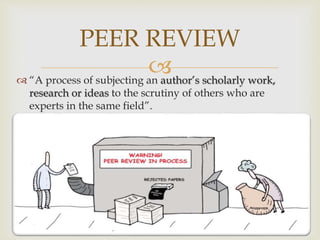
 “A process of subjecting an author’s scholarly work,
research or ideas to the scrutiny of others who are
experts in the same field”.
PEER REVIEW

 Two primary purposes:
1. Acts as a filter
Validity,
Significance
Originality
of the study.
2. Improve the quality
PURPOSE


 The concept of peer review was developed long
before the scholarly journal.
 The peer review process was first described by a
physician named Ishaq bin Ali al-Rahwi of
Syria (854-931), in his book Ethics of the Physician .
HISTORY OF PEER REVIEW

Systematized and institutionalized
form has developed immensely since
the Second World War.
Due to the large increase in
scientific research during this period.
 The foundation of the scholarly publication system.
 It encourages authors to strive to produce high quality
research that will advance the field.
 Peer review also supports and maintains integrity and
authenticity in the advancement of science.
IMPACT OF THE PEER REVIEW
PROCESS

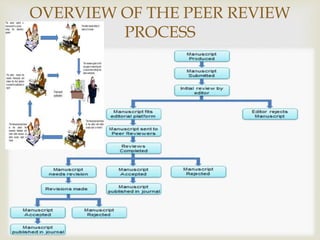
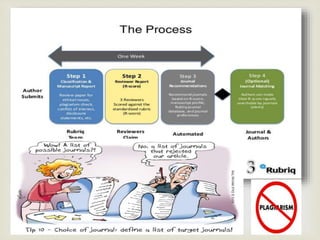
OVERVIEW OF THE PEER REVIEW
PROCESS



HOW LONG DOES IT TAKE TO REVIEW
ONE PAPER?
8 reviews
per year,
6 hours to
review
one paper
Depending on the content of
the paper and the nature of
the peer reviewer
According
(PRC).

THE EVALUATION CRITERIA FOR PEER
REVIEW OF SCIENTIFIC PAPERS

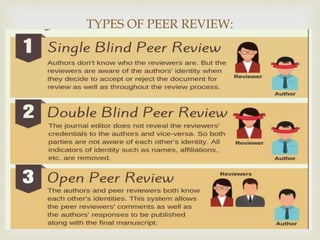
TYPES OF PEER REVIEW:
ADVANTAGES AND DISADVANTAGES


 Slow
 Expansive
 Unable to accurately detect plagiarism.
 Electronic plagiarism tools to help improve this issue.
CRITICISM OF PEER REVIEW

RECENT INITIATIVES TOWARDS
IMPROVING PEER REVIEW

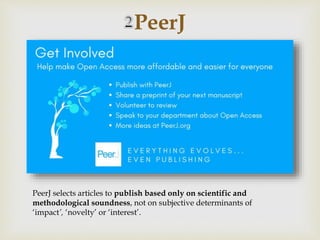
PeerJ
PeerJ selects articles to publish based only on scientific and
methodological soundness, not on subjective determinants of
‘impact’, ‘novelty’ or ‘interest’.


 Peer review has become fundamental in assisting editors
in selecting
 Credible,
 High quality,
 Novel and
 Interesting research papers
to publish in scientific journals and
Ensure the correction of any
errors or issues present
in submitted papers.
CONCLUSION

 Though the peer review process still
has some flaws and deficiencies, a
more suitable screening method for
scientific papers has not yet been
proposed or developed. Researchers
have begun and must continue to look
for means of addressing the current
issues with peer review to ensure that
it is a full-proof system that ensures
only quality research papers are
released into the scientific community.

References:
1. https://www.ncbi.nlm.nih.gov/pmc/articles/PMC4975196/
2. https://www.editage.com/insights/a-history-of-academic-peer-review
3. https://www.researchgate.net/figure/Main-advantages-and-
disadvantages-of-different-types-of-peer-review_tbl2_248386857
4. https://www.researchgate.net/publication/286894875_Criticism_of_peer_
review_and_ways_to_improve_it
5. https://www.overleaf.com/blog/212-overleaf-partners-with-peerj-to-
celebrate-the-launch-of-the-peerj-computer-science-journal
6. https://www.slideshare.net/kec9g/rubriq-independent-peer-review-
journal-matching-ismte-2012


Peer Review

  • 1.
  • 2.
  • 3.
     “A processof subjecting an author’s scholarly work, research or ideas to the scrutiny of others who are experts in the same field”. PEER REVIEW
  • 4.
      Two primarypurposes: 1. Acts as a filter Validity, Significance Originality of the study. 2. Improve the quality PURPOSE
  • 5.
  • 6.
      The conceptof peer review was developed long before the scholarly journal.  The peer review process was first described by a physician named Ishaq bin Ali al-Rahwi of Syria (854-931), in his book Ethics of the Physician . HISTORY OF PEER REVIEW
  • 7.
     Systematized and institutionalized formhas developed immensely since the Second World War. Due to the large increase in scientific research during this period.
  • 8.
     The foundationof the scholarly publication system.  It encourages authors to strive to produce high quality research that will advance the field.  Peer review also supports and maintains integrity and authenticity in the advancement of science. IMPACT OF THE PEER REVIEW PROCESS
  • 9.
     OVERVIEW OF THEPEER REVIEW PROCESS
  • 10.
  • 11.
  • 12.
     HOW LONG DOESIT TAKE TO REVIEW ONE PAPER? 8 reviews per year, 6 hours to review one paper Depending on the content of the paper and the nature of the peer reviewer According (PRC).
  • 13.
     THE EVALUATION CRITERIAFOR PEER REVIEW OF SCIENTIFIC PAPERS
  • 14.
  • 15.
  • 16.
  • 17.
      Slow  Expansive Unable to accurately detect plagiarism.  Electronic plagiarism tools to help improve this issue. CRITICISM OF PEER REVIEW
  • 18.
  • 19.
     PeerJ PeerJ selects articlesto publish based only on scientific and methodological soundness, not on subjective determinants of ‘impact’, ‘novelty’ or ‘interest’.
  • 20.
  • 21.
      Peer reviewhas become fundamental in assisting editors in selecting  Credible,  High quality,  Novel and  Interesting research papers to publish in scientific journals and Ensure the correction of any errors or issues present in submitted papers. CONCLUSION
  • 22.
      Though thepeer review process still has some flaws and deficiencies, a more suitable screening method for scientific papers has not yet been proposed or developed. Researchers have begun and must continue to look for means of addressing the current issues with peer review to ensure that it is a full-proof system that ensures only quality research papers are released into the scientific community.
  • 23.
     References: 1. https://www.ncbi.nlm.nih.gov/pmc/articles/PMC4975196/ 2. https://www.editage.com/insights/a-history-of-academic-peer-review 3.https://www.researchgate.net/figure/Main-advantages-and- disadvantages-of-different-types-of-peer-review_tbl2_248386857 4. https://www.researchgate.net/publication/286894875_Criticism_of_peer_ review_and_ways_to_improve_it 5. https://www.overleaf.com/blog/212-overleaf-partners-with-peerj-to- celebrate-the-launch-of-the-peerj-computer-science-journal 6. https://www.slideshare.net/kec9g/rubriq-independent-peer-review- journal-matching-ismte-2012
  • 24.