z
PREDATORY
PUBLISHERS
AND
JOURNALS
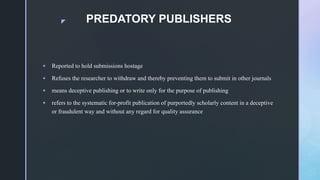
z PREDATORY PUBLISHERS
 Reported to hold submissions hostage
 Refuses the researcher to withdraw and thereby preventing them to submit in other journals
 means deceptive publishing or to write only for the purpose of publishing
 refers to the systematic for-profit publication of purportedly scholarly content in a deceptive
or fraudulent way and without any regard for quality assurance
z
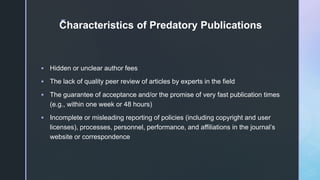
Characteristics of Predatory Publications
 Hidden or unclear author fees
 The lack of quality peer review of articles by experts in the field
 The guarantee of acceptance and/or the promise of very fast publication times
(e.g., within one week or 48 hours)
 Incomplete or misleading reporting of policies (including copyright and user
licenses), processes, personnel, performance, and affiliations in the journal’s
website or correspondence
z
 Poor language usage (including poor grammar) and low production quality,
both in the presentation of the journal’s description and guidelines, and in
some of the articles that are published
 The lack of ethics policies and need for ethics declarations, particularly
related to animal and human studies, conflicts of interest, and study funding
 The lack of any corrections/retractions of articles
 The lack of ability for articles to be retrieved on an electronic search platform
in perpetuity, or for articles to be retrieved at all despite being listed in a table
of contents
zTYPES OF PREDATORY PUBLISHERS
 Phisher
 Impostor/Hijacker
 Trojan Horse
 Unicorn
z
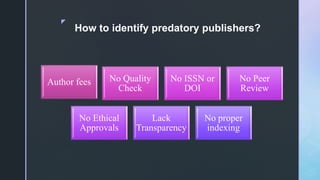
How to identify predatory publishers?
Author fees No Quality
Check
No ISSN or
DOI
No Peer
Review
No Ethical
Approvals
Lack
Transparency
No proper
indexing
z
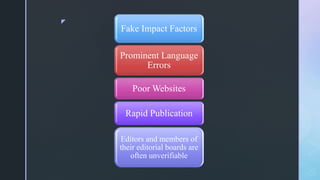
Fake Impact Factors
Prominent Language
Errors
Poor Websites
Rapid Publication
Editors and members of
their editorial boards are
often unverifiable
z
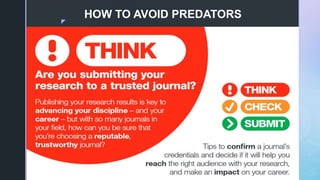
HOW TO AVOID PREDATORS
z PREDATORY JOURNALS
 also called fraudulent, deceptive, or pseudo-journals
 A publication that actively asks researchers for manuscript.
 Have no peer review system, no editorial board
 Asks for huge publication charges
 Coined by Jeffery Beall – refers to journals whose main purpose seems to be to exploit
scholars and academics and their needs to publish the results of their research
 an opportunistic publishing venue that exploits the academic need to publish but offers
little reward for those using their services
z
 Prioritize self-interest at the expense of scholarship
 Deviate from best editorial and publication practices
 Use indiscriminate solicitation practices (repeated e-mails)
 Boastful language like ‘leading publisher’
 Broad journal title – includes subject fields not normally grouped together
 High acceptance rate
z
CHARACTERISTICS
• Primary goal is to make money
• Do not care about the quality of the work published (i.e. no or little editing or peer-
review)
• Make false claims or promises (i.e. claims of impact factors and indexing)
• Engage in unethical business practices
• Fail to follow accepted standards or best practices of scholarly publishing
• Massive spamming
• Excessive use of words like scientific, academic, research
 Accepting articles quickly with little or no prior review or quality control
z
 Notifying academics of article fees only after papers are accepted
 Aggressively campaigning for academics to submit articles or serve on editorial boards
 Listing academics as members of editorial boards without their permission and not
allowing them to resign
 Apointing fake academics to editorial boards
 Mimicking the name or website style of more established journals
 Making misleading claims about the publishing operation, such as a false location
 Using ISSN improperly
 Citing fake or non-existing impact factor
z
Warning signs of fake journals based on 16 Principles
of Transparency
o Website: The journal’s website contains misleading or false information (eg, indexing,
metrics, membership of scholarly publishing organizations), lacks an ISSN or uses one that
has already been assigned to another publication, mimics another journal/publisher’s site, or
has no past or recent journal content.
o Name of journal: The journal name is the same as or easily confused with that of another;
scope, or association.
o Peer review process: Peer review and peer review process and model are not mentioned, or
manuscript acceptance or a very short peer review time is guaranteed. Submitted manuscripts
receive inadequate or no peer review.
o Ownership and management: Information about the ownership and/or management is
missing, unclear, misleading, or false.
o Governing body: Information on the editorial board is missing, misleading, false, or
inappropriate for the journal; full names and affiliations of editorial board members are
missing.
z
o Editorial team/contact information: Full names and affiliations of the journal’s editor/s and
full contact information for the editorial office are missing, the editor-in-chief is also the
owner/publisher, or the editor-in-chief is also the editor of many other journals, especially in
unrelated fields.
o Copyright and licensing: Policies and notices of copyright (and publishing license and user
license) are missing or unclear.
o Author fees: Mandatory fees for publication are not stated or not explained clearly on the
journal website, submission system, or the letter of acknowledgement and/or are revealed only
in the acceptance letter, as a condition of acceptance.
o Process for identification of and dealing with allegations of research misconduct: There is
no description on how cases of alleged misconduct are handled.
o Publication ethics: There are no policies on publishing ethics (eg, authorship/contributorship,
data sharing and reproducibility, intellectual property, ethical oversight, conflicts of interest,
corrections/retractions).
z
o Publishing schedule: The periodicity of publication is not indicated and/or the
publishing schedule appears erratic from the available journal content.
o Access: The way(s) in which content is available to readers, and any associated costs,
is not stated, and in some cases listed articles are not available at all.
o Archiving: There is no electronic backup and preservation of access to journal content
(despite such claims).
o Revenue sources: Business models, business partnerships/agreements, or revenue
sources are not stated; publishing fees or waiver status are linked to editorial decision
making.
o Advertising: Advertising policy is not given, or advertisements are linked to editorial
decision making or are integrated with published content.
o Direct marketing: Direct marketing is obtrusive and gives misleading or false
information
Predatory publishers and journals

Predatory publishers and journals

  • 1.
  • 2.
    z PREDATORY PUBLISHERS Reported to hold submissions hostage  Refuses the researcher to withdraw and thereby preventing them to submit in other journals  means deceptive publishing or to write only for the purpose of publishing  refers to the systematic for-profit publication of purportedly scholarly content in a deceptive or fraudulent way and without any regard for quality assurance
  • 3.
    z Characteristics of PredatoryPublications  Hidden or unclear author fees  The lack of quality peer review of articles by experts in the field  The guarantee of acceptance and/or the promise of very fast publication times (e.g., within one week or 48 hours)  Incomplete or misleading reporting of policies (including copyright and user licenses), processes, personnel, performance, and affiliations in the journal’s website or correspondence
  • 4.
    z  Poor languageusage (including poor grammar) and low production quality, both in the presentation of the journal’s description and guidelines, and in some of the articles that are published  The lack of ethics policies and need for ethics declarations, particularly related to animal and human studies, conflicts of interest, and study funding  The lack of any corrections/retractions of articles  The lack of ability for articles to be retrieved on an electronic search platform in perpetuity, or for articles to be retrieved at all despite being listed in a table of contents
  • 5.
    zTYPES OF PREDATORYPUBLISHERS  Phisher  Impostor/Hijacker  Trojan Horse  Unicorn
  • 6.
    z How to identifypredatory publishers? Author fees No Quality Check No ISSN or DOI No Peer Review No Ethical Approvals Lack Transparency No proper indexing
  • 7.
    z Fake Impact Factors ProminentLanguage Errors Poor Websites Rapid Publication Editors and members of their editorial boards are often unverifiable
  • 8.
    z HOW TO AVOIDPREDATORS
  • 9.
    z PREDATORY JOURNALS also called fraudulent, deceptive, or pseudo-journals  A publication that actively asks researchers for manuscript.  Have no peer review system, no editorial board  Asks for huge publication charges  Coined by Jeffery Beall – refers to journals whose main purpose seems to be to exploit scholars and academics and their needs to publish the results of their research  an opportunistic publishing venue that exploits the academic need to publish but offers little reward for those using their services
  • 10.
    z  Prioritize self-interestat the expense of scholarship  Deviate from best editorial and publication practices  Use indiscriminate solicitation practices (repeated e-mails)  Boastful language like ‘leading publisher’  Broad journal title – includes subject fields not normally grouped together  High acceptance rate
  • 11.
    z CHARACTERISTICS • Primary goalis to make money • Do not care about the quality of the work published (i.e. no or little editing or peer- review) • Make false claims or promises (i.e. claims of impact factors and indexing) • Engage in unethical business practices • Fail to follow accepted standards or best practices of scholarly publishing • Massive spamming • Excessive use of words like scientific, academic, research  Accepting articles quickly with little or no prior review or quality control
  • 12.
    z  Notifying academicsof article fees only after papers are accepted  Aggressively campaigning for academics to submit articles or serve on editorial boards  Listing academics as members of editorial boards without their permission and not allowing them to resign  Apointing fake academics to editorial boards  Mimicking the name or website style of more established journals  Making misleading claims about the publishing operation, such as a false location  Using ISSN improperly  Citing fake or non-existing impact factor
  • 13.
    z Warning signs offake journals based on 16 Principles of Transparency o Website: The journal’s website contains misleading or false information (eg, indexing, metrics, membership of scholarly publishing organizations), lacks an ISSN or uses one that has already been assigned to another publication, mimics another journal/publisher’s site, or has no past or recent journal content. o Name of journal: The journal name is the same as or easily confused with that of another; scope, or association. o Peer review process: Peer review and peer review process and model are not mentioned, or manuscript acceptance or a very short peer review time is guaranteed. Submitted manuscripts receive inadequate or no peer review. o Ownership and management: Information about the ownership and/or management is missing, unclear, misleading, or false. o Governing body: Information on the editorial board is missing, misleading, false, or inappropriate for the journal; full names and affiliations of editorial board members are missing.
  • 14.
    z o Editorial team/contactinformation: Full names and affiliations of the journal’s editor/s and full contact information for the editorial office are missing, the editor-in-chief is also the owner/publisher, or the editor-in-chief is also the editor of many other journals, especially in unrelated fields. o Copyright and licensing: Policies and notices of copyright (and publishing license and user license) are missing or unclear. o Author fees: Mandatory fees for publication are not stated or not explained clearly on the journal website, submission system, or the letter of acknowledgement and/or are revealed only in the acceptance letter, as a condition of acceptance. o Process for identification of and dealing with allegations of research misconduct: There is no description on how cases of alleged misconduct are handled. o Publication ethics: There are no policies on publishing ethics (eg, authorship/contributorship, data sharing and reproducibility, intellectual property, ethical oversight, conflicts of interest, corrections/retractions).
  • 15.
    z o Publishing schedule:The periodicity of publication is not indicated and/or the publishing schedule appears erratic from the available journal content. o Access: The way(s) in which content is available to readers, and any associated costs, is not stated, and in some cases listed articles are not available at all. o Archiving: There is no electronic backup and preservation of access to journal content (despite such claims). o Revenue sources: Business models, business partnerships/agreements, or revenue sources are not stated; publishing fees or waiver status are linked to editorial decision making. o Advertising: Advertising policy is not given, or advertisements are linked to editorial decision making or are integrated with published content. o Direct marketing: Direct marketing is obtrusive and gives misleading or false information