
Publish be cited, or perish
Towards a publication strategy
Wouter Gerritsma, Wageningen UR Library
At the beginning it all starts with good research
After you've completed your excellent research
you should consider your options carefully
when it comes to publishing
Outline

 Citations and impact
 h-index
 Journal selection
 Collaboration
 Open Access
 Some publishing tips
 Data Management
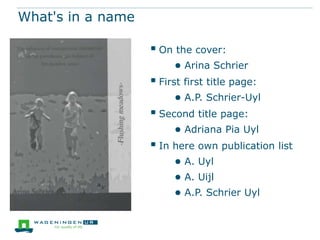
 What's in a name
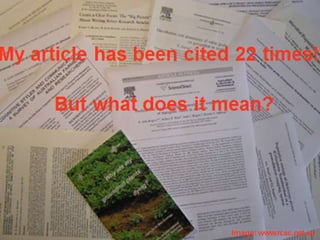
What is impact?

CC-BY-NC-SA 2.0 Tim Ove
Beeldvullende foto met titel
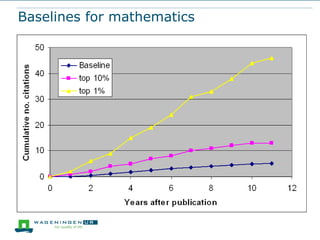
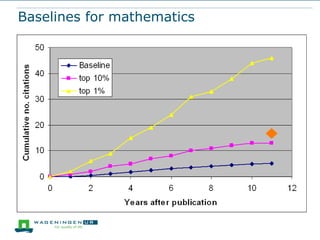
How do we compare numbers

 Scientist Z. Math has a publication from 2002 with 17
citations

 Scientist M. Biology has a publication from 2008 with 24
citations
Baselines for mathematics
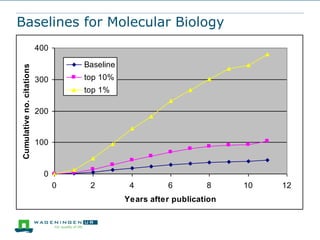
Baselines for Molecular Biology

Cumulative no. citations

400
Baseline
top 10%

300

top 1%
200

100

0
0

2

4

6

8

Years after publication

10

12
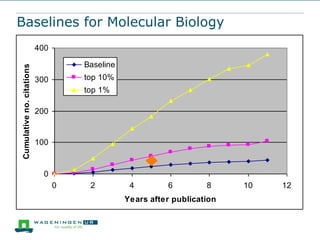
Baselines for Molecular Biology

Cumulative no. citations

400
Baseline
top 10%

300

top 1%
200

100

0
0

2

4

6

8

Years after publication

10

12
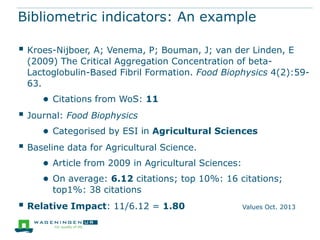
Bibliometric indicators: An example
 Kroes-Nijboer, A; Venema, P; Bouman, J; van der Linden, E

(2009) The Critical Aggregation Concentration of betaLactoglobulin-Based Fibril Formation. Food Biophysics 4(2):5963.
● Citations from WoS: 11

 Journal: Food Biophysics
● Categorised by ESI in Agricultural Sciences

 Baseline data for Agricultural Science.
● Article from 2009 in Agricultural Sciences:
● On average: 6.12 citations; top 10%: 16 citations;
top1%: 38 citations

 Relative Impact: 11/6.12 = 1.80

Values Oct. 2013
We are not the only ones doing these
calculations

http://www.wti2.nl/
We are not the only ones doing these
calculations

http://www.wti2.nl/

http://www.science-metrix.com
We are not the only ones doing these
calculations

http://www.wti2.nl/
http://www.scienceeurope.org

http://www.science-metrix.com
Sooner or later, you will be subject of such
an analysis!
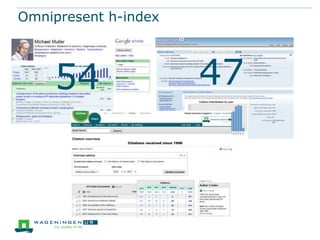
What about the h-index?
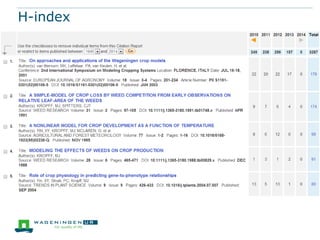
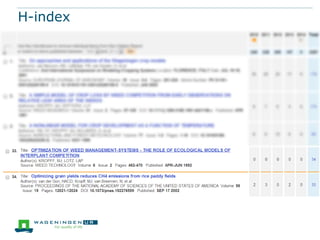
H-index
H-index
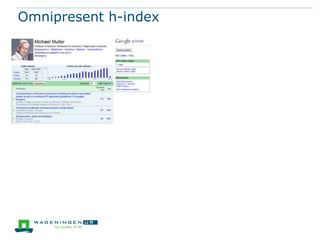
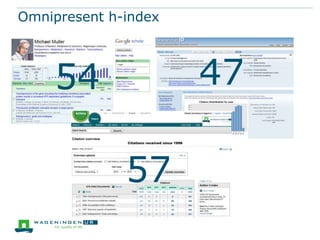
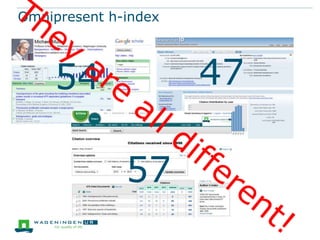
Omnipresent h-index
Omnipresent h-index

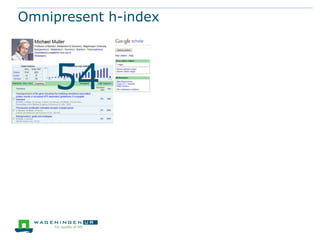
54
Omnipresent h-index

54
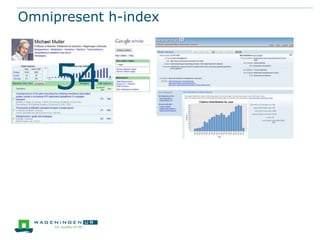
Omnipresent h-index

54

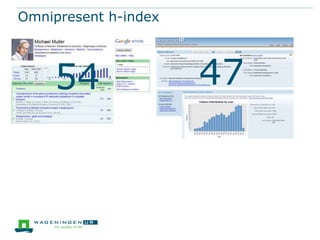
47
Omnipresent h-index

54

47
Omnipresent h-index

47

54
57
Omnipresent h-index

47

54
57
What are properties of impactful papers?
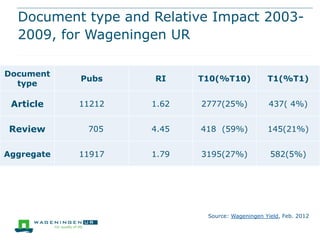
Document type and Relative Impact 20032009, for Wageningen UR
Document
type

Pubs

RI

T10(%T10)

T1(%T1)

Article

11212

1.62

2777(25%)

437( 4%)

Review

705

4.45

418 (59%)

145(21%)

11917

1.79

3195(27%)

582(5%)

Aggregate

Source: Wageningen Yield, Feb. 2012
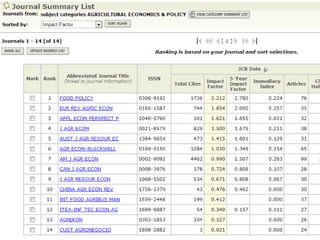
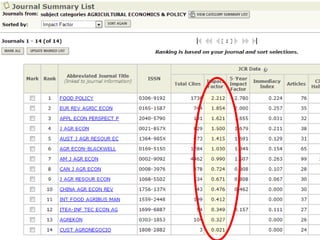
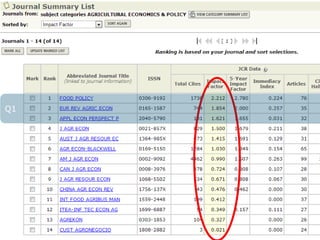
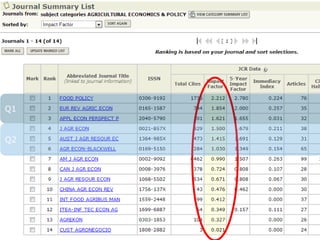
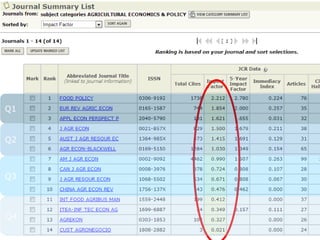
Another take at the Impact Factor
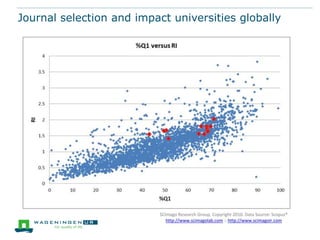
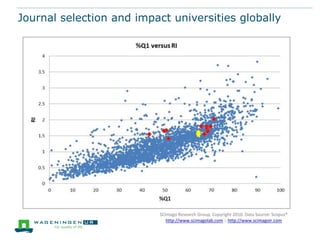
Journal selection and impact universities globally
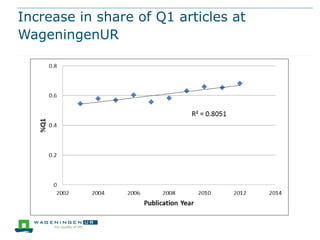
Increase in share of Q1 articles at
WageningenUR
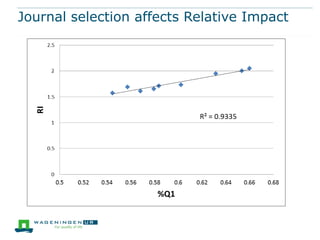
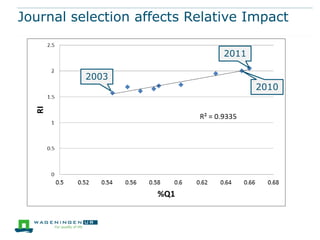
Journal selection affects Relative Impact
2011
2003

2010
The impact factor Matthew effect
"The journal in which papers are published have a
strong influence on their citation rates, as duplicate
papers published in high-impact journals obtain, on
average, twice as many citations as their identical
counterparts published in journals with lower impact
factors"
Larivière, V. and Y. Gingras (2010). The impact factor's Matthew Effect: A natural
experiment in bibliometrics. Journal of the American Society for Information Science and
Technology 61(2): 424-427. http://dx.doi.org/10.1002/asi.21232
Where you publish matters most

"Where you publish is the primary
determinant of how many citations your work
will receive in the future"

Peng, T.-Q. & J.J.H. Zhu (2012). Where you publish matters most: A multilevel analysis of factors
affecting citations of internet studies. Journal of the American Society for Information Science
and Technology, 63(9): 1789-1803 http://dx.doi.org/10.1002/asi.22649
Final word on journal quality

"It is better to publish one paper in a quality journal
than multiple papers in lesser journals. [...]. Try to
publish in journals that have high impact factors;

chances are your paper will have high impact, too, if
accepted."

Bourne, P. E. (2005). Ten Simple Rules for Getting Published. PLoS Computational
Biology 1(5): e57. http://dx.doi.org/10.1371/journal.pcbi.0010057
Networking

cc-by Andy Lamb
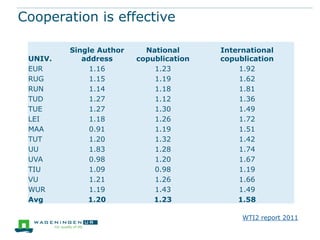
Cooperation is effective
UNIV.
EUR
RUG
RUN
TUD
TUE
LEI
MAA
TUT
UU
UVA
TIU
VU
WUR
Avg

Single Author
address
1.16
1.15
1.14
1.27
1.27
1.18
0.91
1.20
1.83
0.98
1.09
1.21
1.19
1.20

National
copublication
1.23
1.19
1.18
1.12
1.30
1.26
1.19
1.32
1.28
1.20
0.98
1.26
1.43
1.23

International
copublication
1.92
1.62
1.81
1.36
1.49
1.72
1.51
1.42
1.74
1.67
1.19
1.66
1.49
1.58
WTI2 report 2011
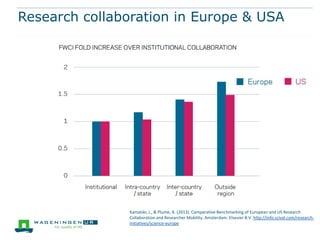
Research collaboration in Europe & USA

Kamalski, J., & Plume, A. (2013). Comparative Benchmarking of European and US Research
Collaboration and Researcher Mobility. Amsterdam: Elsevier B.V. http://info.scival.com/researchinitiatives/science-europe
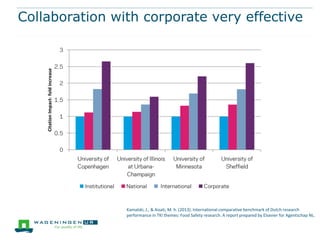
Collaboration with corporate very effective

Kamalski, J., & Aisati, M. h. (2013). International comparative benchmark of Dutch research
performance in TKI themes: Food Safety research. A report prepared by Elsevier for Agentschap NL.
University-industry collaboration and impact

"The average scientific impact of universityindustry papers is significantly above that of
both university-only papers and industry-only
papers"

Lebeau, L. M., Laframboise, M. C., Larivière, V., & Gingras, Y. (2008). The effect of university-industry
collaboration on the scientific impact of publications: The Canadian case, 1980-2005. Research
Evaluation, 17(3), 227-232. http://dx.doi.org/10.3152/095820208x331685
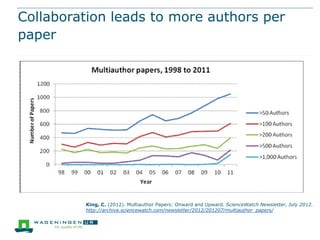
Collaboration leads to more authors per
paper

King, C. (2012). Multiauthor Papers: Onward and Upward. ScienceWatch Newsletter, July 2012.
http://archive.sciencewatch.com/newsletter/2012/201207/multiauthor_papers/
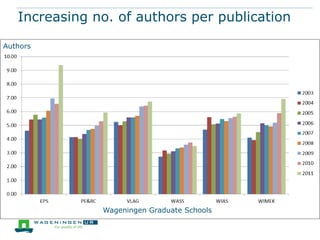
Increasing no. of authors per publication
Authors

Wageningen Graduate Schools
Start networking early!

 Who is your neighbour in this audience?
 Be active at conferences
 Make use of social media
 Use the social network tools
● Next to LinkedIn and Facebook
● Mendeley, Researchgate.net or Academia.edu
Start networking early!

 Who is your neighbour in this audience?
 Be active at conferences
#awpc
 Make use of social media
 Use the social network tools
● Next to LinkedIn and Facebook
● Mendeley, Researchgate.net or Academia.edu
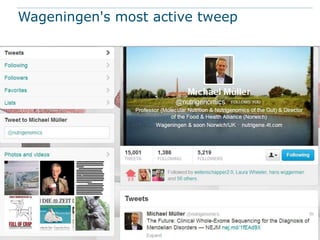
Wageningen's most active tweep
More on Open Access
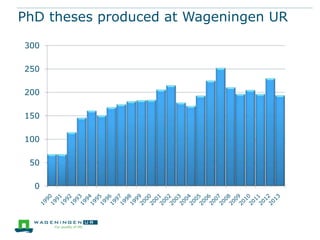
PhD theses produced at Wageningen UR
300
250
200
150
100

50
0
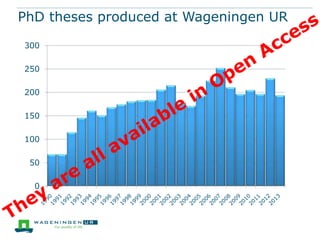
PhD theses produced at Wageningen UR
300
250
200
150
100

50
0
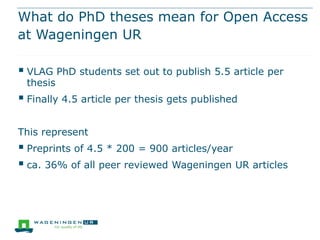
What do PhD theses mean for Open Access
at Wageningen UR

 VLAG PhD students set out to publish 5.5 article per
thesis

 Finally 4.5 article per thesis gets published
This represent

 Preprints of 4.5 * 200 = 900 articles/year
 ca. 36% of all peer reviewed Wageningen UR articles
After your thesis publication what are your
options for Open Access publishing?
Open Access publishing

 Golden Road e.g. PLoS, BMC, SpringerOpen, Sage Open
● Directory of open access journals DOAJ (currently
9957 journals)

● Often author pays model; many society publishers
for free

 Delayed OA publishing
● Cambridge UP, Highwire press, many society
publishers

 Green Road : self-archiving in repositories e.g.
Wageningen Yield (WaY)
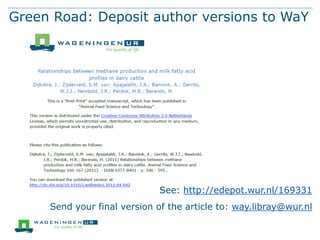
Green Road: Deposit author versions to WaY

See: http://edepot.wur.nl/169331
Send your final version of the article to: way.libray@wur.nl
Open Access Publishing

 Open Access leads to more citations!
● Open access increases societal relevance
● Vital for Wageningen's international collaborators

 Be aware of predatory publishers!
● Have a look at Beall's list
You are what you cite
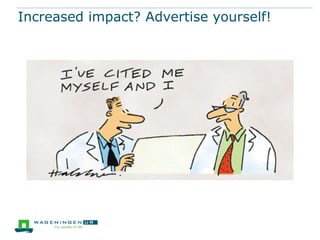
Increased impact? Advertise yourself!
Self citations

"The model implies that external citations are
enhanced by self-citations, so that we have

the 'chain reaction:' Larger size leads to more
self-citations, which lead to more external
citations"
11/28
van Raan, A. F. J. (2008). Self-citation as an impact-reinforcing mechanism in the science system.
Journal of the American Society for Information Science and Technology 59(10): 1631-1643.
http://dx.doi.org/10.1002/asi.20868
More on references

Articles that cite more references are in turn
cited more themselves
Webster, G. D., P. K. Jonason, et al. (2009). Hot Topics and Popular Papers in Evolutionary Psychology:
Analyses of Title Words and Citation Counts in Evolution and Human Behavior, 1979 – 2008. Evolutionary
Psychology 7(3): 348-362. http://www.epjournal.net/filestore/ep07348362.pdf

To be the best, cite the best
Borrowed from: Corbyn, Z. (2010). "To be the best, cite the best." Nature News, 13 October
2010, http://dx.doi.org/10.1038/news.2010.539 Reporting on the publication of Bornmann, L., F. de Moya
Anegón, et al. (2010). Do Scientific Advancements Lean on the Shoulders of Giants? A Bibliometric
Investigation of the Ortega Hypothesis. PLoS ONE 5(10): e13327 DOI:
http://dx.doi.org/10.1371/journal.pone.0013327.
More articles per research project?

 Publishing more articles results in higher citation counts

if the articles provide sufficient substantive content to
other researchers.

● Beware of the ethical standards
● Bornmann looked at total citations, not to relative
impact

Bornmann, L. & H.-D. Daniel (2007). Multiple publication on a single research study: Does it pay? The influence
of number of research articles on total citation counts in biomedicine. Journal of the American Society for
Information Science and Technology, 58(8): 1100-1107 http://dx.doi.org/10.1002/asi.20531
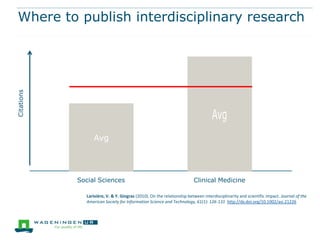
Citations

Where to publish interdisciplinary research

Avg

Social Sciences

Clinical Medicine

Larivière, V. & Y. Gingras (2010). On the relationship between interdisciplinarity and scientific impact. Journal of the
American Society for Information Science and Technology, 61(1): 126-131 http://dx.doi.org/10.1002/asi.21226
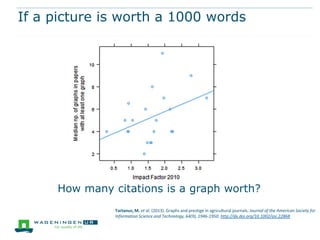
If a picture is worth a 1000 words

How many citations is a graph worth?
Tartanus, M. et al. (2013). Graphs and prestige in agricultural journals. Journal of the American Society for
Information Science and Technology, 64(9), 1946-1950. http://dx.doi.org/10.1002/asi.22868
Wageningen UR Data Management Proof
Why is data management important

 Good data management improves thinking and writing
up your results

 Data should be reproducible 5 years after publication
(code of conduct)

 It facilitates sharing of data with other researchers
Why is data management important

 Good data management improves thinking and writing
up your results

 Data should be reproducible 5 years after publication
(code of conduct)

 It facilitates sharing of data with other researchers
 As of April 2014, a Data Management Plan becomes
mandatory for new PhD students
Sharing data increases impact

"Publicly available data was significantly associated with a
69% increase in citations, independently of journal impact
factor, date of publication, and author country of origin"

Piwowar, H. A., Day, R. S., & Fridsma, D. B. (2007). Sharing Detailed Research Data Is Associated with Increased
Citation Rate. PLoS ONE, 2(3), e308. http://dx.doi.org/10.1371/journal.pone.0000308
What's in a name

 On the cover:
● Arina Schrier

 First first title page:
● A.P. Schrier-Uyl

 Second title page:
● Adriana Pia Uyl

 In here own publication list
● A. Uyl
● A. Uijl
● A.P. Schrier Uyl
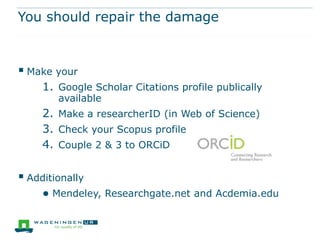
You should repair the damage

 Make your
1. Google Scholar Citations profile publically
available

2. Make a researcherID (in Web of Science)
3. Check your Scopus profile
4. Couple 2 & 3 to ORCiD

 Additionally
● Mendeley, Researchgate.net and Acdemia.edu
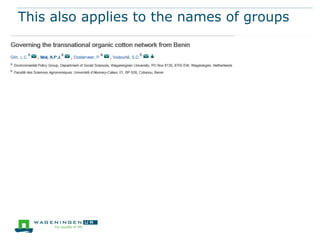
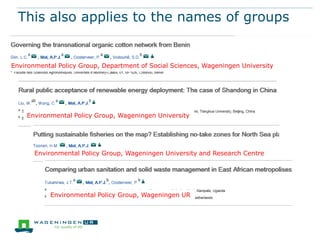
This also applies to the names of groups

Environmental Policy Group, Department of Social Sciences, Wageningen University
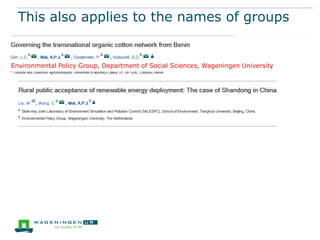
This also applies to the names of groups

Environmental Policy Group, Department of Social Sciences, Wageningen University

Environmental Policy Group, Wageningen University
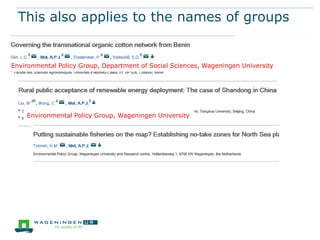
This also applies to the names of groups

Environmental Policy Group, Department of Social Sciences, Wageningen University

Environmental Policy Group, Wageningen University

Environmental Policy Group, Wageningen University and Research Centre
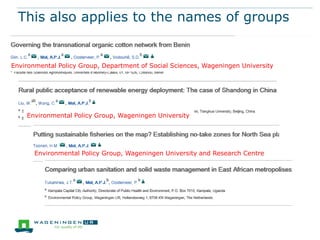
This also applies to the names of groups

Environmental Policy Group, Department of Social Sciences, Wageningen University

Environmental Policy Group, Wageningen University

Environmental Policy Group, Wageningen University and Research Centre

Environmental Policy Group, Wageningen UR
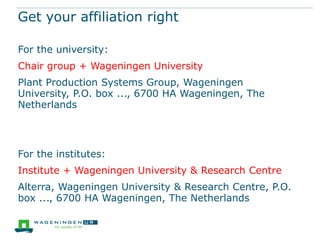
Get your affiliation right
For the university:
Chair group + Wageningen University
Plant Production Systems Group, Wageningen
University, P.O. box ..., 6700 HA Wageningen, The
Netherlands

For the institutes:

Institute + Wageningen University & Research Centre
Alterra, Wageningen University & Research Centre, P.O.
box ..., 6700 HA Wageningen, The Netherlands
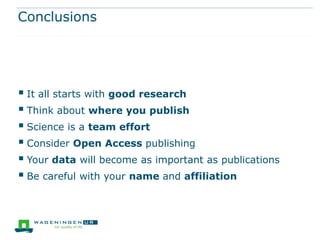
Conclusions

 It all starts with good research
 Think about where you publish
 Science is a team effort
 Consider Open Access publishing
 Your data will become as important as publications
 Be careful with your name and affiliation
Thank you!

On the Web:
@wowter
wowter.net

www.slideshare.net/wowter

Publish be cited, or perish

  • 1.
    Publish be cited,or perish Towards a publication strategy Wouter Gerritsma, Wageningen UR Library
  • 2.
    At the beginningit all starts with good research
  • 3.
    After you've completedyour excellent research you should consider your options carefully when it comes to publishing
  • 4.
    Outline  Citations andimpact  h-index  Journal selection  Collaboration  Open Access  Some publishing tips  Data Management  What's in a name
  • 5.
  • 6.
  • 7.
    How do wecompare numbers  Scientist Z. Math has a publication from 2002 with 17 citations  Scientist M. Biology has a publication from 2008 with 24 citations
  • 8.
  • 9.
  • 10.
    Baselines for MolecularBiology Cumulative no. citations 400 Baseline top 10% 300 top 1% 200 100 0 0 2 4 6 8 Years after publication 10 12
  • 11.
    Baselines for MolecularBiology Cumulative no. citations 400 Baseline top 10% 300 top 1% 200 100 0 0 2 4 6 8 Years after publication 10 12
  • 12.
    Bibliometric indicators: Anexample  Kroes-Nijboer, A; Venema, P; Bouman, J; van der Linden, E (2009) The Critical Aggregation Concentration of betaLactoglobulin-Based Fibril Formation. Food Biophysics 4(2):5963. ● Citations from WoS: 11  Journal: Food Biophysics ● Categorised by ESI in Agricultural Sciences  Baseline data for Agricultural Science. ● Article from 2009 in Agricultural Sciences: ● On average: 6.12 citations; top 10%: 16 citations; top1%: 38 citations  Relative Impact: 11/6.12 = 1.80 Values Oct. 2013
  • 13.
    We are notthe only ones doing these calculations http://www.wti2.nl/
  • 14.
    We are notthe only ones doing these calculations http://www.wti2.nl/ http://www.science-metrix.com
  • 15.
    We are notthe only ones doing these calculations http://www.wti2.nl/ http://www.scienceeurope.org http://www.science-metrix.com
  • 16.
    Sooner or later,you will be subject of such an analysis!
  • 17.
  • 18.
  • 19.
  • 20.
  • 21.
  • 22.
  • 23.
  • 24.
  • 25.
  • 26.
  • 27.
    What are propertiesof impactful papers?
  • 28.
    Document type andRelative Impact 20032009, for Wageningen UR Document type Pubs RI T10(%T10) T1(%T1) Article 11212 1.62 2777(25%) 437( 4%) Review 705 4.45 418 (59%) 145(21%) 11917 1.79 3195(27%) 582(5%) Aggregate Source: Wageningen Yield, Feb. 2012
  • 29.
    Another take atthe Impact Factor
  • 35.
    Journal selection andimpact universities globally
  • 36.
    Journal selection andimpact universities globally
  • 37.
    Increase in shareof Q1 articles at WageningenUR
  • 38.
  • 39.
    Journal selection affectsRelative Impact 2011 2003 2010
  • 40.
    The impact factorMatthew effect "The journal in which papers are published have a strong influence on their citation rates, as duplicate papers published in high-impact journals obtain, on average, twice as many citations as their identical counterparts published in journals with lower impact factors" Larivière, V. and Y. Gingras (2010). The impact factor's Matthew Effect: A natural experiment in bibliometrics. Journal of the American Society for Information Science and Technology 61(2): 424-427. http://dx.doi.org/10.1002/asi.21232
  • 41.
    Where you publishmatters most "Where you publish is the primary determinant of how many citations your work will receive in the future" Peng, T.-Q. & J.J.H. Zhu (2012). Where you publish matters most: A multilevel analysis of factors affecting citations of internet studies. Journal of the American Society for Information Science and Technology, 63(9): 1789-1803 http://dx.doi.org/10.1002/asi.22649
  • 42.
    Final word onjournal quality "It is better to publish one paper in a quality journal than multiple papers in lesser journals. [...]. Try to publish in journals that have high impact factors; chances are your paper will have high impact, too, if accepted." Bourne, P. E. (2005). Ten Simple Rules for Getting Published. PLoS Computational Biology 1(5): e57. http://dx.doi.org/10.1371/journal.pcbi.0010057
  • 43.
  • 44.
    Cooperation is effective UNIV. EUR RUG RUN TUD TUE LEI MAA TUT UU UVA TIU VU WUR Avg SingleAuthor address 1.16 1.15 1.14 1.27 1.27 1.18 0.91 1.20 1.83 0.98 1.09 1.21 1.19 1.20 National copublication 1.23 1.19 1.18 1.12 1.30 1.26 1.19 1.32 1.28 1.20 0.98 1.26 1.43 1.23 International copublication 1.92 1.62 1.81 1.36 1.49 1.72 1.51 1.42 1.74 1.67 1.19 1.66 1.49 1.58 WTI2 report 2011
  • 45.
    Research collaboration inEurope & USA Kamalski, J., & Plume, A. (2013). Comparative Benchmarking of European and US Research Collaboration and Researcher Mobility. Amsterdam: Elsevier B.V. http://info.scival.com/researchinitiatives/science-europe
  • 46.
    Collaboration with corporatevery effective Kamalski, J., & Aisati, M. h. (2013). International comparative benchmark of Dutch research performance in TKI themes: Food Safety research. A report prepared by Elsevier for Agentschap NL.
  • 47.
    University-industry collaboration andimpact "The average scientific impact of universityindustry papers is significantly above that of both university-only papers and industry-only papers" Lebeau, L. M., Laframboise, M. C., Larivière, V., & Gingras, Y. (2008). The effect of university-industry collaboration on the scientific impact of publications: The Canadian case, 1980-2005. Research Evaluation, 17(3), 227-232. http://dx.doi.org/10.3152/095820208x331685
  • 48.
    Collaboration leads tomore authors per paper King, C. (2012). Multiauthor Papers: Onward and Upward. ScienceWatch Newsletter, July 2012. http://archive.sciencewatch.com/newsletter/2012/201207/multiauthor_papers/
  • 49.
    Increasing no. ofauthors per publication Authors Wageningen Graduate Schools
  • 50.
    Start networking early! Who is your neighbour in this audience?  Be active at conferences  Make use of social media  Use the social network tools ● Next to LinkedIn and Facebook ● Mendeley, Researchgate.net or Academia.edu
  • 51.
    Start networking early! Who is your neighbour in this audience?  Be active at conferences #awpc  Make use of social media  Use the social network tools ● Next to LinkedIn and Facebook ● Mendeley, Researchgate.net or Academia.edu
  • 52.
  • 53.
  • 54.
    PhD theses producedat Wageningen UR 300 250 200 150 100 50 0
  • 55.
    PhD theses producedat Wageningen UR 300 250 200 150 100 50 0
  • 56.
    What do PhDtheses mean for Open Access at Wageningen UR  VLAG PhD students set out to publish 5.5 article per thesis  Finally 4.5 article per thesis gets published This represent  Preprints of 4.5 * 200 = 900 articles/year  ca. 36% of all peer reviewed Wageningen UR articles
  • 57.
    After your thesispublication what are your options for Open Access publishing?
  • 58.
    Open Access publishing Golden Road e.g. PLoS, BMC, SpringerOpen, Sage Open ● Directory of open access journals DOAJ (currently 9957 journals) ● Often author pays model; many society publishers for free  Delayed OA publishing ● Cambridge UP, Highwire press, many society publishers  Green Road : self-archiving in repositories e.g. Wageningen Yield (WaY)
  • 59.
    Green Road: Depositauthor versions to WaY See: http://edepot.wur.nl/169331 Send your final version of the article to: way.libray@wur.nl
  • 60.
    Open Access Publishing Open Access leads to more citations! ● Open access increases societal relevance ● Vital for Wageningen's international collaborators  Be aware of predatory publishers! ● Have a look at Beall's list
  • 62.
    You are whatyou cite
  • 63.
  • 64.
    Self citations "The modelimplies that external citations are enhanced by self-citations, so that we have the 'chain reaction:' Larger size leads to more self-citations, which lead to more external citations" 11/28 van Raan, A. F. J. (2008). Self-citation as an impact-reinforcing mechanism in the science system. Journal of the American Society for Information Science and Technology 59(10): 1631-1643. http://dx.doi.org/10.1002/asi.20868
  • 65.
    More on references Articlesthat cite more references are in turn cited more themselves Webster, G. D., P. K. Jonason, et al. (2009). Hot Topics and Popular Papers in Evolutionary Psychology: Analyses of Title Words and Citation Counts in Evolution and Human Behavior, 1979 – 2008. Evolutionary Psychology 7(3): 348-362. http://www.epjournal.net/filestore/ep07348362.pdf To be the best, cite the best Borrowed from: Corbyn, Z. (2010). "To be the best, cite the best." Nature News, 13 October 2010, http://dx.doi.org/10.1038/news.2010.539 Reporting on the publication of Bornmann, L., F. de Moya Anegón, et al. (2010). Do Scientific Advancements Lean on the Shoulders of Giants? A Bibliometric Investigation of the Ortega Hypothesis. PLoS ONE 5(10): e13327 DOI: http://dx.doi.org/10.1371/journal.pone.0013327.
  • 66.
    More articles perresearch project?  Publishing more articles results in higher citation counts if the articles provide sufficient substantive content to other researchers. ● Beware of the ethical standards ● Bornmann looked at total citations, not to relative impact Bornmann, L. & H.-D. Daniel (2007). Multiple publication on a single research study: Does it pay? The influence of number of research articles on total citation counts in biomedicine. Journal of the American Society for Information Science and Technology, 58(8): 1100-1107 http://dx.doi.org/10.1002/asi.20531
  • 67.
    Citations Where to publishinterdisciplinary research Avg Social Sciences Clinical Medicine Larivière, V. & Y. Gingras (2010). On the relationship between interdisciplinarity and scientific impact. Journal of the American Society for Information Science and Technology, 61(1): 126-131 http://dx.doi.org/10.1002/asi.21226
  • 68.
    If a pictureis worth a 1000 words How many citations is a graph worth? Tartanus, M. et al. (2013). Graphs and prestige in agricultural journals. Journal of the American Society for Information Science and Technology, 64(9), 1946-1950. http://dx.doi.org/10.1002/asi.22868
  • 69.
    Wageningen UR DataManagement Proof
  • 70.
    Why is datamanagement important  Good data management improves thinking and writing up your results  Data should be reproducible 5 years after publication (code of conduct)  It facilitates sharing of data with other researchers
  • 71.
    Why is datamanagement important  Good data management improves thinking and writing up your results  Data should be reproducible 5 years after publication (code of conduct)  It facilitates sharing of data with other researchers  As of April 2014, a Data Management Plan becomes mandatory for new PhD students
  • 72.
    Sharing data increasesimpact "Publicly available data was significantly associated with a 69% increase in citations, independently of journal impact factor, date of publication, and author country of origin" Piwowar, H. A., Day, R. S., & Fridsma, D. B. (2007). Sharing Detailed Research Data Is Associated with Increased Citation Rate. PLoS ONE, 2(3), e308. http://dx.doi.org/10.1371/journal.pone.0000308
  • 75.
    What's in aname  On the cover: ● Arina Schrier  First first title page: ● A.P. Schrier-Uyl  Second title page: ● Adriana Pia Uyl  In here own publication list ● A. Uyl ● A. Uijl ● A.P. Schrier Uyl
  • 76.
    You should repairthe damage  Make your 1. Google Scholar Citations profile publically available 2. Make a researcherID (in Web of Science) 3. Check your Scopus profile 4. Couple 2 & 3 to ORCiD  Additionally ● Mendeley, Researchgate.net and Acdemia.edu
  • 77.
    This also appliesto the names of groups
  • 78.
    This also appliesto the names of groups Environmental Policy Group, Department of Social Sciences, Wageningen University
  • 79.
    This also appliesto the names of groups Environmental Policy Group, Department of Social Sciences, Wageningen University Environmental Policy Group, Wageningen University
  • 80.
    This also appliesto the names of groups Environmental Policy Group, Department of Social Sciences, Wageningen University Environmental Policy Group, Wageningen University Environmental Policy Group, Wageningen University and Research Centre
  • 81.
    This also appliesto the names of groups Environmental Policy Group, Department of Social Sciences, Wageningen University Environmental Policy Group, Wageningen University Environmental Policy Group, Wageningen University and Research Centre Environmental Policy Group, Wageningen UR
  • 82.
    Get your affiliationright For the university: Chair group + Wageningen University Plant Production Systems Group, Wageningen University, P.O. box ..., 6700 HA Wageningen, The Netherlands For the institutes: Institute + Wageningen University & Research Centre Alterra, Wageningen University & Research Centre, P.O. box ..., 6700 HA Wageningen, The Netherlands
  • 83.
    Conclusions  It allstarts with good research  Think about where you publish  Science is a team effort  Consider Open Access publishing  Your data will become as important as publications  Be careful with your name and affiliation
  • 84.
    Thank you! On theWeb: @wowter wowter.net www.slideshare.net/wowter

Editor's Notes

  • #13 At this moment we keep track of ca. 23,000 articles published in journals covered by WoS since 2002
  • #14 The point is, sooner or later you are confronted with these measures too.
  • #15 The point is, sooner or later you are confronted with these measures too.
  • #16 The point is, sooner or later you are confronted with these measures too.