What is peer review?
The Process used to judge the
quality of articles submitted for
publication in a scholarly journal.
PEER REVIEW
YOUR INSTRUCTOR MAY REQUIRE
YOU TO USE PEER REVIEWED
ARTICLES WHEN WRITING A PAPER.
Peer reviewed articles are said to
be the most reliable sources of
information that you can use.
They must undergo a process of
review and examination before
they can be published.
The author of the article must submit it to the journal
editor who forwards the article to experts in the field.
Because the reviewers specialize in the same scholarly
area as the author, they are considered the author’s
peers (hence “peer review”).
HOW DOES THE PROCESS
OF PEER REVIEW WORK?
Impartial reviewers are charged with carefully
evaluating the quality of the submitted manuscript.
HOW DOES THE PROCESS
OF PEER REVIEW WORK?
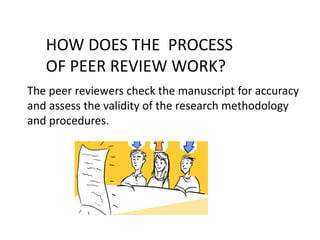
The peer reviewers check the manuscript for accuracy
and assess the validity of the research methodology
and procedures.
HOW DOES THE PROCESS
OF PEER REVIEW WORK?
If appropriate, the reviews will suggest revisions. If
they find the article lacking in scholarly validity and
rigor, they reject it.
HOW DOES THE PROCESS
OF PEER REVIEW WORK?
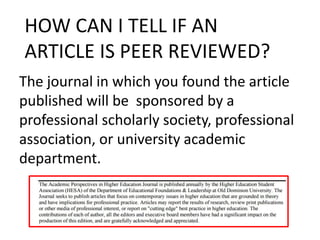
The journal in which you found the article
published will be sponsored by a
professional scholarly society, professional
association, or university academic
department.
HOW CAN I TELL IF AN
ARTICLE IS PEER REVIEWED?
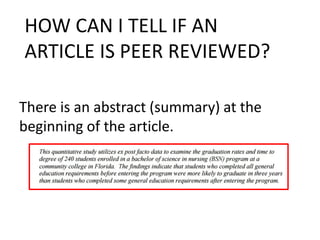
There is an abstract (summary) at the
beginning of the article.
HOW CAN I TELL IF AN
ARTICLE IS PEER REVIEWED?
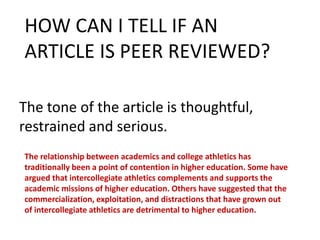
The tone of the article is thoughtful,
restrained and serious.
HOW CAN I TELL IF AN
ARTICLE IS PEER REVIEWED?
The relationship between academics and college athletics has
traditionally been a point of contention in higher education. Some have
argued that intercollegiate athletics complements and supports the
academic missions of higher education. Others have suggested that the
commercialization, exploitation, and distractions that have grown out
of intercollegiate athletics are detrimental to higher education.
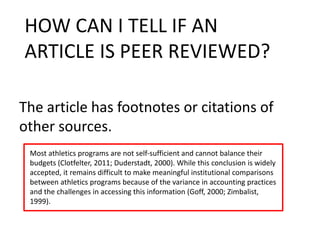
The article has footnotes or citations of
other sources.
HOW CAN I TELL IF AN
ARTICLE IS PEER REVIEWED?
Most athletics programs are not self-sufficient and cannot balance their
budgets (Clotfelter, 2011; Duderstadt, 2000). While this conclusion is widely
accepted, it remains difficult to make meaningful institutional comparisons
between athletics programs because of the variance in accounting practices
and the challenges in accessing this information (Goff, 2000; Zimbalist,
1999).
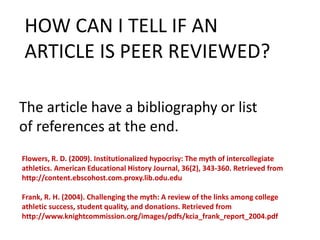
The article have a bibliography or list
of references at the end.
HOW CAN I TELL IF AN
ARTICLE IS PEER REVIEWED?
Flowers, R. D. (2009). Institutionalized hypocrisy: The myth of intercollegiate
athletics. American Educational History Journal, 36(2), 343-360. Retrieved from
http://content.ebscohost.com.proxy.lib.odu.edu
Frank, R. H. (2004). Challenging the myth: A review of the links among college
athletic success, student quality, and donations. Retrieved from
http://www.knightcommission.org/images/pdfs/kcia_frank_report_2004.pdf
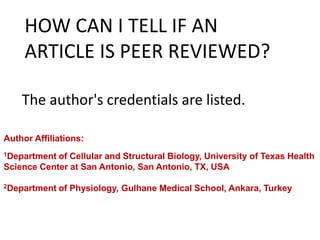
The author's credentials are listed.
HOW CAN I TELL IF AN
ARTICLE IS PEER REVIEWED?
Author Affiliations:
1Department of Cellular and Structural Biology, University of Texas Health
Science Center at San Antonio, San Antonio, TX, USA
2Department of Physiology, Gulhane Medical School, Ankara, Turkey
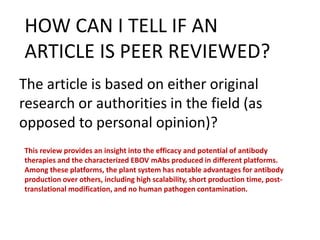
The article is based on either original
research or authorities in the field (as
opposed to personal opinion)?
HOW CAN I TELL IF AN
ARTICLE IS PEER REVIEWED?
This review provides an insight into the efficacy and potential of antibody
therapies and the characterized EBOV mAbs produced in different platforms.
Among these platforms, the plant system has notable advantages for antibody
production over others, including high scalability, short production time, post-
translational modification, and no human pathogen contamination.
The article is written for readers with some
prior knowledge of the subject.
HOW CAN I TELL IF AN
ARTICLE IS PEER REVIEWED?
The effective treatment of vascular leakage and multiorgan failure by combination
of ventilatory support, antibiotic treatment, and renal replacement therapy can
sustain a patient with severe Ebola virus disease until virological remission. FX06
could potentially be a valuable agent in contribution to supportive therapy.
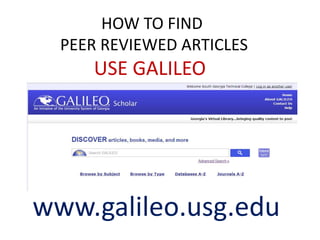
HOW TO FIND
PEER REVIEWED ARTICLES
www.galileo.usg.edu
USE GALILEO
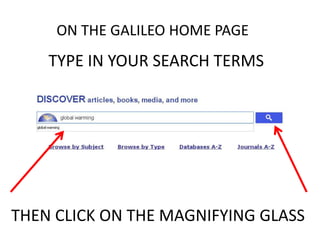
TYPE IN YOUR SEARCH TERMS
THEN CLICK ON THE MAGNIFYING GLASS
ON THE GALILEO HOME PAGE
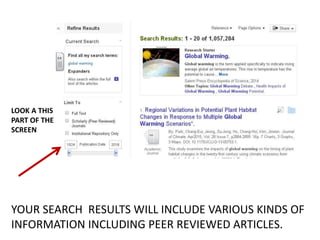
YOUR SEARCH RESULTS WILL INCLUDE VARIOUS KINDS OF
INFORMATION INCLUDING PEER REVIEWED ARTICLES.
LOOK A THIS
PART OF THE
SCREEN
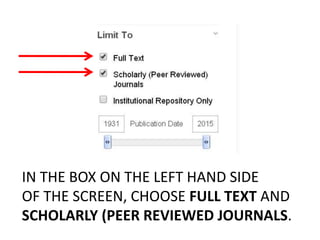
IN THE BOX ON THE LEFT HAND SIDE
OF THE SCREEN, CHOOSE FULL TEXT AND
SCHOLARLY (PEER REVIEWED JOURNALS.
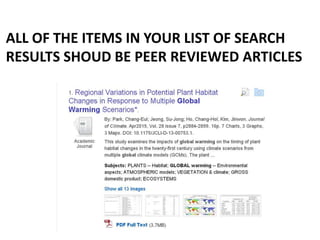
ALL OF THE ITEMS IN YOUR LIST OF SEARCH
RESULTS SHOUD BE PEER REVIEWED ARTICLES
TO VIEW A SHORT VIDEO ON
THE PEER REVIEW PROCESS,
GO TO THE NEXT SLIDE.
What Is Peer Review?

What Is Peer Review?

  • 1.
    What is peerreview?
  • 2.
    The Process usedto judge the quality of articles submitted for publication in a scholarly journal. PEER REVIEW
  • 3.
    YOUR INSTRUCTOR MAYREQUIRE YOU TO USE PEER REVIEWED ARTICLES WHEN WRITING A PAPER.
  • 4.
    Peer reviewed articlesare said to be the most reliable sources of information that you can use. They must undergo a process of review and examination before they can be published.
  • 5.
    The author ofthe article must submit it to the journal editor who forwards the article to experts in the field. Because the reviewers specialize in the same scholarly area as the author, they are considered the author’s peers (hence “peer review”). HOW DOES THE PROCESS OF PEER REVIEW WORK?
  • 6.
    Impartial reviewers arecharged with carefully evaluating the quality of the submitted manuscript. HOW DOES THE PROCESS OF PEER REVIEW WORK?
  • 7.
    The peer reviewerscheck the manuscript for accuracy and assess the validity of the research methodology and procedures. HOW DOES THE PROCESS OF PEER REVIEW WORK?
  • 8.
    If appropriate, thereviews will suggest revisions. If they find the article lacking in scholarly validity and rigor, they reject it. HOW DOES THE PROCESS OF PEER REVIEW WORK?
  • 9.
    The journal inwhich you found the article published will be sponsored by a professional scholarly society, professional association, or university academic department. HOW CAN I TELL IF AN ARTICLE IS PEER REVIEWED?
  • 10.
    There is anabstract (summary) at the beginning of the article. HOW CAN I TELL IF AN ARTICLE IS PEER REVIEWED?
  • 11.
    The tone ofthe article is thoughtful, restrained and serious. HOW CAN I TELL IF AN ARTICLE IS PEER REVIEWED? The relationship between academics and college athletics has traditionally been a point of contention in higher education. Some have argued that intercollegiate athletics complements and supports the academic missions of higher education. Others have suggested that the commercialization, exploitation, and distractions that have grown out of intercollegiate athletics are detrimental to higher education.
  • 12.
    The article hasfootnotes or citations of other sources. HOW CAN I TELL IF AN ARTICLE IS PEER REVIEWED? Most athletics programs are not self-sufficient and cannot balance their budgets (Clotfelter, 2011; Duderstadt, 2000). While this conclusion is widely accepted, it remains difficult to make meaningful institutional comparisons between athletics programs because of the variance in accounting practices and the challenges in accessing this information (Goff, 2000; Zimbalist, 1999).
  • 13.
    The article havea bibliography or list of references at the end. HOW CAN I TELL IF AN ARTICLE IS PEER REVIEWED? Flowers, R. D. (2009). Institutionalized hypocrisy: The myth of intercollegiate athletics. American Educational History Journal, 36(2), 343-360. Retrieved from http://content.ebscohost.com.proxy.lib.odu.edu Frank, R. H. (2004). Challenging the myth: A review of the links among college athletic success, student quality, and donations. Retrieved from http://www.knightcommission.org/images/pdfs/kcia_frank_report_2004.pdf
  • 14.
    The author's credentialsare listed. HOW CAN I TELL IF AN ARTICLE IS PEER REVIEWED? Author Affiliations: 1Department of Cellular and Structural Biology, University of Texas Health Science Center at San Antonio, San Antonio, TX, USA 2Department of Physiology, Gulhane Medical School, Ankara, Turkey
  • 15.
    The article isbased on either original research or authorities in the field (as opposed to personal opinion)? HOW CAN I TELL IF AN ARTICLE IS PEER REVIEWED? This review provides an insight into the efficacy and potential of antibody therapies and the characterized EBOV mAbs produced in different platforms. Among these platforms, the plant system has notable advantages for antibody production over others, including high scalability, short production time, post- translational modification, and no human pathogen contamination.
  • 16.
    The article iswritten for readers with some prior knowledge of the subject. HOW CAN I TELL IF AN ARTICLE IS PEER REVIEWED? The effective treatment of vascular leakage and multiorgan failure by combination of ventilatory support, antibiotic treatment, and renal replacement therapy can sustain a patient with severe Ebola virus disease until virological remission. FX06 could potentially be a valuable agent in contribution to supportive therapy.
  • 17.
    HOW TO FIND PEERREVIEWED ARTICLES www.galileo.usg.edu USE GALILEO
  • 18.
    TYPE IN YOURSEARCH TERMS THEN CLICK ON THE MAGNIFYING GLASS ON THE GALILEO HOME PAGE
  • 19.
    YOUR SEARCH RESULTSWILL INCLUDE VARIOUS KINDS OF INFORMATION INCLUDING PEER REVIEWED ARTICLES. LOOK A THIS PART OF THE SCREEN
  • 20.
    IN THE BOXON THE LEFT HAND SIDE OF THE SCREEN, CHOOSE FULL TEXT AND SCHOLARLY (PEER REVIEWED JOURNALS.
  • 21.
    ALL OF THEITEMS IN YOUR LIST OF SEARCH RESULTS SHOUD BE PEER REVIEWED ARTICLES
  • 22.
    TO VIEW ASHORT VIDEO ON THE PEER REVIEW PROCESS, GO TO THE NEXT SLIDE.