Literature Review
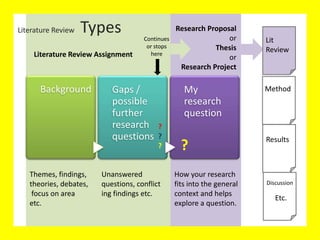
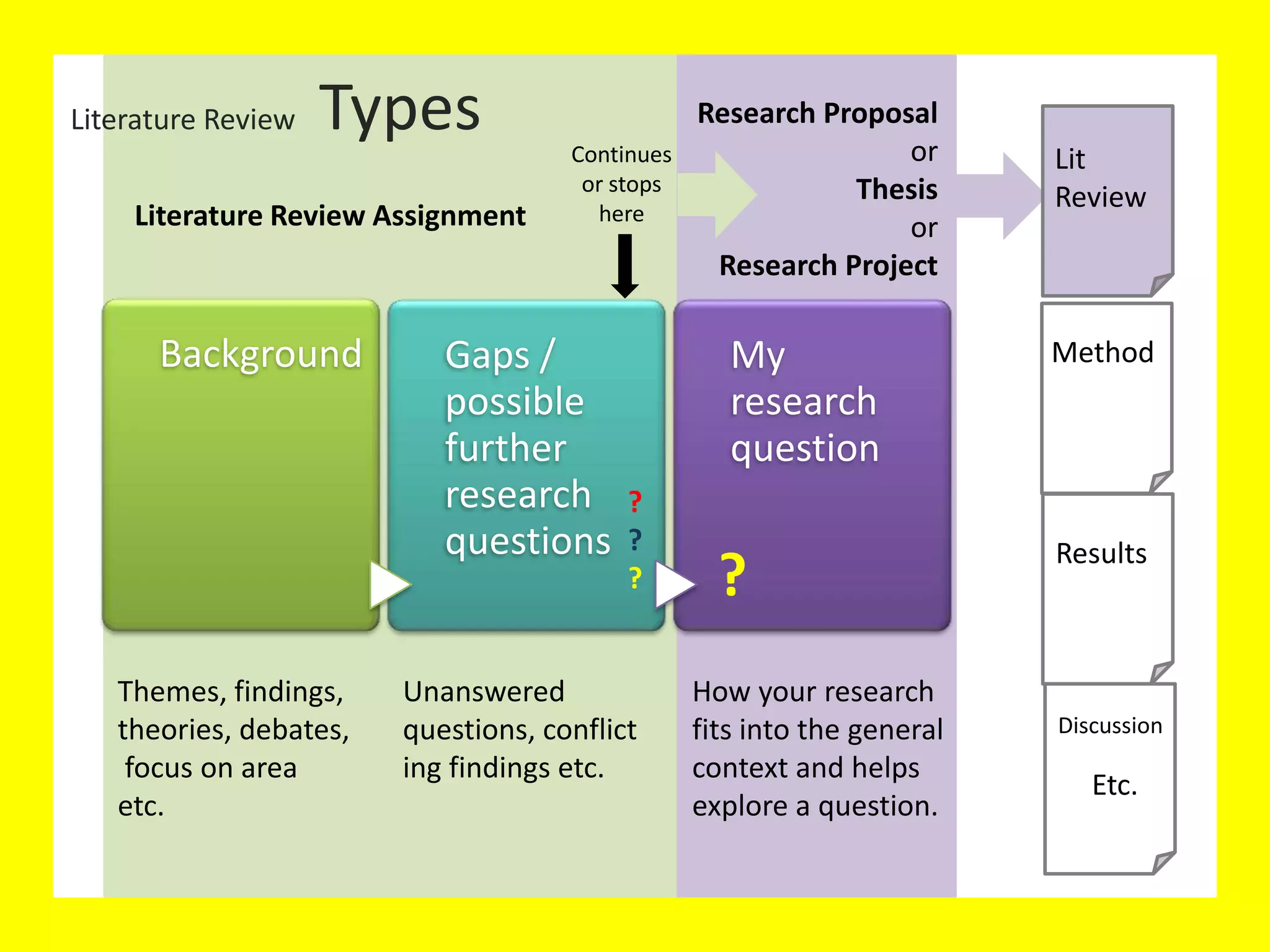
How your research
fits into the general
context and helps
explore a question.
Background Gaps /
possible
further
research
questions
My
research
question
?
?
? ?
Research Proposal
or
Thesis
or
Research Project
Themes, findings,
theories, debates,
focus on area etc.
Literature Review Types
Unanswered
questions,
conflicting
findings etc.
Literature Review Assignment
Lit
Review
Method
Results
Discussion
Etc.
Continues
or stops
here
Literature Review
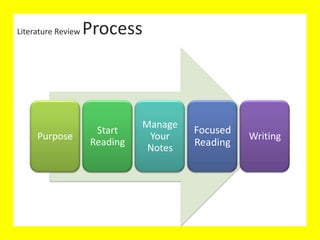
Literature Review Process
Purpose
Start
Reading
Manage
Your
Notes
Focused
Reading
Writing
Literature Review
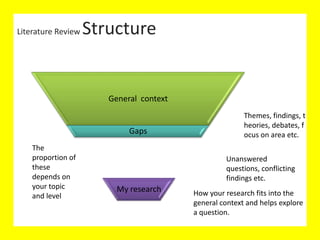
Literature Review Structure
General context
Gaps
My research
Themes, findings,
theories, debates,
focus on area etc.
Unanswered questions,
conflicting findings etc.
How your research fits into the
general context and helps explore
a question.
The
proportion of
these
depends on
your topic
and level
Literature Review
Literature Review Purpose
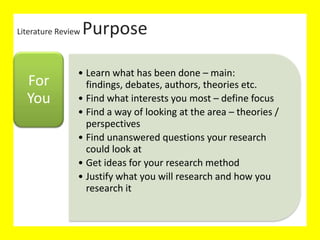
• Learn what has been done – main: findings,
debates, authors, theories etc.
• Find what interests you most – define focus
• Find a way of looking at the area – theories /
perspectives
• Find unanswered questions your research
could look at
• Get ideas for your research method
• Justify what you will research and how you
research it
For
You
Literature Review
Literature Review Purpose
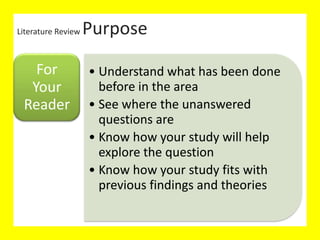
• Understand what has been done
before in the area
• See where the unanswered
questions are
• Know how your study will help
explore the question
• Know how your study fits with
previous findings and theories
For
Your
Reader
Literature Review
Literature Review Start Reading
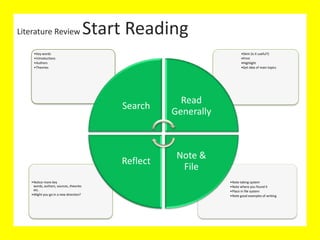
• Note taking
system
• Note where
you found it
• Place in file
system
• Note good
examples of
writing
• Notice more
key words,
authors,
sources,
theories etc.
• Might you go
in a new
direction?
•Skim (is it useful?)
•Print
•Highlight
•Understand main
topics
• Key words
• Introductions
• Authors
• Theories
Search
Read
Generally
Note &
File
Reflect
Literature Review
Literature Review Manage Your Notes
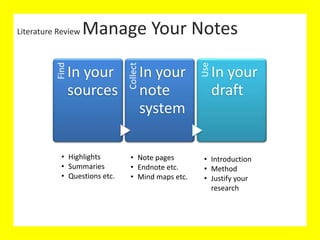
Find
In your
sources
Collect
In your
note
system
Use
In your
draft
• Highlights
• Summaries
• Questions etc.
• Note pages
• Endnote etc.
• Mind maps etc.
• Introduction
• Method
• Justify your
research
Literature Review
Literature Review Focused Reading
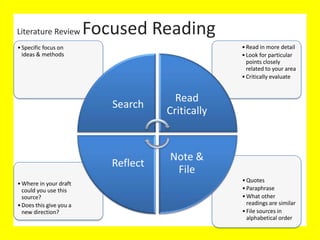
• Quotes
• Paraphrase
• What other
readings are
similar?
• File sources in
alphabetical
order
• Where in your
draft could
you use this
source?
• Does this give
you a new
direction?
• Read in more
detail
• Look for
particular
points closely
related to your
area
• Critically
evaluate
• Specific focus
on ideas &
methods
Search
Read
Critically
Note &
File
Reflect
Literature Review
Literature Review Writing
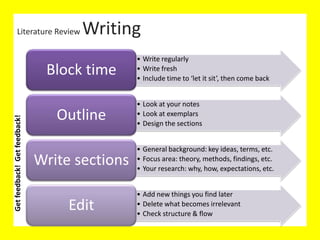
• Write regularly
• Write fresh
• Include time to ‘let it sit’, then come back
Block time
• Look at your notes
• Look at exemplars
• Design the sections
Outline
• General background: key ideas, terms, etc.
• Focus area: theory, methods, findings, etc.
• Your research: why, how, expectations, etc.
Write sections
• Add new things you find later
• Delete what becomes irrelevant
• Check structure & flow
Edit
Getfeedback!Getfeedback!
Literature Review
Literature Review Links
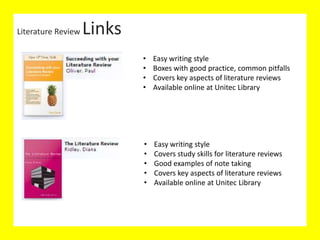
• Easy writing style
• Boxes with good practice, common pitfalls
• Covers key aspects of literature reviews
• Available online at Unitec Library
• Easy writing style
• Covers study skills for literature reviews
• Good examples of note taking
• Covers key aspects of literature reviews
• Available online at Unitec Library

Literature review

  • 1.
    Literature Review How yourresearch fits into the general context and helps explore a question. Background Gaps / possible further research questions My research question ? ? ? ? Research Proposal or Thesis or Research Project Themes, findings, theories, debates, focus on area etc. Literature Review Types Unanswered questions, conflicting findings etc. Literature Review Assignment Lit Review Method Results Discussion Etc. Continues or stops here
  • 2.
    Literature Review Literature ReviewProcess Purpose Start Reading Manage Your Notes Focused Reading Writing
  • 3.
    Literature Review Literature ReviewStructure General context Gaps My research Themes, findings, theories, debates, focus on area etc. Unanswered questions, conflicting findings etc. How your research fits into the general context and helps explore a question. The proportion of these depends on your topic and level
  • 4.
    Literature Review Literature ReviewPurpose • Learn what has been done – main: findings, debates, authors, theories etc. • Find what interests you most – define focus • Find a way of looking at the area – theories / perspectives • Find unanswered questions your research could look at • Get ideas for your research method • Justify what you will research and how you research it For You
  • 5.
    Literature Review Literature ReviewPurpose • Understand what has been done before in the area • See where the unanswered questions are • Know how your study will help explore the question • Know how your study fits with previous findings and theories For Your Reader
  • 6.
    Literature Review Literature ReviewStart Reading • Note taking system • Note where you found it • Place in file system • Note good examples of writing • Notice more key words, authors, sources, theories etc. • Might you go in a new direction? •Skim (is it useful?) •Print •Highlight •Understand main topics • Key words • Introductions • Authors • Theories Search Read Generally Note & File Reflect
  • 7.
    Literature Review Literature ReviewManage Your Notes Find In your sources Collect In your note system Use In your draft • Highlights • Summaries • Questions etc. • Note pages • Endnote etc. • Mind maps etc. • Introduction • Method • Justify your research
  • 8.
    Literature Review Literature ReviewFocused Reading • Quotes • Paraphrase • What other readings are similar? • File sources in alphabetical order • Where in your draft could you use this source? • Does this give you a new direction? • Read in more detail • Look for particular points closely related to your area • Critically evaluate • Specific focus on ideas & methods Search Read Critically Note & File Reflect
  • 9.
    Literature Review Literature ReviewWriting • Write regularly • Write fresh • Include time to ‘let it sit’, then come back Block time • Look at your notes • Look at exemplars • Design the sections Outline • General background: key ideas, terms, etc. • Focus area: theory, methods, findings, etc. • Your research: why, how, expectations, etc. Write sections • Add new things you find later • Delete what becomes irrelevant • Check structure & flow Edit Getfeedback!Getfeedback!
  • 10.
    Literature Review Literature ReviewLinks • Easy writing style • Boxes with good practice, common pitfalls • Covers key aspects of literature reviews • Available online at Unitec Library • Easy writing style • Covers study skills for literature reviews • Good examples of note taking • Covers key aspects of literature reviews • Available online at Unitec Library