Submitted To: Submitted By:
www.studymafia.org www.studymafia.org
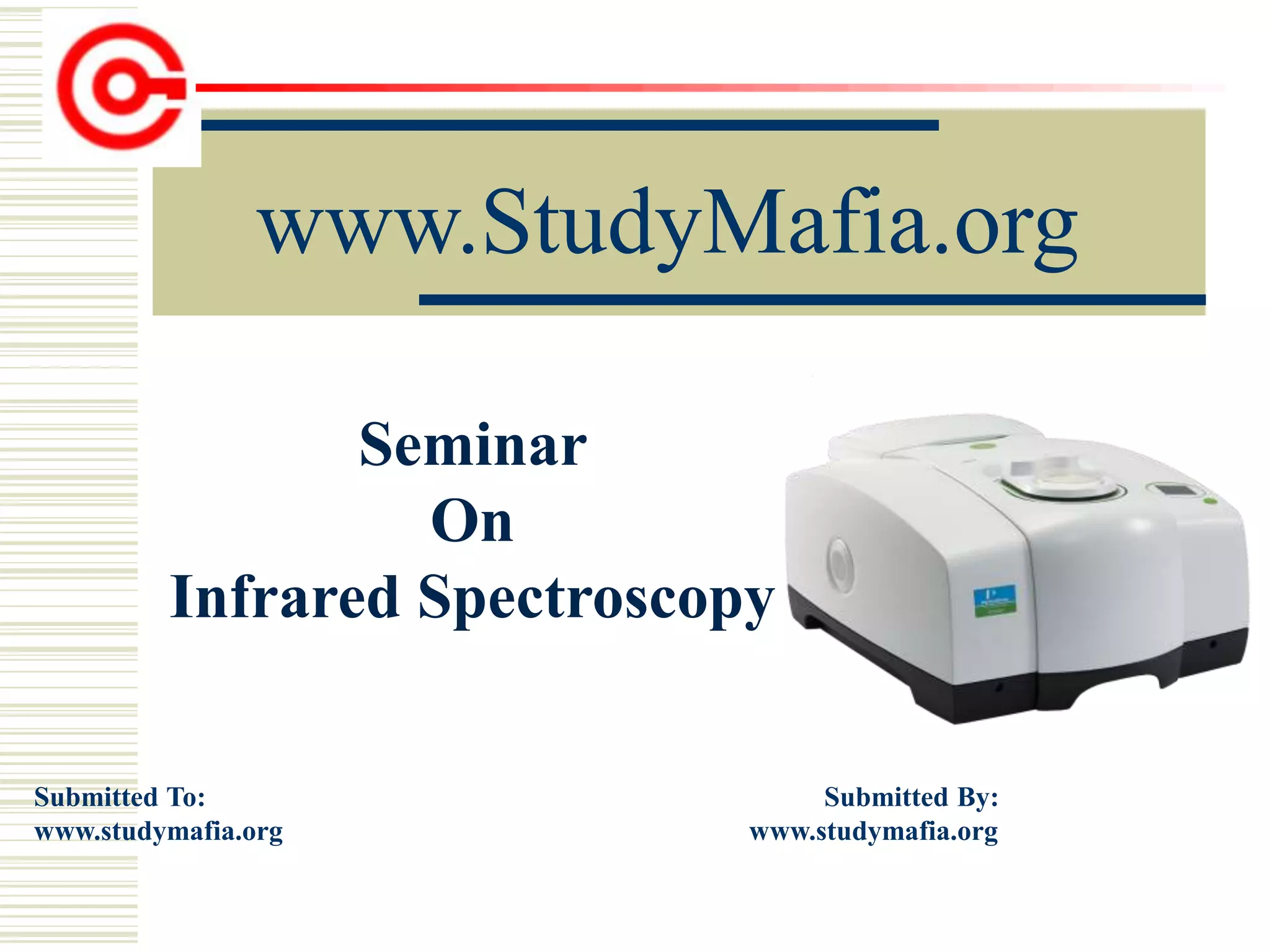
Seminar
On
Infrared Spectroscopy
www.StudyMafia.org
Table Of Content
 What is Infrared Spectroscopy?
 IR Spectroscopic Process
 Example OF IR
 Theory of Infrared Absorption Spectroscopy
 Uses and Application
 Advantages
 Disadvantages
 Conclusion
 Reference
Definition of Infrared
Spectroscopy
 The absorption of light, as it passes through a
medium, varies linearly with the distance the light
travels and with concentration of the absorbing
medium. Where a is the absorbance, the Greek
lower-case letter epsilon is a characteristic constant
for each material at a given wavelength (known as
the extinction coefficient or absorption coefficient),
c is concentration, and l is the length of the light
path, the absorption of light may be expressed by
the simple equation a= epsilon times c times l.
Infrared Spectroscopy
 Infrared spectroscopy is the measurement of the wavelength
and intensity of the absorption of mid-infrared light by a
sample. Mid-infrared is energetic enough to excite
molecular vibrations to higher energy levels.
 The wavelength of infrared absorption bands is
characteristic of specific types of chemical bonds, and
infrared spectroscopy finds its greatest utility for
identification of organic and organometallic molecules. The
high selectivity of the method makes the estimation of an
analyte in a complex matrix possible.
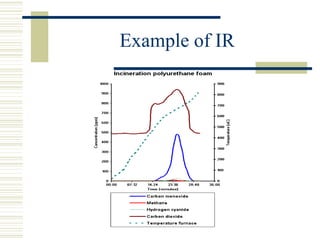
Example of IR
Theory of Infrared Absorption
Spectroscopy
 For a molecule to absorb IR, the vibrations or rotations
within a molecule must cause a net change in the dipole
moment of the molecule. The alternating electrical field of
the radiation (remember that electromagnetic radiation
consists of an oscillating electrical field and an oscillating
magnetic field, perpendicular to each other) interacts with
fluctuations in the dipole moment of the molecule.
 If the frequency of the radiation matches the vibrational
frequency of the molecule then radiation will be absorbed,
causing a change in the amplitude of molecular vibration.
Molecular Rotations
 Rotational transitions are of little use to the
spectroscopist. Rotational levels are
quantized, and absorption of IR by gases
yields line spectra.
 However, in liquids or solids, these lines
broaden into a continuum due to molecular
collisions and other interactions.
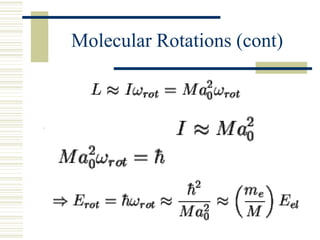
Molecular Rotations (cont)
,
Vibrational-Rotational
Transitions
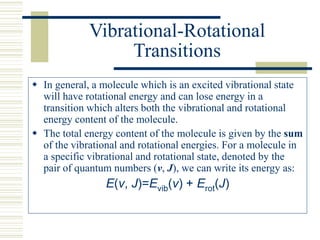
 In general, a molecule which is an excited vibrational state
will have rotational energy and can lose energy in a
transition which alters both the vibrational and rotational
energy content of the molecule.
 The total energy content of the molecule is given by the sum
of the vibrational and rotational energies. For a molecule in
a specific vibrational and rotational state, denoted by the
pair of quantum numbers (v, J), we can write its energy as:
E(v, J)=Evib(v) + Erot(J)
Transitions (cont)
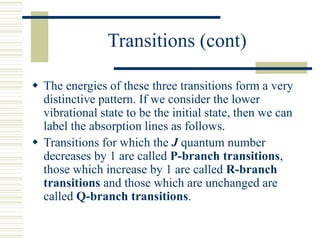
 The energies of these three transitions form a very
distinctive pattern. If we consider the lower
vibrational state to be the initial state, then we can
label the absorption lines as follows.
 Transitions for which the J quantum number
decreases by 1 are called P-branch transitions,
those which increase by 1 are called R-branch
transitions and those which are unchanged are
called Q-branch transitions.
Molecular Vibrations
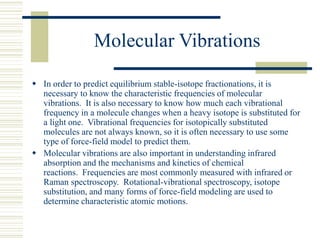
 In order to predict equilibrium stable-isotope fractionations, it is
necessary to know the characteristic frequencies of molecular
vibrations. It is also necessary to know how much each vibrational
frequency in a molecule changes when a heavy isotope is substituted for
a light one. Vibrational frequencies for isotopically substituted
molecules are not always known, so it is often necessary to use some
type of force-field model to predict them.
 Molecular vibrations are also important in understanding infrared
absorption and the mechanisms and kinetics of chemical
reactions. Frequencies are most commonly measured with infrared or
Raman spectroscopy. Rotational-vibrational spectroscopy, isotope
substitution, and many forms of force-field modeling are used to
determine characteristic atomic motions.
Vibrational Motion
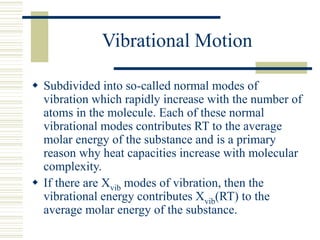
 Subdivided into so-called normal modes of
vibration which rapidly increase with the number of
atoms in the molecule. Each of these normal
vibrational modes contributes RT to the average
molar energy of the substance and is a primary
reason why heat capacities increase with molecular
complexity.
 If there are Xvib modes of vibration, then the
vibrational energy contributes Xvib(RT) to the
average molar energy of the substance.
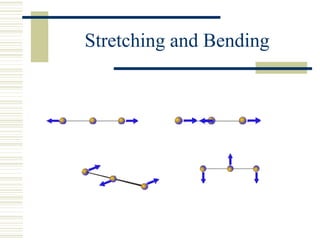
Stretching and Bending
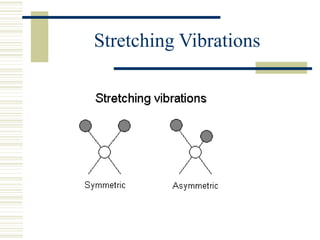
Stretching Vibrations
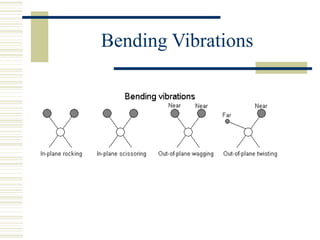
Bending Vibrations
Quantum Treatment of
Vibrations
 Transitions in vibrational energy levels can be
brought about by absorption of radiation, provided
the energy of the radiation exactly matches the
difference in energy levels between the vibrational
quantum states and provided also that the vibration
causes a fluctuation in dipole.
 Infrared measurements permit the evaluation of the
force constants for various types of chemical bonds.
Infrared Instruments
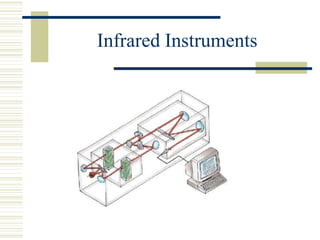
 An infrared spectrophotometer is an instrument that passes
infrared light through an organic molecule and produces a
spectrum that contains a plot of the amount of light
transmitted on the vertical axis against the wavelength of
infrared radiation on the horizontal axis. In infrared spectra
the absorption peaks point downward because the vertical
axis is the percentage transmittance of the radiation through
the sample.
 Absorption of radiation lowers the percentage transmittance
value. Since all bonds in an organic molecule interact with
infrared radiation, IR spectra provide a considerable amount
of structural data.
Infrared Instruments
Uses and Applications
It is also used in forensic analysis in both criminal and civil
cases, for example in identifying polymer degradation.
Chemical Analysis: Testing Pill Quality. According to "Medical
News Today," scientists at the University of Maryland have
been successful in using the method of near-infrared
spectroscopy (NIR) to make a prediction regarding quick
dissolution of pills inside the body. The success of the
experiment can help drug manufacturers in checking the
quality of pills to benefit consumers in the health industry.
Uses and Applications
Chemistry Applications. Using infrared spectroscopy, it is
possible to measure the degree of polymerization in
compounds. Polymerization happens when monomer
undergo chemical reaction to form polymer chains. Infrared
spectroscopy can measure the changes in the nature and
quantity of molecular bonds. Portable instruments that can
measure infrared spectroscopy are used in field trials. This
method is important for researchers in identifying more
different substances to improve the lives of modern society.
Advantages
• It's cheap and fast compared to things like NMR.
• It also works for a wide variety of samples and can
detect things very strongly, whereas similar
techniques like raman spectroscopy are weaker.
Disadvantages
• Sample preparation is time consuming and that it can't
give information as detailed as other techniques such as
NMR.
• It's also a destructive analysis method and therefore
precious or scarce sample should be analysed by a non-
destructive method such as raman.
• It's also qualitative rather than quantitative and there are
a lot of compounds which are not IR active and
therefore can't be detected.
Conclusion
• IR identifies the components of a sample (liquid, solid or
gas).
• Infrared (IR) spectrometers measure the interaction of IR
radiation with samples. The FTIR spectrometer measures
the frequencies at which the samples absorb the radiation,
and the intensities of the absorptions.
• Intensity and frequency of samples absorption are depicted
in a two-dimensional plot called a spectrum. Intensity is
generally reported in terms of absorbance - the amount of
light absorbed by a sample, or percent transmittance – i.e.
the amount of light, which passes through it.
References
 http://www.acs.org
 http://www.cas.org
 http://www.chemcenter/org
 http://www.sciencemag.org
 http://www.shu.ac.uk/schools/sci/chem/tutorials/molspec/irspec/.htm
 http://www.kerouac.pharm.uky.edu/asrg/wave/wavehp.html
 http://hiq.linde-
gas.com/international/web/lg/spg/likelgspg.nsf/DocByAlias/anal_infra

Infrared-Spectroscopy-ppt.pptx

  • 1.
    Submitted To: SubmittedBy: www.studymafia.org www.studymafia.org Seminar On Infrared Spectroscopy www.StudyMafia.org
  • 2.
    Table Of Content What is Infrared Spectroscopy?  IR Spectroscopic Process  Example OF IR  Theory of Infrared Absorption Spectroscopy  Uses and Application  Advantages  Disadvantages  Conclusion  Reference
  • 3.
    Definition of Infrared Spectroscopy The absorption of light, as it passes through a medium, varies linearly with the distance the light travels and with concentration of the absorbing medium. Where a is the absorbance, the Greek lower-case letter epsilon is a characteristic constant for each material at a given wavelength (known as the extinction coefficient or absorption coefficient), c is concentration, and l is the length of the light path, the absorption of light may be expressed by the simple equation a= epsilon times c times l.
  • 4.
    Infrared Spectroscopy  Infraredspectroscopy is the measurement of the wavelength and intensity of the absorption of mid-infrared light by a sample. Mid-infrared is energetic enough to excite molecular vibrations to higher energy levels.  The wavelength of infrared absorption bands is characteristic of specific types of chemical bonds, and infrared spectroscopy finds its greatest utility for identification of organic and organometallic molecules. The high selectivity of the method makes the estimation of an analyte in a complex matrix possible.
  • 5.
  • 6.
    Theory of InfraredAbsorption Spectroscopy  For a molecule to absorb IR, the vibrations or rotations within a molecule must cause a net change in the dipole moment of the molecule. The alternating electrical field of the radiation (remember that electromagnetic radiation consists of an oscillating electrical field and an oscillating magnetic field, perpendicular to each other) interacts with fluctuations in the dipole moment of the molecule.  If the frequency of the radiation matches the vibrational frequency of the molecule then radiation will be absorbed, causing a change in the amplitude of molecular vibration.
  • 7.
    Molecular Rotations  Rotationaltransitions are of little use to the spectroscopist. Rotational levels are quantized, and absorption of IR by gases yields line spectra.  However, in liquids or solids, these lines broaden into a continuum due to molecular collisions and other interactions.
  • 8.
  • 9.
    Vibrational-Rotational Transitions  In general,a molecule which is an excited vibrational state will have rotational energy and can lose energy in a transition which alters both the vibrational and rotational energy content of the molecule.  The total energy content of the molecule is given by the sum of the vibrational and rotational energies. For a molecule in a specific vibrational and rotational state, denoted by the pair of quantum numbers (v, J), we can write its energy as: E(v, J)=Evib(v) + Erot(J)
  • 10.
    Transitions (cont)  Theenergies of these three transitions form a very distinctive pattern. If we consider the lower vibrational state to be the initial state, then we can label the absorption lines as follows.  Transitions for which the J quantum number decreases by 1 are called P-branch transitions, those which increase by 1 are called R-branch transitions and those which are unchanged are called Q-branch transitions.
  • 11.
    Molecular Vibrations  Inorder to predict equilibrium stable-isotope fractionations, it is necessary to know the characteristic frequencies of molecular vibrations. It is also necessary to know how much each vibrational frequency in a molecule changes when a heavy isotope is substituted for a light one. Vibrational frequencies for isotopically substituted molecules are not always known, so it is often necessary to use some type of force-field model to predict them.  Molecular vibrations are also important in understanding infrared absorption and the mechanisms and kinetics of chemical reactions. Frequencies are most commonly measured with infrared or Raman spectroscopy. Rotational-vibrational spectroscopy, isotope substitution, and many forms of force-field modeling are used to determine characteristic atomic motions.
  • 12.
    Vibrational Motion  Subdividedinto so-called normal modes of vibration which rapidly increase with the number of atoms in the molecule. Each of these normal vibrational modes contributes RT to the average molar energy of the substance and is a primary reason why heat capacities increase with molecular complexity.  If there are Xvib modes of vibration, then the vibrational energy contributes Xvib(RT) to the average molar energy of the substance.
  • 13.
  • 14.
  • 15.
  • 16.
    Quantum Treatment of Vibrations Transitions in vibrational energy levels can be brought about by absorption of radiation, provided the energy of the radiation exactly matches the difference in energy levels between the vibrational quantum states and provided also that the vibration causes a fluctuation in dipole.  Infrared measurements permit the evaluation of the force constants for various types of chemical bonds.
  • 17.
    Infrared Instruments  Aninfrared spectrophotometer is an instrument that passes infrared light through an organic molecule and produces a spectrum that contains a plot of the amount of light transmitted on the vertical axis against the wavelength of infrared radiation on the horizontal axis. In infrared spectra the absorption peaks point downward because the vertical axis is the percentage transmittance of the radiation through the sample.  Absorption of radiation lowers the percentage transmittance value. Since all bonds in an organic molecule interact with infrared radiation, IR spectra provide a considerable amount of structural data.
  • 18.
  • 19.
    Uses and Applications Itis also used in forensic analysis in both criminal and civil cases, for example in identifying polymer degradation. Chemical Analysis: Testing Pill Quality. According to "Medical News Today," scientists at the University of Maryland have been successful in using the method of near-infrared spectroscopy (NIR) to make a prediction regarding quick dissolution of pills inside the body. The success of the experiment can help drug manufacturers in checking the quality of pills to benefit consumers in the health industry.
  • 20.
    Uses and Applications ChemistryApplications. Using infrared spectroscopy, it is possible to measure the degree of polymerization in compounds. Polymerization happens when monomer undergo chemical reaction to form polymer chains. Infrared spectroscopy can measure the changes in the nature and quantity of molecular bonds. Portable instruments that can measure infrared spectroscopy are used in field trials. This method is important for researchers in identifying more different substances to improve the lives of modern society.
  • 21.
    Advantages • It's cheapand fast compared to things like NMR. • It also works for a wide variety of samples and can detect things very strongly, whereas similar techniques like raman spectroscopy are weaker.
  • 22.
    Disadvantages • Sample preparationis time consuming and that it can't give information as detailed as other techniques such as NMR. • It's also a destructive analysis method and therefore precious or scarce sample should be analysed by a non- destructive method such as raman. • It's also qualitative rather than quantitative and there are a lot of compounds which are not IR active and therefore can't be detected.
  • 23.
    Conclusion • IR identifiesthe components of a sample (liquid, solid or gas). • Infrared (IR) spectrometers measure the interaction of IR radiation with samples. The FTIR spectrometer measures the frequencies at which the samples absorb the radiation, and the intensities of the absorptions. • Intensity and frequency of samples absorption are depicted in a two-dimensional plot called a spectrum. Intensity is generally reported in terms of absorbance - the amount of light absorbed by a sample, or percent transmittance – i.e. the amount of light, which passes through it.
  • 24.
    References  http://www.acs.org  http://www.cas.org http://www.chemcenter/org  http://www.sciencemag.org  http://www.shu.ac.uk/schools/sci/chem/tutorials/molspec/irspec/.htm  http://www.kerouac.pharm.uky.edu/asrg/wave/wavehp.html  http://hiq.linde- gas.com/international/web/lg/spg/likelgspg.nsf/DocByAlias/anal_infra