Dr. BASAVARAJAIAH S. M.
Assistant Professor and Coordinator
P.G. Department of Chemistry
Vijaya College
Bangalore-560 004
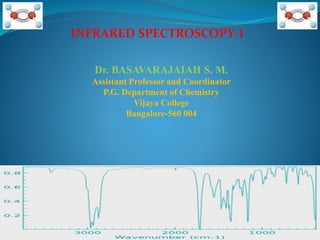
INFRARED SPECTROSCOPY-I
Contents:
Introduction
Instrumentation
Sampling techniques
Group frequencies
Factors affecting group frequencies
Complementarity of IR and Raman spectroscopy
Applications of Infrared spectroscopy
INTRODUCTION
Infra-red spectrum is an important record which gives sufficient
information about the structure of a compound.
IR electromagnetic radiation is just less energetic than visible light.
The infrared spectral regions are as follows.
The absorption of Infra-red radiations (quantized) causes the
various bands in a molecule to stretch and bend with respect to one
another.
The frequency of IR radiation is commonly expressed in wave
numbers.
Wavenumber (ῡ): The number of waves per centimeter, cm-1 (read
reciprocal centimeters).
Expressed in wavenumbers, the vibrational IR extends from 4000
cm-1 to 670 cm -1
.
Convert a wavenumber (ῡ) to a frequency (υ) by multiplying it by
the speed of light.
The main reason chemists prefer to use wave numbers as units is
that they are directly proportional to energy.
Wavenumber (ῡ) = 1/ Frequency (υ) = c/
THE INFRARED ABSORPTION PROCESS
 The absorption of infrared radiation is, like other absorption
processes, a quantized process.
A molecule absorbs only selected frequencies (energies) of infrared
radiation (8 to 40 kJ/mole).
Radiation in this energy range corresponds to the range
encompassing the stretching and bending frequencies of the bonds in
most covalent molecules.
Energy absorbed serves to increase the amplitude of the vibrational
motions of the bonds in the molecule.
Only those bonds that have a dipole moment that changes as a
function of time are capable of absorbing infrared radiation.
USES OF THE INFRARED SPECTRUM
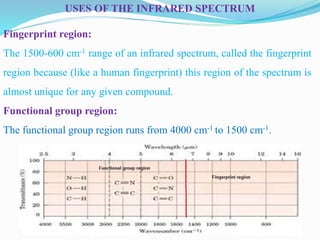
Fingerprint region:
The 1500-600 cm-1 range of an infrared spectrum, called the fingerprint
region because (like a human fingerprint) this region of the spectrum is
almost unique for any given compound.
Functional group region:
The functional group region runs from 4000 cm-1 to 1500 cm-1.
Number of Vibrational Modes
For a molecule with N atoms, the positions of all N nuclei depend on a
total of 3N coordinates, so that the molecule has 3N degrees of
freedom including translation, rotation and vibration.
A nonlinear molecule can rotate about any of three mutually
perpendicular axes and therefore has 3 rotational degrees of freedom. For
a linear molecule, rotation about the molecular axis does not involve
movement of any atomic nucleus, so there are only 2 rotational degrees
of freedom which can vary the atomic coordinates.
The number of vibrational modes is therefore 3N minus the number of
translational and rotational degrees of freedom, or 3N–5 for linear and
3N–6 for nonlinear molecules.
Ethane, C2H6 has eight atoms (N=8) and is a nonlinear molecule so
of the 3N=24 degrees of freedom, three are translational and three
are rotational. The remaining 18 degrees of freedom are internal
(vibrational). This is consistent with:
3N−6=3(8)−6=18
Carbon Dioxide, CO2 has three atoms (N=3) and is a linear
molecule so of the 3N=9 degrees of freedom, three are translational
and two are rotational. The remaining 4 degrees of freedom are
vibrational. This is consistent with:
3N−5=3(3)−5=4
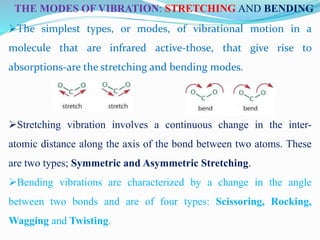
THE MODES OF VIBRATION: STRETCHING AND BENDING
The simplest types, or modes, of vibrational motion in a
molecule that are infrared active-those, that give rise to
absorptions-are the stretching and bending modes.
Stretching vibration involves a continuous change in the inter-
atomic distance along the axis of the bond between two atoms. These
are two types; Symmetric and Asymmetric Stretching.
Bending vibrations are characterized by a change in the angle
between two bonds and are of four types: Scissoring, Rocking,
Wagging and Twisting.
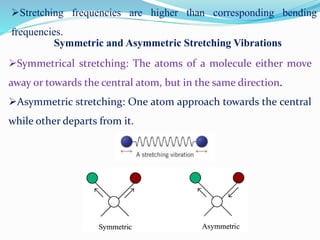
Stretching frequencies are higher than corresponding bending
frequencies.
Symmetric and Asymmetric Stretching Vibrations
Symmetrical stretching: The atoms of a molecule either move
away or towards the central atom, but in the same direction.
Asymmetric stretching: One atom approach towards the central
while other departs from it.
BENDING VIBRATIONS
Scissoring is the movement of two atoms toward and away from
each other.
Rocking is like the motion of a pendulum on a clock, but an atom is
the pendulum and there are two instead of one.
Wagging is like the motion in which you make a "V" sign with your
fingers and bend them back and forth from your wrist.
Twisting is a motion as if the atoms were walking on a treadmill.
Examples:
OVERTONES, COMBINATION BAND, DIFFERENCE BANDS
and FERMI RESONANCE
The vibrations we have been discussing are called fundamental
absorptions. They arise from excitation from the ground state to the
excited state. Usually the spectrum is complicated because of the presence
of weak overtone, combination, and difference bands.
Overtones result from excitation from the ground state to higher energy
states, which correspond to integral multiples of the frequency of the
fundamental (υ). For examples 2υ , 3υ ,…….
When two vibrational frequencies (υ1 and υ2) in a molecule couple to
give rise to a vibration of a new frequency within the molecule, and when
such a vibration is infrared active, it is called combination band. This
band is the sum of the two interacting bands (υcomb= υ1+ υ2).
Difference bands are similar to combination bands. The observed
frequency in this case results from the difference the two interacting
bands (υ diff= υ1-υ2).
One can calculate overtone, combination, and difference bands by
directly manipulating frequencies in wavenumbers via multiplication,
addition, and subtraction, respectively.
When a fundamental vibration couples with an overtone or
combination band, the coupled vibration is called Fermi resonance.
Again, certain combinations are allowed. Fermi resonance is often
observed in carbonyl compounds.
Let us now consider how bond strength and the masses of the
bonded atoms affect the infrared absorption frequency.
The natural frequency of vibration of a bond is given by the
equation (Hooke’s law).
VIBRATIONAL FREQUENCY
A new expression is obtained by inserting the actual values of π
and c:
Examples:
Note: Vibrational frequency is directly proportional to force constant
(K) (Bond strength) and inversely proportional to reduced mass (μ).
In general, triple bonds are stronger than double or single bonds between the
same two atoms and have higher frequencies of vibration (Higher wavenumbers):
The C-H stretch occurs at about 3000 cm-1. As the atom bonded to carbon increases
in mass, the reduced mass (μ) increases, and the frequency of vibration decreases
(wavenumbers get smaller):
Bending motions occur at lower energy (lower frequency) than the typical stretching
motions because of the lower value for the bending force constant K.
Hybridization affects the force constant K, also. Bonds are stronger in the order
sp>sp2>sp3, and the observed frequencies of C-H vibration illustrate this nicely.
INSTRUMENTATION
The main parts of IR spectrometer are as follows:
Radiation source
Sample cells and sampling of substances
Monochromators
Detectors
Recorder
Radiation source
IR instruments require a source of radiant energy which emit IR
radiation which must be steady, intense enough for detection and
extend over the desired wavelength.
Various sources of IR radiations are as follows:
Nernst glower
Incandescent lamp
Mercury arc
Tungsten lamp
Glober source
Nichrome wire
Sample cells and sampling of substances
IR spectroscopy has been used for the characterization of solid, liquid
or gas samples.
Solid – Various techniques are used for preparing solid samples
such as pressed pellet technique, solid run in solution, solid films,
mull technique etc.
Liquid – Samples can be held using a liquid sample cell made of
alkali halides. Aqueous solvents cannot be used as they will dissolve
alkali halides. Only organic solvents like chloroform can be used.
Gas– Sampling of gas is similar to the sampling of liquids.
Monochromators
Various types of monochromators are prism, gratings and filters.
Prisms are made of Potassium bromide, Sodium chloride or Caesium
iodide.
Filters are made up of Lithium Fluoride and Diffraction gratings are
made up of alkali halides.
Detectors
Detectors are used to measure the intensity of unabsorbed infrared
radiation.
Detectors like thermocouples, Bolometers, thermisters, Golay cell,
and pyro-electric detectors are used.
Recorder
Computer stores all the data generated and produces the spectrum of
the desired compound.
The infrared spectrophotometer:
Two type of infrared spectrometers are in common use in the
organic laboratory:
Dispersive infrared spectrophotometer
Fourier transform infrared spectrophotometer
Both provide common range of 4000 to 400 cm-1.
Both provide identical spectra.
FT-IR provide spectrum much more rapidly.
Dispersive infrared spectrophotometer
Fourier transform infrared spectrophotometer
SAMPLING TECHNIQUES
To determine the infrared spectrum of a compound, one must place the compound
in a sample holder, or cell.
Cells must be constructed of ionic substances- typically sodium chloride or
potassium bromide.
Potassium bromide plates are expensive and have the advantages.
Sodium chloride plates are used widely because of their low cost.
GROUP FREQUENCIES
Factors affecting group frequencies
The value of vibrational frequency of a bond calculated by Hooke’s
Law is not always equal to their observed value.
The force constant is changed with the electronic and steric effects
caused by other groups present in the surroundings.
Following are some important factors affecting the vibrational
frequency of a bond.
Effect of Bond Order
Bond order affects the position of absorption bands. Higher the bond
order larger is the band frequency.
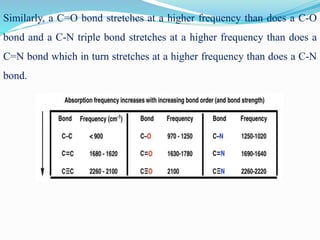
A C-C triple bond is stronger than a C=C bond, so a C-C triple bond
has higher stretching frequency than does a C=C bond.
Similarly, a C=O bond stretches at a higher frequency than does a C-O
bond and a C-N triple bond stretches at a higher frequency than does a
C=N bond which in turn stretches at a higher frequency than does a C-N
bond.
Electronic Effects:
Changes in the absorption frequencies for a particular group take place when the
substituent's in the neighbourhood of that particular group are changed.
The frequency shifts are due to the electronic effects which include Inductive
effect, Mesomeric effect, Field effects etc.
 Under the influence of these effects, the force constant or the bond strength
changes and its absorption frequency shifts from the normal value.
The introduction of alkyl group causes +I effect which results in the lengthening
or the weakening of the bond and hence the force constant is lowered and
wavenumber of absorption decreases.
Wavenumber of νC=O Formaldehyde (HCHO) 1750 cm-1
Acetaldehyde (CH3CHO) 1745 cm-1
Acetone (CH3COCH3) 1715 cm-1
Note: Aldehydes absorb at higher wavenumber than ketones
The introduction of an electronegative atom or group causes –I effect
which results in the bond order to increase.
Thus, the force constant increases and hence the wavenumber of
absorption rises.
Wavenumber of νC=O Acetone (CH3COCH3) 1715 cm-1
Chloroacetone (ClCH2COCH3) 1725 cm-1
Dichloroacetone (Cl2CHCOCH3) 1740 cm-1
Conjugation lowers the absorption frequency of C=O stretching whether
the conjugation due to α, β-unsaturation or due to an aromatic ring.
O
O
Methyl vinyl ketone Acetophenone
νC=O 1706 cm-1 1693 cm-1
Note: -I effect is dominated by mesomeric effect.
The electron pair on nitrogen atom in amide is more labile and participates more in
conjugation, hence the amide absorbs less frequency than the esters.
The lone pair of electrons participates more in conjugation in compound I as
compared to that compound III. Thus, in compound I, ν(C=O) absorption occurs at
lower wave number compared to that in compound III. In compounds II and IV,
inductive effect dominates over mesomeric effect and hence absorption takes place
at comparatively higher frequencies.
Hydrogen Bonding
The presence of hydrogen bonding changes the position and shape of
an infrared absorption band.
Frequencies of both stretching as well as bending vibrations are
changed because of hydrogen bonding.
The X-H stretching bands move to lower frequency usually with
increased intensity and band widening. The X-H bending vibration
usually shifts to higher frequencies.
Stronger the hydrogen bonding, greater is the absorption shift towards
lower wavenumber from the normal values.
The two types of hydrogen bonding (intramolecular and
intermolecular) can be differentiated by the use of infrared
spectroscopy.
The extent of inter-molecular hydrogen bonding depends upon the concentration of
the solution and hence the position and the shape of an absorption band also depend
on the concentration of the solution.
The more concentrated the solution, the more likely it is for the OH-containing
molecules to form intermolecular hydrogen bonds. It is easier to stretch an O-H bond
if it is hydrogen bonded, because the hydrogen is attracted to the oxygen of
neighbouring molecule.
Therefore, the O-H stretching of a concentrated (hydrogen bonded) solution of an
alcohol occurs at about 3550 cm-1, whereas the O-H stretching band of a dilute
solution (with little or no hydrogen bonding) appears at 3650 cm-1 .
Additionally, hydrogen-bonded OH groups also have broader absorption bands
whereas the absorption bands of non-hydrogen–bonded OH groups are sharper.
Field effect:
In ortho substitution, inductive effect, mesomeric effect along with steric
effect is considered. In ortho substituted compounds, the lone pairs of
electrons on two atoms influence each other through space interactions and
change the vibrational frequencies of both the groups. This effect is called
field effect.
The non-bonding electrons present on oxygen atom and halogen cause electrostatic
repulsions. This causes a change in the C=O hybridization and which in turn makes it
to go out of plane of the double bond.
Thus, the conjugation is diminished and absorption occurs at a higher wavenumber.
Thus, for such ortho substituted compounds, cis absorbs (field effect) at a higher
frequency as compared to the trans isomer.
Bond angles
Smaller ring requires the use of more p-character to make the
internal C-C bonds for the requisite small angles.
This gives more s character to the C=O sigma bond which causes the
strengthening and stiffening of the exocyclic double bond. The force
constant K is then increased and the absorption frequency increases.
Complementarity of IR and Raman spectroscopy
For the infra-red spectrum to occur, the molecule must show a
change in the dipole moment. For the Raman spectra, there must be
a polarstability of the molecule.
As these two requirements are somewhat different, lines may be
formed in one of the spectra or in both. The symmetrical stretching
of the molecule which are usually missing in the infra-red appear
prominently in Raman spectra.
On the other hand, asymmetric vibrations show opposite behavior.
Thus, we say that vibrational modes which are inactive in Infra-red
are somewhat active in Raman spectra.
For carbon dioxide, the bending and antisymmetric modes are infrared active, while
the symmetric stretch mode is Raman active. This behaviour is typical of all
centrosymmetric molecules. Modes that are infrared active are Raman inactive and
vice versa.
This is the Rule of Mutual Exclusion, which states that no normal mode can be both
infrared and Raman active in a molecule that possesses a centre of symmetry.
Rule of Mutual Exclusion:
Difference Between IR and Raman Spectroscopy
Applications of IR spectroscopy
Identification of organic compounds
Structure determination
Qualitative analysis of functional group
Distinction between two types of hydrogen bonding
Quantitative analysis
Study of chemical reaction
Study of Keto-Enol tautomerism
Study of complex molecules
Detection of impurity in a compound.
Infrared spectroscopy  i

Infrared spectroscopy i

  • 1.
    Dr. BASAVARAJAIAH S.M. Assistant Professor and Coordinator P.G. Department of Chemistry Vijaya College Bangalore-560 004 INFRARED SPECTROSCOPY-I
  • 2.
    Contents: Introduction Instrumentation Sampling techniques Group frequencies Factorsaffecting group frequencies Complementarity of IR and Raman spectroscopy Applications of Infrared spectroscopy
  • 3.
    INTRODUCTION Infra-red spectrum isan important record which gives sufficient information about the structure of a compound. IR electromagnetic radiation is just less energetic than visible light. The infrared spectral regions are as follows. The absorption of Infra-red radiations (quantized) causes the various bands in a molecule to stretch and bend with respect to one another.
  • 4.
    The frequency ofIR radiation is commonly expressed in wave numbers. Wavenumber (ῡ): The number of waves per centimeter, cm-1 (read reciprocal centimeters). Expressed in wavenumbers, the vibrational IR extends from 4000 cm-1 to 670 cm -1 . Convert a wavenumber (ῡ) to a frequency (υ) by multiplying it by the speed of light. The main reason chemists prefer to use wave numbers as units is that they are directly proportional to energy. Wavenumber (ῡ) = 1/ Frequency (υ) = c/
  • 5.
    THE INFRARED ABSORPTIONPROCESS  The absorption of infrared radiation is, like other absorption processes, a quantized process. A molecule absorbs only selected frequencies (energies) of infrared radiation (8 to 40 kJ/mole). Radiation in this energy range corresponds to the range encompassing the stretching and bending frequencies of the bonds in most covalent molecules. Energy absorbed serves to increase the amplitude of the vibrational motions of the bonds in the molecule. Only those bonds that have a dipole moment that changes as a function of time are capable of absorbing infrared radiation.
  • 6.
    USES OF THEINFRARED SPECTRUM Fingerprint region: The 1500-600 cm-1 range of an infrared spectrum, called the fingerprint region because (like a human fingerprint) this region of the spectrum is almost unique for any given compound. Functional group region: The functional group region runs from 4000 cm-1 to 1500 cm-1.
  • 7.
    Number of VibrationalModes For a molecule with N atoms, the positions of all N nuclei depend on a total of 3N coordinates, so that the molecule has 3N degrees of freedom including translation, rotation and vibration. A nonlinear molecule can rotate about any of three mutually perpendicular axes and therefore has 3 rotational degrees of freedom. For a linear molecule, rotation about the molecular axis does not involve movement of any atomic nucleus, so there are only 2 rotational degrees of freedom which can vary the atomic coordinates. The number of vibrational modes is therefore 3N minus the number of translational and rotational degrees of freedom, or 3N–5 for linear and 3N–6 for nonlinear molecules.
  • 8.
    Ethane, C2H6 haseight atoms (N=8) and is a nonlinear molecule so of the 3N=24 degrees of freedom, three are translational and three are rotational. The remaining 18 degrees of freedom are internal (vibrational). This is consistent with: 3N−6=3(8)−6=18 Carbon Dioxide, CO2 has three atoms (N=3) and is a linear molecule so of the 3N=9 degrees of freedom, three are translational and two are rotational. The remaining 4 degrees of freedom are vibrational. This is consistent with: 3N−5=3(3)−5=4
  • 9.
    THE MODES OFVIBRATION: STRETCHING AND BENDING The simplest types, or modes, of vibrational motion in a molecule that are infrared active-those, that give rise to absorptions-are the stretching and bending modes. Stretching vibration involves a continuous change in the inter- atomic distance along the axis of the bond between two atoms. These are two types; Symmetric and Asymmetric Stretching. Bending vibrations are characterized by a change in the angle between two bonds and are of four types: Scissoring, Rocking, Wagging and Twisting.
  • 10.
    Stretching frequencies arehigher than corresponding bending frequencies. Symmetric and Asymmetric Stretching Vibrations Symmetrical stretching: The atoms of a molecule either move away or towards the central atom, but in the same direction. Asymmetric stretching: One atom approach towards the central while other departs from it.
  • 11.
    BENDING VIBRATIONS Scissoring isthe movement of two atoms toward and away from each other. Rocking is like the motion of a pendulum on a clock, but an atom is the pendulum and there are two instead of one. Wagging is like the motion in which you make a "V" sign with your fingers and bend them back and forth from your wrist. Twisting is a motion as if the atoms were walking on a treadmill.
  • 12.
  • 13.
    OVERTONES, COMBINATION BAND,DIFFERENCE BANDS and FERMI RESONANCE The vibrations we have been discussing are called fundamental absorptions. They arise from excitation from the ground state to the excited state. Usually the spectrum is complicated because of the presence of weak overtone, combination, and difference bands. Overtones result from excitation from the ground state to higher energy states, which correspond to integral multiples of the frequency of the fundamental (υ). For examples 2υ , 3υ ,……. When two vibrational frequencies (υ1 and υ2) in a molecule couple to give rise to a vibration of a new frequency within the molecule, and when such a vibration is infrared active, it is called combination band. This band is the sum of the two interacting bands (υcomb= υ1+ υ2).
  • 14.
    Difference bands aresimilar to combination bands. The observed frequency in this case results from the difference the two interacting bands (υ diff= υ1-υ2). One can calculate overtone, combination, and difference bands by directly manipulating frequencies in wavenumbers via multiplication, addition, and subtraction, respectively. When a fundamental vibration couples with an overtone or combination band, the coupled vibration is called Fermi resonance. Again, certain combinations are allowed. Fermi resonance is often observed in carbonyl compounds.
  • 15.
    Let us nowconsider how bond strength and the masses of the bonded atoms affect the infrared absorption frequency. The natural frequency of vibration of a bond is given by the equation (Hooke’s law). VIBRATIONAL FREQUENCY
  • 16.
    A new expressionis obtained by inserting the actual values of π and c: Examples: Note: Vibrational frequency is directly proportional to force constant (K) (Bond strength) and inversely proportional to reduced mass (μ).
  • 17.
    In general, triplebonds are stronger than double or single bonds between the same two atoms and have higher frequencies of vibration (Higher wavenumbers): The C-H stretch occurs at about 3000 cm-1. As the atom bonded to carbon increases in mass, the reduced mass (μ) increases, and the frequency of vibration decreases (wavenumbers get smaller): Bending motions occur at lower energy (lower frequency) than the typical stretching motions because of the lower value for the bending force constant K. Hybridization affects the force constant K, also. Bonds are stronger in the order sp>sp2>sp3, and the observed frequencies of C-H vibration illustrate this nicely.
  • 18.
    INSTRUMENTATION The main partsof IR spectrometer are as follows: Radiation source Sample cells and sampling of substances Monochromators Detectors Recorder
  • 19.
    Radiation source IR instrumentsrequire a source of radiant energy which emit IR radiation which must be steady, intense enough for detection and extend over the desired wavelength. Various sources of IR radiations are as follows: Nernst glower Incandescent lamp Mercury arc Tungsten lamp Glober source Nichrome wire
  • 20.
    Sample cells andsampling of substances IR spectroscopy has been used for the characterization of solid, liquid or gas samples. Solid – Various techniques are used for preparing solid samples such as pressed pellet technique, solid run in solution, solid films, mull technique etc. Liquid – Samples can be held using a liquid sample cell made of alkali halides. Aqueous solvents cannot be used as they will dissolve alkali halides. Only organic solvents like chloroform can be used. Gas– Sampling of gas is similar to the sampling of liquids.
  • 21.
    Monochromators Various types ofmonochromators are prism, gratings and filters. Prisms are made of Potassium bromide, Sodium chloride or Caesium iodide. Filters are made up of Lithium Fluoride and Diffraction gratings are made up of alkali halides. Detectors Detectors are used to measure the intensity of unabsorbed infrared radiation. Detectors like thermocouples, Bolometers, thermisters, Golay cell, and pyro-electric detectors are used.
  • 22.
    Recorder Computer stores allthe data generated and produces the spectrum of the desired compound. The infrared spectrophotometer: Two type of infrared spectrometers are in common use in the organic laboratory: Dispersive infrared spectrophotometer Fourier transform infrared spectrophotometer Both provide common range of 4000 to 400 cm-1. Both provide identical spectra. FT-IR provide spectrum much more rapidly.
  • 23.
  • 24.
    Fourier transform infraredspectrophotometer
  • 25.
    SAMPLING TECHNIQUES To determinethe infrared spectrum of a compound, one must place the compound in a sample holder, or cell. Cells must be constructed of ionic substances- typically sodium chloride or potassium bromide. Potassium bromide plates are expensive and have the advantages. Sodium chloride plates are used widely because of their low cost.
  • 27.
  • 29.
    Factors affecting groupfrequencies The value of vibrational frequency of a bond calculated by Hooke’s Law is not always equal to their observed value. The force constant is changed with the electronic and steric effects caused by other groups present in the surroundings. Following are some important factors affecting the vibrational frequency of a bond. Effect of Bond Order Bond order affects the position of absorption bands. Higher the bond order larger is the band frequency. A C-C triple bond is stronger than a C=C bond, so a C-C triple bond has higher stretching frequency than does a C=C bond.
  • 30.
    Similarly, a C=Obond stretches at a higher frequency than does a C-O bond and a C-N triple bond stretches at a higher frequency than does a C=N bond which in turn stretches at a higher frequency than does a C-N bond.
  • 31.
    Electronic Effects: Changes inthe absorption frequencies for a particular group take place when the substituent's in the neighbourhood of that particular group are changed. The frequency shifts are due to the electronic effects which include Inductive effect, Mesomeric effect, Field effects etc.  Under the influence of these effects, the force constant or the bond strength changes and its absorption frequency shifts from the normal value. The introduction of alkyl group causes +I effect which results in the lengthening or the weakening of the bond and hence the force constant is lowered and wavenumber of absorption decreases. Wavenumber of νC=O Formaldehyde (HCHO) 1750 cm-1 Acetaldehyde (CH3CHO) 1745 cm-1 Acetone (CH3COCH3) 1715 cm-1 Note: Aldehydes absorb at higher wavenumber than ketones
  • 32.
    The introduction ofan electronegative atom or group causes –I effect which results in the bond order to increase. Thus, the force constant increases and hence the wavenumber of absorption rises. Wavenumber of νC=O Acetone (CH3COCH3) 1715 cm-1 Chloroacetone (ClCH2COCH3) 1725 cm-1 Dichloroacetone (Cl2CHCOCH3) 1740 cm-1 Conjugation lowers the absorption frequency of C=O stretching whether the conjugation due to α, β-unsaturation or due to an aromatic ring. O O Methyl vinyl ketone Acetophenone νC=O 1706 cm-1 1693 cm-1 Note: -I effect is dominated by mesomeric effect.
  • 33.
    The electron pairon nitrogen atom in amide is more labile and participates more in conjugation, hence the amide absorbs less frequency than the esters. The lone pair of electrons participates more in conjugation in compound I as compared to that compound III. Thus, in compound I, ν(C=O) absorption occurs at lower wave number compared to that in compound III. In compounds II and IV, inductive effect dominates over mesomeric effect and hence absorption takes place at comparatively higher frequencies.
  • 34.
    Hydrogen Bonding The presenceof hydrogen bonding changes the position and shape of an infrared absorption band. Frequencies of both stretching as well as bending vibrations are changed because of hydrogen bonding. The X-H stretching bands move to lower frequency usually with increased intensity and band widening. The X-H bending vibration usually shifts to higher frequencies. Stronger the hydrogen bonding, greater is the absorption shift towards lower wavenumber from the normal values. The two types of hydrogen bonding (intramolecular and intermolecular) can be differentiated by the use of infrared spectroscopy.
  • 35.
    The extent ofinter-molecular hydrogen bonding depends upon the concentration of the solution and hence the position and the shape of an absorption band also depend on the concentration of the solution. The more concentrated the solution, the more likely it is for the OH-containing molecules to form intermolecular hydrogen bonds. It is easier to stretch an O-H bond if it is hydrogen bonded, because the hydrogen is attracted to the oxygen of neighbouring molecule. Therefore, the O-H stretching of a concentrated (hydrogen bonded) solution of an alcohol occurs at about 3550 cm-1, whereas the O-H stretching band of a dilute solution (with little or no hydrogen bonding) appears at 3650 cm-1 . Additionally, hydrogen-bonded OH groups also have broader absorption bands whereas the absorption bands of non-hydrogen–bonded OH groups are sharper.
  • 36.
    Field effect: In orthosubstitution, inductive effect, mesomeric effect along with steric effect is considered. In ortho substituted compounds, the lone pairs of electrons on two atoms influence each other through space interactions and change the vibrational frequencies of both the groups. This effect is called field effect. The non-bonding electrons present on oxygen atom and halogen cause electrostatic repulsions. This causes a change in the C=O hybridization and which in turn makes it to go out of plane of the double bond. Thus, the conjugation is diminished and absorption occurs at a higher wavenumber. Thus, for such ortho substituted compounds, cis absorbs (field effect) at a higher frequency as compared to the trans isomer.
  • 37.
    Bond angles Smaller ringrequires the use of more p-character to make the internal C-C bonds for the requisite small angles. This gives more s character to the C=O sigma bond which causes the strengthening and stiffening of the exocyclic double bond. The force constant K is then increased and the absorption frequency increases.
  • 38.
    Complementarity of IRand Raman spectroscopy For the infra-red spectrum to occur, the molecule must show a change in the dipole moment. For the Raman spectra, there must be a polarstability of the molecule. As these two requirements are somewhat different, lines may be formed in one of the spectra or in both. The symmetrical stretching of the molecule which are usually missing in the infra-red appear prominently in Raman spectra. On the other hand, asymmetric vibrations show opposite behavior. Thus, we say that vibrational modes which are inactive in Infra-red are somewhat active in Raman spectra.
  • 39.
    For carbon dioxide,the bending and antisymmetric modes are infrared active, while the symmetric stretch mode is Raman active. This behaviour is typical of all centrosymmetric molecules. Modes that are infrared active are Raman inactive and vice versa. This is the Rule of Mutual Exclusion, which states that no normal mode can be both infrared and Raman active in a molecule that possesses a centre of symmetry. Rule of Mutual Exclusion:
  • 40.
    Difference Between IRand Raman Spectroscopy
  • 41.
    Applications of IRspectroscopy Identification of organic compounds Structure determination Qualitative analysis of functional group Distinction between two types of hydrogen bonding Quantitative analysis Study of chemical reaction Study of Keto-Enol tautomerism Study of complex molecules Detection of impurity in a compound.