1
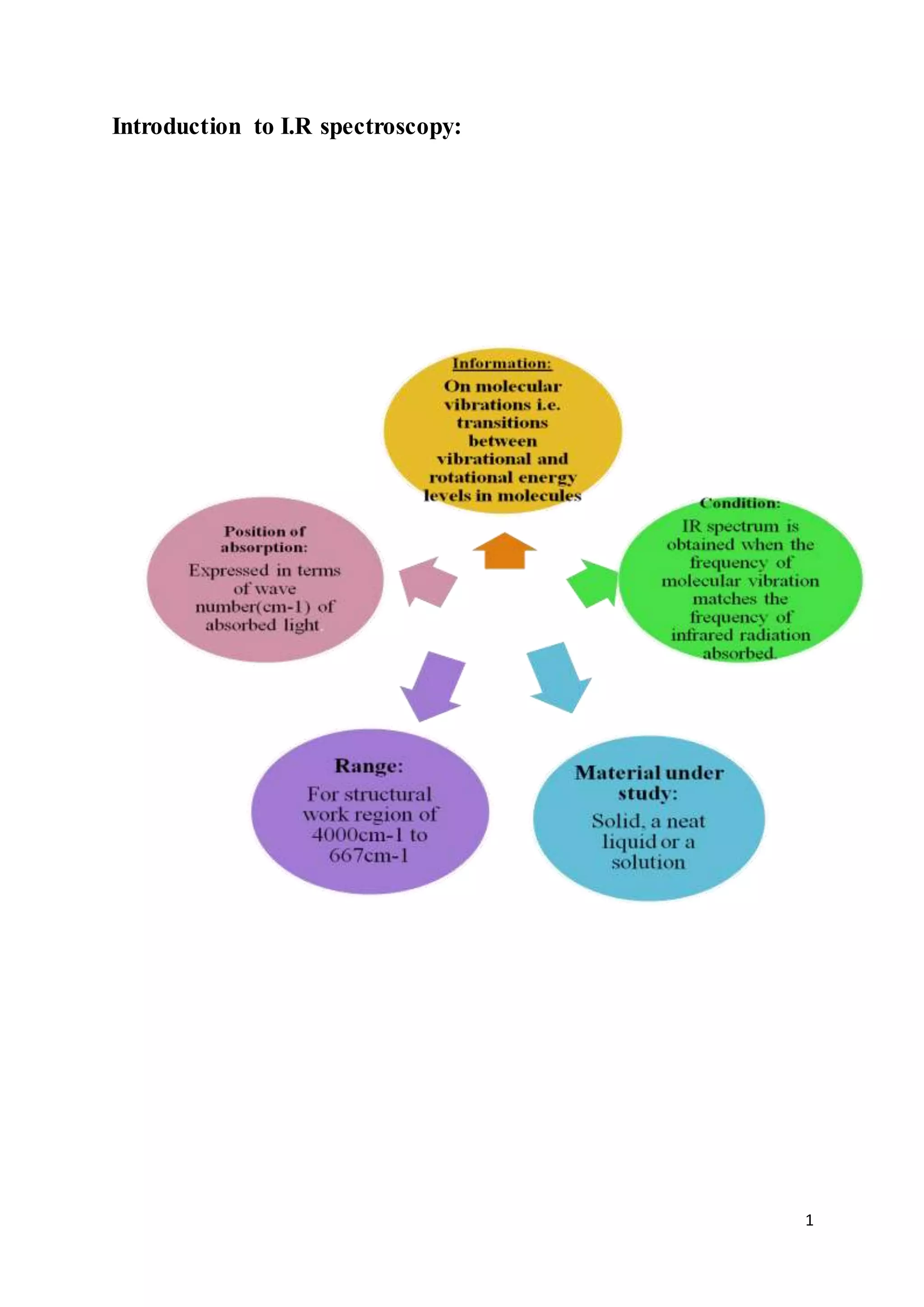
Introduction to I.R spectroscopy:
2
Infrared Spectrum:
 Represents:
Energy absorption pattern in the infrared region and obtained by plotting
absorbance or %transmittance of IR radiation as a function of wavelength or wavenumber.
 Division:
Overtones of fundamental pure rotational
and combination region
band
Vibrational plus rotational transition
Absorption bands due to a number characteristic of the compound
of functional groups
 Region of 1400-900cm-1 is complex and contains fundamental str and bending
plus sum or difference of their vibrational freq.
 Units:
Radiation in the infrared region is expressed with the unit “Wavenumber” rather than
“Wavelength (μ or μm)”.
Wavenumer are expressed in cm-1.
 Reason:
The wavelength unit is directly proportional to energy. The higher the
wavenumber the shorter the wavelength and higher the energy
 Conversions:
cm-1 = 1/μm x 10,000 and μm= 1/ cm-1 x 10,000
3
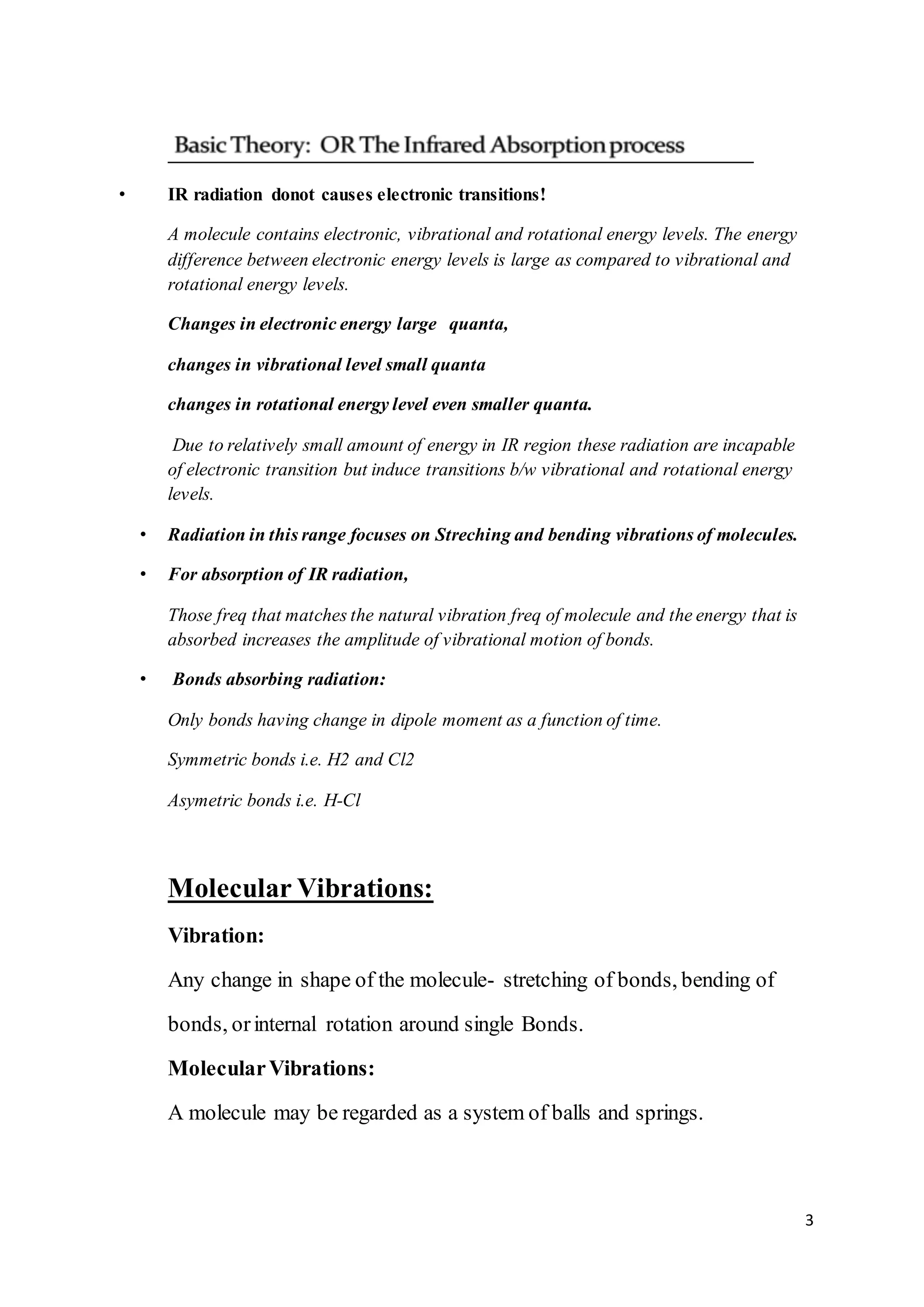
• IR radiation donot causes electronic transitions!
A molecule contains electronic, vibrational and rotational energy levels. The energy
difference between electronic energy levels is large as compared to vibrational and
rotational energy levels.
Changes in electronic energy large quanta,
changes in vibrational level small quanta
changes in rotational energy level even smaller quanta.
Due to relatively small amount of energy in IR region these radiation are incapable
of electronic transition but induce transitions b/w vibrational and rotational energy
levels.
• Radiation in this range focuses on Streching and bending vibrations of molecules.
• For absorption of IR radiation,
Those freq that matches the natural vibration freq of molecule and the energy that is
absorbed increases the amplitude of vibrational motion of bonds.
• Bonds absorbing radiation:
Only bonds having change in dipole moment as a function of time.
Symmetric bonds i.e. H2 and Cl2
Asymetric bonds i.e. H-Cl
Molecular Vibrations:
Vibration:
Any change in shape of the molecule- stretching of bonds, bending of
bonds, orinternal rotation around single Bonds.
MolecularVibrations:
A molecule may be regarded as a system of balls and springs.
4
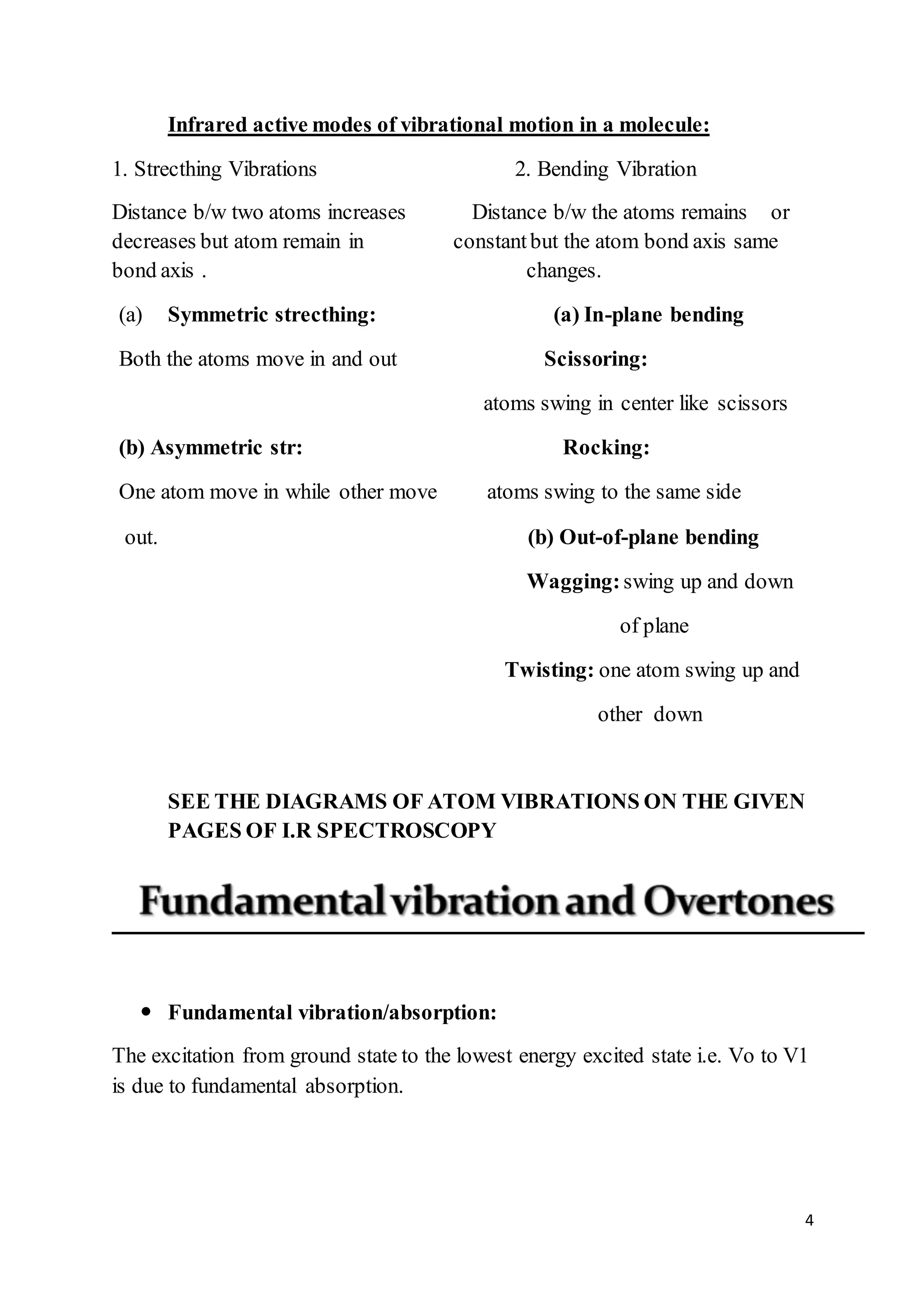
Infrared active modes of vibrational motion in a molecule:
1. Strecthing Vibrations 2. Bending Vibration
Distance b/w two atoms increases Distance b/w the atoms remains or
decreases but atom remain in constantbut the atom bond axis same
bond axis . changes.
(a) Symmetric strecthing: (a) In-plane bending
Both the atoms move in and out Scissoring:
atoms swing in center like scissors
(b) Asymmetric str: Rocking:
One atom move in while other move atoms swing to the same side
out. (b) Out-of-plane bending
Wagging:swing up and down
of plane
Twisting: one atom swing up and
other down
SEE THE DIAGRAMS OF ATOM VIBRATIONS ON THE GIVEN
PAGES OF I.R SPECTROSCOPY
 Fundamental vibration/absorption:
The excitation from ground state to the lowest energy excited state i.e. Vo to V1
is due to fundamental absorption.
5
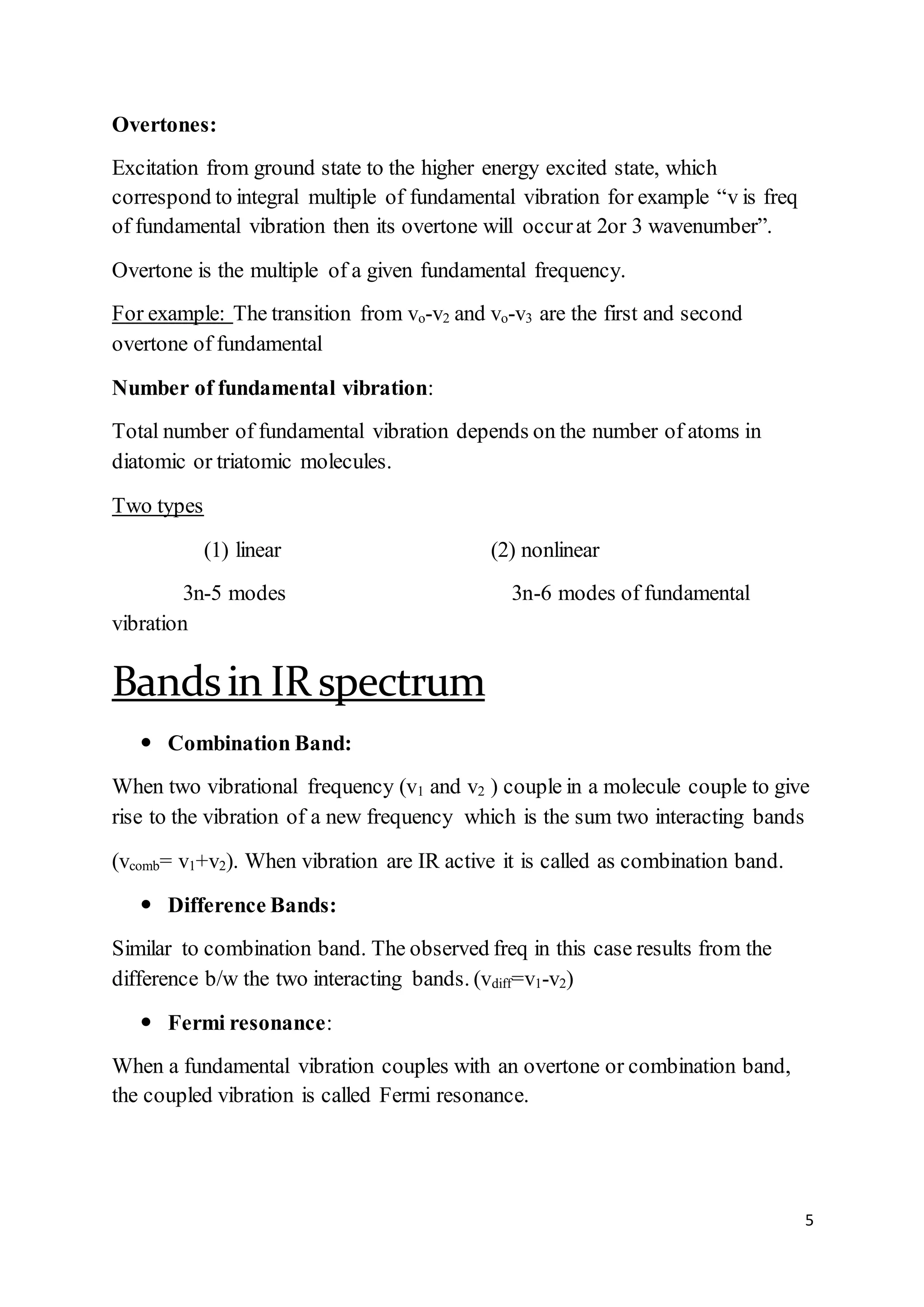
Overtones:
Excitation from ground state to the higher energy excited state, which
correspond to integral multiple of fundamental vibration for example “v is freq
of fundamental vibration then its overtone will occurat 2or 3 wavenumber”.
Overtone is the multiple of a given fundamental frequency.
For example: The transition from vo-v2 and vo-v3 are the first and second
overtone of fundamental
Number of fundamental vibration:
Total number of fundamental vibration depends on the number of atoms in
diatomic or triatomic molecules.
Two types
(1) linear (2) nonlinear
3n-5 modes 3n-6 modes of fundamental
vibration
Bandsin IR spectrum
 Combination Band:
When two vibrational frequency (v1 and v2 ) couple in a molecule couple to give
rise to the vibration of a new frequency which is the sum two interacting bands
(vcomb= v1+v2). When vibration are IR active it is called as combination band.
 Difference Bands:
Similar to combination band. The observed freq in this case results from the
difference b/w the two interacting bands. (vdiff=v1-v2)
 Fermi resonance:
When a fundamental vibration couples with an overtone or combination band,
the coupled vibration is called Fermi resonance.
6
BBoonndd pprrooppeerrttiieess
 How the bond strength and masses ofbonded atoms affectthe IR
absorption frequency!
Hooke’s Law
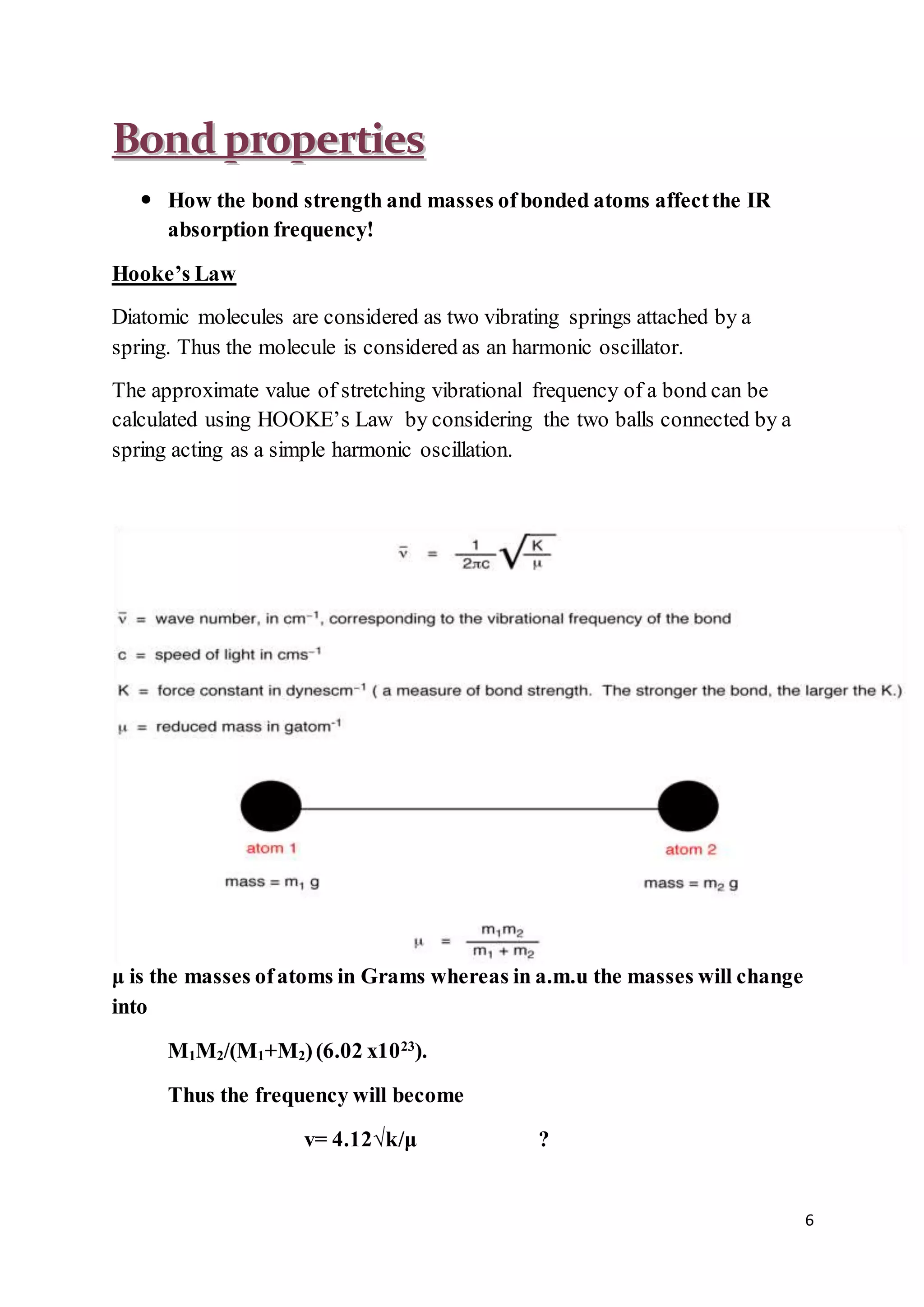
Diatomic molecules are considered as two vibrating springs attached by a
spring. Thus the molecule is considered as an harmonic oscillator.
The approximate value of stretching vibrational frequency of a bond can be
calculated using HOOKE’s Law by considering the two balls connected by a
spring acting as a simple harmonic oscillation.
μ is the masses ofatoms in Grams whereas in a.m.u the masses will change
into
M1M2/(M1+M2)(6.02 x1023
).
Thus the frequency will become
v= 4.12√k/μ ?
7
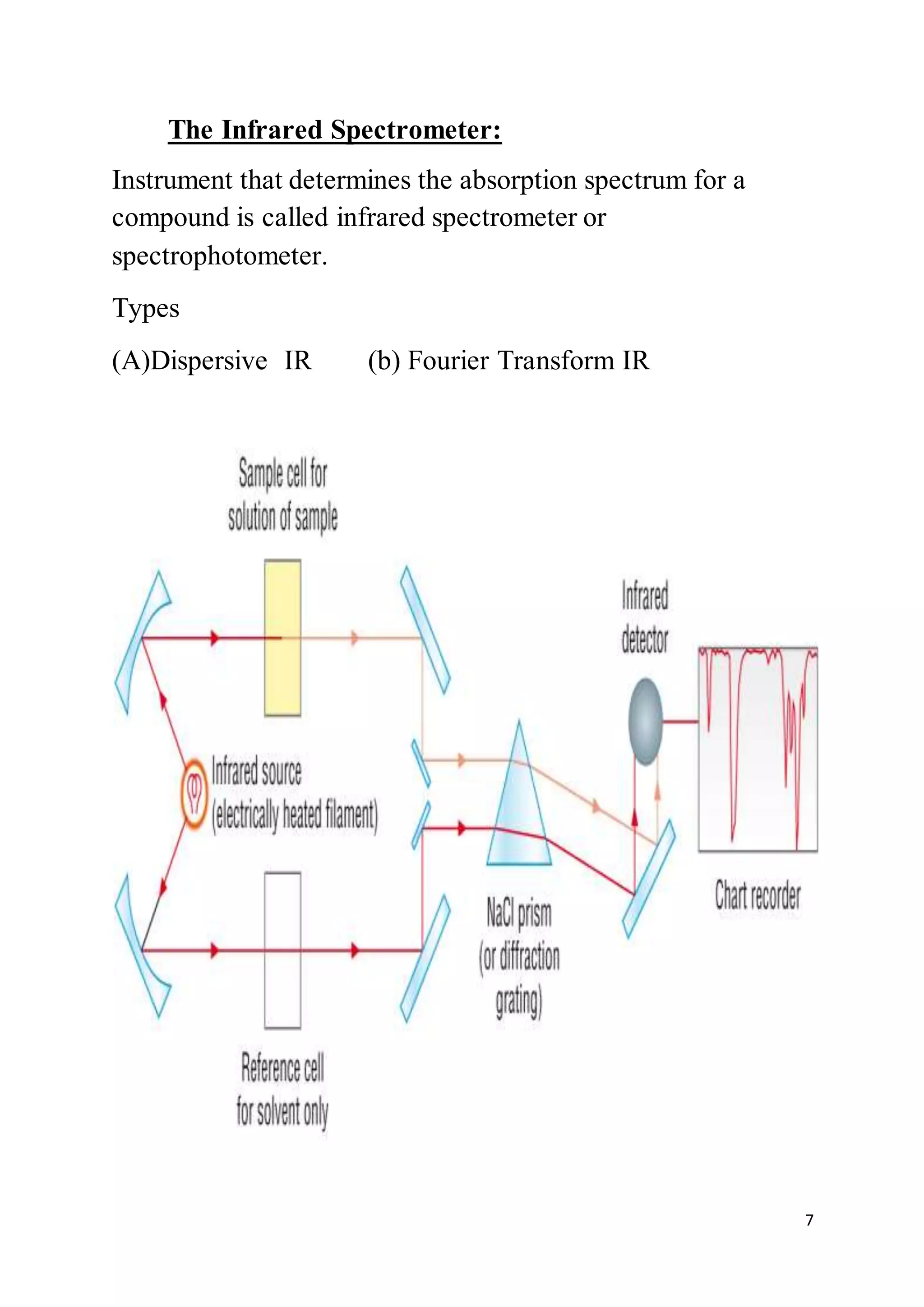
The Infrared Spectrometer:
Instrument that determines the absorption spectrum for a
compound is called infrared spectrometer or
spectrophotometer.
Types
(A)Dispersive IR (b) Fourier Transform IR
8
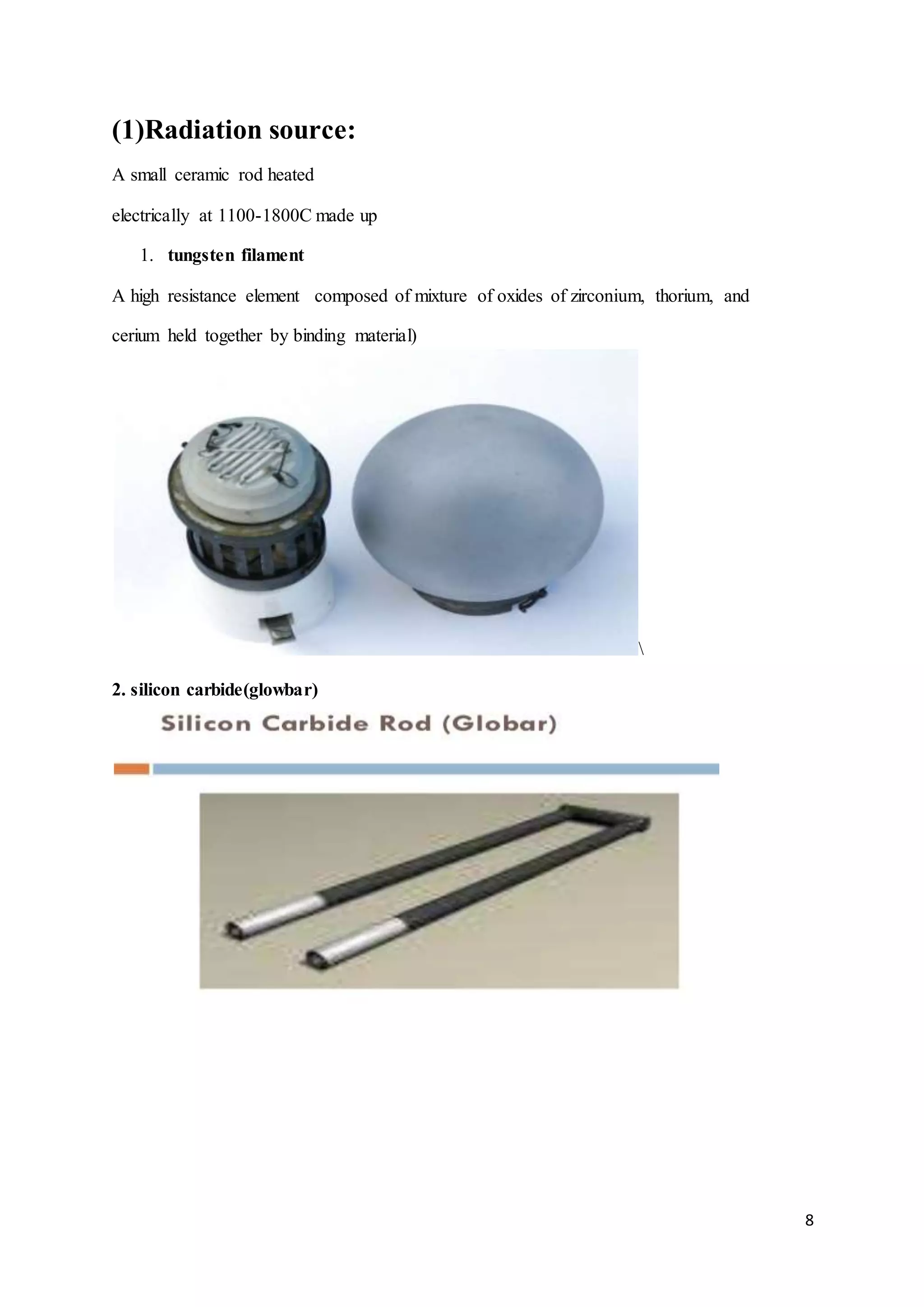
(1)Radiation source:
A small ceramic rod heated
electrically at 1100-1800C made up
1. tungsten filament
A high resistance element composed of mixture of oxides of zirconium, thorium, and
cerium held together by binding material)

2. silicon carbide(glowbar)
9
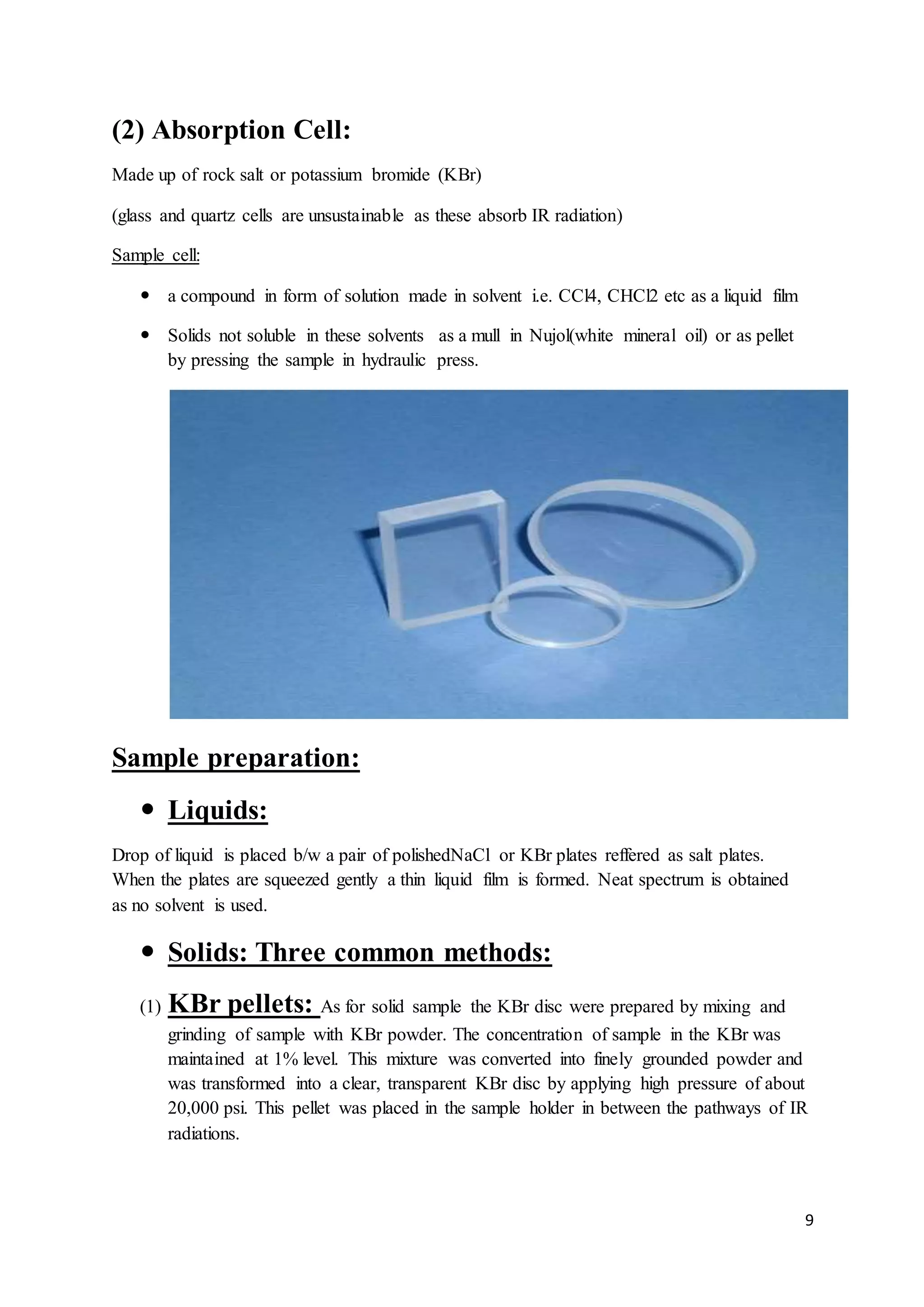
(2) Absorption Cell:
Made up of rock salt or potassium bromide (KBr)
(glass and quartz cells are unsustainable as these absorb IR radiation)
Sample cell:
 a compound in form of solution made in solvent i.e. CCl4, CHCl2 etc as a liquid film
 Solids not soluble in these solvents as a mull in Nujol(white mineral oil) or as pellet
by pressing the sample in hydraulic press.
Sample preparation:
 Liquids:
Drop of liquid is placed b/w a pair of polishedNaCl or KBr plates reffered as salt plates.
When the plates are squeezed gently a thin liquid film is formed. Neat spectrum is obtained
as no solvent is used.
 Solids: Three common methods:
(1) KBr pellets: As for solid sample the KBr disc were prepared by mixing and
grinding of sample with KBr powder. The concentration of sample in the KBr was
maintained at 1% level. This mixture was converted into finely grounded powder and
was transformed into a clear, transparent KBr disc by applying high pressure of about
20,000 psi. This pellet was placed in the sample holder in between the pathways of IR
radiations.
10
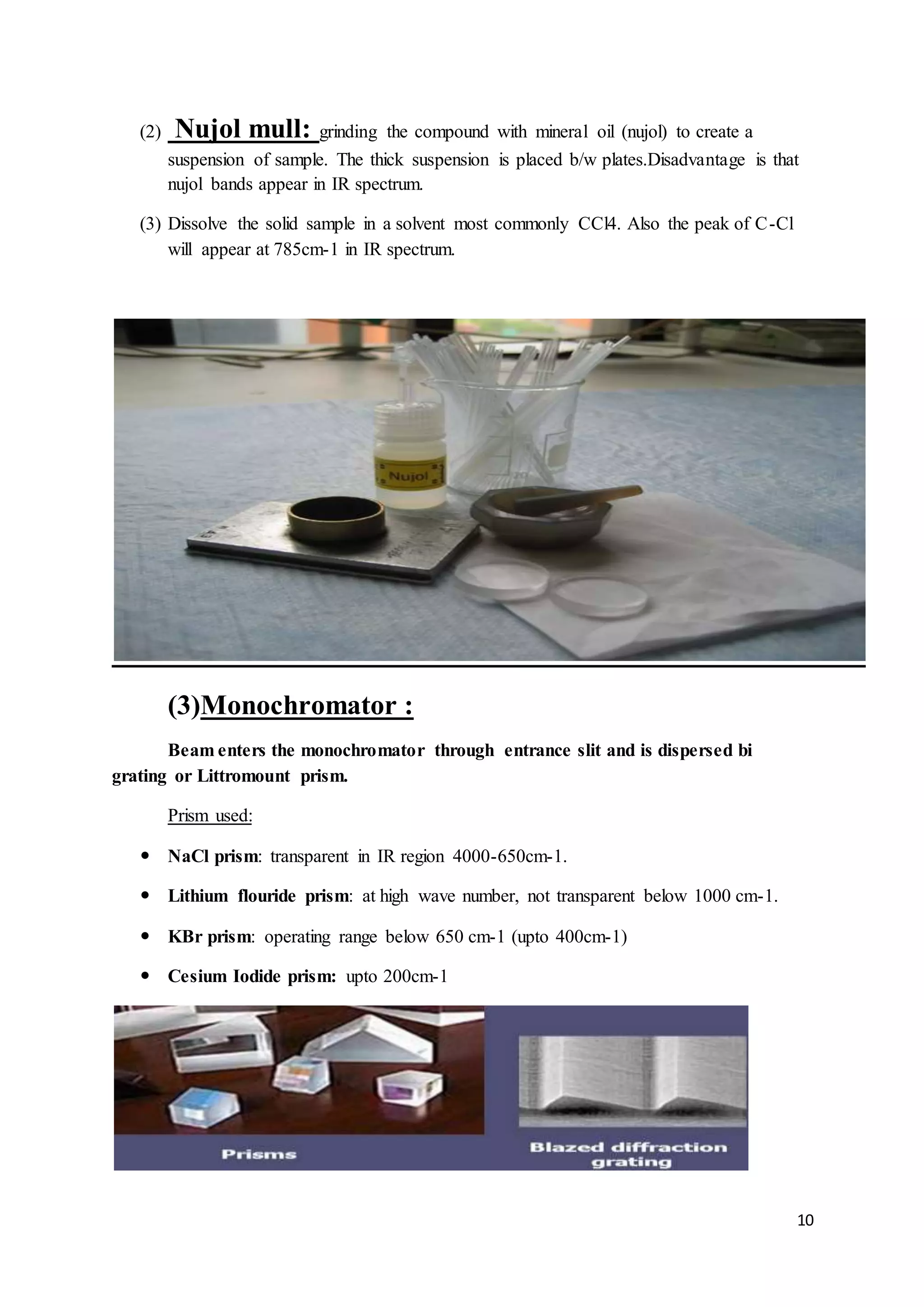
(2) Nujol mull: grinding the compound with mineral oil (nujol) to create a
suspension of sample. The thick suspension is placed b/w plates.Disadvantage is that
nujol bands appear in IR spectrum.
(3) Dissolve the solid sample in a solvent most commonly CCl4. Also the peak of C-Cl
will appear at 785cm-1 in IR spectrum.
(3)Monochromator :
Beam enters the monochromator through entrance slit and is dispersed bi
grating or Littromount prism.
Prism used:
 NaCl prism: transparent in IR region 4000-650cm-1.
 Lithium flouride prism: at high wave number, not transparent below 1000 cm-1.
 KBr prism: operating range below 650 cm-1 (upto 400cm-1)
 Cesium Iodide prism: upto 200cm-1
11
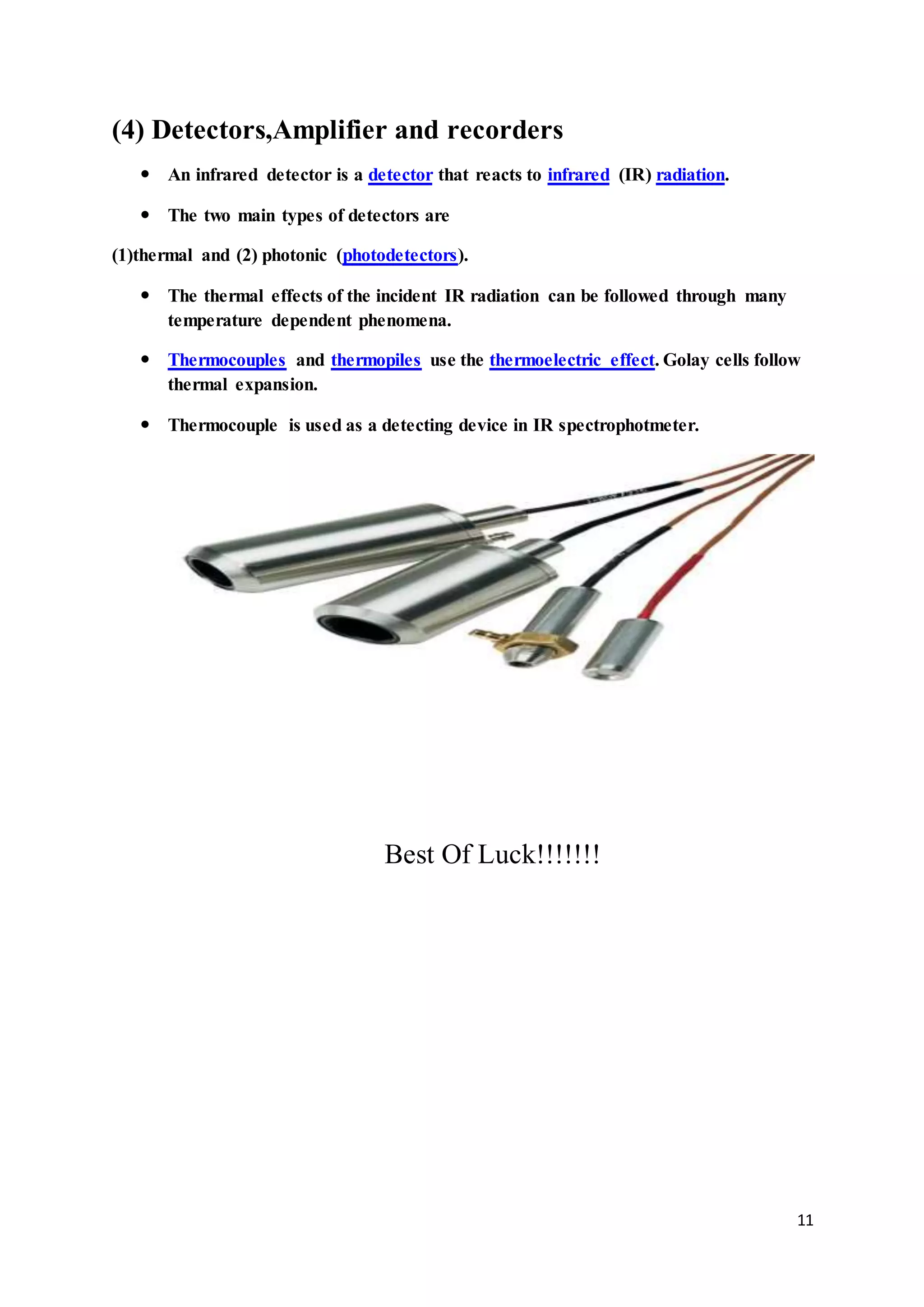
(4) Detectors,Amplifier and recorders
 An infrared detector is a detector that reacts to infrared (IR) radiation.
 The two main types of detectors are
(1)thermal and (2) photonic (photodetectors).
 The thermal effects of the incident IR radiation can be followed through many
temperature dependent phenomena.
 Thermocouples and thermopiles use the thermoelectric effect. Golay cells follow
thermal expansion.
 Thermocouple is used as a detecting device in IR spectrophotmeter.
Best Of Luck!!!!!!!

Introduction to ir spectroscopy

  • 1.
    1 Introduction to I.Rspectroscopy:
  • 2.
    2 Infrared Spectrum:  Represents: Energyabsorption pattern in the infrared region and obtained by plotting absorbance or %transmittance of IR radiation as a function of wavelength or wavenumber.  Division: Overtones of fundamental pure rotational and combination region band Vibrational plus rotational transition Absorption bands due to a number characteristic of the compound of functional groups  Region of 1400-900cm-1 is complex and contains fundamental str and bending plus sum or difference of their vibrational freq.  Units: Radiation in the infrared region is expressed with the unit “Wavenumber” rather than “Wavelength (μ or μm)”. Wavenumer are expressed in cm-1.  Reason: The wavelength unit is directly proportional to energy. The higher the wavenumber the shorter the wavelength and higher the energy  Conversions: cm-1 = 1/μm x 10,000 and μm= 1/ cm-1 x 10,000
  • 3.
    3 • IR radiationdonot causes electronic transitions! A molecule contains electronic, vibrational and rotational energy levels. The energy difference between electronic energy levels is large as compared to vibrational and rotational energy levels. Changes in electronic energy large quanta, changes in vibrational level small quanta changes in rotational energy level even smaller quanta. Due to relatively small amount of energy in IR region these radiation are incapable of electronic transition but induce transitions b/w vibrational and rotational energy levels. • Radiation in this range focuses on Streching and bending vibrations of molecules. • For absorption of IR radiation, Those freq that matches the natural vibration freq of molecule and the energy that is absorbed increases the amplitude of vibrational motion of bonds. • Bonds absorbing radiation: Only bonds having change in dipole moment as a function of time. Symmetric bonds i.e. H2 and Cl2 Asymetric bonds i.e. H-Cl Molecular Vibrations: Vibration: Any change in shape of the molecule- stretching of bonds, bending of bonds, orinternal rotation around single Bonds. MolecularVibrations: A molecule may be regarded as a system of balls and springs.
  • 4.
    4 Infrared active modesof vibrational motion in a molecule: 1. Strecthing Vibrations 2. Bending Vibration Distance b/w two atoms increases Distance b/w the atoms remains or decreases but atom remain in constantbut the atom bond axis same bond axis . changes. (a) Symmetric strecthing: (a) In-plane bending Both the atoms move in and out Scissoring: atoms swing in center like scissors (b) Asymmetric str: Rocking: One atom move in while other move atoms swing to the same side out. (b) Out-of-plane bending Wagging:swing up and down of plane Twisting: one atom swing up and other down SEE THE DIAGRAMS OF ATOM VIBRATIONS ON THE GIVEN PAGES OF I.R SPECTROSCOPY  Fundamental vibration/absorption: The excitation from ground state to the lowest energy excited state i.e. Vo to V1 is due to fundamental absorption.
  • 5.
    5 Overtones: Excitation from groundstate to the higher energy excited state, which correspond to integral multiple of fundamental vibration for example “v is freq of fundamental vibration then its overtone will occurat 2or 3 wavenumber”. Overtone is the multiple of a given fundamental frequency. For example: The transition from vo-v2 and vo-v3 are the first and second overtone of fundamental Number of fundamental vibration: Total number of fundamental vibration depends on the number of atoms in diatomic or triatomic molecules. Two types (1) linear (2) nonlinear 3n-5 modes 3n-6 modes of fundamental vibration Bandsin IR spectrum  Combination Band: When two vibrational frequency (v1 and v2 ) couple in a molecule couple to give rise to the vibration of a new frequency which is the sum two interacting bands (vcomb= v1+v2). When vibration are IR active it is called as combination band.  Difference Bands: Similar to combination band. The observed freq in this case results from the difference b/w the two interacting bands. (vdiff=v1-v2)  Fermi resonance: When a fundamental vibration couples with an overtone or combination band, the coupled vibration is called Fermi resonance.
  • 6.
    6 BBoonndd pprrooppeerrttiieess  Howthe bond strength and masses ofbonded atoms affectthe IR absorption frequency! Hooke’s Law Diatomic molecules are considered as two vibrating springs attached by a spring. Thus the molecule is considered as an harmonic oscillator. The approximate value of stretching vibrational frequency of a bond can be calculated using HOOKE’s Law by considering the two balls connected by a spring acting as a simple harmonic oscillation. μ is the masses ofatoms in Grams whereas in a.m.u the masses will change into M1M2/(M1+M2)(6.02 x1023 ). Thus the frequency will become v= 4.12√k/μ ?
  • 7.
    7 The Infrared Spectrometer: Instrumentthat determines the absorption spectrum for a compound is called infrared spectrometer or spectrophotometer. Types (A)Dispersive IR (b) Fourier Transform IR
  • 8.
    8 (1)Radiation source: A smallceramic rod heated electrically at 1100-1800C made up 1. tungsten filament A high resistance element composed of mixture of oxides of zirconium, thorium, and cerium held together by binding material) 2. silicon carbide(glowbar)
  • 9.
    9 (2) Absorption Cell: Madeup of rock salt or potassium bromide (KBr) (glass and quartz cells are unsustainable as these absorb IR radiation) Sample cell:  a compound in form of solution made in solvent i.e. CCl4, CHCl2 etc as a liquid film  Solids not soluble in these solvents as a mull in Nujol(white mineral oil) or as pellet by pressing the sample in hydraulic press. Sample preparation:  Liquids: Drop of liquid is placed b/w a pair of polishedNaCl or KBr plates reffered as salt plates. When the plates are squeezed gently a thin liquid film is formed. Neat spectrum is obtained as no solvent is used.  Solids: Three common methods: (1) KBr pellets: As for solid sample the KBr disc were prepared by mixing and grinding of sample with KBr powder. The concentration of sample in the KBr was maintained at 1% level. This mixture was converted into finely grounded powder and was transformed into a clear, transparent KBr disc by applying high pressure of about 20,000 psi. This pellet was placed in the sample holder in between the pathways of IR radiations.
  • 10.
    10 (2) Nujol mull:grinding the compound with mineral oil (nujol) to create a suspension of sample. The thick suspension is placed b/w plates.Disadvantage is that nujol bands appear in IR spectrum. (3) Dissolve the solid sample in a solvent most commonly CCl4. Also the peak of C-Cl will appear at 785cm-1 in IR spectrum. (3)Monochromator : Beam enters the monochromator through entrance slit and is dispersed bi grating or Littromount prism. Prism used:  NaCl prism: transparent in IR region 4000-650cm-1.  Lithium flouride prism: at high wave number, not transparent below 1000 cm-1.  KBr prism: operating range below 650 cm-1 (upto 400cm-1)  Cesium Iodide prism: upto 200cm-1
  • 11.
    11 (4) Detectors,Amplifier andrecorders  An infrared detector is a detector that reacts to infrared (IR) radiation.  The two main types of detectors are (1)thermal and (2) photonic (photodetectors).  The thermal effects of the incident IR radiation can be followed through many temperature dependent phenomena.  Thermocouples and thermopiles use the thermoelectric effect. Golay cells follow thermal expansion.  Thermocouple is used as a detecting device in IR spectrophotmeter. Best Of Luck!!!!!!!