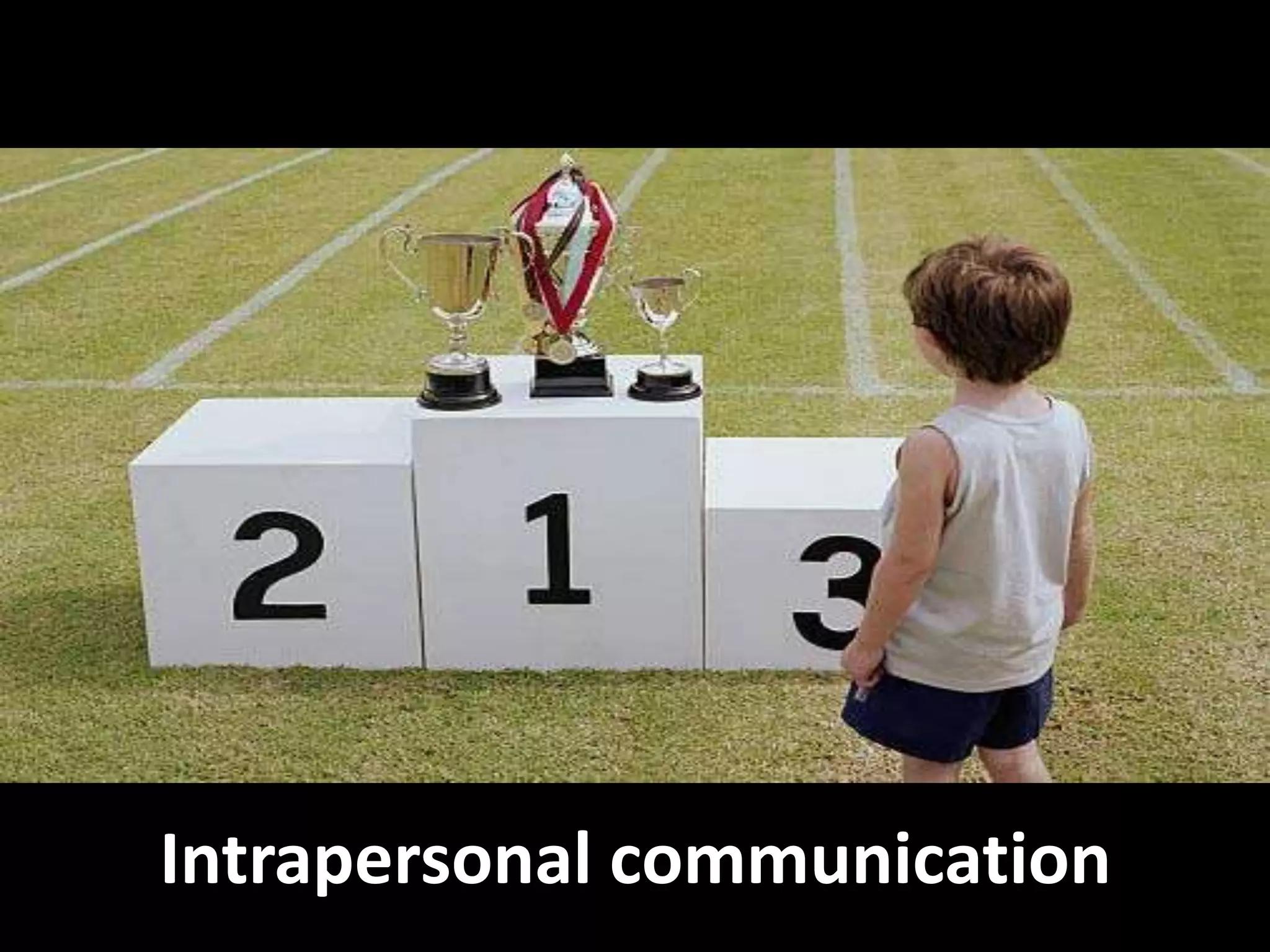
Intrapersonal Communication


   www.humanikaconsulting.com
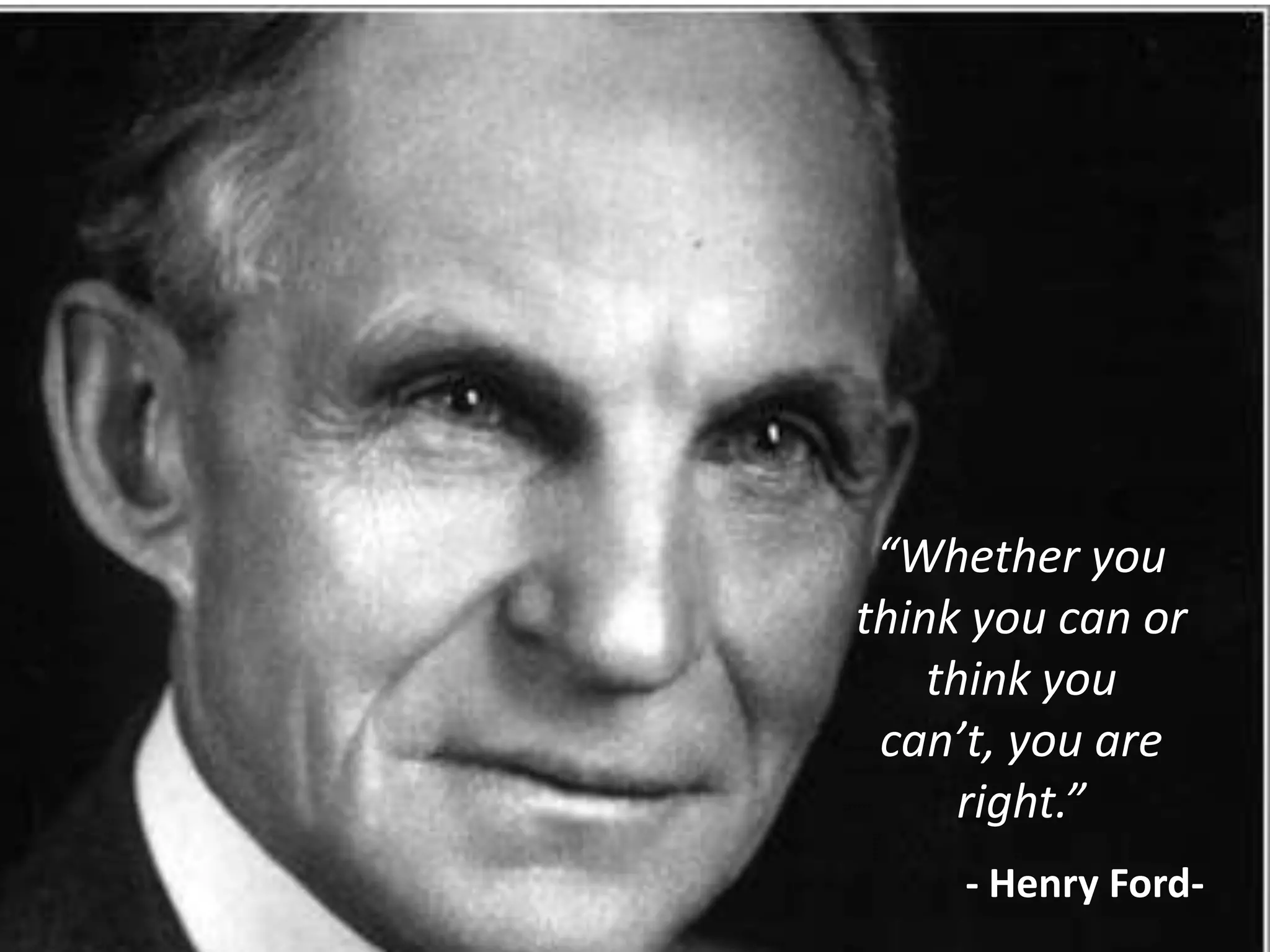
“Whether you
think you can or
    think you
 can’t, you are
      right.”
     - Henry Ford-
Analyze yourself as a communicator

             •   Intrapersonal communication
             •   Perceptions
             •   Self concepts
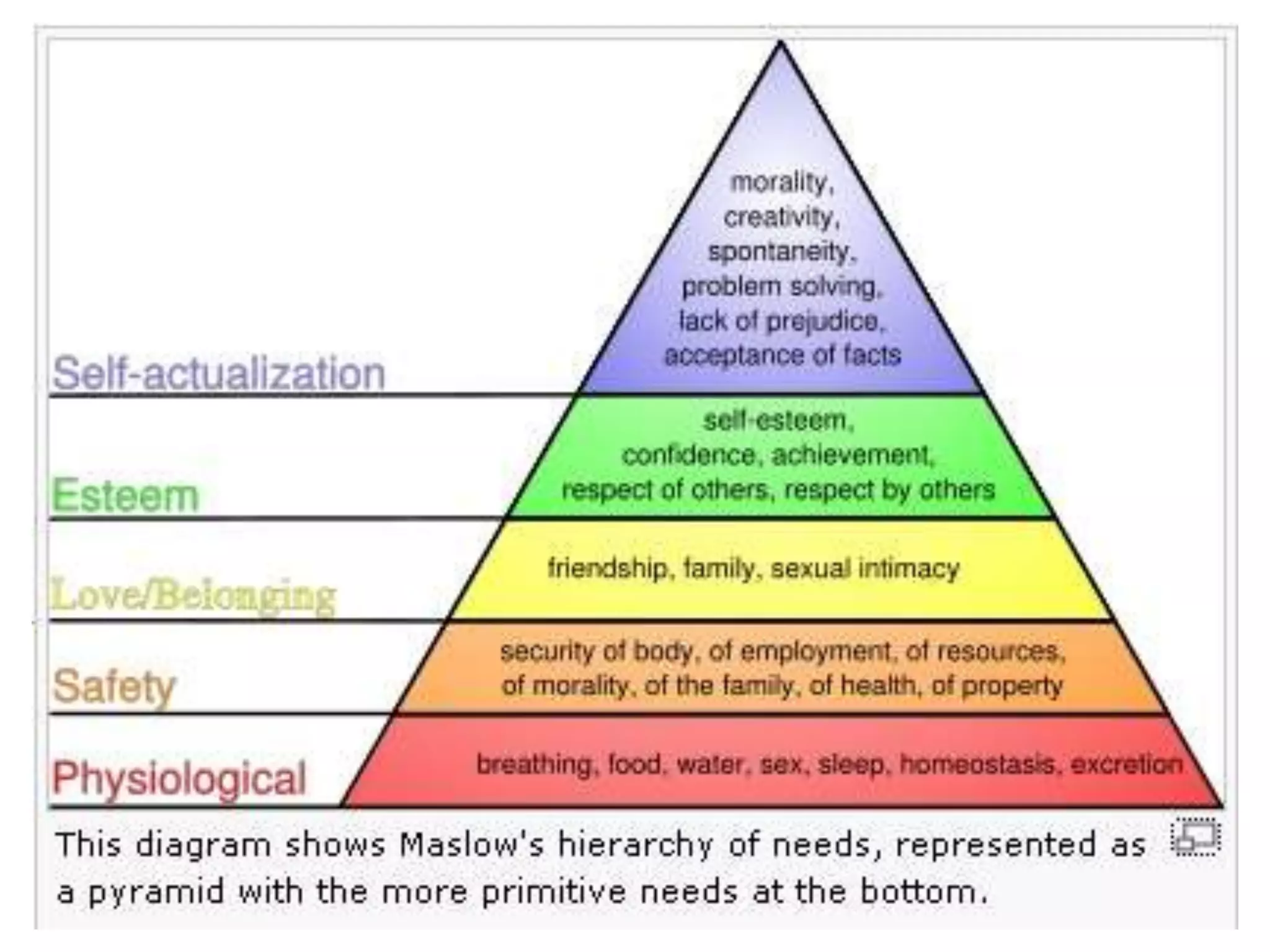
             •   Needs
             •   Communication with others
OBJECTIVES

• Reflect upon the values or
  significance of self-introspection;
• Establish the connection
  between self-concept and
  intrapersonal communication;
  and
• Arrive at a keener understanding
  of one’s self-communication
  prior to acquiring interpersonal
  communication skills
Intrapersonal communication
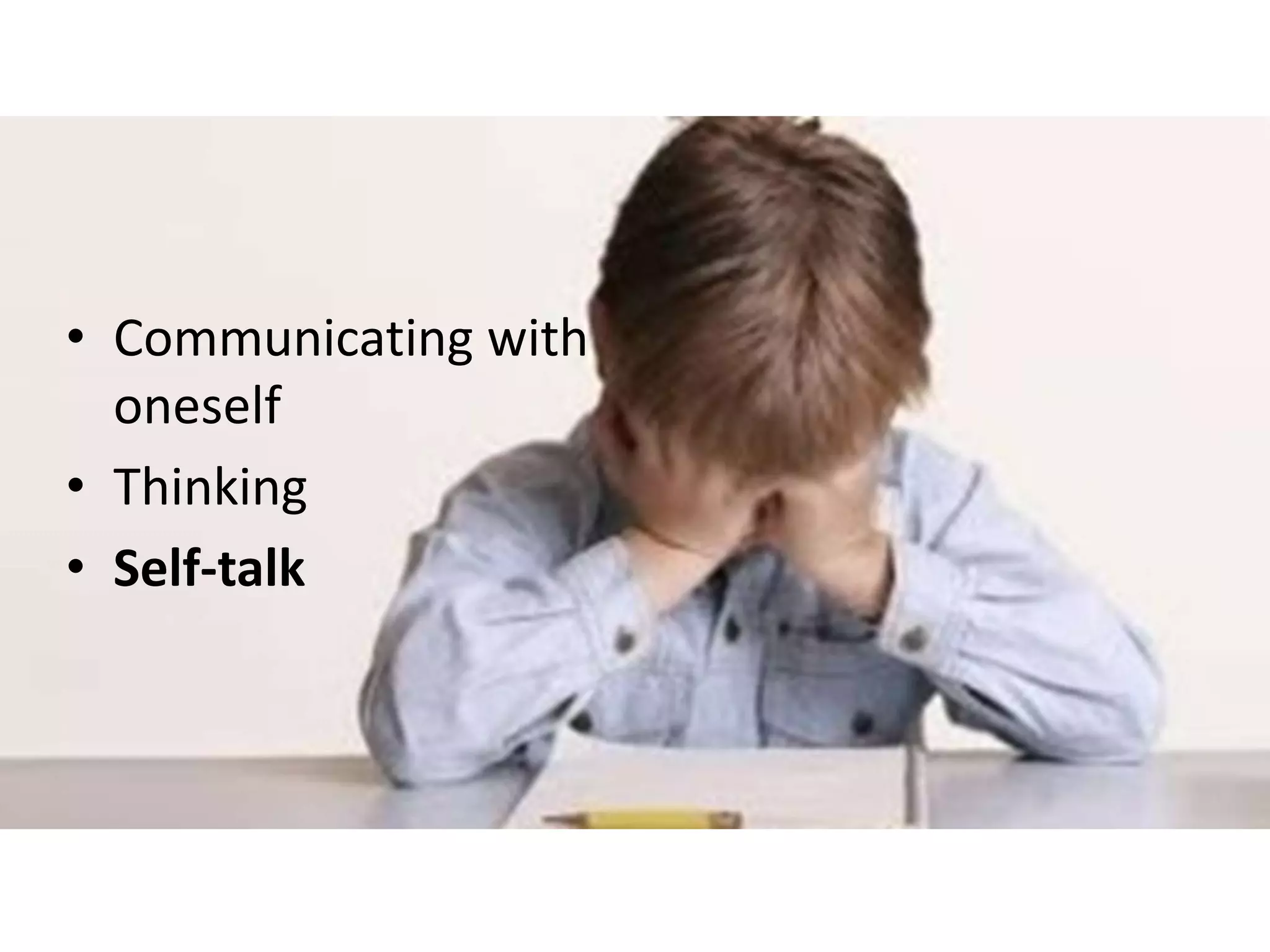
• Communicating with
  oneself
• Thinking
• Self-talk
• In one word describe
  yourself.
• In three words describe
  yourself.
• In ten words describe
  yourself.
• Was one word hard?
  Yes, because we’re
  complex people.
1. “How do I see myself?”
2. “Do I like or not what I see?”
3. “How do I wish to see myself?” “How do I
   present myself to others?”
4. “Who do others say I am?” “What do I imagine
   others say about me?”
5. “How does this affect me?”
Intrapersonal Definition

  Intrapersonal person is a highly
  developed self-
  knowledge, involving accurate
  knowledge or
  goals, strength, limitations, mo
  ods, anxieties desires and
  motivations.
 This takes place within the
  individual.
 Sender = Our relevant organ.
 Receiver = Our brain.
 Feed back by brain.
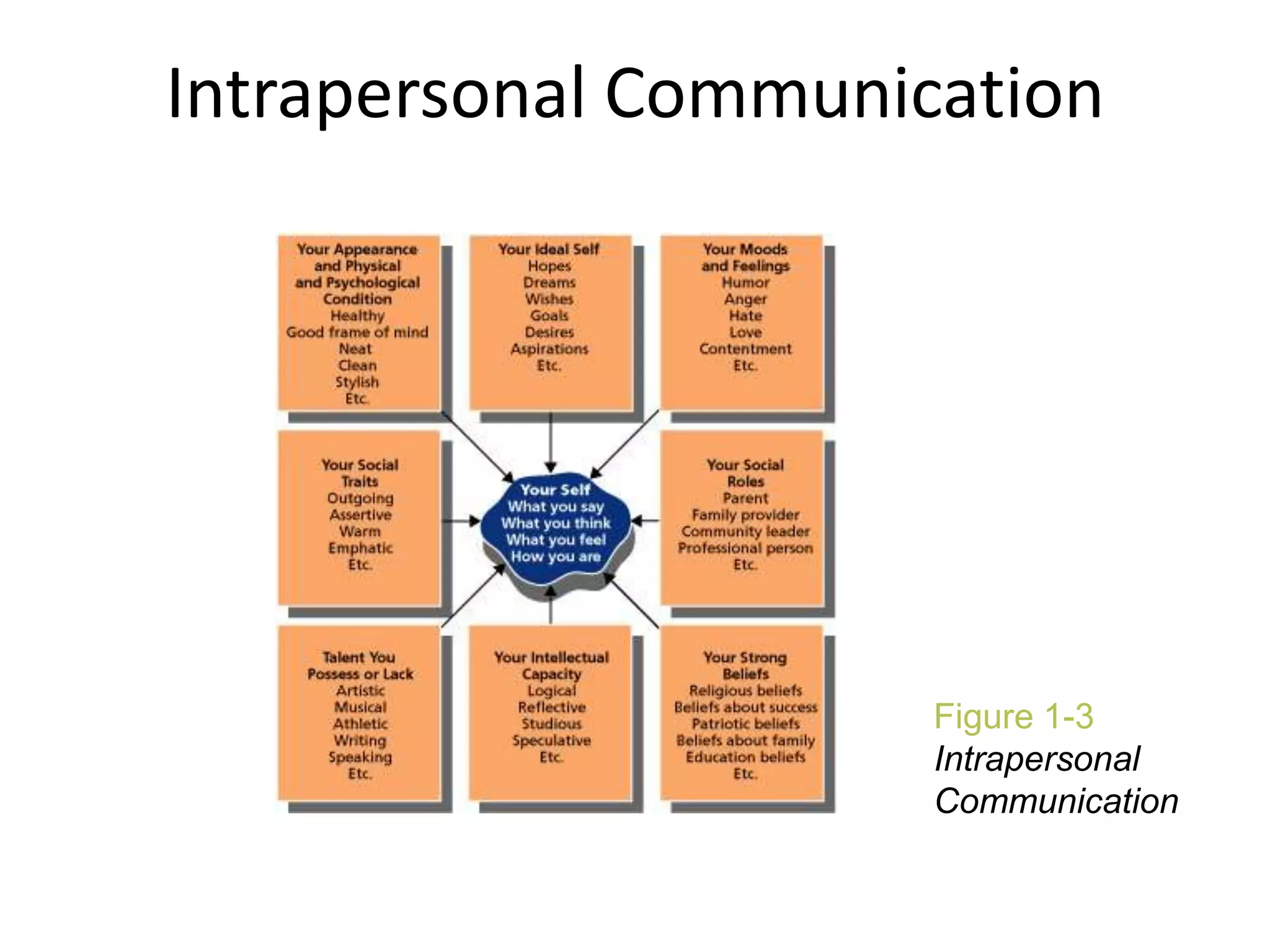
Intrapersonal Communication


                      Figure 1-3
                      Intrapersonal
                      Communication
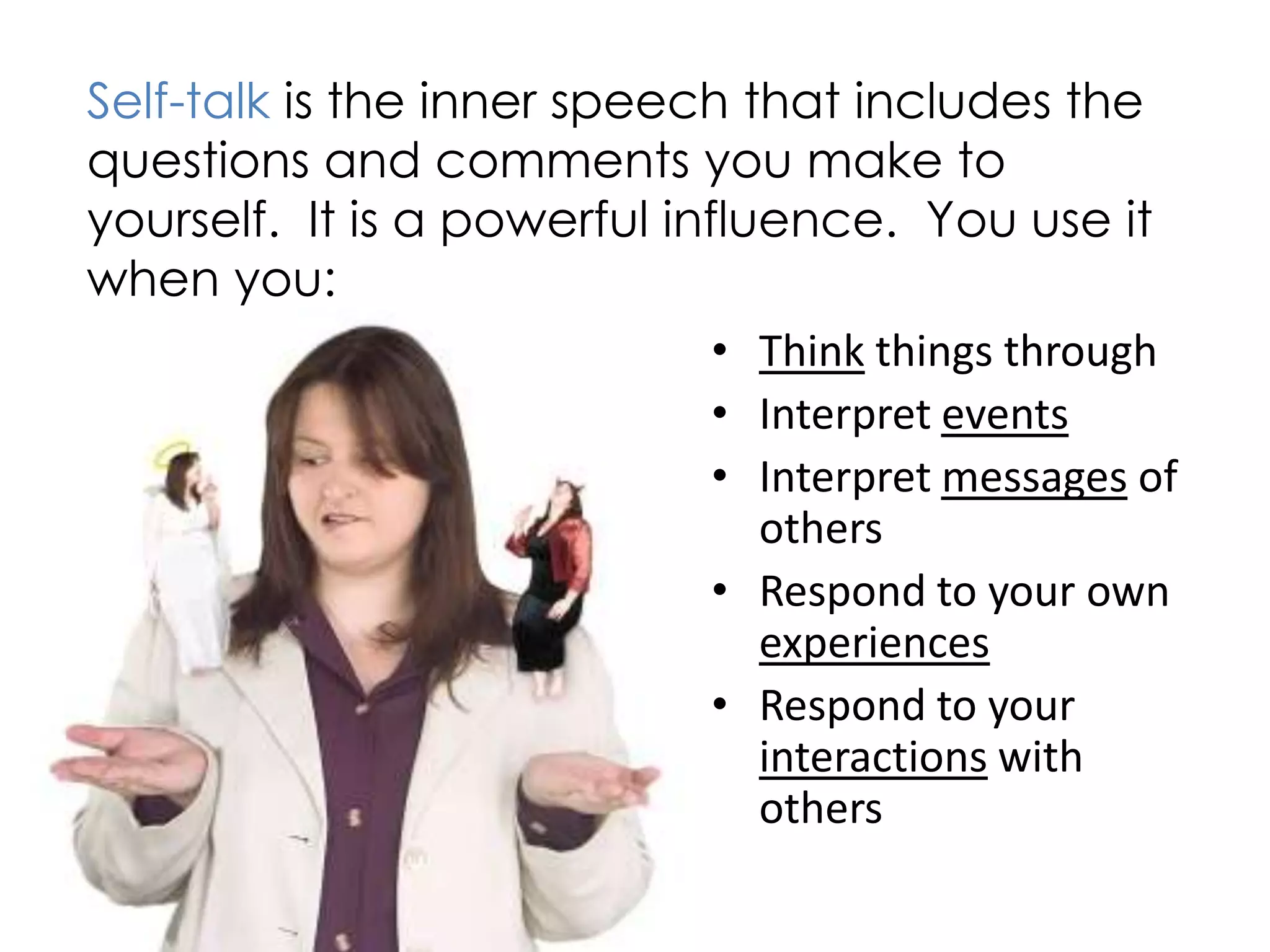
Self-talk is the inner speech that includes the
questions and comments you make to
yourself. It is a powerful influence. You use it
when you:
                              • Think things through
                              • Interpret events
                              • Interpret messages of
                                others
                              • Respond to your own
                                experiences
                              • Respond to your
                                interactions with
                                others
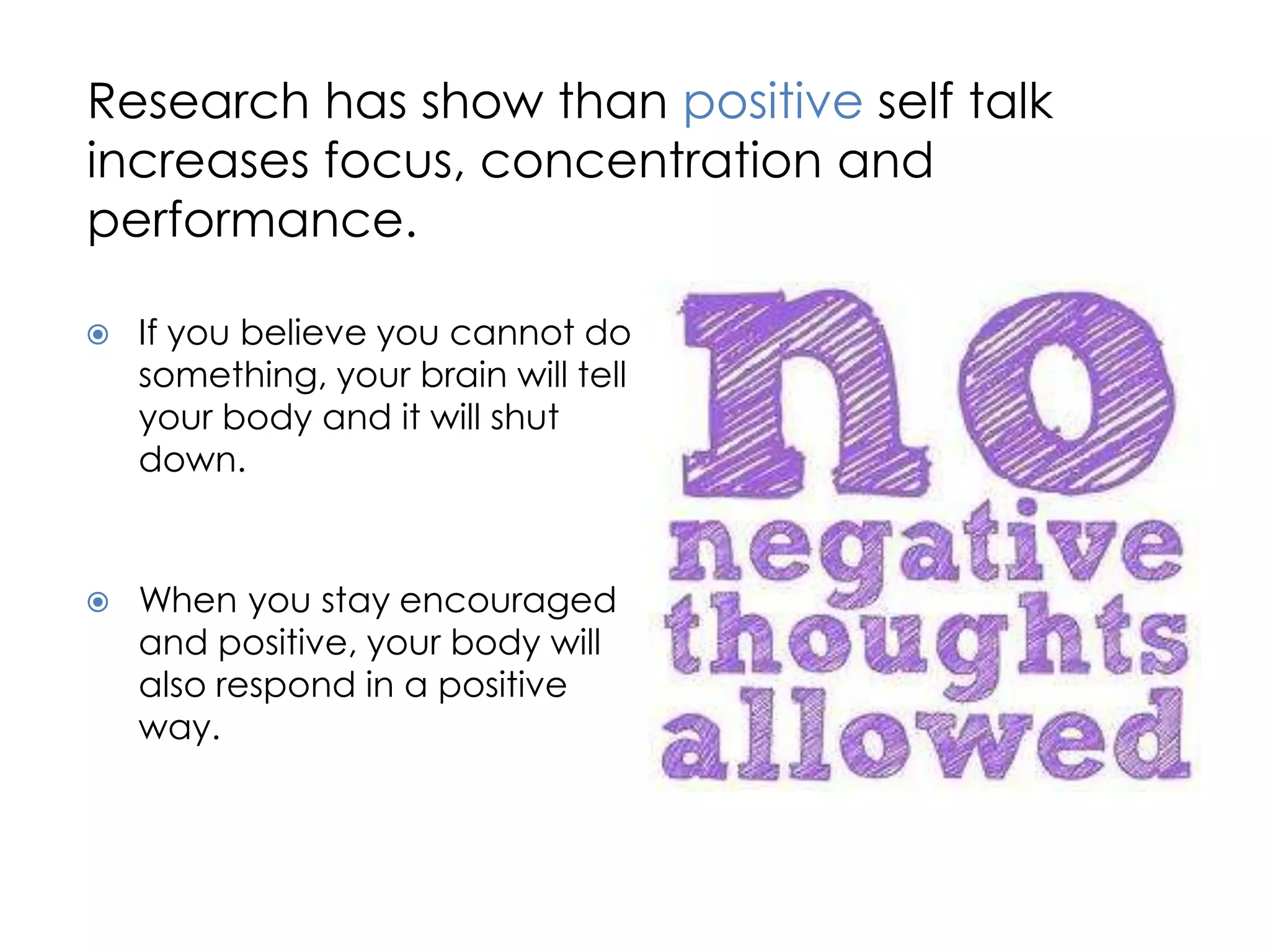
Research has show than positive self talk
increases focus, concentration and
performance.

   If you believe you cannot do
    something, your brain will tell
    your body and it will shut
    down.


   When you stay encouraged
    and positive, your body will
    also respond in a positive
    way.
“In order to successfully
communicate with others you must
first learn to communicate with
yourself. Intrapersonal
communication is the most basic
level of communication. You must
understand who you are and what
you think of yourself.”
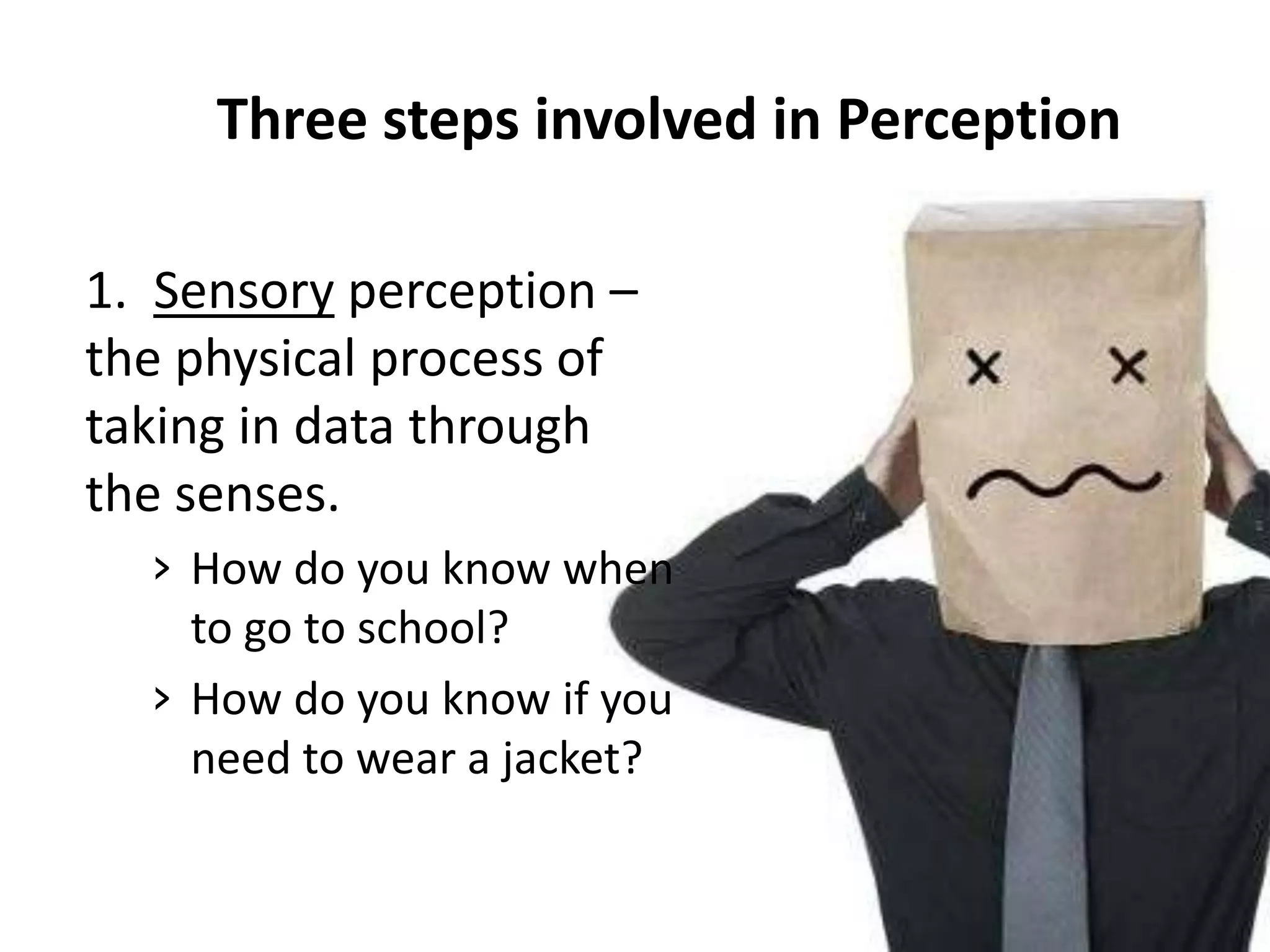
Three steps involved in Perception

1. Sensory perception –
the physical process of
taking in data through
the senses.
  › How do you know when
    to go to school?
  › How do you know if you
    need to wear a jacket?
Three steps involved in
       Perception
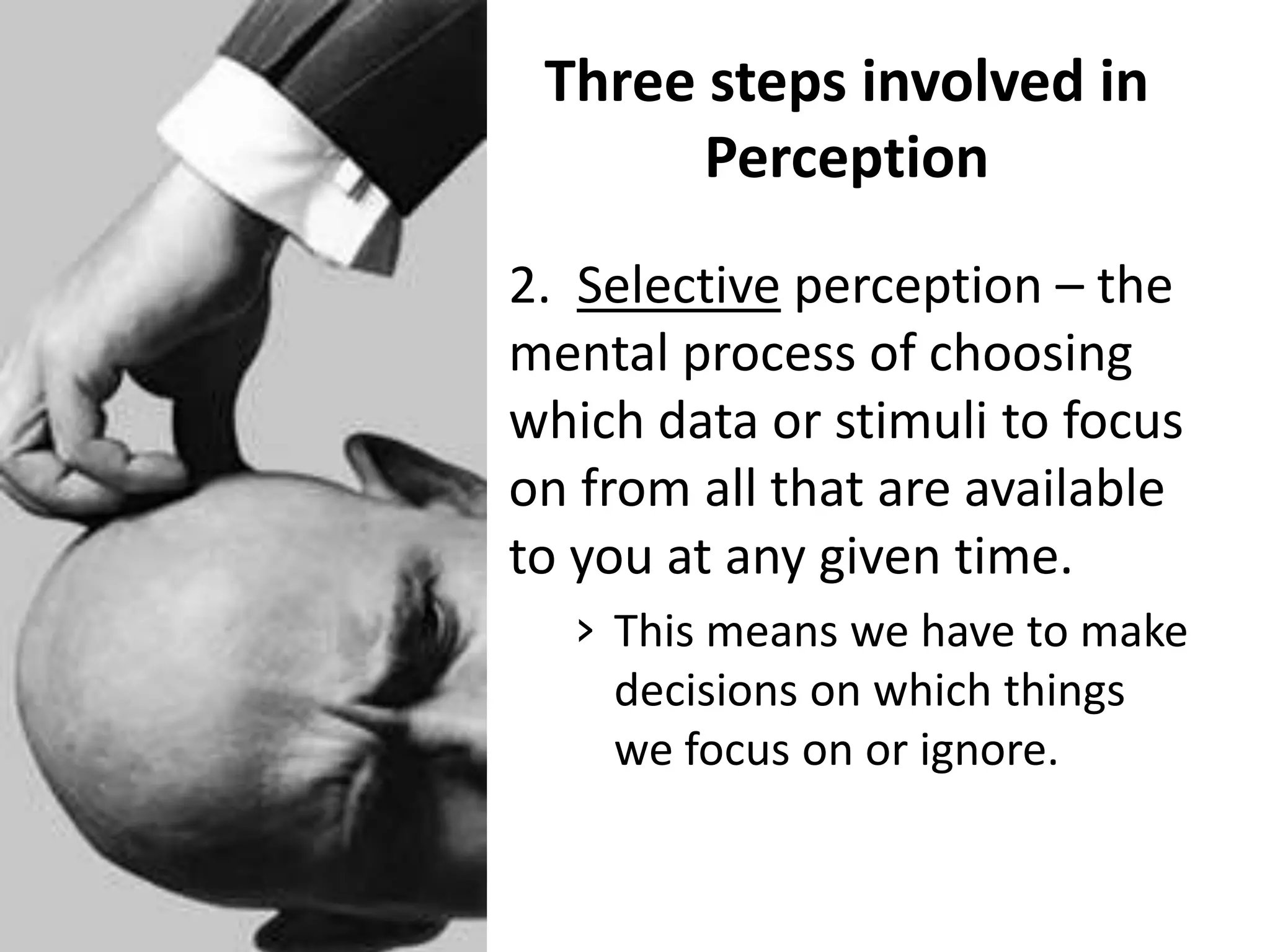
2. Selective perception – the
mental process of choosing
which data or stimuli to focus
on from all that are available
to you at any given time.
  › This means we have to make
    decisions on which things
    we focus on or ignore.
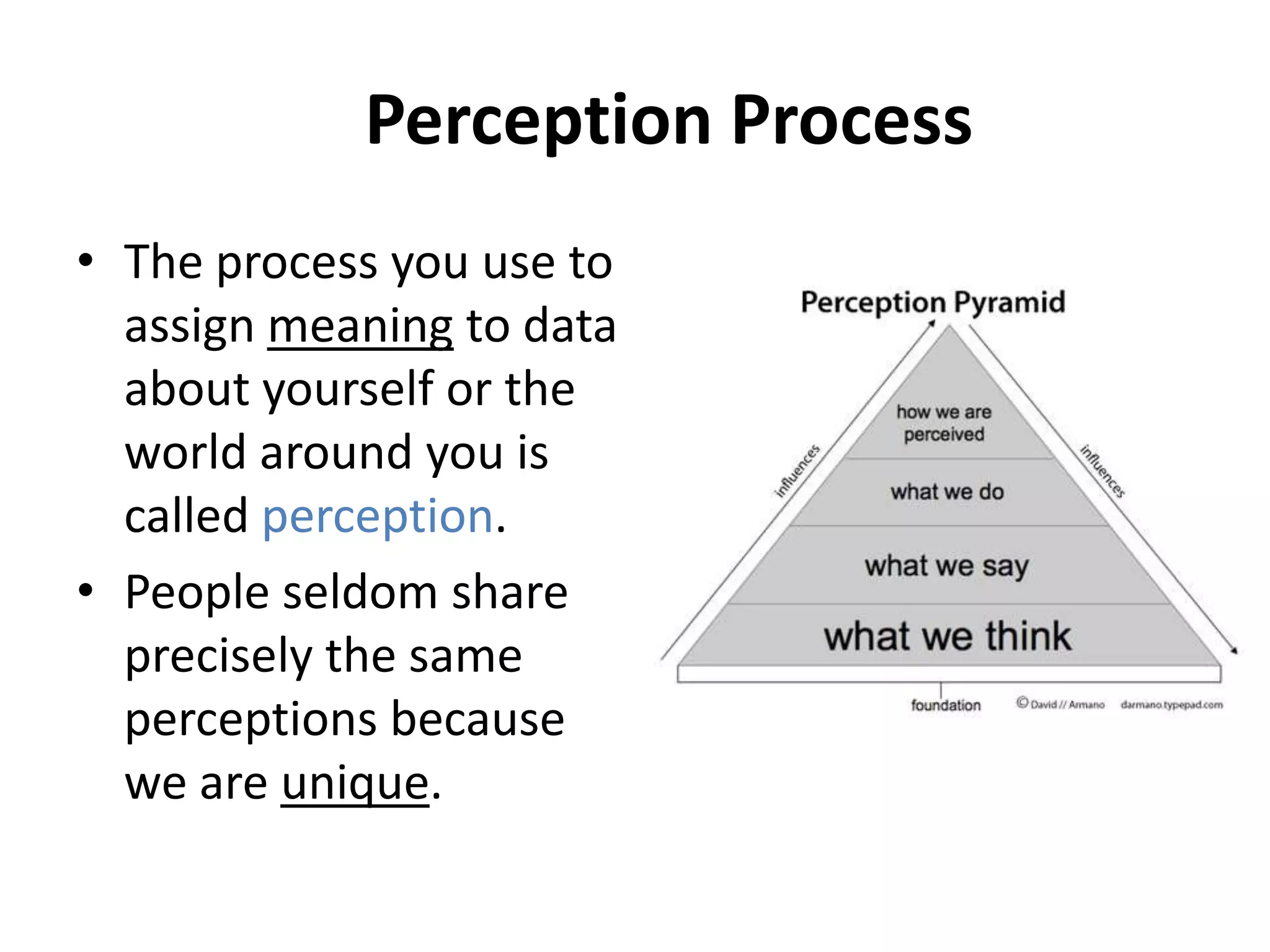
Perception Process
• The process you use to
  assign meaning to data
  about yourself or the
  world around you is
  called perception.
• People seldom share
  precisely the same
  perceptions because
  we are unique.
The following can influence you perception
                       choices:

 Intensity – the more intense or dramatic the
  stimulus, the more likely we are to notice it.
   › Example: someone screaming all of a sudden
 Repetition – the more we are bombarded with
  messages – the more it sinks in and we believe it.
   › Advertising messages
 Uniqueness – things that are
  new, unusual, unexpected & unique are often
  noticed.
 Relevance – noticing things that mirror our own
  interests, needs & motiviations.
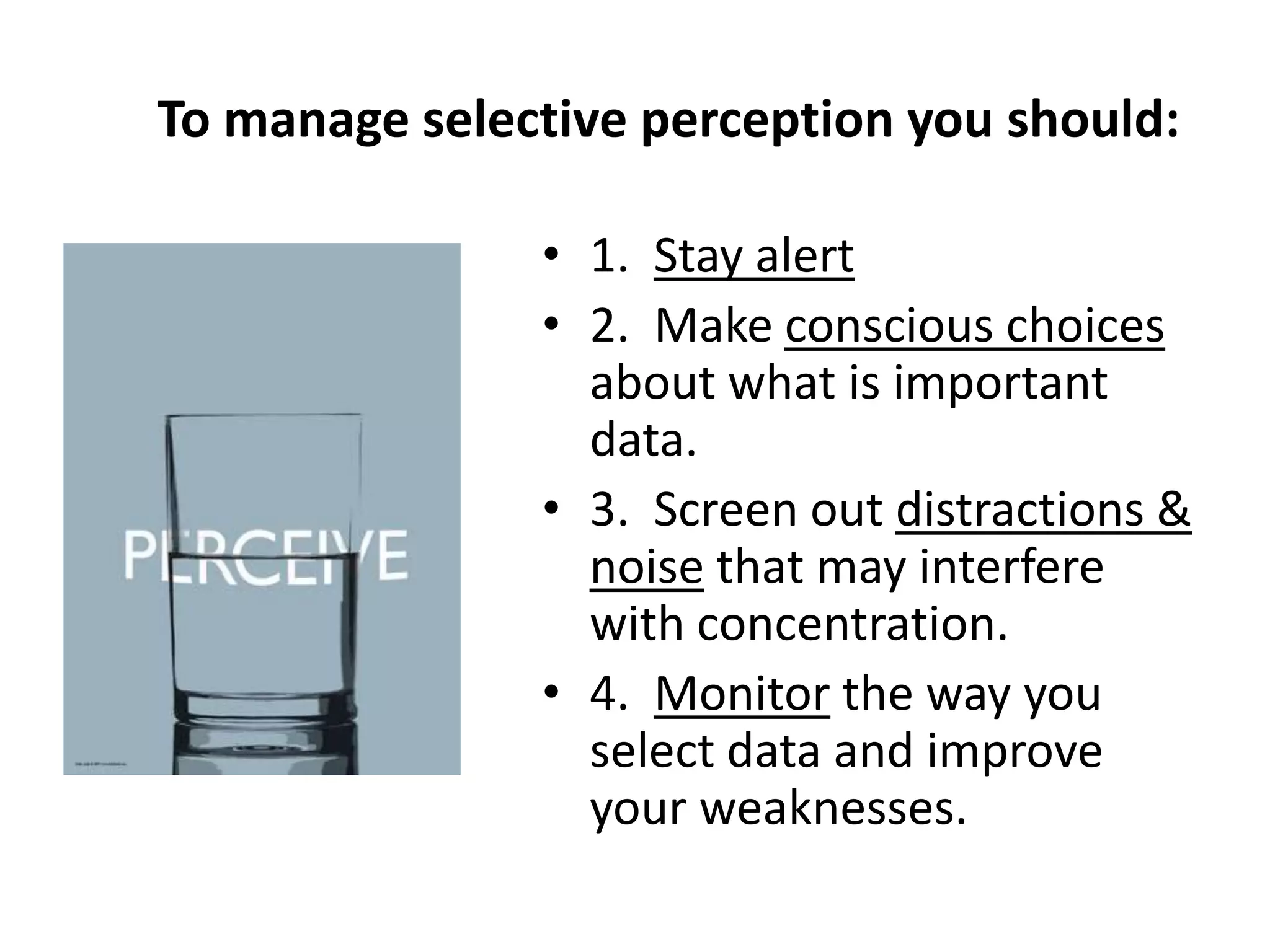
To manage selective perception you should:

               • 1. Stay alert
               • 2. Make conscious choices
                 about what is important
                 data.
               • 3. Screen out distractions &
                 noise that may interfere
                 with concentration.
               • 4. Monitor the way you
                 select data and improve
                 your weaknesses.
Third step in perception process

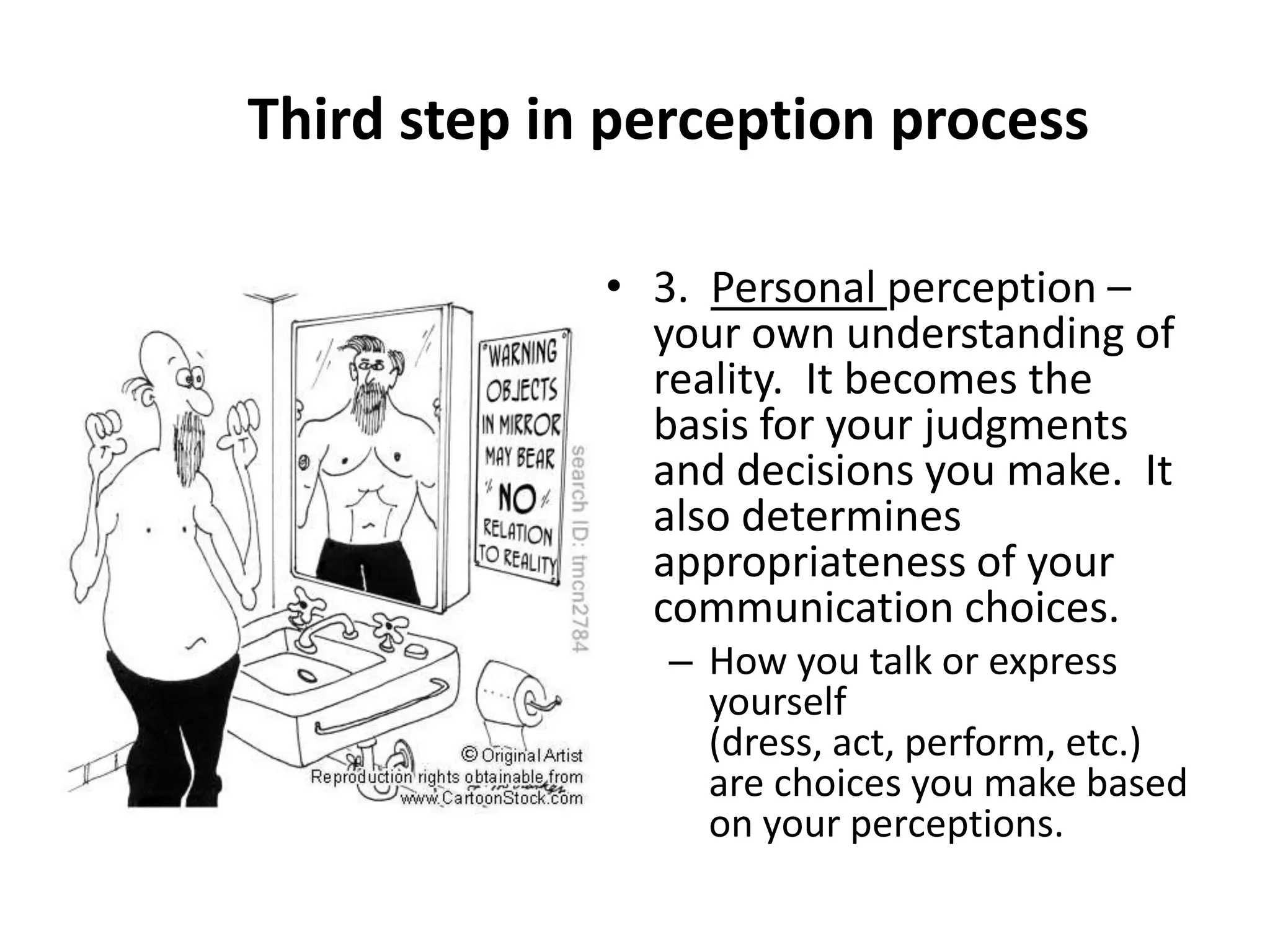
             • 3. Personal perception –
               your own understanding of
               reality. It becomes the
               basis for your judgments
               and decisions you make. It
               also determines
               appropriateness of your
               communication choices.
                – How you talk or express
                  yourself
                  (dress, act, perform, etc.)
                  are choices you make based
                  on your perceptions.
Factors that influence personal perception
• Values – reflect your priorities and what you think is important.
• Beliefs – what one believes to be true that often helps you decide what to
  accept or reject
• Culture – family, community, or organizations to which you belong
• Bias – consistent attitude, viewpoint or pattern of perception.
• Prejudice – preconceived judgment (to pre-judge on opinion rather than facts)
• Attitudes – powerful influences that can be positive or negative.
• Expectations – basing a judgment on what is expected rather than what
  actually happened.
• Knowledge – what you know influences how your organize & interpret
  information.
• Communication skills – if you are lacking in part of the communication
  process, you may have difficulty in understanding and being understood.
Analyzing Perceptions
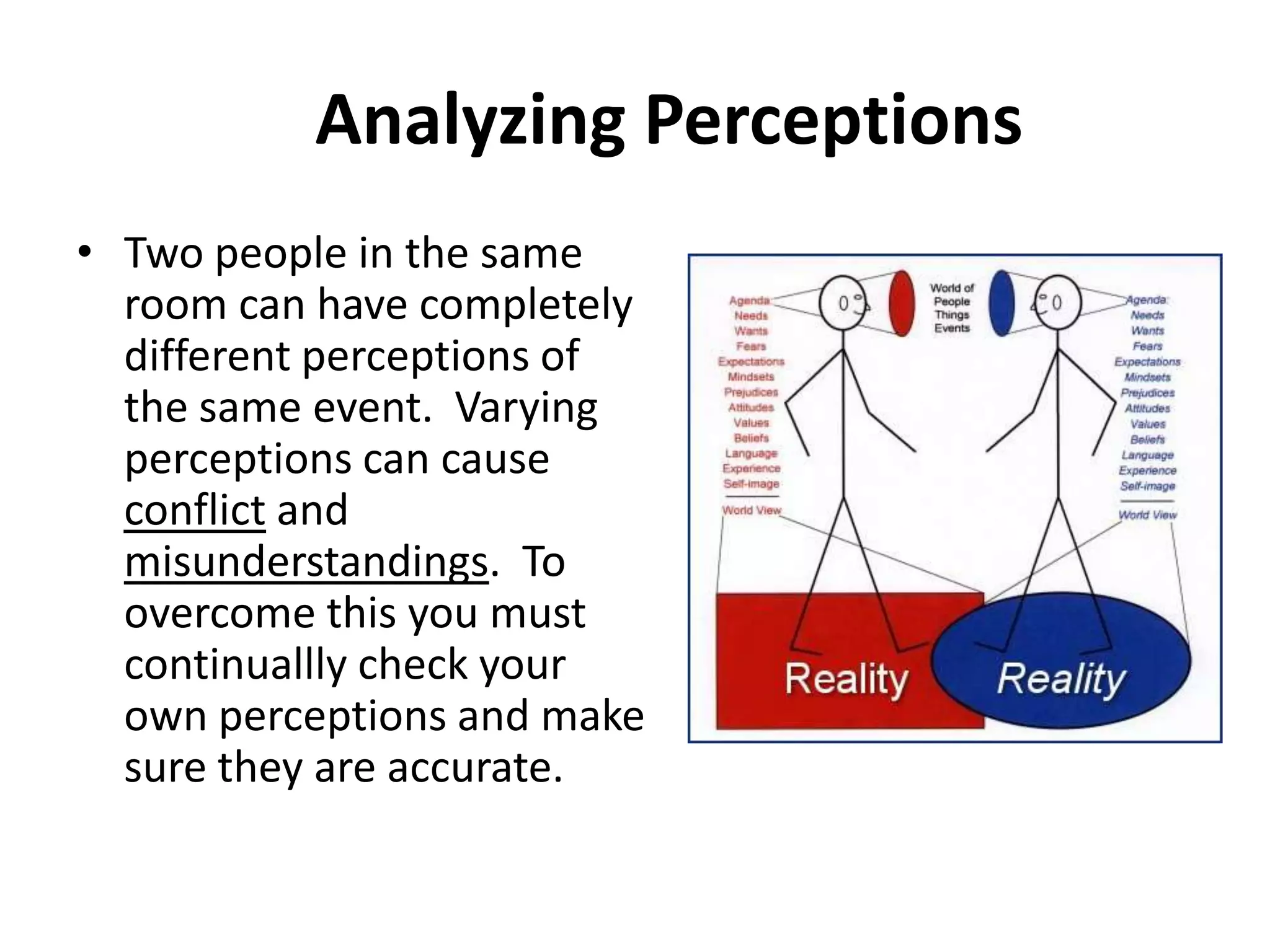
• Two people in the same
  room can have completely
  different perceptions of
  the same event. Varying
  perceptions can cause
  conflict and
  misunderstandings. To
  overcome this you must
  continuallly check your
  own perceptions and make
  sure they are accurate.
   Key – Never assume that what you perceive as the
    truth is the actual, absolute truth.
   Intrapersonal perception check:
      Question your sensory perception
      Question your selective perception
      Question you personal perception
   Interpersonal perception check:
      Clarify your perception of others messages.
      Analyze others’ points of view
      Take responsibility for your own communication.
SELF-CONCEPT
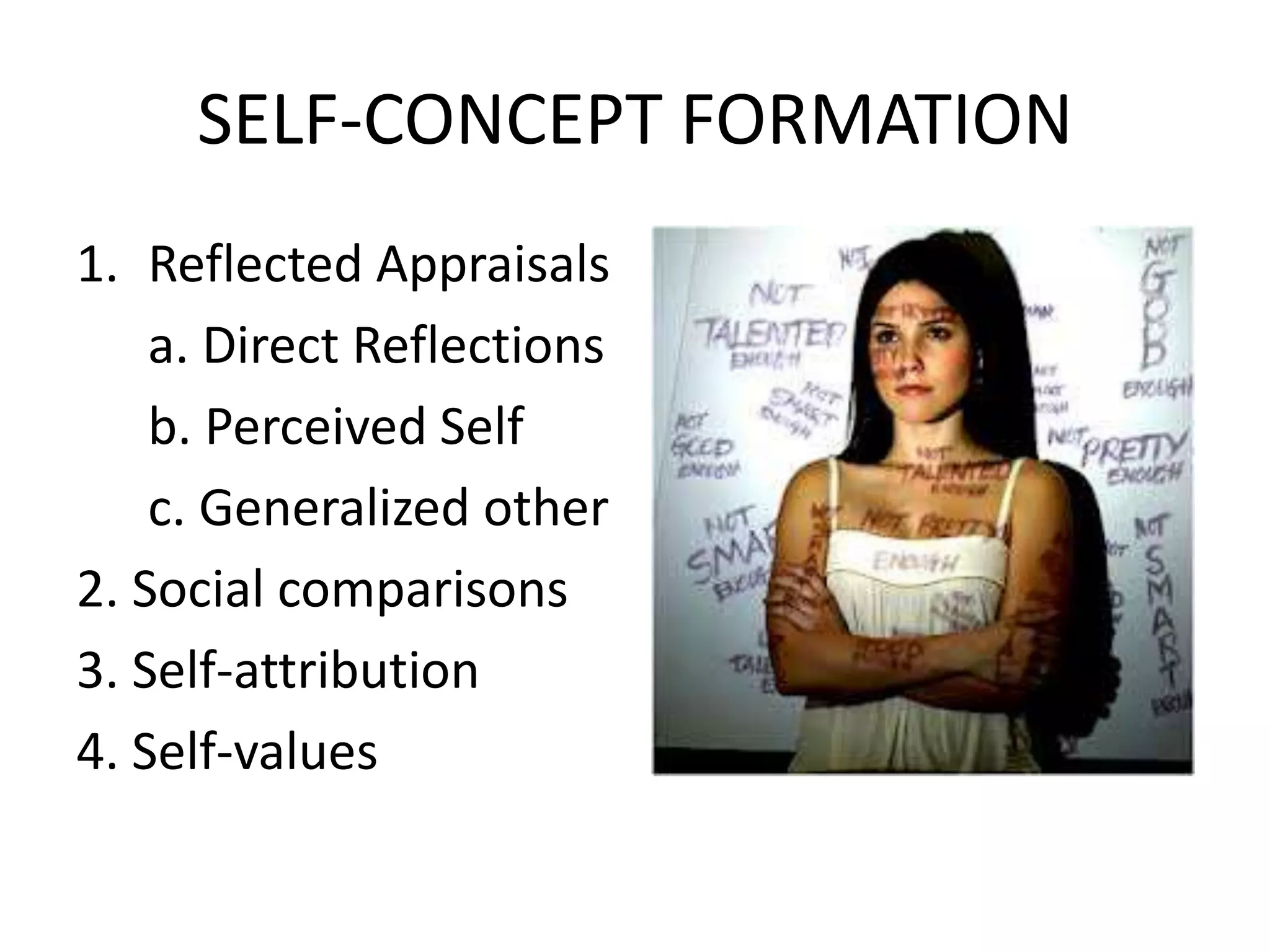
SELF-CONCEPT FORMATION
1. Reflected Appraisals
    a. Direct Reflections
    b. Perceived Self
    c. Generalized other
2. Social comparisons
3. Self-attribution
4. Self-values
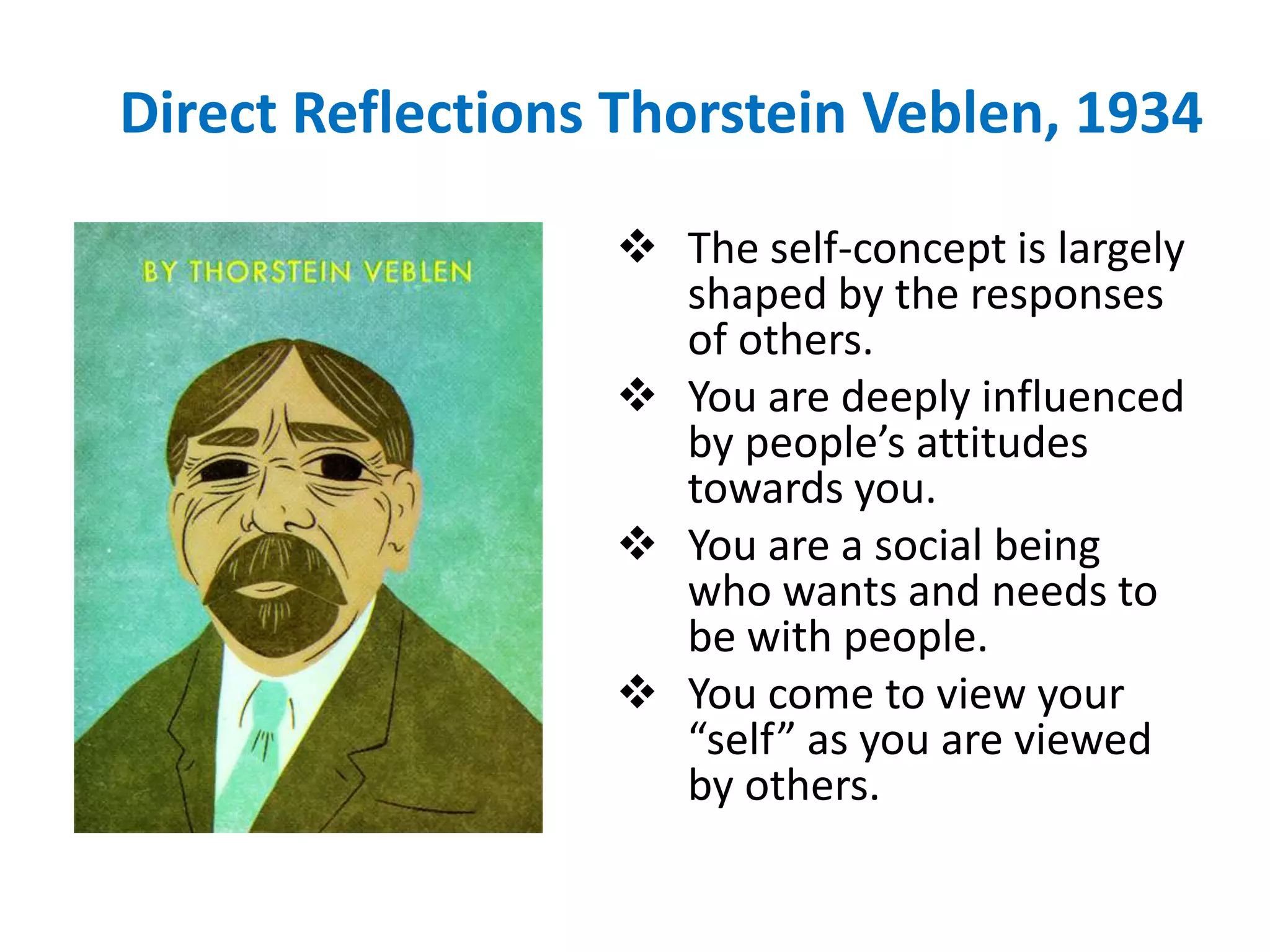
Direct Reflections Thorstein Veblen, 1934

                   The self-concept is largely
                    shaped by the responses
                    of others.
                   You are deeply influenced
                    by people’s attitudes
                    towards you.
                   You are a social being
                    who wants and needs to
                    be with people.
                   You come to view your
                    “self” as you are viewed
                    by others.
Direct Reflections Thorstein Veblen, 1934

 According to Veblen, the
  usual basis of self-respect
  is the respect by one’s
  neighbors or fellows.

 Only individuals with
  dysfunctional
  temperaments can in the
  long run retain their self-
  esteem in the face of
  disesteem of their
  neighbors or colleagues.
Direct Reflections Thorstein Veblen, 1934

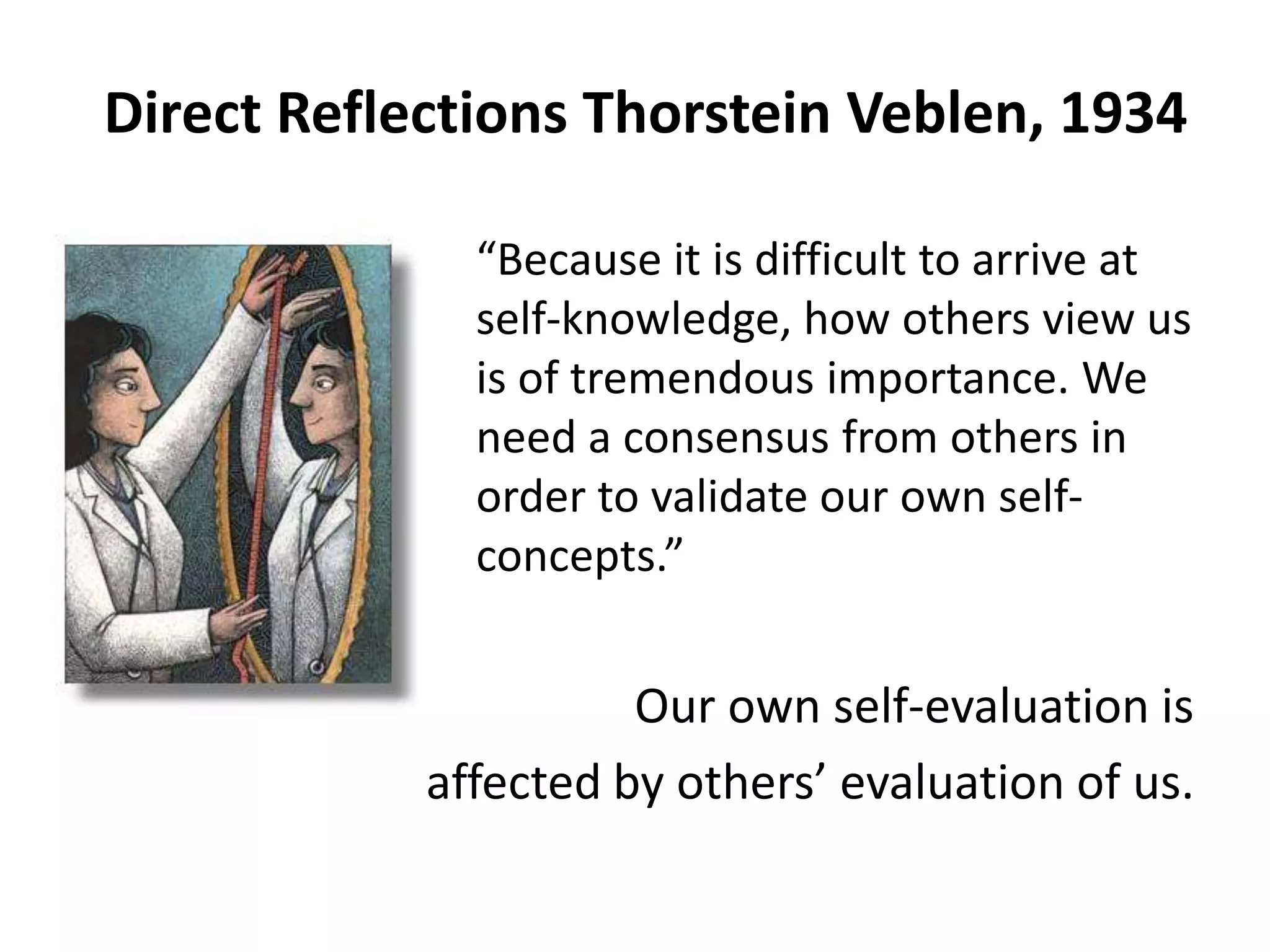
            “Because it is difficult to arrive at
             self-knowledge, how others view us
             is of tremendous importance. We
             need a consensus from others in
             order to validate our own self-
             concepts.”


                      Our own self-evaluation is
            affected by others’ evaluation of us.
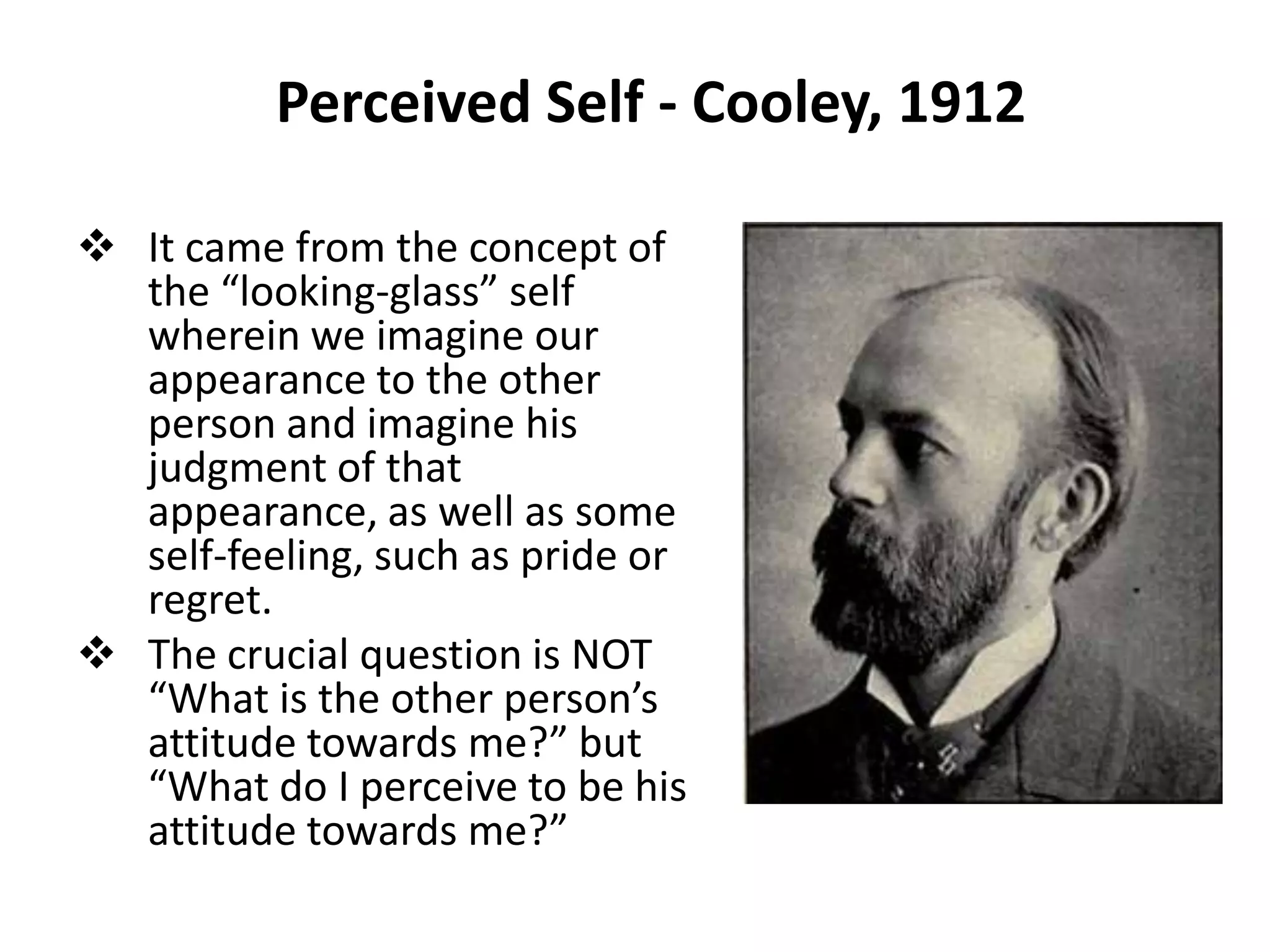
Perceived Self - Cooley, 1912

 It came from the concept of
  the “looking-glass” self
  wherein we imagine our
  appearance to the other
  person and imagine his
  judgment of that
  appearance, as well as some
  self-feeling, such as pride or
  regret.
 The crucial question is NOT
  “What is the other person’s
  attitude towards me?” but
  “What do I perceive to be his
  attitude towards me?”
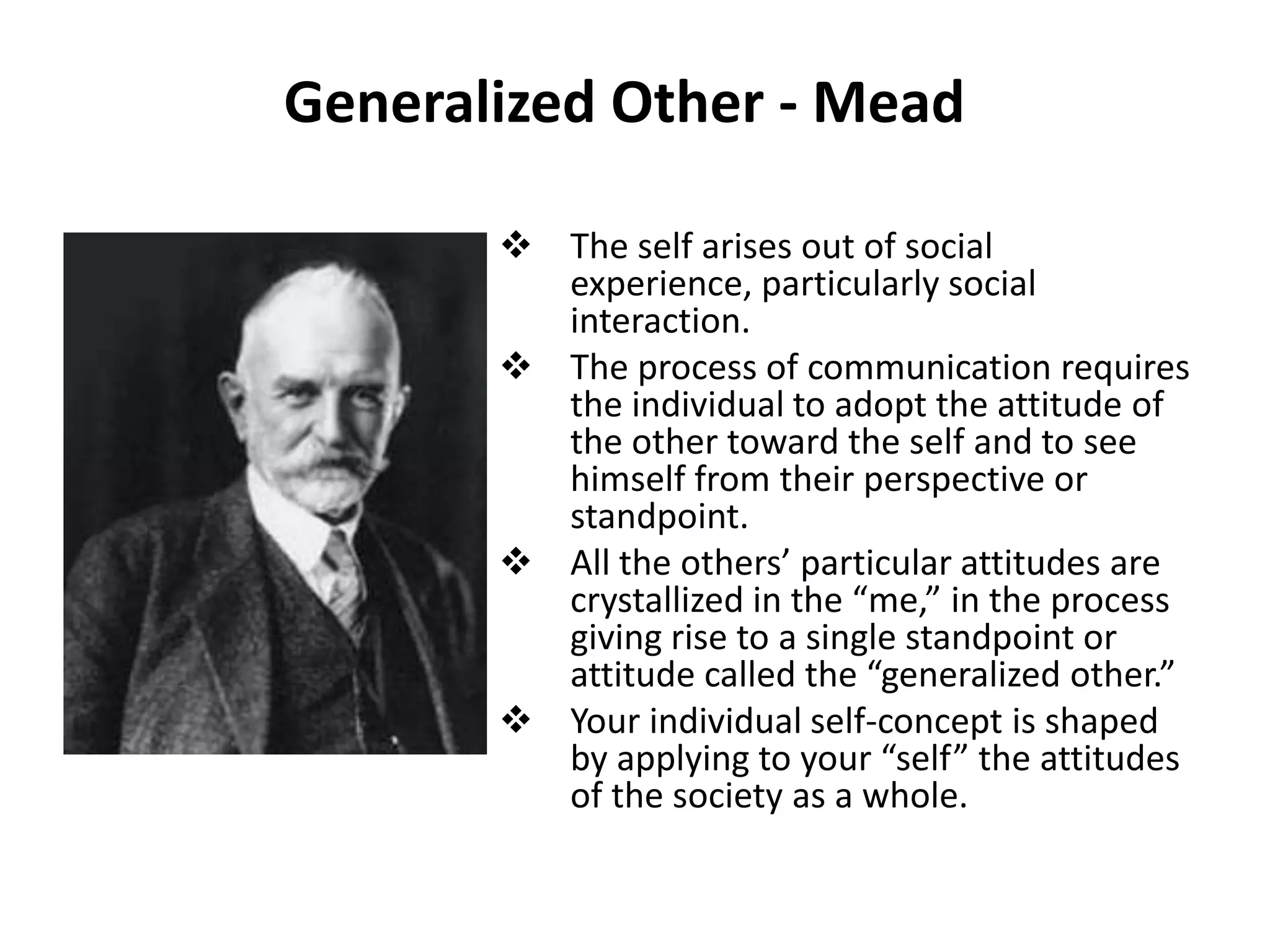
Generalized Other - Mead

        The self arises out of social
         experience, particularly social
         interaction.
        The process of communication requires
         the individual to adopt the attitude of
         the other toward the self and to see
         himself from their perspective or
         standpoint.
        All the others’ particular attitudes are
         crystallized in the “me,” in the process
         giving rise to a single standpoint or
         attitude called the “generalized other.”
        Your individual self-concept is shaped
         by applying to your “self” the attitudes
         of the society as a whole.
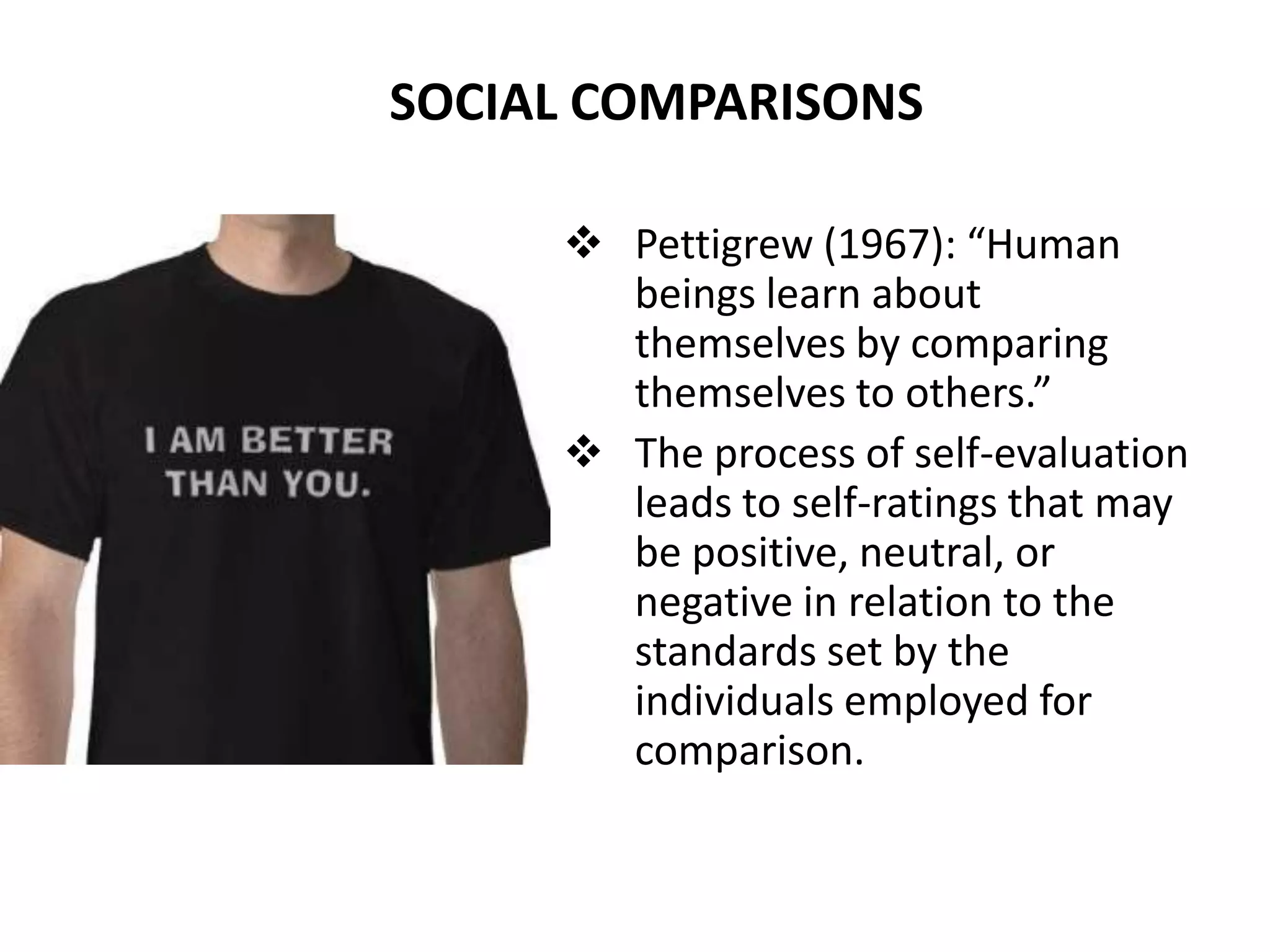
SOCIAL COMPARISONS

      Pettigrew (1967): “Human
       beings learn about
       themselves by comparing
       themselves to others.”
      The process of self-evaluation
       leads to self-ratings that may
       be positive, neutral, or
       negative in relation to the
       standards set by the
       individuals employed for
       comparison.
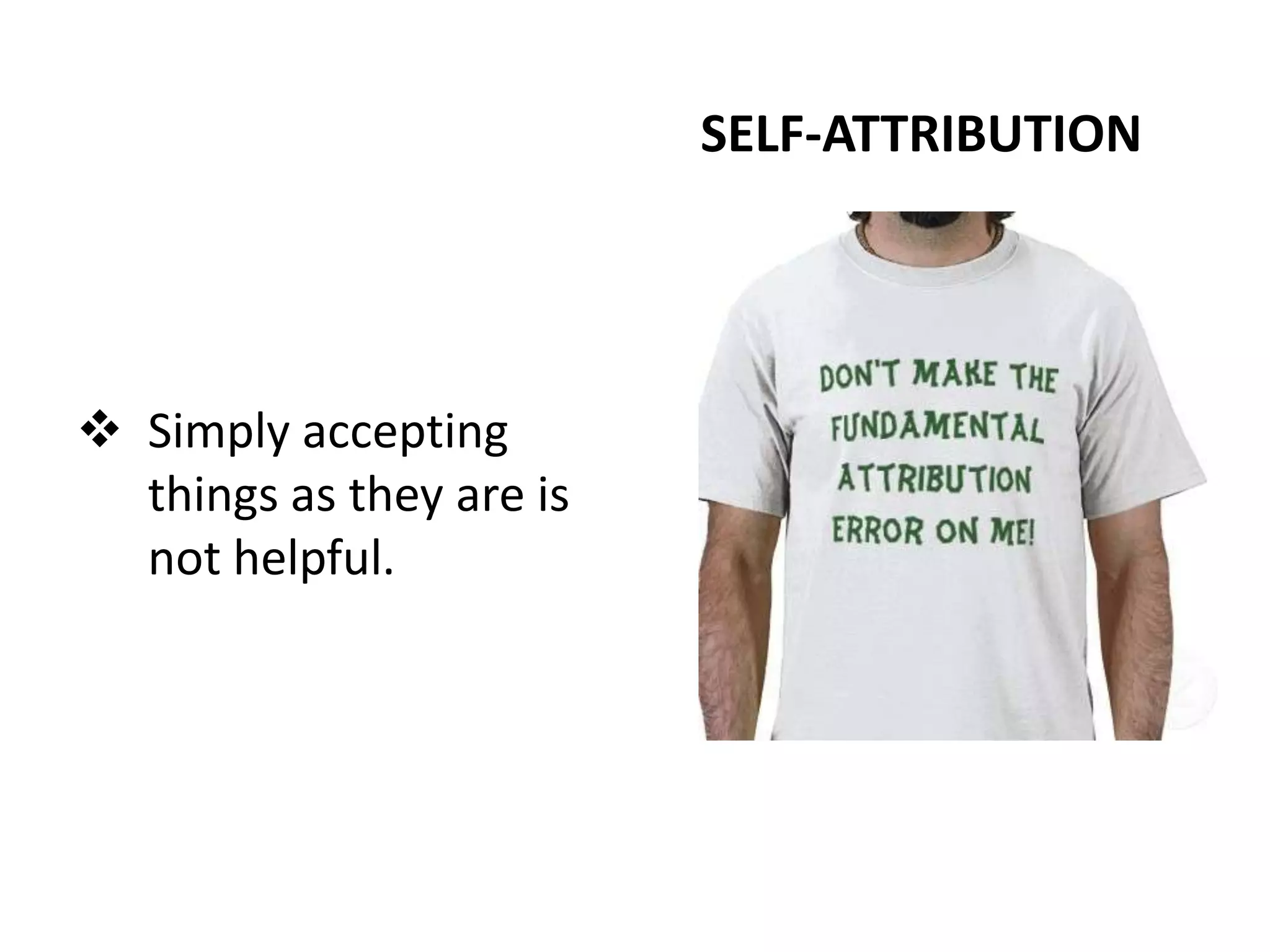
SELF-ATTRIBUTION


 Simply accepting
  things as they are is
  not helpful.
SELF-VALUES


      What is important to
       an individual would
       relate to one’s global
       self-esteem.
WISEMAN and BARKER MODEL
             • Intrapersonal communication is the
“creating, functioning, and evaluation of symbolic
processes which operate within the originating or
                responding communicator.” (1974)
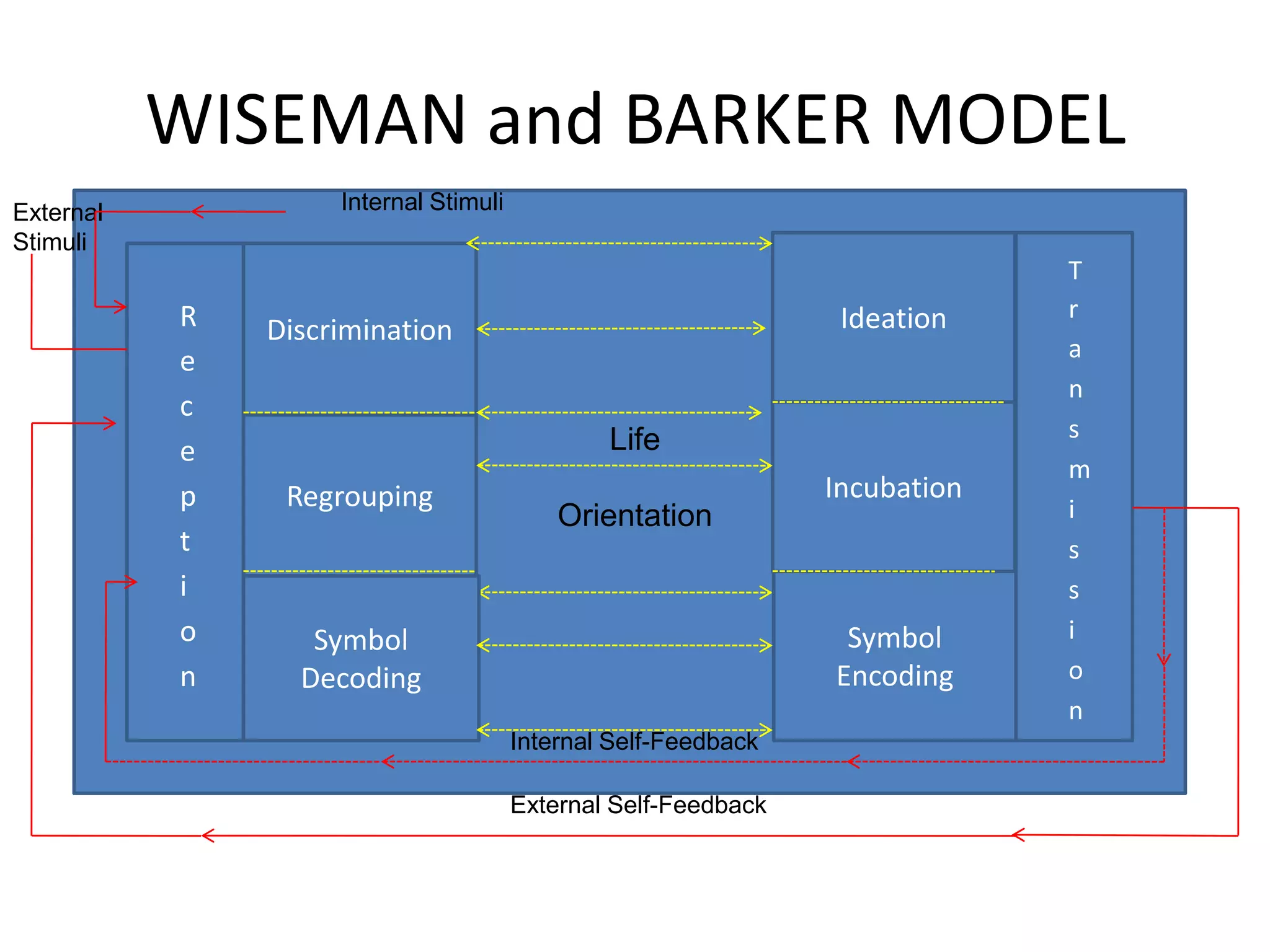
WISEMAN and BARKER MODEL
External            Internal Stimuli
Stimuli
                                                                             T
           R                                                     Ideation    r
               Discrimination
           e                                                                 a
                                                                             n
           c
                                               Life                          s
           e
                                                                             m
           p    Regrouping                                      Incubation
                                           Orientation                       i
           t                                                                 s
           i                                                                 s
           o      Symbol                                         Symbol      i
           n     Decoding                                       Encoding     o
                                                                             n
                                       Internal Self-Feedback

                                       External Self-Feedback
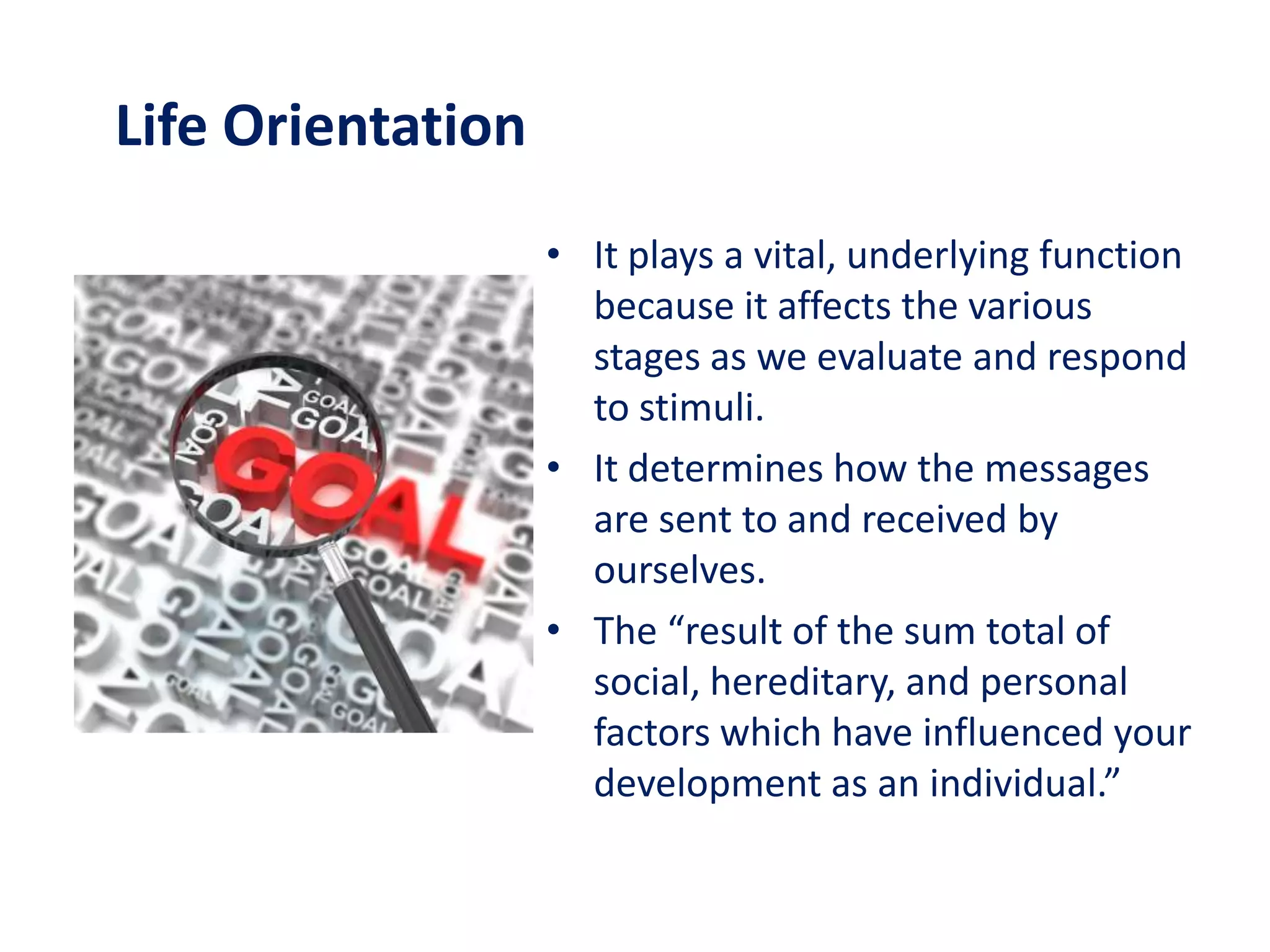
Life Orientation
                   • It plays a vital, underlying function
                     because it affects the various
                     stages as we evaluate and respond
                     to stimuli.
                   • It determines how the messages
                     are sent to and received by
                     ourselves.
                   • The “result of the sum total of
                     social, hereditary, and personal
                     factors which have influenced your
                     development as an individual.”
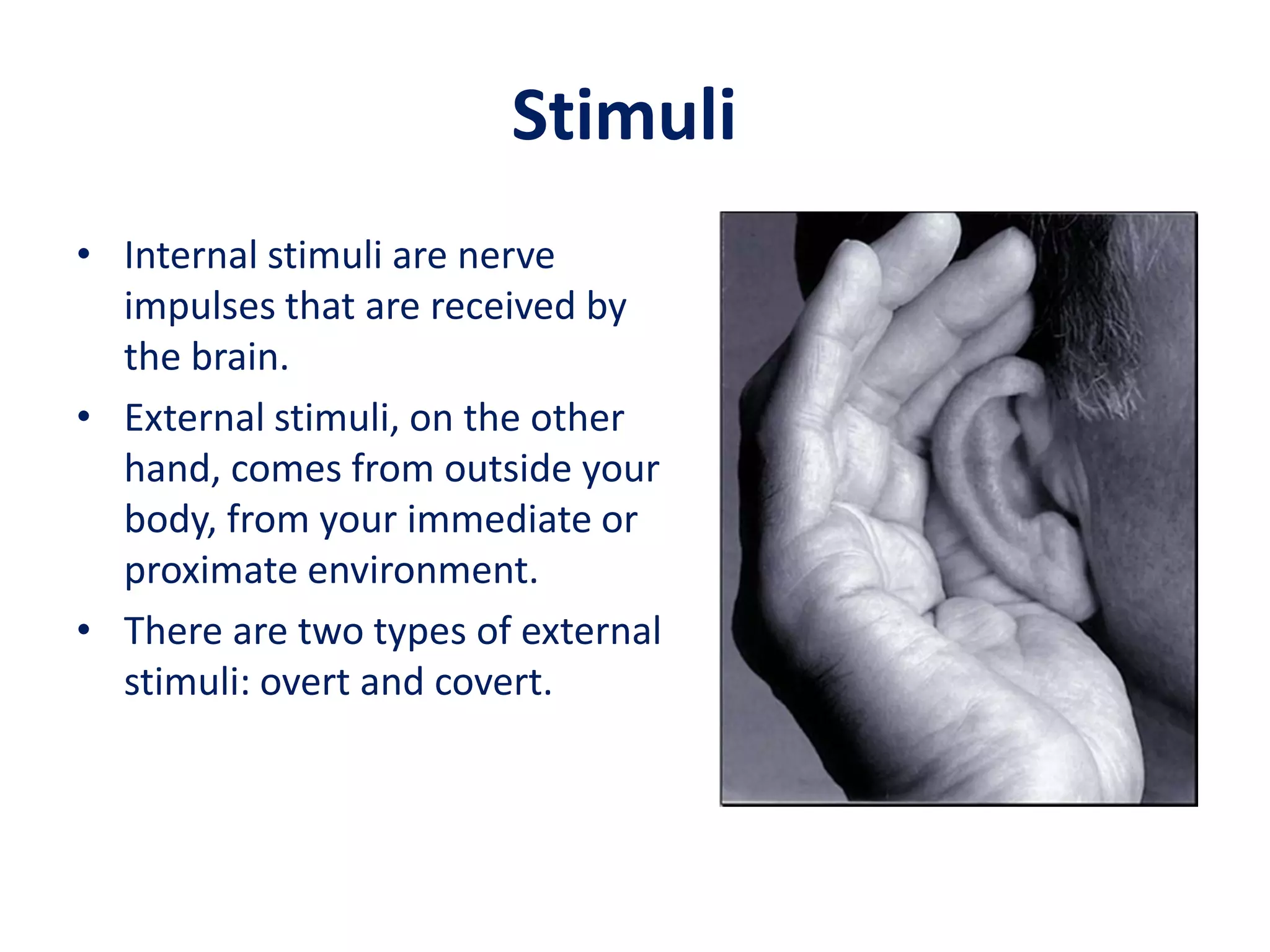
Stimuli
• Internal stimuli are nerve
  impulses that are received by
  the brain.
• External stimuli, on the other
  hand, comes from outside your
  body, from your immediate or
  proximate environment.
• There are two types of external
  stimuli: overt and covert.
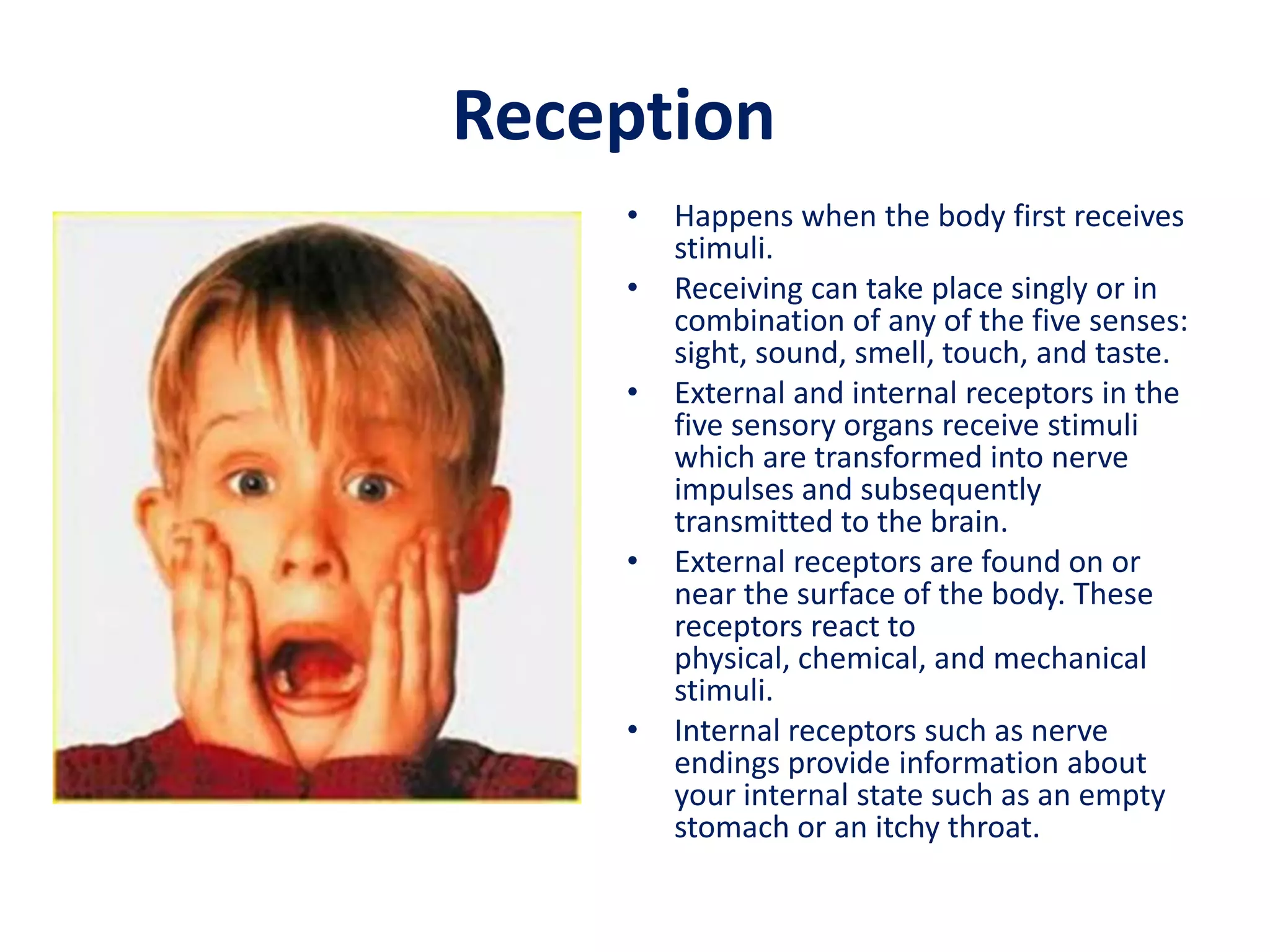
Reception
    •   Happens when the body first receives
        stimuli.
    •   Receiving can take place singly or in
        combination of any of the five senses:
        sight, sound, smell, touch, and taste.
    •   External and internal receptors in the
        five sensory organs receive stimuli
        which are transformed into nerve
        impulses and subsequently
        transmitted to the brain.
    •   External receptors are found on or
        near the surface of the body. These
        receptors react to
        physical, chemical, and mechanical
        stimuli.
    •   Internal receptors such as nerve
        endings provide information about
        your internal state such as an empty
        stomach or an itchy throat.
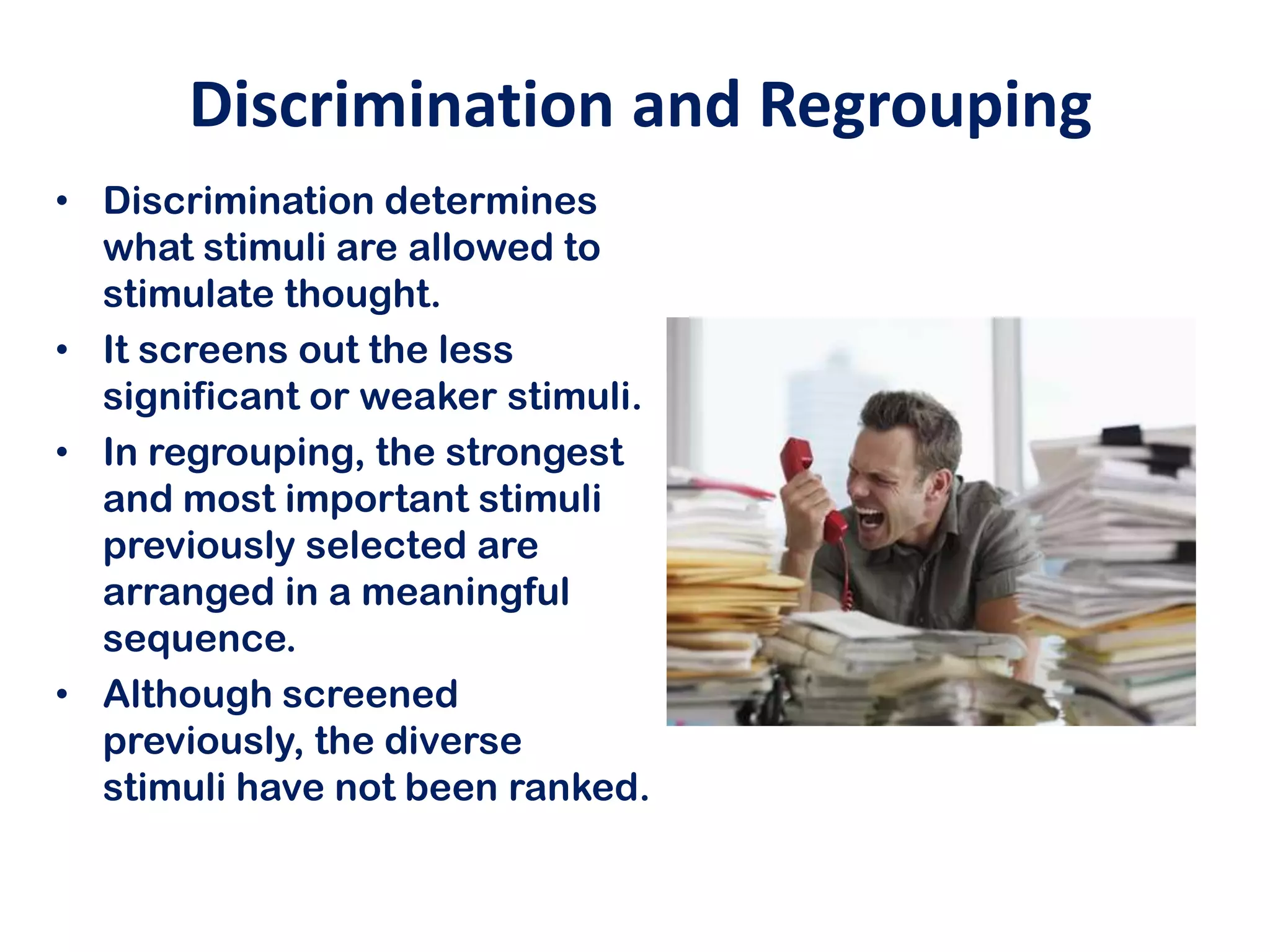
Discrimination and Regrouping
• Discrimination determines
  what stimuli are allowed to
  stimulate thought.
• It screens out the less
  significant or weaker stimuli.
• In regrouping, the strongest
  and most important stimuli
  previously selected are
  arranged in a meaningful
  sequence.
• Although screened
  previously, the diverse
  stimuli have not been ranked.
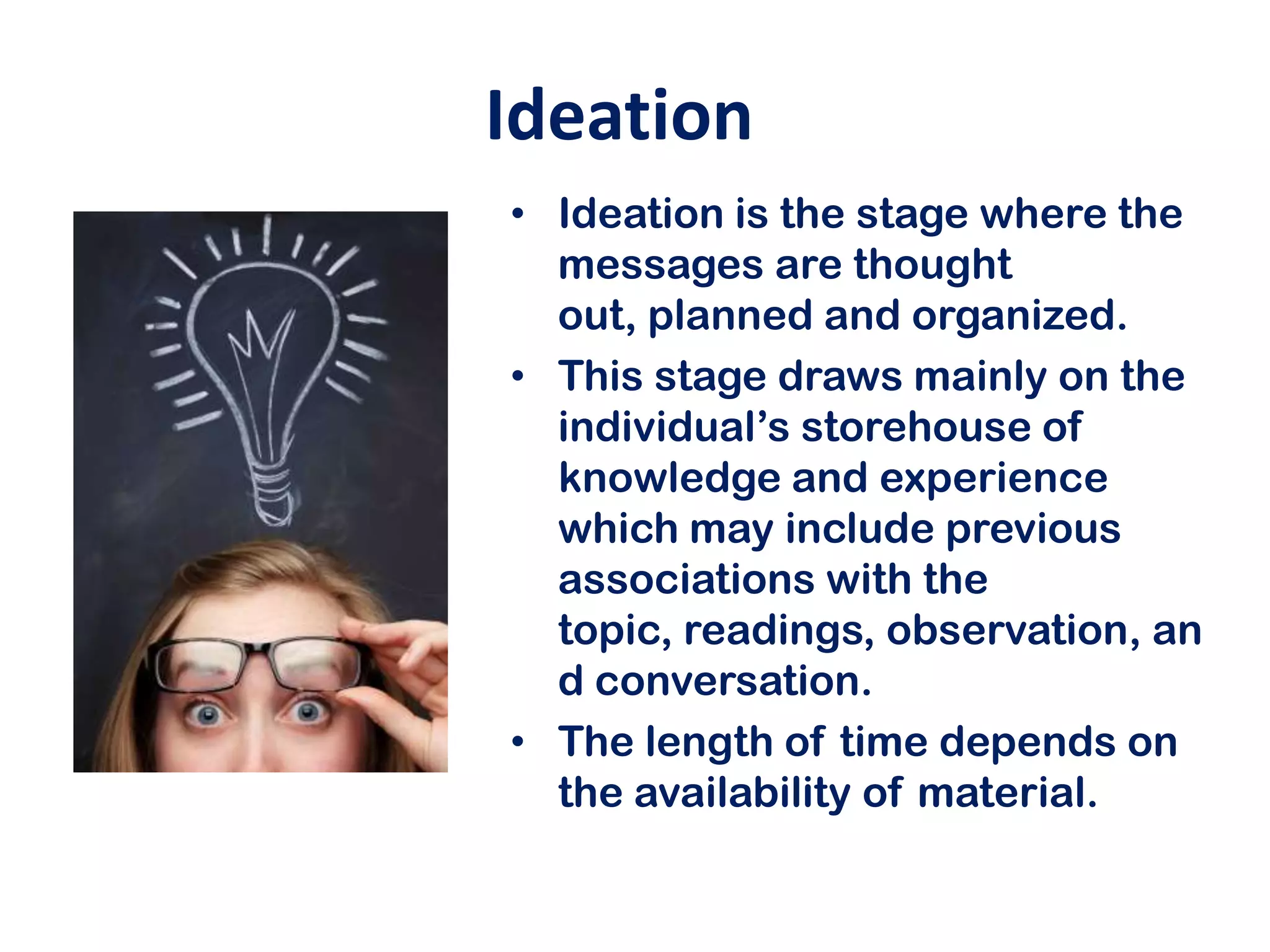
Ideation
• Ideation is the stage where the
  messages are thought
  out, planned and organized.
• This stage draws mainly on the
  individual’s storehouse of
  knowledge and experience
  which may include previous
  associations with the
  topic, readings, observation, an
  d conversation.
• The length of time depends on
  the availability of material.
Incubation and Symbol Encoding
• Incubation is the process of
  allowing your ideas to grow and
  develop further.
• Often referred to as the “jelling or
  hatching period.”
• Allows you time to
  weigh, evaluate, reorganize and
  reflect on your messages.
• In Symbol Encoding, the symbols
  of thought are transformed into
  words and gestures or actions.
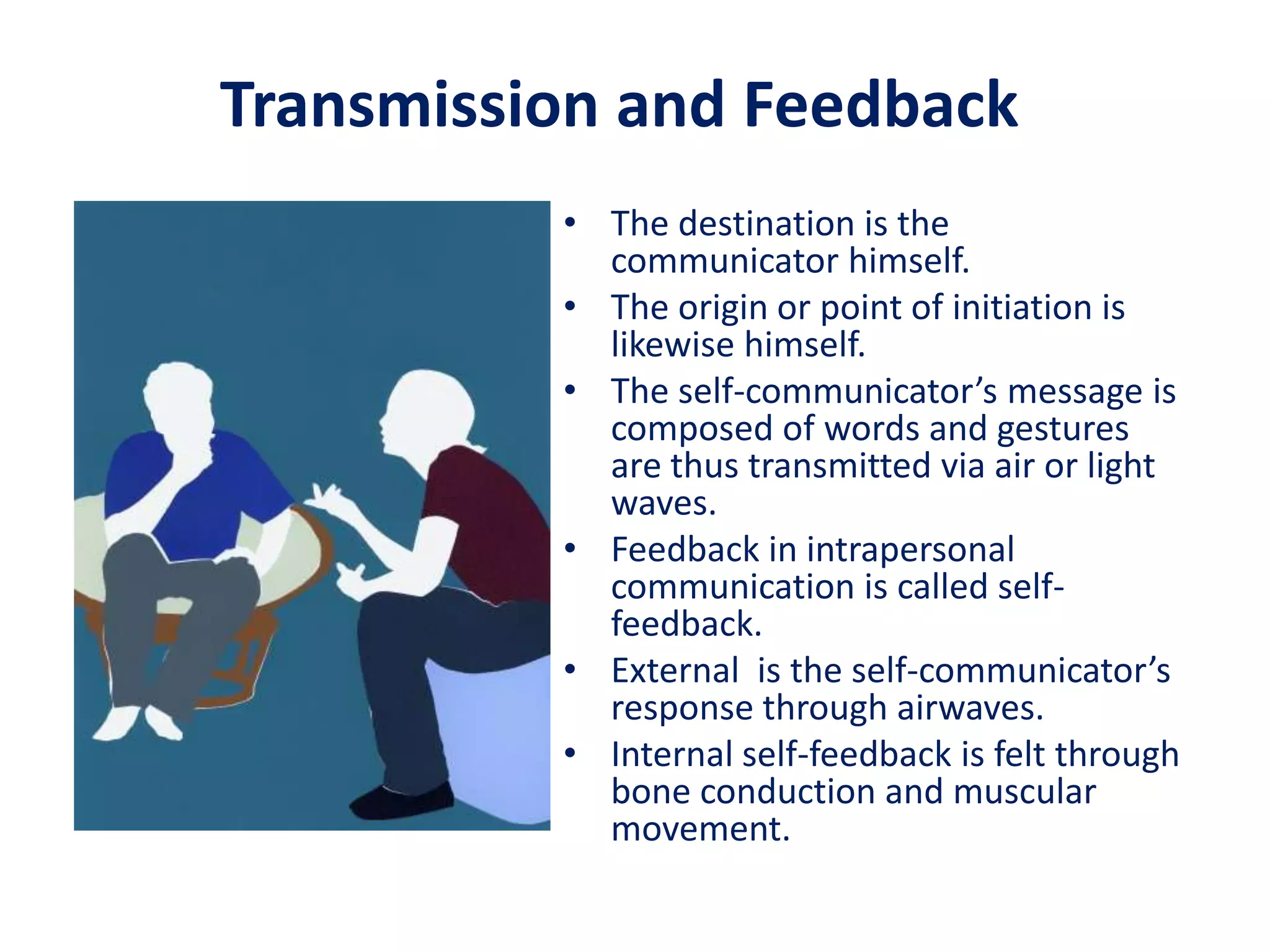
Transmission and Feedback
          • The destination is the
            communicator himself.
          • The origin or point of initiation is
            likewise himself.
          • The self-communicator’s message is
            composed of words and gestures
            are thus transmitted via air or light
            waves.
          • Feedback in intrapersonal
            communication is called self-
            feedback.
          • External is the self-communicator’s
            response through airwaves.
          • Internal self-feedback is felt through
            bone conduction and muscular
            movement.
4 words to know of self
1. self-awareness: the ability
   to reflect on and monitor
   one’s own behavior
2. self-concept: everything
   one thinks and feels about
   oneself
3. self-image: the sort of
   person one perceives
   oneself to be
4. self-esteem: how well one
   likes and values oneself
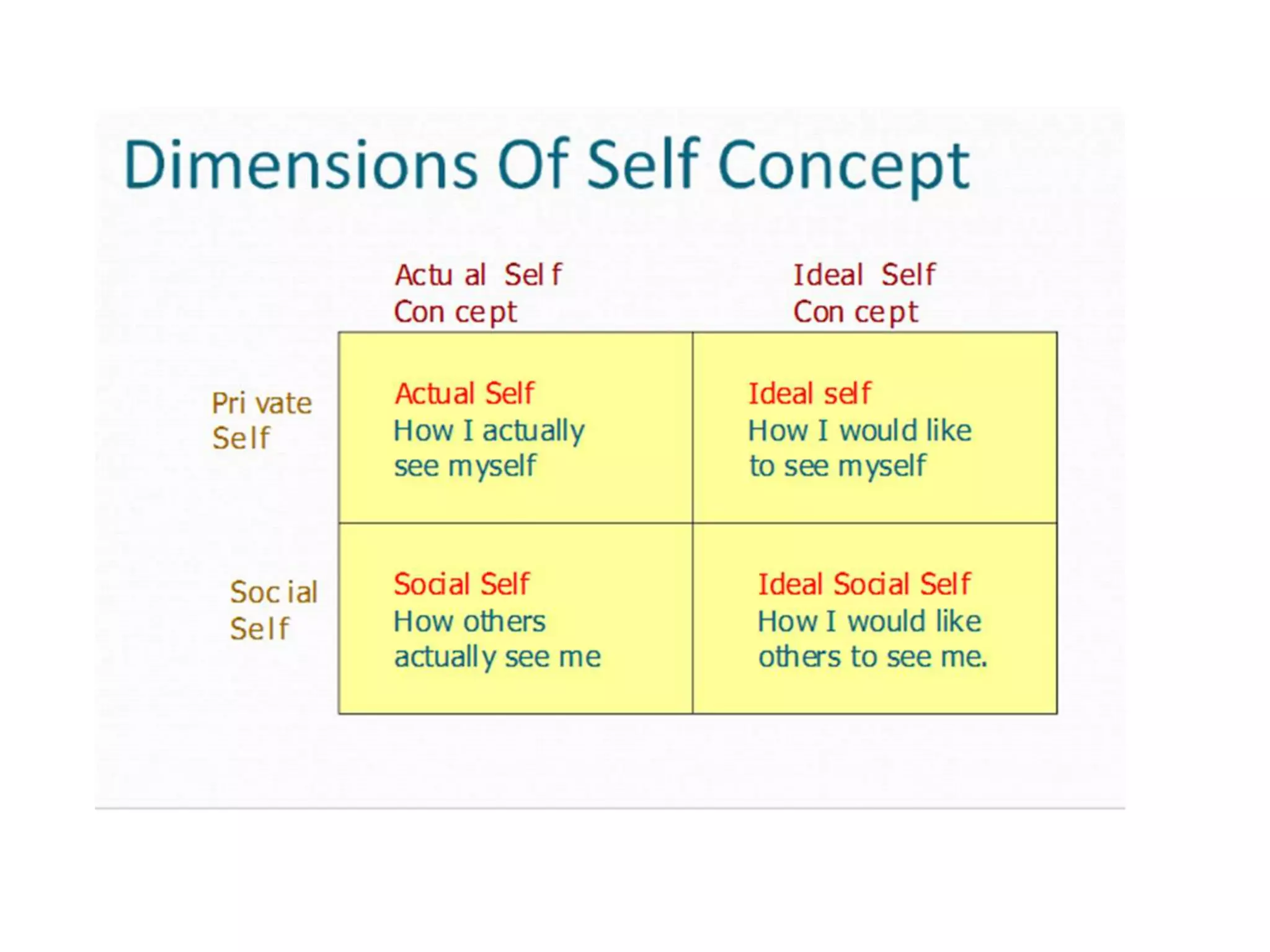
Self-Concept is the self-perception or view you have of yourself. It is the person
  you think you are, formed in your beliefs and attitudes. It is influence by how
  others see you, how you were in your past, are today, and would like to be in the
  future.

Real self – your “core” self; who you really      Intellectual self – who you are as a
are.                                              student and a learner; the part of you
Perceived self – who you see yourself to be.      that acquires and uses knowledge.
Ideal self – who you want to be now or in         Emotional self – the part of you that
the future.                                       processes feelings.
Public self – the self you freely disclose to     Physical self – who you are physically;
others or in public situations.                   including the concept of your own
Private self – the self you do not share with     body, athletic ability, gracefulness and
others; who you are in private.                   coordination, level of
Professional self – who you are in your job       attractiveness, physical health and well
or profession.                                    being.
Social self – who you are when you interact       Artistic self – the part of you that is
with other individuals, groups, in society or     creative or artistic.
social situations.
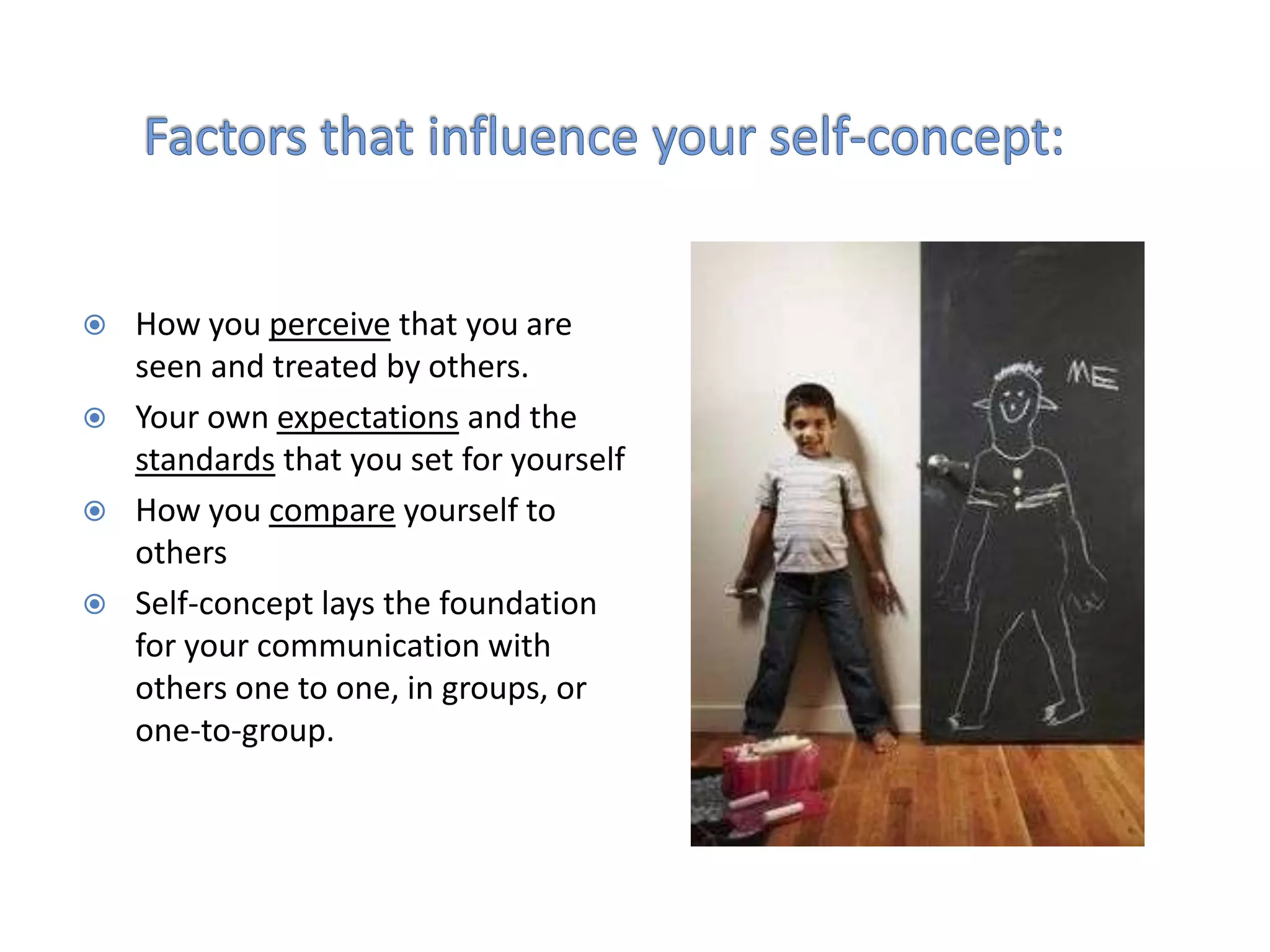
   How you perceive that you are
    seen and treated by others.
   Your own expectations and the
    standards that you set for yourself
   How you compare yourself to
    others
   Self-concept lays the foundation
    for your communication with
    others one to one, in groups, or
    one-to-group.
 Can give you confidence
  you need to
  communicate effectively
 Must draw from your
  strengths
 Must know where you
  need to improve
 Set goals for change
 Self-fulfilling prophecy – a prediction or expectation
  of an event that shapes your behavior, making the
  outcome more likely to occur.
    It comes from your own self-concept and the
        expectations you establish for yourself.
    It also come from what you think others expect
        of you.
 Self-disclosure – is the deliberate revelation of a
  significant information about yourself that is not
  readily apparent to others. It can be tricky because it
  can either be appropriate or inappropriate for a
  particular time, place or circumstance.
    Must know what facts, opinions, or feelings are
        appropriate to reveal under the circumstances.
    Consider the purpose of self-disclosure and your
        communication goals.
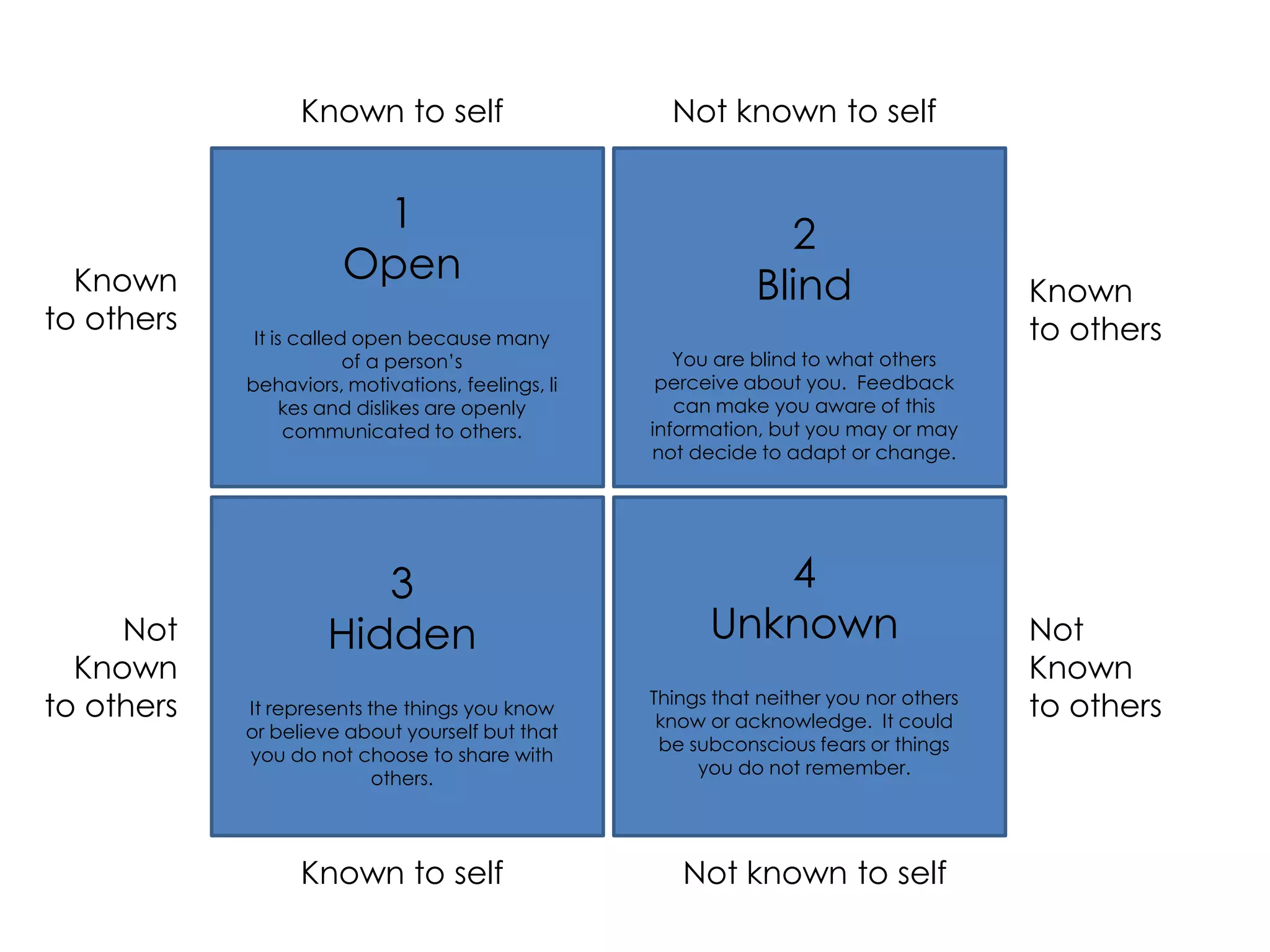
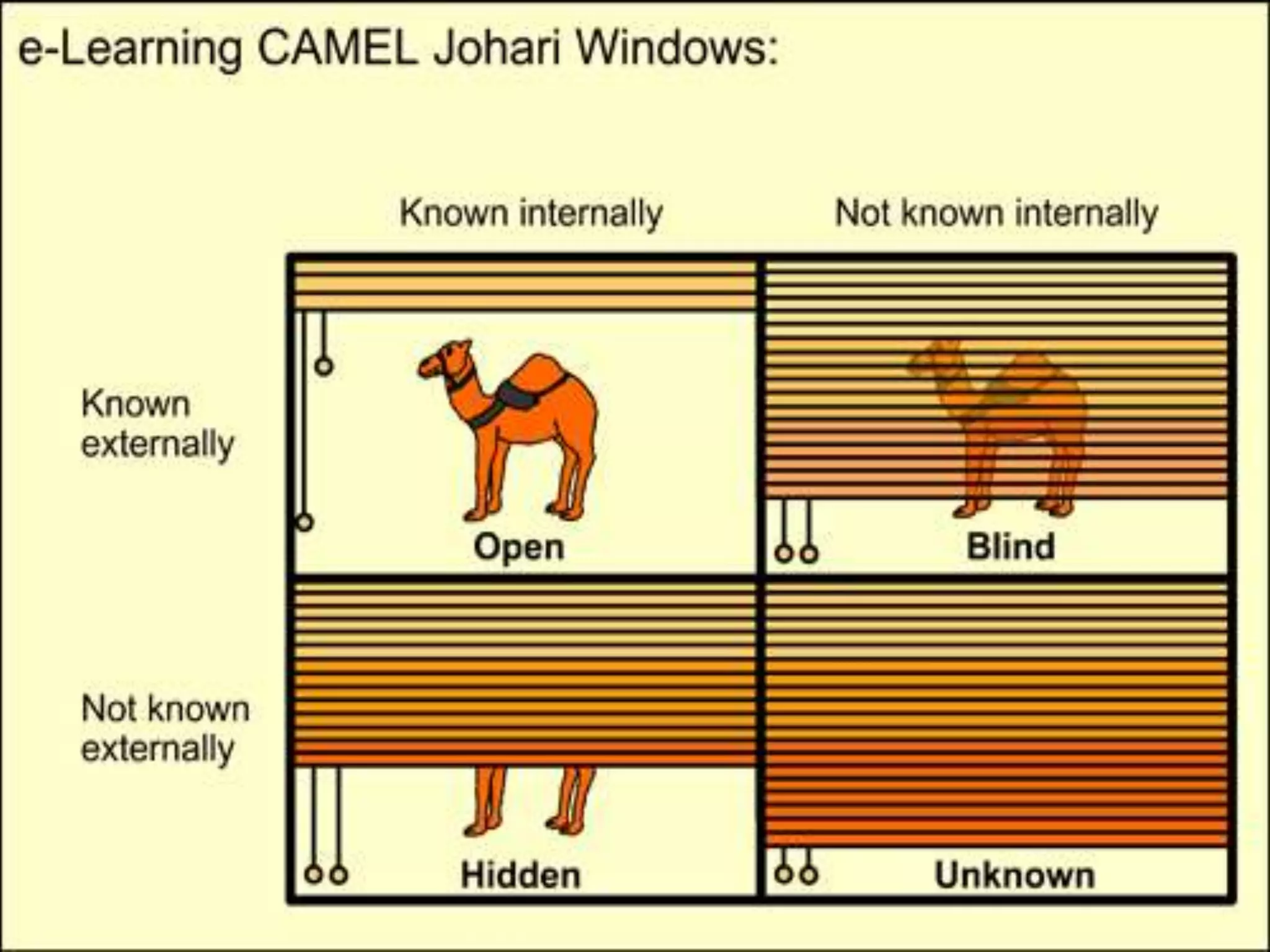
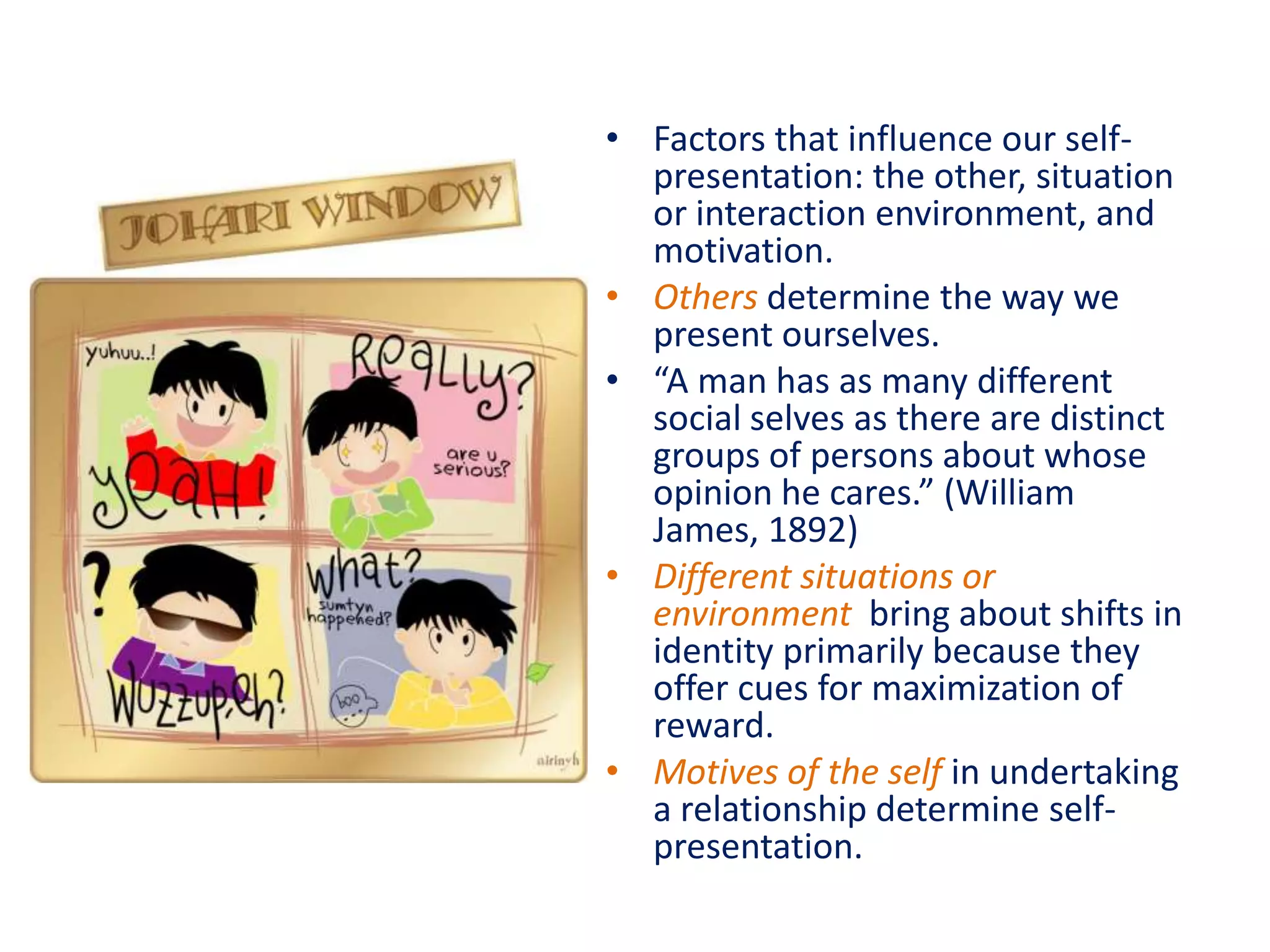
Known to self                      Not known to self


                        1                                       2
                       Open
  Known                                                       Blind                     Known
to others    It is called open because many                                             to others
                         of a person’s                You are blind to what others
            behaviors, motivations, feelings, li    perceive about you. Feedback
                  kes and dislikes are openly         can make you aware of this
                  communicated to others.          information, but you may or may
                                                   not decide to adapt or change.


                        3                                   4
     Not             Hidden                              Unknown                        Not
  Known                                                                                 Known
to others   It represents the things you know
                                                   Things that neither you nor others
                                                    know or acknowledge. It could
                                                                                        to others
            or believe about yourself but that
                                                    be subconscious fears or things
            you do not choose to share with
                                                        you do not remember.
                           others.


                  Known to self                       Not known to self
• Factors that influence our self-
  presentation: the other, situation
  or interaction environment, and
  motivation.
• Others determine the way we
  present ourselves.
• “A man has as many different
  social selves as there are distinct
  groups of persons about whose
  opinion he cares.” (William
  James, 1892)
• Different situations or
  environment bring about shifts in
  identity primarily because they
  offer cues for maximization of
  reward.
• Motives of the self in undertaking
  a relationship determine self-
  presentation.
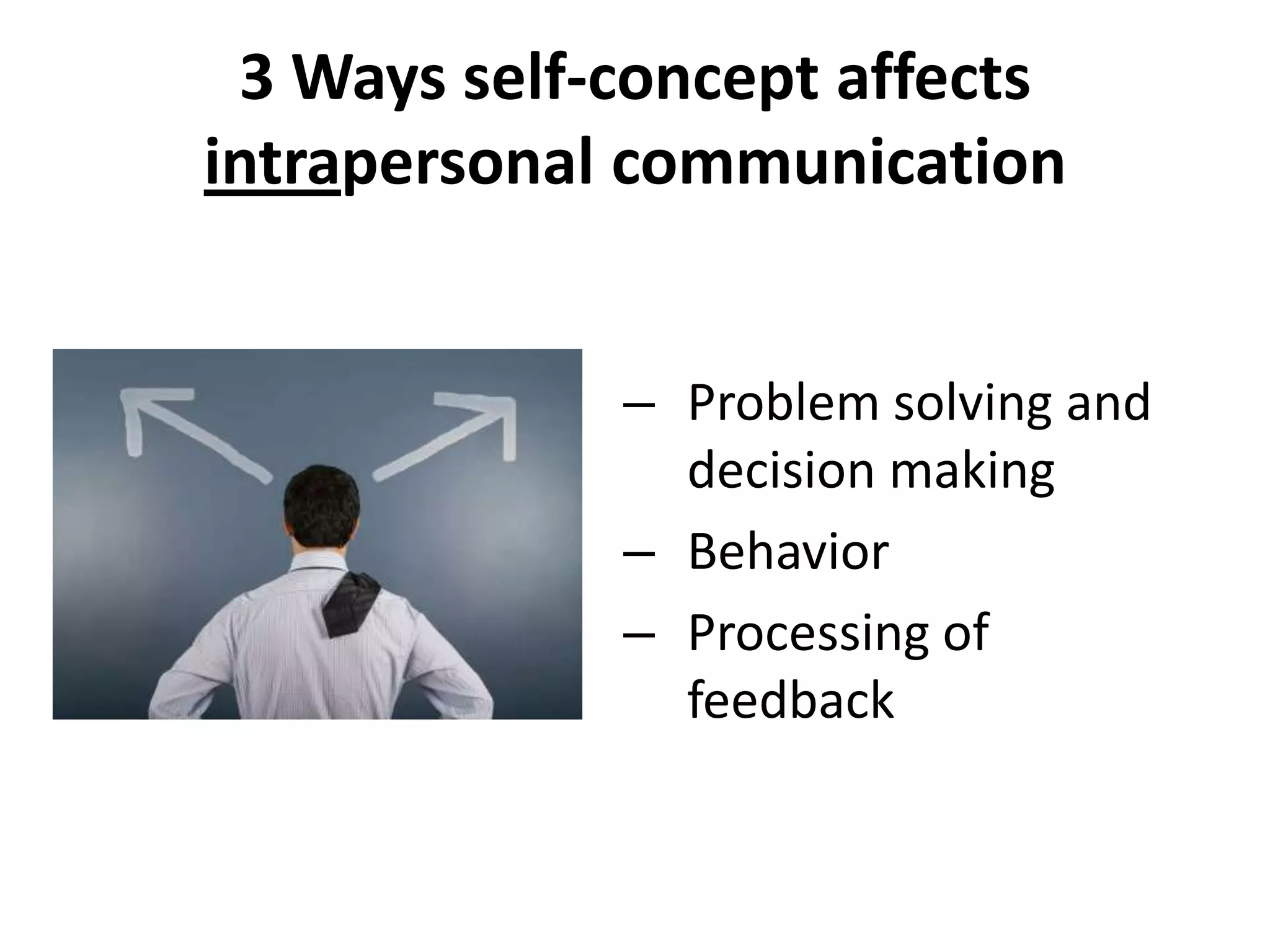
3 Ways self-concept affects
intrapersonal communication


             – Problem solving and
               decision making
             – Behavior
             – Processing of
               feedback
Need
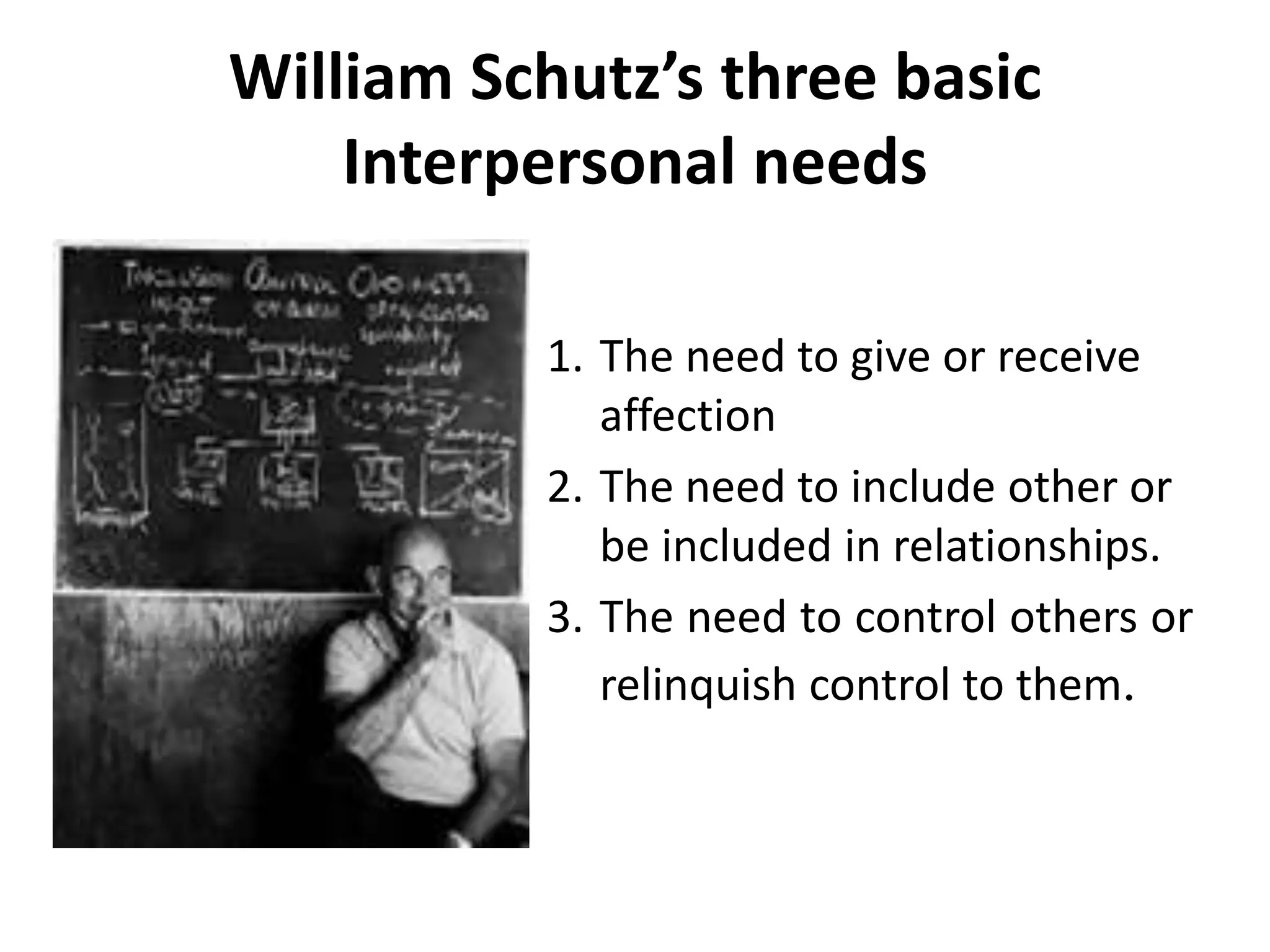
William Schutz’s three basic
    Interpersonal needs

          1. The need to give or receive
             affection
          2. The need to include other or
             be included in relationships.
          3. The need to control others or
             relinquish control to them.
Communicating With Others
Communication with others
Affect on attitude for communicating with others

                    2 types of people

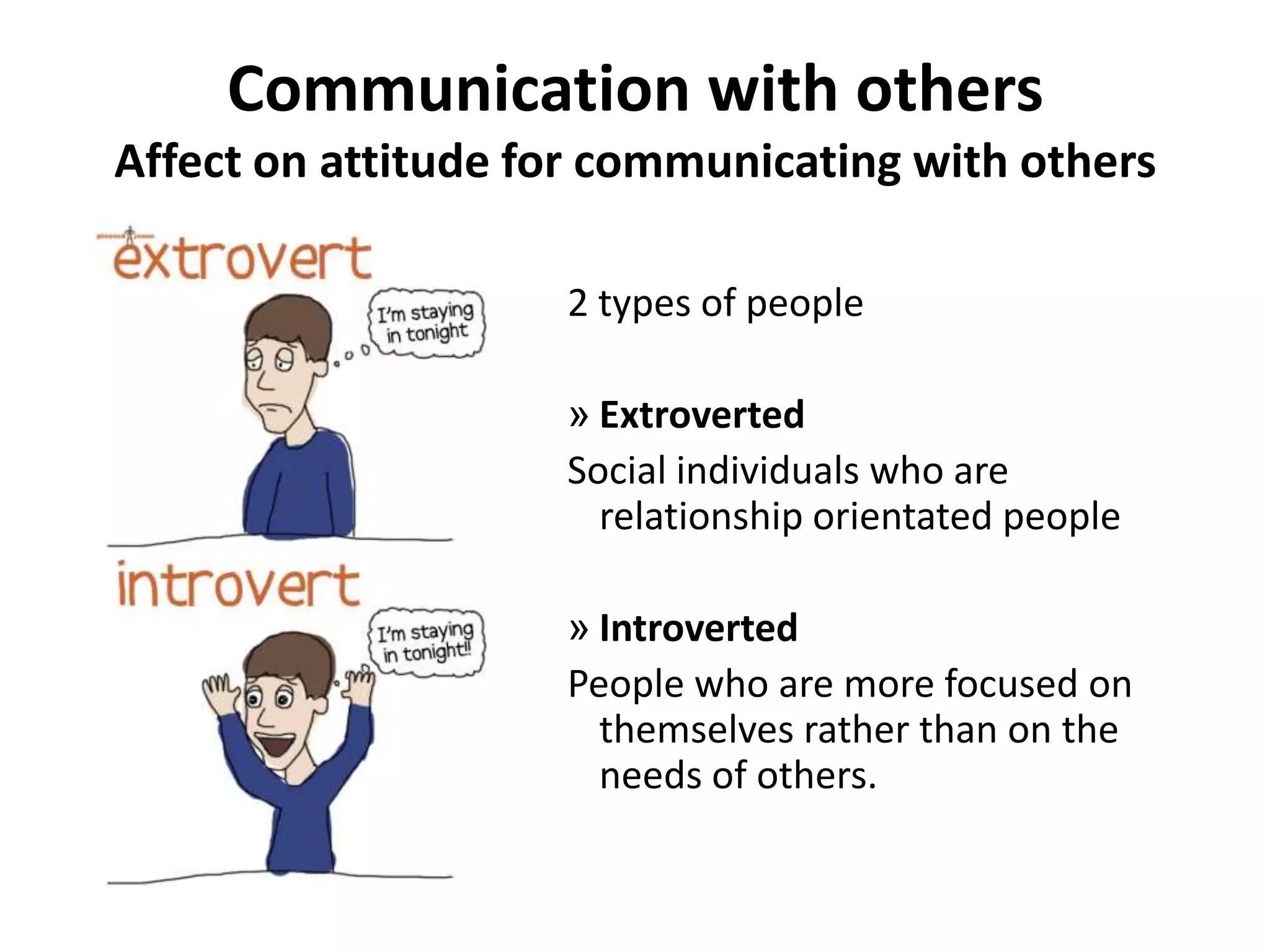
                    » Extroverted
                    Social individuals who are
                      relationship orientated people

                    » Introverted
                    People who are more focused on
                      themselves rather than on the
                      needs of others.
How we make
predictions about
 others based on
first impressions

      • Physical
    characteristics
    • Social traits
 • Emotional states
   • Stereotyping
Confirming Perceptions
                           • Checking perception
                              – Seek more information to verify
                                perceptions
                              – Recognize that even if your
                                original perceptions were
                                accurate, people can change
                                over time
                              – Talk with people about whom
                                you are forming perceptions
                              – Check perceptions verbally
• Perception check
   – Verbal statement that reflects your understanding
Keep on SPIRIT for …
 Better 1ndONEsia

Intrapersonal communication

  • 1.
    Intrapersonal Communication www.humanikaconsulting.com
  • 2.
    “Whether you think youcan or think you can’t, you are right.” - Henry Ford-
  • 3.
    Analyze yourself asa communicator • Intrapersonal communication • Perceptions • Self concepts • Needs • Communication with others
  • 4.
    OBJECTIVES • Reflect uponthe values or significance of self-introspection; • Establish the connection between self-concept and intrapersonal communication; and • Arrive at a keener understanding of one’s self-communication prior to acquiring interpersonal communication skills
  • 5.
  • 6.
    • Communicating with oneself • Thinking • Self-talk
  • 7.
    • In oneword describe yourself. • In three words describe yourself. • In ten words describe yourself. • Was one word hard? Yes, because we’re complex people.
  • 8.
    1. “How doI see myself?” 2. “Do I like or not what I see?” 3. “How do I wish to see myself?” “How do I present myself to others?” 4. “Who do others say I am?” “What do I imagine others say about me?” 5. “How does this affect me?”
  • 9.
    Intrapersonal Definition Intrapersonal person is a highly developed self- knowledge, involving accurate knowledge or goals, strength, limitations, mo ods, anxieties desires and motivations.
  • 10.
     This takesplace within the individual.  Sender = Our relevant organ.  Receiver = Our brain.  Feed back by brain.
  • 11.
    Intrapersonal Communication Figure 1-3 Intrapersonal Communication
  • 12.
    Self-talk is theinner speech that includes the questions and comments you make to yourself. It is a powerful influence. You use it when you: • Think things through • Interpret events • Interpret messages of others • Respond to your own experiences • Respond to your interactions with others
  • 13.
    Research has showthan positive self talk increases focus, concentration and performance.  If you believe you cannot do something, your brain will tell your body and it will shut down.  When you stay encouraged and positive, your body will also respond in a positive way.
  • 14.
    “In order tosuccessfully communicate with others you must first learn to communicate with yourself. Intrapersonal communication is the most basic level of communication. You must understand who you are and what you think of yourself.”
  • 16.
    Three steps involvedin Perception 1. Sensory perception – the physical process of taking in data through the senses. › How do you know when to go to school? › How do you know if you need to wear a jacket?
  • 17.
    Three steps involvedin Perception 2. Selective perception – the mental process of choosing which data or stimuli to focus on from all that are available to you at any given time. › This means we have to make decisions on which things we focus on or ignore.
  • 18.
    Perception Process • Theprocess you use to assign meaning to data about yourself or the world around you is called perception. • People seldom share precisely the same perceptions because we are unique.
  • 20.
    The following caninfluence you perception choices:  Intensity – the more intense or dramatic the stimulus, the more likely we are to notice it. › Example: someone screaming all of a sudden  Repetition – the more we are bombarded with messages – the more it sinks in and we believe it. › Advertising messages  Uniqueness – things that are new, unusual, unexpected & unique are often noticed.  Relevance – noticing things that mirror our own interests, needs & motiviations.
  • 22.
    To manage selectiveperception you should: • 1. Stay alert • 2. Make conscious choices about what is important data. • 3. Screen out distractions & noise that may interfere with concentration. • 4. Monitor the way you select data and improve your weaknesses.
  • 24.
    Third step inperception process • 3. Personal perception – your own understanding of reality. It becomes the basis for your judgments and decisions you make. It also determines appropriateness of your communication choices. – How you talk or express yourself (dress, act, perform, etc.) are choices you make based on your perceptions.
  • 25.
    Factors that influencepersonal perception • Values – reflect your priorities and what you think is important. • Beliefs – what one believes to be true that often helps you decide what to accept or reject • Culture – family, community, or organizations to which you belong • Bias – consistent attitude, viewpoint or pattern of perception. • Prejudice – preconceived judgment (to pre-judge on opinion rather than facts) • Attitudes – powerful influences that can be positive or negative. • Expectations – basing a judgment on what is expected rather than what actually happened. • Knowledge – what you know influences how your organize & interpret information. • Communication skills – if you are lacking in part of the communication process, you may have difficulty in understanding and being understood.
  • 26.
    Analyzing Perceptions • Twopeople in the same room can have completely different perceptions of the same event. Varying perceptions can cause conflict and misunderstandings. To overcome this you must continuallly check your own perceptions and make sure they are accurate.
  • 32.
    Key – Never assume that what you perceive as the truth is the actual, absolute truth.  Intrapersonal perception check:  Question your sensory perception  Question your selective perception  Question you personal perception  Interpersonal perception check:  Clarify your perception of others messages.  Analyze others’ points of view  Take responsibility for your own communication.
  • 33.
  • 34.
    SELF-CONCEPT FORMATION 1. ReflectedAppraisals a. Direct Reflections b. Perceived Self c. Generalized other 2. Social comparisons 3. Self-attribution 4. Self-values
  • 37.
    Direct Reflections ThorsteinVeblen, 1934  The self-concept is largely shaped by the responses of others.  You are deeply influenced by people’s attitudes towards you.  You are a social being who wants and needs to be with people.  You come to view your “self” as you are viewed by others.
  • 38.
    Direct Reflections ThorsteinVeblen, 1934  According to Veblen, the usual basis of self-respect is the respect by one’s neighbors or fellows.  Only individuals with dysfunctional temperaments can in the long run retain their self- esteem in the face of disesteem of their neighbors or colleagues.
  • 39.
    Direct Reflections ThorsteinVeblen, 1934  “Because it is difficult to arrive at self-knowledge, how others view us is of tremendous importance. We need a consensus from others in order to validate our own self- concepts.” Our own self-evaluation is affected by others’ evaluation of us.
  • 40.
    Perceived Self -Cooley, 1912  It came from the concept of the “looking-glass” self wherein we imagine our appearance to the other person and imagine his judgment of that appearance, as well as some self-feeling, such as pride or regret.  The crucial question is NOT “What is the other person’s attitude towards me?” but “What do I perceive to be his attitude towards me?”
  • 41.
    Generalized Other -Mead  The self arises out of social experience, particularly social interaction.  The process of communication requires the individual to adopt the attitude of the other toward the self and to see himself from their perspective or standpoint.  All the others’ particular attitudes are crystallized in the “me,” in the process giving rise to a single standpoint or attitude called the “generalized other.”  Your individual self-concept is shaped by applying to your “self” the attitudes of the society as a whole.
  • 42.
    SOCIAL COMPARISONS  Pettigrew (1967): “Human beings learn about themselves by comparing themselves to others.”  The process of self-evaluation leads to self-ratings that may be positive, neutral, or negative in relation to the standards set by the individuals employed for comparison.
  • 43.
    SELF-ATTRIBUTION  Simply accepting things as they are is not helpful.
  • 44.
    SELF-VALUES  What is important to an individual would relate to one’s global self-esteem.
  • 45.
    WISEMAN and BARKERMODEL • Intrapersonal communication is the “creating, functioning, and evaluation of symbolic processes which operate within the originating or responding communicator.” (1974)
  • 46.
    WISEMAN and BARKERMODEL External Internal Stimuli Stimuli T R Ideation r Discrimination e a n c Life s e m p Regrouping Incubation Orientation i t s i s o Symbol Symbol i n Decoding Encoding o n Internal Self-Feedback External Self-Feedback
  • 47.
    Life Orientation • It plays a vital, underlying function because it affects the various stages as we evaluate and respond to stimuli. • It determines how the messages are sent to and received by ourselves. • The “result of the sum total of social, hereditary, and personal factors which have influenced your development as an individual.”
  • 48.
    Stimuli • Internal stimuliare nerve impulses that are received by the brain. • External stimuli, on the other hand, comes from outside your body, from your immediate or proximate environment. • There are two types of external stimuli: overt and covert.
  • 49.
    Reception • Happens when the body first receives stimuli. • Receiving can take place singly or in combination of any of the five senses: sight, sound, smell, touch, and taste. • External and internal receptors in the five sensory organs receive stimuli which are transformed into nerve impulses and subsequently transmitted to the brain. • External receptors are found on or near the surface of the body. These receptors react to physical, chemical, and mechanical stimuli. • Internal receptors such as nerve endings provide information about your internal state such as an empty stomach or an itchy throat.
  • 50.
    Discrimination and Regrouping •Discrimination determines what stimuli are allowed to stimulate thought. • It screens out the less significant or weaker stimuli. • In regrouping, the strongest and most important stimuli previously selected are arranged in a meaningful sequence. • Although screened previously, the diverse stimuli have not been ranked.
  • 51.
    Ideation • Ideation isthe stage where the messages are thought out, planned and organized. • This stage draws mainly on the individual’s storehouse of knowledge and experience which may include previous associations with the topic, readings, observation, an d conversation. • The length of time depends on the availability of material.
  • 52.
    Incubation and SymbolEncoding • Incubation is the process of allowing your ideas to grow and develop further. • Often referred to as the “jelling or hatching period.” • Allows you time to weigh, evaluate, reorganize and reflect on your messages. • In Symbol Encoding, the symbols of thought are transformed into words and gestures or actions.
  • 53.
    Transmission and Feedback • The destination is the communicator himself. • The origin or point of initiation is likewise himself. • The self-communicator’s message is composed of words and gestures are thus transmitted via air or light waves. • Feedback in intrapersonal communication is called self- feedback. • External is the self-communicator’s response through airwaves. • Internal self-feedback is felt through bone conduction and muscular movement.
  • 54.
    4 words toknow of self 1. self-awareness: the ability to reflect on and monitor one’s own behavior 2. self-concept: everything one thinks and feels about oneself 3. self-image: the sort of person one perceives oneself to be 4. self-esteem: how well one likes and values oneself
  • 55.
    Self-Concept is theself-perception or view you have of yourself. It is the person you think you are, formed in your beliefs and attitudes. It is influence by how others see you, how you were in your past, are today, and would like to be in the future. Real self – your “core” self; who you really Intellectual self – who you are as a are. student and a learner; the part of you Perceived self – who you see yourself to be. that acquires and uses knowledge. Ideal self – who you want to be now or in Emotional self – the part of you that the future. processes feelings. Public self – the self you freely disclose to Physical self – who you are physically; others or in public situations. including the concept of your own Private self – the self you do not share with body, athletic ability, gracefulness and others; who you are in private. coordination, level of Professional self – who you are in your job attractiveness, physical health and well or profession. being. Social self – who you are when you interact Artistic self – the part of you that is with other individuals, groups, in society or creative or artistic. social situations.
  • 56.
    How you perceive that you are seen and treated by others.  Your own expectations and the standards that you set for yourself  How you compare yourself to others  Self-concept lays the foundation for your communication with others one to one, in groups, or one-to-group.
  • 57.
     Can giveyou confidence you need to communicate effectively  Must draw from your strengths  Must know where you need to improve  Set goals for change
  • 58.
     Self-fulfilling prophecy– a prediction or expectation of an event that shapes your behavior, making the outcome more likely to occur.  It comes from your own self-concept and the expectations you establish for yourself.  It also come from what you think others expect of you.  Self-disclosure – is the deliberate revelation of a significant information about yourself that is not readily apparent to others. It can be tricky because it can either be appropriate or inappropriate for a particular time, place or circumstance.  Must know what facts, opinions, or feelings are appropriate to reveal under the circumstances.  Consider the purpose of self-disclosure and your communication goals.
  • 59.
    Known to self Not known to self 1 2 Open Known Blind Known to others It is called open because many to others of a person’s You are blind to what others behaviors, motivations, feelings, li perceive about you. Feedback kes and dislikes are openly can make you aware of this communicated to others. information, but you may or may not decide to adapt or change. 3 4 Not Hidden Unknown Not Known Known to others It represents the things you know Things that neither you nor others know or acknowledge. It could to others or believe about yourself but that be subconscious fears or things you do not choose to share with you do not remember. others. Known to self Not known to self
  • 61.
    • Factors thatinfluence our self- presentation: the other, situation or interaction environment, and motivation. • Others determine the way we present ourselves. • “A man has as many different social selves as there are distinct groups of persons about whose opinion he cares.” (William James, 1892) • Different situations or environment bring about shifts in identity primarily because they offer cues for maximization of reward. • Motives of the self in undertaking a relationship determine self- presentation.
  • 62.
    3 Ways self-conceptaffects intrapersonal communication – Problem solving and decision making – Behavior – Processing of feedback
  • 63.
  • 65.
    William Schutz’s threebasic Interpersonal needs 1. The need to give or receive affection 2. The need to include other or be included in relationships. 3. The need to control others or relinquish control to them.
  • 66.
  • 67.
    Communication with others Affecton attitude for communicating with others 2 types of people » Extroverted Social individuals who are relationship orientated people » Introverted People who are more focused on themselves rather than on the needs of others.
  • 68.
    How we make predictionsabout others based on first impressions • Physical characteristics • Social traits • Emotional states • Stereotyping
  • 69.
    Confirming Perceptions • Checking perception – Seek more information to verify perceptions – Recognize that even if your original perceptions were accurate, people can change over time – Talk with people about whom you are forming perceptions – Check perceptions verbally • Perception check – Verbal statement that reflects your understanding
  • 70.
    Keep on SPIRITfor … Better 1ndONEsia