Topics to becovered
• Understanding the self-preliminaries
• Models of Understanding Self- T-E-A Model, Johari Window, PE Scale
• Meaning and Importance of Self Esteem, Self-Efficacy, Self-Respect
• Behavioural Communication- Assertive Skills
• Technology adoption, Social Media Etiquettes
• Creativity (ICEDIP Model), Visualization
• Problem sensitivity
• Problem Solving (Six Thinking Hats)
• Cognitive Flexibility, Cognitive Errors
• Introduction to Social Cognition
• Attribution Processes (Perceptual Errors)
• Social Inference, Stereotyping, Prejudice
• Accepting Criticism
3.
Understanding self
• Theself is first and foremost the collection of
beliefs that we hold about ourselves.
• What are our important characteristics?
• What are we good at?
• What we do poorly?
• What kinds of situations do we prefer or avoid?
4.
Components of self
•Personal vs. Social Identity
• Working Self-Concept
• Self-Confidence
• Self-Image
5.
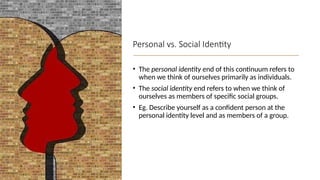
Personal vs. SocialIdentity
• The personal identity end of this continuum refers to
when we think of ourselves primarily as individuals.
• The social identity end refers to when we think of
ourselves as members of specific social groups.
• Eg. Describe yourself as a confident person at the
personal identity level and as members of a group.
6.
Working Self-Concept
• Thisaspect of the self concept that is assessed for
a particular situation is called the working self
concept.
• e.g. in a classroom situation, the academic self is likely
to be the dominant determinant of our thoughts and
feelings, whereas when we are reminded about a party
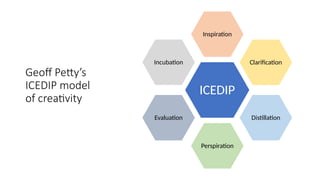
on Friday, the social self may be accessed.
• Think about a situation to justify working self-
concept.
7.
Self-Confidence
• The confidenceone has in oneself, one’s knowledge,
and one’s abilities.
• It is the confidence of the type: “I can do this”. “I have
the ability to do this”.
• Confidence =~ willingness to try
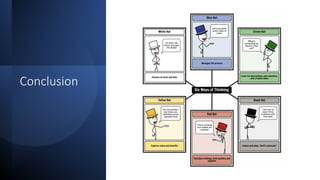
• Think about a situation when trying lead to increased
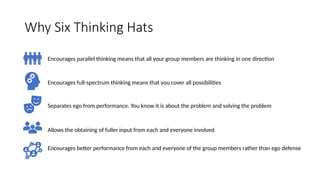
self confidence and fear of failure never make you try
something.
8.
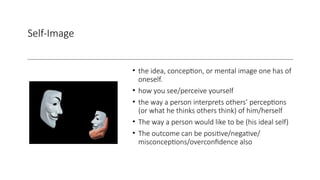
Self-Image
• the idea,conception, or mental image one has of
oneself.
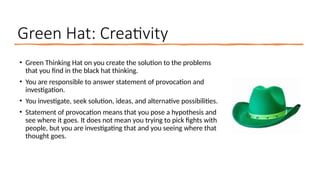
• how you see/perceive yourself
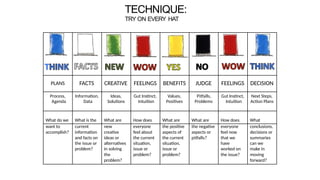
• the way a person interprets others’ perceptions
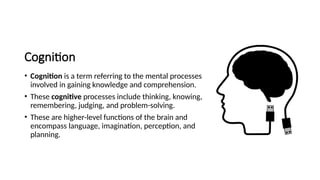
(or what he thinks others think) of him/herself
• The way a person would like to be (his ideal self)
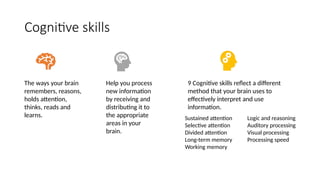
• The outcome can be positive/negative/
misconceptions/overconfidence also
9.
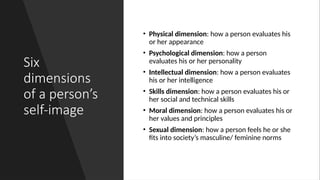
Six
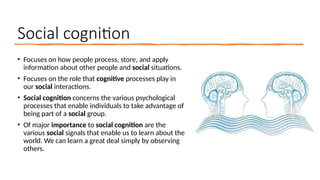
dimensions
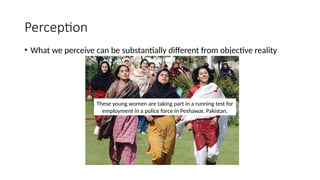
of a person’s
self-image
•Physical dimension: how a person evaluates his
or her appearance
• Psychological dimension: how a person
evaluates his or her personality
• Intellectual dimension: how a person evaluates
his or her intelligence
• Skills dimension: how a person evaluates his or
her social and technical skills
• Moral dimension: how a person evaluates his or
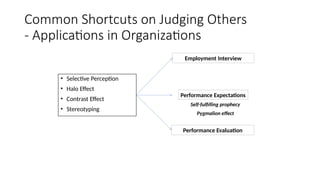
her values and principles
• Sexual dimension: how a person feels he or she
fits into society’s masculine/ feminine norms
10.
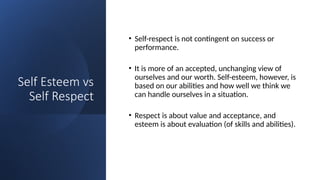
Self Esteem vs
SelfRespect
• Self-respect is not contingent on success or
performance.
• It is more of an accepted, unchanging view of
ourselves and our worth. Self-esteem, however, is
based on our abilities and how well we think we
can handle ourselves in a situation.
• Respect is about value and acceptance, and
esteem is about evaluation (of skills and abilities).
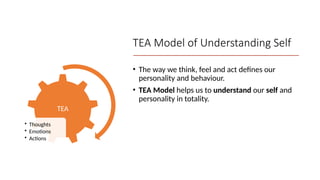
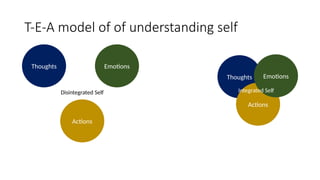
TEA Model ofUnderstanding Self
• The way we think, feel and act defines our
personality and behaviour.
• TEA Model helps us to understand our self and
personality in totality.
TEA
• Thoughts
• Emotions
• Actions
13.
Thoughts
• What doyou want in Life?
• This includes:
i. Life Purpose
ii. Life Values
iii. Life Goals
iv. Beliefs
14.
Emotions
• How doyou feel about what you want?
• How do you feel about where you are right now?
• This includes:
i. Beliefs (& frustrations)
ii. Fears
iii. Self-awareness
• Achievements and Potentials
• Mind, Body, and Soul
15.
Actions
• What dowe do to reach our targets?
• What shall we stop doing to reach our target?
• This includes :
i. Setting Priorities
ii. Identifying Obstacles
iii. Checking hidden beliefs when you are stuck
iv. Refreshing Motivators
v. Setting a Support System
Why Self-awareness?
• Researchsuggests that when we see
ourselves clearly, we :
• Are more confident and more creative
• Make sounder decisions
• Build stronger relationships
• Communicate more effectively
• Are less likely to lie, cheat, and steal
• Better career growth
• Are more-effective leaders
19.
What is Self-awareness?
•represents how we see our own values,
passions, aspirations, fit with our
environment, reactions (including
thoughts, feelings, behaviours, strengths,
and weaknesses), and impact on others.
• is associated with higher job and
relationship satisfaction, personal and
social control, and happiness.
• it is negatively related to anxiety, stress,
and depression.
20.
What is Self-awareness?
•External self-awareness means understanding how other
people view us, in terms of values, passions, aspirations, fit
with our environment, reactions (including thoughts,
feelings, behaviours, strengths, and weaknesses), and impact
on others.
• People who know how others see them are more skilled at
showing empathy and taking others’ perspectives.
• Leaders who see themselves as their employees do, their
employees tend to have a better relationship with them, feel
more satisfied with them, and see them as more effective in
general.
21.
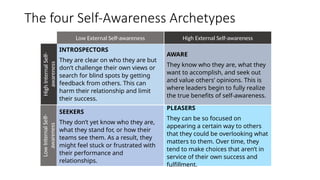
The four Self-AwarenessArchetypes
Low External Self-awareness High External Self-awareness
Low
Internal
Self-
awareness INTROSPECTORS
They are clear on who they are but
don’t challenge their own views or
search for blind spots by getting
feedback from others. This can
harm their relationship and limit
their success.
SEEKERS
They don’t yet know who they are,
what they stand for, or how their
teams see them. As a result, they
might feel stuck or frustrated with
their performance and
relationships.
PLEASERS
They can be so focused on
appearing a certain way to others
that they could be overlooking what
matters to them. Over time, they
tend to make choices that aren’t in
service of their own success and
fulfillment.
AWARE
They know who they are, what they
want to accomplish, and seek out
and value others’ opinions. This is
where leaders begin to fully realize
the true benefits of self-awareness.
High
Internal
Self-
awareness
22.
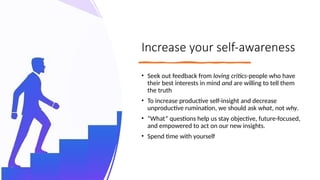
Increase your self-awareness
•Seek out feedback from loving critics-people who have
their best interests in mind and are willing to tell them
the truth
• To increase productive self-insight and decrease
unproductive rumination, we should ask what, not why.
• “What” questions help us stay objective, future-focused,
and empowered to act on our new insights.
• Spend time with yourself
Activity-2
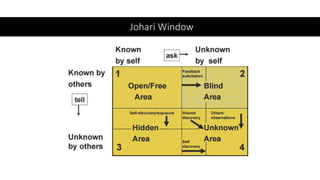
• Sit withyour best friend in class and construct your Johari
Window
• Next, sit with a far acquaintance and construct your Johari
Window
• Compare the two windows
• What difference do you see?
• What strategies/ways could you adopt to expand your
Open Area. Suggest specific measures for shrinking each of
the three boxes.
25.
Self Acceptance
• Anindividual’s satisfaction or happiness with oneself
• Necessary for good mental health.
• Results in an individual’s feeling about oneself that they are
of “unique worth”
• Prerequisite for change to occur
• Tolerating oneself to be imperfect in some parts
26.
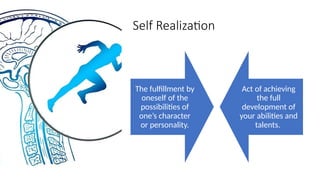
Self Realization
The fulfillmentby
oneself of the
possibilities of
one’s character
or personality.
Act of achieving
the full
development of
your abilities and
talents.
27.
Behavioral Communication
• Apsychological construct that addresses people's
use of day-to-day behaviors as a form of
communication.
• It refers to people's tendency to express feelings,
needs, and thoughts by means of indirect messages
and behavioral impacts.
• The symbols attached to these words are a function
of who we are, our social upbringing and culture,
which will pretty much vary quite widely in today's
work environment.
28.
Different Types ofCommunication Behaviour
1. Aggressive behaviour offends or isolates others’ rights.
2. Avoidance behaviour (Passive-Aggressive Communication) ignores the isolation
of rights and responsibilities through fear of the consequences or because you
don’t wish to be bothered with the consequences.
3. Submissive or accommodating behaviour lets you reduce anxiety, guilt or fear
by letting your views or thoughts be misconstrued, ignored or lets you be taken
advantage of.
4. Assertive Behaviour means being able to stand up for your own or other
people's rights in a calm and positive way, without being either aggressive, or
passively accepting 'wrong'.
29.
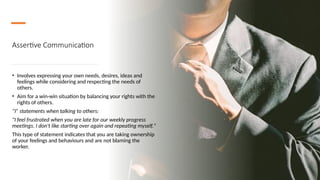
Assertive Communication
• Involvesexpressing your own needs, desires, ideas and
feelings while considering and respecting the needs of
others.
• Aim for a win-win situation by balancing your rights with the
rights of others.
“I” statements when talking to others:
"I feel frustrated when you are late for our weekly progress
meetings. I don't like starting over again and repeating myself."
This type of statement indicates that you are taking ownership
of your feelings and behaviours and are not blaming the
worker.
30.
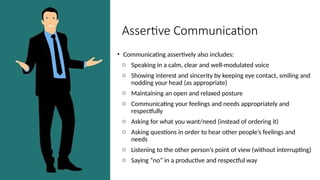
Assertive Communication
• Communicatingassertively also includes:
o Speaking in a calm, clear and well-modulated voice
o Showing interest and sincerity by keeping eye contact, smiling and
nodding your head (as appropriate)
o Maintaining an open and relaxed posture
o Communicating your feelings and needs appropriately and
respectfully
o Asking for what you want/need (instead of ordering it)
o Asking questions in order to hear other people’s feelings and
needs
o Listening to the other person’s point of view (without interrupting)
o Saying “no” in a productive and respectful way
31.
Aggressive Communication
• Withaggressive communication, you express your
own needs, desires, ideas and feelings without
considering and respecting the needs of others.
• Aggressive communication often involves “you”
statements and attacks on a worker, rather than
effective expressions of needs.
• For example, stating "you are never on time"
instead of "I need you to be on time".
• Managers and workers who communicate in an
aggressive manner are in general perceived as
egoistic and unwilling to make compromises.
32.
Aggressive Communication
• Othercharacteristics of aggressive communication may include:
o Speaking in a loud, bossy and demanding voice
o Having piercing eye contact
o Maintaining an overbearing posture
o Acting impulsively and rudely (low frustration tolerance)
o Commanding what you want/need (instead of requesting)
o Rarely asking questions (only interested in your needs and goals)
o Not listening well to the other person
o Interrupting the other person frequently
o Being unwilling to accept “no” or to make compromises
33.
Passive (Submissive) Communication
•When you do not express your own needs, desires, ideas and feelings, where this
would be advisable.
• You simply don’t stand up for yourself.
o Speaking in an overly apologetic or submissive manner
o Avoiding eye contact/poor eye contact
o Having a slumped body posture
o Holding back on stating your feelings and needs
o Giving in to other people, and ignoring your own needs
o Doing what you are asked regardless of how you feel about it
o Being unable to say “no” when asked for a favor
34.
Passive-Aggressive Communication (Avoidance)
•It is a combination of the above two styles- being passive in the manner in which
you express your needs, desires, ideas and feelings, but being aggressive in your
underlying intent.
• Communicating passive-aggressively often involves not speaking your message,
but rather trying to convey it through small disrespectful, annoying or ambiguous
comments and actions.
• E.g., when they avoid speaking directly to managers about their concerns and
express their dissatisfaction through other behaviours that seem manipulative.
35.
Passive-Aggressive Communication (Avoidance)
•Characteristics of passive-aggressive communication may include:
o Speaking in a sarcastic voice/using sarcasm
o Using non-verbal behaviours such as sighing and eye-rolling
o Using facial expressions and body language that are inconsistent with how you
feel (e.g., smiling when you’re upset)
o Avoiding dealing directly with a disruptive issue (e.g., acting passively and
denying that there is a problem, muttering to yourself rather than confronting
the person)
o Acting deceptively (appearing cooperative but acting uncooperatively)
o Acting out in a subtle, indirect manner (e.g., sabotaging another person to get
even)
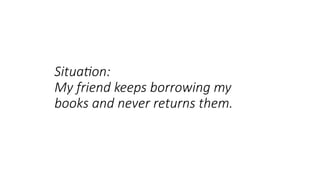
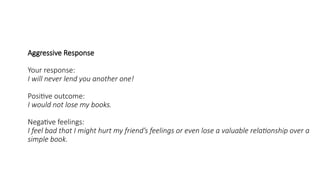
Aggressive Response
Your response:
Iwill never lend you another one!
Positive outcome:
I would not lose my books.
Negative feelings:
I feel bad that I might hurt my friend’s feelings or even lose a valuable relationship over a
simple book.
38.
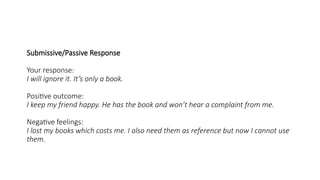
Submissive/Passive Response
Your response:
Iwill ignore it. It’s only a book.
Positive outcome:
I keep my friend happy. He has the book and won’t hear a complaint from me.
Negative feelings:
I lost my books which costs me. I also need them as reference but now I cannot use
them.
39.
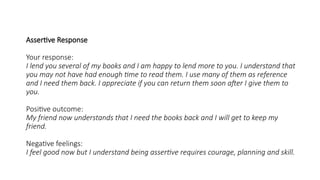
Assertive Response
Your response:
Ilend you several of my books and I am happy to lend more to you. I understand that
you may not have had enough time to read them. I use many of them as reference
and I need them back. I appreciate if you can return them soon after I give them to
you.
Positive outcome:
My friend now understands that I need the books back and I will get to keep my
friend.
Negative feelings:
I feel good now but I understand being assertive requires courage, planning and skill.
40.
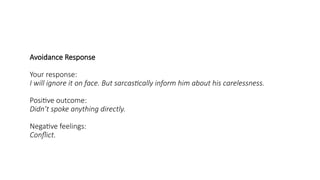
Avoidance Response
Your response:
Iwill ignore it on face. But sarcastically inform him about his carelessness.
Positive outcome:
Didn’t spoke anything directly.
Negative feelings:
Conflict.
41.
Technology adoption
Refers tothe acceptance, integration, and use of new technology in society.
The technology life cycle has four distinct stages: research and development,
ascent, maturity, and decline.
Organisations adopt new technologies to improve the efficiency and effectiveness of
various work processes. ... Failed investments in technology may not only cause
financial losses, but also lead to dissatisfaction among employees (Venkatesh, 2000).
42.
Social Media Etiquettes
1.Fill out your online profiles completely with information about you
and your business.
2. Use a different profile or account for your personal connections.
3. Create a section on your main profile detailing who you are seeking
to befriend and ask that visitors abide by that information.
4. Offer information of value.
5. Don't approach strangers and ask them to be friends with you just
so you can then try to sell them on your products or services.
6. Pick a screen name that represents you and your company well.
43.
Social Media Etiquettes
7.Don't send out requests for birthdays, invitations to play games
or other timewasters for those using the site.
8. Don't put anything on the Internet that you don't want your
future boss, current client or potential clients to read.
9. Check out the people who want to follow you or be your
friend.
10.If someone does not want to be your friend, accept their
decision gracefully.
11.Never post when you're overly-tired, jet lagged, intoxicated,
angry or upset.
12.Compose your posts, updates or tweets in a word processing
document so you can check grammar and spelling before you
send them.
Inspiration
• Idea-generation phase,many ideas are generated
• Characterised by spontaneity, experimentation,
intuition, and risk-taking.
• If you ‘can’t think of anything’, perhaps it is because
you are too self-critical, or expect good ideas to
come too quickly.
• Creativity is like mining for diamonds, most of what
you dig is thrown away, but that doesn’t make the
digging a waste of time.
46.
Clarification
• The aimis to clarify the purpose/objective of the work
• Seek answer to questions like:
• what am I trying to achieve here?
• what am I trying to say?
• what exactly is the problem I am trying to solve?
• what would I like the finished work to be like?
• And in more open-ended work:
• how could I exploit the ideas I have had?
• where could this idea take me - what could I make of it?
47.
Distillation
• Requires coolanalysis and judgment rather than
slap-happy spontaneity
• Look through the ideas you have generated and try
to determine which ones to work on
• The best ideas are chosen for further development,
or are combined into even better ideas
48.
Perspiration
• You workdeterminedly on your best ideas
• In this phase the real work is done
• Persistent effort is made towards your goal
attainment
• Usually involve further 'inspiration'
‘distillation’ and 'clarification' phases
49.
Evaluation
• Review phasein which you look back over your work in
progress:
• Hardly anyone gets things perfect first time, examine
your work for strengths and weaknesses
• How the work could be improved
• probably need to be another perspiration phase to
respond positively to the suggestions for
improvement
• Perspiration and evaluation phases often alternate to
form a cycle.
• Creative people adapt to improve
50.
Incubation
• You leavethe work alone, though you still ponder about it
occasionally , leaving it ‘on the surface of your mind’.
• If you are able to stop work on a project for a few days,
perhaps to work on other things, this will give your
subconscious time to work on any problems encountered,
it will also distance you somewhat from your ideas so that
you are better able to evaluate them.
• 'Incubation' is particularly useful after an 'inspiration' or a
'perspiration' phase, or if a problem has been encountered.
• Creative people are patient and untidy, and are content to
let half-baked ideas, loose ends and inconsistencies brew
away in their sub-conscious until 'something turns up'.
51.
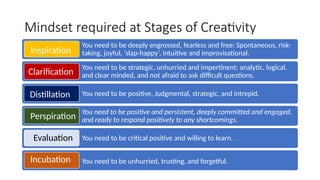
Mindset required atStages of Creativity
You need to be deeply engrossed, fearless and free: Spontaneous, risk-
taking, joyful, ‘slap-happy’, intuitive and improvisational.
You need to be strategic, unhurried and impertinent: analytic, logical,
and clear minded, and not afraid to ask difficult questions.
You need to be positive, Judgmental, strategic, and intrepid.
You need to be positive and persistent, deeply committed and engaged,
and ready to respond positively to any shortcomings.
You need to be critical positive and willing to learn.
You need to be unhurried, trusting, and forgetful.
Inspiration
Clarification
Distillation
Evaluation
Incubation
Perspiration
52.
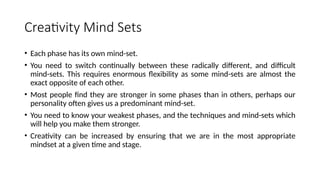
Creativity Mind Sets
•Each phase has its own mind-set.
• You need to switch continually between these radically different, and difficult
mind-sets. This requires enormous flexibility as some mind-sets are almost the
exact opposite of each other.
• Most people find they are stronger in some phases than in others, perhaps our
personality often gives us a predominant mind-set.
• You need to know your weakest phases, and the techniques and mind-sets which
will help you make them stronger.
• Creativity can be increased by ensuring that we are in the most appropriate
mindset at a given time and stage.
53.
Problem sensitivity
• Problemsensitivity is the ability to tell when something is wrong or is likely to go
wrong.
• Problem sensitivity does not involve solving the problem, only recognizing there
is a problem.
54.
Six Thinking Hats
•Edward de Bono in 1967 invented this Lateral Thinking
technique
• Six thinking hats is basically a critical thinking tool
• The premise of six thinking hats is: Doing everything at
the same time would only create confusion.
• Used as a tool for optimizing group discussion and
individual thinking
• A mean for a group to think together more effectively
• A way to plan thinking processes in a detailed and
cohesive way
55.
Why Six ThinkingHats
Encourages parallel thinking means that all your group members are thinking in one direction
Encourages full-spectrum thinking means that you cover all possibilities
Separates ego from performance. You know it is about the problem and solving the problem
Allows the obtaining of fuller input from each and everyone involved
Encourages better performance from each and everyone of the group members rather than ego defense
56.
Blue Hat: Process
•With blue thinking hat on you focus on the process
• Talks about how are we going to think and discuss the
subject
• We are not just thinking, we are thinking about how to think
• It plans for action that needs to be taken
• In charge of the decision making
• Is the discussion about something enough or do we need to
discuss some more?
• It is in charge of coming up with a summary and predicting
the outcome or collecting the outcome of the discussion
57.
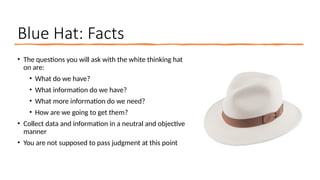
Blue Hat: Facts
•The questions you will ask with the white thinking hat
on are:
• What do we have?
• What information do we have?
• What more information do we need?
• How are we going to get them?
• Collect data and information in a neutral and objective
manner
• You are not supposed to pass judgment at this point
58.
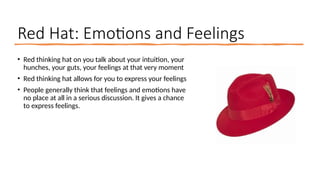
Red Hat: Emotionsand Feelings
• Red thinking hat on you talk about your intuition, your
hunches, your guts, your feelings at that very moment
• Red thinking hat allows for you to express your feelings
• People generally think that feelings and emotions have
no place at all in a serious discussion. It gives a chance
to express feelings.
59.
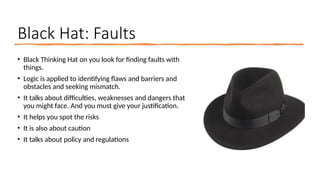
Black Hat: Faults
•Black Thinking Hat on you look for finding faults with
things.
• Logic is applied to identifying flaws and barriers and
obstacles and seeking mismatch.
• It talks about difficulties, weaknesses and dangers that
you might face. And you must give your justification.
• It helps you spot the risks
• It is also about caution
• It talks about policy and regulations
60.
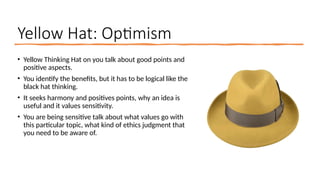
Yellow Hat: Optimism
•Yellow Thinking Hat on you talk about good points and
positive aspects.
• You identify the benefits, but it has to be logical like the
black hat thinking.
• It seeks harmony and positives points, why an idea is
useful and it values sensitivity.
• You are being sensitive talk about what values go with
this particular topic, what kind of ethics judgment that
you need to be aware of.
61.
Green Hat: Creativity
•Green Thinking Hat on you create the solution to the problems
that you find in the black hat thinking.
• You are responsible to answer statement of provocation and
investigation.
• You investigate, seek solution, ideas, and alternative possibilities.
• Statement of provocation means that you pose a hypothesis and
see where it goes. It does not mean you trying to pick fights with
people, but you are investigating that and you seeing where that
thought goes.
62.
TECHNIQUE:
TRY ON EVERYHAT
PLANS FACTS CREATIVE FEELINGS BENEFITS JUDGE FEELINGS DECISION
Process,
Agenda
Information,
Data
Ideas,
Solutions
Gut Instinct,
Intuition
Values,
Positives
Pitfalls,
Problems
Gut Instinct,
Intuition
Next Steps,
Action Plans
What do we What is the What are How does What are What are How does What
want to current new everyone the positive the negative everyone conclusions,
accomplish? information creative feel about aspects of aspects or feel now decisions or
and facts on ideas or the current the current pitfalls? that we summaries
the issue or alternatives situation, situation, have can we
problem? in solving issue or issue or worked on make in
the problem? problem? the issue? moving
problem? forward?
Cognition
• Cognition isa term referring to the mental processes
involved in gaining knowledge and comprehension.
• These cognitive processes include thinking, knowing,
remembering, judging, and problem-solving.
• These are higher-level functions of the brain and
encompass language, imagination, perception, and
planning.
65.
Cognitive skills
Sustained attention
Selectiveattention
Divided attention
Long-term memory
Working memory
Logic and reasoning
Auditory processing
Visual processing
Processing speed
The ways your brain
remembers, reasons,
holds attention,
thinks, reads and
learns.
Help you process
new information
by receiving and
distributing it to
the appropriate
areas in your
brain.
9 Cognitive skills reflect a different
method that your brain uses to
effectively interpret and use
information.
66.
Cognitive flexibility
• Theability to switch between thinking about two different concepts or to think
about multiple concepts simultaneously.
• Also related to one's ability to cope situations.
• Allows to analyze a situation and produce alternative plans to meet your goals or
requirements.
• Increases your likelihood of success.
• The ability to quickly adapt to new situations increases one's brain function and
resilience to stress.
67.
Cognitive Errors
• Arebiased perspectives we take on ourselves and the world around us
• Include irrational thoughts and beliefs that we unknowingly reinforce over time
• These patterns and systems of thought are often subtle–it’s difficult to recognize
them when they are a regular feature of your day-to-day thoughts.
• Cognitive distortions come in many forms but they all have some things in
common.
• All cognitive distortions are:
• Tendencies or patterns of thinking or believing;
• false or inaccurate;
• And have the potential to cause psychological damage.
68.
Most Common CognitiveErrors
• All-or-Nothing Thinking / Polarized Thinking
• Overgeneralization
• Mental Filter
• Disqualifying the Positive
• Jumping to Conclusions – Mind Reading
• Jumping to Conclusions – Fortune Telling
• Magnification (Catastrophizing) or Minimization
• Emotional Reasoning
69.
Social cognition
• Focuseson how people process, store, and apply
information about other people and social situations.
• Focuses on the role that cognitive processes play in
our social interactions.
• Social cognition concerns the various psychological
processes that enable individuals to take advantage of
being part of a social group.
• Of major importance to social cognition are the
various social signals that enable us to learn about the
world. We can learn a great deal simply by observing
others.
70.
Perception
• What weperceive can be substantially different from objective reality
These young women are taking part in a running test for
employment in a police force in Peshawar, Pakistan.
71.
Perception
• A processby which individuals organize and interpret their sensory
impressions in order to give meaning to their environment.
72.
At Home Activity01
• Elaborate for yourself how different factors influencing perception
have worked in your case and affected your perceptions of:
• A person
• A life event / situation
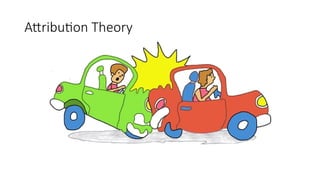
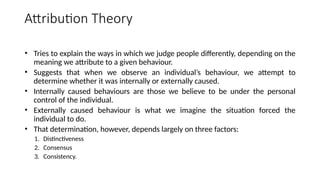
• Tries toexplain the ways in which we judge people differently, depending on the
meaning we attribute to a given behaviour.
• Suggests that when we observe an individual’s behaviour, we attempt to
determine whether it was internally or externally caused.
• Internally caused behaviours are those we believe to be under the personal
control of the individual.
• Externally caused behaviour is what we imagine the situation forced the
individual to do.
• That determination, however, depends largely on three factors:
1. Distinctiveness
2. Consensus
3. Consistency.
Attribution Theory
75.
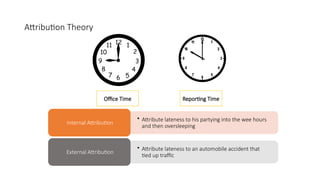
Attribution Theory
Office TimeReporting Time
• Attribute lateness to his partying into the wee hours
and then oversleeping
Internal Attribution
• Attribute lateness to an automobile accident that
tied up traffic
External Attribution
76.
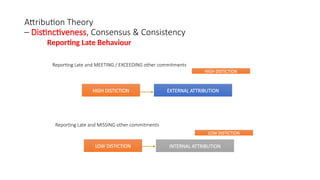
Attribution Theory
– Distinctiveness,Consensus & Consistency
HIGH DISTICTION
LOW DISTICTION
EXTERNAL ATTRIBUTION
INTERNAL ATTRIBUTION
Reporting Late Behaviour
Reporting Late and MEETING / EXCEEDING other commitments
Reporting Late and MISSING other commitments
HIGH DISTICTION
LOW DISTICTION
77.
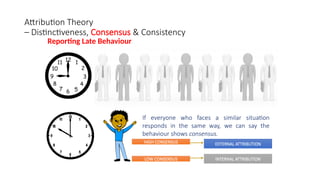
Attribution Theory
– Distinctiveness,Consensus & Consistency
Reporting Late Behaviour
If everyone who faces a similar situation
responds in the same way, we can say the
behaviour shows consensus.
HIGH CONSENSUS
LOW CONSENSUS
EXTERNAL ATTRIBUTION
INTERNAL ATTRIBUTION
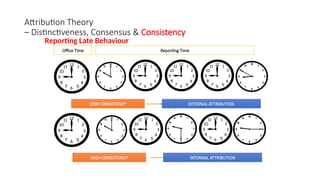
78.
Attribution Theory
– Distinctiveness,Consensus & Consistency
Reporting Late Behaviour
Office Time Reporting Time
LOW CONSISTENCY EXTERNAL ATTRIBUTION
HIGH CONSISTENCY INTERNAL ATTRIBUTION
79.
Activity 3
• Demonstrateattribution theory and how our attributions are determined using
an example from your daily life
80.
Attribution Theory –Errors in Attribution
When we make judgments about the behaviour of other people, we
tend to underestimate the influence of external factors and
overestimate the influence of internal or personal factors
Fundamental
Attribution Error
Individuals and organizations also tend to attribute their own
successes to internal factors such as ability or effort, while blaming
failure on external factors such as bad luck or unproductive co-
workers. People also tend to attribute ambiguous information as
relatively flattering and accept positive feedback while rejecting
negative feedback
Self-Serving Bias
81.
Common Shortcuts onJudging Others (Perception Errors)
• Selective Perception
• The tendency to selectively interpret what one sees on the basis of one’s interests,
background, experience, and attitudes.
• Halo Effect
• When we draw a general impression about an individual on the basis of a single
characteristic, such as intelligence, sociability, or appearance, a halo effect is operating.
• Contrast Effect
• Evaluation of a person’s characteristics that is affected by comparisons with other people
recently encountered who rank higher or lower on the same characteristics.
• Stereotyping
• When we judge someone on the basis of our perception of the group to which he or she
belongs, we are using the shortcut called stereotyping
82.
Common Shortcuts onJudging Others (Perception Errors)
• Self-fulfilling Prophecy
• sociopsychological phenomenon of someone "predicting" or expecting something, and this
"prediction" or expectation coming true simply because the person believes it will and the
person's resulting behaviors align to fulfill the belief. This suggests that people's beliefs
influence their actions. The principle behind this phenomenon is that people create
consequences regarding people or events, based on previous knowledge of the subject.
• Pygmalion Effect
• a psychological phenomenon wherein high expectations lead to improved performance in a
given area.
At Home Activity
•Demonstrate the application of perception errors in your life
• In first paragraph explain the concept
• In the second, describe the experience
85.
Self-fulfilling Prophecy
• Asituation in which a person inaccurately perceives a second person, and the
resulting expectations cause the second person to behave in ways consistent
with the original perception.
86.
Improving Perceptions
• Awarenessof Perceptual Biases
• Improving Self-awareness
• Johari Window
• Meaningful Interaction
• Contact Hypothesis: This is the principle that bringing people together who
are in conflict (or where one is bullying the other), the conflict will subside as
they get to understand one another.
87.
Activity 4
• PygmalionEffect
• With your partner (the one sitting next to you) share an incident from
your life where someone was Pygmalion. Also share the impact / result of
it for you.
• Contact Hypotheses
• With your partner share the application of Contact Hypotheses in your
life. Discuss a specific encounter with a person or any entity where
contact hypotheses actually proved right and your perception changed
about the person or the entity.
88.
Handling Criticism
"THE ONLYWAY TO AVOID CRITICISM IS TO SAY NOTHING, DO NOTHING, BE
NOTHING.”
• Criticism is "the art of evaluating or analyzing with knowledge and propriety."
• Criticism is often delivered when someone perceives that we have failed them,
not lived up to their expectations.
89.
Handling Criticism
• Theresult is that we find ourselves on the receiving end of words spoken out of
frustration, disappointment, anger, envy.
• Typically, our reaction is to respond in the same manner - with anger, sarcasm,
defensiveness.
• When two people communicate with each other in this fashion, a healthy,
respectful relationship is not possible.
• Therefore, it is important to understand how to deal with criticism within our
relationships - whether they are intimate, casual, work or school-related.
90.
Two Types ofCriticism: Valid Criticism
• Can be considered constructive
• Based on accurate perceptions of events or behaviour
• Person criticizing wants to help and provides solid suggestions for change
You know it is valid criticism when you:
• have heard the criticism from more than one person
• the critic knows a great deal about the subject
• the critic is generally known as someone who has and applies reasonable
standards of behaviour
91.
Two Types ofCriticism: Unjustified Criticism
• Often delivered by someone when you don't live up to their expectations
• The critic might nag, recite your failures as a person, try to appear smarter, better,
etc. than you, or criticize what you are doing to get you to do something else.
92.
Responding to Criticism
•The best way to respond to criticism is to use an assertive communication style.
• Show respect for yourself and your critic, without attacking or surrendering.
• Resolve misunderstandings, acknowledge what may be accurate in the criticism,
and nip in the bud any unjustified attack.
Activity: Handling RepeatedEvents and Behaviours
Review each scenario individually. Identify the positive aspect of
each situation. Then identify the negative behavior or event that
should be addressed. Finally, come up with a solution that can be
used to stop it.
• Scenarios:
• Positive:
_____________________________________________
• Negative:
_____________________________________________
• Solution:
___________________________________________________
_______________________________________
95.
Activity 5: HandlingRepeated Events and
Behaviours
Use following Scenarios:
1. An employee works hard during the day and stays late to
finish projects and assignments. However, she is always tardy
in the morning when reporting to work.
2. An employee is on several committees and continues to
volunteer to work on others. In return, her quality of work
has started to drop.
Editor's Notes
#8 self-image is based on our perceptions of reality, that it is built over a lifetime and continues to change as we do, and that it’s something we have some influence over.
A positive self-image is having a good view of yourself; for example:
Seeing yourself as an attractive and desirable person.
Having an image of yourself as a smart and intelligent person.
Seeing a happy, healthy person when you look in the mirror.
negative self-image is the flipside of the above; it looks like:
Seeing yourself as unattractive and undesirable.
Having an image of yourself as a stupid or unintelligent person.
Seeing an unhappy, unhealthy person when you look in the mirror.
Believing that you are nowhere near your ideal version of yourself.
Thinking that others perceive you as all of the above as well as yourself.