COMMUNICATION
MODELS
Linear Communication Model
• Lasswell’s Model
• Aristotle’s Model
• Berlo’s SMCR Model
Transactional Model
• Shannon & Weaver Model
Interactive Model
• Schramm’s Model
• Dance-helical Model
COMMUNICATION MODELS
A. LINEAR MODEL OF COMMUNICATION
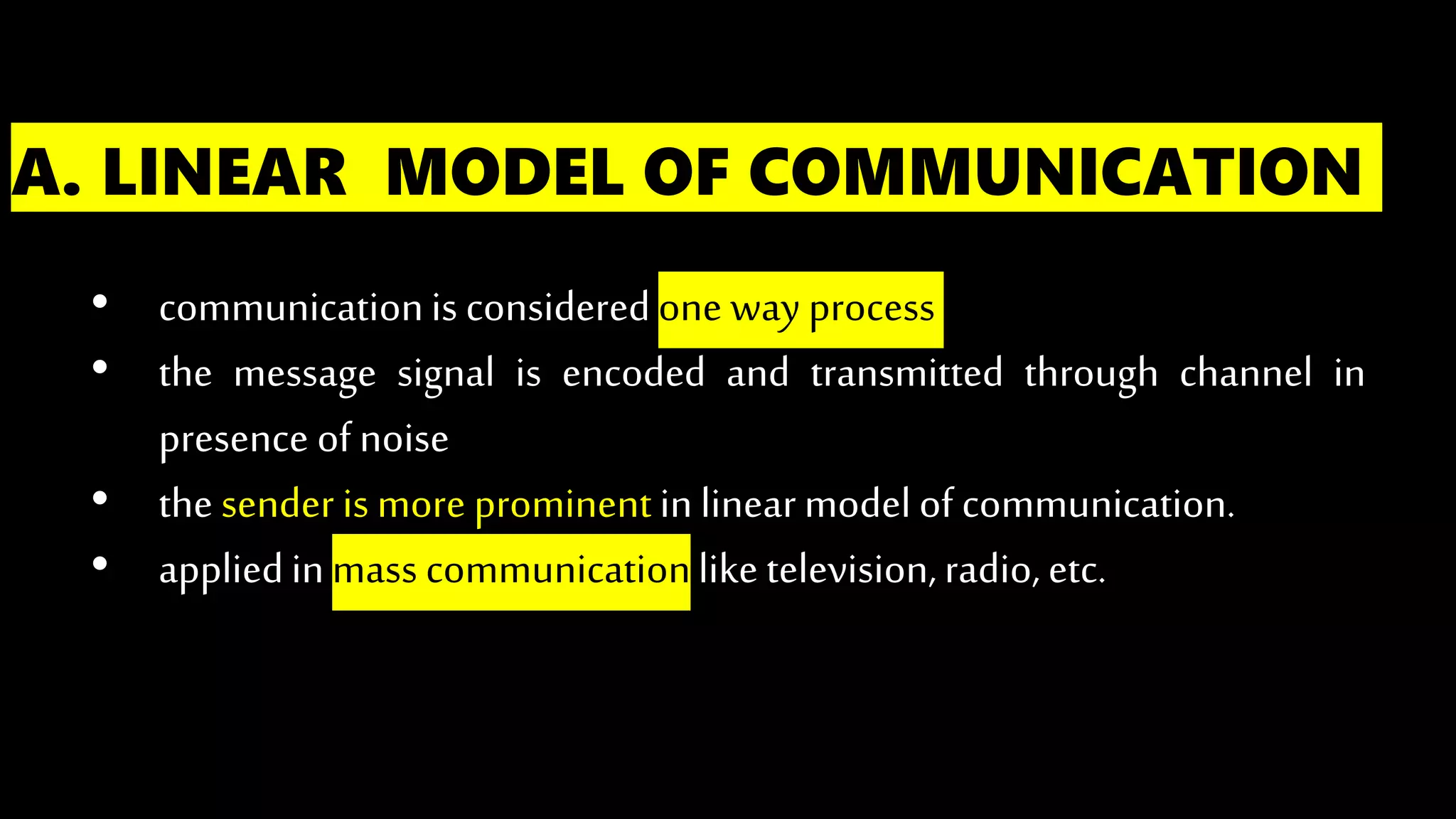
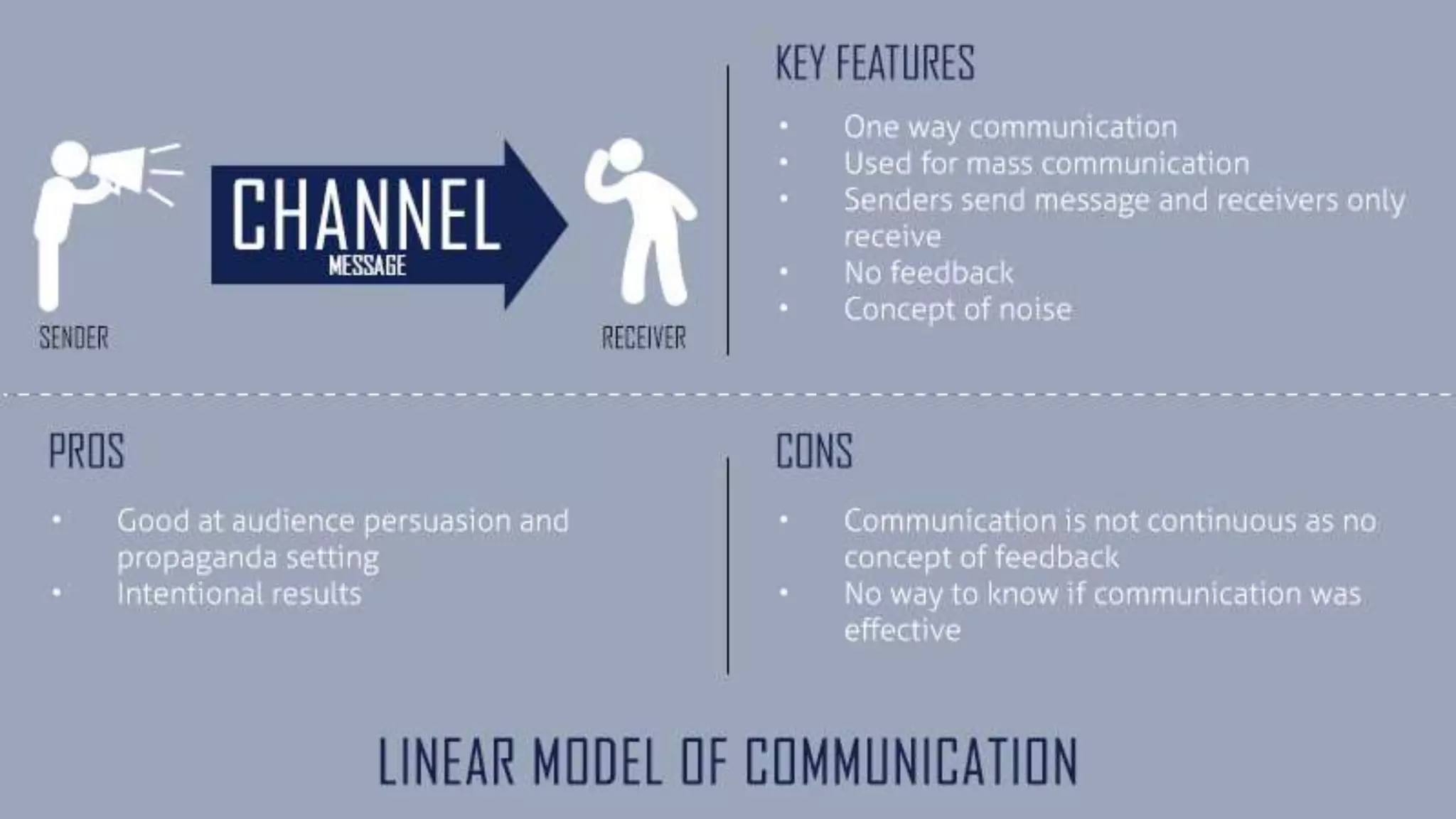
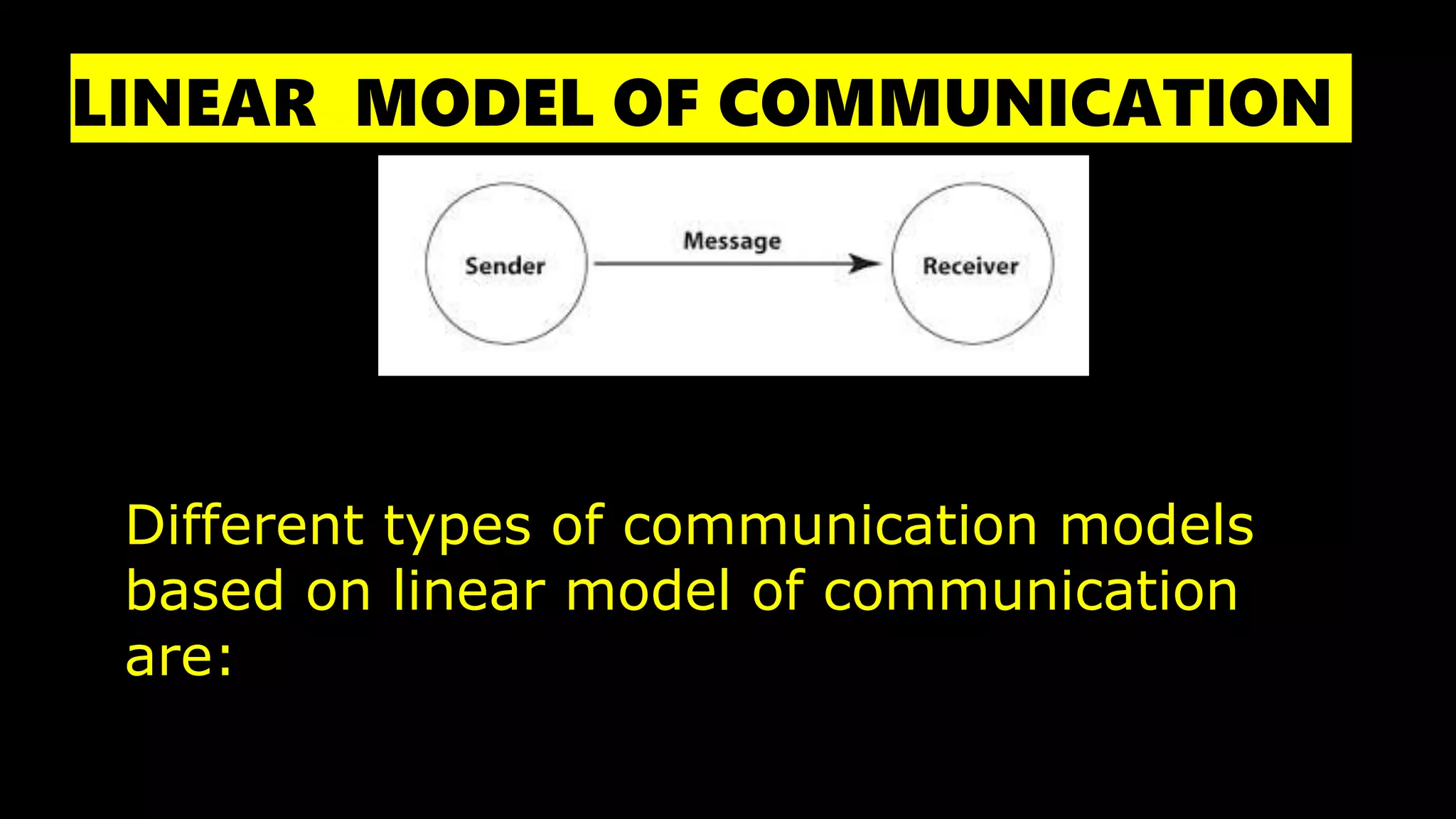
• communicationis consideredone way process
• the message signal is encoded and transmitted through channel in
presence ofnoise
• the sender is more prominentinlinearmodel of communication.
• appliedinmass communicationlike television,radio, etc.
LINEAR MODEL OF COMMUNICATION
Different types of communication models
based on linear model of communication
are:
1. ARISTOTLE’S MODEL OF COMMUNICATION
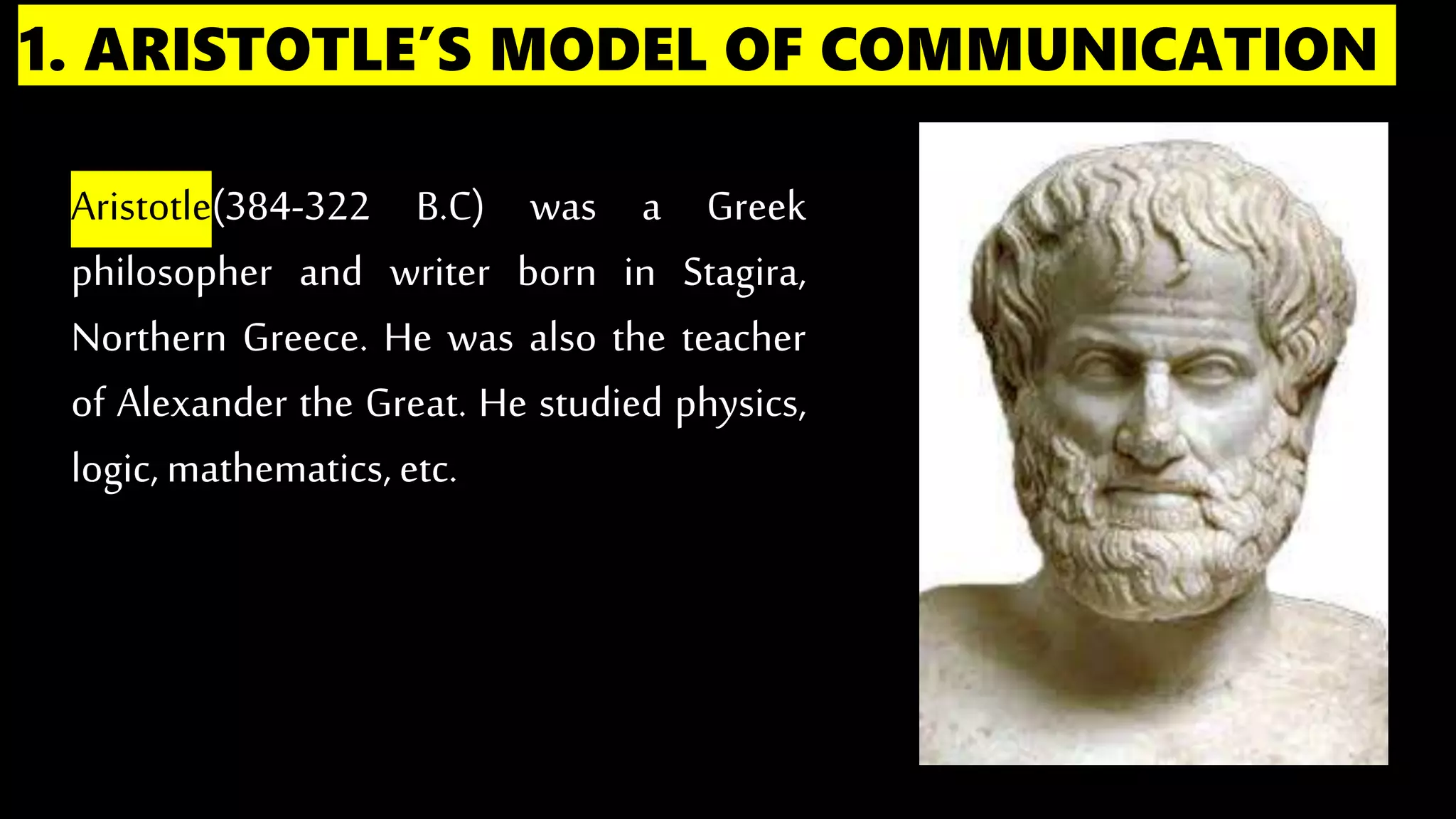
Aristotle(384-322 B.C) was a Greek
philosopher and writer born in Stagira,
Northern Greece. He was also the teacher
of Alexander the Great. He studied physics,
logic, mathematics,etc.
1. ARISTOTLE’S MODEL OF COMMUNICATION
• considered as the first model of communication and was proposed before 300
B.C.
• most widely acceptedamong allcommunicationmodels.
1. ARISTOTLE’S MODEL OF COMMUNICATION
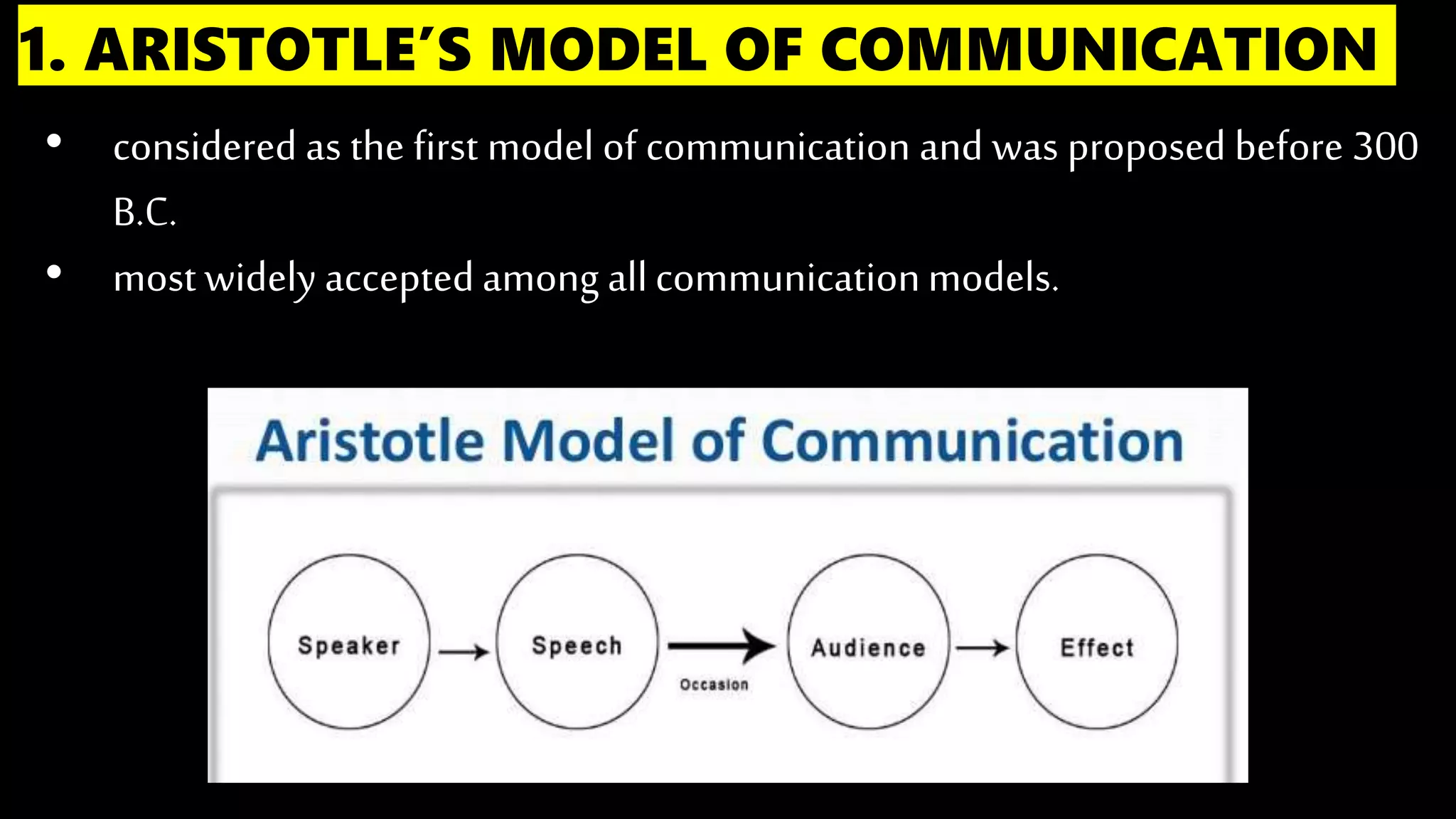
• Aristotle Model is mainly focused on speaker and speech. It can be broadly divided into
5 primary elements:Speaker, Speech, Occasion, Audienceand Effect
• speaker centeredmodel
• highly used to develop public speaking skills and create a propaganda at that time so, it
is lessfocused on intrapersonal or interpersonal communication
• speaker must have a very good non-verbal communication with the audience like eye
contact
ELEMENTS OF GOOD COMMUNICATOR
1. ETHOS
• Credibility of the speaker
• characteristicwhich makes you credible in front of the audience
2. PATHOS
• Emotional bond
• f whatyou say matters to them andthey canconnect with it, then they willbe more interested
3. LOGOS
• sense of reason
• You must present factsto the audience for them to believe in you
CRITICISMS OF ARISTOTLE’S MODEL OF
COMMUNICATION
There are few criticisms around this model. Some of
them are:
• There is no concept of feedback, it is one way from speaker to audience.
• Thereis no concept of communicationfailurelike noise and barriers.
• This model can only be used in public speaking.
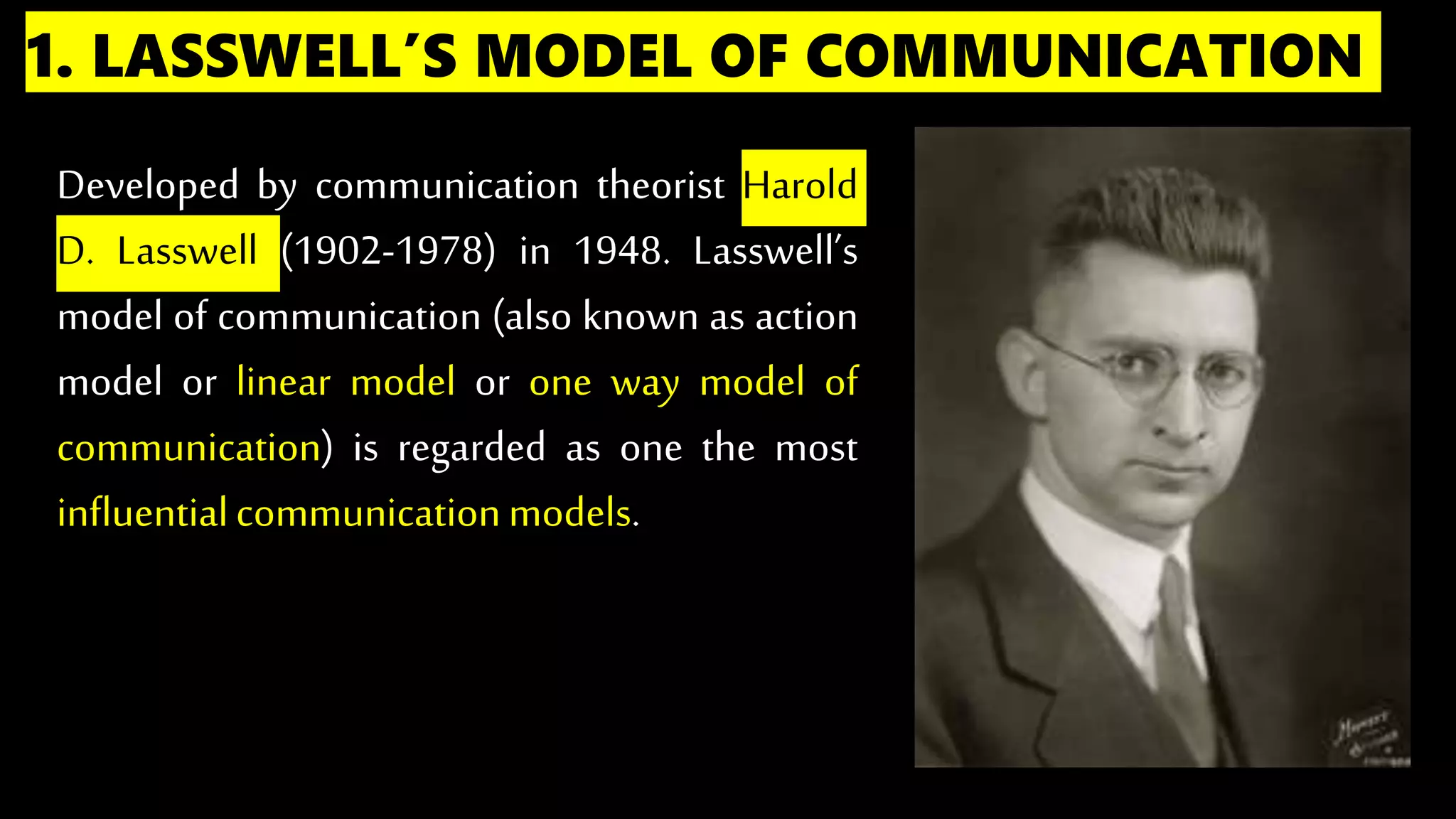
1. LASSWELL’S MODEL OF COMMUNICATION
Developed by communication theorist Harold
D. Lasswell (1902-1978) in 1948. Lasswell’s
model of communication (also known as action
model or linear model or one way model of
communication) is regarded as one the most
influentialcommunicationmodels.
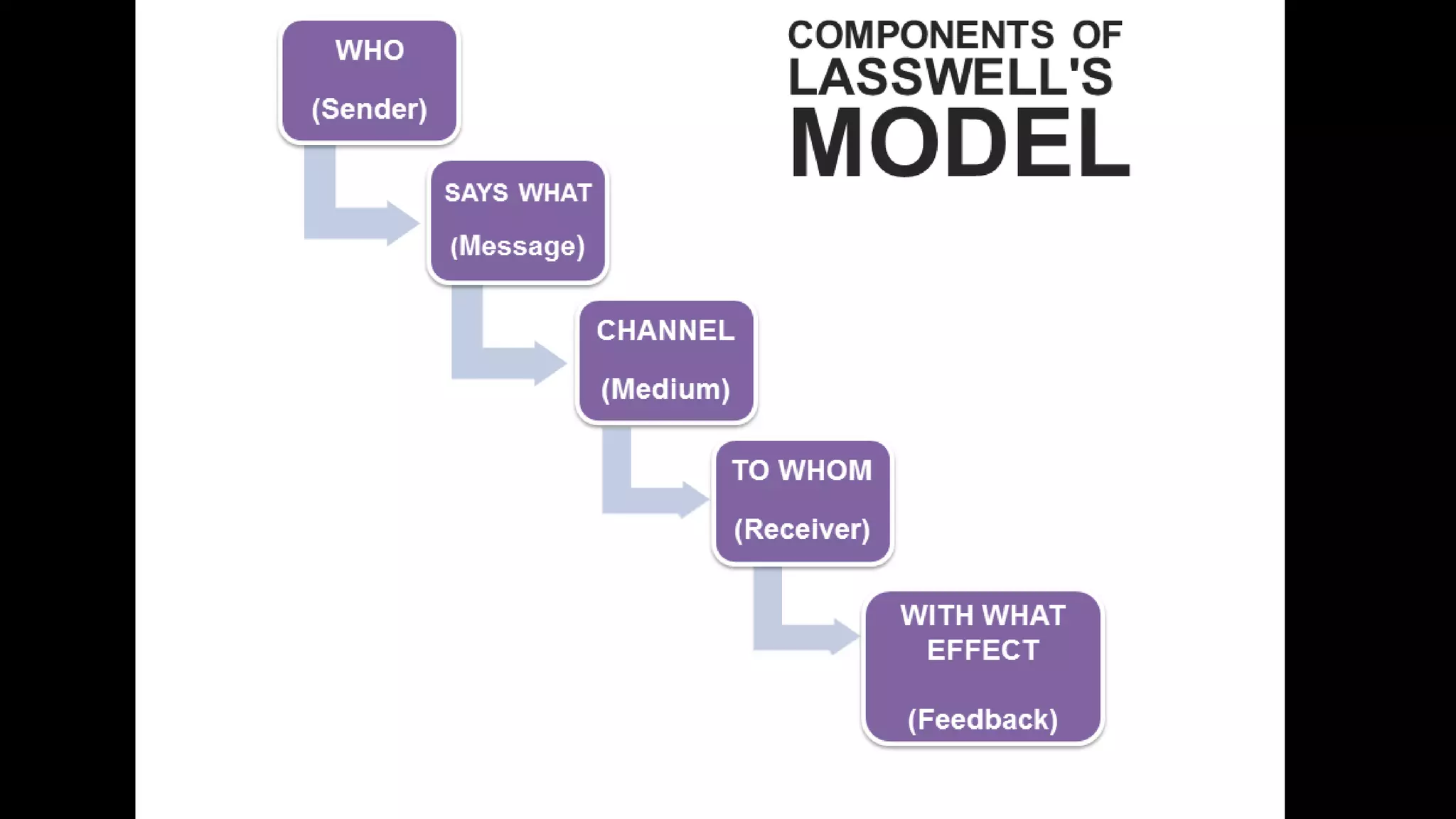
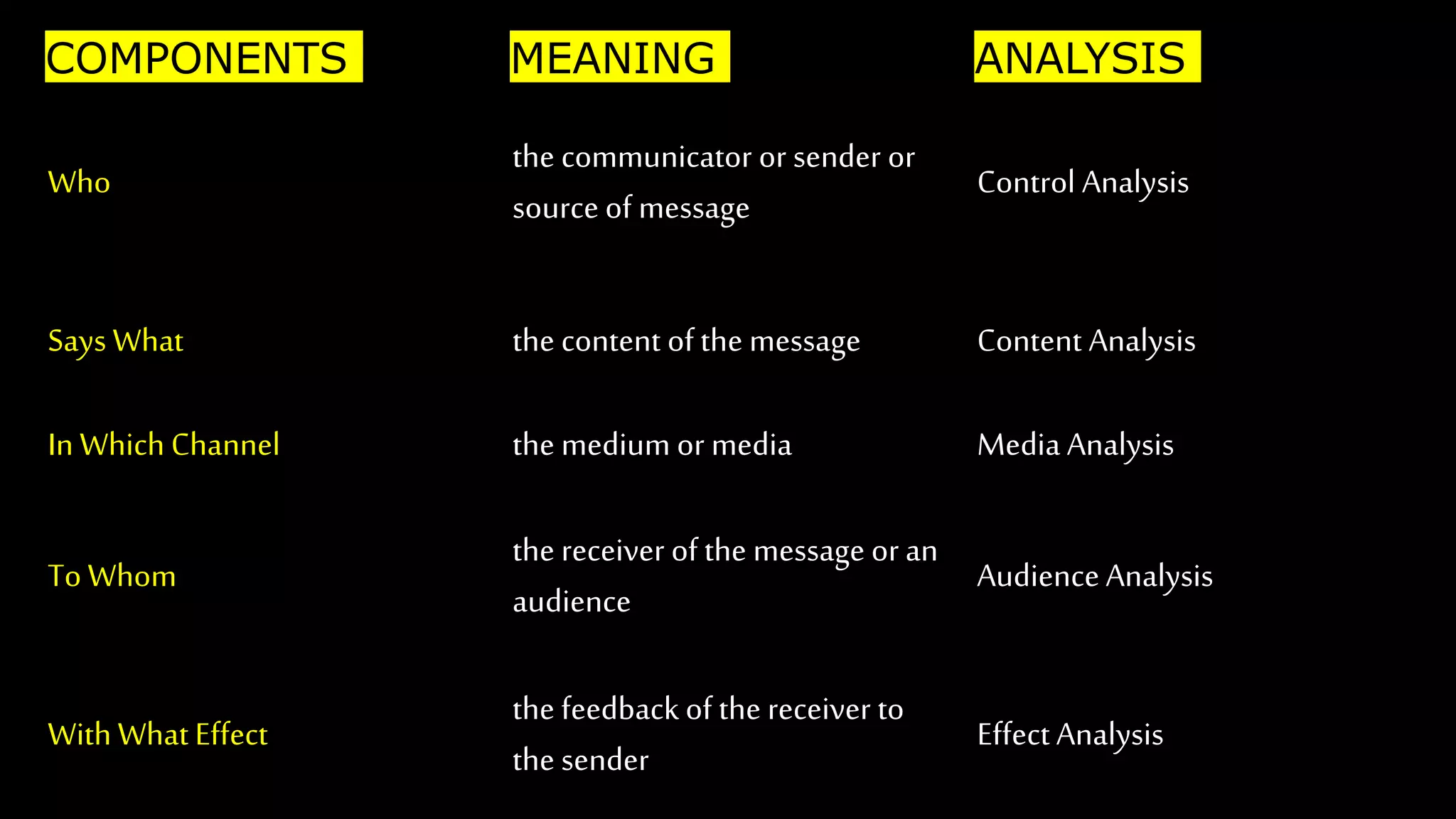
COMPONENTS MEANING ANALYSIS
Who
the communicator or sender or
source of message
Control Analysis
Says What the content of the message Content Analysis
In Which Channel the medium or media Media Analysis
To Whom
the receiver of the message or an
audience
Audience Analysis
With What Effect
the feedback of the receiver to
the sender
Effect Analysis
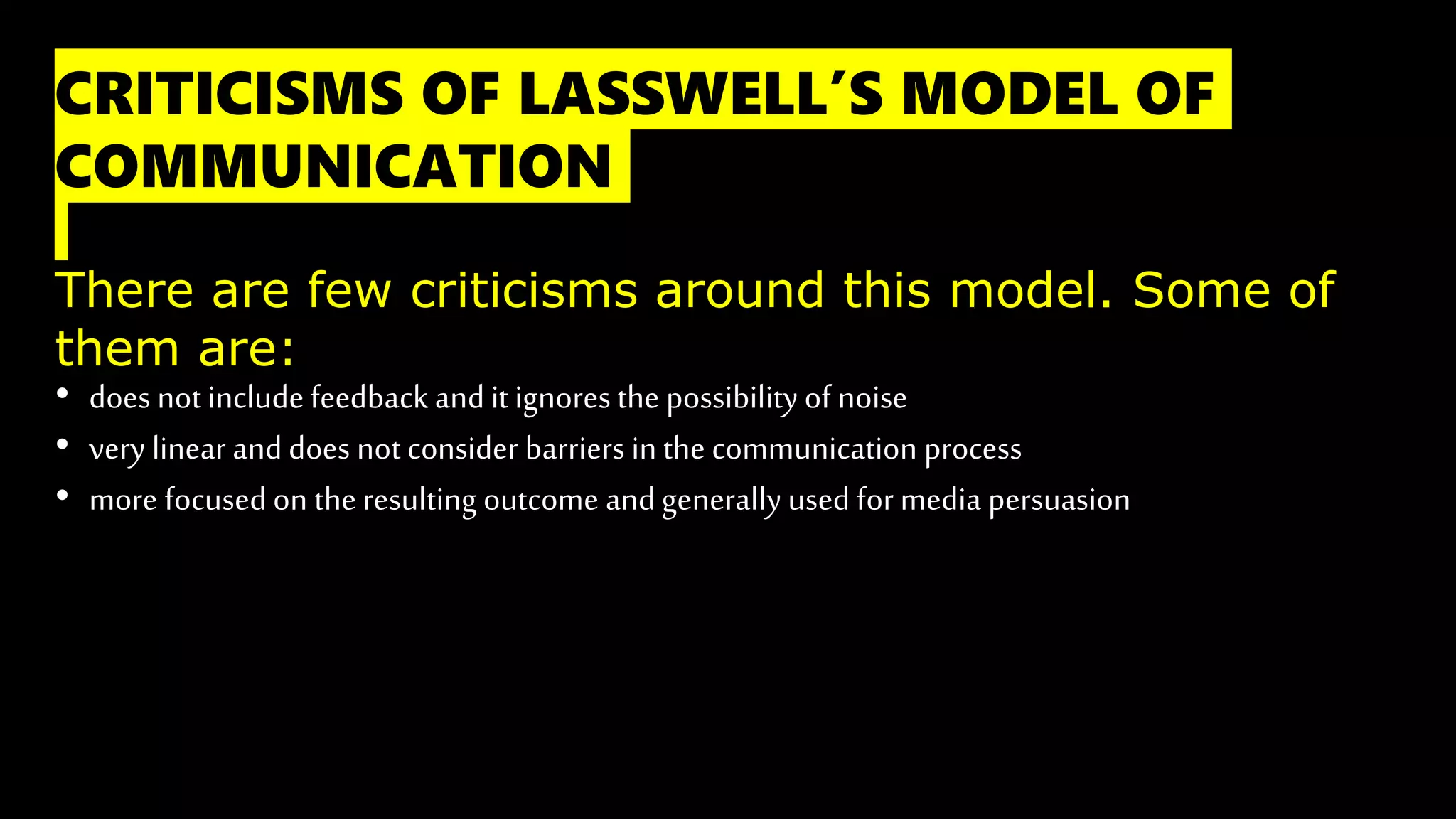
CRITICISMS OF LASSWELL’S MODEL OF
COMMUNICATION
There are few criticisms around this model. Some of
them are:
• does not include feedback and it ignores the possibility of noise
• very linear and does not consider barriers in the communication process
• more focused on the resulting outcome and generally used for media persuasion
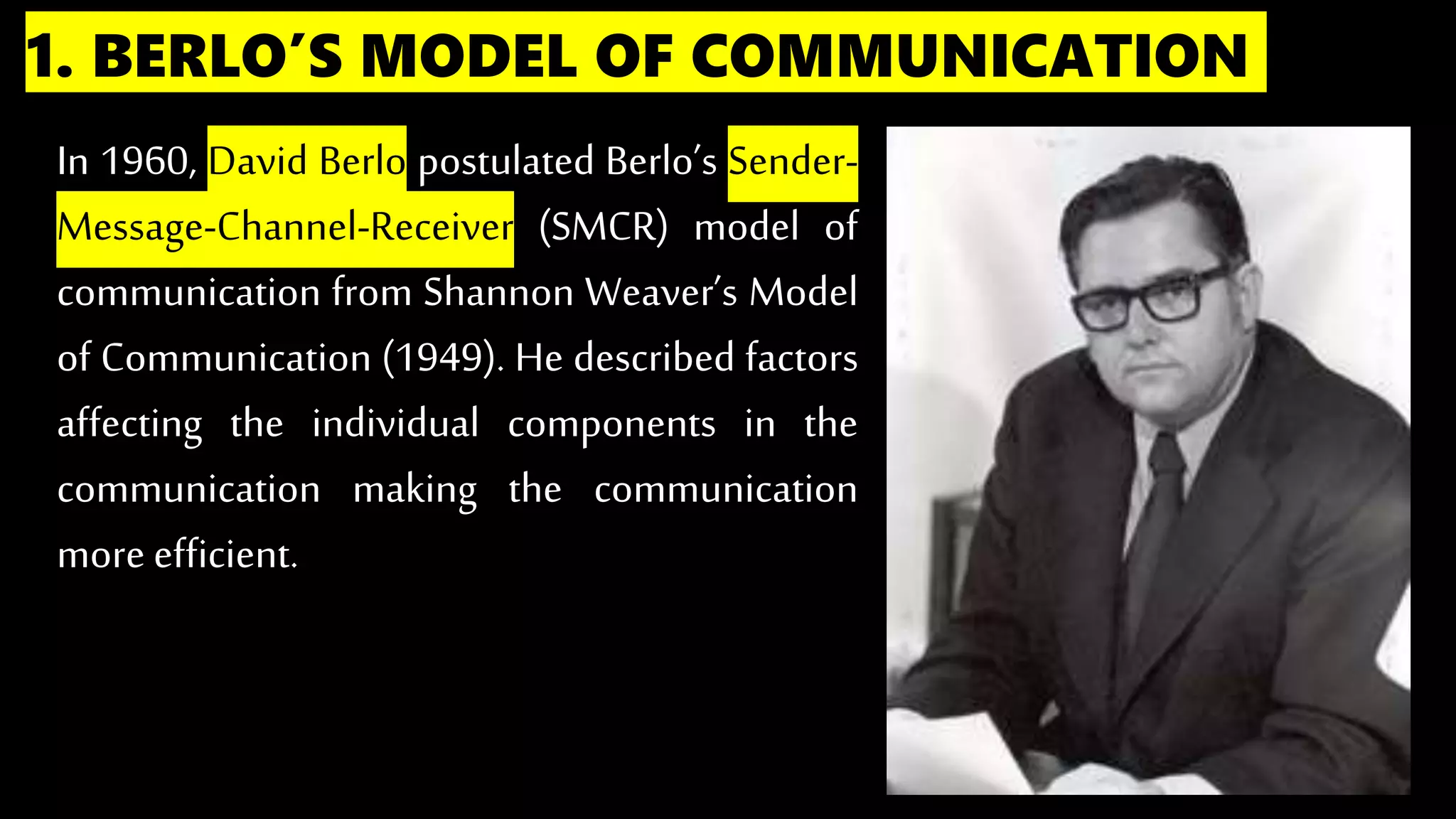
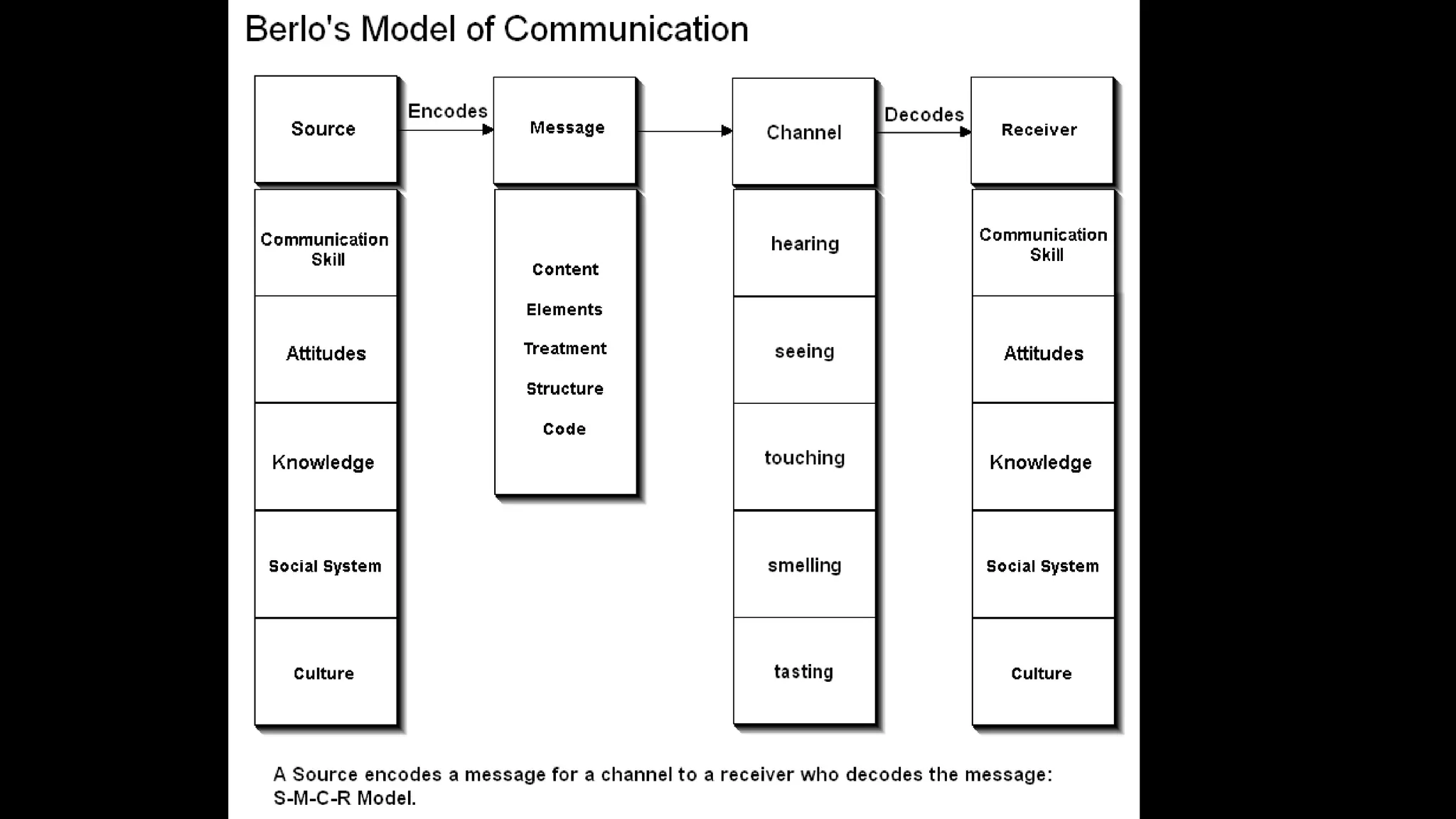
1. BERLO’S MODEL OF COMMUNICATION
In 1960, David Berlo postulated Berlo’s Sender-
Message-Channel-Receiver (SMCR) model of
communication from Shannon Weaver’s Model
of Communication (1949). He described factors
affecting the individual components in the
communication making the communication
more efficient.
1. BERLO’S MODEL OF COMMUNICATION
• focuses on encoding and decoding which happens before sender sends the
message andbefore receiver receives the message respectively
• Berlo’s Model has mainly, four components to describe the communication
process. They are sender, message, channel and receiver. Each of the
component is affectedby many factors.
CRITICISMS OF BERLO’S MODEL OF
COMMUNICATION
There are few criticisms around this model. Some of
them are:
• There is no concept of feedback, so the effect is not considered.
• There is no concept of noise or anykind of barriers in communication process.
• It is a linear model of communication, there is no two way communication.
• Both of the people must be similar according to allthe factors mentioned above.
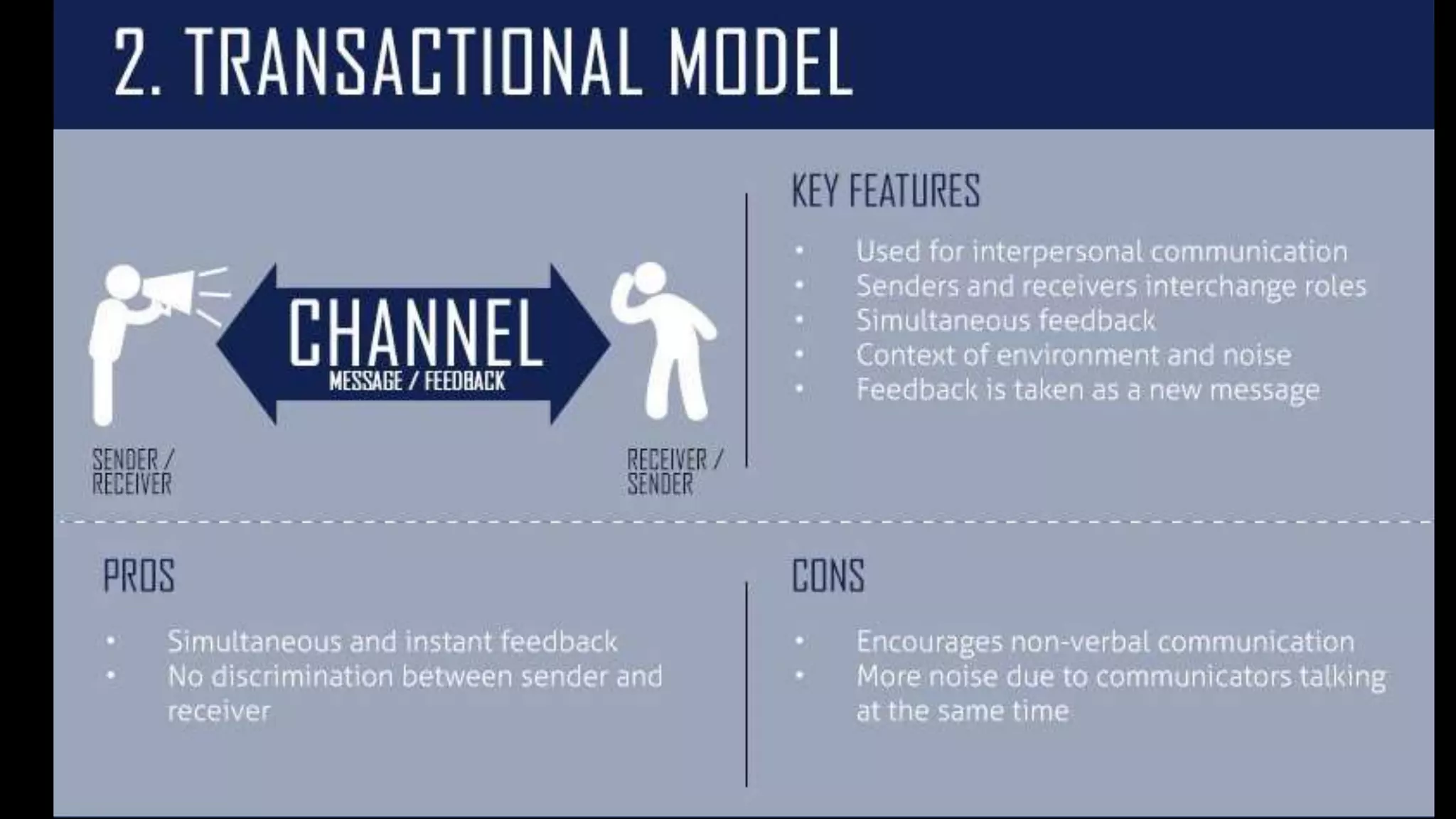
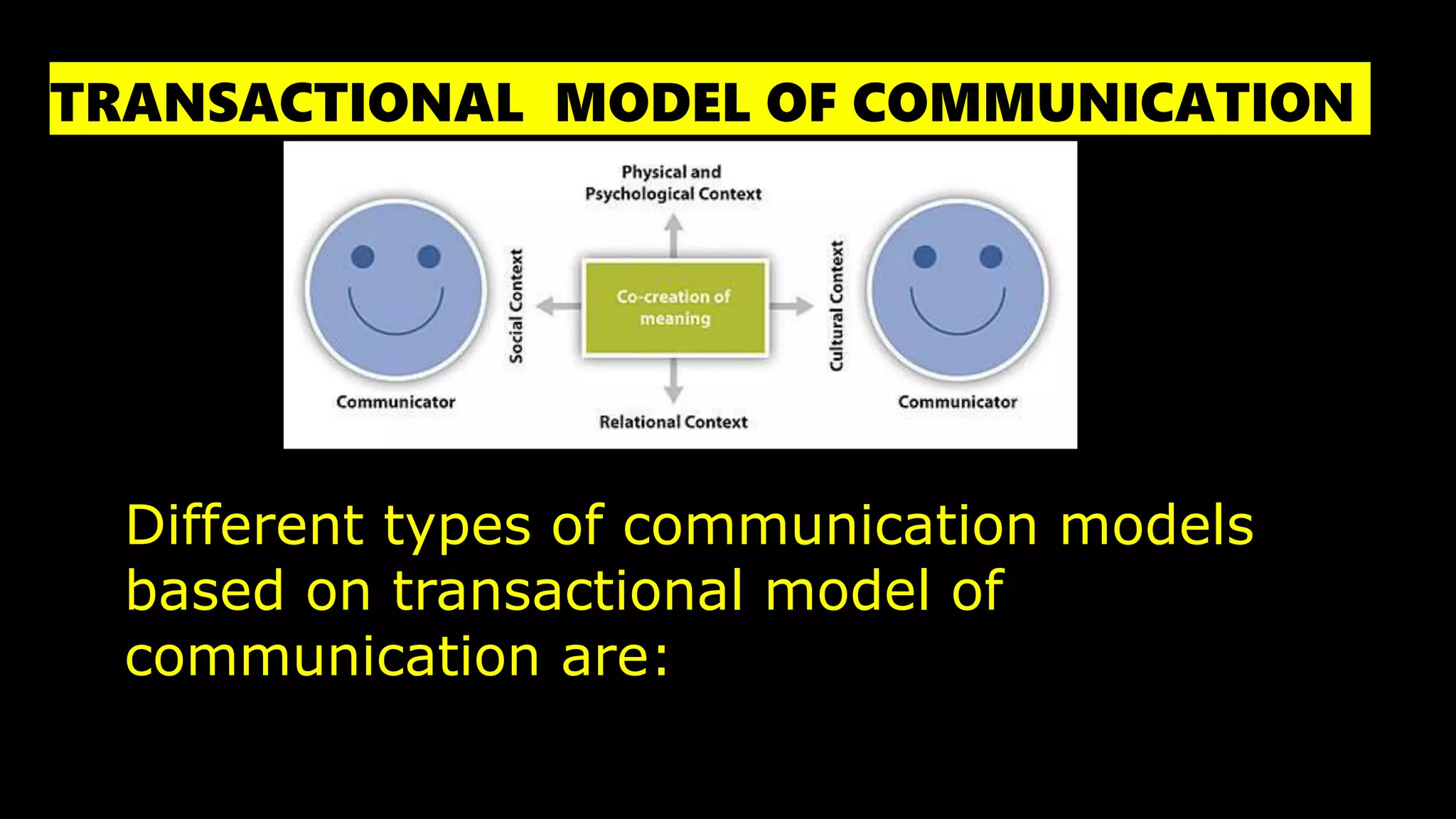
B. TRANSACTIONAL MODEL OF COMMUNICATION
• Transactional model of communication is the exchange of messages
between sender and receiver where each take turns to send or receive
messages.
• bothsender andreceiver are known ascommunicators
• The model is mostly used for interpersonal communication and is also
calledcircular model ofcommunication.
TRANSACTIONAL MODEL OF COMMUNICATION
Different types of communication models
based on transactional model of
communication are:
SHANNON and WEAVER’S
MODEL OF COMMUNICATION (INFORMATION THEORY)
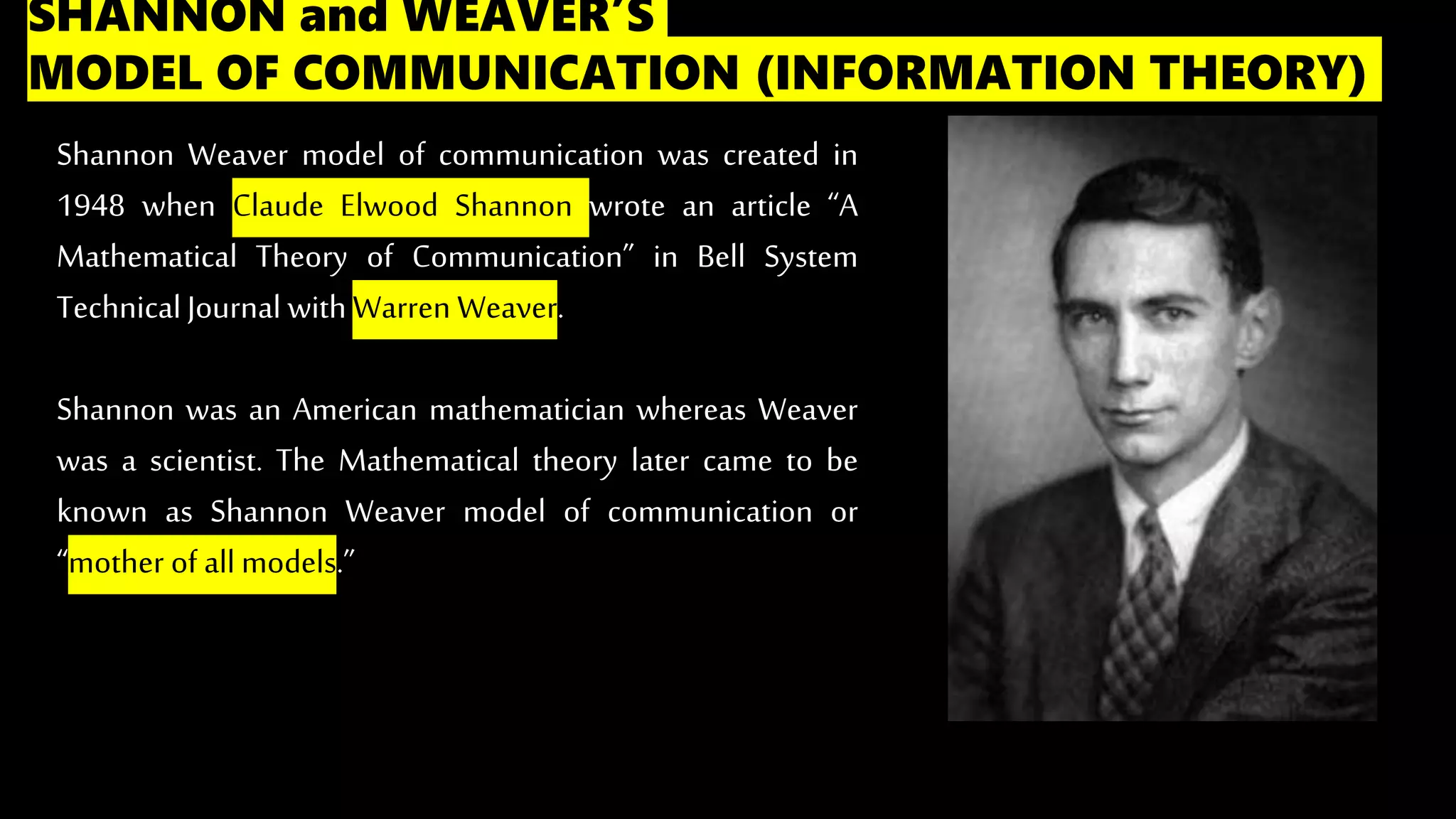
Shannon Weaver model of communication was created in
1948 when Claude Elwood Shannon wrote an article “A
Mathematical Theory of Communication” in Bell System
TechnicalJournal with Warren Weaver.
Shannon was an American mathematician whereas Weaver
was a scientist. The Mathematical theory later came to be
known as Shannon Weaver model of communication or
“mother of all models.”
CONCEPTS IN SHANNON WEAVER MODEL
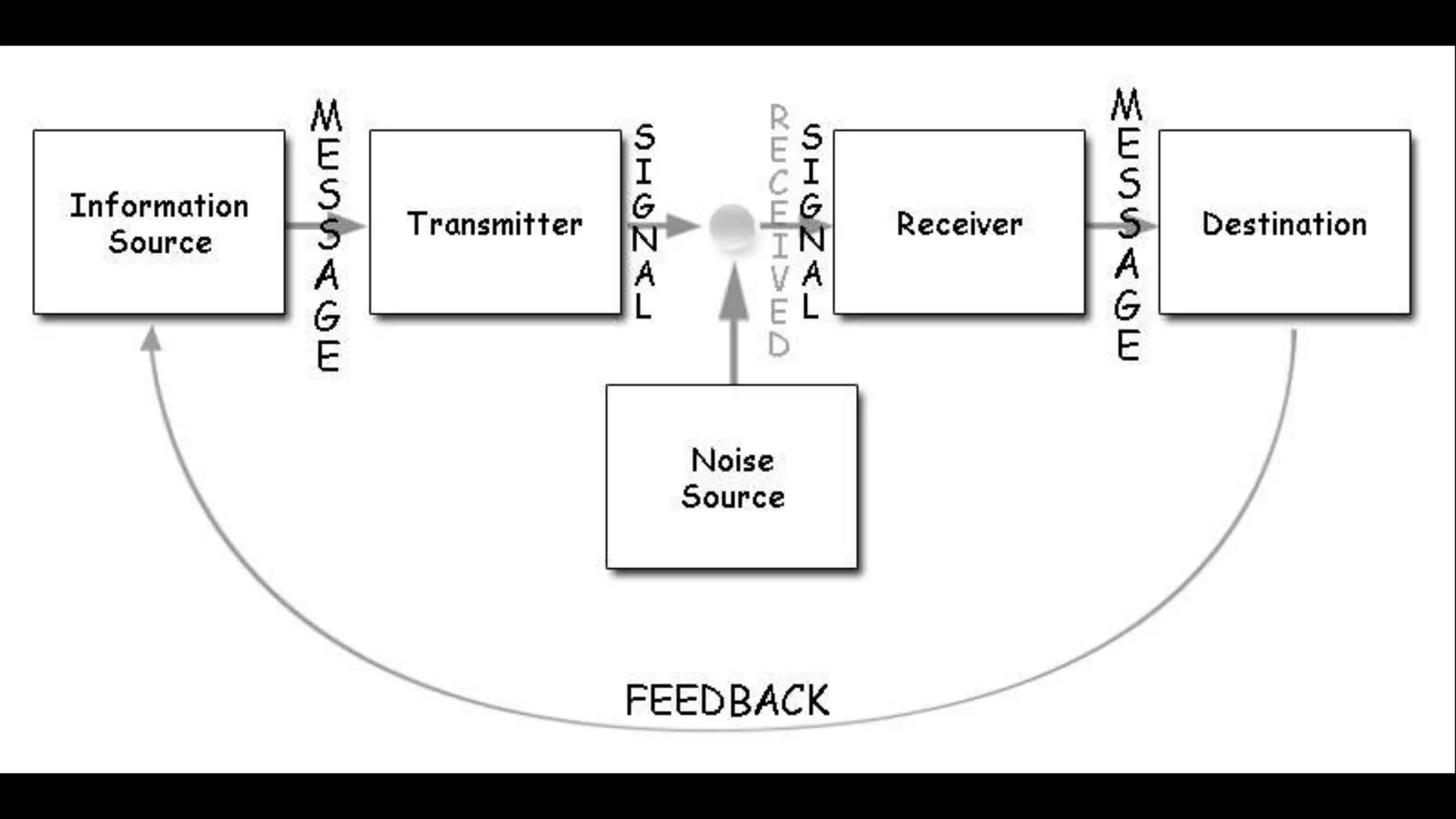
• Sender(Information source)– Senderis the person who makes the message,chooses the channel and sends the message.
• Encoder (Transmitter) –Encoder is the sender who uses machine, which converts message into signals or binary data. It
might also directly refer to the machine.
• Channel –Channel is the medium used to send message.
• Decoder (Receiver) – Decoder is the machine used to convert signals or binary data into message or the receiver who
translates the message from signals.
• Receiver (Destination) –Receiver is the person who gets the message or the place where the message must reach. The
receiverprovides feedback accordingto the message.
• Noise –Noise is the physical disturbances like environment, people, etc. which does not let the message get to the receiver
aswhat is sent.
ADVANTAGES OF BERLO’S MODEL OF
COMMUNICATION
There are few advantages around this model. Some of
them are:
• Concept of noise helps in making the communication effective by removing the noise or problem
causingnoise.
• Thismodel takescommunication asa two way process. It makes the model applicable in general
communication.
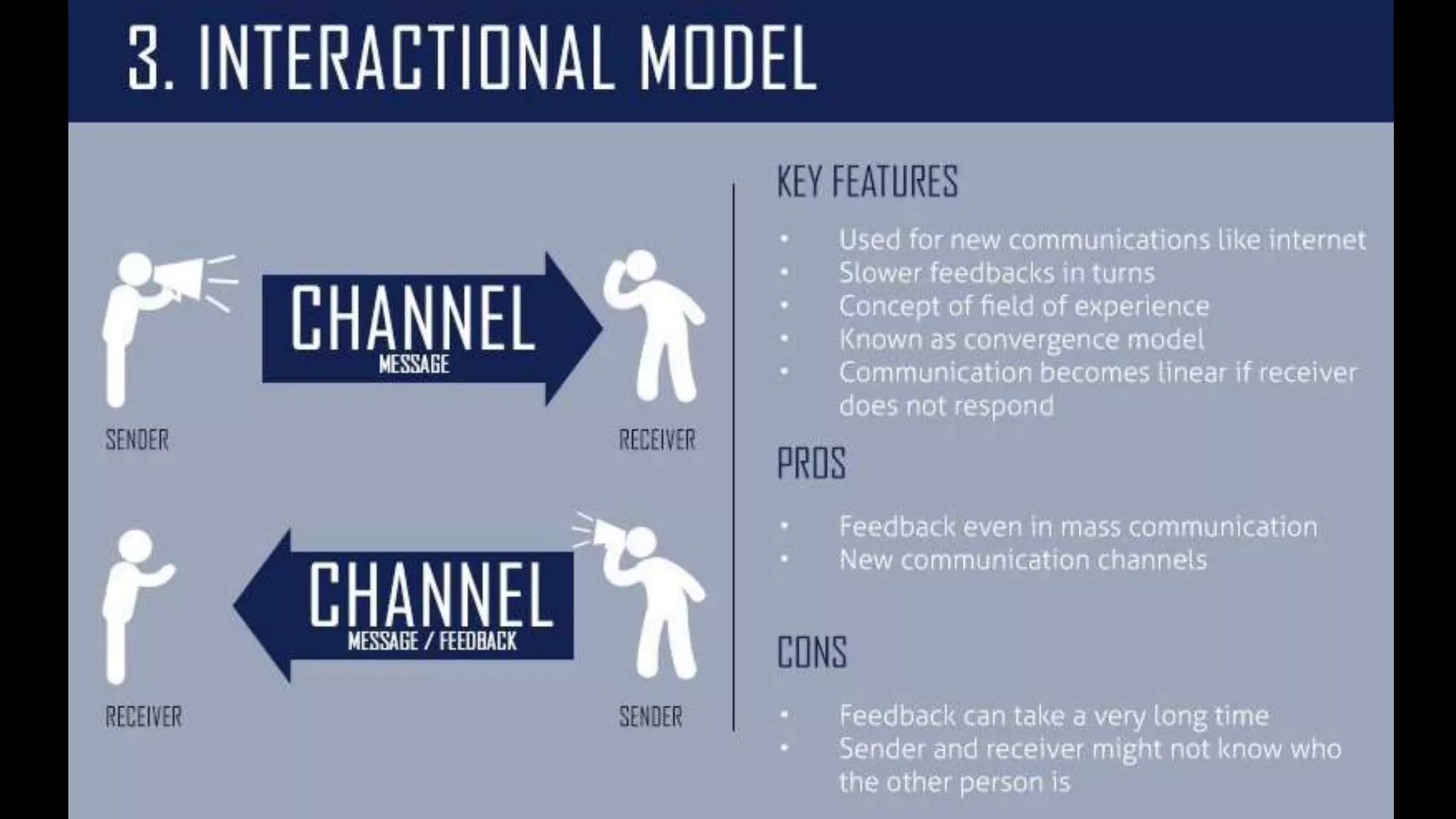
B. INTERACTIVE MODEL OF COMMUNICATION
• alsoknownas convergence model
• deals with exchange of ideas and messages taking place both ways from
sender toreceiver and vice-versa
• The communication process take place between humans or machines in
bothverbal or non-verbal way
• This is a relatively new model of communication for new technologies
like web.
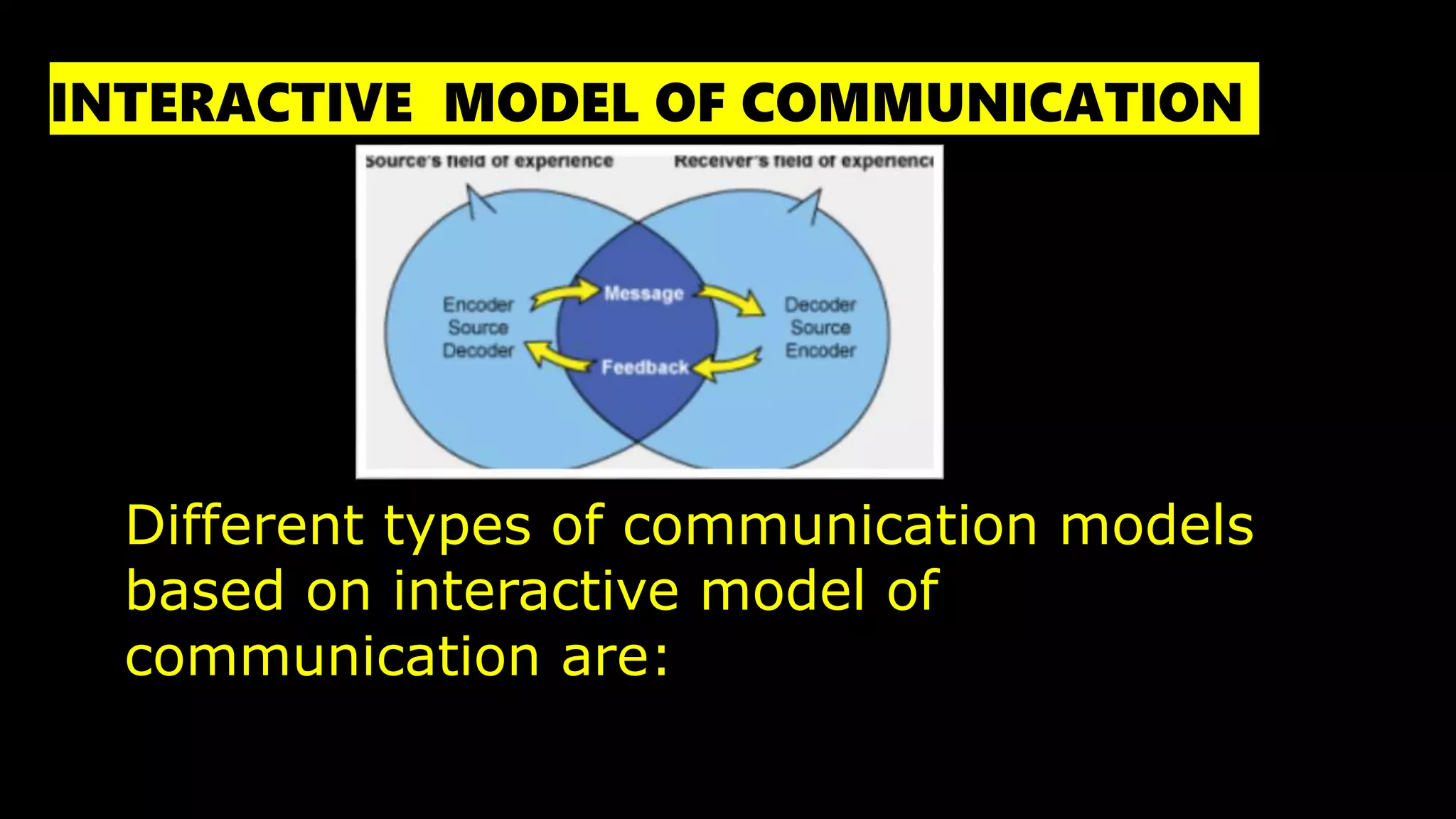
INTERACTIVE MODEL OF COMMUNICATION
Different types of communication models
based on interactive model of
communication are:
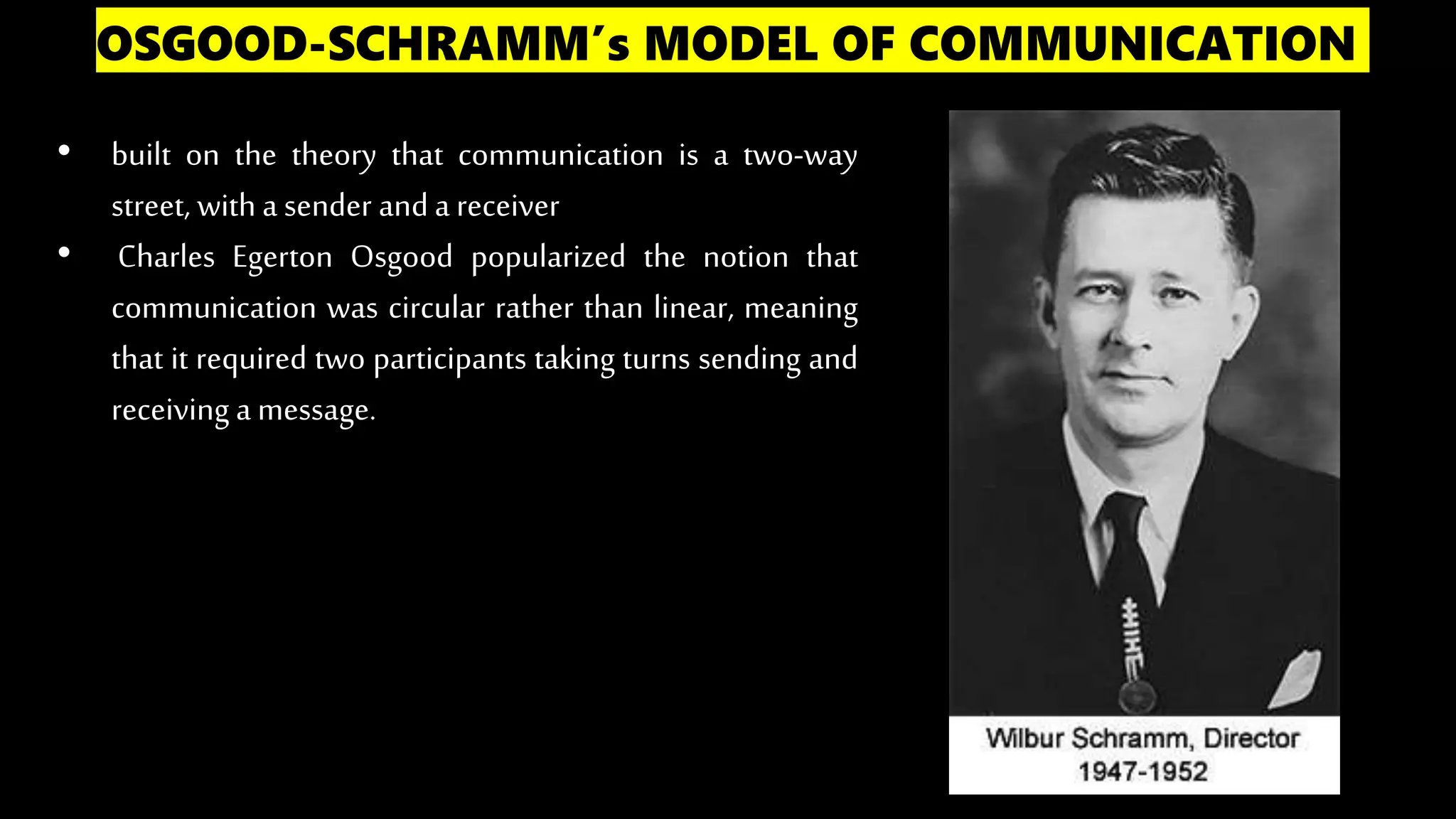
OSGOOD-SCHRAMM’s MODEL OF COMMUNICATION
• built on the theory that communication is a two-way
street, with a sender anda receiver
• Charles Egerton Osgood popularized the notion that
communication was circular rather than linear, meaning
that it required two participants taking turns sending and
receiving a message.
Field of experience incorporates what is mutually understood between the
sender and receiver. For example, a professor of calculus would have very little
luck communicating important math principles to a classroom of kindergarten
students, because they do not share a field of experience that makes the
message easy tounderstand.
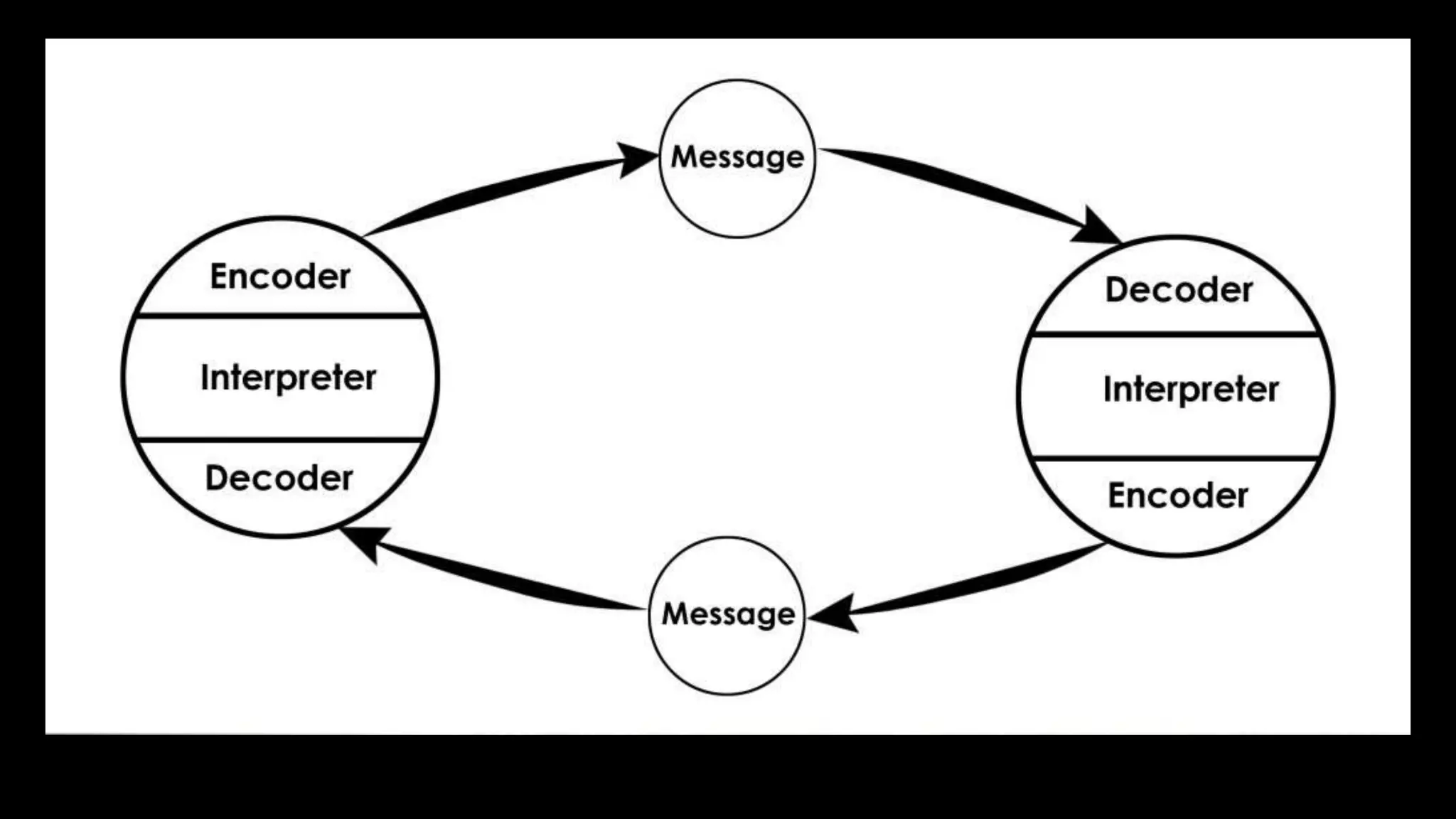
It is a Circular Model, so that communication is something circular in nature
Encoder – Who does encoding or Sends the message (message originates)
Decoder – Who receives the message
Interpreter – Person trying to understand (analyses, perceive) or interpret
Note: From the message starting to ending, there is aninterpretation goes on. Based on this interpretation
only the message is received.
DANCE-HELICAL’s MODEL OF COMMUNICATION
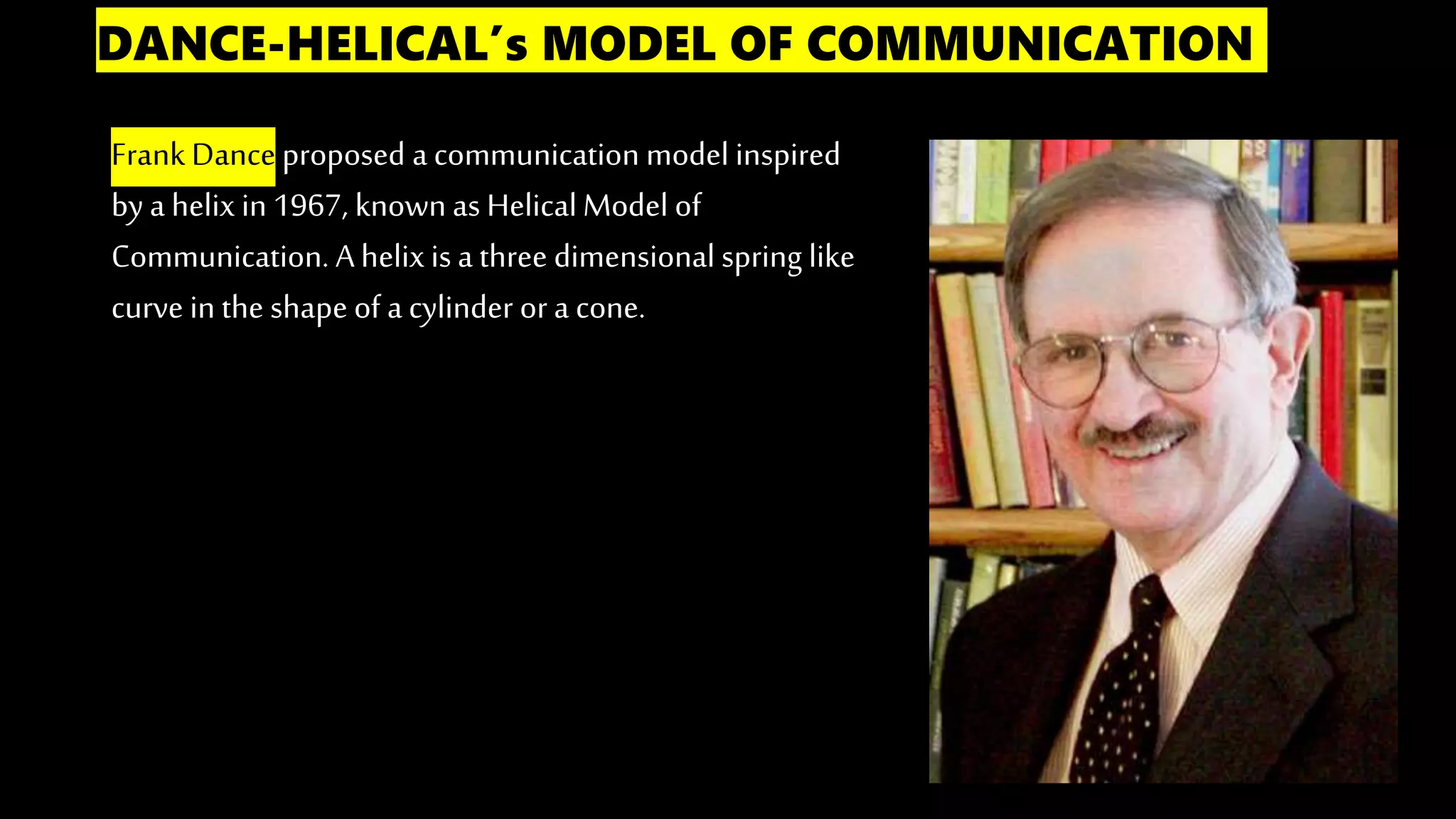
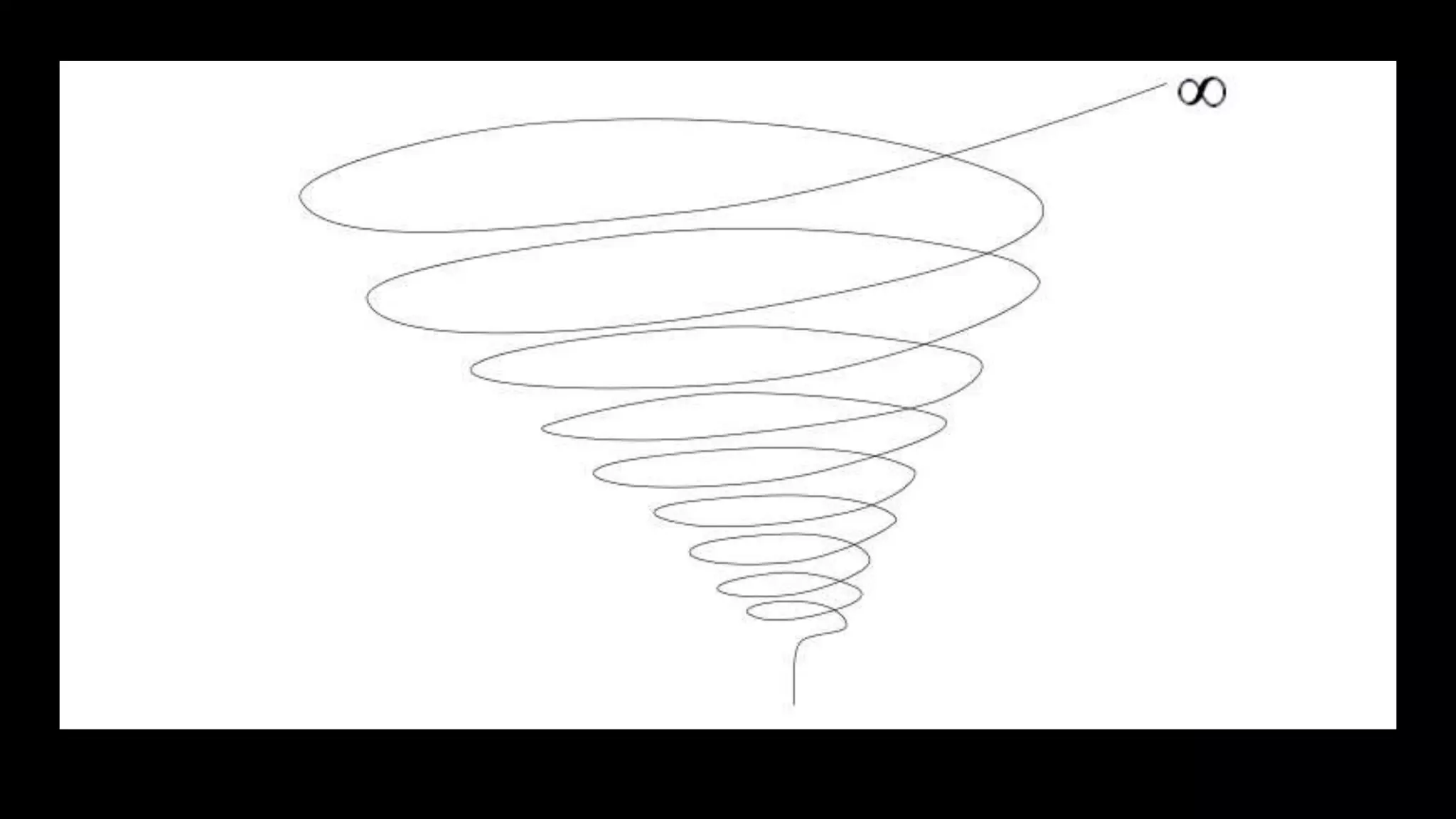
• Frank Dance proposed a communication model inspired
by a helix in 1967, known as HelicalModel of
Communication. A helixis a three dimensional spring like
curve in the shape of a cylinder or a cone.
Helix is compared with evolution of communication of a human since birth to
existence or existing moment. Helical model gives geometrical testimony of
communication. The model is linear as well as circular combined and disagrees
the conceptoflinearityandcircularityindividually.
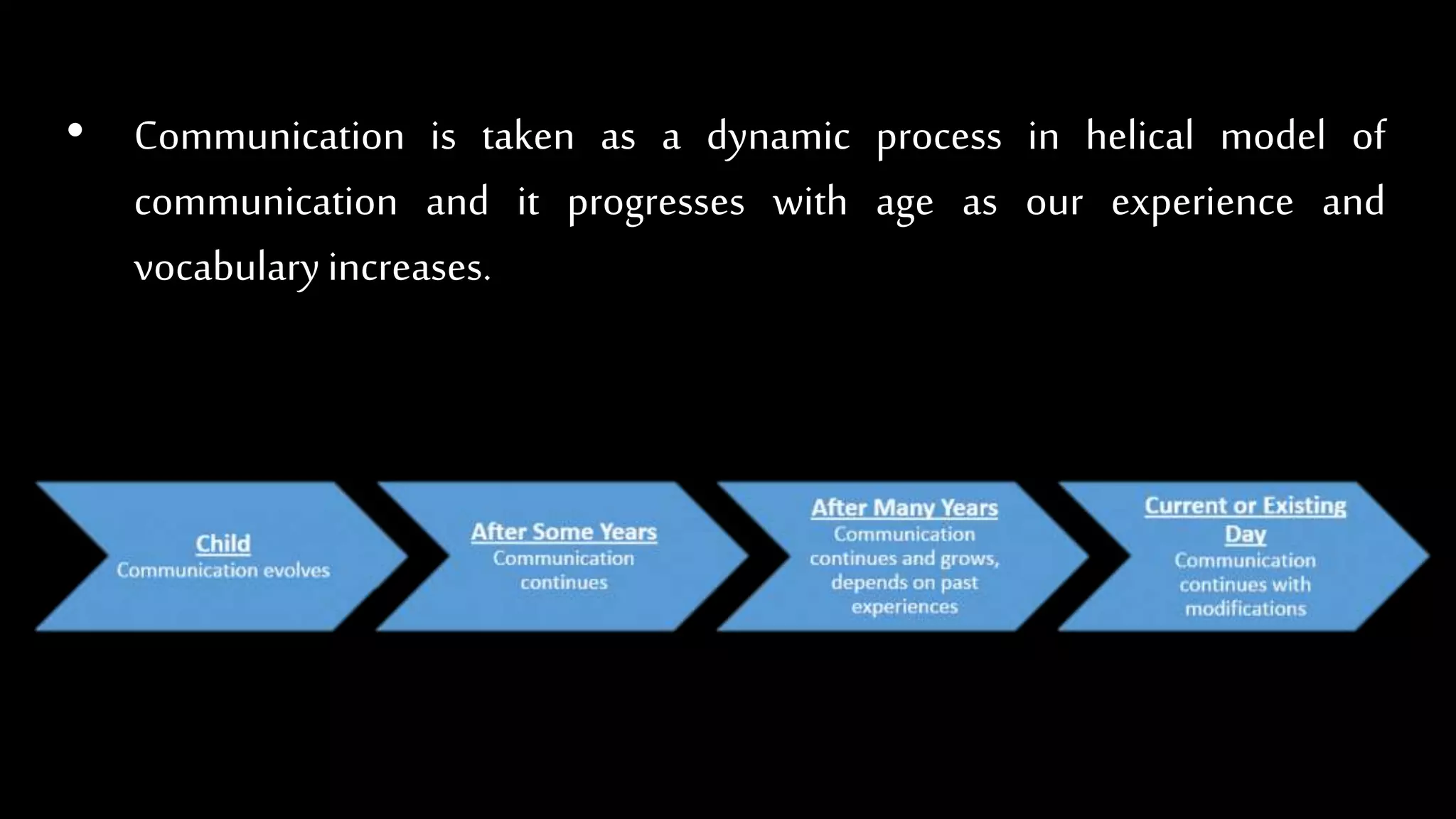
• Communication is taken as a dynamic process in helical model of
communication and it progresses with age as our experience and
vocabularyincreases.
REFERENCE:
https://www.businesstopia.net

Models of Communication

  • 1.
  • 2.
    Linear Communication Model •Lasswell’s Model • Aristotle’s Model • Berlo’s SMCR Model Transactional Model • Shannon & Weaver Model Interactive Model • Schramm’s Model • Dance-helical Model COMMUNICATION MODELS
  • 3.
    A. LINEAR MODELOF COMMUNICATION • communicationis consideredone way process • the message signal is encoded and transmitted through channel in presence ofnoise • the sender is more prominentinlinearmodel of communication. • appliedinmass communicationlike television,radio, etc.
  • 5.
    LINEAR MODEL OFCOMMUNICATION Different types of communication models based on linear model of communication are:
  • 6.
    1. ARISTOTLE’S MODELOF COMMUNICATION Aristotle(384-322 B.C) was a Greek philosopher and writer born in Stagira, Northern Greece. He was also the teacher of Alexander the Great. He studied physics, logic, mathematics,etc.
  • 7.
    1. ARISTOTLE’S MODELOF COMMUNICATION • considered as the first model of communication and was proposed before 300 B.C. • most widely acceptedamong allcommunicationmodels.
  • 8.
    1. ARISTOTLE’S MODELOF COMMUNICATION • Aristotle Model is mainly focused on speaker and speech. It can be broadly divided into 5 primary elements:Speaker, Speech, Occasion, Audienceand Effect • speaker centeredmodel • highly used to develop public speaking skills and create a propaganda at that time so, it is lessfocused on intrapersonal or interpersonal communication • speaker must have a very good non-verbal communication with the audience like eye contact
  • 9.
    ELEMENTS OF GOODCOMMUNICATOR 1. ETHOS • Credibility of the speaker • characteristicwhich makes you credible in front of the audience 2. PATHOS • Emotional bond • f whatyou say matters to them andthey canconnect with it, then they willbe more interested 3. LOGOS • sense of reason • You must present factsto the audience for them to believe in you
  • 10.
    CRITICISMS OF ARISTOTLE’SMODEL OF COMMUNICATION There are few criticisms around this model. Some of them are: • There is no concept of feedback, it is one way from speaker to audience. • Thereis no concept of communicationfailurelike noise and barriers. • This model can only be used in public speaking.
  • 11.
    1. LASSWELL’S MODELOF COMMUNICATION Developed by communication theorist Harold D. Lasswell (1902-1978) in 1948. Lasswell’s model of communication (also known as action model or linear model or one way model of communication) is regarded as one the most influentialcommunicationmodels.
  • 13.
    COMPONENTS MEANING ANALYSIS Who thecommunicator or sender or source of message Control Analysis Says What the content of the message Content Analysis In Which Channel the medium or media Media Analysis To Whom the receiver of the message or an audience Audience Analysis With What Effect the feedback of the receiver to the sender Effect Analysis
  • 14.
    CRITICISMS OF LASSWELL’SMODEL OF COMMUNICATION There are few criticisms around this model. Some of them are: • does not include feedback and it ignores the possibility of noise • very linear and does not consider barriers in the communication process • more focused on the resulting outcome and generally used for media persuasion
  • 15.
    1. BERLO’S MODELOF COMMUNICATION In 1960, David Berlo postulated Berlo’s Sender- Message-Channel-Receiver (SMCR) model of communication from Shannon Weaver’s Model of Communication (1949). He described factors affecting the individual components in the communication making the communication more efficient.
  • 16.
    1. BERLO’S MODELOF COMMUNICATION • focuses on encoding and decoding which happens before sender sends the message andbefore receiver receives the message respectively • Berlo’s Model has mainly, four components to describe the communication process. They are sender, message, channel and receiver. Each of the component is affectedby many factors.
  • 18.
    CRITICISMS OF BERLO’SMODEL OF COMMUNICATION There are few criticisms around this model. Some of them are: • There is no concept of feedback, so the effect is not considered. • There is no concept of noise or anykind of barriers in communication process. • It is a linear model of communication, there is no two way communication. • Both of the people must be similar according to allthe factors mentioned above.
  • 19.
    B. TRANSACTIONAL MODELOF COMMUNICATION • Transactional model of communication is the exchange of messages between sender and receiver where each take turns to send or receive messages. • bothsender andreceiver are known ascommunicators • The model is mostly used for interpersonal communication and is also calledcircular model ofcommunication.
  • 21.
    TRANSACTIONAL MODEL OFCOMMUNICATION Different types of communication models based on transactional model of communication are:
  • 22.
    SHANNON and WEAVER’S MODELOF COMMUNICATION (INFORMATION THEORY) Shannon Weaver model of communication was created in 1948 when Claude Elwood Shannon wrote an article “A Mathematical Theory of Communication” in Bell System TechnicalJournal with Warren Weaver. Shannon was an American mathematician whereas Weaver was a scientist. The Mathematical theory later came to be known as Shannon Weaver model of communication or “mother of all models.”
  • 23.
    CONCEPTS IN SHANNONWEAVER MODEL • Sender(Information source)– Senderis the person who makes the message,chooses the channel and sends the message. • Encoder (Transmitter) –Encoder is the sender who uses machine, which converts message into signals or binary data. It might also directly refer to the machine. • Channel –Channel is the medium used to send message. • Decoder (Receiver) – Decoder is the machine used to convert signals or binary data into message or the receiver who translates the message from signals. • Receiver (Destination) –Receiver is the person who gets the message or the place where the message must reach. The receiverprovides feedback accordingto the message. • Noise –Noise is the physical disturbances like environment, people, etc. which does not let the message get to the receiver aswhat is sent.
  • 25.
    ADVANTAGES OF BERLO’SMODEL OF COMMUNICATION There are few advantages around this model. Some of them are: • Concept of noise helps in making the communication effective by removing the noise or problem causingnoise. • Thismodel takescommunication asa two way process. It makes the model applicable in general communication.
  • 26.
    B. INTERACTIVE MODELOF COMMUNICATION • alsoknownas convergence model • deals with exchange of ideas and messages taking place both ways from sender toreceiver and vice-versa • The communication process take place between humans or machines in bothverbal or non-verbal way • This is a relatively new model of communication for new technologies like web.
  • 28.
    INTERACTIVE MODEL OFCOMMUNICATION Different types of communication models based on interactive model of communication are:
  • 29.
    OSGOOD-SCHRAMM’s MODEL OFCOMMUNICATION • built on the theory that communication is a two-way street, with a sender anda receiver • Charles Egerton Osgood popularized the notion that communication was circular rather than linear, meaning that it required two participants taking turns sending and receiving a message.
  • 30.
    Field of experienceincorporates what is mutually understood between the sender and receiver. For example, a professor of calculus would have very little luck communicating important math principles to a classroom of kindergarten students, because they do not share a field of experience that makes the message easy tounderstand.
  • 32.
    It is aCircular Model, so that communication is something circular in nature Encoder – Who does encoding or Sends the message (message originates) Decoder – Who receives the message Interpreter – Person trying to understand (analyses, perceive) or interpret Note: From the message starting to ending, there is aninterpretation goes on. Based on this interpretation only the message is received.
  • 33.
    DANCE-HELICAL’s MODEL OFCOMMUNICATION • Frank Dance proposed a communication model inspired by a helix in 1967, known as HelicalModel of Communication. A helixis a three dimensional spring like curve in the shape of a cylinder or a cone.
  • 34.
    Helix is comparedwith evolution of communication of a human since birth to existence or existing moment. Helical model gives geometrical testimony of communication. The model is linear as well as circular combined and disagrees the conceptoflinearityandcircularityindividually.
  • 35.
    • Communication istaken as a dynamic process in helical model of communication and it progresses with age as our experience and vocabularyincreases.
  • 37.

Editor's Notes

  • #2 systematic description/ illustration of a phenomenon or abstract process
  • #4 where sender is the only one who sends message and receiver doesn’t give feedback or response.
  • #6 where sender is the only one who sends message and receiver doesn’t give feedback or response.
  • #9 It is the speaker’s role to deliver a speech to the audience. The role of the audience is passive, influenced by the speech. This makes the communication process one way, from speaker to receiver. The speaker must organize the speech beforehand, according to the target audience and situation (occasion). The speech must be prepared so that the audience be persuaded or influenced from the speech. No concept of feedbacks Politician’s speech
  • #10 Aristotle has given 3 elements that must be present in a good communicator or public speaker. These elements are related to each other and they reinforce the other elements. Expertise and positions also give credibility to a person Example corrupy politician
  • #14 5 components 
  • #20 where sender is the only one who sends message and receiver doesn’t give feedback or response.
  • #21  communicators are also interdependent to each other most general model of communication Everyday talk fficiency and reliability of communicated message also depends on the medium used.
  • #22 where sender is the only one who sends message and receiver doesn’t give feedback or response.
  • #29 where sender is the only one who sends message and receiver doesn’t give feedback or response.