INTERPERSONAL
COMMUNICATION
Presented by:
Azfar Javed
Welcome
Contents
Introduction
Nature of Interpersonal Communication
Purposes of interpersonal communication
Ways to improve interpersonal communication
Elements and traits of ethics in interpersonal communication
Conclusion
Introduction
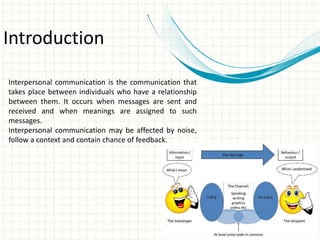
Interpersonal communication is the communication that
takes place between individuals who have a relationship
between them. It occurs when messages are sent and
received and when meanings are assigned to such
messages.
Interpersonal communication may be affected by noise,
follow a context and contain chance of feedback.
Introduction (cont.)
The overall benefits of interpersonal communication can be broadly categorized into
two groups, i.e. personal/social and professional.
 Personal/Social: The bonds of relationships are made, sustained, and at times
broken through our interpersonal communication. The success of our family
relationships depends heavily on the interpersonal communication among the
members.
 Professional: The ability to communicate interpersonally is acknowledged to be a key
to professional success. From the first interview as an internee to participating in and
then leading meetings, the candidate’s interpersonal communication skills will
largely determine his/her success. It has become a widely known fact that, amongst
the various attributes, “communication and interpersonal skills” are accorded high
priority in hiring decisions.
Major benefits of interpersonal communication
The Nature of Interpersonal
Communication
Verbal and nonverbal interactions between
two or more interdependent individuals
represent interpersonal communication.
Interpersonal interaction comprises of the
exchange of verbal and nonverbal messages. The
words one uses as well as the facial expressions—
the eye contact and the body posture. Similarly,
messages are received through sense of hearing
and other senses, e.g. visual and touch senses.
At times even silence speaks a thousand words.
Purposes of interpersonal
communication
Interpersonal communication is a purposeful and
focused interaction that can be used to accomplish a
variety of purposes.
 To learn:
 To connect:
 To inspire:
 To support:
 To play and enjoy:
Purposes of interpersonal
communication
Some of them are discussed as under:
 To learn: IPC enable us to learn and to better
understand the world around us.
 To connect: IPC helps to connect to others and to
form significant connections.
 To inspire: During our interpersonal connections we
may inspire others; e.g. to choose a certain career,
to behave in a certain way
 To support: we all interact every day to help our
connections in one way or another. Examples
include, consoling and comforting a friend who has
just lost his father, counselling a student about
career prospects or offering advice to a co-worker.
 To play and enjoy: Messaging friends about
outstation holidays, discussing interests on chat,
making a practical joke, posting an event or photo
on some social media site, and gossiping with
friends are all examples to play and enjoy functions.
Ways to improve interpersonal
communication
Interpersonal skills are invaluable in personal as well as
professional life. These
skills measure how well you interact with others.
Therefore, you must be aware of
the ways these skills can be improved. Some of them
are discussed briefly as
under:
 Smile
 Encourage others
 Have courtesy for others
 Active listening
 Bridging gaps
 Resolve conflicts
 Communicate clearly
 Humour
 Empathy
 Stop complaining
The business communicator’s vital responsibility is to be ethical. Ethics
denotes a set of principles or rules of correct conduct. Communicating
ethically involves being open, respectful, and trustworthy—overall, actually
practicing the “Golden Rule” i.e. treat your audience the way
you would want yourself to be treated.
Elements and traits of ethics in
interpersonal communication
o Equality
o Positive relationship with the audience
o Balance between speaking and listening
o Respect
o Trustworthiness
o Authentic information
CONCLUSION
Here are some very interesting
statistics on this topic. when
someone else communicates with us,
the way we interpret their message is
based on the following three things:
• 55% is based on their facial
expressions and their body
language.
• 37% is based on the tone of their
voice.
• 8% is based on the words they say.
CONCLUSION
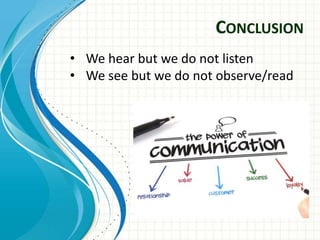
• We hear but we do not listen
• We see but we do not observe/read
ANY QUESTION ???

INTERPERSONAL COMMUNICATION by Azfar Javed

  • 1.
  • 2.
  • 3.
    Contents Introduction Nature of InterpersonalCommunication Purposes of interpersonal communication Ways to improve interpersonal communication Elements and traits of ethics in interpersonal communication Conclusion
  • 4.
    Introduction Interpersonal communication isthe communication that takes place between individuals who have a relationship between them. It occurs when messages are sent and received and when meanings are assigned to such messages. Interpersonal communication may be affected by noise, follow a context and contain chance of feedback.
  • 5.
    Introduction (cont.) The overallbenefits of interpersonal communication can be broadly categorized into two groups, i.e. personal/social and professional.  Personal/Social: The bonds of relationships are made, sustained, and at times broken through our interpersonal communication. The success of our family relationships depends heavily on the interpersonal communication among the members.  Professional: The ability to communicate interpersonally is acknowledged to be a key to professional success. From the first interview as an internee to participating in and then leading meetings, the candidate’s interpersonal communication skills will largely determine his/her success. It has become a widely known fact that, amongst the various attributes, “communication and interpersonal skills” are accorded high priority in hiring decisions. Major benefits of interpersonal communication
  • 6.
    The Nature ofInterpersonal Communication Verbal and nonverbal interactions between two or more interdependent individuals represent interpersonal communication. Interpersonal interaction comprises of the exchange of verbal and nonverbal messages. The words one uses as well as the facial expressions— the eye contact and the body posture. Similarly, messages are received through sense of hearing and other senses, e.g. visual and touch senses. At times even silence speaks a thousand words.
  • 7.
    Purposes of interpersonal communication Interpersonalcommunication is a purposeful and focused interaction that can be used to accomplish a variety of purposes.  To learn:  To connect:  To inspire:  To support:  To play and enjoy:
  • 8.
    Purposes of interpersonal communication Someof them are discussed as under:  To learn: IPC enable us to learn and to better understand the world around us.  To connect: IPC helps to connect to others and to form significant connections.  To inspire: During our interpersonal connections we may inspire others; e.g. to choose a certain career, to behave in a certain way  To support: we all interact every day to help our connections in one way or another. Examples include, consoling and comforting a friend who has just lost his father, counselling a student about career prospects or offering advice to a co-worker.  To play and enjoy: Messaging friends about outstation holidays, discussing interests on chat, making a practical joke, posting an event or photo on some social media site, and gossiping with friends are all examples to play and enjoy functions.
  • 9.
    Ways to improveinterpersonal communication Interpersonal skills are invaluable in personal as well as professional life. These skills measure how well you interact with others. Therefore, you must be aware of the ways these skills can be improved. Some of them are discussed briefly as under:  Smile  Encourage others  Have courtesy for others  Active listening  Bridging gaps  Resolve conflicts  Communicate clearly  Humour  Empathy  Stop complaining
  • 10.
    The business communicator’svital responsibility is to be ethical. Ethics denotes a set of principles or rules of correct conduct. Communicating ethically involves being open, respectful, and trustworthy—overall, actually practicing the “Golden Rule” i.e. treat your audience the way you would want yourself to be treated. Elements and traits of ethics in interpersonal communication o Equality o Positive relationship with the audience o Balance between speaking and listening o Respect o Trustworthiness o Authentic information
  • 11.
    CONCLUSION Here are somevery interesting statistics on this topic. when someone else communicates with us, the way we interpret their message is based on the following three things: • 55% is based on their facial expressions and their body language. • 37% is based on the tone of their voice. • 8% is based on the words they say.
  • 12.
    CONCLUSION • We hearbut we do not listen • We see but we do not observe/read
  • 13.