Perception and the Self in
Interpersonal Communication


                 Chapter 3
                 Angell’ Beswetherick
The Self in Interpersonal Communication

   Self-Concept – The way you see
    yourself.


          http://bahaicoherence.blogspot.com/2009/11/self-identity.html
The Self in Interpersonal Communication


Sources of Self-Concept:

   Others’ images – How significant others see
    you.

   Social Comparisons – How you compare to
    your peers.

   Cultural Teachings – How you fulfill the
    teachings of your culture.

   Self-Evaluations – How you evaluate your own
    feelings and behavior.
The Self in Interpersonal Communication


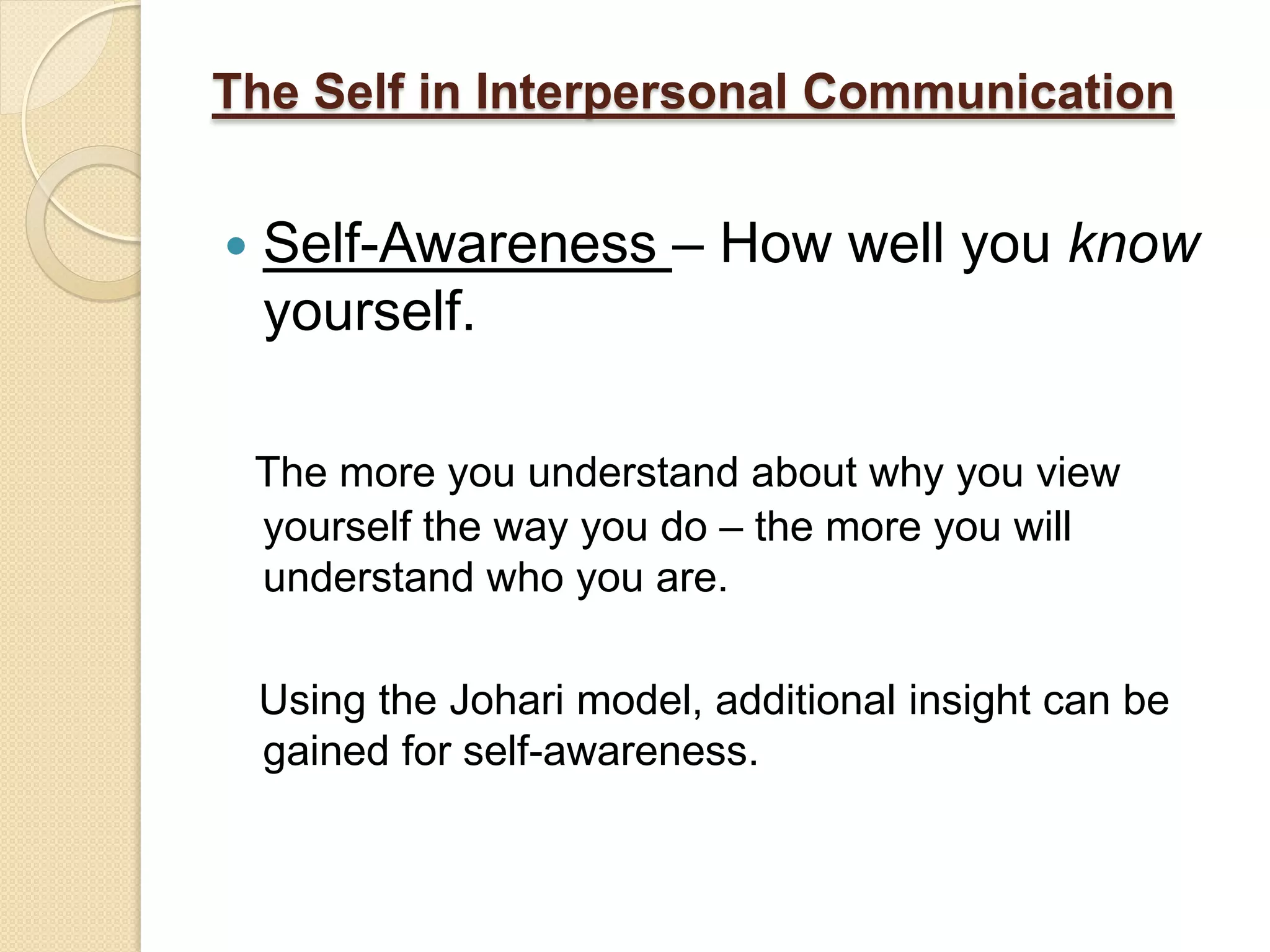
   Self-Awareness – How well you know
    yourself.

    The more you understand about why you view
    yourself the way you do – the more you will
    understand who you are.

    Using the Johari model, additional insight can be
    gained for self-awareness.
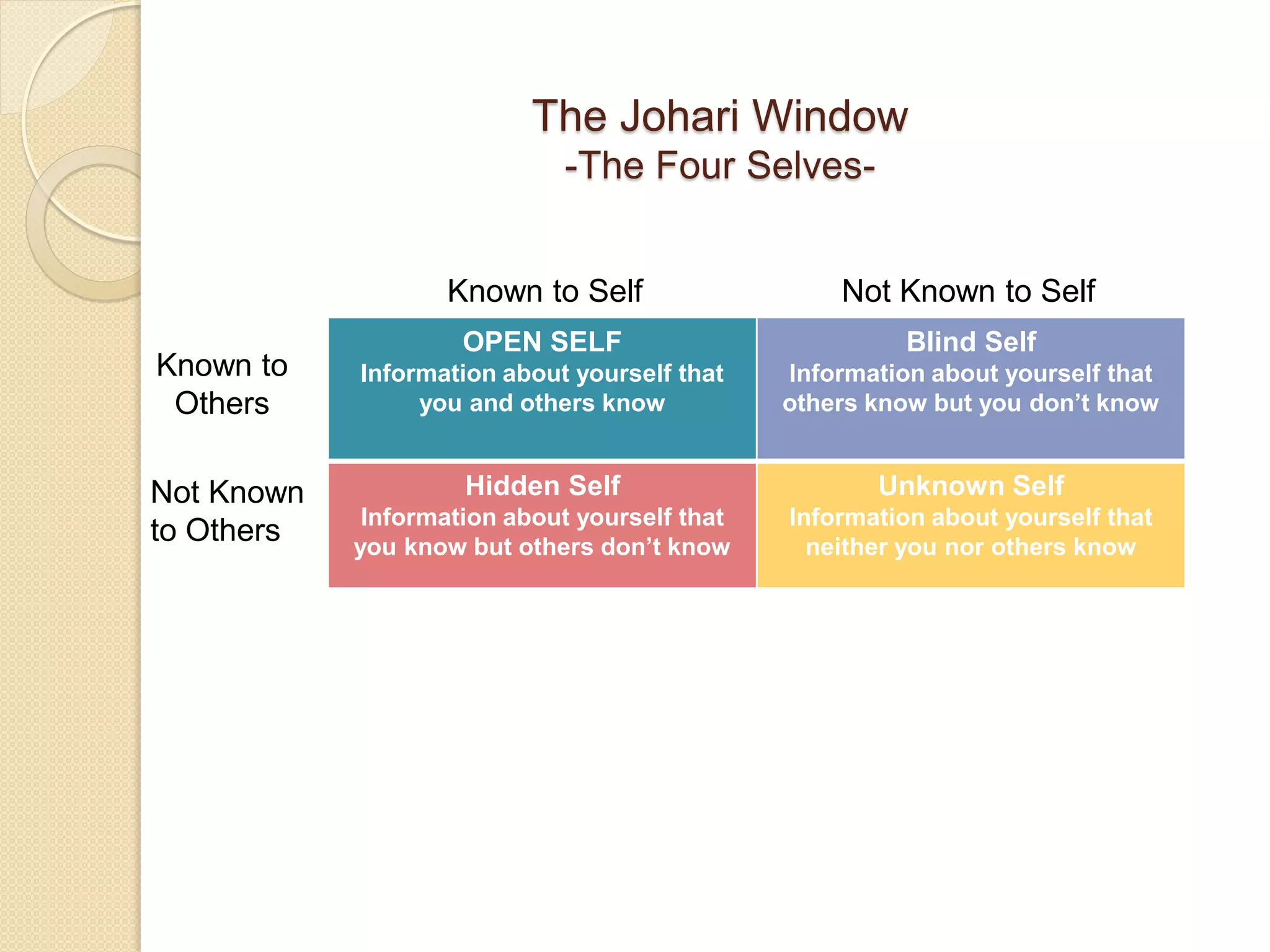
The Johari Window
                             -The Four Selves-


                   Known to Self                   Not Known to Self
                     OPEN SELF                           Blind Self
Known to    Information about yourself that    Information about yourself that
 Others          you and others know           others know but you don’t know


Not Known            Hidden Self                      Unknown Self
             Information about yourself that   Information about yourself that
to Others   you know but others don’t know       neither you nor others know
The Self in Interpersonal Communication

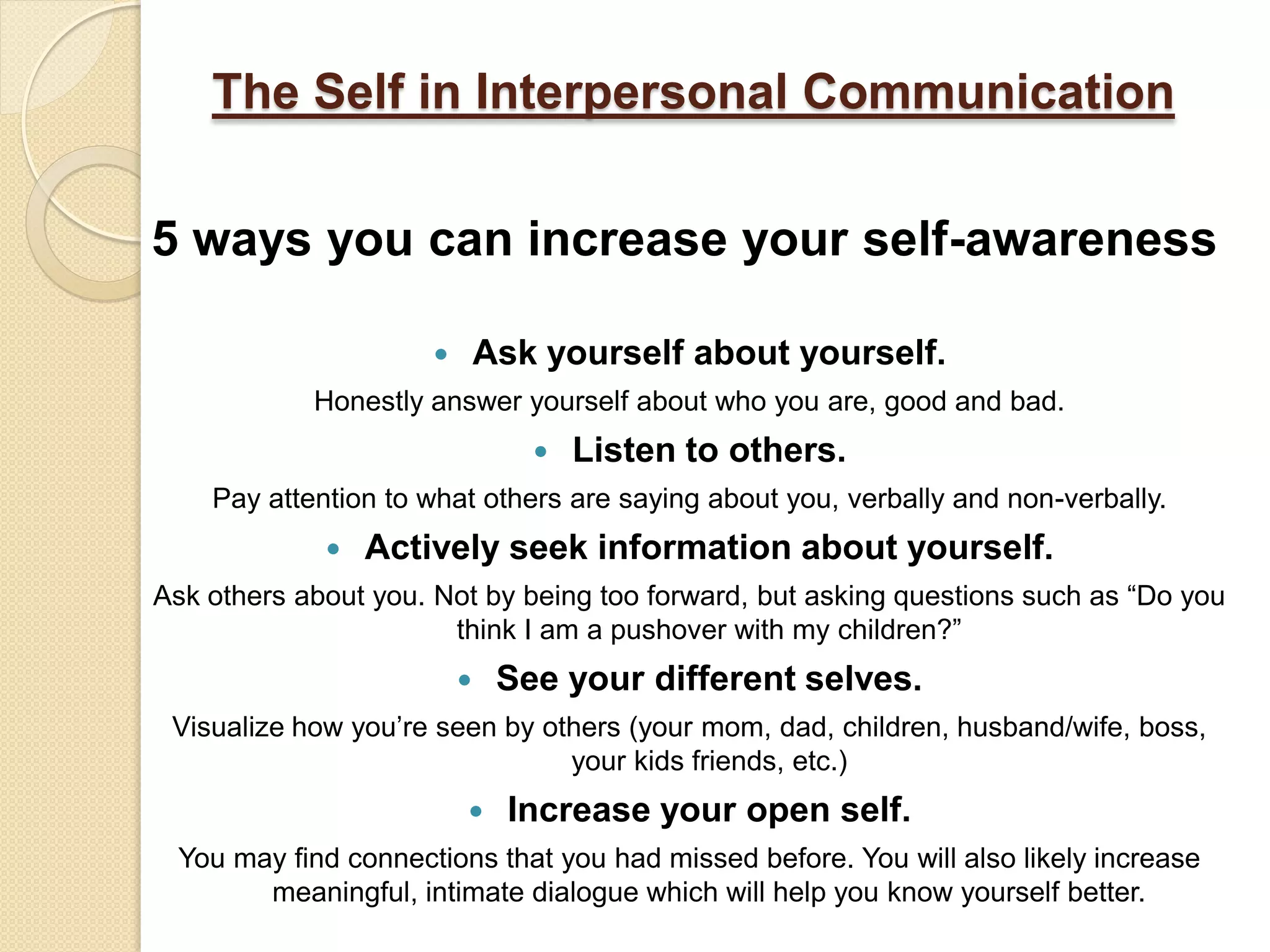
5 ways you can increase your self-awareness

                            Ask yourself about yourself.
            Honestly answer yourself about who you are, good and bad.
                                   Listen to others.
    Pay attention to what others are saying about you, verbally and non-verbally.
                Actively seek information about yourself.
Ask others about you. Not by being too forward, but asking questions such as “Do you
                       think I am a pushover with my children?”
                             See your different selves.
 Visualize how you’re seen by others (your mom, dad, children, husband/wife, boss,
                                your kids friends, etc.)
                              Increase your open self.
 You may find connections that you had missed before. You will also likely increase
       meaningful, intimate dialogue which will help you know yourself better.
The Self in Interpersonal Communication


   Self-Esteem – The measure of how
    valuable you think you are.
     High self-esteem = think highly of yourself
Low self-esteem = usually think negatively of yourself


Usually, the better self-esteem you have, the better
 you feel about yourself. This in turn, generally,
 means you’ll perform better.


                                       http://www.psychologytoday.com/blog/making-
                                       change/200910/how-high-self-esteem-can-get-
                                       us-down
The Self in Interpersonal Communication


5 ways to increase self-esteem
                           Attack self-destructive beliefs.
Get rid of those unrealistic expectations you have set for yourself or ideas that are
              unproductive. Like being perfect, or having to please others.
                            Seek out nourishing people.
                Be around people that are positive and optimistic.
             Work on projects that will result in success.
                              Don’t set yourself up for failing.
                   Remind yourself of your successes.
Don’t focus solely on failures or negative experiences. Think of the successes and
                           learn from the failed experiences.
                                  Secure Affirmation.
                   Remind yourself that “I am”, “I can”, and “I will”.
Assignment #1
Choose 3 of the following, find pictures that
 represent these and post on Tumblr. Make
 sure you label each picture with what it
 represents and your name.

     1. Self-Concept         4. Open self
     2. Self-Awareness       5. Hidden self
     3. Blind self           6. Unknown self
Assignment #2
Watch the following video on YouTube.
     http://youtu.be/Z-Ji8zrtrIw

Answer the following questions and answer on the
  Discussion Board.
Also reply to one other classmates post.
  1. According to the video above, what did Jim
  Clark experience as a child that lowered his self
  esteem?
  2. What do you think turned around his self-
  esteem and how he then became successful?
Perception in Interpersonal Communication

   Perception – The process in which you
    become aware of objects, events, and
    especially people through senses (sight,
    smell, taste, touch, and hearing).
       Perceptions result from your own
       experiences, desires, needs and wants, loves
       and hatreds.
Why is perception so important in
 Interpersonal Communication?
       It influences communication choices
       because it depends on how you see the world or
       how you see yourself to determine the message
       you send out or what you listen to.
Perception in Interpersonal Communication

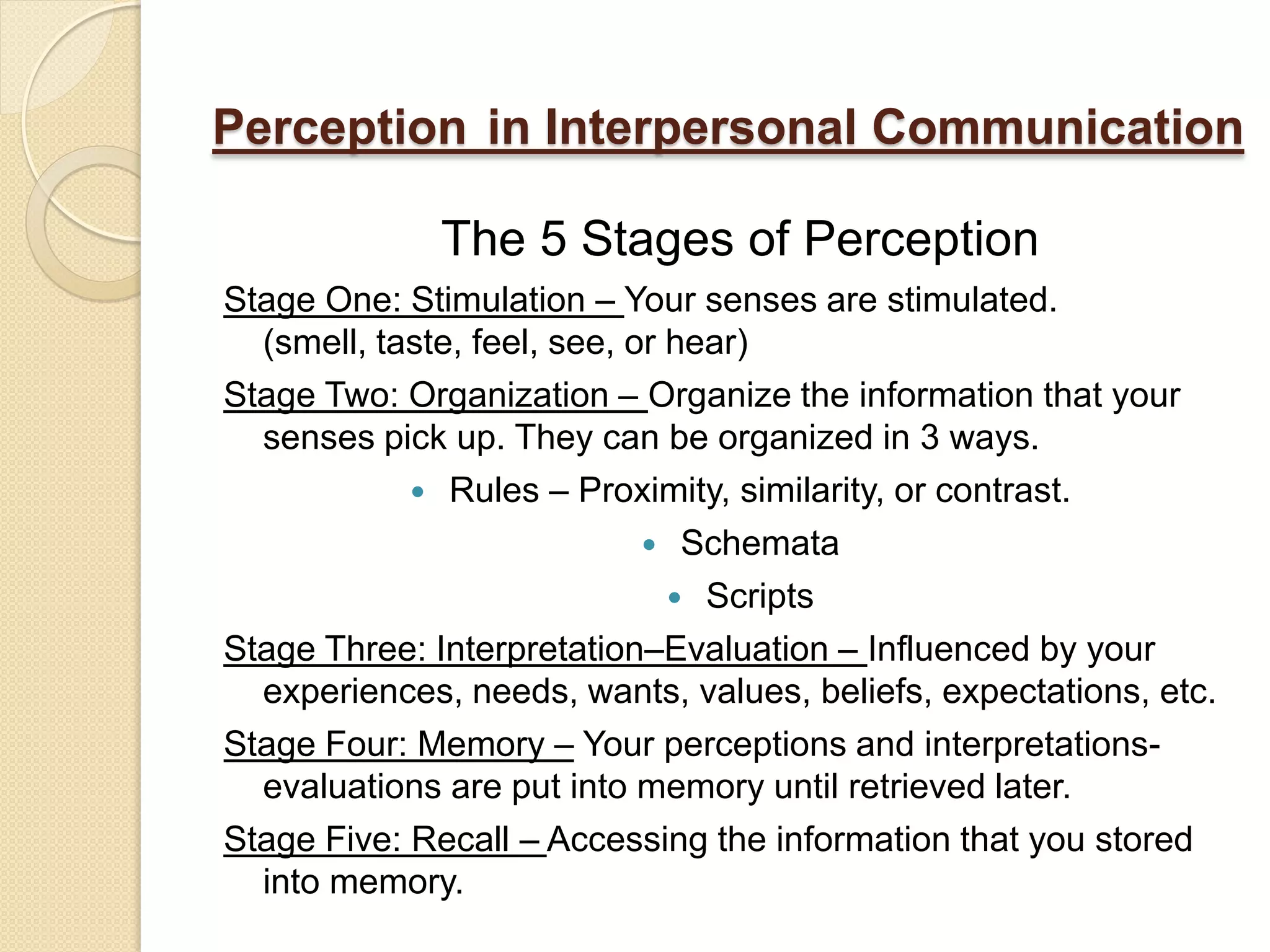
              The 5 Stages of Perception
Stage One: Stimulation – Your senses are stimulated.
  (smell, taste, feel, see, or hear)
Stage Two: Organization – Organize the information that your
  senses pick up. They can be organized in 3 ways.
             Rules – Proximity, similarity, or contrast.
                              Schemata
                                Scripts
Stage Three: Interpretation–Evaluation – Influenced by your
  experiences, needs, wants, values, beliefs, expectations, etc.
Stage Four: Memory – Your perceptions and interpretations-
  evaluations are put into memory until retrieved later.
Stage Five: Recall – Accessing the information that you stored
  into memory.
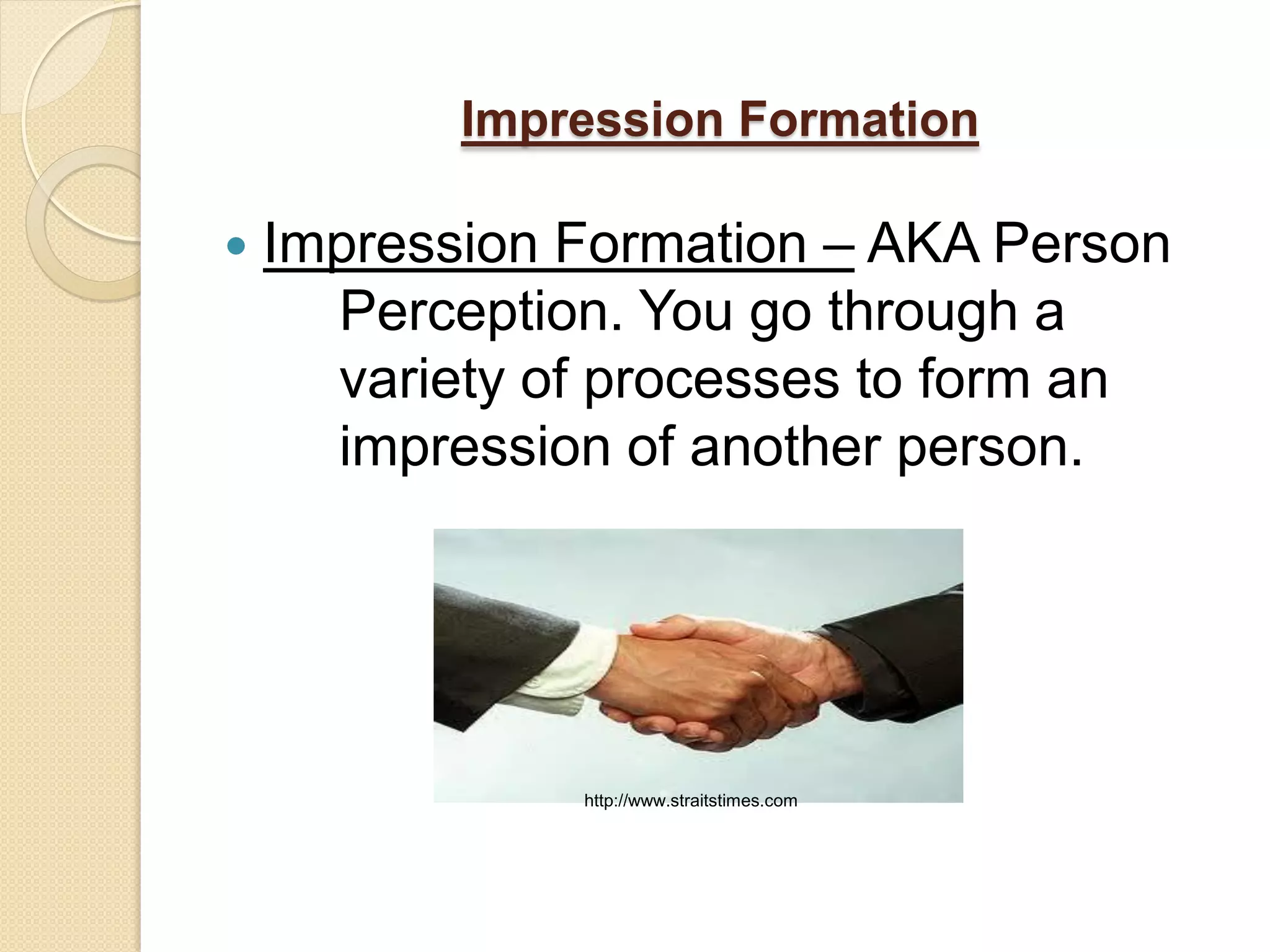
Impression Formation

   Impression Formation – AKA Person
      Perception. You go through a
      variety of processes to form an
      impression of another person.


               http://www.straitstimes.com
Impression Formation

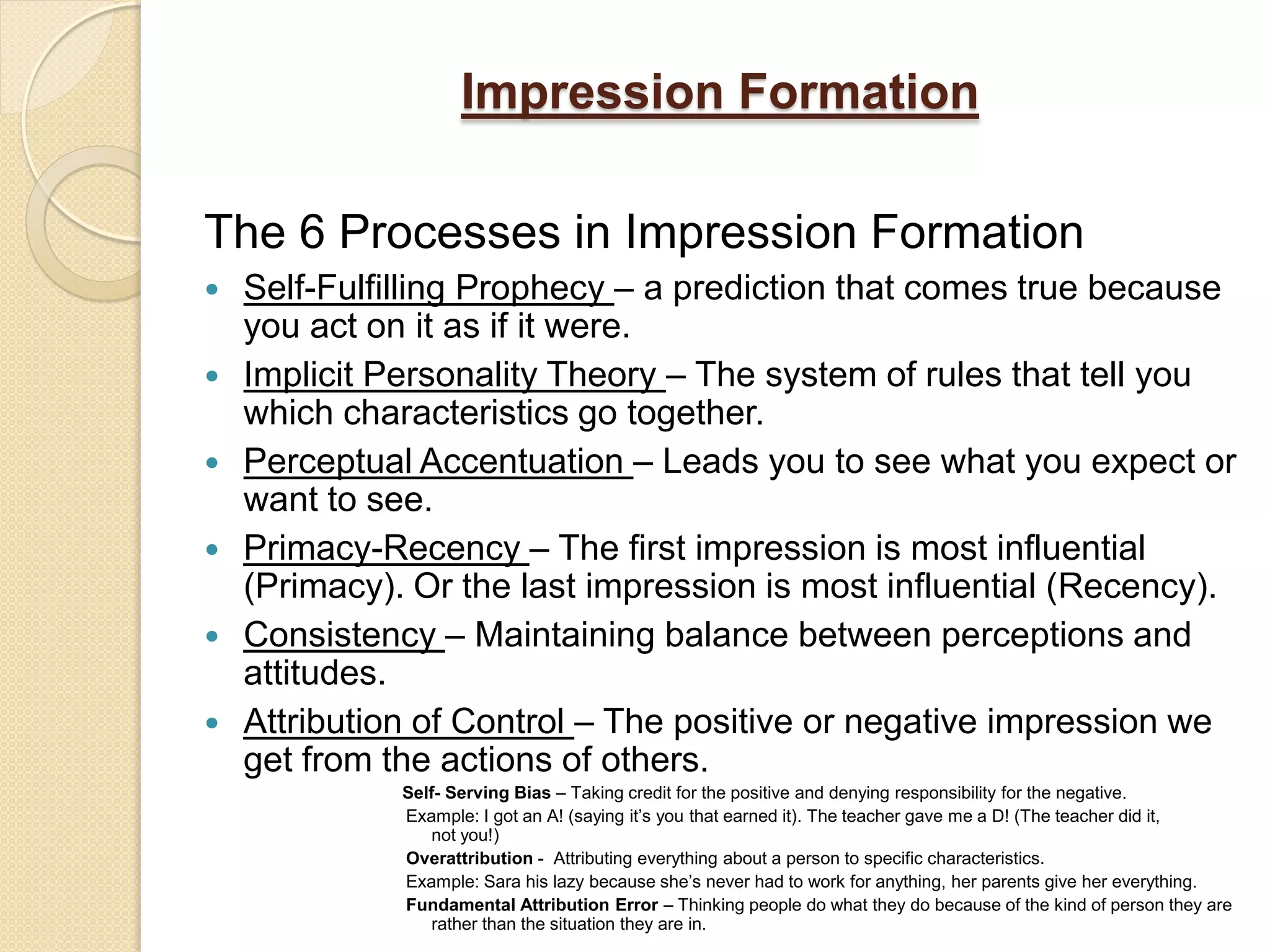
The 6 Processes in Impression Formation
   Self-Fulfilling Prophecy – a prediction that comes true because
    you act on it as if it were.
   Implicit Personality Theory – The system of rules that tell you
    which characteristics go together.
   Perceptual Accentuation – Leads you to see what you expect or
    want to see.
   Primacy-Recency – The first impression is most influential
    (Primacy). Or the last impression is most influential (Recency).
   Consistency – Maintaining balance between perceptions and
    attitudes.
   Attribution of Control – The positive or negative impression we
    get from the actions of others.
              Self- Serving Bias – Taking credit for the positive and denying responsibility for the negative.
              Example: I got an A! (saying it’s you that earned it). The teacher gave me a D! (The teacher did it,
                 not you!)
              Overattribution - Attributing everything about a person to specific characteristics.
              Example: Sara his lazy because she’s never had to work for anything, her parents give her everything.
              Fundamental Attribution Error – Thinking people do what they do because of the kind of person they are
                 rather than the situation they are in.
Impression Formation

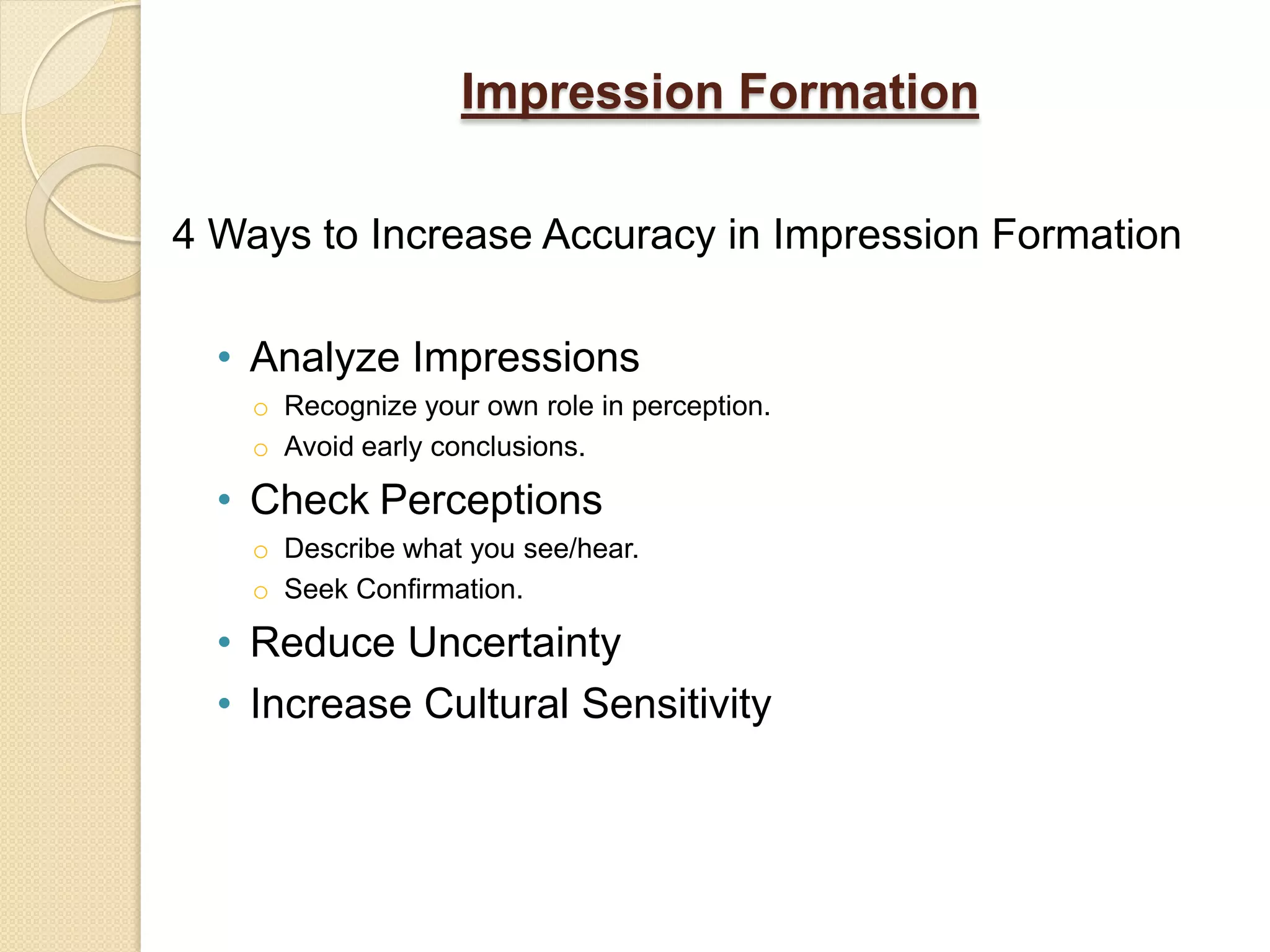
4 Ways to Increase Accuracy in Impression Formation

  • Analyze Impressions
    o Recognize your own role in perception.
    o Avoid early conclusions.

  • Check Perceptions
    o Describe what you see/hear.
    o Seek Confirmation.

  • Reduce Uncertainty
  • Increase Cultural Sensitivity
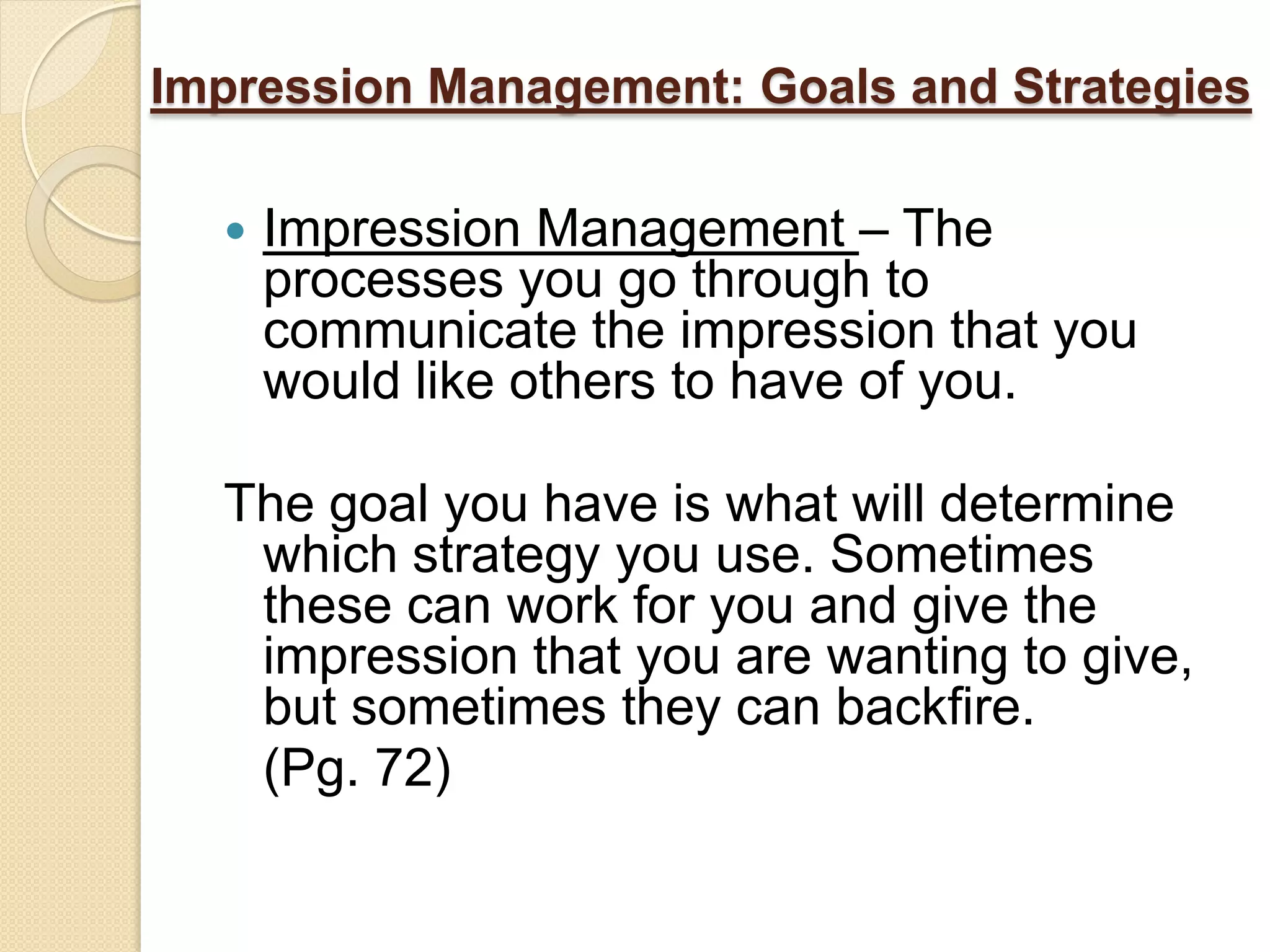
Impression Management: Goals and Strategies

     Impression Management – The
      processes you go through to
      communicate the impression that you
      would like others to have of you.

  The goal you have is what will determine
   which strategy you use. Sometimes
   these can work for you and give the
   impression that you are wanting to give,
   but sometimes they can backfire.
   (Pg. 72)
Impression Management: Goals and Strategies

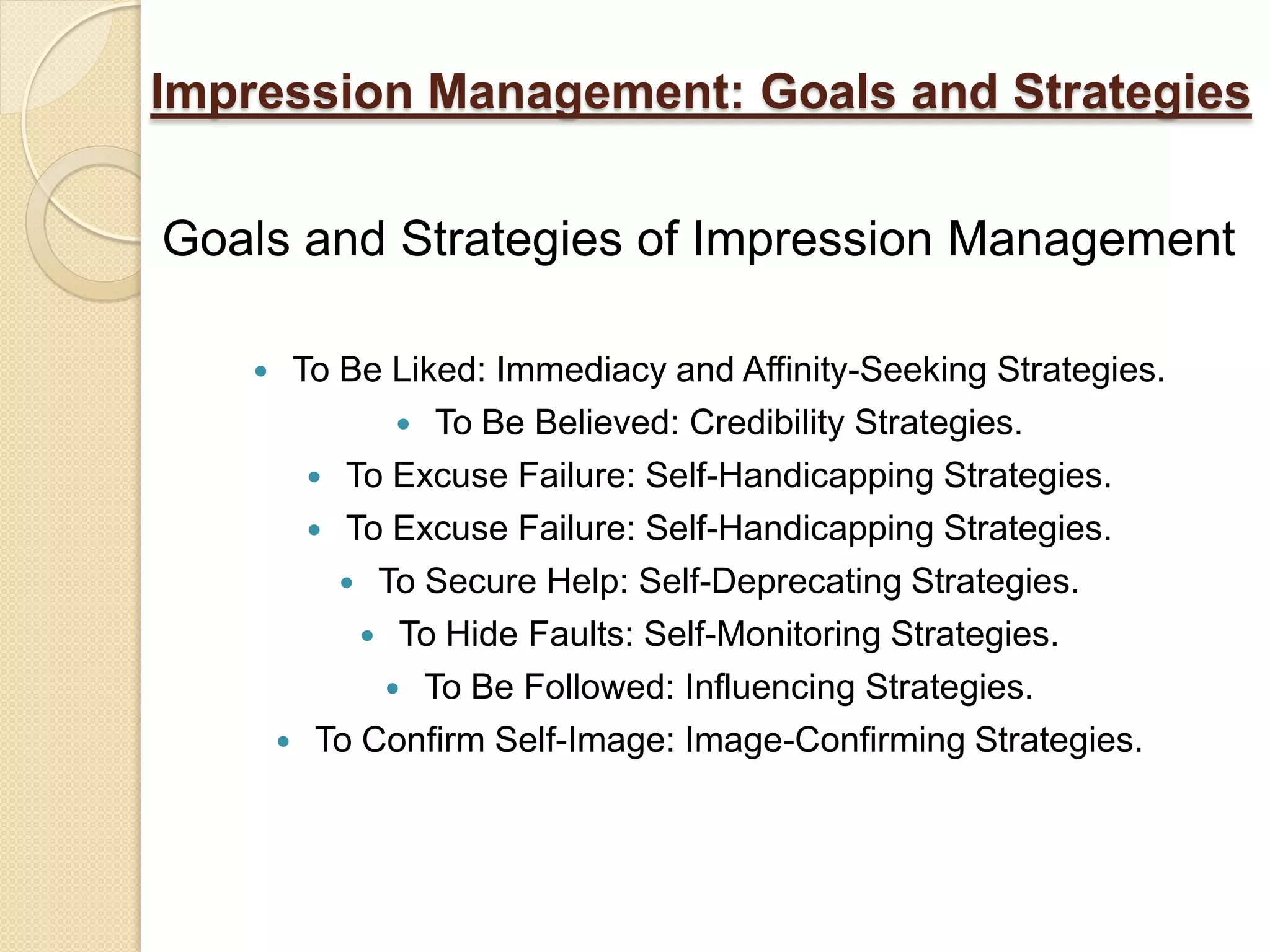
Goals and Strategies of Impression Management

        To Be Liked: Immediacy and Affinity-Seeking Strategies.
                To Be Believed: Credibility Strategies.
           To Excuse Failure: Self-Handicapping Strategies.
           To Excuse Failure: Self-Handicapping Strategies.
             To Secure Help: Self-Deprecating Strategies.
              To Hide Faults: Self-Monitoring Strategies.
               To Be Followed: Influencing Strategies.
         To Confirm Self-Image: Image-Confirming Strategies.
Assignment #3

Post a video on the Facebook “like”
 page that shows one of the
 Impression Management Goals &
 Strategies.

Comm 215 you teach chapter 3

  • 1.
    Perception and theSelf in Interpersonal Communication Chapter 3 Angell’ Beswetherick
  • 2.
    The Self inInterpersonal Communication  Self-Concept – The way you see yourself. http://bahaicoherence.blogspot.com/2009/11/self-identity.html
  • 3.
    The Self inInterpersonal Communication Sources of Self-Concept:  Others’ images – How significant others see you.  Social Comparisons – How you compare to your peers.  Cultural Teachings – How you fulfill the teachings of your culture.  Self-Evaluations – How you evaluate your own feelings and behavior.
  • 4.
    The Self inInterpersonal Communication  Self-Awareness – How well you know yourself. The more you understand about why you view yourself the way you do – the more you will understand who you are. Using the Johari model, additional insight can be gained for self-awareness.
  • 5.
    The Johari Window -The Four Selves- Known to Self Not Known to Self OPEN SELF Blind Self Known to Information about yourself that Information about yourself that Others you and others know others know but you don’t know Not Known Hidden Self Unknown Self Information about yourself that Information about yourself that to Others you know but others don’t know neither you nor others know
  • 6.
    The Self inInterpersonal Communication 5 ways you can increase your self-awareness  Ask yourself about yourself. Honestly answer yourself about who you are, good and bad.  Listen to others. Pay attention to what others are saying about you, verbally and non-verbally.  Actively seek information about yourself. Ask others about you. Not by being too forward, but asking questions such as “Do you think I am a pushover with my children?”  See your different selves. Visualize how you’re seen by others (your mom, dad, children, husband/wife, boss, your kids friends, etc.)  Increase your open self. You may find connections that you had missed before. You will also likely increase meaningful, intimate dialogue which will help you know yourself better.
  • 7.
    The Self inInterpersonal Communication  Self-Esteem – The measure of how valuable you think you are. High self-esteem = think highly of yourself Low self-esteem = usually think negatively of yourself Usually, the better self-esteem you have, the better you feel about yourself. This in turn, generally, means you’ll perform better. http://www.psychologytoday.com/blog/making- change/200910/how-high-self-esteem-can-get- us-down
  • 8.
    The Self inInterpersonal Communication 5 ways to increase self-esteem  Attack self-destructive beliefs. Get rid of those unrealistic expectations you have set for yourself or ideas that are unproductive. Like being perfect, or having to please others.  Seek out nourishing people. Be around people that are positive and optimistic.  Work on projects that will result in success. Don’t set yourself up for failing.  Remind yourself of your successes. Don’t focus solely on failures or negative experiences. Think of the successes and learn from the failed experiences.  Secure Affirmation. Remind yourself that “I am”, “I can”, and “I will”.
  • 9.
    Assignment #1 Choose 3of the following, find pictures that represent these and post on Tumblr. Make sure you label each picture with what it represents and your name. 1. Self-Concept 4. Open self 2. Self-Awareness 5. Hidden self 3. Blind self 6. Unknown self
  • 10.
    Assignment #2 Watch thefollowing video on YouTube. http://youtu.be/Z-Ji8zrtrIw Answer the following questions and answer on the Discussion Board. Also reply to one other classmates post. 1. According to the video above, what did Jim Clark experience as a child that lowered his self esteem? 2. What do you think turned around his self- esteem and how he then became successful?
  • 11.
    Perception in InterpersonalCommunication  Perception – The process in which you become aware of objects, events, and especially people through senses (sight, smell, taste, touch, and hearing). Perceptions result from your own experiences, desires, needs and wants, loves and hatreds. Why is perception so important in Interpersonal Communication? It influences communication choices because it depends on how you see the world or how you see yourself to determine the message you send out or what you listen to.
  • 12.
    Perception in InterpersonalCommunication The 5 Stages of Perception Stage One: Stimulation – Your senses are stimulated. (smell, taste, feel, see, or hear) Stage Two: Organization – Organize the information that your senses pick up. They can be organized in 3 ways.  Rules – Proximity, similarity, or contrast.  Schemata  Scripts Stage Three: Interpretation–Evaluation – Influenced by your experiences, needs, wants, values, beliefs, expectations, etc. Stage Four: Memory – Your perceptions and interpretations- evaluations are put into memory until retrieved later. Stage Five: Recall – Accessing the information that you stored into memory.
  • 13.
    Impression Formation  Impression Formation – AKA Person Perception. You go through a variety of processes to form an impression of another person. http://www.straitstimes.com
  • 14.
    Impression Formation The 6Processes in Impression Formation  Self-Fulfilling Prophecy – a prediction that comes true because you act on it as if it were.  Implicit Personality Theory – The system of rules that tell you which characteristics go together.  Perceptual Accentuation – Leads you to see what you expect or want to see.  Primacy-Recency – The first impression is most influential (Primacy). Or the last impression is most influential (Recency).  Consistency – Maintaining balance between perceptions and attitudes.  Attribution of Control – The positive or negative impression we get from the actions of others. Self- Serving Bias – Taking credit for the positive and denying responsibility for the negative. Example: I got an A! (saying it’s you that earned it). The teacher gave me a D! (The teacher did it, not you!) Overattribution - Attributing everything about a person to specific characteristics. Example: Sara his lazy because she’s never had to work for anything, her parents give her everything. Fundamental Attribution Error – Thinking people do what they do because of the kind of person they are rather than the situation they are in.
  • 15.
    Impression Formation 4 Waysto Increase Accuracy in Impression Formation • Analyze Impressions o Recognize your own role in perception. o Avoid early conclusions. • Check Perceptions o Describe what you see/hear. o Seek Confirmation. • Reduce Uncertainty • Increase Cultural Sensitivity
  • 16.
    Impression Management: Goalsand Strategies  Impression Management – The processes you go through to communicate the impression that you would like others to have of you. The goal you have is what will determine which strategy you use. Sometimes these can work for you and give the impression that you are wanting to give, but sometimes they can backfire. (Pg. 72)
  • 17.
    Impression Management: Goalsand Strategies Goals and Strategies of Impression Management  To Be Liked: Immediacy and Affinity-Seeking Strategies.  To Be Believed: Credibility Strategies.  To Excuse Failure: Self-Handicapping Strategies.  To Excuse Failure: Self-Handicapping Strategies.  To Secure Help: Self-Deprecating Strategies.  To Hide Faults: Self-Monitoring Strategies.  To Be Followed: Influencing Strategies.  To Confirm Self-Image: Image-Confirming Strategies.
  • 18.
    Assignment #3 Post avideo on the Facebook “like” page that shows one of the Impression Management Goals & Strategies.